TL;DR
- Entry-level quartz runs $50 to $75 per square foot installed for solid colors and simple edges.
- Mid-range engineered stone lands at $75 to $120, and premium veined slabs push past $150.
- The biggest cost lever is not the brand name.
- It's the fabricator's shop rate, your edge detail, and how many cutouts the job needs.
What do affordable quartz countertops actually cost per square foot?
The honest installed range for entry-level quartz is $50 to $75 per square foot, all-in. That covers the slab, fabrication labor (cutting, polishing, edge work), and basic installation. A typical 40-square-foot kitchen lands between $2,000 and $3,000 at that tier. [1]
"Per square foot" hides a lot, though. Fabricators charge a minimum per job, often $400 to $800, so a tiny 10-square-foot bar top costs way more per square foot than that range suggests. Sink and cooktop cutouts add $150 to $400 each depending on the sink type. A farmhouse apron sink cutout runs $300 to $500 on its own. [1]
Edge profiles are the other quiet add-on. A standard eased or beveled edge is usually baked into the base price. Go with an ogee, waterfall, or double-profile edge and you add $15 to $30 per linear foot. Do the math on a 25-linear-foot perimeter at $20 extra per foot and that's $500 on top of your base quote.
Installation itself, separate from fabrication, typically runs $10 to $30 per square foot depending on your region, the number of pieces, and whether the crew has to tear out old counters first. Labor is not where you want to cut corners. It is where you can shop hard.
How does quartz price compare to granite, laminate, and other countertop materials?
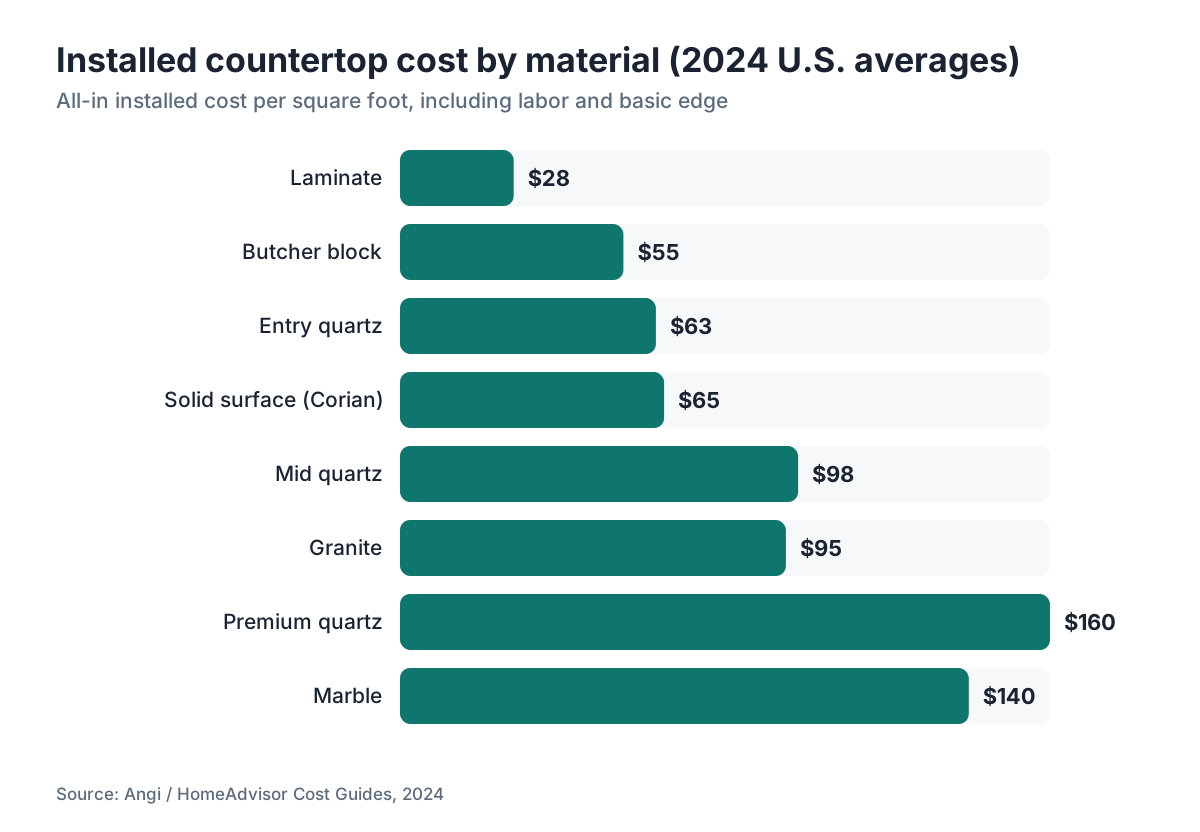
Here's a straight comparison of installed cost ranges for the common countertop materials. These figures reflect 2024 U.S. national averages from contractor and home-improvement cost surveys. Regional labor swings the numbers a lot.
| Material | Installed cost (per sq ft) | Notes |
|---|---|---|
| Laminate | $15, $40 | DIY-friendly; lower durability |
| Butcher block | $30, $80 | DIY possible; needs oiling |
| Entry quartz | $50, $75 | Solid colors, basic edges |
| Mid quartz | $75, $120 | Veined patterns, more edge options |
| Granite | $60, $130 | Varies heavily by slab origin |
| Premium quartz | $120, $200+ | Jumbo format, complex patterns |
| Marble | $80, $200+ | Higher maintenance |
For a full kitchen remodel, entry-tier quartz is genuinely competitive with granite once you count the consistency. Natural stone has movement, color variation, and sometimes hidden structural flaws that make matching pieces harder. Quartz is engineered to be uniform, which speeds up fabrication and can shave shop labor hours. [2]
Laminate countertops and Formica countertops still cost less, but the gap has narrowed as quartz entry pricing dropped. Flipping a house on a tight budget? Laminate wins. Staying ten years? The math tilts toward quartz.
Which quartz brands are the most affordable?
The market breaks into four tiers: the big two (Silestone and Cambria), the mid-tier makers (MSI, Vicostone, Viatera), private-label and builder-grade lines, and the direct-import slabs sold through warehouse stores. Price climbs roughly in that order.
Silestone and Cambria countertops sit at the premium end. Silestone is a Cosentino product and typically quotes $65 to $90 per square foot for the slab alone, before fabrication. Cambria is U.S.-made, family-owned, and known for thick, consistent slabs; it prices similarly or a bit higher. Both are excellent. Neither is cheap. [3]
MSI Quartz (M S International) is one of the largest engineered-stone importers in North America. Its Q Premium Natural Quartz line runs $45 to $65 per square foot for material only. Viatera, LX Hausys's engineered-stone brand, sits close by. These are real, serviceable products, not knockoffs.
The real budget play is warehouse-club and big-box store programs. Costco countertop programs (fulfilled through third-party fabricators) and Home Depot's countertop service regularly quote full installs at $55 to $75 per square foot for in-stock quartz colors. The catch: your color selection is limited to whatever's in the program, and the sub-contractor fabrication quality varies by region. [4]
Private-label slabs at stone yards and online marketplaces can drop to $28 to $45 per square foot for material alone. If you're a fabricator or a very hands-on homeowner managing the install separately, those can be a find. Just verify the NSF certification status and silica content disclosure, which I'll cover below.
What actually drives the price up on a quartz quote?
Four things reliably blow up a quartz budget: layout complexity, upgrade edges, sink type, and shop minimums.
Layout is the one most homeowners never see coming. A U-shaped kitchen with one sink cutout is a straightforward job. An L-kitchen with a waterfall island leg, an undermount farmhouse sink, a cooktop cutout, and mitered corners is a different animal. Every miter joint, every radius corner, every unsupported span adds shop time. That time is billed in labor hours whether or not the quote spells it out.
Waterfall edges, where the slab runs vertically down the side of an island, need bookmatched slabs or very careful color matching. That means buying extra material and paying for the matching labor. A waterfall on a 4-foot island can add $600 to $1,200.
Sink cutouts sound simple but vary a lot in price. A drop-in or overmount cutout is fast. An undermount rectangular sink is moderate. An undermount farmhouse apron sink means removing material from the front face of the cabinet run, more than a hole in the top, and that adds real time. If your sink is custom-built or an odd dimension, the shop may need to template twice. [1]
Shop minimums hit small jobs hard. If the minimum is $600 and you have 8 square feet of bathroom vanity top, you're paying $75 per square foot no matter what the posted rate says. Ask about the minimum charge before you get deep into a quote.
Is cheap quartz as durable as expensive quartz?
Mostly yes, with one real caveat. Engineered stone is roughly 90 to 94 percent ground quartz bound with polymer resin. That chemistry is the same in a $50 slab and a $150 slab. Scratch resistance (Mohs 7), heat resistance up to about 150 degrees Fahrenheit, and stain resistance run similar across the board. [5]
The caveat is thickness. Most builder-grade and entry slabs are 2 cm (about 3/4 inch). Most premium slabs are 3 cm (about 1.2 inches). Thicker slabs resist cracking under stress better, look more substantial at the edge, and skip the plywood buildup that a 2 cm slab needs to reach standard counter height. The buildup isn't structurally bad, but it adds a little cost and a seam line at the edge unless you pay for a laminated edge.
The other real difference is finish consistency and pattern fidelity. Cambria and Silestone's top lines hold very tight quality control on vein alignment slab to slab, which matters on a big island where two pieces meet. Budget slabs can shift color lots between production runs. If you need to add a piece six months later for a repair, matching gets harder.
For most kitchens, 3 cm budget quartz holds up for decades. Premium products earn their price on large, high-visibility islands and jobs where pattern continuity matters to the eye.
How do you get the best price on quartz countertops without getting burned?
Get at least three quotes from independent fabricators, plus one from a big-box program. Regional shop rates vary more than most people expect. In the same metro, I've seen identical-job quotes swing 35 to 40 percent between shops. [6]
Ask about remnants by name. Fabricators pile up remnant slabs from bigger jobs, pieces that run 10 to 30 square feet, and they want them gone. A bathroom vanity, a laundry counter, or a small bar top often cuts from a remnant for 30 to 50 percent less than a full slab. Most shops don't advertise this. You have to ask.
Pick a simpler edge. The eased edge (a slight bevel on the top corner) or a straight square edge costs nothing above base at most shops. An ogee or triple-pencil edge tacks on $15 to $25 per linear foot. On 25 linear feet of counter, that's $375 to $625 for a detail nobody notices once the appliances are in.
Time the purchase. Fabrication shops slow down in late fall and early winter across most regions, and some will negotiate on install or upgrade costs to fill the schedule. Summer is peak season. Expect less give.
Fabricators building customer quotes close faster when they can show a clean breakdown instead of a handwritten number. SlabWise's quoting software is built for exactly this, generating per-piece pricing from real slab inventory and shop rates.
Verify the fabricator carries insurance and pulls permits where required. Countertop installation that involves plumbing reconnection may need a licensed plumber in your jurisdiction, no matter who sets the stone.
Are there health or safety concerns with cheap quartz countertops?
This is a real and serious topic that deserves a straight answer. Fabricating engineered stone has a documented occupational silica dust hazard. NIOSH and OSHA have both issued guidance on silica exposure during dry-cutting and grinding of engineered stone, which carries higher crystalline silica content than natural granite. The people at risk are fabrication workers, not the people who live with the finished counter. [7]
For homeowners, the installed surface is inert. The silica is locked inside cured resin. You do not need to worry about silica exposure from a finished countertop.
The consumer safety question is NSF/ANSI 51 certification, the standard for materials that touch food. Some off-brand slabs, especially imports without paperwork, were never tested to NSF standards. That's a legitimate concern with very cheap imports. Ask any fabricator for the manufacturer's NSF compliance documentation before you buy an unbranded slab. [8]
There's a California Prop 65 angle too. Some quartz binders and pigments have triggered Prop 65 notices under California's OEHHA-listed chemicals. That applies to manufacturing and fabrication, not home use, but it's worth knowing if you're buying for a California home and want to ask about brand documentation. [9]
Short version: installed quartz from a reputable brand or a documented import is safe for food contact and daily use. The health story is a fabricator workplace story, not a homeowner story.
Can you install quartz countertops yourself to save money?
Technically possible. Practically, most homeowners should not.
Quartz is heavy. A 3 cm slab runs about 18 to 20 pounds per square foot. A standard 25-square-foot kitchen section weighs 450 to 500 pounds before cutting. Moving, positioning, and seaming it takes at least two strong people, usually a third to coordinate. Drop a slab and you damage the counter, the cabinets, and maybe the floor.
The bigger problem is templating and cutting. Quartz needs a precise template of your cabinet layout, including all the out-of-square walls every older house hides. The slab then gets CNC-cut or hand-cut on a wet saw to those specs. Miss by 3/16 of an inch at a wall and the gap shows. Most DIYers have no CNC access, and wet-saw cutting quartz demands a diamond blade, a steady hand, and experience to dodge chipping.
DIY makes sense in one narrow case: a counter on a perfectly square cabinet run with no wall contact (a freestanding island, say), where the fabricator already cut and edge-finished the slab. Then you can sometimes handle final placement and adhesive yourself. Some shops sell a cut-and-finished slab for DIY pickup at a reduced price.
For anything touching a wall, any sink cutout, or any mitered corner, pay for professional installation. A botched DIY costs you a new slab plus a fresh install quote.
How do quartz countertops compare to Corian and other solid-surface options?
Solid-surface materials like Corian countertops and similar acrylic-based products are a real alternative to budget quartz. Installed cost runs $45 to $85 per square foot, which overlaps the entry quartz range a lot. [10]
The key differences come down to how each behaves. Solid surface is repairable. Scratches sand out. Quartz scratches are permanent, though quartz is harder and scratches far less in normal use. Solid surface can be formed into a seam-free integrated sink, a genuine advantage in wet areas. Quartz cannot be heat-formed.
For kitchens, quartz wins on scratch and heat resistance. For bathrooms and laundry rooms where seam-free construction and repairability matter more than hardness, solid surface earns a real look.
Want to compare stone options instead? The how to clean stone countertops guide covers maintenance differences across materials, and how to clean quartzite countertops helps if you're weighing natural quartzite against engineered quartz. They are completely different materials despite the similar name.
What questions should you ask a fabricator before signing a quartz quote?
A handful of specific questions separate good fabricators from shops you want to avoid.
First: what thickness slab does the quote include, 2 cm or 3 cm? If 2 cm, does the price include the plywood substrate buildup? Some shops quote the slab and leave out the buildup, which adds $3 to $6 per square foot.
Second: what's in the edge profile? Get it in writing. "Standard edge" means different things at different shops.
Third: who does the install? Some shops sub it to a regular crew. Others keep it in-house. In-house is generally better for accountability. Ask whether the crew that templated will also install.
Fourth: what's the lead time from template to install? In busy seasons, four to six weeks is normal. If a shop promises three days, ask why. Either they have spare capacity (fine) or they're rushing fabrication (not fine).
Fifth: what happens if a slab cracks during fabrication? Reputable shops eat it and order a replacement. Get that confirmed in writing before you sign.
Sixth: how do they handle seams? Ask to see seam samples on the color you're buying. On a solid dark color, seams show far more than on a heavily veined pattern. If seam placement matters to you, say so before the template, not after the cut.
Fabricators who quote from software instead of the back of an envelope tend to hit fewer surprises at install, because the pricing ties to actual measurements and real slab inventory. When a shop can show you exactly how your job nests across the slab, you know they've thought it through. SlabWise builds that transparency into every quote, and homeowners should feel free to ask for it.
What are the most common mistakes homeowners make buying cheap quartz?
Picking a color online without seeing a full-size sample in person. Phone screens and monitor profiles lie. A warm gray online often reads lavender-gray in a kitchen with warm overhead light. Ask for a large sample, at least 12 by 12 inches, and hold it against your cabinet fronts and flooring under your actual light.
Buying on the lowest per-square-foot number without reading the full quote. The base rate means almost nothing until you know the edge, the thickness, whether the sink cutout and old-counter removal are included, and what the shop minimum is. Ask for an all-in total before you compare.
Skipping the seam conversation. On an L-shaped or U-shaped kitchen, there's almost always at least one seam. Where it lands, in a dead corner or right down a visible run, is a fabrication decision you should help make. Good fabricators show you the planned seam placement on a drawing before cutting.
Ignoring the layout conversation entirely. If you're planning a kitchen countertops remodel, the countertop decision ties to cabinet height, appliance specs, and sink selection in ways that are hard to undo later. Don't finalize the quartz order until your sink is confirmed and delivered to the job site. Fabricators should template against the actual sink, not a spec sheet.
And paying the full invoice before the install is done. A reasonable structure is a deposit (usually 50 percent) at contract signing and the balance on install day, after you've inspected the work. Any shop demanding 100 percent upfront before cutting is a yellow flag.
Frequently asked questions
What is the cheapest quartz countertop option available?
Builder-grade and private-label slabs from warehouse stores like Costco, or from big-box home improvement programs, are generally the cheapest route. Installed prices can start around $50 per square foot for basic solid colors in standard 3/4-inch thickness. Remnant slabs from local fabricators can go lower for small projects, sometimes 30 to 50 percent below full-slab pricing.
Is quartz worth it over granite for a budget kitchen remodel?
At the entry tier, quartz and granite overlap heavily, both around $50 to $80 per square foot installed. Quartz wins on consistency, which matters if your kitchen needs matched pieces. Granite wins if you like the natural variation and don't mind occasional sealing. Neither is a clear financial winner. It comes down to your aesthetic and how much variation you want to manage.
How much does a quartz countertop cost for a small bathroom vanity?
A small vanity top, typically 5 to 15 square feet, often hits a fabricator's shop minimum of $400 to $700 regardless of the per-square-foot rate. Expect $400 to $900 total for a single-sink vanity top in entry quartz, including a basic undermount cutout. Remnant slabs are the best way to cut this cost on small bathroom projects.
Does the color or pattern of quartz affect the price?
Yes, meaningfully. Solid white and solid gray quartz almost always sits in the entry tier. Heavily veined patterns that mimic marble, Calacatta-style or Statuario-style designs, land in the mid to premium tier and can add $20 to $50 per square foot over base. The extra cost reflects more expensive pigmenting, tighter production tolerances, and higher demand for those looks.
Can I put hot pans directly on quartz countertops?
You should not. Quartz resin binders can discolor or crack under sustained heat above 150 degrees Fahrenheit, lower than a pan pulled from a 400-degree oven. Use a trivet or hot pad. This applies equally to cheap and expensive quartz, since the resin chemistry is similar across price points. Heat discoloration is not covered by most manufacturer warranties.
How long do quartz countertops last?
With normal kitchen use, quartz lasts 20 to 30 years or more. The resin surface never needs sealing, doesn't react with acidic foods, and shrugs off most cleaning products. The main failure modes are edge chipping from impact, cracking from uneven cabinet support, and discoloration from sustained heat or harsh chemicals. None of those track with how much you paid for the slab.
What edge profile is cheapest on a quartz countertop?
The eased edge (a slight bevel on the top corner) and the straight square edge are the standard no-upcharge options at most fabricators. Both look clean and modern. Ogee, dupont, waterfall, and bullnose round-over profiles add $10 to $30 per linear foot. On a full kitchen perimeter of 25 linear feet, choosing the eased edge over a fancy profile saves $250 to $750.
Is quartz countertop maintenance expensive?
No. Quartz needs no sealing, no polishing, no special cleaners. Soap and water or a mild all-purpose cleaner handles daily cleaning. Skip bleach-based cleaners and abrasive pads, which can dull the finish over time. There are no annual maintenance costs the way there are with marble or unsealed granite. The ongoing cost of owning quartz is basically zero.
Do big-box stores like Home Depot and Lowes offer good quartz deals?
Big-box countertop programs can be competitive, especially for homeowners who want a simple process and no separate fabricator relationships. The trade-off is limited color selection (only what's in the program) and fabrication quality that varies by region since they use local sub-contractors. Get a written itemized quote from the big-box program and compare it against two local independent fabricator quotes before deciding.
What thickness of quartz should I buy, 2 cm or 3 cm?
Buy 3 cm (about 1.2 inches) if you can. It skips the plywood buildup substrate, holds up better at unsupported overhangs, and reads more substantial at the edge. 2 cm slabs cost less per square foot, but the substrate buildup often narrows the gap. For islands and heavily used surfaces, 3 cm is the right call. For low-traffic surfaces like laundry counters, 2 cm is fine.
Are quartz countertops from China or overseas lower quality?
Not necessarily. Many major brands, including MSI and Viatera, import from overseas factories with tight quality controls. The real question is documentation: NSF food-contact certification, a disclosed silica content, and a traceable manufacturer. Undocumented slabs with no brand affiliation or paperwork carry more risk. Ask for the manufacturer name and NSF compliance letter on any import before buying.
What is a quartz countertop remnant and how do I find one?
A remnant is the leftover piece of a slab after a bigger job has been cut. Fabrication shops accumulate remnants regularly and usually store them in a remnant rack or yard. Sizes range from 5 to 40 square feet. Call local stone yards and fabricators directly and ask about remnant availability, since many don't advertise it. Remnants can cost 30 to 50 percent less than new material and are perfect for bathrooms, laundry rooms, and small bar tops.
How do I compare quartz countertop quotes from different fabricators?
Ask every shop to quote identical specs: same square footage, same edge profile (eased), same sink cutout type, same slab thickness (3 cm), and same installation scope including old-counter removal if needed. Get each quote in writing with line items. A quote that bundles everything into one number is harder to compare than one that shows material, fabrication, and install separately. The all-in total is what matters.
Does quartz add value to a home resale?
The National Association of Realtors' 2022 Remodeling Impact Report found kitchen renovations recover roughly 67 percent of cost at resale. Quartz benefits from being a broadly recognized, low-maintenance material buyers understand. Whether entry quartz or premium quartz adds meaningfully different resale value is unclear; there's no reliable data separating the two. Updated countertops in good condition help; the brand tier probably matters less than condition and color neutrality.
Sources
- HomeAdvisor (Angi), Quartz Countertop Installation Cost Guide: Installed quartz countertop costs range from $50 to $200+ per square foot depending on material tier, edge profile, and cutout complexity; farmhouse sink cutouts add $300 to $500.
- U.S. Geological Survey, National Minerals Information Center: Engineered stone is composed of approximately 90 to 94 percent crushed quartz bound with polymer resin, giving consistent hardness properties across product tiers.
- Cosentino Group, Silestone Product Technical Data: Silestone by Cosentino is a premium engineered quartz surface with slab-only pricing typically in the $65 to $90 per square foot range before fabrication and installation.
- Consumer Reports, Kitchen Countertop Buying Guide: Big-box store countertop programs, including those at Home Depot and Costco, can offer all-in quartz installation in the $55 to $75 per square foot range for in-program colors.
- NSF International, NSF/ANSI 51: Food Equipment Materials Standard: NSF/ANSI 51 certifies that materials used in food zones, including engineered stone countertops, do not leach harmful substances under normal contact conditions; heat resistance for polymer-resin surfaces is typically rated to 150 degrees Fahrenheit.
- National Kitchen and Bath Association, Kitchen and Bath Market Index: Regional fabrication shop rates vary significantly within the same metro area; NKBA cost data shows installed countertop pricing can differ 30 to 40 percent between shops for identical scope.
- NIOSH (National Institute for Occupational Safety and Health), Engineered Stone / Silica Dust Guidance: NIOSH has documented that dry-cutting engineered stone during fabrication generates crystalline silica dust at concentrations that can exceed the OSHA permissible exposure limit; the hazard is to fabrication workers, not to consumers of installed countertops.
- NSF International, Food Equipment Materials Certification Directory: Imported engineered stone slabs without traceable manufacturer documentation may lack NSF/ANSI 51 certification for food-contact use; consumers should request compliance documentation before purchase.
- California OEHHA, Proposition 65 Listed Chemicals: California Proposition 65 lists crystalline silica (airborne, from occupational sources) as a carcinogen; this applies in the fabrication and manufacturing context, not to homeowners with installed quartz countertops.
- HomeAdvisor (Angi), Solid Surface Countertop Cost Guide: Solid surface countertops (including Corian and comparable products) install at $45 to $85 per square foot, overlapping the entry-level quartz price range.
- National Association of Realtors, 2022 Remodeling Impact Report: The NAR 2022 Remodeling Impact Report found kitchen renovations recover approximately 67 percent of project cost at resale on a national average basis.
- OSHA, Occupational Exposure to Respirable Crystalline Silica (29 CFR 1910.1053): OSHA's silica standard at 29 CFR 1910.1053 sets a permissible exposure limit of 50 micrograms per cubic meter of air for crystalline silica in general industry, with specific provisions for engineered stone fabrication shops.
Last updated 2026-07-10