TL;DR
- Synthetic marble countertops are man-made surfaces that mimic the look of natural marble.
- The category covers cultured marble, engineered quartz with marble veining, acrylic solid surface, and high-pressure laminate.
- Installed costs run $15 to $90 per square foot depending on material.
- None of them require sealing, and none etch the way real stone does.
What is a synthetic marble countertop, exactly?
The phrase "synthetic marble" gets used loosely, so let's pin it down. It refers to any countertop that looks like marble but is made in a factory rather than quarried from the earth. Four distinct product families fall under this label, and they behave very differently from each other.
Cultured marble is the oldest of the group. It's a mix of crushed limestone, polyester resin, and pigment poured into a mold, then coated with a clear gel coat. It's been around since the 1960s and is still common in bathrooms [1].
Engineered quartz with marble-look patterns, sold under brand names like Calacatta Nuvo or Silestone Ethereal, is roughly 90 to 93% ground quartz bound with polymer resins and pigment. It's the most popular synthetic marble for kitchens right now [2].
Acrylic solid surface (think Corian or similar) is 100% polymer with mineral filler and colorfast pigment. It has no stone content at all, but the better patterns get close enough to fool a casual glance.
High-pressure laminate with a marble print, like some Formica and laminate lines, is the most affordable option: a photographic image of marble bonded under high heat and pressure to a substrate. It looks the least convincing up close but costs a fraction of the others.
What all four share: no sealing required, consistent patterning (no surprises from the quarry), and factory-controlled thickness and flatness.
How does synthetic marble compare to real marble?
Real marble countertops are calcium carbonate, which means any acid, including lemon juice, vinegar, tomato sauce, or even some cleaning sprays, can etch the surface. Etching is not a stain. It's a chemical erosion of the stone itself. You can polish it out, but it comes back every time someone makes a margarita on an unsealed slab.
Synthetic options sidestep that problem entirely because their surfaces are either resin-bound (quartz, cultured marble) or polymer (solid surface, laminate), and those materials don't react with household acids.
Heat resistance is a different story. Real marble handles a hot pan without complaint. Engineered quartz can tolerate brief contact with warm dishes but can crack or discolor from pots directly off a burner; the polymer binder is the weak point. Cultured marble and solid surface have similar limits. Laminate is the most vulnerable to heat.
Scratch resistance: engineered quartz scores a 7 on the Mohs hardness scale, which puts it above marble (3 to 5) and on par with granite [2]. Solid surface scratches more easily but can be sanded and buffed. Laminate scratches and cannot be repaired invisibly.
The visual gap has narrowed dramatically. High-end quartz slabs with waterjet-cut veining or continuous book-matched patterns are genuinely hard to distinguish from natural stone in photographs. In person, the perfectly uniform repeat of the pattern is usually the tell.
Weight: engineered quartz and cultured marble run similar to natural stone, around 18 to 22 lbs per square foot at 3/4 inch thickness. Standard cabinetry handles this. Laminate is much lighter.
For a full side-by-side with another popular natural stone, the granite countertops article covers durability and maintenance in comparable detail.
What do synthetic marble countertops cost?
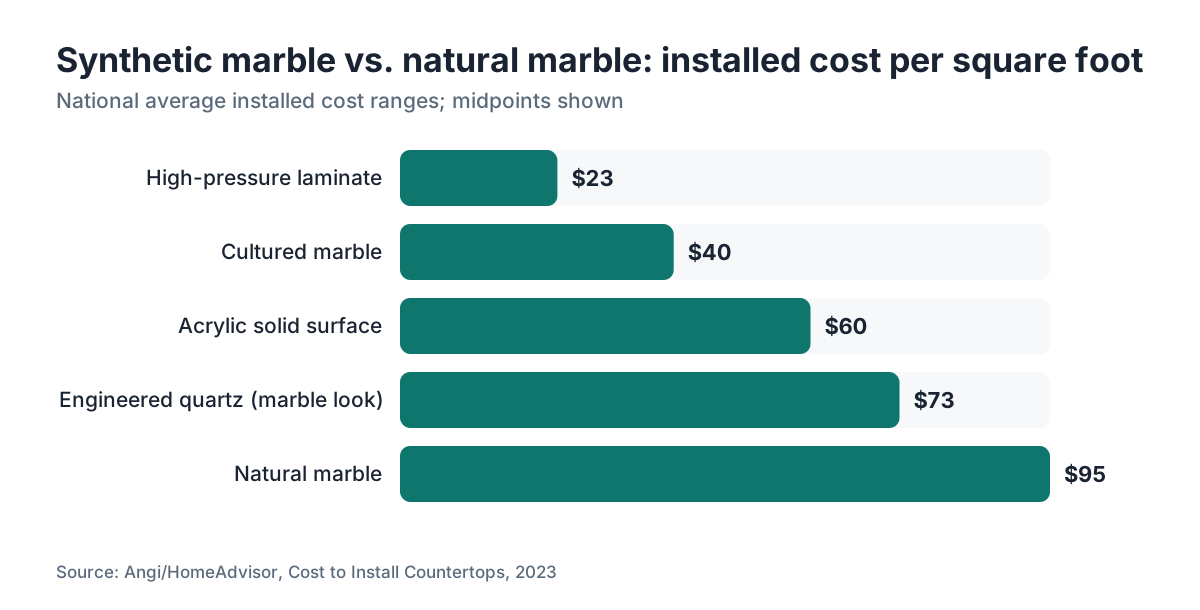
Pricing varies widely by product type, edge profile, cutouts, and your region. The numbers below are installed costs including basic fabrication and a standard eased edge, based on national data from HomeAdvisor/Angi consumer surveys and contractor pricing reports [3].
| Material | Installed cost (per sq ft) | Sealing required | Heat resistance |
|---|---|---|---|
| High-pressure laminate | $15, $30 | No | Low |
| Cultured marble | $25, $55 | No (gel coat) | Moderate |
| Acrylic solid surface | $45, $75 | No | Moderate |
| Engineered quartz (marble look) | $55, $90 | No | Moderate |
| Natural marble (for comparison) | $60, $130 | Yes, annually | High |
A typical kitchen with 30 square feet of countertop runs $450, $900 for laminate, $1,650, $2,700 for cultured marble, and $1,650, $2,700 for solid surface. Engineered quartz in a marble pattern for that same kitchen lands at $1,650, $2,700 on the low end and up to $3,000 or more for premium slabs with elaborate veining [3].
Edge profiles add cost. A simple eased edge is usually included. An ogee, waterfall, or mitered edge on quartz can add $10, $25 per linear foot. Cutouts for undermount sinks, cooktops, and faucet holes typically run $50, $150 each depending on the shop.
Fabrication labor varies more than most homeowners expect. A shop in a high-cost metro might charge $35, $50 per square foot for labor alone on a quartz install, while a rural shop might charge $18, $25. If you're a fabricator pricing jobs, tools like SlabWise can model these variables automatically so your quotes stop leaking margin.
Installation itself, separate from fabrication, generally runs $200, $500 for a standard kitchen depending on complexity and tearout.
What are the different types of synthetic marble in more detail?
Cultured marble deserves more explanation than it usually gets. The manufacturing process creates a surface that's actually quite durable under normal bathroom use, which is why it's still the dominant material for one-piece vanity tops with integrated sinks. The gel coat surface is nonporous and doesn't need sealing. The catch is that the gel coat can dull over years of cleaning with abrasive products, and once it's scratched through, the material underneath looks and feels completely different. You can re-polish cultured marble with automotive rubbing compound, but you can't sand it the way you can solid surface.
Engineered quartz is the most technically sophisticated product in this group. Manufacturers like Cambria, Caesarstone, Silestone, and MSI all offer marble-inspired patterns. Cambria countertops in particular market heavily on their US manufacturing and lifetime warranty. Quartz slabs typically come in 55 x 120 inch or 63 x 126 inch slabs, which limits how far a run can go without a seam. For long islands, a seam is usually unavoidable.
Acrylic solid surface (Corian is the original, made by DuPont and now owned by Trinseo) has one real advantage over quartz: it's thermoformable. A fabricator can heat it and bend it around a curved edge, which is impossible with stone or quartz. It's also fully repairable by sanding. A deep scratch in solid surface can be buffed out by a professional and the surface looks like new. That's not true for any other countertop material. See the Corian countertops article for a full breakdown.
Laminate's reputation is from the 1970s, and the current product is genuinely better. Formica's 180fx line uses a high-resolution photograph of actual stone with a subtle texture embossed into the surface, and it fools people at cabinet distance. The honest limitation is that laminate has a visible substrate at cut edges and around sinks, which signals its price point clearly. Waterfall edges and undermount sinks are difficult or impossible depending on the product.
Is synthetic marble durable enough for a kitchen?
For everyday cooking use, engineered quartz and solid surface are genuinely durable. Quartz's Mohs hardness of about 7 means it resists scratching from most kitchen tasks [2]. A ceramic knife or metal utensil dragged across it won't leave visible damage under normal pressure.
The durability concern most fabricators hear is about chips at edges. Quartz is hard but brittle. A corner can chip if you bang a heavy cast iron pan against it, and that chip is very difficult to repair invisibly. Marble has the same issue. Laminate doesn't chip at the surface but can delaminate at edges if water gets in.
UV exposure matters if your countertop is near a sunny window. Most engineered quartz uses pigments that resist UV fade reasonably well, but the resin binder can yellow over many years of direct sun exposure. Solid surface has similar behavior. Cultured marble with a gel coat is the most UV-stable of the group. Laminate can fade and is generally specified for interior use only.
Hot pans are the number one durability issue with synthetic marble in kitchens. Quartz manufacturers universally warn against placing hot pots directly on the surface; the resin can scorch, discolor, or in extreme cases crack. This is real, and it's a meaningful trade-off compared to natural stone. Always use a trivet.
For a kitchen with heavy cooking use, I'd choose engineered quartz for its scratch resistance and cleaning ease, but I'd communicate the heat limitation clearly to every homeowner. Cultured marble belongs in bathrooms, not kitchens. Laminate is fine for a rental or a tight budget, but don't promise it will look new after ten years of hard use.
How do you clean and maintain synthetic marble countertops?
This is where synthetic marble has a real, practical advantage over natural stone. You don't need to seal any of these materials, and you don't need to track annual resealing schedules.
For engineered quartz, warm water and dish soap is all you need for daily cleaning. For stuck-on debris, a nonabrasive plastic scraper and a mild cleaner work fine. Avoid bleach-based cleaners and anything with high pH; they can break down the resin surface over time. The manufacturer guidelines from Caesarstone and Silestone both specify pH-neutral cleaners [10].
Cultured marble cleans the same way: mild soap, warm water, soft cloth. The gel coat is what you're protecting. Don't use powdered abrasive cleaners like Comet or Bon Ami on cultured marble; they'll dull the finish over time.
Solid surface is the most forgiving. Because it's homogenous all the way through, you can clean it with a wider range of products. If it gets badly stained, a professional can sand and buff the surface back to new condition. This makes solid surface a particularly good choice for households with kids.
Laminate is also easy to clean, but you need to keep water away from seams and edges. Standing water that gets under the laminate layer causes the substrate to swell and delaminate. Wipe up spills at edges promptly.
For disinfecting: a diluted isopropyl alcohol solution (typically 70%) is safe on quartz and solid surface and kills common pathogens. Check with your specific manufacturer before using bleach at any concentration.
If you want to see how these cleaning rules compare for natural stone options, the how to clean stone countertops guide covers granite, marble, and quartzite in detail.
Does synthetic marble look as good as real marble?
Honestly, it depends on which product and how closely you look.
Top-tier engineered quartz slabs from manufacturers like Caesarstone or Cambria have improved dramatically. Their Calacatta and Statuario patterns use digital printing technology that creates convincing veining, and some lines carry real translucency that gives the slab depth. From ten feet away, or in a magazine photograph, many homeowners can't tell.
Get within three feet and the tell is usually the repeat. Natural marble is cut from the earth, so the veining is unique across every square inch. Manufactured slabs have a pattern that, if you look, repeats across the slab at some interval. High-end manufacturers try to randomize this, and some waterjet-cut veining products do better than others, but it's rarely perfect.
Cultured marble looks unmistakably manufactured in most cases. The swirling pattern is pretty but reads as fake to anyone familiar with natural stone. That's fine for a vanity top. It's not what you'd put in a high-end kitchen renovation expecting to impress.
Laminate looks good in photographs but rarely convinces in person. The embossed texture helps, but the flat, lightweight feel and the visible edge give it away.
My honest take: if the primary goal is the look of white marble with gray veining (the most requested pattern in residential remodels right now), a premium quartz slab gets you 85 to 90% of the visual result at 50 to 70% of the cost and none of the maintenance burden. For a client who cooks heavily and has kids, that's the right call. For someone who wants the genuine article and will maintain it properly, real marble is still real marble.
What are the pros and cons of synthetic marble countertops?
Rather than a vague list, here's what actually matters in practice.
The real advantages: no sealing, acid resistance (for quartz and solid surface), consistent appearance across slabs, wider color availability, lower cost than natural marble, and in the case of solid surface, full repairability.
The real disadvantages: heat sensitivity for every synthetic option (quartz, solid surface, laminate, and cultured marble all have lower heat tolerance than granite or marble), pattern repetition that reads as artificial on close inspection, and edge damage that's hard to repair invisibly on quartz and impossible to repair on laminate.
A note on resale value: there's no rigorous study I'm aware of that isolates the effect of countertop material on home sale price after controlling for kitchen renovation cost overall. Realtors often claim granite or natural stone adds more value than engineered surfaces, but this conflates correlation with causation. A well-installed quartz countertop in a renovated kitchen does not appear to hurt sale price in any documented way [5].
Environmental footprint: cultured marble and engineered quartz both require energy-intensive manufacturing. Quartz is abundant, so raw material sourcing isn't a concern, but the resin binders are petroleum-derived. Solid surface is also largely petroleum-derived. Natural marble's footprint is dominated by quarrying and transport. No option is clearly "green," and anyone claiming otherwise is hand-waving.
For a different low-maintenance surface with a completely different look, butcher block countertops are worth considering if warmth matters more than the marble aesthetic.
How is synthetic marble installed, and can you DIY it?
Installation difficulty varies sharply by material.
Laminate is the most DIY-accessible. A homeowner with basic woodworking tools can install laminate countertops in a weekend, especially if they buy pre-formed post-form laminate tops from a home center. Custom laminate requires more skill: you need to cut the substrate accurately, route edge profiles, and apply the laminate sheet without bubbles.
Solid surface can be installed by a skilled DIYer for simple layouts, but seaming requires a router and color-matched adhesive, and a bad seam is very visible. Most manufacturers recommend professional installation.
Engineered quartz and cultured marble are not realistic DIY projects. Slabs weigh 18 to 22 lbs per square foot [6], and a typical kitchen island top might weigh 250 to 400 lbs. Moving, cutting, and setting stone-weight materials requires specialized handling equipment, diamond-blade bridge saws, CNC routing for sink cutouts, and professional installation teams. Drop a quartz slab wrong and it cracks.
For professional installation, the process is: template the cabinets (usually with laser or physical template), fabricate in the shop, deliver and set the cut pieces, seam if needed, attach to cabinets, and set the sink. A standard kitchen takes one to two installation days after fabrication. Fabrication lead time at most shops is one to three weeks from template approval [see countertop installation for the full process breakdown].
One practical tip for fabricators quoting synthetic marble jobs: quartz slabs have defined yield per slab, and pattern-matched veining can increase waste significantly on non-rectangular layouts. If you're running quartz with continuous veining patterns, model your nesting carefully before committing to a price.
How does synthetic marble perform in bathrooms vs. kitchens?
The application matters a lot here.
In bathrooms, cultured marble has decades of proven performance. It's nonporous, handles typical cleaning products well, and integrated vanity tops with molded-in sinks eliminate the seam at the sink edge that collects grime. This is genuinely useful in a bathroom. The material has been standard in mid-range residential construction for fifty years and holds up.
Engineered quartz works well in bathrooms too, and the look is much closer to natural marble. The heat sensitivity is irrelevant in a bathroom context since you're not putting hot pots there. UV exposure can be a concern at a sunny bathroom window, but it's slow-developing.
In kitchens, quartz is the synthetic marble material that makes sense for most homeowners. It handles acidic foods without etching, it's hard enough to resist everyday scratching, and it cleans easily. The heat limitation is real but manageable with trivets.
Solid surface is underrated for kitchens, particularly for households with high-traffic use. The ability to sand out damage is a meaningful practical benefit that quartz can't match. The trade-off is that solid surface looks less stone-like.
Laminate in a kitchen is a legitimate choice for a tight budget or a rental property. It's not a choice I'd make for a long-term primary kitchen, but the judgment call is yours and the new products are better than their reputation.
For context on how other materials handle the kitchen environment, the kitchen countertops guide covers the full field.
Which brands make the best synthetic marble countertops?
In engineered quartz, the leading brands are Cambria (US-manufactured, lifetime warranty), Caesarstone (Israeli company, US warehousing), Silestone by Cosentino (Spanish, wide distribution), and MSI Q (US warehousing, price-accessible). IKEA sells Silestone under a private label in some markets. For marble-look patterns specifically, Cambria's Brittanicca and Calacatta lines are widely regarded as among the most convincing [7].
In solid surface, Corian is still the category originator and benchmark. Avonite, Wilsonart, and LG Hi-Macs are the main competitors. All perform similarly at comparable quality tiers.
Cultured marble is mostly sold through plumbing suppliers and home centers rather than branded prominently. The quality is largely determined by the local manufacturer's gel coat thickness and resin mix rather than a national brand name.
For laminate, Formica and Wilsonart are the established names. Both offer marble-look patterns in their premium lines. Dekton (by Cosentino) sometimes gets grouped with synthetic marble due to its appearance, but it's actually an ultra-compact surface made from raw materials used in glass and porcelain; it's considerably more expensive and more durable than standard engineered quartz.
One thing worth knowing about quartz brands: the underlying manufacturing is highly consolidated. Several brands source slabs from the same overseas factories and differentiate primarily on marketing, warranty terms, and pattern selection. The warranty matters: a lifetime residential warranty from a solvent, established company is worth something. A warranty from an unknown importer may be worth less.
What should fabricators know about working with synthetic marble materials?
Engineered quartz is the dominant material in most residential fabrication shops today, and working it well requires different habits than natural stone.
Diamond tooling: quartz is hard on tooling because of the silica content. Use diamond blades and router bits rated specifically for engineered stone, and expect shorter tool life than with granite. The Occupational Safety and Health Administration has issued guidance on silica dust control for quartz fabrication specifically [8]; OSHA's Table 1 for the stone fabrication industry requires wet methods or local exhaust ventilation when cutting quartz. This is a real regulatory requirement, not optional.
The International Agency for Research on Cancer classifies respirable crystalline silica as a Group 1 human carcinogen [9]. This is not a hypothetical risk. Proper wet cutting, vacuum extraction, and respiratory protection are required. NIOSH documents silicosis clusters among engineered-stone fabricators as a high-exposure occupational hazard [11].
Seaming quartz with marble veining is harder than seaming a solid color because the veining has to visually continue across the seam. On continuous-vein patterns, fabricators are increasingly using book-matched slab pairs or digital waterjet-cut inserts. Customers who want veining that flows across a seam should know this adds significant cost and fabrication time.
Templating accuracy matters more on quartz than solid surface because quartz is not forgiving of gaps; there's no flexible adhesive that disguises a bad fit. Laser templating has become standard at shops doing significant quartz volume.
Quoting quartz jobs accurately requires knowing your slab yield. Pattern-matched installs with lots of cutouts can run 40 to 60% waste on a single slab. If you're not modeling waste per slab before quoting, you're pricing blind. Fabrication software like SlabWise lets you model nesting and material usage before you commit to a quote, which protects margin on exactly these complex jobs.
For silica dust exposure control, OSHA's construction standard 29 CFR 1926.1153 applies to stone fabrication shops [8].
Frequently asked questions
Is synthetic marble countertop waterproof?
Engineered quartz, solid surface, and cultured marble are all nonporous and effectively waterproof at the surface. Water damage risk comes from seams and edges, especially on laminate, where water infiltrating the substrate causes swelling and delamination. Keep edges and seams dry and sealed with silicone. The countertop face itself won't absorb water on any synthetic marble product.
Can you put hot pans on synthetic marble countertops?
No. This is the most common damage claim on engineered quartz and solid surface. The polymer resin binders in quartz and solid surface can scorch, discolor, or crack under direct heat above roughly 150°C (300°F). Cultured marble and laminate have similar heat limits. Always use a trivet or hot pad. Natural marble and granite tolerate heat far better. If hot pots are a daily reality in your kitchen, factor this in before buying.
Does synthetic marble countertop need to be sealed?
No. Sealing is not required for any synthetic marble material. Engineered quartz, solid surface, laminate, and cultured marble are all nonporous by manufacturing. This is one of the main practical advantages over natural marble and granite, which require sealing every one to three years depending on use. Skip the sealing products; they won't penetrate and are a waste of money on these surfaces.
How long does a synthetic marble countertop last?
Engineered quartz and solid surface installed properly can last 20 to 30 years or longer under normal residential use. Cultured marble in a bathroom typically lasts 15 to 20 years before the gel coat shows significant wear. Laminate usually shows its age at 10 to 15 years with heavy kitchen use: scratches, edge wear, and faded color. Treatment and cleaning habits matter as much as the material itself.
Is engineered quartz the same thing as synthetic marble?
Engineered quartz is one type of synthetic marble, not the only one. Synthetic marble is the broader category covering cultured marble, solid surface, laminate, and quartz. Quartz happens to dominate the synthetic marble kitchen countertop market right now because it offers the best combination of durability and realistic stone appearance. When someone says 'synthetic marble countertop' in a kitchen context, they often mean quartz specifically, but the terms aren't identical.
What is the cheapest synthetic marble countertop option?
High-pressure laminate with a marble pattern is the cheapest, running $15, $30 per square foot installed. Post-form laminate tops are available off-the-shelf at home centers starting around $10, $20 per linear foot. If you want something that looks more convincingly like stone, cultured marble starts around $25, $55 installed per square foot. Engineered quartz is the most expensive synthetic option, starting around $55 and running to $90 or more per square foot installed.
Can synthetic marble countertops be repaired if they chip or scratch?
Solid surface is the most repairable: a professional can sand and buff out scratches and most chips completely. Engineered quartz chip repairs are possible with color-matched epoxy filler kits, but the repair is usually visible on close inspection. Cultured marble gel coat can be professionally re-polished for dullness but deep chips are hard to hide. Laminate cannot be invisibly repaired; scratches and chips are permanent. Repair options are a meaningful factor in the material choice decision.
Does synthetic marble increase home value?
There's no rigorous study isolating countertop material as a driver of home sale price independent of overall kitchen renovation quality and cost. Realtors frequently cite stone countertops as a selling point, but that reflects correlation: kitchens with quality countertops tend to have other upgrades too. A well-installed engineered quartz countertop in a clean, updated kitchen will not hurt your sale. Expecting a specific dollar return attributable to the countertop material alone is not supported by the available data.
What's the difference between cultured marble and engineered quartz?
Cultured marble is crushed limestone in polyester resin with a gel coat surface, made since the 1960s, and most common in bathrooms. Engineered quartz is 90 to 93% ground quartz bound in polymer resin, developed later, harder (Mohs 7 vs. 3 to 4 for cultured marble), and the dominant synthetic marble for kitchens. Quartz is more scratch-resistant and visually convincing. Cultured marble is less expensive and integrates sink and top into one molded piece, which is useful for vanities.
Is silica dust a health risk when fabricating quartz countertops?
Yes, and it's a serious one. The International Agency for Research on Cancer classifies respirable crystalline silica as a Group 1 carcinogen. OSHA's construction standard 29 CFR 1926.1153 requires wet cutting or local exhaust ventilation when fabricating engineered stone. Several countries including Australia have seen clusters of silicosis cases in young quartz countertop fabricators. Any shop cutting quartz without proper dust controls is exposing workers to a real, documented lung disease risk.
Can synthetic marble countertops be used outdoors?
Generally not recommended. UV exposure can yellow the resin binders in quartz and solid surface over time. Laminate is specified for interior use only. Cultured marble is also indoor-only. If you want a marble-look surface for an outdoor kitchen, porcelain tile or a natural stone that's been sealed for outdoor use is a better option. Some manufacturers offer specific outdoor-rated products, but standard synthetic marble lines are designed for interior conditions.
How thick are synthetic marble countertops?
Engineered quartz slabs come in 1.2 cm (about 1/2 inch), 2 cm (3/4 inch), and 3 cm (1-1/4 inch) thicknesses. Three centimeter is standard for kitchen countertops in the US because it doesn't require a plywood sub-base and has a substantial edge profile. Solid surface is typically 1/2 inch. Laminate post-form tops are 3/4 inch particle board substrate with laminate bonded on top. Cultured marble varies by mold design.
What colors and patterns are available in synthetic marble countertops?
The range is wide. White with gray veining (Calacatta and Statuario patterns) are the most popular by a significant margin in current residential design. Manufacturers also offer Carrara-look patterns (lighter, finer veining), dramatic black marble looks, green, gold, and blue marble patterns, and solid-color options in the same product lines. Solid surface and laminate offer more unusual color options than quartz because they're not constrained by what looks like real stone.
How do I choose between solid surface and engineered quartz for my kitchen?
If repairability matters most, choose solid surface: scratches sand out completely, a major advantage in a family kitchen. If visual realism and scratch resistance matter most, choose engineered quartz. Quartz is harder and looks more convincingly like natural stone. Both avoid etching from acids. Quartz costs roughly 20 to 30% more than solid surface at comparable quality tiers. If you have kids who will scratch the countertop and you want a long life without visible wear, solid surface is the practical choice despite the lower prestige perception.
Sources
- National Park Service, Preservation Briefs on Interior Finishes: Cultured marble has been used in residential construction since the 1960s as a cast polymer product combining limestone, resin, and pigment
- Marble Institute of America (now Natural Stone Institute), Dimension Stone Design Manual: Engineered quartz rates approximately 7 on the Mohs hardness scale due to its high quartz content, compared to natural marble at 3 to 5
- Angi (formerly HomeAdvisor), Cost to Install Countertops: Installed countertop costs by material: laminate $15, $30/sq ft, cultured marble $25, $55, solid surface $45, $75, engineered quartz $55, $90, natural marble $60, $130
- U.S. Federal Trade Commission, Home Improvement and Remodeling Guidance: No documented data isolates countertop material as an independent driver of home resale value after controlling for overall renovation quality
- MSI Surfaces, Technical Data on Engineered Quartz Slab Weight: Engineered quartz slabs at 3 cm thickness weigh approximately 18 to 22 lbs per square foot, requiring professional handling equipment for safe installation
- Cambria, Product Specifications and Warranty: Cambria manufactures engineered quartz in the US and offers a lifetime limited residential warranty; Brittanicca and Calacatta lines are among its most specified marble-look patterns
- U.S. Occupational Safety and Health Administration, Respirable Crystalline Silica Standard for Construction, 29 CFR 1926.1153: OSHA's Table 1 for the stone fabrication industry requires wet methods or local exhaust ventilation when cutting engineered quartz; this standard applies to fabrication shops
- International Agency for Research on Cancer, IARC Monographs Volume 100C: IARC classifies respirable crystalline silica inhaled from occupational sources as a Group 1 carcinogen (carcinogenic to humans)
- Silestone by Cosentino, Technical and Care Specifications: Silestone specifies pH-neutral cleaners and warns against placing items above 150°C directly on the quartz surface due to risk of thermal shock to the polymer binder
- U.S. Centers for Disease Control and Prevention (CDC), Silicosis and Silica Dust Exposure: NIOSH documents silicosis risk in stone fabrication workers, with engineered stone identified as a high-exposure source due to elevated crystalline silica content
Last updated 2026-07-09