TL;DR
- Stone fabricators in San Jose typically charge $60 to $130 per square foot installed for granite or quartz, with natural stone slabs adding $40 to $200 per square foot on top of that.
- High Bay Area labor pushes prices above national averages.
- Expect 2 to 4 weeks from template to install.
- Check a shop's saw type, seam policy, and warranty before you sign.
What does a stone fabricator in San Jose actually do?
A stone fabricator buys raw slabs, cuts them to your exact kitchen or bathroom dimensions, and installs the finished pieces. That sounds simple. It's not.
The process starts at a slab yard or the shop's own inventory, where you pick your material. The fabricator then sends a templater to your home, usually after your cabinets are set and level, to measure every dimension with either physical templating boards or a digital laser tool. Those measurements feed into CNC (computer numerical control) cutting machines that shape the stone. After cutting, edges get profiled and polished. Seams get planned. Then the crew shows up and sets everything in place.
Fabrication is where the project either goes well or goes sideways. A shop with a quality CNC bridge saw and an experienced polisher produces tight seams, clean edges, and cutouts that don't crack. A shop cutting by hand with an angle grinder can still do good work, but the margin for error is smaller and depends entirely on who's holding the tool that day.
In San Jose specifically, you're in a market with a high density of shops. They range from one-person operations working out of a small warehouse in the Berryessa area to mid-size shops running full Brembana or Park Industries CNC lines. That range matters for pricing and quality.
What do stone fabricators in San Jose charge?
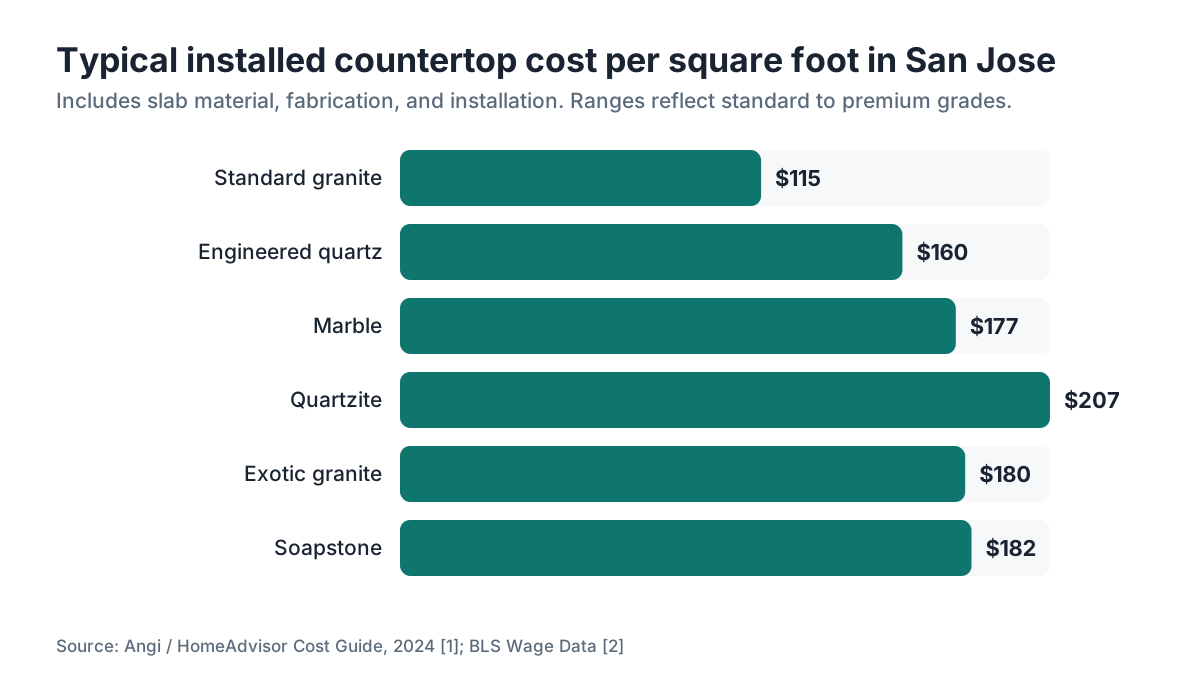
Fabrication and installation labor in the San Jose metro runs roughly $60 to $130 per square foot, depending on material, edge complexity, and shop overhead [1]. That figure covers templating, cutting, edge finishing, and installation. It does not include the slab.
Slab material is a separate line item. Here's a realistic breakdown by material type:
| Material | Slab cost ($/sq ft) | Fab + install ($/sq ft) | Typical total ($/sq ft) |
|---|---|---|---|
| Granite (standard) | $15 to $40 | $65 to $110 | $80 to $150 |
| Granite (premium/exotic) | $50 to $120 | $70 to $120 | $120 to $240 |
| Quartz (engineered) | $50 to $100 | $60 to $110 | $110 to $210 |
| Quartzite (natural) | $60 to $150 | $75 to $130 | $135 to $280 |
| Marble | $40 to $120 | $70 to $125 | $110 to $245 |
| Soapstone | $55 to $120 | $70 to $120 | $125 to $240 |
A typical San Jose kitchen with 40 square feet of countertop lands between $3,200 and $6,000 for mid-grade granite or quartz, fully installed. Exotic materials or complex layouts push that to $8,000 to $12,000 without much trouble.
Bay Area labor rates run 20 to 35 percent above the national median for construction trades, which is a big part of why San Jose prices beat what you'd pay in Sacramento or Fresno [2]. Santa Clara County's prevailing wage rules apply to public projects, not private residential work, so that's not the driver for most homeowners. The driver is supply, rent, and wages.
For kitchen countertops, material choice is the biggest lever you have. Going from exotic quartzite to a standard granite saves $1,500 to $3,000 on a mid-size kitchen with no change in the quality of the fabrication.
How do you find a reputable stone fabricator in San Jose?
Start with the Marble Institute of America member directory [3]. MIA membership requires adherence to a code of standards and carries an accreditation program (MIACSA) that tests shop practices. Not every good shop is a member, but it's a fast filter for shops that take the craft seriously.
After that, check the California Contractors State License Board database at cslb.ca.gov [4]. Any shop doing countertop installation in California must hold a C-54 tile and stone contractor license or a B general building contractor license. Verifying the license takes 60 seconds. If a shop can't pass that check, walk away.
Google reviews help, but they aren't enough. Look specifically for mentions of seam quality, how the shop handled a problem, and whether the final measurement matched the quote. One-star reviews about administrative issues tell you less than reviews that discuss the actual stonework.
Ask the shop three questions before you go further:
- What equipment do you cut on? A CNC bridge saw with a calibrated waterjet table is the current standard. If they say "we hand-cut most jobs," that's not automatically bad, but ask to see recent work.
- What is your seam policy? Good shops show you the seam plan before they cut. You should approve seam placement.
- What does your warranty cover? Anything less than one year on workmanship sits below the industry norm.
Visit the shop in person once you've narrowed to two or three candidates. A shop that lets you walk the floor and see a job in progress is confident in its process. One that keeps you in the showroom and nowhere else is either hiding something or poorly organized.
What is the countertop fabrication timeline in San Jose?
From the day you sign a contract to the day the countertop is installed, expect 2 to 4 weeks at most established San Jose shops. Here's where that time goes.
Week 1 is usually slab selection and contract finalization. If the shop has in-house inventory, you can pick your slab the same day. If they're sourcing from a distributor, add 3 to 5 days for the slab to arrive.
Templating happens after your cabinets are fully installed and level. The templater visits, measures the space (30 to 90 minutes depending on complexity), and brings those measurements back to the shop. Digital templating with tools like Laser Products Industries' LT-2D3D shortens the time from template to cut because the file goes straight to the CNC machine without a manual drawing step.
Cutting and finishing typically take 2 to 5 shop days. A complex job with multiple cutouts, a waterfall edge, or highly directional stone veining takes longer because the layout needs more planning.
Installation day usually takes 4 to 8 hours for a standard kitchen. The crew sets the pieces, bonds them with color-matched epoxy at seams, caulks the backsplash line, and does a final polish. Do a walkthrough before they leave.
Busy seasons (spring and fall, when remodels peak) add 1 to 2 weeks. If your project is time-sensitive, say so upfront and ask where you'd fall in the queue.
What materials are San Jose fabricators most skilled with?
The Bay Area market runs heavily toward quartz and granite, the two materials most San Jose shops have the most reps on. Quartz from brands like Caesarstone, Silestone, and Cambria makes up a large share of residential countertop work here. Cambria countertops carry a lifetime transferable warranty that some homeowners treat as a selling point when listing a home.
Granite stays the volume leader for homeowners chasing cost per square foot on a mid-grade project. The material is forgiving to work with and widely available at local slab yards, including the several large distributors along the 880 corridor in Milpitas and Newark.
Natural stones like quartzite, marble, and soapstone are less common but not rare. San Jose has enough demand from high-end remodels in Willow Glen, Los Altos, and Saratoga that most established shops have done plenty of marble and quartzite work. If you're going with something unusual, ask to see photos of comparable past jobs specifically, not a general portfolio.
For marble countertops and granite countertops, the fabrication fundamentals are the same, but marble is far more sensitive to seam grinding and polishing. Great granite work doesn't automatically mean great marble results. Ask specifically.
Soapstone is a niche material that fewer shops handle confidently. If you want soapstone, verify the shop has cut and installed it, more than seen it. How to clean soapstone countertops is a separate subject, but understanding the material's quirks helps you judge whether a shop knows what it's working with.
How does stone fabrication pricing get quoted, and what should you watch for?
Most San Jose fabricators quote by the square foot, but how they calculate square footage varies. Some shops measure the rectangular footprint of each slab piece, rounding up to the nearest whole square foot. Others use the actual cut dimensions. On a kitchen with an L-shape or a peninsula, the difference can be 8 to 15 percent of the total price.
Ask the shop to show you the measurement breakdown. A transparent quote lists each section by dimensions and square footage, then adds line items for cutouts (sinks, cooktops), edge profiles, and special work like mitered edges or bookmatch layout.
Common upsells worth understanding:
Edge profiles. A simple eased or beveled edge is usually included in the base price. Ogee, waterfall, or laminated (double-thick) edges add $15 to $40 per linear foot. Some of these cost more in labor than material.
Sink cutouts. A standard undermount sink cutout runs $100 to $200. A farmhouse (apron front) sink cutout is more work and typically $200 to $400 because the front face of the stone has to be cut and polished precisely.
Demolition. Removing your old countertop adds $150 to $400 depending on size and what's underneath. Some shops include it; most charge separately.
Sealing. Natural stone should be sealed. Some shops seal as part of installation; others charge $100 to $250 as a separate line. On granite, one seal at installation plus resealing every 1 to 3 years is typical.
Fabrication software has made quoting more consistent across shops. Tools like SlabWise help shops calculate nesting layouts (how slabs are cut to minimize waste) and generate itemized quotes, which means estimates from tech-forward shops tend to be more accurate than those from shops still working off a notepad. If a quote looks suspiciously low, ask how they calculated the slab yield.
For reference, countertop installation costs across material types nationally average $3,500 to $7,000 for a full kitchen, according to contractor data aggregators, with San Jose running at the upper end of that range [1].
Are there affordable alternatives if stone fabrication is out of budget?
Yes. Stone isn't the only option, and being honest about that is worth doing.
Laminate countertops have come a long way. Modern laminate from brands like Formica and Wilsonart mimics stone visuals at $20 to $50 per square foot installed, a fraction of natural stone pricing. It doesn't require a stone fabricator at all. A cabinet shop or general contractor can handle installation.
Formica countertops are worth a look if you're furnishing a rental unit or a secondary kitchen space. The durability is real, the maintenance is near-zero, and you won't feel bad if a tenant damages them.
Butcher block countertops run $40 to $100 per square foot installed and add warmth that no stone material matches. They need more maintenance than stone, including periodic oiling and sanding if they get scored.
Corian countertops (solid surface) sit in the mid-range at $60 to $100 per square foot installed and let you integrate the sink into the counter with no visible joint, which stone can't do. Scratches sand out, which is a real advantage.
If you're set on stone but the budget is tight, remnant slabs are the honest answer. Many San Jose fabricators keep a remnant yard or bin with pieces left over from larger jobs. A small bathroom vanity or a laundry room countertop can often come out of remnants for $200 to $600 total, a big saving over full slab pricing. Ask every shop you visit whether they have remnants.
What questions should you ask a San Jose stone fabricator before signing?
A few questions separate the shops that know what they're doing from the ones that will cause you headaches.
Who does the installation? Some shops subcontract their install crews. That's not automatically bad, but you want to know who is actually showing up at your house. If the shop can't name the install crew or doesn't verify their work, that's a flag.
Can I see the slab I'm getting? The slab in the showroom sample and the slab in the yard are different pieces. You should select and mark your specific slab with your name before the shop takes it. This is standard practice for premium materials. Shops that don't offer it are either cutting corners or dealing mostly in uniform engineered stone.
How do you handle damage during installation? Stone cracks occasionally during install, especially near sink cutouts. Ask the shop's policy: do they replace the slab, repair with epoxy, or fight you about it? A shop with a clear written policy that offers to document the slab condition before cutting is operating professionally.
What is the payment schedule? A common structure is 50 percent down, 50 percent on install completion. Be cautious about shops requiring 100 percent upfront before any work starts. That's not a blanket red flag in a small-shop market, but it warrants an explanation.
Do you pull permits? For standard countertop replacement, permits are generally not required in San Jose. But if your project involves gas line repositioning or electrical work next to the countertop, the general contractor handling that work needs permits. The stone fabricator isn't responsible for other trades, but a knowledgeable shop knows where those lines are.
How does California regulate stone fabrication shops (and why silica dust matters)?
This is the piece most homeowners don't know about, and it actually matters.
California's Division of Occupational Safety and Health (Cal/OSHA) has some of the strictest silica dust rules in the country. Cutting stone produces respirable crystalline silica, which causes silicosis, an irreversible and potentially fatal lung disease. In 2024, California Senate Bill 1130 set stricter requirements for engineered stone fabrication specifically, following a cluster of silicosis cases in workers who cut Silestone and similar quartz-based products [5].
The federal OSHA silica standard (29 CFR 1910.1053) set a permissible exposure limit of 50 micrograms per cubic meter of air, down from the previous 100 micrograms [6]. Cal/OSHA matches or exceeds federal minimums [7]. California's SB 1130 went further, effectively phasing out artificial stone (engineered quartz) in California fabrication starting in July 2024, though implementation and enforcement details have continued to shift since the bill's passage.
As a homeowner, this matters for two reasons. First, shops that follow proper silica controls (wet cutting, local exhaust ventilation, respiratory protection) are operating legitimately and taking care of their workers. A shop cutting dry without controls endangers its employees and may be operating outside Cal/OSHA compliance. Second, the California ban on engineered stone fabrication means that if you want quartz countertops in San Jose, your fabricator may need to use pre-cut or pre-fabricated engineered stone pieces rather than cutting raw quartz slabs in the shop. The law is recent enough that practices are still shifting. Ask your fabricator directly how they're handling quartz jobs under the current rules.
NIOSH documented these silicosis clusters among engineered stone workers before the state acted, and its findings supported California's regulatory response [10].
For how to clean stone countertops and how to clean quartzite countertops, the material specifics matter for maintenance, but the fabrication safety issue sits upstream of all of that.
What should the slab selection process look like?
Picking a slab is the most underestimated step in the whole process. Most homeowners spend a weekend looking at showroom samples (usually 2-by-2-inch chips or 12-by-12-inch tiles) and then are surprised when the installed countertop looks completely different.
Natural stone, especially marble, quartzite, and high-movement granite, looks entirely different at slab scale than it does in a sample. A slab might have dramatic veining concentrated in one area and subtle coloring elsewhere. How that veining falls on your countertop depends entirely on how the fabricator lays out the cuts, and a skilled shop works with you on this layout before anything is cut.
Go to the slab yard in person. Most large distributors in the San Jose area, concentrated along the 880 corridor in Milpitas, let you walk the yard with your fabricator or on your own with a referral. Bring a photograph of your kitchen, your cabinet door sample, and your flooring sample. Stand a slab upright (distributors have lifts for this) and look at the full piece from 6 to 8 feet away, which approximates seeing the countertop from across the room.
Mark the slab you want. Seriously, write your name on blue painter's tape and stick it to the slab after the shop confirms it's purchasing that specific piece. Slab yards move inventory. Without this step, your bookmarked piece could sell to another customer before your fabricator places the order.
For bookmatched stone (where two adjacent slabs open like a book to create a mirrored vein pattern), verify the shop has done this before. It requires precise alignment at the seam and is a real skill differentiator.
How can fabricators in San Jose run a more efficient shop?
This section is for shop owners and fabricators, not homeowners.
The biggest operational bottleneck in most mid-size fabrication shops is the gap between the quote and the cut. A job gets estimated on a napkin or a spreadsheet, the slab arrives, and then someone on the floor re-measures and re-lays everything out by hand. That re-work costs 45 to 90 minutes per job on average in shops that haven't systematized it, according to discussions within the stone fabrication trade community.
CNC integration is the obvious solution, but the file management around it is where most shops lose time. A quote that doesn't translate cleanly into a cut file forces a technician to rebuild the layout from scratch. Nesting software that connects to your quoting tool cuts out that translation step.
Pricing accuracy is the other issue. Shops that still quote by feel, or by a flat per-square-foot rate without modeling slab yield, tend to leave money on the table on complex jobs and lose bids on simple ones because the blanket rate doesn't match actual cost. A job with a lot of cutouts and short pieces has worse yield than a simple rectangle, and the quote should reflect that.
SlabWise is built for stone fabrication shops to handle quoting and nesting in one place, with the intent of closing that gap between estimate and cut file. If you run a San Jose shop and still do those steps in separate tools, it's worth seeing what integrated software does to your job margins.
Labor is the dominant cost in the Bay Area market. Anything that reduces re-work on the floor or re-measurement at the job site pays back faster here than in lower-wage markets.
Frequently asked questions
How much does it cost to get stone countertops installed in San Jose?
Expect $80 to $240 per square foot all-in for natural stone in San Jose, depending on material and complexity. A typical 40-square-foot kitchen in mid-grade granite or quartz runs $3,200 to $6,000 fully installed. Bay Area labor rates push costs 20 to 35 percent above the national median, so don't use national average pricing as your benchmark.
How long does countertop fabrication take in San Jose?
Most San Jose shops complete the process in 2 to 4 weeks from contract signing to installation. Template day happens after your cabinets are set. Cutting and finishing take 2 to 5 shop days. Installation day runs 4 to 8 hours. During busy seasons (spring and fall), add 1 to 2 weeks for scheduling. Ask your shop explicitly where you'd land in the queue when you sign.
What license should a stone fabricator in San Jose have?
California requires countertop installers to hold either a C-54 tile and stone contractor license or a B general building contractor license from the California Contractors State License Board (CSLB). You can verify any contractor's license in seconds at cslb.ca.gov. Any shop that can't produce a current, active license should not be doing work in your home.
Is engineered stone (quartz) still available from San Jose fabricators?
California SB 1130, signed in 2024, placed significant restrictions on engineered stone fabrication because of silica dust hazards that caused silicosis in workers. As of 2025, fabricating raw engineered quartz slabs in California shops is heavily regulated and partially phased out. Some shops now source pre-cut pieces or run wet-cutting systems that meet updated Cal/OSHA standards. Ask your fabricator directly how they're handling quartz under current rules.
What is the difference between a fabricator and a slab yard in San Jose?
A slab yard (stone distributor) imports and stores raw slabs and sells them to fabricators or occasionally directly to homeowners. A fabricator cuts, finishes, and installs the stone. They're two different businesses, though some large operations combine both. The main slab distributor corridor in the San Jose metro runs along Highway 880 through Milpitas and Newark. Your fabricator usually has preferred distributors it works with.
Can I save money by buying my own slab and hiring a fabricator to cut it?
Yes, some San Jose fabricators do cut-only or cut-and-install work on a slab you supply. The savings depend on where you source the slab. Buying directly from a distributor as a homeowner often doesn't save much because you lose the fabricator's trade pricing. The real opportunity is remnant slabs, which fabricators often sell cheaply. A bathroom vanity from remnants can cost $200 to $600 total versus $800 to $1,400 from full slab pricing.
What edge profiles are standard vs. extra cost with San Jose stone fabricators?
Eased (slightly softened square) and beveled edges are almost always included in base pricing. Bullnose, half-bullnose, and ogee profiles typically add $15 to $30 per linear foot. Waterfall edges and mitered 45-degree edges for thick-profile looks add $30 to $60 per linear foot or more, depending on complexity. Laminated (double-thickness) edges add material cost on top of the profile cost. Get these itemized in your quote.
How do I know if a seam placement is acceptable?
Seams should ideally land in low-visibility areas, away from the center of islands and away from cooktops where heat cycling can stress the joint. A good fabricator shows you the seam plan before cutting. For bookmatch stone, seam placement is dictated by the vein alignment. If a shop won't show you the seam plan or won't move a seam after you raise a concern, that's a sign of a shop that doesn't value customer input on a decision that changes the finished look.
What should I do on countertop installation day?
Clear everything off the existing countertops and give the crew full access to the kitchen. Make sure your sink is on-site if the fabricator is setting it. Do a walkthrough before they leave: check seam tightness, verify overhangs are even, confirm all edges are polished, and look at cutout edges around the sink and cooktop. Do not sign off until you've inspected everything in good lighting. Fixes after the crew leaves are harder to get done.
Do stone countertops in San Jose need permits?
Standard countertop replacement in San Jose does not require a building permit. You're replacing a finish surface, not altering structure. If your remodel involves moving plumbing, gas lines, or electrical under the countertop, those trades require permits through the City of San Jose's Development Services Department. The stone fabricator isn't responsible for other permits, but confirm with your general contractor or the city if your project scope is broader than a countertop swap.
How often do granite or stone countertops need to be sealed?
Most granite and natural stone countertops need sealing every 1 to 3 years, depending on the stone's porosity and how hard the surface gets used. Denser stones like quartzite and soapstone may need sealing less often. Engineered quartz doesn't need sealing at all because it's non-porous. A simple water-bead test tells you when it's time: if water soaks in rather than beading, reseal. Most fabricators apply the first seal at installation.
What's the best stone material for a San Jose kitchen with heavy use?
For heavy daily use, granite and quartzite are the most practical natural stone options. Both resist heat and scratching better than marble. Engineered quartz is the most forgiving of any of them: non-porous, consistent, and stain-resistant, though California's current regulations around quartz fabrication are shifting. If budget allows and you want natural stone, a dense black granite or a hard quartzite beats marble in a family kitchen with kids.
Are there stone fabricators who specialize in outdoor kitchen countertops in San Jose?
Some San Jose fabricators handle outdoor applications, but not all. For outdoor use, you need a material that handles UV and thermal cycling: granite is the standard choice. Engineered quartz is generally not recommended outdoors because UV exposure can fade the color and degrade the resin over time. When interviewing shops, ask specifically whether they've done outdoor installs and what sealers they use for exterior applications.
What is a bookmatch and do San Jose fabricators do it?
Bookmatching means slicing two adjacent slabs from the same block and opening them like a book so the veining mirrors symmetrically across the seam. It's a high-end technique used on islands and feature walls. Most established San Jose shops with CNC equipment can do it, but it requires two slabs from the same lot (purchased together), precise seam planning, and a fabricator experienced at aligning natural vein patterns. Expect a real cost premium over standard layout.
Sources
- HomeAdvisor / Angi, Countertop Installation Cost Guide: National countertop installation costs average $3,500 to $7,000 for a full kitchen; Bay Area costs run at the upper end of that range
- U.S. Bureau of Labor Statistics, Occupational Employment and Wage Statistics, Construction Trades: Bay Area construction trade wages run 20 to 35 percent above national median for skilled trades
- Marble Institute of America, Member Directory and MIACSA Accreditation: MIA membership requires adherence to a code of standards; MIACSA accreditation tests shop practices
- California Contractors State License Board, License Lookup: California requires C-54 or B license for countertop fabrication and installation; license status verifiable at cslb.ca.gov
- California Legislative Information, SB 1130 (2024), Artificial Stone: Silicosis: California SB 1130 (2024) established stricter requirements for engineered stone fabrication following silicosis cases in quartz countertop workers
- U.S. Occupational Safety and Health Administration, Silica Rule 29 CFR 1910.1053: Federal OSHA permissible exposure limit for respirable crystalline silica is 50 micrograms per cubic meter, down from the prior 100 micrograms
- California Department of Industrial Relations, Cal/OSHA Standards for Construction: Cal/OSHA matches or exceeds federal silica exposure standards for stone cutting operations
- City of San Jose, Development Services Department, Permits: Standard countertop replacement in San Jose does not require a building permit; plumbing, gas, and electrical modifications do
- Marble Institute of America, Dimension Stone Design Manual: Industry standard sealing frequency for granite and natural stone countertops is every 1 to 3 years depending on porosity
- National Institute for Occupational Safety and Health (NIOSH), Silicosis and Stone Countertop Workers: NIOSH documented clusters of silicosis cases among engineered stone countertop fabricators, supporting California's regulatory response
Last updated 2026-07-09