TL;DR
- Elite stone fabricators hold cutting tolerances under 1/32 inch on miters, staff layout people who hand-pick and match slabs, and run a documented process from template to install.
- They charge 20-40% more than budget shops, usually $110-$175 per square foot installed.
- For a primary kitchen you're keeping, that premium pays back.
- This guide covers what to look for, what to ask, and what to avoid.
What actually makes a stone fabricator 'elite'?
Every shop with a new bridge saw and a truck wrap calls itself elite. The word means something specific, though, once you look at the operational gaps between top-tier fabricators and the average outfit.
An elite fabricator has three things most shops don't. Tight dimensional tolerances that the equipment and process actually enforce. Staff who understand how stone behaves (grain, veining, the fragile zones around cutouts). And an install team that treats the job as precision work instead of delivery plus placement.
Tolerance is the clearest thing to measure. A high-quality countertop cut should land within 1/16 inch on length and width, and within 1/32 inch on the miter joints that show. Many shops work to 1/8 inch or looser. You can't read the difference off a spec sheet. You feel it the day a mitered waterfall edge doesn't line up, or a backsplash gap runs wider on one end than the other.
The Marble Institute of America (now part of the Natural Stone Institute) has published dimensional tolerances for finished stone since the 1990s. Their technical guidance puts finished countertop length and width tolerance at plus or minus 1/16 inch, and surface flatness at 1/8 inch over a 10-foot span [1]. Shops that hit those numbers job after job operate on a different level than shops that treat them as a goal to aim for.
What equipment do top stone fabricators use?
Equipment alone doesn't make a shop elite. But there's a floor below which you can't produce elite work no matter how skilled the crew. Here's what the best shops run.
A CNC bridge saw or a 5-axis waterjet is the baseline for precision cutting. A manual bridge saw in skilled hands can produce good work, but repeatability drops on complex profiles and high volume. The best shops pair a CNC saw with a CNC router for edge profiles, so the edge doesn't depend on one craftsman's muscle memory on a given day.
Digital templating with a laser system (a Prodim Proliner or similar) replaces cardboard with point-cloud data accurate to 1/64 inch or better [2]. That matters on irregular walls and out-of-square cabinets, which describes nearly every real kitchen. A shop still cutting MDF templates isn't wrong for simple layouts, but they're adding human measurement error at a step that no longer needs it.
Water recycling systems are an indirect quality signal. A shop with a closed-loop water pit is spending on compliance and long-term operations, and that tends to track with shops that take process seriously everywhere else. The EPA's effluent guidelines cover total suspended solids discharged from fabrication operations [3]. Shops that respect those rules usually respect the small stuff too.
Slab inventory matters more than people expect. Elite fabricators either carry a wide inventory or hold standing relationships with tier-one importers, so you pick from full unbroken slabs instead of a distributor's secondary stock.
How much do elite stone fabricators charge compared to average shops?
Pricing swings by region, material, and edge profile. The premium for an elite shop over a budget one is still real and measurable.
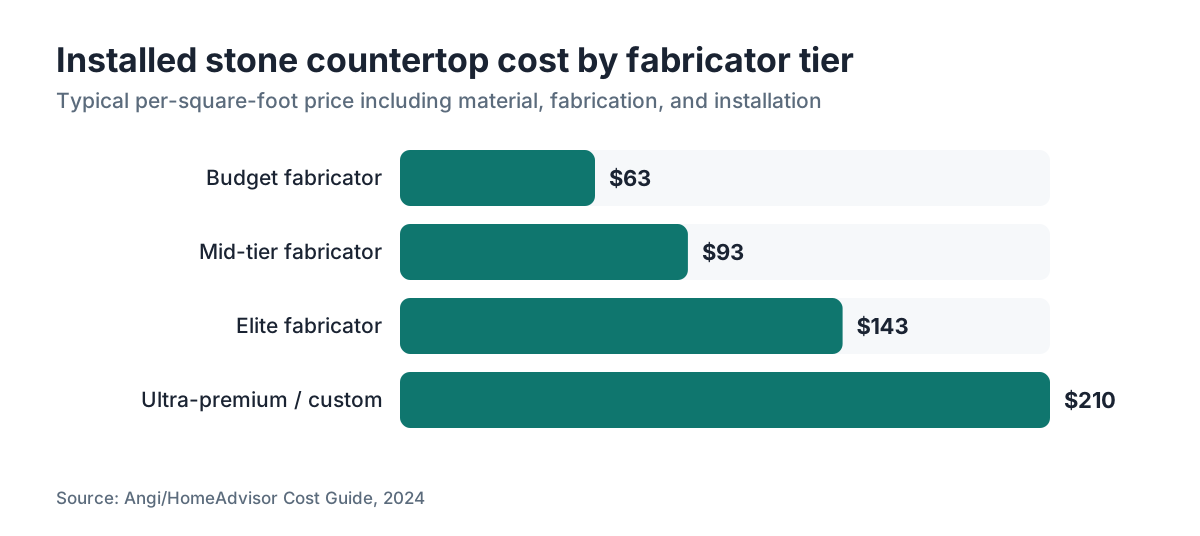
For installed granite or quartz in an average U.S. kitchen (roughly 45-55 square feet of counter), budget fabricators have historically quoted $50-$75 per square foot installed, mid-tier shops $75-$110, and high-end shops $110-$175 or more depending on material and complexity [4]. Those ranges move with material costs, so treat them as relative gaps, not fixed prices.
The 20-40% premium at an elite shop buys a few concrete things. Better stone selection (a layout person who carries veining across seams instead of cutting in sequence). Tighter install tolerances. Cleaner edge finishing (consistent profile depth, no tool marks under raking light). And usually a crew that doesn't leave silicone fingerprints on your cabinet faces.
Run the math. A 50-square-foot kitchen at $130 per square foot versus $90 is a $2,000 gap. On a $50,000 kitchen renovation, that's not the line to cut. On a $12,000 renovation where the counter is 40% of the budget, it's a harder call.
The table below gives a rough regional breakdown. The numbers come from aggregated contractor survey data, so read them as ballparks. Your local market can run 25% higher or lower.
| Fabricator tier | Typical installed price (granite/quartz) | What you get extra |
|---|---|---|
| Budget | $50-$75/sq ft | Basic cuts, standard edge, limited slab selection |
| Mid-tier | $75-$110/sq ft | Better equipment, some layout attention, 1-2 edge options |
| Elite | $110-$175/sq ft | CNC precision, full slab layout, matched veining, experienced install crew |
| Ultra-premium/custom | $175+/sq ft | Rare stone, artistic edge work, concierge service |
Those ranges bundle material plus fabrication plus installation into one quote, which is how countertop shops normally sell.
How do you vet a stone fabricator before hiring them?
Most homeowners pick a fabricator off a Google search or a builder referral and never ask a hard question. That's how you end up with a seam in the middle of your island and a backsplash that won't sit flush.
Here's what to actually check.
Ask to visit the shop. A fabricator who won't let you walk the floor during business hours is hiding something, usually a cramped, understaffed operation with equipment nobody has calibrated in a while. A good shop is proud of its floor. You want clean water pits, organized slab storage, and people who clearly have years in.
Ask for three recent references on projects like yours in material and complexity. Call them. Ask whether the seams landed where the shop promised, whether install ran on time, and whether anything chipped or cracked during the set. Good fabricators hand over references without blinking. Hesitation here is a red flag.
Ask how they template. If the answer is cardboard, it's not 1995. That's fine for square walls, but an irregular layout wants digital. Ask who runs the template and whether that same person touches the cut layout.
Read the warranty terms in writing before you sign. Elite fabricators warrant workmanship for one year at minimum and handle seam failures, fabrication chips, and install damage without argument. Ask what voids it, then read the fine print.
Check licensing and insurance. Stone fabricators in most states need a general or specialty contractor license to install. The class varies. California, for example, requires a C-54 (tile) or C-51 (masonry) license for stone installation in most cases [5]. Ask for the license number and verify it on your state board's site. Confirm they carry general liability ($1 million per occurrence is standard) and workers' comp.
What stones do elite fabricators work with that budget shops don't?
Budget and mid-tier shops mostly stock commodity quartz brands and the common granite colors. Elite fabricators work a broader, harder-to-source range, and they have the skill and tooling to handle the materials that punish careless cutting.
Quartzite is the clearest example. True quartzite (not engineered quartz) is harder and denser than granite, but it has strong grain planes that can delaminate or spall when cut wrong. An experienced fabricator orients cuts away from the bedding planes and supports the slab differently than granite in transport. Plenty of budget shops just skip the unusual quartzite colors because the failure risk runs high.
Marble is forgiving to cut but asks for a different discipline. It scratches and stains easily, so the whole workflow from saw to polish to install has to treat the face as finished the second the slab leaves the rack. Shops that handle a lot of marble countertops pad their saw tables, wipe pooling water on contact, and never stack marble face-to-face without felt.
Soapstone and granite countertops each carry their own quirks. Soapstone is soft and scratches during handling, and its talc-based surface loads up polishing wheels if you don't swap grits properly. Granite varies wildly in silica content (which drives cutting speed and blade wear) and in internal fissures (which can crack at an unsupported overhang or cutout).
Ultra-compact surfaces like Dekton and Neolith are the hardest test of a shop's equipment and skill. They run 12-13mm thick, resist abrasion, and flex almost not at all, so any stress concentration during a cut or a set causes a clean catastrophic crack. Cosentino publishes fabrication protocols for Dekton and says outright that fabricators need specialized diamond tooling and should finish the certification program before touching the material [6].
What does the fabrication process look like at a high-end shop?
Follow a top-tier shop's process from order to installed counter and you see exactly where quality gets built in, and where lesser shops cut corners.
It starts with templating. A digital templater (most often on a Prodim Proliner or a laser system) captures the exact geometry of your cabinets, walls, and cutouts. Figure 45-90 minutes on a typical kitchen. The data drops straight into the shop's CAD software.
Layout is where elite shops pull away. A senior layout person lays the template over a digital photo of the actual slab and decides where every piece gets cut to match vein flow and hide seams. On a book-matched island, that one step can eat an hour. At a budget shop, a machine operator nests for maximum yield and hits cut.
Cutting on a CNC bridge saw runs 30-90 minutes per slab depending on complexity. Edge profiling on the CNC router follows. Then polishing, a second inspection for chips and scratches, and packing for delivery.
Installation by a trained crew (not day labor hired the morning of) is the last step. Elite shops use their own installers, people who set stone daily and know how to level cabinets, cut a clean sink opening, run silicone without visible squeeze-out, and deal with the wall that's 3/4 inch out of plumb.
Running this workflow across a dozen simultaneous jobs takes real production tracking. Software like SlabWise ties quoting, slab inventory, and job scheduling together so nothing slips between the template appointment and the install date. That kind of organization is part of what separates a shop that occasionally does elite work from one that does it every week.
How important is slab selection, and do elite fabricators help with it?
Slab selection is the most underrated step in the whole process, and it's genuinely the line between a great counter and a mediocre one cut from the identical material.
Every granite slab is unique. Two slabs off the same quarry block can differ in color saturation, movement, and background tone. Buy countertops without seeing the actual slab and you're trusting someone else's read on what suits your cabinets and floor. Sometimes that trust is earned. Often it isn't.
Elite fabricators either run their own slab warehouse where you walk and pick, or they take you to the distributor's yard and help you choose. The move that matters is picking consecutive slabs from the same bundle. Slabs get cut sequentially and numbered, and bundle mates match far better than random slabs of the same color. A good layout person will also show you how the slab sits on your cabinets before you commit.
For high-movement stones like Calacatta marble or Azul Bahia granite, slab selection can swing the final look by half. You aren't picking a color swatch. You're picking this specific 6-by-10-foot piece of geology.
Some elite shops offer book-matching, where two adjacent slabs open like a book and the veining mirrors across the centerline. It's dramatic on islands and fireplace surrounds. It needs slabs from the same sequential cut, careful layout, and a fabricator willing to burn extra slab to land the match.
What certifications and industry affiliations do the best fabricators have?
Certification in stone fabrication is looser than in some trades, but a few credentials are worth asking about.
The Natural Stone Institute (NSI) runs an Accredited Natural Stone Fabricator program. Accredited shops get audited on equipment, staff training, quality process, and business practices. Under the NSI's published standards, accredited fabricators must show proficiency across natural stone types and keep up continuing education [7]. It doesn't guarantee perfection. It's a real signal that a shop takes the work seriously enough to invite an outside audit.
Manufacturer certifications matter for engineered stone. Caesarstone, Cambria, and Silestone all run fabricator certification or preferred-fabricator programs that require demonstrated install quality and volume minimums. If you're buying a premium engineered product like Cambria countertops, a manufacturer-certified shop makes it more likely the material warranty gets honored.
OSHA 10 or OSHA 30 construction training is worth asking about for the install crew. Stone installation means lifting heavy slabs, working around power tools, and often working over existing fixtures. A crew with safety training moves differently on a job site than one without [8].
Business credentials count too. A Better Business Bureau accreditation, or a steady 4.5-plus star rating across 50 or more Google reviews (not 10 curated from family), tells you how the shop handles problems. That matters more than how it performs when everything goes right.
What red flags should you watch for when hiring a stone fabricator?
Bad fabrication jobs follow predictable patterns. These are the ones that come up most.
An extremely low bid with no explanation. If a quote lands 30% under every other shop, something is different, and it's rarely raw efficiency. Usual causes: they plan to substitute a lower grade of material, they use subcontract installers with no accountability, or the price leaves out things you assumed were in it (sink cutout, edge profile, backsplash cuts). Get it itemized.
Vague or verbal timelines. Elite fabricators give you a written schedule: template date, fabrication completion, install date. A shop that says 'a few weeks' and won't commit further is probably overbooked and managing you with soft language to dodge a promise it can't keep.
No seam placement policy. Before you sign, ask where the seams land on your specific layout. A good shop has already worked it out and answers on the spot. A shop that says 'we'll figure it out on site' is telling you it doesn't plan layout in advance.
Pressure to sign same-day. Good shops are busy and don't need to close you in one visit. Today-only pricing and limited-time slab holds are sales tactics, not quality signals.
No physical address or walk-in policy. Some outfits run from storage units or borrow someone else's shop. You want a fixed facility you can visit, both to judge the work and to know where your stone lives while it's being cut.
Walk through the countertop installation plan carefully with any shop before you commit, no matter how sharp the showroom looks.
How do elite stone fabricators handle seams, and why does it matter?
Seams are the hardest part of countertop work to do well, and the first thing you'll notice when they're done badly.
A seam in natural stone is always visible to some degree. The goal isn't invisibility. It's minimizing it through good placement, a tight gap, and matched filler color. Elite fabricators work it systematically.
Placement. Seams should go where they're least visible (not in the sightline at the range, not centered on an island) and where the stone is supported (over a cabinet base or wall, never over a span). The Natural Stone Institute's installation guidelines recommend seams sit at least 6 inches from any cutout edge and stay clear of high-stress areas [1].
Gap tolerance. A well-made seam in granite or quartz runs 1/16 inch or less. Color-matched epoxy or polyester filler closes it, but a wider gap is more prone to settling, staining, and cracking over time. Budget shops often run seams at 1/8 inch because the saw can't hold tighter or the installer won't take the time to close it.
Color matching. Filler color gets mixed on site by a skilled installer who blends pigment to the stone's background tone and its dominant vein. That takes real experience. A bad color match usually reads worse than a slightly wide gap, because the eye catches contrast instantly.
On strong-veined stones (Calacatta marble, Azul Macaubas quartzite), elite fabricators line up the vein across the seam. It needs careful layout, careful cutting, and some wasted material, but the result reads as one continuous piece.
If you're using an unusual or hard-to-match material like quartzite, read up on its care before you finalize the choice. Our guide on how to clean quartzite countertops covers the long-term picture.
Is hiring an elite fabricator worth it for a budget renovation?
Honest answer: sometimes no.
Renovating a rental with laminate countertops or basic quartz, where the goal is durable and clean instead of impressive? A mid-tier fabricator doing competent work at $80 per square foot is the right call. The extra quality of elite fabrication doesn't pay back there.
Installing an entry-level stone in a home you'll sell in two years? The return on an extra $2,000 for premium fabrication is thin. Stone counters do add resale value, but the marginal value of elite over mid-tier fabrication isn't something most buyers notice or pay for.
Where the premium earns its keep: the primary kitchen in a home you're holding 10-plus years, any natural stone with visible movement or veining (where layout and seam work show), any unusual or expensive material where a fabrication error means a $3,000 replacement slab, and any design with complex geometry (waterfall edges, curved counters, integrated drainboards).
A useful rule: if the material itself runs over $80 per square foot, spend the extra on a fabricator who handles it daily. At that price point, fabrication quality becomes a much bigger share of the outcome.
For how different materials compare in what they demand from a fabricator, see our articles on kitchen countertops and how to clean stone countertops for a read on maintenance and durability after the install.
How do stone fabricators price jobs, and what should your quote include?
Understanding how a fabricator builds a quote lets you compare apples to apples and spot where a low bid is quietly cutting corners.
Most shops quote by the square foot, measuring the finished stone surface including overhangs but usually not material waste (they fold waste into the slab price). The per-square-foot rate covers material, fabrication labor, and sometimes installation. Get clarity on which pieces are in.
Adders that show up as line items on elite quotes: sink cutout ($150-$350 depending on style), faucet hole drilling ($30-$60 each), cooktop cutout ($100-$250), specialty edge profiles (waterfall, ogee, dupont, rope) at $10-$30 per linear foot over a basic eased edge, backsplash fabrication and install, removal and disposal of the old counter, and a travel charge for installs outside the shop's home market.
A transparent, itemized quote is itself a quality signal. A shop that hands you one number and won't break it down is harder to compare and harder to hold accountable when something goes missing at install.
Fabricators on modern shop software (the kind that pulls templating data straight into the quote) tend to produce more accurate quotes with fewer surprise add-ons at install, because the system catches edge footage, cutouts, and special conditions on its own instead of relying on a salesperson to remember every line. SlabWise is one platform built for exactly this. Shops running it give homeowners quote-to-install accuracy visibly tighter than shops working off spreadsheets and gut feel.
Get at least three quotes on any job over $3,000 in material and labor. Not to find the cheapest, but to see where the market sits and flag the outliers on either end.
Frequently asked questions
What is the difference between a stone fabricator and a stone installer?
A fabricator cuts, edges, and finishes raw slabs into finished countertop pieces. An installer sets those pieces, makes final adjustments, and applies adhesive and sealant. Many shops do both under one roof. Some fabricators subcontract installation, which creates accountability gaps if the set piece doesn't match the fabricated one. Ask whether the company's own employees will be on site during installation.
How long does it take an elite stone fabricator to complete a kitchen countertop?
Template to install typically runs 5-10 business days at a well-run elite shop, with some offering rush turnaround in 3 days for a premium. Budget shops may look faster on paper but often have longer real lead times from crew scheduling. Complex jobs with book-matching or multiple materials realistically take 10-14 days. Get the timeline in writing with a specific install date before you sign.
Do elite fabricators charge more for exotic or rare stones?
Yes, in two ways. The material itself costs more (some exotic granites and quartzites wholesale at $20-$60 per square foot versus $5-$15 for commodity granite). Elite shops also charge more for fabrication labor on hard materials like ultra-compact surfaces, certain quartzites, and very large slabs, because error rate and tool wear run higher. Expect a 15-30% fabrication premium on truly unusual materials.
Can I buy my own slab and have a fabricator cut it?
Many elite fabricators will cut a homeowner-supplied slab, but most charge a premium (10-20% higher fabrication rate) because they're taking breakage risk on material they didn't select, inspect, or price. They also lose their material margin. If you have access to a rare stone or want to match an existing slab, it's worth asking, but expect the shop to inspect the slab closely before agreeing.
What warranty should I expect from a top stone fabricator?
A one-year workmanship warranty covering fabrication defects and installation failures is the minimum for a reputable shop. Some elite fabricators go longer, including lifetime seam warranties. The warranty should cover seam failure, edge chips from fabrication defects, and installation damage. It usually won't cover staining, etching, impact chips after install, or damage from improper cleaning. Get the terms in writing before signing.
How do I find accredited or certified stone fabricators near me?
The Natural Stone Institute keeps a directory of accredited fabricators at naturalstoneinstitute.org. Manufacturer sites for Caesarstone, Cambria, and Silestone list their certified fabricator networks. The National Kitchen and Bath Association can provide referrals too. Beyond directories, read Google and Houzz reviews specifically for comments on seam quality and install precision, more than general satisfaction.
What should I ask about silica dust safety when hiring a stone fabricator?
Silica dust from cutting engineered quartz is a serious occupational hazard. OSHA's permissible exposure limit for crystalline silica is 50 micrograms per cubic meter as an 8-hour time-weighted average, in effect since 2018 for construction. Ask whether the shop uses wet cutting, local exhaust ventilation, or supplied-air respirators. A shop that can't answer clearly hasn't invested in respiratory protection, which tells you how it treats other safety details.
Is it worth paying extra for a mitered waterfall edge on a stone island?
A waterfall edge (stone running vertically down the island side, with a mitered 45-degree corner joint) is one of the most demanding cuts in fabrication. Done well, it looks dramatic and adds $500-$1,500 to a project. Done poorly, with a gap at the miter or mismatched veining, it's one of the most noticeable failures in a kitchen. Only order this from a shop that does several a month and can show you photos of finished installs.
Do elite fabricators work on small jobs or remnant pieces?
Most elite shops take smaller jobs, but some set minimums (often $500-$1,000 in fabrication). Remnant pieces (off-cuts from previous slabs) sell at steep discounts and work great for small bathrooms, laundry rooms, or bar tops. An elite shop's remnant rack often holds high-quality material left over from premium projects. Ask to see it. It's one of the best values in countertops.
How do elite fabricators handle damaged or cracked stone after installation?
A reputable shop assesses whether a crack came from a fabrication defect (tension from a bad cut, an undetected fissure, a poorly supported seam) or from post-install impact or abuse. Fabrication defects are their responsibility; impact damage after install is not. Elite shops send a senior technician to assess, not a junior estimator. They repair cracks with color-matched epoxy and replace a piece if the repair doesn't meet standard.
What's the difference between a fabricator and a countertop retailer or big-box store?
Big-box stores (Home Depot, Lowe's) sell countertops and subcontract fabrication and install to third-party shops in their network. You don't always know which shop until after you sign, and quality varies widely. An independent elite fabricator controls the whole process, picks its own slabs, and sends its own crew. You pay a premium but get one accountable party. For complex natural stone, working directly with a fabricator is almost always the right call.
How is countertop square footage measured for quoting purposes?
Most fabricators measure the total finished stone surface including overhangs (typically 1.5 inches on an eating edge, 0 on backsplash). They measure length times depth at each run and add them up. The standard is to round up to the nearest square foot. Cutouts (sinks, cooktops) are sometimes deducted, sometimes not, so ask. A 20x20-foot kitchen typically has 45-60 square feet of counter depending on island size and layout.
Sources
- Natural Stone Institute, Technical Manual: Dimensional tolerances for finished countertop work: plus or minus 1/16 inch on length and width, surface flatness within 1/8 inch over a 10-foot span; seams should be located at least 6 inches from cutout edges.
- U.S. EPA, Effluent Guidelines: EPA effluent guidelines set discharge limits on total suspended solids from fabrication operations including stone cutting.
- Angi (formerly HomeAdvisor), Countertop Installation Cost Guide: Installed granite and quartz countertop costs range from approximately $50-$175 per square foot depending on fabricator tier and material grade.
- California Contractors State License Board, License Classifications: California requires a C-54 (tile) or C-51 (masonry) specialty contractor license for stone installation in most residential and commercial applications.
- Cosentino, Dekton Technical Fabrication Guide: Cosentino publishes specific fabrication protocols for Dekton ultra-compact surfaces and recommends fabricators complete certification training before working with the material.
- Natural Stone Institute, Accredited Natural Stone Fabricator Program: NSI accredited fabricators are audited for equipment, staff training, quality processes, and business practices, and must maintain continuing education requirements.
- U.S. Department of Labor, OSHA Outreach Training Program: OSHA 10 and OSHA 30 construction industry outreach training programs are available for construction workers and supervisors including those in stone installation trades.
- U.S. Department of Labor, OSHA Respirable Crystalline Silica Standard for Construction (29 CFR 1926.1153): OSHA's permissible exposure limit for crystalline silica in construction is 50 micrograms per cubic meter as an 8-hour time-weighted average, effective 2018.
- National Kitchen and Bath Association (NKBA): NKBA tracks kitchen and bath renovation spending and fabricator market data used as reference for countertop cost benchmarking.
- Caesarstone, Authorized Fabricator Program: Caesarstone maintains a certified and preferred fabricator network requiring demonstrated installation quality and minimum volume to qualify.
- U.S. Bureau of Labor Statistics, Occupational Outlook for Tile and Stone Setters: BLS data on tile and stone setter employment, wages, and working conditions in the U.S. construction industry.
Last updated 2026-07-09