TL;DR
- A stone fabricator buys raw slabs of granite, marble, quartzite, or quartz, then cuts, edges, polishes, and installs countertops to fit your exact kitchen or bath.
- Installed costs run $40 to $150 per square foot depending on material and edge complexity.
- The fabricator matters more to your finished result than the slab supplier or the designer does.
What exactly does a stone fabricator do?
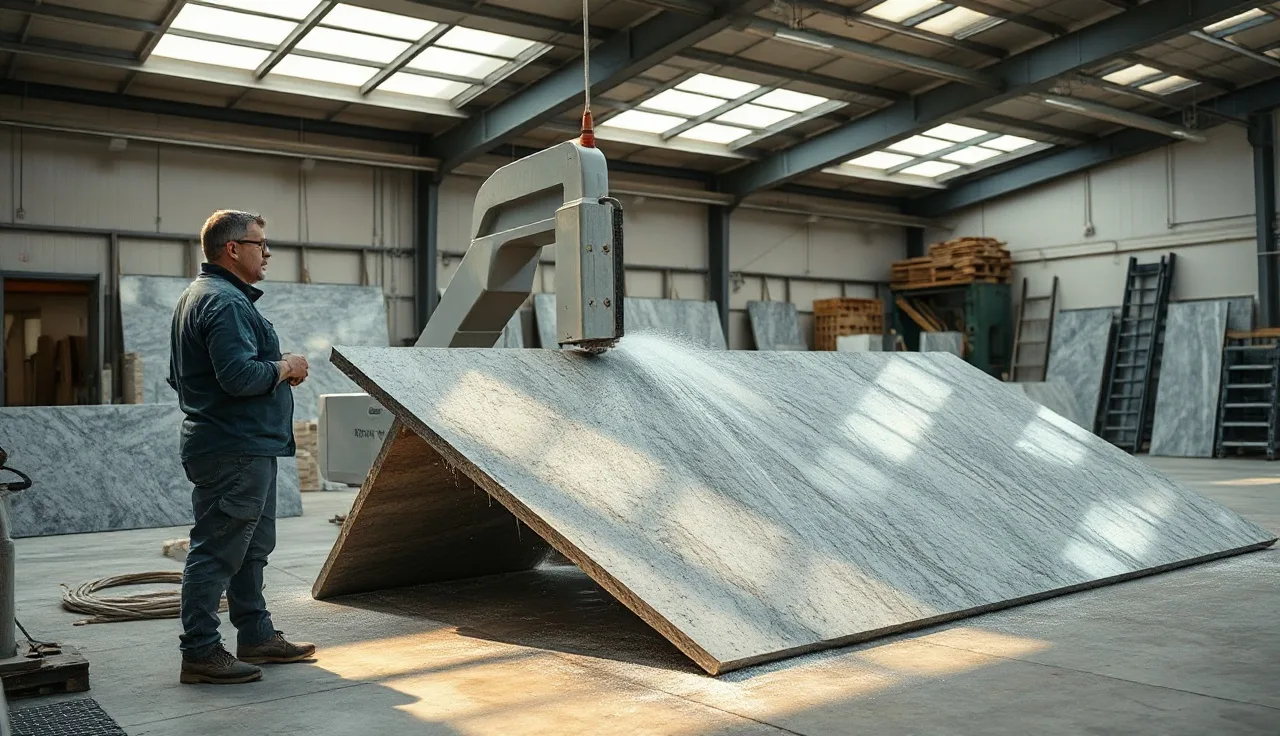
A stone fabricator is a manufacturing shop. They take a raw slab, usually 9 to 10 feet long and 5 to 6 feet wide, and turn it into finished countertops cut to your actual kitchen. That means templating your space, programming cuts into a CNC bridge saw or waterjet, grinding edge profiles, cutting sink holes, polishing the surface, then sending a crew to set the pieces and run the silicone joints.
Most fabricators do all of that in-house. Some subcontract templating or installation to independent crews, which adds a coordination layer worth asking about upfront.
Here is the distinction that trips up most homeowners. A stone yard or distributor sells slabs. A fabricator processes them. Plenty of fabricators run their own showroom and sell slabs directly, which is the easiest one-stop experience. Others buy from a regional distributor like Arizona Tile, MSI, or Dal-Tile and pass the slab cost through to you with markup [1].
The work is physical and it eats capital. A mid-tier CNC bridge saw costs $80,000 to $250,000. A waterjet adds another $150,000 to $400,000. That equipment barrier is why there are only about 7,000 to 9,000 active stone fabrication businesses in the United States, most of them small shops with 5 to 25 employees [2].
How much do stone fabricators charge?
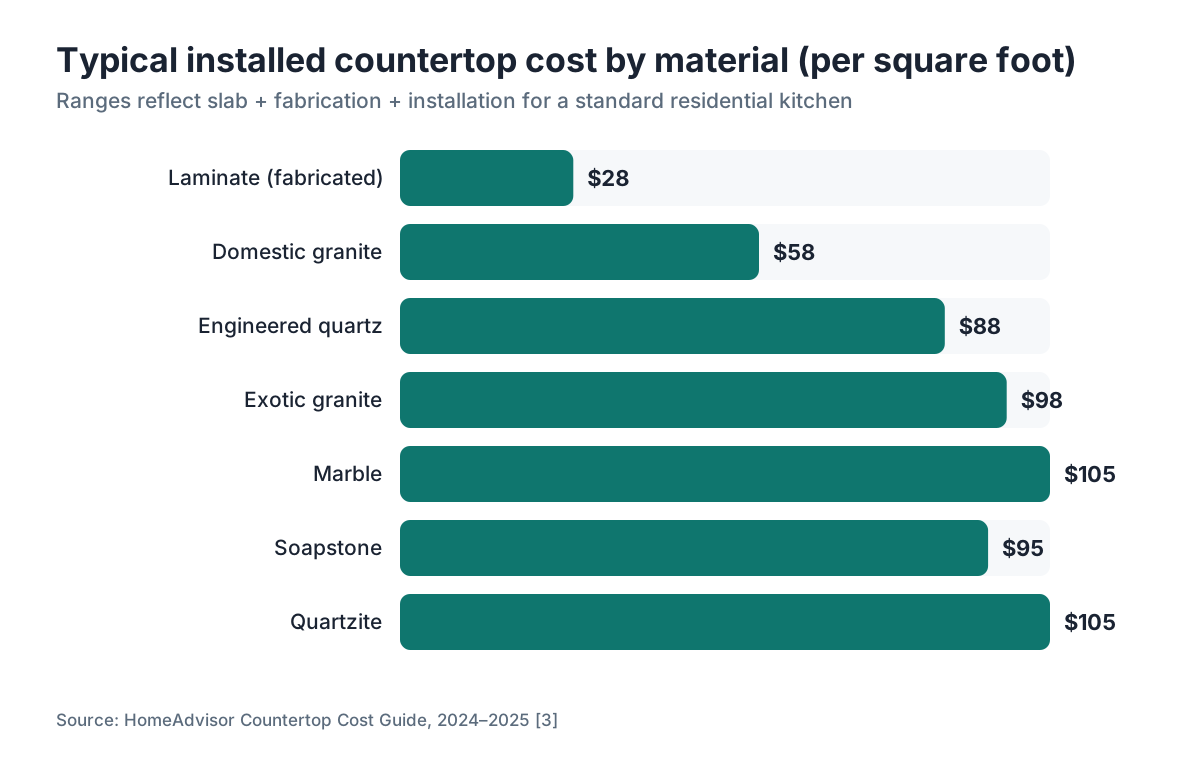
Prices vary more than most homeowners expect. Fabrication labor by itself (cutting, edging, polishing) usually runs $15 to $40 per square foot before material. Installed prices that bundle slab, fabrication, and basic installation land between $40 and $150 per square foot, and the spread comes almost entirely from material choice and edge work [3].
| Material | Typical installed range (per sq ft) | Notes |
|---|---|---|
| Laminate (fabricated) | $15, $40 | Usually separate shops; not stone |
| Granite (domestic) | $40, $75 | Common granite, simple edges |
| Granite (exotic/imported) | $65, $130 | Rarer patterns, thicker slabs |
| Marble | $60, $150 | Soft stone; more finish work |
| Quartzite | $70, $140 | Hard to cut; tool wear is high |
| Engineered quartz | $55, $120 | Brand matters (Cambria, Silestone) |
| Quarry soapstone | $70, $120 | Specialty shops preferred |
Edge profiles add cost. A standard eased or bevel edge is often included. An ogee, waterfall, or laminated mitered edge can add $10 to $25 per linear foot. Sink cutouts run $50 to $150 each. Cooktop cutouts cost about the same. Backsplash pieces cut from the same slab cost extra per linear foot.
Removal and disposal of your old countertops is usually quoted separately, typically $100 to $300 for a kitchen, though some shops fold it in.
One honest caveat: nobody has authoritative national data that breaks fabrication labor out from installed totals. The ranges above reflect published estimates from HomeAdvisor, Fixr, and Angi across 2024 and 2025, cross-checked against contractor forums. Your local market may run 20% higher or lower depending on labor costs and competition [3].
What is the difference between a fabricator and a stone yard?
A stone yard (also called a slab distributor or supplier) imports and warehouses raw slabs. They sell by the slab or the square foot to fabricators, builders, and sometimes directly to homeowners. They do not cut, edge, or install anything.
A fabricator buys from one or more distributors, processes the stone, and delivers finished countertops. Some fabricators own their slab inventory. Others work from distributor yards where you go pick your specific slab.
Why does this matter? If you fall for a particular slab at a stone yard, you still have to hire a fabricator separately, unless that yard runs a fabrication shop on site. The two businesses have historically been separate, though vertical integration is common now in larger markets.
Hire a full-service fabricator and you get slab sourcing, material advice, precise cutting, and installation under one contract. That single point of accountability is worth real money. If an edge chips on delivery or a seam sits crooked, one phone call fixes it. Split-vendor arrangements (you buy the slab, they fab it) breed finger-pointing when something goes wrong.
What materials do stone fabricators work with?
Most shops work the full range of natural and engineered stone. Some specialize.
Granite countertops are the bread and butter of most fabrication shops. Granite cuts predictably and has been the dominant material for 20-plus years, so almost every shop is competent with it.
Marble countertops need more care. Marble is soft (Mohs 3 to 4), blade scratches show, and seaming it without visible glue lines takes skill. Ask to see a shop's marble work specifically.
Quartzite (not the same as quartz) is genuinely hard, often Mohs 7, and it dulls saw blades fast. Inexperienced shops underestimate the tool cost and either quote too high or rush the cut and blow out an edge. If you want quartzite, read our how to clean quartzite countertops guide for care expectations, then ask the fabricator how many quartzite slabs they process per month.
Engineered quartz like Cambria, Silestone, or Caesarstone cuts consistently. Some brands run authorized fabricator networks. Cambria countertops require fabricators to meet Cambria's training and warranty standards, so check that certification if you choose Cambria.
Soapstone is soft and non-porous but needs attention at the finish stage. See how to clean soapstone countertops for a sense of the material's ongoing needs.
Some fabricators also handle butcher block countertops and solid surface like Corian countertops, though those are different processes and many stone shops refer them out. Laminate countertops and Formica countertops almost always go to separate shops with different tooling.
How does the fabrication process work, step by step?
Knowing the steps tells you what to ask and where delays hide.
-
Template. After your cabinets are fully installed (a firm requirement at most shops), a crew visits with either a physical template made of lauan strips or a digital laser or LiDAR scanner. Digital templating is standard now at shops doing volume, and it cuts measurement errors sharply. The template captures exact wall angles, corner radii, and appliance cutout positions.
-
Slab selection. You go to the fabricator's yard or their distributor's yard and pick the specific slabs. For a typical kitchen you want to see both slabs side by side and check how the pattern books across seams. Do this in person. Samples and phone photos do not capture full-slab movement.
-
Layout and programming. The shop lays your template over the slab, digitally or physically, to cut waste and match pattern at the seams. This is where nesting software earns its keep. Shops running fabrication software like SlabWise can model the whole job before a single cut, which trims both mistakes and slab waste.
-
Cutting. A CNC bridge saw or waterjet cuts the pieces. Cooktop and sink cutouts happen here too.
-
Edge work. CNC edge profilers or hand polishers grind the profile through several grits up to a final polish. Slow, hands-on work, and it is where the quality gap between shops shows most.
-
Polishing and cleaning. Pieces get cleaned, sometimes sealed depending on material, and staged for delivery.
-
Installation. Usually a two-person crew. Pieces come in (heavy, a full kitchen can be 400 to 700 pounds of stone), get set on the cabinet bases, leveled with shims, adhered with silicone, and the joints are filled and polished. Undermount sinks get clipped and siliconed from below. Install on an average kitchen takes 2 to 5 hours.
Total time from template to install usually runs 7 to 21 days at normal capacity. During supply crunches or the spring renovation surge, expect 3 to 5 weeks [4].
What should you look for when choosing a stone fabricator?
Portfolio and references come first. Ask for photos of finished jobs in your material. Ask for two or three references from work done in the last six months, then actually call them.
Licensing matters. Stone installation generally falls under general contracting or specialty contractor licensing, though rules vary a lot by state. Many states require contractors who install countertops to hold an active license and carry general liability insurance of at least $1 million per occurrence [5]. Ask for the license number and verify it with your state contractor board.
Warranty terms tell you plenty. A confident shop warrants its fabrication workmanship for at least one year. Material issues (cracks from thermal shock, say) get more nuanced, but seam quality and edge integrity should be unconditional.
Capacity and lead time are worth asking about head-on. A shop six weeks out can still be worth the wait if the work is excellent. A shop that can start Monday but runs two guys, one saw, and mostly does rental countertops may not be set up for a premium marble island.
Get at least three quotes. Not because the cheapest wins, but because the act of quoting forces each shop to explain what it includes. A quote that looks high might cover slab removal, haul-away, and a premium edge the others left out.
Ask how they handle seams, and ask to see seam samples in your specific material, more than granite. Seaming marble or a dramatic quartzite is far harder than seaming uniform granite, and the answer tells you how experienced they really are.
Regional shops like Northwest Stone Fabricators LLC in the Pacific Northwest show the model you usually want: full-service work with slab sourcing, template, fabrication, and installation under one roof. That setup fits a straightforward residential project.
How do stone fabricators price a job? (What goes into a quote?)
When a fabricator quotes your job, they are usually pricing six things.
First, slab cost. Priced by the square foot of raw slab, not finished countertop. Slabs are not perfectly rectangular, and every layout has waste, so the raw area you need always beats your countertop square footage. A 20% to 40% waste factor is normal on a kitchen layout.
Second, fabrication labor. Cutting, edging, polishing, usually quoted as a per-square-foot rate on finished area.
Third, edge profiles. Linear feet of exposed edge times a per-foot charge by profile type.
Fourth, cutouts. Each sink, cooktop, or outlet box cut is a flat fee.
Fifth, installation. Sometimes baked into a flat package, sometimes quoted per square foot of installed area.
Sixth, extras. Removing old tops, sealer, backsplash pieces, corbels, waterfall panels.
Shops on modern quoting software can hand you an itemized quote that breaks all of this out. Shops still on spreadsheets or paper tend to give one lump sum, which makes comparison hard. If you get a lump sum, ask them to split it into material, labor, and extras. Any reputable shop will.
Quoting software helps shops price accurately and cut the re-quoting cycle that drives everyone crazy. A shop that can send you a clean itemized PDF within 24 hours of your consult is telling you it runs an organized operation.
What are common problems with stone fabrication and how do you avoid them?
Visible seams top the complaint list. Seams are unavoidable on countertops wider than the slab or longer than about 9 to 10 feet. A good fabricator puts seams where they hide (away from the sink, out of the sightline from the doorway) and matches the pattern across them. Settle seam placement before you sign, and get it in writing.
Chipped edges usually happen during delivery or install. Inspect every piece before the crew leaves. A chip found after they drive off turns into a fight about when it happened.
Measurement errors from bad templates make pieces that do not fit. Digital templating has mostly solved this at shops that invested in it. If a shop still does paper templates by hand, ask how many remakes they ran last year.
Color or pattern mismatch shows up when a shop swaps in a different slab lot after you approved samples. Tag your specific slabs at the yard before fabrication starts. Most shops expect you to.
Delays from subcontracted installers are common when a shop fabricates in-house but farms out the install. Ask who actually shows up at your house and whether they are employees or subs.
Sealer overselling is real. Many shops charge $50 to $200 to apply sealer at install. For granite and quartzite, a quality penetrating sealer (Tenax, Aqua Mix, StoneTech) costs $20 to $40 a bottle and is genuinely worth applying. For engineered quartz, sealer does nothing because the material is non-porous. Do not pay to seal quartz [6]. See our how to clean stone countertops guide for maintenance specifics.
How do fabricators handle commercial vs. residential projects differently?
Residential work is usually one kitchen, one bath, maybe a laundry room. The homeowner is the client, decisions happen in real time, and the slab count is low.
Commercial work (hospitality, healthcare, multi-family, office) means larger square footage, tighter contractor schedules, and a general contractor as the client instead of the end user. Payment terms shift too. Residential jobs often want 50% deposit, balance on install. Commercial jobs may be net-30 or net-60, which hits a shop's cash flow hard.
Many small shops steer clear of commercial work on purpose. The payment cycle is punishing, and the GC can back-charge the sub for delays other trades caused. Larger shops with the cash to carry receivables like commercial work for its volume and steadiness.
If you are a GC or developer sourcing a fabricator for a multi-family project, the conversation looks nothing like homeowner sourcing. You want to know the shop's throughput (slabs per week), whether they have a dedicated commercial project manager, and how they handle change orders in writing.
Do stone fabricators need licenses, certifications, or insurance?
Licensing rules vary by state and sometimes by county. Most states that regulate home improvement contractors require a license for installation work, since the installer is affixing things to a structure. The Natural Stone Institute (which absorbed the former Marble Institute of America) offers voluntary certification including the Accredited Natural Stone Professional credential, covering installation, safety, and product knowledge [7].
The Institute also runs an accreditation program for fabrication shops that evaluates equipment, employee training, and quality control systems. Accredited shops display the credential, which signals operational quality, though plenty of excellent small shops skip it because the paperwork burden is high.
OSHA rules apply to fabrication shops like any manufacturing plant. Stone dust (respirable crystalline silica from cutting granite and engineered quartz) is a serious health hazard. OSHA's silica rule, 29 CFR 1910.1053 for general industry and 29 CFR 1926.1153 for construction, requires shops and install crews to control silica exposure through wet cutting, ventilation, or respirators [8]. OSHA states the permissible exposure limit for respirable crystalline silica is "50 micrograms per cubic meter of air as an 8-hour time-weighted average" [8]. That is a worker safety issue, not a customer one, but a shop serious about silica control usually runs a tight operation overall.
Always ask for a certificate of insurance showing general liability (at least $1 million per occurrence is the standard floor for residential contractors) and workers' compensation. If they cannot produce a current COI, walk away.
How do fabricators handle countertop installation?
The countertop installation is a separate phase from fabrication. For residential stone work, the install crew shows up with all pieces already cut and finished. Their job is to carry pieces in without cracking them, set them level on the cabinet bases, adhere them with silicone (not construction adhesive, which can crack under movement), fill seams with color-matched epoxy, and set the undermount sink.
Stone slabs are heavy. A 3 cm granite slab weighs about 19 to 20 pounds per square foot. A typical kitchen with 50 square feet of countertop is 950 to 1,000 pounds of stone, broken into pieces two people can carry. If your kitchen sits on a second floor or the corners are tight, say so when getting quotes. Some shops add a surcharge for hard access.
Watch a few things on install day. Check that the leveling shims are not visible from the front. Check every seam while the epoxy is still wet, because small flaws are far easier to fix before cure. Confirm the sink clips are all in and tight before the crew leaves. Run the sink and check for drips before you sign off. That is not paranoid, it is smart.
Most fabricators require your plumber to disconnect and reconnect the plumbing. Some will pull the old tops and reconnect plumbing for a fee. Nail down that scope before you sign.
For the full picture of install timelines and what can go sideways, see our kitchen countertops guide.
How has the stone fabrication industry changed in recent years?
Digital templating replaced paper at most volume shops over the past decade. Laser and LiDAR tools cut errors and speed the process. A digital template takes 30 to 45 minutes on site versus an hour or more for a skilled manual templater.
CNC machining is the norm now, not the premium. Shops still working by hand saw and angle grinder are either very small or in markets where the equipment spend does not pay off yet. CNC consistency drops callbacks.
Engineered quartz climbed to roughly 40% of the residential countertop market by the early 2020s, per National Kitchen and Bath Association research, while natural stone held its ground at the premium end [9].
Silica safety turned into a real legal and regulatory issue after a wave of silicosis cases among workers who cut engineered quartz (about 90% crystalline silica) without proper dust control. OSHA stepped up enforcement. Workers' comp and personal injury cases have settled, and some engineered quartz makers now require fabricators to wet-cut and provide respirators as a condition of selling their product.
On the business side, quoting and shop management software moved from optional to close to essential for any shop doing real volume. Manual spreadsheets fall apart fast when you are juggling 20 or 30 jobs at once, each with its own slab dimensions, edge profiles, and cutout specs. Platforms built for fabricators, like SlabWise, let shops quote faster, track slab inventory, and cut the estimating errors that quietly eat margin.
Labor shortages hit stone fabrication hard after 2020. Skilled CNC operators and seasoned installers are hard to find and expensive to keep. Some shops raised prices in response. Others invested in automation and CNC upgrades that shave skilled-labor hours per job.
Frequently asked questions
How much does stone fabrication cost per square foot?
Fabrication labor alone (cutting, edging, polishing) runs $15 to $40 per square foot. Installed prices that bundle slab, fabrication, and installation range from $40 per square foot for basic domestic granite up to $150 or more for exotic marble or quartzite. Engineered quartz usually falls in the $55 to $120 range installed. These are 2024 to 2025 estimates; your market may run 10 to 25% different.
What is the difference between a stone fabricator and a stone supplier?
A stone supplier (distributor or slab yard) imports and warehouses raw slabs and sells them to fabricators or the public. A fabricator buys raw slabs, then cuts, edges, polishes, and installs finished countertops. Many fabricators run their own showroom and sell slabs directly, making them a one-stop shop. Buy a slab straight from a yard and you still need a separate fabricator to process and install it.
How long does it take from template to installation?
Most residential jobs run 7 to 21 days from template to install when a shop is at normal capacity. During busy seasons like the spring renovation surge, or when shops are backlogged, expect 3 to 5 weeks. Digital templating and CNC cutting have shortened production time at well-equipped shops. Always ask for the shop's current lead time before signing a contract.
Do I need a license to be a stone fabricator?
Requirements vary by state. Fabrication itself (cutting and edging in a shop) is manufacturing and generally not licensed. Installation (setting stone in a home) often falls under general or specialty contractor licensing, which most states require. The Natural Stone Institute offers voluntary accreditation for fabrication shops. Check your state's contractor licensing board for current rules.
How do I know if a stone fabricator is reputable?
Ask for photos of finished jobs in your specific material, call at least two recent references, and verify their contractor license with your state board. Request a certificate of insurance showing general liability of at least $1 million per occurrence and active workers' compensation. A shop that gives you an itemized written quote, discusses seam placement upfront, and lets you tag your specific slabs at the yard is running a professional operation.
What questions should I ask a stone fabricator before hiring them?
Ask: how many jobs like mine have you done in this material? Can I see seam samples? Who does the template, and is it digital or manual? Who installs, your employees or subs? What does the warranty cover and for how long? What is your current lead time? Can I see the slabs before you cut them? And ask them to itemize the quote so you can compare it fairly to other bids.
What is the silica dust risk in stone fabrication?
Cutting granite and especially engineered quartz (about 90% crystalline silica) throws off fine dust that can cause silicosis, a serious and irreversible lung disease. OSHA's silica standard (29 CFR 1910.1053) sets a permissible exposure limit of 50 micrograms per cubic meter as an 8-hour time-weighted average. Reputable shops use wet cutting, ventilation, and respirators. It is a worker safety issue, but a shop that takes it seriously tends to run a tighter operation overall.
Can a stone fabricator fix a chipped or cracked countertop?
Yes, most fabricators offer repair. Small edge chips can be filled with color-matched epoxy and polished down. Cracks are harder. A surface crack can sometimes be stabilized with epoxy, but a structural crack through the full thickness usually means replacing that section. Get repair quotes from two or three shops, because prices vary widely and whether a repair will look good is partly a judgment call.
What does a stone fabricator warranty cover?
A standard fabrication warranty covers workmanship: seam quality, edge finish, cutout dimensions, and installation levelness, usually for one year. It does not cover thermal shock damage (setting a hot pan on stone), staining from bad sealing, or cracks from cabinet settlement. Defects in the slab itself are generally covered by the manufacturer or distributor, not the fabricator. Get the warranty terms in writing before you sign.
What is northwest stone fabricators and where do they operate?
Northwest Stone Fabricators LLC is a regional stone fabrication company operating in the Pacific Northwest. Like most full-service regional fabricators, they handle slab sourcing, template, CNC fabrication, and installation for residential and commercial clients. If you are in their service area, get a quote from them alongside two or three other local shops to compare pricing, lead time, and workmanship before committing.
Is engineered quartz harder to fabricate than natural stone?
Engineered quartz cuts consistently and predictably, which makes it easier in some ways. But its high silica content (around 90%) creates serious dust hazards that demand wet cutting and strong dust control. Quartzite (a natural stone often confused with quartz) is actually harder to cut than engineered quartz because of its extreme hardness, which dulls blades fast and adds tool cost. Marble is soft and easy to cut but scratches from blades if technique is poor.
How do stone fabricators calculate how much slab I need?
Fabricators add a waste factor, typically 20% to 40%, on top of your finished countertop square footage to account for unusable slab edges, grain matching at seams, and cutout offcuts. For a 40-square-foot kitchen, expect to pay for 48 to 56 square feet of raw slab. Complex layouts with lots of corners, islands, or pattern-matched slabs push toward the higher end. Ask your fabricator to show you the layout before they cut.
Can a stone fabricator work with slabs I already bought?
Yes, many fabricators offer fabricate-only service where you supply the slab and they cut, edge, and install. Expect a different price structure, since they make no margin on material. Some shops charge a premium for customer-supplied slabs because they carry the risk of cutting a stone they did not select or inspect. Confirm this arrangement in writing and clarify who is liable if the slab cracks during cutting.
How do I find stone fabricators near me?
Start with the Natural Stone Institute's member directory at naturalstoneinstitute.org, which lists accredited shops by region. Google searches for stone fabricators in your city work fine, but filter by reviews that include photos of actual finished jobs. Ask your kitchen designer or cabinet installer for referrals, since they work with local fabricators all the time and know who is reliable on turnaround and install quality.
Sources
- MSI Surfaces, About MSI (distributor overview): Major slab distributors like MSI sell slabs wholesale to fabricators who process and install them for end customers
- U.S. Census Bureau, Statistics of U.S. Businesses, NAICS 327991 Cut Stone and Stone Product Manufacturing: Approximately 7,000 to 9,000 active stone fabrication businesses operate in the United States under NAICS 327991
- HomeAdvisor, Countertop Installation Cost Guide (2024-2025): Installed countertop prices range roughly $40 to $150 per square foot depending on material and edge complexity
- National Kitchen and Bath Association, NKBA Market Research: Typical residential fabrication lead times of 7 to 21 days; busy seasons extend timelines to 3 to 5 weeks
- California Contractors State License Board, License Classifications: Most states require contractors who install countertops to hold an active contractor license and carry general liability insurance
- Caesarstone, Quartz Care and Maintenance FAQ: Engineered quartz countertops are non-porous and do not require sealing
- Natural Stone Institute, Accreditation and Certification Programs: The Natural Stone Institute offers the Accredited Natural Stone Professional credential and fabrication shop accreditation programs
- OSHA, Occupational Exposure to Respirable Crystalline Silica, 29 CFR 1910.1053: OSHA's permissible exposure limit for respirable crystalline silica is 50 micrograms per cubic meter as an 8-hour time-weighted average
- National Kitchen and Bath Association, 2023 Design Report: Engineered quartz captured approximately 40% of the residential countertop market by the early 2020s
- U.S. Bureau of Labor Statistics, Occupational Outlook Handbook, Stone Cutters and Carvers: Stone fabrication is a manufacturing occupation tracked by BLS under stone cutters and related processing occupations
- Environmental Protection Agency, RCRA Hazardous Waste: Stone fabrication shops generate process water and stone slurry that may require disposal under state environmental regulations
Last updated 2026-07-09