TL;DR
- A working stone fabrication shop needs five machine categories: a bridge saw or waterjet for cutting, a CNC router for edges and cutouts, polishing gear for finishing, seam setters for installation, and material handling like A-frames and vacuum lifters.
- New equipment packages run roughly $150,000 to $600,000 and up.
- Buying used cuts that by 30 to 60%.
What equipment does a stone fabricator actually need?
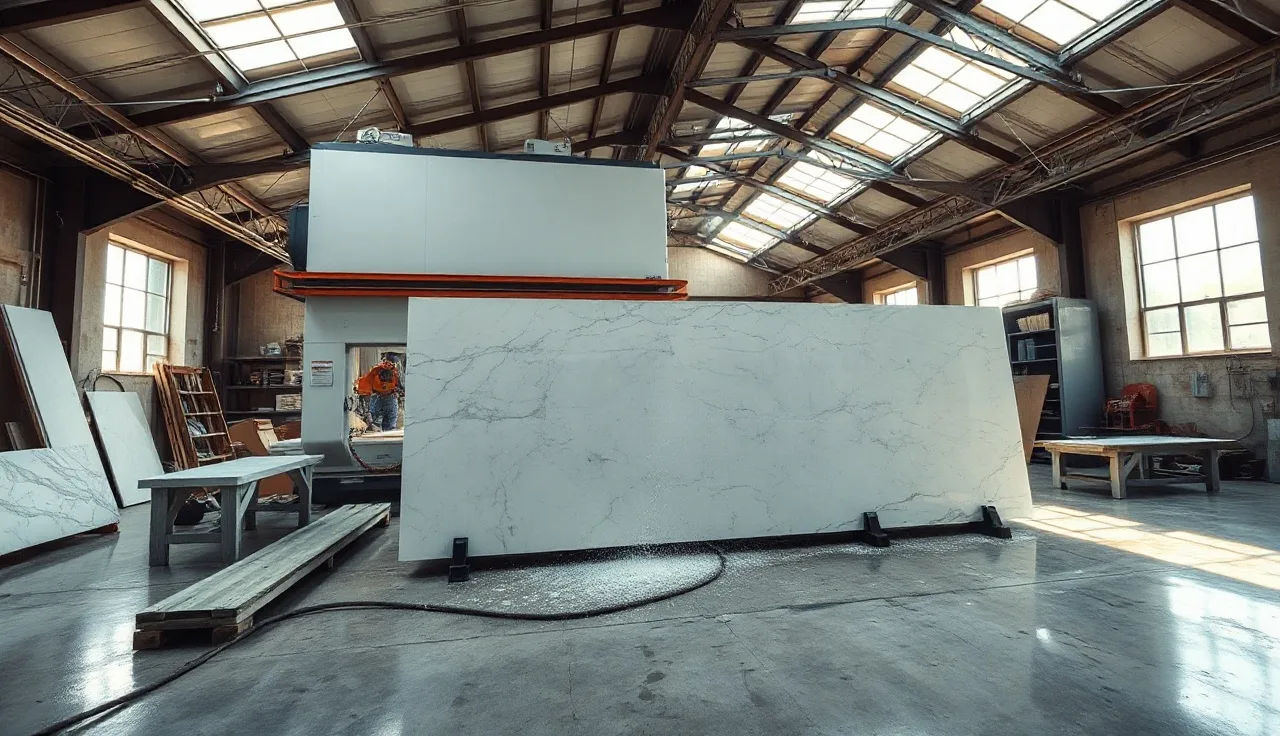
Every stone shop, whether it's cutting granite countertops or marble countertops, runs the same sequence. Receive a slab, cut it to shape, profile the edges, polish, deliver. Each step has a machine built for it.
The five core categories are:
- Cutting machines (bridge saw or waterjet)
- CNC machining centers (edges, sink cutouts, carved details)
- Grinding and polishing equipment
- Material handling (A-frames, vacuum lifters, cranes)
- Templating and layout tools (digital templaters, manual templates)
Small shops sometimes start with a bridge saw and hand-held angle grinders, then farm out CNC work to a service shop. That works. But the margin you give up on edge profiles adds up fast, and most shops outgrow the purely manual setup inside two or three years and add a CNC or at least a manual edge machine.
Beyond those five categories, a shop needs fabrication tables sturdy enough to hold 400-plus pound slabs, air compressors, water recirculation and filtration, dust collection, and hand tools like angle grinders, polishers, and seam setters. The machines get the headlines. The supporting infrastructure is where first-time shop owners get ambushed on startup cost.
What does a bridge saw do and how much does one cost?
A bridge saw is the workhorse of the shop. It runs a diamond blade along two rails, making straight cuts through slabs 2 to 3 centimeters thick (or more for marble and heavy granite). Most bridge saws also tilt for miter cuts, which you need for waterfall edges and furniture-style work.
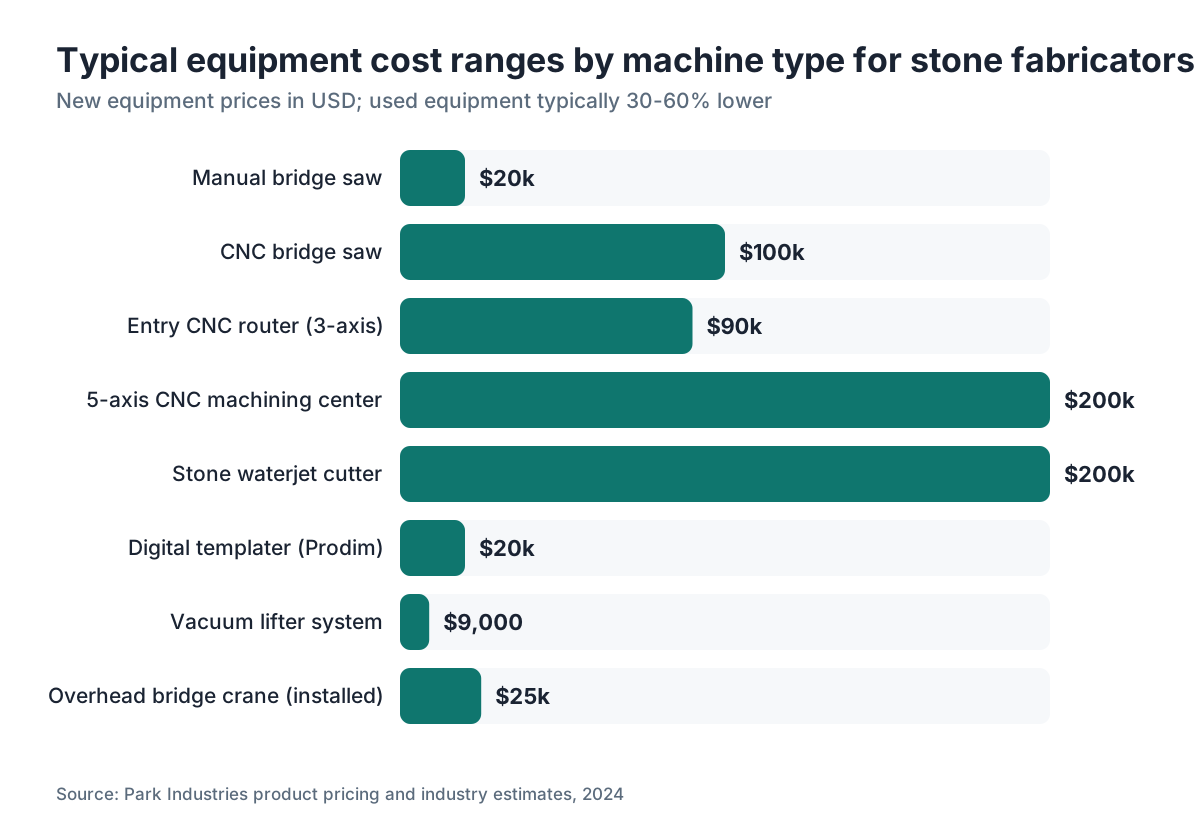
Entry-level bridge saws from brands like Achilli or Comandulli start around $15,000 to $25,000 for a basic manual unit [1]. Mid-range CNC-controlled saws, where the operator programs the cut list and the machine runs it, land at $60,000 to $150,000. High-end 5-axis machines that handle complex geometry push past $200,000.
The blade matters. A quality continuous-rim diamond blade for stone runs $80 to $300 depending on diameter and bond. You go through them, especially on quartzite and hard granites. Budget $3,000 to $8,000 a year in blades for a shop running two shifts.
Bridge saws need water. A lot of it. Water cools the blade and knocks down silica dust. Most saws ship with a basic recirculation pump, but a proper water recycling system with a settling tank and filtration is a separate line item, usually $5,000 to $20,000. That's not optional. OSHA's silica standard for construction (29 CFR 1926.1153) requires dust controls, and wet cutting is one of the primary engineering controls listed [2].
A waterjet is the alternative or the complement to a bridge saw. Waterjets cut with a high-pressure stream of water and abrasive garnet, no blade contact, which means zero chipping on polished faces and curves a bridge saw can't touch. The tradeoff is money. Industrial stone waterjets start around $100,000 and commonly run $150,000 to $300,000 new [1]. Operating cost is higher too, because garnet burns off constantly.
What is a CNC router and why do fabricators use them?
A CNC (computer numerical control) router in a stone shop is a gantry machine that moves a spindle in X, Y, and Z axes over a fixed slab. It does the work that would otherwise eat an hour of a skilled hand-tool operator's time per piece: edge profiles, sink cutouts, faucet holes, decorative carving.
For a shop making kitchen countertops, a CNC pays for itself on edge labor alone. An ogee or dupont edge that takes 20 to 30 minutes by hand takes 4 to 8 minutes on a CNC, and it comes out identical across every piece. No drift from operator fatigue.
CNC stone machining centers run from about $40,000 for a basic 3-axis unit to $250,000 and up for a 5-axis machine that cuts sink profiles and undermount reliefs in one setup [1]. Most production shops settle on a 3-axis or 4-axis machine in the $80,000 to $140,000 range as their primary CNC.
These machines need tooling. Diamond profile wheels for edges run $150 to $600 each, and a stocked tooling library for common profiles costs $3,000 to $8,000 upfront. The wheels wear, so budget ongoing replacement.
One thing to check before you buy: CNCs need dry, level floors and often a dedicated concrete pad. The vibration and weight (some units run 8,000 to 15,000 pounds) cause leveling problems on older shop floors. That's a construction cost, and it hides in the fine print.
What equipment handles polishing and finishing stone?
Once a slab is cut and profiled, the surfaces and edges need finishing. In a CNC shop the machine handles edge polishing with diamond wheels in sequenced grits. But flat-surface polishing, scratch removal, and honed finishes often still fall to hand or overhead polishing equipment.
Angle grinders with diamond-cup wheels and polishing pads are the most common finishing tools. A 4.5-inch or 5-inch variable-speed wet polisher from Makita, Flex, or Metabo costs $150 to $400 and lasts years with decent care [3]. Polishing pads (Velcro-backed diamond discs) run $15 to $60 each and are consumables.
High-volume shops use a bridge polisher or automated line polisher to hold labor cost down on slab-face work. These machines run $30,000 to $120,000 and only make sense if you process enough slabs to earn back the capital.
Edge polishing machines, sometimes called edge polishing lines or pencil edge machines, are conveyorized tools that run straight edges through a sequence of wheels. They beat a CNC on plain straight edges and run $15,000 to $60,000.
For how to clean stone countertops advice on finished surfaces, that's a separate care conversation. The quality of the polish leaving your shop decides how the stone performs in the customer's kitchen.
How do shops handle heavy stone slabs safely?
A standard 3-centimeter granite slab measuring 5 feet by 10 feet weighs roughly 450 to 500 pounds. You can't move that by hand without injury risk and OSHA exposure. Material handling gear is safety equipment first and productivity equipment second.
The core tools:
- A-frame carts (portable, for loading, unloading, and staging): $300 to $1,500 each
- Vacuum lifters (suction cups on a crane or jib arm that grip the slab face): $3,000 to $15,000 depending on capacity and reach
- Overhead bridge cranes or jib cranes (mounted to building structure): $8,000 to $40,000 installed
- Forklift or slab clamp forklift attachment: $20,000 to $60,000 for a dedicated stone forklift
OSHA's general industry standard for materials handling and storage (29 CFR 1910.176) governs safe storage and handling, and OSHA guidance favors mechanical assists over manual lifting for heavy loads [4]. Plan your layout around the crane or jib system first, then position the processing machines underneath it.
Vacuum lifters are the most practical dollar you spend on the floor. A good lifter rated for 700 to 1,000 pounds lets one person safely set a full slab on a bridge saw or CNC table. Without one, every move takes two or three people, which is expensive and still risky.
Slab storage is its own headache. Slabs stored flat crack under their own weight over time. Store them near-vertical on padded A-frames or saddle racks. A shop carrying real inventory needs 20 to 40 A-frames minimum, plus rack systems for remnants.
What does a complete stone fabrication shop cost to equip?
This is where the plan meets the checkbook. Cost estimates swing because shops target different output, run different materials, and start in different buildings. The table gives honest ranges by shop tier.
| Shop Tier | Output Target | Core Equipment | Estimated Equipment Cost |
|---|---|---|---|
| Startup / low volume | Under 30 slabs/month | Used bridge saw, hand tools, basic vacuum lifter | $30,000 to $80,000 |
| Mid-size production | 30 to 100 slabs/month | New or late-model bridge saw, entry CNC, edge polisher, jib crane | $150,000 to $300,000 |
| High-volume production | 100+ slabs/month | CNC bridge saw, 5-axis CNC, waterjet, bridge crane, automated polishing | $400,000 to $800,000+ |
These numbers skip the building, the water system, electrical upgrades, and tooling. Add 15 to 25% for infrastructure and consumables in year one.
Used equipment is a real option, and experienced fabricators buy used all the time. A used CNC bridge saw from a shop that upgraded shows up at $25,000 to $60,000. A used waterjet from the 2010s might go for $40,000 to $90,000. The risk is support and part lead times, which can idle your shop for weeks if a controller board or pump dies on an older machine.
Leasing is common for the big-ticket machines. Terms usually run 48 to 72 months, and equipment loan rates for small businesses climbed to roughly 8 to 12% across 2024 and 2025 depending on credit [5]. Bake financing cost into your per-piece math before you sign.
If you're quoting across several materials and job sizes, the software that tracks equipment time and consumable cost matters as much as the machines. SlabWise (slabwise.com) tracks cost per piece alongside quoting and nesting, which is worth a look if you're building your pricing model from scratch.
What is a digital templater and do fabricators really need one?
A digital templater (sometimes called a laser templater or LT) measures a kitchen or bath directly and produces a digital file that feeds the CNC exact dimensions, sink locations, cooktop cutouts, and edge lengths. The two dominant names in the US are Prodim (Proliner) and LT-55 arm systems from various resellers.
Prodim Proliner units run $15,000 to $25,000 new [6]. LT-style arm-based templaters are cheaper, often $8,000 to $15,000, though some fabricators find the Prodim workflow faster on complex kitchens with many inside corners and appliance cutouts.
The alternative is paper or cardboard templating. It costs almost nothing per template, but it takes longer, invites measurement error, and needs someone back at the shop to transfer the numbers into CAD. For shops doing more than 15 to 20 jobs a week, a digital templater pays for itself in remakes avoided. A single remake on a countertop installation job runs $800 to $3,000 in material, labor, and lost goodwill.
Low-volume shops skip the digital templater for years, and that's a legitimate call. But if you're bidding against a competitor who has one, their margin for error is tighter than yours, and homeowners with complicated kitchens figure that out fast.
How does silica dust regulation affect shop equipment choices?
This is the regulation that shapes fabrication shops in the United States more than any other. OSHA's respirable crystalline silica standard for general industry (29 CFR 1910.1053) set a permissible exposure limit of 50 micrograms per cubic meter of air as an 8-hour time-weighted average, down from the old 250 mcg/m3 [2]. That's a five-fold cut in allowable exposure.
The practical effect on equipment is direct. Dry cutting and dry grinding are functionally impossible to do legally at production volume. Shops need wet cutting systems with water supply and collection, integrated vacuum extraction on CNCs and grinders, and respiratory protection programs for any exposure that's left.
OSHA states in 29 CFR 1910.1053 that "the employer shall use engineering and work practice controls to reduce and maintain employee exposure to respirable crystalline silica to or below the PEL." Wet methods and local exhaust ventilation are the primary engineering controls [2].
The equipment implications:
- Bridge saws need plumbed water supply and a recirculation/settling system
- CNCs need integrated water and vacuum systems
- Hand grinders need either wet attachments or shrouded vacuum attachments
- Shop air filtration and ventilation may need upgrading depending on baseline air quality
State-plan states like California and Washington sometimes run stricter rules than federal OSHA. California's Division of Occupational Safety and Health (Cal/OSHA) enforces its own silica standard, parallel to federal but with its own enforcement approach [7].
Skipping silica controls is not a way to save money. OSHA fines for serious violations reach $16,131 per violation as of 2024, and willful violations reach $161,323 [8]. The human cost is worse. Silicosis is irreversible, and it can kill.
What hand tools does every stone fabrication shop use?
Machines cut and shape. Hand tools finish, fix, and make the job fit. No shop runs without a full drawer of them, no matter how automated the floor is.
The short list every shop needs:
- Variable-speed wet angle polishers (4.5" to 7"): $150 to $400 each, need several
- Diamond polishing pad sets (50 to 3000 grit): $100 to $300 per set
- Seam setters (pneumatic clamps that pull two pieces level during installation): $200 to $600 each
- Suction cup hand lifters (for moving cut pieces on the table): $40 to $150 per pair
- Scoring tools and tile nippers for small adjustments
- Angle grinders with segmented blades for field cuts: $80 to $200 each
- Caulking guns and epoxy mixing guns for seam filling
- Diamond core drill bits for faucet holes: $30 to $80 each
Specialty materials change the tool kit. Butcher block countertops need woodworking tools, not diamond tooling. Laminate countertops and Formica countertops use router bits and scoring knives. Corian countertops are solid surface and machine with carbide tooling rather than diamond.
Hand tool inventory for a new stone shop realistically runs $5,000 to $15,000 to stock right. Consumables (blades, pads, bits) add $500 to $2,000 a month depending on volume.
What software do fabricators use alongside their machines?
Equipment makes the parts. Software decides whether the shop makes money making them.
A fabrication shop needs at least three things: a quoting tool, a job management system, and CAD/CAM software that talks to the CNC. Many shops add nesting software to squeeze more out of each slab, and that's where real money lives. A slab of quality quartzite runs $800 to $2,000. Every extra square foot you pull out of it through better nesting is pure margin.
The main CAD/CAM platforms for stone CNC are Alphacam, Vero, and Stone Profit (built for the stone trade). Licensing runs $5,000 to $20,000 plus annual maintenance.
For quoting and job tracking, options range from spreadsheet builds to industry platforms. The trouble with generic quoting tools is they don't know how stone gets priced: by square foot, with edge linear feet priced separately, with material yield factored in. That takes heavy customization or a purpose-built tool.
SlabWise was built for stone fabricators and puts quoting with material and edge pricing, nesting for slab yield, and job tracking in one place. If you want to see it run a real job, the demo is at slabwise.com.
For Cambria countertops and other engineered stone, the quoting model shifts a little because Cambria sells through authorized fabricators with set pricing structures. Your software has to handle those cases without breaking the general quoting flow.
How do you choose between buying new versus used fabrication equipment?
New equipment comes with a warranty, factory support, and current software. Used equipment comes with uncertainty and opportunity. The right call depends on your cash, your ability to troubleshoot, and the specific machine.
For bridge saws, used is often fine. The mechanical design hasn't changed much in 20 years. A well-kept Italian or German saw from 2010 to 2015 cuts stone as accurately as a new one, and parts are generally around. Look for documented service history and watch the machine run before you buy.
For CNC machining centers, used gets riskier. Controllers age, software compatibility with modern CAD files becomes a fight, and if the manufacturer has dropped support you're on your own when the spindle fails. Ask specifically about controller model, software version, and parts availability before you commit.
For waterjets, used is common but the pump is the wild card. High-pressure intensifier pumps have finite service lives measured in hours. A machine with 15,000 hours on the pump may need a $20,000 to $40,000 rebuild soon. Get the service records.
General rule: used makes sense when you can inspect in person, the machine has a known service history, and parts still come from the OEM or aftermarket. Miss any one of those three and the discount probably doesn't cover the risk.
Leasing new equipment deserves serious thought for high-capital items like waterjets and 5-axis CNCs. You keep cash on hand, and the loan can be structured to match the revenue the machine throws off. Section 179 of the US tax code allows immediate expensing of qualifying equipment purchases, with a 2023 limit of $1,160,000 that adjusts annually [9], which changes the after-tax math on buying versus leasing.
What maintenance does stone fabrication equipment need?
Equipment that isn't maintained stops being equipment. It becomes an expensive paperweight.
Bridge saws need daily cleaning (stone slurry is abrasive and gets into everything), weekly rail lubrication, and periodic blade arbor inspection. The water system needs its settling tank cleaned every week or two, or sludge recirculates and eats your pumps. Budget 30 to 60 minutes a day of basic maintenance on a bridge saw in production use.
CNCs are fussier. Spindle bearings have rated service lives, typically 5,000 to 15,000 hours depending on load and speed. Rails and linear guides need regular greasing. Vacuum tables that hold slabs down need periodic seal replacement. Most CNC makers publish recommended preventive maintenance schedules. Follow them. A spindle rebuild on a mid-range CNC runs $5,000 to $20,000 and pulls the machine off the floor for one to three weeks.
Waterjets demand the most attention. High-pressure seals, focusing tubes, and jewel orifices are wear items replaced on a schedule measured in cut hours, not calendar days. Focusing tubes typically last 40 to 80 cutting hours. Orifices last 500 to 1,000 hours. These are known costs you can budget.
A realistic maintenance budget for a mid-size shop with a bridge saw, a CNC, and hand tools is $15,000 to $35,000 a year, before major repairs. Add a waterjet and tack on another $20,000 to $40,000 a year for consumable cutting components.
The failure that costs fabricators the most isn't the dramatic breakdown. It's the slow drift. The bridge saw cutting slightly out of square because nobody checked the rails in six months, quietly making pieces that don't fit at installation.
Frequently asked questions
How much does it cost to start a stone fabrication shop from scratch?
A basic startup shop with a used bridge saw, hand tools, a vacuum lifter, and minimal supporting equipment can open for $50,000 to $100,000 in equipment, not counting building, water systems, or electrical upgrades. A shop capable of 50 to 100 slabs a month with a CNC realistically needs $200,000 to $400,000 in total equipment investment. Most startups underestimate water infrastructure and silica control costs.
What is the most important piece of equipment for a stone fabricator?
The bridge saw. Without it, you can't make straight cuts from full slabs, and everything downstream depends on accurate cuts. A CNC adds speed and edge-profile capability, but a skilled operator with a bridge saw and hand tools still produces finished countertops. No fabrication shop functions without a cutting machine of some kind.
Can a small shop survive without a CNC router?
Yes, many do. Small shops handle edge profiles with hand polishers and profile wheels, and outsource complex sink shapes to service shops with CNCs. The cost is time and labor, not capital. As volume grows past 20 to 30 jobs a month, the labor cost of hand profiling usually justifies a CNC purchase. Below that, outsourcing or manual methods are financially rational.
What is the difference between a bridge saw and a waterjet for stone?
A bridge saw uses a spinning diamond blade to make straight cuts. It's fast, relatively affordable, and cuts most production work well. A waterjet uses high-pressure abrasive water to cut any shape, including curves, with no blade contact and no edge chipping. Waterjets cost more to buy and run but handle jobs a bridge saw can't. Most production shops use both.
What OSHA regulations apply to stone fabrication shops?
Two main standards apply. OSHA 29 CFR 1910.1053 (general industry crystalline silica standard) sets a permissible exposure limit of 50 micrograms per cubic meter for respirable crystalline silica. OSHA 29 CFR 1910.176 covers safe materials handling. Wet cutting, integrated dust collection, and periodic air monitoring are required engineering controls. Serious violations can cost up to $16,131 per citation as of 2024.
How long does stone fabrication equipment last?
A well-maintained bridge saw runs 15 to 25 years. CNCs typically have a useful life of 10 to 15 years before controller obsolescence becomes a serious problem. Waterjet intensifier pumps get rebuilt at intervals measured in thousands of cut hours. Hand tools like angle polishers last 3 to 7 years with regular use. Tooling and consumables (blades, wheels, pads) are ongoing costs regardless of machine age.
What does a digital templating system cost and is it worth it?
Digital templaters like the Prodim Proliner cost $15,000 to $25,000 new. Entry-level arm-based systems run $8,000 to $15,000. For shops doing more than 15 to 20 jobs a week, the reduced remake rate pays for the system within one to two years. A single countertop remake typically costs $800 to $3,000 in material and labor, so the error reduction is directly measurable.
What brands make stone fabrication equipment?
Major bridge saw makers include Achilli, Comandulli, Park Industries, and GMM (Italian or North American). CNC machining centers come from Brembana, Baca Systems, Intermac, and Flow (waterjet). Prodim (Netherlands) leads digital templating. For hand polishers, Flex, Makita, and Metabo are the workhorses in most US shops. Parts and service availability should drive brand choice as much as price.
How much does it cost to run a waterjet cutter for stone?
Operating cost for a stone waterjet runs $15 to $30 an hour in consumables alone, mostly garnet abrasive ($0.25 to $0.50 per pound, burning 1 to 2 pounds a minute at full speed) plus orifices and focusing tubes. Add power, water, and labor and total cost per hour is typically $35 to $65. That cost has to be baked into per-piece pricing for any job run on the waterjet.
Can stone fabrication equipment cut materials other than granite and marble?
Yes. Bridge saws and CNCs cut quartz (engineered stone like Cambria), porcelain slabs, travertine, quartzite, limestone, and soapstone with the right blade and wheel selection. Porcelain and ultra-compact surfaces need specific thin-kerf blades and slower feed rates. Soapstone is soft enough for general-purpose diamond tooling, while quartzite is hard enough to wear tooling faster than granite.
What is a seam setter and how is it used in stone installation?
A seam setter is a pneumatic clamping tool that pulls two adjacent stone pieces to the same height while epoxy or seam adhesive cures. Without it, even a slight height difference between pieces creates a ridge you can see and feel at the seam. Most installers carry two to four seam setters per truck. They cost $200 to $600 each and rank among the most-used tools in the field.
Does Section 179 apply to stone fabrication equipment purchases?
Yes. Section 179 of the US tax code lets businesses immediately expense the cost of qualifying equipment rather than depreciate it over years. The 2023 deduction limit was $1,160,000, phasing out above $2,890,000 in total equipment purchases. Bridge saws, CNCs, waterjets, and material handling equipment generally qualify. Talk to a tax professional to confirm eligibility for your purchases and business structure.
What water management equipment does a stone shop need?
At minimum, a recirculation pump and settling tank to capture slurry from wet cutting, plus a collection basin under the bridge saw or CNC. Properly sized systems add a multi-stage settling tank, an overflow pit, and a pump to return clean water to the saw. Costs run $5,000 to $20,000 depending on shop size. Some municipalities require slurry disposal permits, so check local wastewater rules before you design the system.
Sources
- Park Industries, Stone Fabrication Equipment Product Pages: Bridge saw pricing ranges from ~$15,000 for entry-level manual units to $200,000+ for 5-axis CNC machines; waterjet systems start around $100,000
- OSHA, 29 CFR 1910.1053 Respirable Crystalline Silica Standard for General Industry: OSHA PEL for respirable crystalline silica is 50 micrograms per cubic meter as an 8-hour TWA; engineering and work practice controls required to or below the PEL
- Flex Power Tools USA: Variable-speed wet angle polishers for stone finishing retail at $150 to $400 depending on model and motor size
- OSHA, Occupational Safety and Health Standards (General Industry, 29 CFR 1910): OSHA general industry standard 29 CFR 1910.176 requires safe storage and handling of materials; guidance favors mechanical assists where manual handling poses injury risk
- Federal Reserve Banks, Small Business Credit Survey: Equipment loan interest rates for small businesses ran roughly 8 to 12% in 2024 depending on creditworthiness and loan term
- Cal/OSHA, Division of Occupational Safety and Health: California's Division of Occupational Safety and Health enforces silica exposure standards parallel to federal OSHA with state-specific enforcement procedures
- OSHA, Penalties for Violations: OSHA serious violations carry maximum penalties of $16,131 per violation; willful violations up to $161,323 as of 2024 adjusted figures
- IRS, Section 179 Deduction, Publication 946: Section 179 allows immediate expensing of qualifying equipment up to $1,160,000 for tax year 2023, phasing out above $2,890,000 in total purchases
- OSHA, Crystalline Silica Rulemaking and Fact Sheets: OSHA identifies stone countertop fabrication as a high-risk occupation for crystalline silica exposure; wet methods are listed as a primary engineering control
Last updated 2026-07-09