TL;DR
- Northeast Ohio has a competitive commercial stone fabrication market centered on Cleveland, Akron, and Canton.
- Commercial projects run roughly $40 to $120 per square foot installed depending on stone type and edge complexity, with lead times of 2 to 6 weeks.
- Vet a fabricator on CNC capability, slab inventory access, and project management experience.
- Price alone tells you almost nothing.
What does a commercial stone countertop fabricator actually do?
A commercial fabricator is a different animal from a residential shop, even though both cut granite. Commercial work means restaurant prep counters, hotel vanities, office reception desks, healthcare surfaces, and retail fixtures. Often dozens or hundreds of linear feet per project, not the 40-square-foot kitchen a homeowner needs. The scope changes everything. Scheduling, jobsite coordination with general contractors, phased installs, and the paperwork trail all get more complex.
The core work is still templating, cutting, edge profiling, polishing, and installing stone slabs. But a shop serving commercial clients also needs to carry (or have fast access to) large slab inventories, run CNC waterjet or bridge saw equipment built for repeatable production, and staff enough people to run multiple crews at once.
Some Northeast Ohio shops do both commercial and residential, treating commercial as a smaller side business. Others are almost entirely commercial. When you're sourcing a fabricator for a real commercial project, you want one that genuinely runs commercial volume, not a residential shop taking a big job as a favor.
Stone types that dominate commercial work in the region are granite (the workhorse), engineered quartz, and marble or quartzite for hospitality and retail finishes. Granite countertops and marble countertops are the natural stones architects specify most often for commercial builds in Ohio.
Where are commercial stone fabricators concentrated in Northeast Ohio?
Fabrication shops cluster where the population and commercial construction are. In Northeast Ohio that means the Cleveland metro (Cuyahoga County and its ring counties), the Akron metro (Summit and Medina Counties), and the Canton area (Stark County).[1]
Cleveland proper and its close suburbs, especially the east-side corridor through Beachwood and Solon, have the highest shop density. Several larger operations have moved to industrial parks in Strongsville, Brook Park, and Mentor because those sites offer the slab yard space a real commercial operation needs. Akron shops tend to serve Summit County commercial work plus the construction corridor along I-77 running south toward Canton.
If you're a GC or developer sourcing fabrication for a project in the Cleveland or Akron metro, you have genuine choices. Projects in Mahoning County (Youngstown area) or Lake County have fewer local options and often pull from Cleveland shops willing to travel.
One practical note. Proximity matters more for commercial than residential because multi-phase installs require the crew to return two or three times. A shop 90 minutes away adds real cost and scheduling friction that a shop 20 minutes away doesn't.
What does commercial stone fabrication cost in Northeast Ohio?
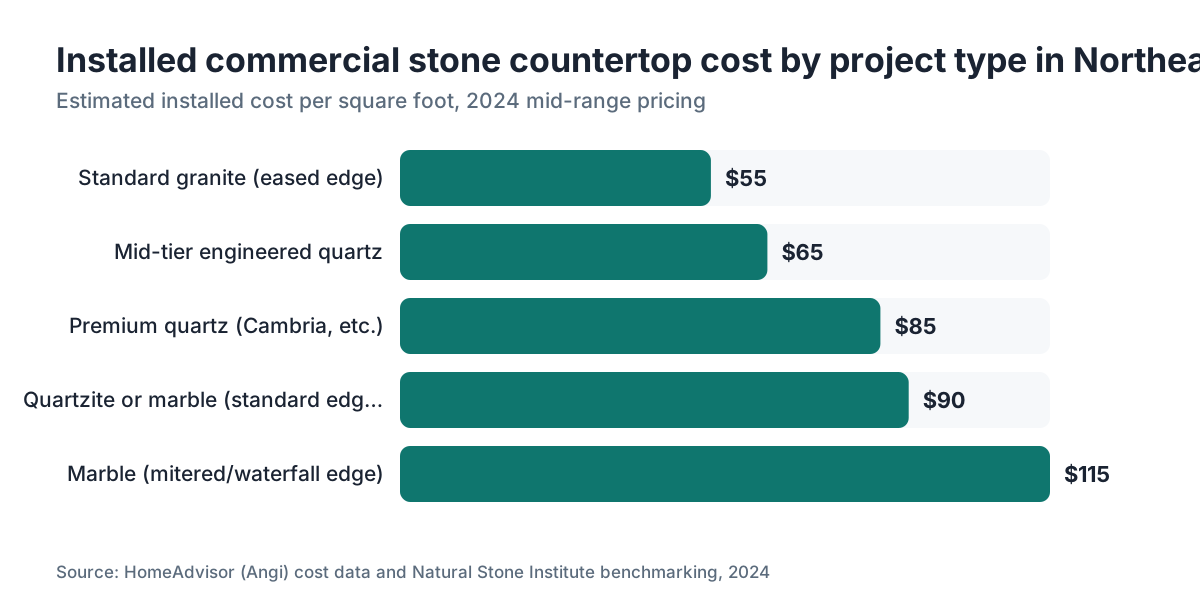
Pricing is the question everyone asks first and the one that varies the most. For Northeast Ohio commercial projects, the realistic installed range runs roughly $40 to $75 per square foot for standard granite or quartz on straightforward jobs, and $80 to $120 or more for premium natural stones, complex edge profiles, mitered waterfall edges, or CNC cutouts that eat real machine time.[2]
Those numbers are per square foot of finished countertop surface, not per square foot of raw slab purchased. Commercial projects get modest volume pricing breaks, but the savings are smaller than people expect because labor is the dominant cost on complex work.
Here's what drives price up fast. Unusual edge profiles (ogee, triple pencil, dupont), backsplashes cut from matching slab rather than tile, integrated drainboards, non-rectangular geometry, and any stone that's hard to fabricate like soft or heavily veined marble. Restaurant clients adding stainless-banded sanitary edges pay more than office clients with simple eased edges.
Material alone for commercial-grade granite slab runs roughly $10 to $35 per square foot at the slab yard in 2024, with engineered quartz slabs typically $20 to $45 depending on brand and pattern.[3] The rest of your installed cost is fabrication labor, edge work, template, delivery, and install.
Get itemized quotes. Any fabricator unwilling to break out material from labor and from installation is hiding margin somewhere, and on a large commercial project that adds up fast.
What stone types are best suited for commercial applications in Ohio?
The answer depends on what you're surfacing. Healthcare and food-service clients, get granite or engineered quartz and stop there. Both score well on hardness (granite is 6 to 7 on Mohs, engineered quartz is 7 or higher), resist most cleaning chemicals used in commercial settings, and take the abuse of high-traffic use.[4]
Hospitality, retail, and office reception have more latitude. Marble is beautiful, and architects specify it constantly for hotel lobbies and high-end reception desks. But marble is calcium carbonate. It etches from acidic cleaners and scratches from grit. If your clients or end users don't understand that and won't seal and maintain it, marble looks rough within two years. A fabricator who talks you out of marble for the wrong application is doing you a favor.
Quartzite (the natural stone, not to be confused with quartz) sits between granite and marble on durability. Some quartzites are genuinely hard and excellent for commercial use. Others test soft and behave more like marble in practice. A good fabricator knows the specific material's test data, more than the generic category name.
Engineered quartz (Silestone, Cambria, MSI Q, and others) has become dominant in commercial healthcare and office projects because it's non-porous by construction, needs no sealing, and looks consistent across lots of slabs. Cambria countertops are made in the US and have a strong commercial specification track record.
For back-of-house or budget commercial jobs, laminate and solid surface still earn their place. Laminate countertops and Corian-type solid surface materials cost a fraction of stone and are easier to repair in the field, which matters in facilities that can't close a surface for repolishing.
How do lead times work for commercial stone projects in Northeast Ohio?
Plan on 2 to 4 weeks from template to install for a well-organized commercial job with a local fabricator who has the material in stock. Add another 1 to 2 weeks if the stone has to be ordered from a distributor. Add more if the project is large enough to require multiple fabrication runs or phased installs.[5]
The single biggest schedule killer is template timing. Commercial template can't happen until the substrate is set, the cabinets or steel supports are secured, and the rough plumbing penetrations are known. On new construction, fabricators can't template until the GC gives access. When that access slips, the fabrication schedule compresses but the install date often doesn't move, and that creates a crunch.
The second killer is change orders. A spec change to a different stone after slabs are ordered, or a field dimension change after templates are cut, can reset lead time by weeks. Experienced commercial fabricators build change order pricing into their contracts for exactly this reason.
For large hospitality or multi-unit projects (hotels, apartment complexes, multi-tenant office builds), the best shops phase fabrication by floor or wing, so the GC can keep moving without waiting for the whole building to be templateable at once. Ask prospective fabricators straight out whether they've done phased installs and how they schedule template crews separately from install crews.
What equipment should a credible Northeast Ohio commercial fabricator have?
This is where you separate the real commercial shops from the residential shops who say yes to everything. A legitimate commercial operation needs a CNC bridge saw or a 5-axis CNC machining center, water recycling systems (Ohio EPA requires proper wastewater handling for stone shops), a calibrated polishing line, and enough forklift and A-frame capacity to move full slabs safely.[6]
CNC capability matters for commercial work because you're doing repeatable production. A shop cutting 200 identical bathroom vanity tops for an apartment building by hand template is going to produce dimensional variation that causes install problems. CNC machines hold tighter tolerances and can run overnight.
Ask to walk the shop floor. A well-run commercial fabrication shop is organized. The slab storage is safe and logical, the machinery is maintained, and the waste stone management is under control. Slabs stacked haphazardly and machines that look like they haven't been serviced in years are a warning sign no matter what the salesperson says.
Fabrication software is increasingly standard at commercial-grade shops. Tools like SlabWise help on the quoting and nesting side, cutting material waste on large jobs by optimizing how pieces lay out across slabs before any blade touches stone. It's fair to ask whether a fabricator uses any digital workflow tools. Shops still doing everything on paper tend to have slower quote turnaround and more estimating errors on complex commercial jobs.
Confirm they carry general liability insurance (minimum $1 million per occurrence is standard, $2 million is better for large commercial work) and workers' compensation. Get certificates before any work begins, not after.
What licenses and regulations apply to stone fabricators in Ohio?
Ohio doesn't require a specific state license to operate a stone countertop fabrication business, but several other regulatory requirements apply.[7]
The biggest one is environmental. Stone fabrication produces silica-containing dust, regulated under OSHA's respirable crystalline silica standard (29 CFR 1926.1153 for construction and 29 CFR 1910.1053 for general industry). OSHA lowered the permissible exposure limit for respirable silica to 50 micrograms per cubic meter of air averaged over an 8-hour shift, effective since 2018.[8] Any commercial shop that dry-cuts stone without proper engineering controls is both an OSHA violation and a worker health liability. Wet-cutting and local exhaust ventilation are the standard controls.
Wastewater from stone polishing carries fine stone particulates and must be settled and handled per Ohio EPA rules before discharge. Most commercial shops run closed-loop water recycling systems to comply.[9]
On the contractor side, commercial installation work in Ohio often requires the installing company to hold a contractor registration with the Ohio Construction Industry Licensing Board (OCILB) depending on scope, and many commercial GCs require fabricators to be registered and bonded before adding them to an approved subcontractor list.[10]
For commercial projects, especially in healthcare or food service, the stone specs may also need to meet building codes, NSF/ANSI standards for food contact surfaces, or specific health department requirements. Your fabricator should know which standards apply to your project type. If they give you a blank look, that's useful information.
How do you qualify and vet a commercial stone fabricator in Northeast Ohio?
Start with a reference list from similar-scope commercial projects, not residential testimonials. Ask for two or three contacts at GCs or property managers who can speak to schedule reliability, communication during problems, and punch list responsiveness. Then actually call them. Most people don't, and then they regret it.
Ask the fabricator for a sample commercial contract and read what it says about change order pricing, lead time commitments, warranty on material and labor, and payment schedule. Standard commercial payment is often 30 to 40% deposit, 40 to 50% at template or delivery, and the balance on completion. Be cautious of shops demanding full payment before install. That removes your only real bargaining power if the job goes sideways.
Get competitive bids, but don't award on price alone. The cheapest bid on a commercial stone job is usually cheap because the shop is buying lower-grade material, underestimating the difficulty, or planning to cut corners on edge work and tolerances. On a 300-square-foot restaurant counter, saving $8 per square foot matters a lot less than the counter being done right the first time.
Ask specifically about experience with your building type. A shop that's done 50 restaurant kitchens knows the NSF surface requirements, the health department inspection process, and how commercial kitchen layouts affect template. A shop that's done 50 apartment complex bathrooms knows phased install scheduling cold. That domain experience is worth paying for.
For large projects, ask whether the fabricator assigns a dedicated project manager. The worst commercial stone jobs go sideways not because of fabrication quality but because nobody owns the schedule and communication between the shop, the GC, and the install crew falls apart.
What questions should you ask when getting a commercial fabrication quote?
A solid quote request covers these points:
Material specification: What exact stone, brand, and finish are you quoting? Get the slab lot number if you can. Stone is natural, and lot variation is real.
Edge profile: What edge is included in base pricing, and what does upgrading to a mitered or ogee edge cost?
Template and field measurement: Is template included or billed separately? Who templates, a shop employee or a sub?
Lead time commitment: From template completion, what's the fabrication-to-install timeline in writing?
Install crew: Who installs, shop employees or independent installers? This matters for accountability.
Warranty: What's covered and for how long? Industry standard is one year on labor. Material defects go back to the manufacturer.
Change order process: What's the markup on change orders, and what triggers a restart of the lead time clock?
Waste and offcuts: On large commercial jobs, who owns the offcut material? Can you buy it back at a discount for future repairs?
For a reference on countertop installation specifics, including what to expect from a professional install crew, that article covers the process in detail.
What are typical project timelines for common commercial stone jobs in Northeast Ohio?
The table below shows realistic end-to-end timelines for common commercial stone project types, assuming template access is ready and material is in stock locally. These aren't guarantees. They're the middle of the range a well-organized shop should be able to hit.
| Project Type | Square Footage Range | Fabrication Lead Time | Total Template-to-Install |
|---|---|---|---|
| Restaurant prep counters (granite) | 100 to 300 sq ft | 1 to 2 weeks | 2 to 3 weeks |
| Office break room / reception desk | 50 to 150 sq ft | 1 week | 1.5 to 2 weeks |
| Hotel vanity tops (multi-unit) | 500 to 2,000+ sq ft | 3 to 6 weeks | 5 to 8 weeks |
| Apartment complex bathrooms (phased) | 1,000 to 5,000 sq ft | 4 to 8 weeks | 6 to 12 weeks |
| Healthcare nurses station / lab | 200 to 600 sq ft | 2 to 3 weeks | 3 to 5 weeks |
| Retail fixture counters | 100 to 400 sq ft | 1 to 2 weeks | 2 to 4 weeks |
Phased multi-unit projects like hotels and apartment complexes have the widest range because the schedule depends heavily on when floors and units become templateable, which is a GC coordination problem as much as a fabrication problem.[11]
How does slab sourcing and inventory work in Northeast Ohio?
Northeast Ohio sits within delivery range of several major stone distributors and slab yards. The primary wholesale slab distributors serving the region include companies with distribution centers in Cleveland and Columbus, plus several that pull from larger hubs in Pittsburgh and Indianapolis.[12]
For commercial projects specifying a particular stone, availability matters. Popular commercial granite colors (Black Galaxy, Absolute Black, Bianco Antico) are almost always in stock at local distributors. Unusual or architect-specified stones may need to be imported from overseas, which adds 4 to 12 weeks and can push costs up hard if the client insists on a rare material.
Some larger Northeast Ohio commercial shops keep their own slab inventory to cut lead times and give clients more control over lot selection. Shops without inventory pull from distributors on order, which is fine for standard materials but risky on exotic specs.
When you tour a potential commercial fabricator's facility, ask to see their slab yard or their relationship with a nearby distributor. A shop that can walk you through a distributor yard and help you pick matched lots for a large hotel project is providing real value beyond cutting stone.
What maintenance obligations come with commercial stone countertops?
This is where commercial clients often get surprised. Natural stone, especially granite and quartzite, needs sealing on a schedule. A penetrating sealer, applied right, repels water and most stains. Frequency depends on the stone's porosity and how much daily abuse the surface takes. A restaurant counter might need resealing annually, while a low-traffic office reception desk can go three to five years.[13]
Engineered quartz needs no sealing. That's a real maintenance advantage for commercial clients who don't want to manage a sealing schedule across 200 apartment units.
Daily cleaning in commercial settings is simpler than most people think. Use a pH-neutral cleaner, avoid anything acidic (vinegar, citrus-based degreasers), and skip abrasive pads. For healthcare, confirm that the disinfectants in use (especially quaternary ammonium compounds) are compatible with the stone and sealer. Some break down sealers over time with repeated use. A reputable fabricator hands over material safety data and cleaning recommendations in writing as part of the closeout package.
If you need to go deeper on maintaining specific stone types after installation, the guides for how to clean stone countertops and how to clean quartzite countertops cover what actually works in practice.
Frequently asked questions
How many commercial stone fabricators are there in Northeast Ohio?
There's no official count, but the Cleveland-Akron metro area has somewhere between 15 and 30 shops with meaningful commercial capability. The number is higher if you include residential shops that take occasional commercial jobs, lower if you restrict it to shops with CNC equipment, commercial crew staffing, and a track record of multi-unit or contractor-driven work. Quality and capacity vary widely.
Do commercial stone fabricators in Ohio require permits for countertop installation?
Countertop installation itself rarely requires a separate permit in Ohio, but the surrounding work often does. Rough plumbing, electrical for pop-ups, and structural modifications need permits. On commercial jobs, the GC typically pulls the relevant permits and the fabricator installs under that umbrella. Confirm with your local building department for the specific jurisdiction, since requirements differ by municipality.
What's the difference between a stone fabricator and a stone supplier?
A supplier (or distributor) sells raw slabs. A fabricator cuts, edges, polishes, and installs finished countertops. Some shops do both, selling slabs and fabricating. For commercial projects you want a fabricator with real production capacity, not a slab reseller who subcontracts the cutting to another shop, because that adds cost and breaks your direct accountability chain.
Can Northeast Ohio fabricators handle large hotel or apartment complex stone projects?
Yes, but not every shop has the capacity. Multi-unit hospitality and residential projects require phased templating and installation, large slab inventory or distributor relationships, multiple cutting and install crews, and project management experience with GC coordination. Ask specifically how many hotel or apartment projects the shop has completed and request references from the GCs on those jobs.
What stone is most commonly specified for commercial restaurant counters in Ohio?
Granite is the standard choice for restaurant prep surfaces because it's hard, heat-resistant, and relatively affordable. Engineered quartz is increasingly specified too, especially for front-of-house surfaces like bars and host stands, because it's non-porous and needs no sealing. Stainless steel still dominates true commercial kitchens, but stone shows up in hybrid spaces and grab-and-go food service environments.
What warranty should I expect from a commercial stone fabricator?
Industry standard is one year on fabrication labor and installation workmanship. Material defects from the stone manufacturer or slab distributor are usually handled separately under the supplier's warranty. Engineered quartz brands like Cambria offer 10-year or lifetime warranties on the material itself. Get the warranty in writing before signing a contract. Verbal warranty commitments are nearly impossible to enforce.
How do I compare commercial stone fabrication quotes fairly?
Make sure every quote specifies the same stone species, grade, and finish; the same edge profile; and the same scope (template, fabrication, delivery, and install). Price per square foot means nothing if one quote includes a simple eased edge and another includes a mitered waterfall. Get quotes broken into line items: material, fabrication, edge work, template, and install. Then compare line by line.
Does silica dust regulation affect which fabricator I should choose?
It should factor into your decision. OSHA's crystalline silica standard (29 CFR 1910.1053) requires engineering controls, exposure monitoring, and a written exposure control plan. A fabricator in compliance has wet-cutting systems, local exhaust ventilation, and proper respiratory protection in place. One who isn't in compliance is creating worker health risk and regulatory liability that could delay your project if OSHA cites them during your job.
Can a commercial stone fabricator also supply and install stone for healthcare facilities in Ohio?
Yes. Healthcare is one of the more common commercial stone markets in Northeast Ohio, with hospital systems and outpatient clinic construction being active. Fabricators serving healthcare need to know NSF and infection control requirements, use non-porous stone or engineered quartz for clinical surfaces, and coordinate installs during off-hours to avoid disrupting patient areas. Not all commercial fabricators have healthcare experience, so ask directly.
What should the payment schedule look like for a commercial stone project?
A standard commercial payment structure is 30 to 40% deposit at contract signing, 40 to 50% due at template or material delivery, and the remaining 10 to 20% on completion and sign-off. Avoid any shop that demands 100% upfront. That strips away your bargaining power if installation quality is poor or the schedule slips. Large projects over $50,000 sometimes use AIA-style progress billing tied to GC payment schedules.
How far will Northeast Ohio commercial stone fabricators travel for installation?
Most Cleveland and Akron-area commercial fabricators will work anywhere within a roughly 60 to 90 mile radius without a significant travel surcharge. That covers most of Northeast Ohio and extends into parts of Western Pennsylvania. Projects beyond that range typically incur travel and per diem charges, or you may be better served sourcing a local fabricator closer to the project site.
Is engineered quartz or natural granite better for a commercial office project?
For most commercial office applications, either works well. Engineered quartz wins on consistency (matched lots across a large project look identical, natural granite varies) and on zero maintenance since it needs no sealing. Granite wins on cost at the lower price tiers and on the visual appeal of natural variation if the design calls for it. For office break rooms with food prep, the non-porous nature of quartz is a practical advantage.
What's a realistic budget for a commercial stone countertop project in Northeast Ohio?
For a standard office break room or reception area in the 50 to 100 square foot range, budget $4,000 to $8,000 installed with granite or mid-tier quartz. A restaurant counter in the 150 to 250 square foot range runs $8,000 to $20,000 depending on stone and edge complexity. Large multi-unit projects scale to six figures. Get itemized bids. The per-square-foot number alone gives you false confidence on complex commercial scopes.
Sources
- U.S. Census Bureau, County Business Patterns: Business concentration data by county for fabricated stone product establishments in Cuyahoga, Summit, and Stark Counties in Ohio
- HomeAdvisor (Angi), Cost of Stone Countertops: Installed stone countertop cost ranges of $40, $120 per square foot depending on material and complexity
- Natural Stone Institute, Stone Industry Benchmarking Report: Wholesale slab costs for commercial-grade granite and engineered quartz in the $10, $45 per square foot range
- Marble Institute of America / Natural Stone Institute, Dimension Stone Design Manual: Mohs hardness ratings for granite (6 to 7) and engineered quartz (7+) and suitability for commercial high-traffic applications
- Associated General Contractors of America, Construction Project Scheduling Guidance: Commercial specialty trade lead time norms and template-to-install scheduling ranges for stone subcontractors
- Ohio Secretary of State, Business Licensing and Registration: Ohio does not require a specific state fabrication license for stone countertop shops; general business registration requirements apply
- OSHA, Occupational Exposure to Respirable Crystalline Silica (29 CFR 1910.1053 and 1926.1153): OSHA's permissible exposure limit for respirable crystalline silica is 50 micrograms per cubic meter of air averaged over an 8-hour shift, effective 2018
- Marble Institute of America, Commercial Fabrication and Installation Guidelines: Typical phased commercial stone installation timelines for hotel and multi-unit residential projects
- Natural Stone Institute, Distributor Directory: Stone slab distributor locations and regional coverage for the Northeast Ohio and greater Midwest market
- Natural Stone Institute, Care and Maintenance of Natural Stone: Recommended sealing frequency for commercial granite surfaces ranges from annually for high-traffic food service to every 3 to 5 years for low-traffic applications
Last updated 2026-07-09