TL;DR
- Stone fabricators in and near Palo Alto cut, edge, and install countertops from granite, quartz, marble, and other slabs.
- Installed prices typically run $50 to $150 per square foot depending on material and complexity.
- The Bay Area market is competitive but premium-priced.
- This guide covers how to find a good shop, what to ask, how pricing works, and what fabricators themselves need to run a tight operation.
What does a stone fabricator actually do?
A stone fabricator is the shop that takes a raw slab and turns it into a finished countertop. That means templating your kitchen (measuring every inch of the space), cutting the slab to shape with a CNC bridge saw or waterjet, grinding the edges to whatever profile you chose, cutting sink and cooktop holes, and then sending a crew to your home to install the pieces.
It sounds simple. It's not. A single slab of granite or quartzite can weigh 700 to 1,000 pounds [1]. Moving it, positioning it on a vacuum-lift table, and making precise cuts within a sixteenth of an inch while accounting for the fact that no kitchen wall is truly square takes real skill and equipment.
The fabricator is different from the slab yard (also called a stone wholesaler or distributor), though many shops have a slab yard attached or a strong buying relationship with one nearby. When you're shopping in Palo Alto, you'll often visit a showroom where sample slabs are displayed, then get sent to a nearby yard in San Jose, South San Francisco, or elsewhere in the Bay Area to choose your specific slab before the shop does the work.
For kitchen countertops specifically, the fabricator's precision in cutting around corners, peninsulas, and appliance cutouts is where quality really shows.
Where are stone fabricators located near Palo Alto?
Palo Alto itself (population roughly 68,000) [2] is a dense residential and commercial city with very little industrial zoning. Stone fabrication shops need loading docks, overhead cranes, and space for CNC equipment, so most of the actual cutting happens in shops located in the surrounding South Bay and Peninsula industrial corridors: San Jose, Santa Clara, Milpitas, South San Francisco, and Hayward are the most common clusters.
What this means practically: a 'Palo Alto stone fabricator' is often a company headquartered or showroomed near Palo Alto but running its fabrication floor ten to twenty miles away. That's normal. The templater drives to your home, takes measurements (digitally now at most modern shops), and the cutting happens at the plant. Installation crews return a few days to two weeks later.
If you want to see your slab before it's cut, which you should, ask which slab yard the fabricator sources from and plan a trip there. Major wholesale slab distributors in the Bay Area include yards in Milpitas, South San Francisco, and San Jose where you can walk slabs and mark the specific section you want cut from your stone.
The Bay Area also has several showrooms and design centers built for the high-end residential market Palo Alto sits firmly in. These showrooms often carry imported Italian marble, Brazilian quartzite, and exotic granite that you won't find at a standard big-box retailer.
What does stone fabrication cost in the Palo Alto area?
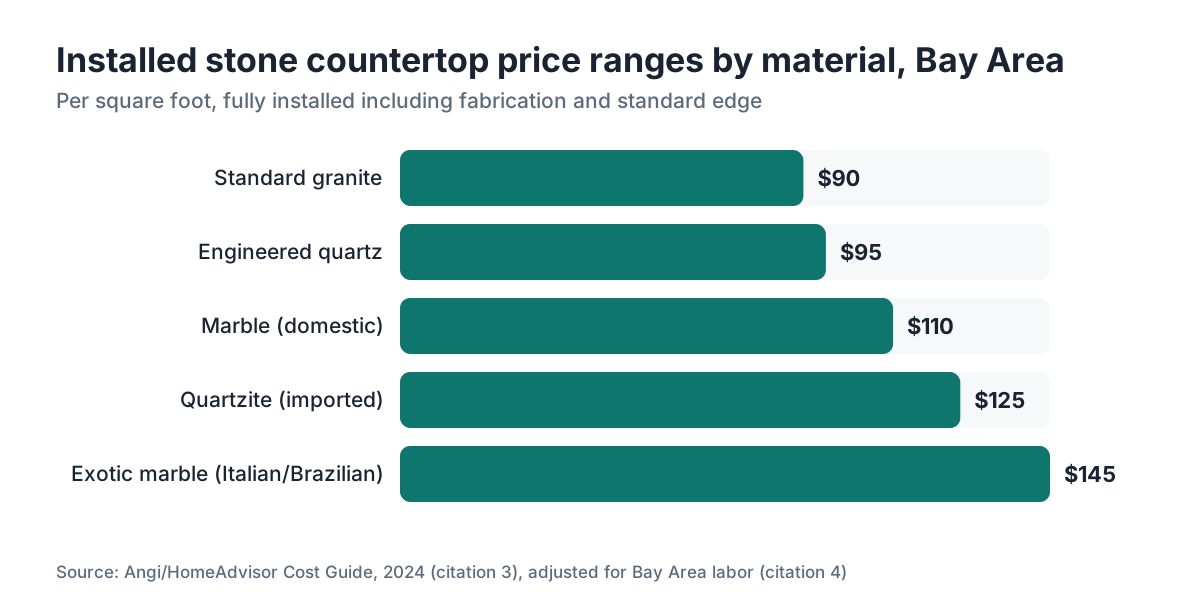
Bay Area stone fabrication pricing runs higher than the national average. Nationally, installed granite countertops average around $40 to $100 per square foot; in the San Francisco Bay Area, expect $60 to $150 per square foot all-in depending on material, edge profile, and complexity [3].
Here's a rough breakdown of what drives the number up or down:
| Factor | Lower cost | Higher cost |
|---|---|---|
| Material | Granite, standard quartz | Exotic quartzite, bookmatched marble |
| Edge profile | Eased or straight | Ogee, waterfall, full bullnose |
| Layout complexity | One straight run | L-shape, island, multiple pieces |
| Sink cutout | None or simple undermount | Farmhouse apron or double bowl |
| Slab grade | Remnant or builder grade | Premium imported single-origin slab |
Labor in Santa Clara County runs high because of the local cost of living [4]. Fabrication shop wages for skilled CNC operators and installers in the Bay Area routinely run $30 to $55 per hour [5], and that labor cost passes through to the consumer.
For granite countertops, mid-range installed prices in this market typically land between $70 and $110 per square foot. For imported marble countertops, budget $90 to $150 or more.
Remnant slabs (leftover pieces from previous jobs, often enough for a bathroom vanity or small kitchen) are one of the best ways to get quality stone at a discount. Ask any local fabricator directly. Most have a remnant pile they'll sell at steep reductions, sometimes 30 to 50 percent below full-slab pricing.
How do you evaluate a stone fabricator before hiring?
The California Contractors State License Board (CSLB) licenses stone installation contractors under the C-54 (Ceramic and Mosaic Tile) or C-61/D-12 (Synthetic Products) classifications depending on the material, and general B-license contractors who perform countertop work [6]. Before you pay a deposit, look up the contractor's license on the CSLB license search tool [6]. It's free, takes thirty seconds, and tells you whether the license is active, whether the bond is current, and whether there are any disciplinary actions on record.
Beyond the license check, here's what actually separates good fabricators from mediocre ones:
Templating method matters. Digital templating (using a Prodim Proliner or similar laser-based tool) produces far more accurate templates than cardboard or wood strips. A fabricator still using cardboard templates in 2025 is not running a modern shop.
Ask to see the shop floor. A well-run fabrication shop is organized, has slabs stored safely on A-frame cradles, and has visible quality control practices. A chaotic shop usually means chaotic work.
Check references from jobs similar to yours. A shop that mainly does commercial or builder-grade work may not have the eye for a custom residential project with a premium slab.
Get at least three quotes and make sure they're comparing the same scope: same material grade, same edge, same number of cutouts, same removal of existing countertops if applicable. Bay Area pricing varies enough that the spread between a low and high quote for an identical project can be $2,000 or more.
Deposits of 50 percent are standard in the fabrication industry. Be wary of any shop demanding full payment before installation.
What materials do Palo Alto area fabricators work with?
Most full-service stone fabricators in the area cut and install all of the major hard surface materials.
Granite is still one of the most common residential choices, durable and available at many price points. Quartzite (not to be confused with quartz) is a metamorphic natural stone that gets a lot of attention in the Bay Area luxury market for its dramatic veining; see the full care guide on how to clean quartzite countertops. Quartz (engineered stone from brands like Cambria, Silestone, and Caesarstone) makes up a large share of new installations because it barely needs maintenance. Cambria countertops in particular have significant presence in the Bay Area market.
Marble is popular in Palo Alto's high-end kitchen and bath market despite requiring more maintenance than other materials. Soapstone, with its matte finish and resistance to heat, appeals to a specific buyer; if you go that route, the care guide on how to clean soapstone countertops is worth reading before you commit.
Fabrication shops generally do not work with laminate or solid-surface materials like Corian because those are cut with different tools and installed by different trades. If you're considering laminate countertops or Corian countertops, you'd typically work with a separate specialty installer or a cabinet shop that does surface work.
Some Palo Alto area shops have expanded into porcelain slab countertops, which require diamond tooling and special handling because the material is extremely hard and brittle. It's a growing category but still handled by fewer shops than granite or quartz.
What questions should you ask a stone fabricator before signing?
Walk into any quote conversation with these specific questions. The answers tell you a lot.
'Do you fabricate in-house or subcontract the cutting?' Some showroom-only operations take your deposit and farm the fabrication to a third-party shop. That's not always bad, but you deserve to know.
'What is your standard lead time from deposit to installation?' In the Bay Area market, four to six weeks is typical for a custom job. Anything under two weeks for a non-remnant project deserves skepticism unless the shop has confirmed slab availability.
'What templating method do you use?' Digital is the right answer for any job above basic builder-grade work.
'What edge profiles are included in the quoted price, and which cost extra?' Eased and straight edges are often included; ogee, mitered waterfall, and complex profiles add $10 to $30 per linear foot or more.
'What is your warranty and what does it cover?' Most fabricators offer a one-year workmanship warranty on installation. Stone itself carries no manufacturer warranty because it's a natural material.
'Who pulls the permits if required?' In Santa Clara County, countertop-only replacements generally don't need a building permit, but if you're doing a full kitchen remodel that changes the layout, permits become the contractor's or general contractor's responsibility [7].
'What happens if the slab breaks during installation?' This is rare but it happens. Know upfront who absorbs the cost of a replacement slab: you, the fabricator, or their insurance.
How does the stone fabrication process work from start to finish?
Here's the real sequence, so you know what to expect.
First, you select your material and get a quote. This is often done at a showroom or via an in-home consultation. The quote should cover templating, fabrication, edge work, cutouts, and installation as a package, more than the cutting.
Second, you choose your actual slab. For premium materials, this means going to a slab yard and marking the specific slab (or the specific section of a slab) you want. Bring photos of your kitchen and a paint chip. Lighting at a slab yard is different from your kitchen; slabs look different once installed.
Third, a templater comes to your home, usually after you've signed and paid a deposit. If you're replacing existing countertops, the old ones are often removed the day of templating or the day before. Your kitchen will be without countertops and typically without a working sink for however long fabrication takes.
Fourth, the slab is cut at the shop. CNC equipment handles the rough cuts and waterjet or CNC routers handle sink holes and complex shapes. Edge polishing runs on a separate polishing machine.
Fifth, the installation crew arrives, typically two to four people for a kitchen. They dry-fit pieces, check for gaps, apply adhesive, seam pieces together using color-matched epoxy, and bolt the countertop to the cabinet substrate. The sink gets undermounted at this stage too.
Finally, sealing. Natural stone (granite, marble, quartzite, soapstone) needs sealing before use and periodically after. Engineered quartz does not. Many fabricators include the initial seal; ask before assuming.
For a full overview of what the installation day looks like, the countertop installation guide covers every stage in detail.
Are there supply chain or sourcing issues affecting Bay Area stone shops?
Yes, and they've been persistent since 2020. Natural stone is an internationally traded commodity. Granite comes primarily from Brazil, India, and China; marble from Italy, Turkey, and Spain; quartzite from Brazil [8]. When shipping costs spike or port congestion backs up, slab availability in Northern California yards gets tight.
The Port of Oakland is the primary West Coast gateway for stone imports from Asia and Brazil [9]. Container shipping rates, which hit historic highs in 2021 and 2022, have moderated since but remain above pre-pandemic baselines [10]. The practical effect for a Palo Alto homeowner: certain exotic slabs may have longer lead times (eight to twelve weeks) if your chosen stone isn't in stock at a local yard.
Domestically quarried stones (some granites from Vermont and Georgia, domestic quartzite) have shorter supply chains but narrower selection. Engineered quartz from brands like Caesarstone (manufactured partly in the U.S.) and Cambria (made in Minnesota) [11] has more predictable availability because it's made domestically from ground quartz mixed with resin.
The silica dust hazard in fabrication shops has also reshaped the industry. California's Division of Occupational Safety and Health (Cal/OSHA) adopted rules tightening permissible silica exposure limits for stone workers, matching the federal OSHA standard of 50 micrograms per cubic meter as an eight-hour TWA [12]. Shops that invested in wet cutting, dust collection, and proper respiratory protection have stayed compliant; others have faced citations. When you're vetting a local fabricator, it's reasonable to ask how they handle silica dust control. A shop that takes worker safety seriously tends to run a tighter operation overall.
Shops running modern quoting and job-management software tend to handle supply chain complexity better because they can track slab inventory, flag long-lead materials early, and communicate lead times accurately to homeowners. SlabWise, for example, is built specifically for stone fabrication shops and includes slab-level job tracking that helps shops avoid surprises when a slab doesn't arrive as scheduled. (Fabricators curious about that can request a demo at slabwise.com.)
What does the Bay Area silica dust regulation mean for fabricators?
California's Cal/OSHA enforcement of silica rules is real and active. The federal OSHA silica standard for construction, published in 2016 at 29 CFR 1926.1153, set an action level of 25 micrograms per cubic meter (8-hour TWA) and a PEL of 50 micrograms [12]. California adopted equivalent rules. As OSHA's own guidance states, "Workers who breathe crystalline silica over many years can develop silicosis, a disabling and potentially fatal lung disease" [12].
For fabricators, this means wet cutting is no longer optional as a best practice: it's the standard. Shops should have local exhaust ventilation on grinding and polishing stations, HEPA-filtered vacuums, and N95 or higher respirators available to workers during dry processes. Air monitoring and written exposure control plans are required above the action level.
This has driven some smaller shops out of business (compliance costs are real) and pushed others to upgrade equipment. Engineered quartz slabs containing up to 90 percent crystalline silica have come under particular scrutiny; several countries have moved toward restricting high-silica engineered stone. Australia effectively banned engineered stone with greater than 1 percent silica content in 2024 [13]. California and the U.S. have not gone that far yet, but California's Division of Occupational Safety and Health has increased inspections of stone fabrication shops.
For homeowners, this background matters because it tells you something about which shops are well-run. A shop that has modernized for dust control has usually modernized its equipment across the board.
How do fabricators price jobs, and how can you negotiate?
Fabricators price by the square foot of finished surface, with add-on line items for edges, cutouts, removal, and travel. The square footage calculation includes the full rectangular bounding box of the countertop pieces before cutouts are removed (this is standard in the industry; you pay for the stone that gets cut away because the shop can't use that waste efficiently).
Edge linear footage adds to the base price. A standard kitchen might have 15 to 25 linear feet of exposed edge. At $10 to $30 per linear foot for a complex profile, that's $150 to $750 in edge charges alone.
Sink cutouts typically run $100 to $250 per sink opening. Cooktop cutouts are similar. Faucet holes are often $25 to $50 each.
Removal and disposal of old countertops runs $150 to $400 depending on material and size.
Where can you actually negotiate? Material grade: going one tier down in a slab series often saves 15 to 25 percent with no visible quality difference once installed. Remnant slabs for secondary surfaces (laundry rooms, bar tops, powder room vanities) are much cheaper. Edge profile: sticking with an eased or straight edge instead of an ogee saves money and actually looks cleaner in modern kitchens. Off-peak scheduling: some shops offer small discounts for mid-week or slow-season installs.
What you cannot really negotiate: labor rates, disposal fees, or material cost on in-demand exotic slabs. The Bay Area has enough high-budget buyers that a fabricator doesn't need to discount to stay busy.
What are the differences between stone fabricators, stone yards, and big-box stores?
These three are different businesses that homeowners frequently confuse.
A stone yard (distributor or importer) stocks and sells raw slabs. They generally don't fabricate anything. You go there to pick your material, then either bring a fabricator with you or have the fabricator order from them directly. Most yards sell to fabricators at wholesale and to the public at retail (which is usually 10 to 30 percent higher than what a fabricator pays).
A stone fabricator cuts, edges, and installs. Many have a small in-house slab selection or partnerships with specific yards, but their core business is labor and equipment, not slab inventory.
A full-service stone company does both: they carry slabs and they fabricate and install. This is the most common model for mid-to-high-end shops in the Bay Area, and it simplifies the buying process for the homeowner.
Big-box stores like Home Depot and Lowe's offer countertop installation services, but they subcontract the actual fabrication to third-party shops. The advantage is price certainty and a single point of contact; the disadvantage is limited slab selection, less flexibility on edge profiles, and the reality that you don't get to choose which fabrication shop does your work. For standard materials in straightforward layouts, big-box can work fine. For premium slabs, complex jobs, or any stone where the specific section of slab matters visually (like a dramatic veined marble), a specialty fabricator is worth the extra cost.
For materials like butcher block countertops or formica countertops, neither a stone yard nor a stone fabricator is the right call. Those require different specialists entirely, and you should learn how to clean stone countertops before committing to any natural material.
How should a stone fabrication shop in Palo Alto operate to stay competitive?
This section is for shop owners and fabricators, not homeowners. Feel free to skip it if that's not you.
The Bay Area market is lucrative but punishing for shops that underestimate their costs. Labor is the dominant expense: a four-person installation crew in Santa Clara County running at $35 to $50 per hour per person burns $140 to $200 per hour in the field. A two-hour install that runs four hours because of a measurement error costs the shop real money.
Accurate quoting is the foundation of a healthy margin. Shops that quote from memory or gut feel consistently either leave money on the table or win jobs they should have priced higher. Quoting software purpose-built for stone fabrication automates the square footage calculation, applies material markups, and generates professional PDFs that homeowners can sign digitally. SlabWise is one option built specifically for this industry, handling quoting and nesting (optimizing how slabs are cut to minimize waste) in a single tool. Shops that want to see how it works can request a demo at slabwise.com.
Nesting matters more than most small shops realize. Bay Area slab prices mean that wasting even a quarter of a slab on poor layout planning can erase the margin on an entire job. A job that nets $800 in profit on a $3,500 quote disappears fast when you've over-cut an expensive quartzite slab.
Marketing in this market rewards before/after photography (Instagram and Houzz are where Bay Area homeowners discover fabricators), Yelp and Google reviews (the market researches heavily), and relationships with Palo Alto and Peninsula kitchen designers and contractors who recommend fabricators repeatedly.
Cal/OSHA compliance is not optional and getting caught short is expensive. The cost of a proper wet saw, dust collection, and air monitoring is far less than a citation and corrective action costs.
Frequently asked questions
How much does stone countertop fabrication cost in Palo Alto?
Installed stone countertops in the Palo Alto area typically run $60 to $150 per square foot depending on material, edge complexity, and number of cutouts. Standard granite is on the lower end ($70 to $110 installed), while imported marble or exotic quartzite can reach $130 to $150 or more. Bay Area labor costs push prices above the national average of $40 to $100 per square foot.
Do stone fabricators near Palo Alto work with quartz as well as natural stone?
Yes. Most full-service fabricators in the area cut and install both natural stone (granite, marble, quartzite, soapstone) and engineered quartz from brands like Caesarstone, Silestone, Cambria, and MSI. The fabrication equipment and techniques differ slightly, but nearly every established shop handles both. Some also work with porcelain slabs, though that's a smaller specialty.
How long does a stone countertop project take from start to installation?
Plan on three to six weeks for a typical custom project from the time you sign a contract. Templating happens within a week or two of signing, then fabrication takes one to two weeks, then installation is scheduled. If your chosen slab is in stock locally, timelines compress. Rare or imported materials that need to be ordered can push timelines to eight to twelve weeks.
What license should a stone fabricator in California have?
Check the California Contractors State License Board (CSLB) at cslb.ca.gov. Most stone countertop installers operate under a Class B general building contractor license or a C-54 specialty license. An active license means the contractor is bonded and insured. Never pay a deposit to an unlicensed contractor; in California that can void your consumer protections.
Can I visit the slab yard to pick my exact stone?
Yes, and you should. For any premium natural stone where veining and color matter, visiting a slab yard to choose your specific slab is strongly recommended. Ask your fabricator which yards they buy from and arrange a visit before signing. Mark your chosen slab with chalk or a sticker so the section you want is the one that gets cut.
Do stone fabricators near Palo Alto remove old countertops?
Most offer removal as an add-on service, typically priced at $150 to $400 depending on how much material needs to come out and how difficult demolition is. Laminate countertops are easier to remove than existing stone. Confirm this is in the quote, because some shops price fabrication and installation only and leave demolition to you or a separate contractor.
What is the silica dust risk from stone fabrication, and should I be concerned?
Silica dust is a serious occupational hazard for fabrication workers, not for homeowners receiving a finished countertop. OSHA and Cal/OSHA enforce exposure limits for workers in cutting shops. Reputable Bay Area fabricators use wet cutting and proper ventilation to stay compliant. As a homeowner, asking about a shop's dust control practices is a reasonable proxy for how well-run the overall operation is.
Are remnant slabs a good deal in the Bay Area?
Remnants can be excellent value. They're leftover pieces from previous jobs, often sold at 30 to 50 percent below full-slab pricing. A remnant is perfect for a bathroom vanity, bar top, laundry room, or small kitchen island. Ask every local fabricator directly; most have a remnant inventory they don't actively advertise but will show you on request.
What edge profiles are available and how do they affect price?
Common profiles include eased (slightly softened square edge), bevel, bullnose, ogee, and mitered waterfall. Eased and straight edges are often included in the base quote. Complex profiles like ogee or full waterfall add $10 to $30 per linear foot. A kitchen with 20 linear feet of exposed edge and an ogee profile could add $200 to $600 to the total cost compared to a straight edge.
How do I find reputable stone fabricators near Palo Alto?
Start with the CSLB license lookup to verify any contractor. Then check Houzz and Google reviews specifically for stone or countertop work in Santa Clara County or the Peninsula. Ask any kitchen designer or general contractor you're working with for fabricator referrals; those trade relationships are reliable because designers stake their own reputation on the sub they recommend. Get at least three quotes.
Do I need a permit to replace countertops in Palo Alto?
A like-for-like countertop replacement in an existing kitchen generally does not require a building permit from the City of Palo Alto. If you're reconfiguring the kitchen layout, moving plumbing, or doing work that touches structural elements as part of a larger remodel, permits apply to that broader scope. Confirm the specifics with the City of Palo Alto Building Division before starting any remodel work.
What is digital templating and why does it matter?
Digital templating uses laser-based devices (like the Prodim Proliner) to capture exact measurements of your kitchen walls, corners, and existing cabinet positions. The data transfers directly to CNC cutting equipment, reducing human transcription errors. It typically produces cuts accurate to within one millimeter. Shops still using cardboard templates introduce more opportunity for error, which shows up as gaps, unlevel seams, or misaligned cutouts.
Is engineered quartz or natural stone better for a Palo Alto kitchen?
Neither is universally better; it depends on your priorities. Natural stone is unique, heat-resistant (especially granite and quartzite), and can be repaired if chipped. Engineered quartz is non-porous, requires no sealing, and has consistent color throughout the slab. In a busy household with kids, quartz is more forgiving. For a high-end aesthetic with dramatic veining, natural stone is hard to beat and is what most Palo Alto luxury kitchen projects use.
Can stone fabricators do outdoor kitchen countertops in the Bay Area?
Some can. Granite and quartzite are the most suitable natural stones for outdoor applications because they handle temperature swings and UV exposure better than marble. Engineered quartz generally performs poorly outdoors long-term because the resin binders degrade under UV exposure. If you're doing an outdoor kitchen, confirm explicitly that the shop has experience with outdoor installations and that your chosen material is appropriate.
Sources
- OSHA, 'Stone Fabrication: Crystalline Silica': Stone slabs used in countertop fabrication are heavy and contain crystalline silica; OSHA guidance covers stone fabrication hazards including material handling.
- U.S. Census Bureau, City of Palo Alto QuickFacts: Palo Alto, California population is approximately 68,000.
- HomeAdvisor / Angi, 'Countertop Installation Cost Guide': Installed stone countertop costs nationally average $40 to $100 per square foot; premium Bay Area markets run higher.
- U.S. Bureau of Labor Statistics, 'Occupational Employment and Wages, Santa Clara County': Labor wages in Santa Clara County are among the highest in California and the U.S., directly affecting fabrication and installation costs.
- U.S. Bureau of Labor Statistics, 'Tile and Stone Setters' Occupational Employment Statistics: Skilled stone installation and CNC operator wages in the Bay Area run in the $30 to $55 per hour range.
- City of Palo Alto Building Division, Permit Requirements: Like-for-like countertop replacements generally do not require a City of Palo Alto building permit; permits apply to structural or layout changes.
- U.S. Geological Survey, 'Stone, Crushed and Dimension' Mineral Commodity Summary: Natural stone for countertops is imported primarily from Brazil, India, China, Italy, and Turkey; supply chain disruptions affect U.S. availability.
- Port of Oakland, Trade Statistics: The Port of Oakland is the primary West Coast gateway for stone slab imports from Asia and South America to Northern California.
- Cambria, Manufacturing and Company Overview: Cambria engineered quartz is manufactured in Le Sueur, Minnesota, giving it more predictable domestic supply availability.
Last updated 2026-07-09