TL;DR
- A national commercial stone fabricator is a company with fabrication shops, distribution, and installation crews across multiple states, able to run large-volume or multi-site stone projects under one contract.
- They serve general contractors, developers, and property managers on jobs from 50-unit apartment buildings to full hotel renovations.
- Commercial pricing runs 15-40% below retail because volume drives every cost down.
What is a national commercial stone fabricator?
A national commercial stone fabricator is a stone processing company with physical fabrication capacity in more than one region, usually tied together under one sales and project management structure. That matters because a multi-site hotel chain, a national apartment developer, or a hospital system building in five states cannot manage a separate local shop in each city. They need one purchase order, one warranty, and one throat to choke if something goes wrong.
The word 'national' gets used loosely. Some companies own a genuine network of shops. Others broker the work through vetted regional partners, keeping quality control and project management central. Both models work. They are not the same thing, and the difference matters when you're deciding who carries liability for a bad install in Denver.
Commercial stone work is a different animal from residential in volume, specification complexity, and how the work gets bought. A general contractor on a 200-unit apartment complex might need 800 countertop slabs cut to spec and delivered on a rolling schedule tied to the construction timeline, not all at once. A national fabricator builds the whole business around that kind of demand [1].
For fabricators reading this: the commercial side runs on tighter margins than residential but higher absolute revenue per project. The tradeoff is more administrative overhead, longer payment cycles, and much higher bonding and insurance requirements.
What types of projects do national commercial fabricators handle?
The project list is broader than most people assume. Here are the main categories:
| Project Type | Typical Stone Scope | Common Materials |
|---|---|---|
| Multifamily / Apartment | Kitchen and bath countertops, lobby surfaces | Engineered quartz, granite, porcelain |
| Hotel renovation | Guest bath vanities, lobby cladding, bar tops | Marble, quartzite, quartz, travertine |
| Hospital / Healthcare | Nurse stations, break rooms, public restrooms | Non-porous quartz (code-driven) |
| Office build-out | Reception desks, kitchen counters | Quartz, granite |
| Restaurant / Hospitality | Bar tops, server stations, host stands | Granite, butcher block, marble |
| Retail / Mixed-use | Display counters, feature walls | Porcelain panels, engineered stone |
Multifamily is the single biggest volume driver. The National Multifamily Housing Council reported that roughly 440,000 new apartment units were completed in the US in 2023, nearly all requiring countertop installation [2]. Even at a modest four linear feet per unit, that's a lot of stone.
Healthcare is a growing segment, largely because infection control rules in many states push designers toward non-porous quartz at nurse stations and patient rooms. The Centers for Disease Control has published guidance on surface materials in healthcare settings, and quartz's non-porous surface fits those standards [3].
Hospitality is where you see the most design complexity. A lobby feature wall in bookmatched marble needs precise digital templating, matched slab selection, and careful logistics. Not every fabricator can pull it off.
How does pricing work for national commercial stone projects?
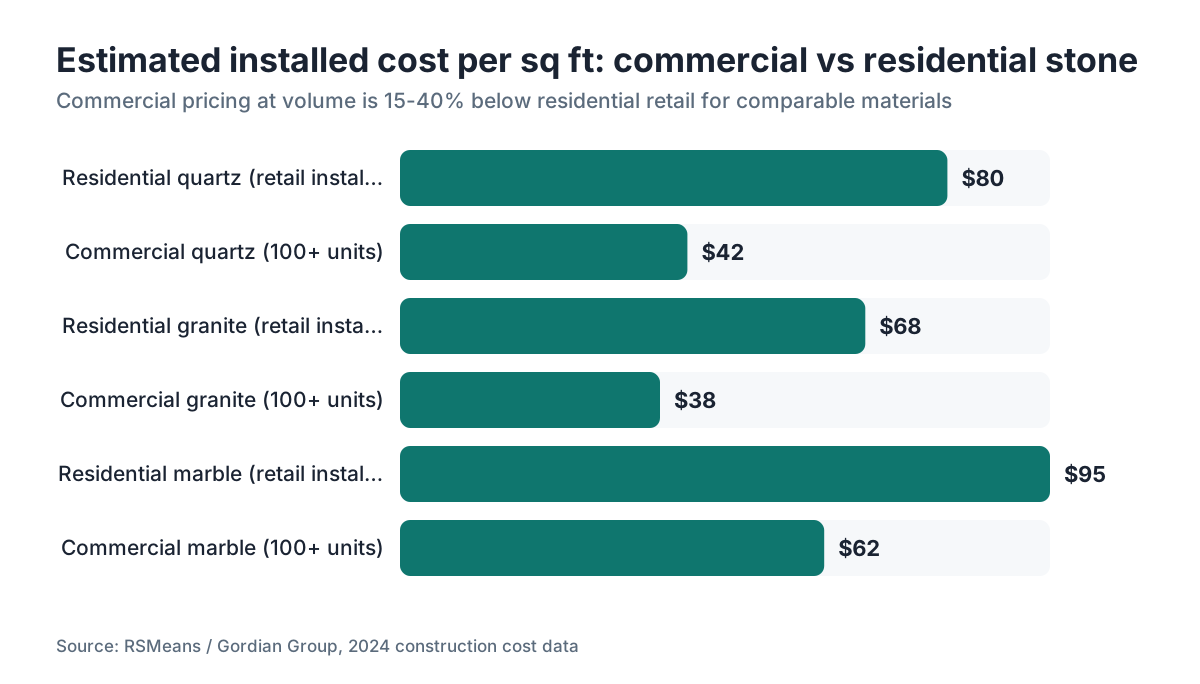
Commercial stone pricing works on a per-square-foot basis, but with very different assumptions than residential retail. A homeowner paying $75 per square foot installed for quartz is covering overhead, showroom cost, small-batch labor, and retail margin. A developer on a 300-unit project pays something closer to $28-$55 per square foot installed for a similar quartz product, depending on specification, region, and volume [4].
Those savings come from real mechanisms. Slabs get bought at distributor or importer pricing, not dealer retail. The repetitive nature of commercial work (same edge, same thickness, same dimension repeated hundreds of times) lets shops optimize CNC cutting paths and cut waste. Installation runs in continuous stretches instead of individual appointments, which drops mobilization cost per unit.
The tradeoff is specification compliance. Commercial projects run on submittal documents, shop drawings, and approved product lists. The fabricator matches an architect's specified material exactly, or files a formal substitution request. That administrative work costs real money, and it's baked into commercial pricing.
Payment terms are almost always net-30 or net-60 from invoice, not the upfront deposit model residential shops use. A fabricator doing $5 million in commercial work carries heavy accounts receivable. Factoring fees or a business line of credit to bridge that gap can add 1.5-3% to the effective cost of doing business [5].
For kitchen countertops in residential projects, prices sit well above these commercial benchmarks, and the buying process is entirely different.
How do national commercial fabricators handle multi-site projects?
Multi-site logistics are the real test of whether a 'national' fabricator is actually national or just national in the marketing.
A genuine multi-site operation usually runs like this: a developer awards a master purchase agreement covering all sites. The fabricator assigns a national account manager who coordinates with regional project managers at each shop. Stone gets sourced centrally to keep it consistent across sites, then distributed to regional fabrication points. Crews local to each job site handle installation, which keeps travel and per-diem costs down.
The consistency problem is harder than it sounds. Natural stone varies by quarry batch. If a hotel chain wants the same granite countertop in Atlanta, Phoenix, and Minneapolis, the fabricator either stockpiles enough matched stone from a single lot or specs an engineered product (quartz, porcelain) where batch consistency is tighter. Most large commercial projects default to engineered stone partly for this reason [6].
Scheduling is the other headache. Construction timelines slip. The fabricator who can flex delivery by two weeks without chaos has a real edge. National fabricators keep more slab inventory than small shops precisely to absorb schedule changes without scrambling for material.
Some national players run a hub-and-spoke model: one large central facility does the cutting, and regional distribution centers handle local delivery and installation. That works for highly repetitive projects (same countertop, 400 times). It works less well for complex or design-forward work.
What materials do national commercial fabricators typically stock?
Volume commercial projects lean on a short list of materials, for practical reasons.
Engineered quartz is the dominant surface in commercial interiors right now. Silestone, Caesarstone, and Cambria all run dedicated commercial programs with volume pricing, large slab formats, and consistent batching. Cambria countertops carry NSF certification relevant to food service applications, which helps in restaurant and healthcare work.
Granite still shows up all over multifamily because it prices competitively and holds up well in rental units. Popular commercial granites (Venetian Gold, Santa Cecilia, Uba Tuba) sit in large stock quantities at major distributors. See more on granite countertops for material specifics.
Porcelain panels are growing fast, especially for lobby cladding and feature walls. Large-format porcelain (up to 126 by 63 inches) covers more area per piece, which cuts seam count and installation time. The Tile Council of North America tracks installation standards for large-format tile that apply here [7].
Marble countertops turn up in hotel lobbies and high-end restaurants but rarely in standard multifamily, because of maintenance cost. Marble needs sealing and etches from acids, a real problem in rental units where maintenance is inconsistent.
Quartzite, butcher block, soapstone, and specialty materials appear occasionally but aren't staples. They get specified for one design feature, not an entire project.
What certifications and standards should a commercial fabricator have?
This is where commercial procurement separates serious fabricators from shops that do occasional commercial work on the side.
Start with insurance. Commercial general contractors typically require a minimum of $2 million per occurrence in commercial general liability, with the GC named as additional insured. Workers' compensation coverage is mandatory. Public works projects often require payment and performance bonds [8].
NSF/ANSI 51 certification matters for surfaces in food service environments. NSF International tests and certifies that a surface material won't contaminate food contact areas. Commercial kitchen designers spec quartz products with this certification, and some local health codes require it [9].
Installation standards from the Natural Stone Institute (formerly the Marble Institute of America) get referenced in spec documents by sophisticated buyers. The Institute also runs a fabricator accreditation program that audits shop practices, equipment, and quality control [10].
OSHA compliance is non-negotiable. Silica dust from cutting stone is a genuine health hazard. OSHA's Silica Rule (29 CFR 1926.1153 for construction, 29 CFR 1910.1053 for general industry) sets a permissible exposure limit of 50 micrograms per cubic meter as an 8-hour time-weighted average and requires written exposure control plans for covered operations [11]. Any fabricator cutting without wet equipment, exhaust systems, or respiratory protection is a liability risk to their own crew and to the GC who hired them.
Green building certification is increasingly relevant. LEED v4 credits can apply to stone surfaces when regional material sourcing is documented, and some materials qualify under low-emission standards. A fabricator who can hand over the documentation chain for LEED submittals has a real advantage in commercial bidding.
How do general contractors and developers vet and select a national fabricator?
Selection criteria in commercial stone procurement stay pretty consistent across project types.
Capacity verification comes first. A GC needs to know the fabricator can physically produce the volume on the required timeline. That means asking for current backlog, available CNC capacity, and references from projects of similar scale. A shop running one CNC bridge saw is the wrong fit for a 400-unit apartment project with a 16-week install window.
Financial stability matters because commercial stone often gets supplied before full payment clears. A fabricator who runs out of cash mid-project and stops ordering slabs creates a serious schedule problem. Developers and GCs on large jobs sometimes ask for financial statements or a bank reference.
Samples and mock-ups are standard. The architect's specified material has to be matched, and most commercial projects require a physical sample or full mock-up approved before production starts. A fabricator who turns a mock-up around fast signals production readiness.
References from comparable projects are the most useful filter. A fabricator who has done five hotel renovations for a national brand is a much lower risk for your hotel renovation than one with excellent residential work but no hospitality experience.
Pricing transparency matters too. Commercial bids should break out material cost, fabrication, delivery, installation, and any prevailing wage or union labor costs separately. A single lump-sum number with no breakdown is a yellow flag on a large project.
Software and reporting capability is now a real differentiator. A fabricator who can push real-time job status, digital as-built documentation, and integrated scheduling into a GC's workflow fits better than one running everything on paper. Tools like SlabWise help fabricators build the quoting and production tracking that commercial clients expect, and walking into a bid meeting with that system in place signals seriousness.
What are realistic lead times for national commercial stone projects?
Lead times stack several components on top of each other, and the total usually runs longer than buyers expect.
Material procurement: for standard commercial stone in stock at a regional distributor, 1-2 weeks is normal. For a specified imported material ordered from an overseas quarry, 8-16 weeks is realistic, and that's before any fabrication begins [6].
Fabrication: once slabs land at the shop, CNC cutting, edge profiling, polishing, and QC for a commercial batch takes 2-4 weeks depending on volume and backlog. Rush scheduling is possible, costs more, and only works for smaller runs.
Delivery and staging: commercial sites often have strict delivery windows and limited staging space. Coordinating delivery to the construction schedule is a real logistical job, more than dropping off a truck.
Installation: for a multifamily building, installation gets sequenced floor by floor as construction completes. A 200-unit building might take 6-10 weeks of crew time with multiple crews running in parallel.
Total realistic timeline from project award to final installation on a mid-size commercial project (100-300 units or equivalent): 16-28 weeks. Projects that assume less than that either have unrealistic schedules or already pre-planned procurement before award.
COVID-era supply chain disruptions stretched these timelines badly in 2021-2022. As of 2024-2025, most material supply chains have normalized, but certain specialty imported stones (Italian marble, Brazilian quartzite in specific colors) can still run long if global demand spikes [4].
How does the bidding process work for commercial stone contracts?
Commercial stone bidding follows the broader construction procurement process, which looks nothing like how homeowners get quotes.
For public projects (government buildings, public universities, public hospitals), procurement follows competitive bid rules. The owner issues an Invitation to Bid or Request for Proposals, fabricators submit sealed bids, and the contract usually goes to the lowest responsive and responsible bidder. 'Responsible' means the bidder has the capacity, experience, and financial standing to perform the work [8].
For private commercial projects, negotiated bids are common. A developer or GC you have a relationship with can award work without formal competitive bidding. This is where long-term relationships pay off for commercial fabricators.
Bid documents for commercial stone projects usually include architectural drawings and specifications, finish schedules, a material submittal requirement, insurance and bonding requirements, a scope of work description, and a schedule of values format.
The scope of work description matters more than people think. Stone fabrication scope can include or exclude demolition, plumbing disconnection and reconnection, substrate preparation, and disposal. Misunderstandings about scope boundaries are the most common source of disputes on commercial stone projects. Get the exclusions in writing.
For fabricators new to commercial bidding: the biggest mistake is underbidding to win the job. Commercial work carries real costs residential doesn't. Submittal preparation, shop drawing production, compliance documentation, longer payment cycles, and the coordination overhead of working inside a GC's schedule all cost money. Bid those costs in, or you'll lose money at scale.
What are the biggest risks in national commercial stone fabrication?
Schedule risk is the most common source of commercial project problems. Stone is one of the last trades to install, so every slip upstream (framing delays, MEP rough-in overruns, drywall problems) compresses the stone installation window. A fabricator who commits to a hard completion date with no float gets punished for other trades' delays. Build schedule contingency into contracts, or charge for accelerated timelines.
Silica dust exposure is both a worker health risk and a legal liability. OSHA has cited stone fabrication operations under 29 CFR 1910.1053, with penalties that reach into the tens of thousands of dollars per violation [11]. Fabricators without proper engineering controls are one inspection away from a shutdown.
Payment risk is real. Commercial payment cycles are slow, and some GCs and developers are slower than others. Mechanic's lien rights protect subcontractors in most states, but the process is time-sensitive and state-specific. Fabricators doing commercial work need to know the lien laws in every state where they operate [12].
Material batch consistency is a risk unique to natural stone at commercial scale. If half the slabs for a job come from one quarry lot and the second shipment is a different lot, the color variation can be visible enough that the owner rejects the installation. Specifying engineered products, where the manufacturer controls batch consistency, cuts this risk.
Warranty exposure is broader in commercial than residential. A residential warranty covers one homeowner. A commercial warranty covers a developer who might own 50 properties. Read warranty terms carefully before signing a national account agreement.
How are national commercial fabricators different from local or regional shops?
The honest answer is that the difference is real in some ways and overstated in others.
What national scale genuinely provides: buying power on materials, the ability to staff multiple simultaneous projects across regions, centralized quality control, and the administrative infrastructure to handle large commercial contracts (bonding, insurance, compliance documentation).
What local shops often do better: responsiveness, local market knowledge, flexibility on non-standard requests, and relationship quality. A local fabricator who has cut stone in your city for 20 years knows the GC community, the inspection norms, and the distributor relationships in ways a national brand's regional manager may not.
Many successful commercial stone projects run a hybrid: a regional fabricator who has grown their commercial capabilities and can handle projects up to a certain scale, partnering with a national firm for documentation and account management on the biggest jobs.
For a homeowner weighing countertop installation, the commercial context is mostly irrelevant. What matters for residential is local shop quality, responsiveness, and price. The national commercial infrastructure exists for a different buyer with different needs.
Fabrication software is one place where the gap between national and local operations is narrowing. Tools that help smaller shops produce professional quote documents, track jobs, and manage production scheduling let regional fabricators compete on commercial projects that used to require a national player's infrastructure. SlabWise is built for that gap, letting a regional shop quote and manage commercial-scale complexity without hiring a full administrative staff.
What does the national commercial stone fabrication market look like?
The US countertop fabrication market, residential and commercial combined, was valued at roughly $13.2 billion in 2022, with commercial projects a significant and growing share [13].
The market is fragmented. A small number of genuinely national players (companies with owned shops in five or more states) sit alongside a much larger crowd of regional shops that chase commercial work opportunistically. The top 50 fabricators by revenue account for a relatively small slice of total industry volume, because the business is inherently local. Stone is heavy, shipping it long distances is expensive, and installation needs local labor.
Private equity has been active in the fabrication space, backing roll-up strategies that acquire regional shops and rebrand them under a national umbrella. The logic is that centralized purchasing and shared infrastructure lower costs enough to improve margins. Results have been mixed. Integrating shop cultures and equipment systems across regions is harder than the acquisition math suggests.
The apartment construction cycle swings commercial stone demand hard. The 2021-2023 apartment building boom drove large commercial stone volumes. As new unit starts moderated in 2024, some commercial fabricators saw booking slowdowns [2].
Hotel renovation is more counter-cyclical. Hotels renovate on a rolling basis regardless of new construction trends, driven by brand standards that require periodic property refreshes. A commercial fabricator with strong hospitality relationships tends to have steadier revenue than one dependent on new multifamily construction.
Frequently asked questions
Can a small regional fabricator compete for national commercial stone contracts?
Yes, but it takes specific infrastructure: adequate bonding capacity, commercial general liability insurance at the right limits, the ability to produce shop drawings and submittal documents, and references from comparable commercial projects. Many GCs prefer a proven regional shop over a national brand's local branch if the regional shop can show commercial experience. The administrative gap is real but not insurmountable.
What's the minimum project size where a national commercial fabricator makes sense?
Most national commercial fabricators have informal minimums around 50 units or $150,000 in stone scope. Below that, a local shop is usually more responsive and priced about the same. The national model earns its overhead at scale, roughly 100+ units or multi-site projects where consistency across locations is a genuine requirement.
What material is most commonly specified in commercial multifamily projects?
Engineered quartz dominates commercial multifamily countertops in the US, followed by standard commercial granites. Quartz wins on consistent batch coloring, a non-porous surface that's easier to maintain in rental units, and competitive volume pricing. Brands like Silestone and Caesarstone run dedicated commercial programs with volume pricing tiers.
How do fabricators handle silica dust compliance in commercial shop operations?
OSHA's Silica Rule (29 CFR 1910.1053 for fabrication shops) requires wet-cutting methods, local exhaust ventilation, or enclosed operator booths to control dust. Shops must keep a written exposure control plan and either conduct air monitoring or assume exposure sits above the action level. Violations carry penalties up to $16,131 per serious violation under 2024 OSHA penalty schedules.
Are prevailing wage requirements common on commercial stone contracts?
On public projects funded by federal dollars, the Davis-Bacon Act requires contractors and subcontractors to pay locally prevailing wages and fringe benefits. Stone installation falls under wage determinations for tile setters or terrazzo workers, depending on jurisdiction. State 'little Davis-Bacon' laws extend similar requirements to state-funded projects. Prevailing wage adds real cost and must be bid accordingly [14].
How does a commercial fabricator protect against slow payment from a general contractor?
Mechanic's lien rights are the primary protection. A stone fabricator who supplies and installs on a commercial project has lien rights in most states, but notice deadlines are strict and state-specific. Sending a preliminary notice within 20-30 days of first furnishing material (required in many states) preserves those rights. A construction attorney familiar with the project state is worth the consultation fee.
What is NSF/ANSI 51 and why does it matter for commercial stone?
NSF/ANSI 51 is the Food Equipment Materials standard from NSF International. It certifies that a surface material is safe for food contact and won't leach harmful substances. Commercial kitchen designers and local health departments sometimes require NSF-certified surfaces for countertops near food prep areas. Several engineered quartz products carry this certification; natural stone generally does not.
How are stone countertops priced differently for commercial versus residential projects?
Commercial installed pricing typically runs 15-40% below residential retail for similar materials, driven by volume purchasing, repetitive fabrication efficiency, and no showroom overhead. A quartz product retailing at $70-85 per square foot installed in a home might be priced at $30-55 per square foot on a 200-unit commercial project. Payment terms and administrative overhead offset some of those savings from the fabricator's side.
What's the difference between a commercial stone fabricator and a stone distributor?
A distributor imports or warehouses slabs and sells them to fabricators and occasionally to end buyers. A fabricator cuts, finishes, and installs the stone. National commercial fabricators typically buy from distributors and may have preferred distributor relationships or direct importer accounts. Some large national fabricators have backward-integrated into distribution to control material cost and availability.
Do national commercial fabricators also do residential work?
Many do, though residential volume is usually a smaller share of revenue than commercial. Some national fabricators run separate residential showroom operations under the same company umbrella. The operational differences are big enough that the best shops treat them as essentially separate businesses with separate sales teams, scheduling systems, and pricing structures.
How does the LEED certification process affect commercial stone selection?
LEED v4 (Leadership in Energy and Environmental Design) awards credits for regionally sourced materials, low-emission products, and responsible quarrying practices. A fabricator who can document that stone was extracted and fabricated within 500 miles of the project site, or provide Environmental Product Declarations for specified materials, helps the developer earn LEED credits. That's a real differentiator in commercial bidding.
What software do national commercial fabricators use to manage large projects?
Commercial fabricators run a mix of ERP systems, CNC job management software, and specialized countertop quoting and nesting tools. QuickBooks or Sage handle accounting. Alphacam, Thermwood, or Countergo handle CNC programming. Project management often runs through Procore or Buildertrend on the GC side, which fabricators integrate with for scheduling and documentation. Quoting and production tracking tools specific to fabrication, like SlabWise, cut the overhead of managing high-volume commercial job files.
What warranties do commercial stone fabricators typically offer?
Fabrication workmanship warranties of one year are common for commercial projects. Material defect coverage flows through the stone or quartz manufacturer's warranty, which for engineered products like Cambria or Silestone can run 10-15 years or lifetime for original owners. Commercial property changes hands, so warranty transferability matters. Read both the fabricator's and the manufacturer's warranty terms before specifying a product.
Sources
- Associated General Contractors of America, Construction Industry Resources: Commercial stone procurement for large-scale projects typically flows through general contractors who require single-vendor accountability across multiple project sites.
- National Multifamily Housing Council, Apartment Supply Data: Approximately 440,000 new apartment units were completed in the US in 2023, driving significant commercial countertop demand.
- Centers for Disease Control and Prevention, Environmental Infection Control Guidelines: CDC guidelines on healthcare surface materials support the use of non-porous surfaces in clinical and patient-contact areas.
- RSMeans Construction Cost Data, Gordian Group: Commercial countertop installation pricing for engineered quartz ranges from approximately $28-$55 per square foot installed depending on region and volume, compared to $60-$90+ for residential retail.
- US Small Business Administration, Financing Your Business: Invoice factoring and business lines of credit used to bridge commercial accounts receivable typically cost 1.5-3% of financed receivables.
- Natural Stone Institute, Technical and Architectural Resources: Natural stone color consistency across project sites requires sourcing from matched quarry lots; engineered stone products offer tighter batch consistency for multi-site commercial applications.
- Tile Council of North America, Large Format Tile Installation Standards: TCNA publishes installation standards for large-format tile and porcelain panels, which apply to commercial cladding and countertop applications in the 63-126 inch format range.
- US Federal Acquisition Regulation (FAR), Title 48 CFR: Public procurement requires competitive bidding and contractor responsibility evaluation including financial capacity and relevant experience; payment and performance bonds are commonly required.
- NSF International, Food Equipment Standards NSF/ANSI 51: NSF/ANSI 51 certifies food equipment materials including countertop surfaces for safety in commercial food contact applications.
- Natural Stone Institute, Accreditation Program: The Natural Stone Institute offers a fabricator accreditation program that audits shop practices, equipment quality, and installation standards.
- US Occupational Safety and Health Administration, Respirable Crystalline Silica Standard, 29 CFR 1910.1053: OSHA's Silica Rule sets a permissible exposure limit of 50 micrograms per cubic meter as an 8-hour TWA for general industry stone fabrication operations and requires written exposure control plans.
- American Bar Association, Construction Law Resources: Mechanic's lien rights for stone fabricators and installers in commercial projects are state-specific and subject to strict preliminary notice deadlines.
- IBISWorld, Countertop & Cabinet Manufacturing Industry Report: The US countertop fabrication and installation market was valued at approximately $13.2 billion in 2022, with commercial projects representing a growing share of total revenue.
- US Department of Labor, Davis-Bacon and Related Acts: Davis-Bacon Act requires payment of locally prevailing wages on federally funded construction projects; stone installation is covered under applicable wage determinations.
Last updated 2026-07-09