TL;DR
- Fabricators can buy directly from stone importers by obtaining a business license and resale certificate, attending trade shows like Coverings, visiting importer warehouses, and negotiating container or lot purchases.
- Direct buying typically saves 15 to 40% over distributor pricing, but it requires upfront cash, storage space, and the ability to inspect slabs in person before you commit.
Why would a fabricator want to buy direct from importers in the first place?
The honest answer is margin. A typical stone distributor marks up slab cost anywhere from 20% to 50% before it reaches you. That markup is real money that either compresses your margin or inflates your customer's quote and costs you the job.
On a busy shop running 300 slabs a year, shaving even $80 per slab off material cost is $24,000 back in your pocket. At scale, the math becomes hard to ignore.
There are secondary reasons too. When you buy direct, you get first pick of a container. You see the actual slabs, not a photo from a distributor's catalog. Exotic materials, especially the Brazilian quartzites and Italian marbles that command premium retail prices, often land at importers at costs that would shock you if you saw the invoice. Distributors know this, which is why they guard their supplier relationships carefully.
Direct sourcing also gives you differentiation. If you are pulling from the same distributor as six other shops in your metro, your material selection looks identical to theirs. Buy a container of something unusual, say a bookmatched Fusion quartzite or a less common Taj Mahal lot, and you can show a customer slabs nobody else in town has.
What credentials do you actually need to buy from a stone importer?
Most US stone importers will not sell to an individual without a business entity. The minimum they want to see is a registered business (LLC, S-Corp, sole proprietor with a DBA) and a state resale certificate (sometimes called a reseller permit or sales tax exemption certificate). The resale certificate tells the importer you are buying for resale, not personal use, which is how you avoid paying sales tax on a purchase you will later collect tax on when you sell the finished countertop.
You get a resale certificate from your state's department of revenue or taxation. The process is almost always free. In most states you apply online and receive the certificate within a few days. The IRS does not issue these; it is purely a state-level document [1].
Beyond the certificate, importers want to know you are a real shop. A business card, a website, a copy of your contractor's license if your state requires one for countertop installation, and a reference or two from a distributor you already work with, all of these help. Some importers run a Dun & Bradstreet or credit check before extending net terms. If you are buying with cash or a wire transfer, the bar is lower.
A few importers, especially the larger ones with showroom operations, also sell to designers and builders at something close to trade pricing. As a fabricator you generally sit higher in the trust hierarchy than a designer does, because importers know you will come back and buy regularly if the relationship works.
Where do you actually find stone importers to buy from?
The biggest concentration of natural stone importers in the US clusters around a handful of port cities: Miami, Houston, Los Angeles, and the New York/New Jersey area. Inland distribution hubs like Atlanta, Dallas, and Chicago also have importer operations, though some of those are regional distributors who buy from the original importers rather than clearing customs themselves.
The most direct path to finding them is Coverings, the largest tile and stone trade show in North America, held annually in a rotating city (Las Vegas, Orlando, Atlanta) [2]. Importers bring sample programs and booth staff specifically to meet fabricators and designers. You will find Brazilian quartzite importers, Italian marble suppliers, and Indian granite wholesalers all in one place. Bring your resale certificate and business cards.
Surprise (Arizona), Savannah (Georgia), and Roswell (Georgia) have notable concentrations of importers. The Natural Stone Institute maintains a member directory that includes importers, which is a solid starting list [3].
Online, the Stone Business directory and platforms like GlobalStone and Stone Contact list international suppliers, though the vetting burden falls entirely on you with overseas direct orders. For US-based importers specifically, a Google search for "stone importer" plus your nearest port city will surface most of the real players. Call them. Visit in person if you can. The importer that returns your call quickly and lets you walk their warehouse unescorted is usually a better long-term partner than one who routes you through a sales representative for months.
Your fellow fabricators are also a resource. Regional fabricator Facebook groups and the Surface Fabricators Association (SFA) forums are where real supplier conversations happen [4]. Someone in your market has already done the leg work.
What is the difference between a stone importer, a stone distributor, and a stone wholesaler?
These terms get used loosely, so here is how the chain actually works.
An importer clears the container through US Customs, pays the duty, and takes title to the slabs when they land. They are the first domestic owner of the stone. Some importers also quarry or have exclusive quarry contracts in Brazil, Italy, India, or Turkey. Margins are best here because there is no domestic middleman above them.
A distributor buys from importers (or sometimes directly from quarries if they are large enough) and resells into a region. They carry inventory, extend credit, offer local delivery, and provide the selection depth that smaller shops rely on. They add cost but also add genuine service.
A wholesaler is a looser term. In stone it often means a company that sells to the trade (fabricators, builders, designers) but not to consumers. Some are importers. Some are distributors operating at wholesale prices. Ask anyone you call whether they import directly or buy from another domestic source. That one question tells you exactly where they sit in the chain and what margin they are working with.
For granite countertops, marble countertops, and the Brazilian quartzites that dominate premium kitchen installs, the import chain is usually: Brazilian or Italian quarry, then ocean container, then US importer, then regional distributor, then fabricator, then homeowner. Cutting out the regional distributor step is the goal.
How much can you actually save buying direct from an importer?
The range is real but not uniform. For commodity materials like standard white or black granite, distributor pricing is already fairly competitive, and importers often sell those in container minimums that small shops cannot move fast enough to justify. The savings on commodities might be 15 to 20% per square foot.
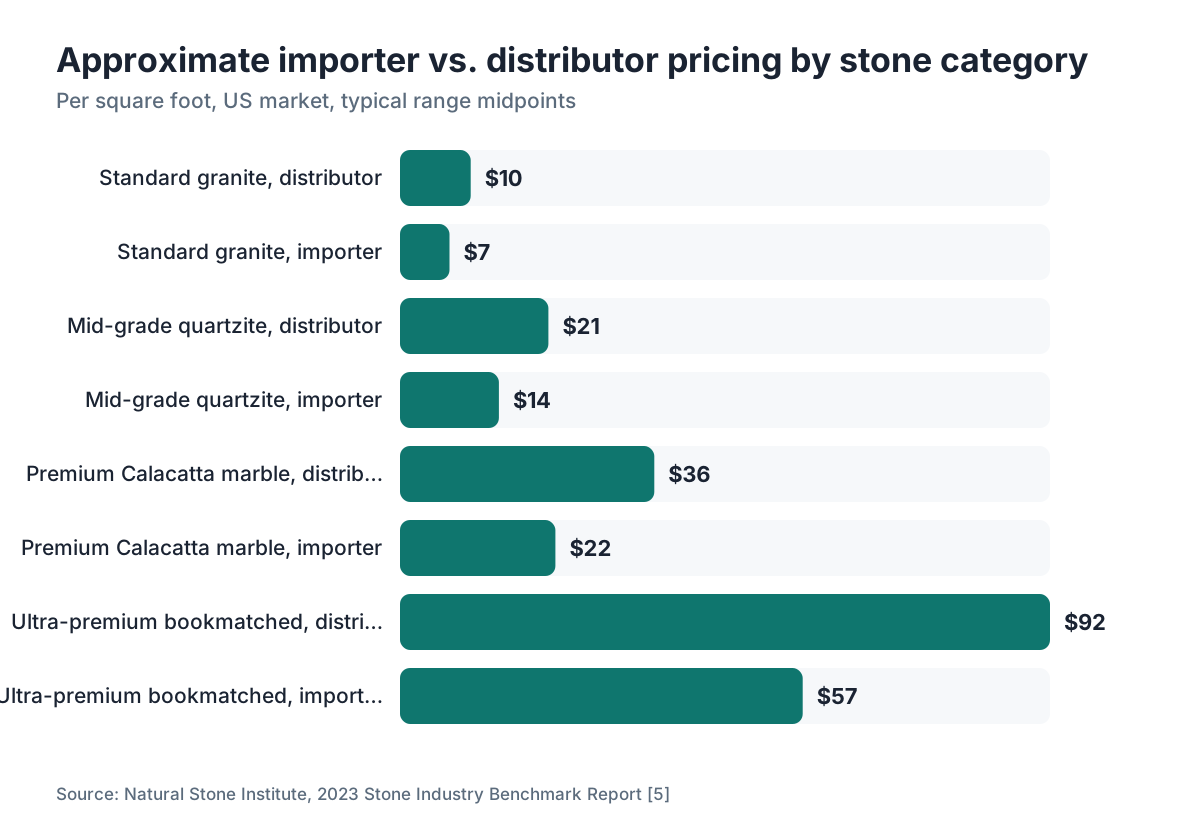
On premium materials, the math gets more interesting. A slab of Calacatta Gold marble that a distributor sells you for $28/sqft might land at an importer for $16 to 18/sqft. Brazilian quartzites like Taj Mahal or Fusion are regularly 30 to 40% cheaper at the importer level than at a regional stone yard [5]. Those are rough estimates based on market conversations, not published invoices, and they shift with currency, freight, and demand.
The table below shows approximate price comparison data across material tiers based on typical US market ranges as reported in Natural Stone Institute surveys and industry pricing guides.
| Material | Distributor avg ($/sqft) | Importer avg ($/sqft) | Approx savings |
|---|---|---|---|
| Standard granite (Brazil/India) | $8 to 12 | $5 to 8 | 20 to 35% |
| Mid-grade quartzite | $18 to 25 | $12 to 17 | 25 to 35% |
| Premium Calacatta marble | $28 to 45 | $16 to 28 | 30 to 40% |
| Ultra-premium bookmatched | $65 to 120 | $40 to 75 | 30 to 40% |
Those savings assume you are buying at or near container quantity, you are paying promptly, and you have the working capital to hold inventory. Spot-buying single slabs from an importer typically nets you less because you lose your volume bargaining power.
One thing nobody talks about enough: freight. If the importer is in Miami and you are in Denver, the trucking cost on a full pallet or partial container can eat a big share of your savings. Run the landed cost math before you get excited about the per-slab number.
What quantity minimums do stone importers typically require?
This varies more than anything else in the sourcing process.
Some importers will sell single slabs, especially on premium materials they are using as a loss leader to get you into their warehouse. Others require a bundle minimum (a bundle is typically 4 to 8 slabs depending on thickness and size), a pallet minimum, or a container minimum (a 20-foot container holds roughly 250 to 350 slabs of 2cm or 3cm material, though that varies by slab size).
If you are a small shop doing 10 to 15 jobs a month, a full container of one material is a lot of capital tied up in inventory. The sweet spot for many mid-size fabricators is a bundle or half-pallet buy, which most importers will accommodate once you have a relationship established.
Container buys are where the real pricing power lives. A 20-foot FCL (full container load) from Brazil runs roughly $3,000 to 5,500 in ocean freight as of recent shipping rates, depending on origin port and destination [6]. Split that across 300 slabs and it is $10 to 18 per slab in freight, which still pencils out on premium material. Some fabricators group together for container buys, splitting a container between two or three shops in non-competing markets. That arrangement requires trust and clear documentation about who gets which bundles.
For shops just starting to explore direct buying, the easiest entry point is showing up at an importer warehouse and buying a bundle of something you already sell a lot of. You are not committing to a container, you are just learning the relationship and the price difference.
How do you vet a stone importer before sending a wire transfer?
Wire fraud in the stone industry is not common but it is not zero. International suppliers especially, though also some domestic importers, have been involved in scams where payment disappears and stone never arrives.
For domestic importers, the basics apply. Check their registration with the Secretary of State in their home state. Verify they are a Natural Stone Institute member if they claim to be [3]. Call references from other fabricators who have bought from them. Visit the warehouse in person before sending a significant payment.
For overseas direct buying, the risk is higher. Using a letter of credit (LC) through your bank protects you: payment only releases when shipping documents confirming the stone is on the vessel are presented to the bank [7]. LCs add cost and friction but are standard practice in international commodity trade. The US Department of Commerce's International Trade Administration maintains resources on letters of credit and international trade payment methods [8].
Before any wire transfer, large or small, call the importer's main phone number to verbally confirm the wire instructions. Fraudsters intercept email and substitute their own bank details. A quick phone call to a number you sourced independently (not from the same email that sent the wire instructions) catches this.
For importers you've vetted and worked with before, the precautions are simpler: just confirm instructions by phone the first time after any change in contact person or banking info.
What should you inspect when you visit an importer's warehouse to buy slabs?
Visiting in person before a large purchase is not optional. Photos do not show you mesh backing failures, through-cracks, or the way veining actually moves across a full 10-foot slab under a shop light.
Bring a bright flashlight and run it at a low angle across the face of each slab. This raking light technique reveals surface pits, filled cracks, and resin repairs that disappear under overhead warehouse lighting. Hairline fissures in marble and quartzite are normal and natural; cracks that run through the full thickness or that have been filled with visible epoxy are yield problems waiting to happen.
Check the back of every slab. Mesh or fiberglass backing on fragile marbles is fine and normal, but check that it is fully adhered with no bubbling or separation. A delaminating mesh back means the slab will crack under cutting tension.
Measure a few slabs if you are buying for specific jobs. Slab dimensions are not always what the tag says. Bundle tags give an average or estimated square footage; the actual slabs in the bundle vary.
For bookmatched pairs, pull the consecutive slabs and lean them together to confirm the match works. Consecutive saw numbers on the tag do not guarantee a clean visual match if there was a shift at the quarry.
Ask to see the full bundle, not the display face slab. The display slab is always the best one. The back two slabs in the bundle are the ones you need to evaluate.
For materials like quartzite where hardness varies (some quartzites are soft enough to scratch with a knife and are really marble), ask the importer for a MOHS hardness test result or any mineralogy documentation. The Natural Stone Institute publishes testing standards for exactly this purpose [3].
How do you handle shipping and logistics when buying direct?
If you are buying from a domestic importer and driving to their warehouse, logistics are simple: bring your truck or flatbed, a forklift-equipped yard, and A-frame racks for transport. Slabs travel on edge, not flat, or they crack.
If the importer is shipping to you, confirm they use a stone-experienced freight carrier. Not all LTL (less-than-truckload) carriers handle stone correctly. Damaged slabs in transit are a claims headache, and most freight carriers have exclusions or low caps for natural stone unless you declare full value and pay additional freight insurance.
For overseas direct container orders, the importer at origin arranges ocean freight to a US port. You or your customs broker then handles port pickup, customs clearance, and drayage to your facility. US Customs requires an Importer of Record (IOR), which is you if this is your own commercial import. You will need a US Customs bond, which a licensed customs broker arranges [9]. Customs duties on natural stone slabs from most countries are currently 0 to 3.7% ad valorem under standard tariff schedules, though this can change with trade policy [10].
A customs broker (a licensed agent who files paperwork with US Customs on your behalf) is worth every penny for a first import. Fees typically run $150 to 400 per entry filing. The National Customs Brokers and Forwarders Association of America (NCBFAA) maintains a member directory for finding licensed brokers [11].
How do you negotiate pricing and terms with a stone importer?
Price is negotiable, but only if you know what you are doing and what you are worth as a customer.
Before you negotiate, know the market. Call three importers for the same material. Get quotes. Importers expect this. Once you have real numbers, you have a position to bargain from.
Volume is your main chip. If you can commit to a container buy, or even a half-container, most importers will move on price. If you are buying a single bundle as a trial, you have less pull, but you can negotiate payment terms instead. Net-30 terms rather than wire-in-advance is a real concession that helps your cash flow even if the per-slab price stays firm.
Timing matters too. Importers with cash-flow pressure will deal. End of quarter, after a slow season, or when they have containers they need to clear before a new shipment arrives, these are good times to push for better pricing. A fabricator who pays promptly and reorders regularly is worth a small price concession to keep.
For quoting jobs accurately after you start buying direct, your cost per square foot is the input that drives everything downstream. Shops that track slab inventory, waste, and job profitability precisely know whether that importer relationship is actually paying off. Software that ties material cost to quote output (like SlabWise's fabrication quoting tools) makes this a lot easier than a spreadsheet, especially when you are holding inventory at multiple cost basis points.
Do not accept a verbal price. Get any agreed pricing in writing, whether that is an email confirmation, a pro-forma invoice, or a signed purchase order. Importers are generally honest but memories differ when a container lands and the market has shifted.
What are the risks of buying direct from importers and how do you manage them?
The biggest risk is cash tied up in inventory that moves slowly. A distributor essentially acts as your warehouse and extends credit. When you take on direct buying, you absorb those costs. A $40,000 container of quartzite sitting in your yard for six months costs real money in capital, space, and the opportunity cost of what else you could have done with that cash.
The second risk is lot variation. When you buy from a distributor, they have already absorbed lot variation across multiple containers. Your Taj Mahal slab today matches reasonably well to the one you bought six months ago because the distributor has blended inventory. Buy a single container direct and you get one lot. That lot might be beautiful or it might run more beige than your samples showed. Inspect before you commit.
Quality disputes on overseas orders are difficult. If a container of stone arrives and 20% of the slabs are cracked, collecting from an overseas supplier is a legal and logistical problem. Insurance, documentary evidence (photos at the origin warehouse before loading), and working with established suppliers rather than chasing the lowest price reduces this risk but does not eliminate it.
Tariff risk is real right now. US trade policy has changed rapidly, and stone from certain countries has been subject to Section 232 or Section 301 tariffs in recent years [10]. Before you commit to a container order from a new country of origin, check the current Harmonized Tariff Schedule classification and any applicable additional duties. The USITC tariff database is free and searchable [12].
None of these risks make direct buying a bad idea. They just mean you should start with a manageable trial purchase, nail down the logistics, and scale up once the relationship is proven.
How does buying direct from importers affect your customer pricing and competitiveness?
Lower material cost gives you flexibility, not an automatic obligation to drop your retail price. Most fabricators who buy direct use the savings in one of three ways: they hold prices and pocket the margin improvement, they price slightly below competitors on the materials where their cost advantage is largest, or they offer premium materials at mid-tier prices to win larger volume jobs.
Which approach makes sense depends on your market. In a price-sensitive market where customers are getting three quotes, material cost savings translate directly to win rate. In a high-end market where customers are buying on relationship and quality, holding the margin and investing in better tools, staff, or showroom is smarter.
For kitchen countertops specifically, where the material makes up 25 to 40% of the total installed cost, a 30% reduction in your material cost on quartzite or marble is a big number. That is the category where most fabricators see the clearest impact from direct sourcing.
Your pricing power also depends on what you do after the stone arrives. Accurate nesting (minimizing waste per job) and efficient templating tighten up the gap between your material cost and what you actually recover on jobs. A shop with good cost tracking knows their true cost per square foot of finished countertop, including waste, and prices accordingly. Most shops that move to direct buying discover their material waste number was quietly destroying the savings they thought they were capturing.
If you work across multiple material categories, remember that direct buying tends to pencil out much better on premium stone than on commodity stone. Do not overinvest in building an importer relationship for standard black granite when your distributor pricing on that material is already tight.
Frequently asked questions
Can a small fabricator with low volume buy direct from stone importers?
Yes, though your bargaining position is limited. Most importers will sell to small shops in bundle quantities (4 to 8 slabs) once you have a business license and resale certificate. Container minimums are not a universal requirement. The best approach for low-volume shops is to start with one importer, buy a single bundle of a material you already sell well, and use that transaction to test the relationship and the pricing before committing to larger orders.
Do I need a customs broker to import stone directly from overseas?
For most first-time commercial imports, yes. A licensed customs broker files your entry with US Customs and Border Protection, arranges your customs bond, and handles classification under the Harmonized Tariff Schedule. Fees run $150 to 400 per entry. The NCBFAA directory at ncbfaa.org lists licensed brokers by location. You can self-file as an Importer of Record, but the learning curve on your first container is steep enough that broker fees are a worthwhile cost.
What is a resale certificate and how do I get one for buying stone?
A resale certificate (also called a reseller permit or sales tax exemption certificate) tells your supplier that you are buying goods for resale, not personal use, so no sales tax is collected at purchase. You apply through your state's department of revenue or taxation. The process is free in almost every state and can usually be completed online in a few days. You will need your state business registration number to apply.
How do I find Brazilian quartzite importers specifically?
The Coverings trade show is the densest concentration of Brazilian stone importers in North America, held annually in April or May. The Natural Stone Institute member directory also lists importers by material specialty. Calling importer warehouses in Miami or Houston directly is effective, since those cities handle the bulk of Brazilian stone entering the US. Fabricator forums on Facebook and the Surface Fabricators Association are good for referrals from peers who are already buying.
What tariffs or duties apply to natural stone imported into the US?
Under the standard Harmonized Tariff Schedule, most natural stone slabs enter at 0 to 3.7% ad valorem, depending on country of origin and product type. However, Section 301 tariffs on goods from China and other trade-policy-driven duties can significantly change the landed cost for certain origins. Always check the current USITC interactive tariff database (usitc.gov) for the exact HTS code and applicable duties before committing to a container order.
What is the minimum order to buy from a US stone importer?
There is no universal minimum. Some importers sell single slabs on premium materials. Others require a bundle (4 to 8 slabs) or a full pallet. Container minimums (250 to 350+ slabs) apply mainly to fabricators negotiating the deepest pricing. When you first contact an importer, ask directly about their minimum and whether they offer trial-bundle pricing for new accounts. Most will accommodate a small first order to start the relationship.
How do I protect myself when sending a wire transfer to a stone importer?
Call the importer's main phone number, sourced independently from the email containing wire instructions, to verbally confirm the bank details before sending any wire. For overseas orders, ask your bank about a letter of credit, which holds your payment until the importer presents shipping documents proving the goods are loaded. For domestic importers you have not worked with before, a credit card payment or ACH with a chargeback option is safer than a wire for the first transaction.
Is it possible to split a container order with another fabricator?
Yes, and many shops do it. Two or three fabricators in non-competing markets can split a container to reach the quantity needed for best pricing while keeping individual inventory at a manageable level. You need a written agreement on who gets which bundles, how disputes about damaged slabs are handled, and how the freight cost is divided. Trust matters here. This arrangement works best between fabricators who already know each other through a trade association or referral network.
What should I look for when inspecting stone slabs at an importer's warehouse?
Use a bright flashlight held at a low angle (raking light) to spot surface pits, resin fills, and through-cracks that overhead lighting hides. Check the back for delaminating mesh on backed marbles. Pull all slabs in a bundle, more than the display face. Measure a few slabs against the bundle tag dimensions. For bookmatched pairs, lean consecutive slabs together to confirm the visual match. Ask for mineralogy or hardness documentation on quartzites to confirm hardness.
How do stone importer prices compare to distributor prices per square foot?
On commodity granite, importers are roughly 20 to 35% cheaper than regional distributors. On premium quartzite and marble, the gap reaches 30 to 40% per square foot at volume. For example, a mid-grade quartzite that costs $18 to 25/sqft at a distributor often runs $12 to 17/sqft at the importer level. Freight to your shop can offset some of that savings, so always calculate the landed cost, more than the purchase price.
What trade shows are best for meeting stone importers?
Coverings (coverings.com) is the largest tile and stone trade show in North America, with strong representation from importers of Brazilian, Italian, Indian, and Turkish stone. It rotates between Las Vegas, Orlando, and Atlanta. The Natural Stone Institute also runs the Marmomacc Americas conference. For networking with fabricators and getting peer referrals to importers, the Surface Fabricators Association annual event is the most targeted option.
How does direct buying from importers affect my slab inventory management?
You take on the inventory risk and storage cost that a distributor previously absorbed. Accurate slab tracking becomes more important because your capital is tied to specific bundles in your yard. Knowing which slabs are committed to jobs, which are available, and what each lot cost you is essential for pricing accuracy. Shops that build out direct sourcing without improving their inventory tracking often find that waste and pricing errors quietly eat the margin they expected to gain.
Can I buy engineered quartz or Cambria directly from the manufacturer?
Engineered quartz brands like Cambria and Silestone control distribution carefully and generally do not sell direct to fabricators outside their authorized dealer network. Becoming an authorized dealer for a brand like Cambria requires meeting sales volume thresholds, showroom requirements, and signing a dealer agreement. You cannot simply call the factory and buy a container. For commodity engineered quartz from overseas manufacturers, direct factory relationships are more possible but carry similar vetting risks to any overseas purchase.
What is an FCL versus an LCL container order, and which is better for stone?
FCL (full container load) means you fill an entire shipping container, typically a 20-foot or 40-foot unit, with your own stone. LCL (less than container load) means your stone shares container space with other shippers' goods and is consolidated at a freight station. FCL is almost always better for stone: lower per-unit freight cost, less handling, and no risk of other cargo shifting against your slabs. LCL is a reasonable option only if your order is too small to justify FCL pricing.
Sources
- IRS, Sales Tax and Resale Certificates: Resale certificates are issued by state tax authorities, not the IRS; they exempt resellers from paying sales tax on goods purchased for resale.
- Coverings, Official Trade Show Website: Coverings is the largest tile and stone trade show in North America, held annually.
- Natural Stone Institute, Member Directory and Testing Standards: The Natural Stone Institute maintains a member directory of importers and publishes testing standards for stone hardness and classification.
- Surface Fabricators Association: The Surface Fabricators Association provides fabricator networking forums and annual events where supplier referrals are shared.
- Natural Stone Institute, 2023 Stone Industry Benchmark Report: Premium Brazilian quartzites are commonly 30 to 40% cheaper at the importer level than at regional stone yards, based on industry pricing surveys.
- Freightos, Ocean Freight Rate Index: A 20-foot FCL from Brazil to a US port runs approximately $3,000 to 5,500 in ocean freight under recent shipping conditions.
- US Department of Commerce, International Trade Administration, Trade Finance Guide: A letter of credit protects the buyer by releasing payment only when the seller presents shipping documents confirming goods are loaded on the vessel.
- US Department of Commerce, International Trade Administration: The ITA maintains resources on international trade payment methods including letters of credit for US importers.
- US Customs and Border Protection, Customs Bond Information: Commercial importers acting as Importer of Record are required to obtain a US Customs bond to clear goods through customs.
- Office of the United States Trade Representative, Section 301 Tariffs: Section 301 and Section 232 tariffs have applied to goods from certain countries and can significantly affect landed cost on stone imports; rates have changed with trade policy.
- National Customs Brokers and Forwarders Association of America, Member Directory: NCBFAA maintains a directory of licensed customs brokers who can file entries and arrange customs bonds for fabricators importing stone.
- US International Trade Commission, Interactive Tariff and Trade DataWeb: The USITC tariff database is free and searchable; most natural stone slabs enter under HTS codes with 0 to 3.7% ad valorem duties, subject to additional duties by country of origin.
Last updated 2026-07-10