TL;DR
- Pittsburgh has roughly 20 to 40 active stone fabrication shops serving Allegheny County and the suburbs.
- Installed granite runs $40 to $100 per square foot; engineered quartz runs $50 to $150.
- Lead times are 2 to 4 weeks from template to install.
- Hire a shop that owns a CNC bridge saw, keeps slabs on the floor, and lets you hand-pick your stone.
What does a stone fabricator actually do (and why it matters who you hire)?
A stone fabricator is not a countertop retailer. Retailers sell slabs. Fabricators cut, edge-profile, polish, and install them. That distinction is the whole game, because the quality of your finished countertop depends almost entirely on how the shop fabricates it, not on which distributor supplied the slab.
The work has four steps: templating, cutting, finishing, and installation. Templating is when a technician comes to your home and measures your counters or cabinet layout, either with a physical template or a digital laser system. That measurement feeds a CNC (computer numerical control) bridge saw, which makes the rough cuts. Then edges get ground and polished, cutouts are made for sinks and cooktops, and the finished pieces are hauled out and set in your kitchen.
A shop that skips digital templating and still cuts freehand is not automatically worse. It is slower, and it leaves more room for measuring error. Shops that run their own CNC equipment can hold tolerances of around 1/16 inch. Shops that farm cutting out to a third-party slab yard give up control over both turnaround and quality.
Here is the practical move. Ask every shop whether they fabricate in-house or send slabs out. If they outsource, ask where. That one question tells you how they will handle a problem when something cracks at 4 p.m. on install day.
How much does a stone fabricator in Pittsburgh charge?
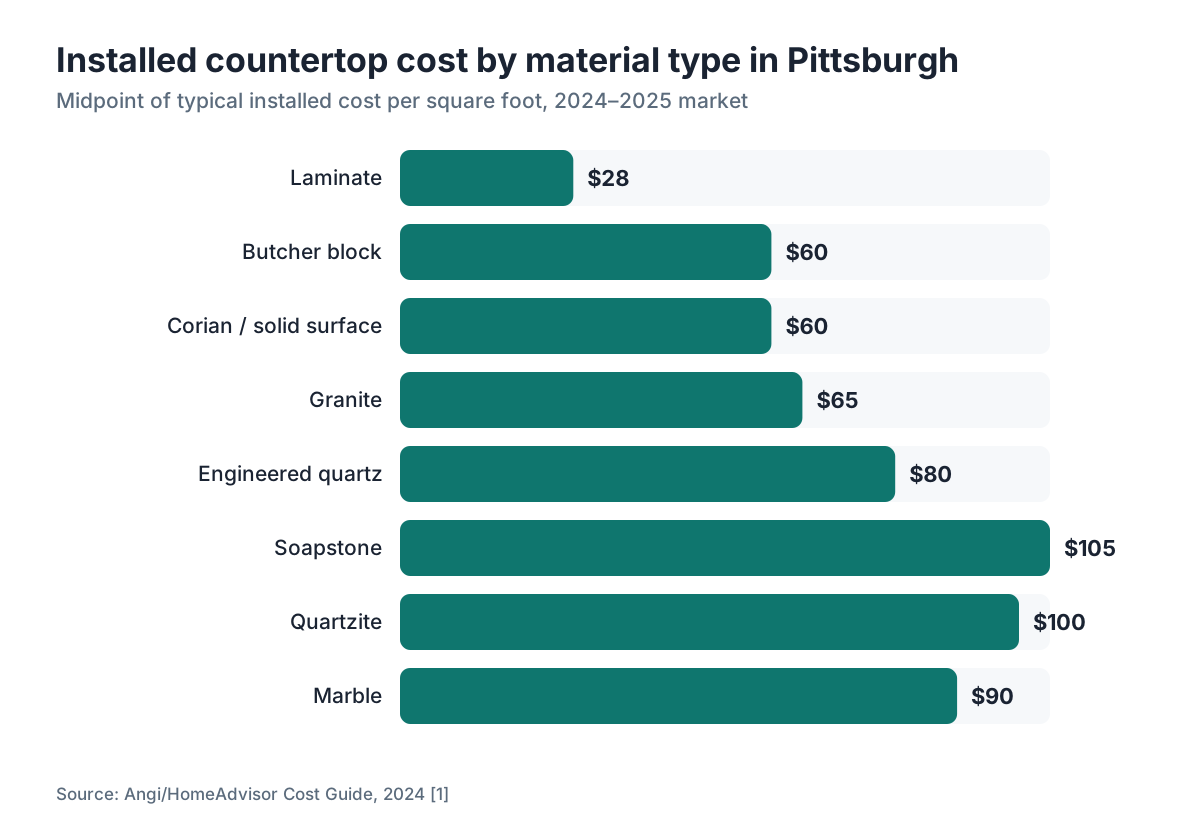
Installed granite in the Pittsburgh metro typically lands between $40 and $100 per square foot. Engineered quartz runs $50 to $150. The spread is wide because stone type, edge profile, cutout complexity, and travel distance all push the number around. Real ranges still exist, so here they are.
Builder-grade granite (simple edges, standard colors) sits at the low end; exotic slabs with waterfall edges or mitered joints reach the top [1]. Engineered quartz (Cambria, Silestone, MSI brands) costs more because the material costs more, though the fabrication labor is about the same [2]. Quartzite, which homeowners constantly confuse with quartz, prices like exotic granite, often $80 to $180 installed depending on how rare the slab is.
Marble is its own animal. The slab is often cheaper than you expect, but fabricators charge more to work it because marble chips at cutouts and needs a gentler hand. Budget $60 to $120 installed for Carrara. Rarer marbles push past $200.
A typical Pittsburgh kitchen has 40 to 60 square feet of countertop. At $65 per square foot all-in (a fair mid-market number), a 50-square-foot kitchen runs about $3,250. Add a full-height backsplash in the same stone and you tack on $30 to $60 per linear foot.
Edges add cost too. A standard eased or beveled edge is usually baked into the base price. An ogee or dupont edge adds $10 to $20 per linear foot. A mitered waterfall panel on an island adds $500 to $1,500 or more depending on slab height and thickness.
The National Kitchen and Bath Association's 2023 survey put the median U.S. countertop budget for a kitchen remodel at $2,000 to $4,500, with higher-end projects topping $8,000 [3]. Pittsburgh tends to run a bit under national averages because fabrication labor costs less here than in coastal metros.
| Stone Type | Low (installed/sq ft) | Mid | High |
|---|---|---|---|
| Granite | $40 | $65 | $100 |
| Engineered quartz | $50 | $80 | $150 |
| Quartzite | $60 | $100 | $180 |
| Marble | $60 | $90 | $200+ |
| Soapstone | $70 | $105 | $150 |
| Butcher block (wood) | $35 | $60 | $120 |
These reflect 2024 to 2025 Pittsburgh conditions, drawn from national cost databases and regional contractor reporting. Shops vary. Always get three quotes.
How do I find a reputable Pittsburgh stone fabricator?
Start with the Marble Institute of America (MIA+BSI) member directory [4]. Member shops sign a code of conduct and get access to professional training. That is not a quality guarantee, but it screens out the smallest pop-up operations.
The Natural Stone Institute also runs an Accredited Natural Stone Fabricator program. Accredited shops have been audited against documented quality standards. As of 2024 roughly 200 shops in North America hold accreditation, and a handful serve the Pittsburgh market [5].
Directories only get you a list. Here is how to actually vet a shop.
Visit the showroom and slab yard in person. Any fabricator worth hiring has real slabs on the floor, more than samples. If they can't show you the actual stone you'll buy, walk away.
Ask for three local references from jobs finished in the last 12 months, and call them. Ask how the shop handled problems, not whether the counter looks pretty.
Look at the equipment. A shop with a CNC bridge saw and a digital templating system (Proliner and LT-55 are common) cuts faster and more accurately than one working by hand alone.
Get the warranty in writing. A solid shop covers workmanship on fabrication and installation for at least a year. The stone itself is warranted by the manufacturer only if it's engineered (Cambria offers a lifetime warranty [6]). Natural stone has no such backing.
Homeowners often find fabricators through a cabinet installer or general contractor. That referral network is genuinely useful. Do your own vetting anyway. A vouch is a starting point, not a substitute.
What questions should I ask a Pittsburgh stone fabricator before hiring them?
Eight questions worth asking every shop:
-
Do you fabricate in-house, or do you outsource cutting? (In-house is better for accountability.)
-
Can I come see your slab yard and hand-pick my stone? (If no, ask why not.)
-
What digital templating system do you use? (Proliner, LT-55, or equivalent; no system at all is a red flag.)
-
What is your current lead time from template to install? (2 to 4 weeks is normal; anything over 6 weeks needs an explanation.)
-
Who does the installation, your own crew or a subcontractor? (Either can be fine; you just want accountability.)
-
What does your warranty cover, and for how long? (Get this in writing.)
-
What is your process when something goes wrong, like a crack during delivery or a mismatch at the seam? (A good shop has a clear answer.)
-
What are all the line items in this quote, and what could push the final price up? (Surprise charges for cutouts, seams, and travel are common.)
A fabricator who gets irritated by these questions is telling you something. Believe them.
What is the typical timeline from quote to installed countertops in Pittsburgh?
Plan on 3 to 6 weeks total from first contact to installation day. Most of that is waiting, not working.
Here is how it breaks down. Getting quotes from three shops takes 1 to 2 weeks if you're responsive with measurements and material choices. Once you sign and pay a deposit (usually 50% upfront), the shop schedules a template appointment. In Pittsburgh-area shops that happens 3 to 10 business days after signing.
After templating, fabrication takes 5 to 10 business days for most shops. Spring and fall renovation peaks push that toward the longer end. Installation itself runs a few hours to a full day depending on kitchen complexity.
An in-stock slab from the shop's yard speeds everything up. A special-order slab from a distributor adds 1 to 3 weeks for arrival.
Remove your old countertops before install day, or pay the crew to do it. Most shops charge $50 to $150 to pull existing laminate or tile. Budget for a sink-free kitchen for 24 to 48 hours around install day if you're also setting a new undermount sink.
Granite vs. quartz vs. quartzite: which should Pittsburgh homeowners choose?
It depends on how you cook and how much upkeep you'll tolerate. That's the honest answer, and anyone who gives you a flat recommendation without asking those two questions is selling.
Granite is natural stone, and every slab is different. It needs sealing at installation and re-sealing every 1 to 3 years depending on porosity. It takes heat well; a hot pan won't hurt it. It can chip at the edges if you hit it hard. Resale value holds because buyers recognize granite. See granite countertops for a full breakdown.
Engineered quartz (Cambria, Silestone, MSI Q Premium) is 90 to 94% ground quartz bound with polymer resin. It's nonporous, so it never needs sealing. Color is consistent across slabs, which makes seams easier to match. The catch: the resin can discolor under long UV exposure, so skip it for outdoor kitchens, and it can scorch under a very hot pan. Cambria is made in Minnesota if domestic origin matters to you [6]. More on Cambria countertops.
Quartzite is natural stone, not engineered, and it's routinely mislabeled at retail. Real quartzite is very hard and mostly nonporous. Fake quartzite is marble or dolomite wearing a fancier name. Ask for a MOHS hardness result or an acid etch test on a sample edge before you commit. Read how to clean quartzite countertops to understand the maintenance you're signing up for.
For most Pittsburgh kitchens where low maintenance wins, engineered quartz is the smart call. If you want a one-of-a-kind surface and you'll seal it once a year, granite gives you something engineered stone can't.
Are there specific building permits or codes in Pittsburgh for countertop installation?
For a straight countertop swap (same footprint, no structural changes), Pittsburgh and Allegheny County generally do not require a building permit [7]. You're replacing a surface, not altering the building.
Permits enter the picture when the job moves a gas line, relocates plumbing, or changes electrical rough-in for a cooktop. Those go through the City of Pittsburgh Bureau of Building Inspection, or your township inspector if you're in the suburbs [8].
Adding an island where none existed may trigger a permit, depending on whether flooring or plumbing gets touched. Check with your municipality directly. The rules shift town by town across Allegheny County.
Lead paint is a real concern in Pittsburgh's older housing. The Census Bureau's American Housing Survey shows the region carries a high share of homes built before 1978 [11]. If your remodel disturbs surfaces that might hold lead paint (say, tearing out a tiled backsplash above old cabinets), the EPA's Renovation, Repair and Painting (RRP) rule requires the contractor to be RRP-certified [9]. Stone fabricators swapping countertops rarely trigger this, but a GC coordinating a full kitchen gut might.
Asbestos is the other old-house issue. Allegheny County homes built before 1980 sometimes have vinyl floor tiles or mastic adhesives containing asbestos. Countertop swaps don't disturb those directly, but if your contractor is pulling old flooring too, ask before anyone starts prying.
How do seams work, and how do I know if my fabricator is doing them right?
Seams are unavoidable on any run longer than the slab allows (most slabs are 108 to 130 inches long). They also show up at inside corners on L-shaped and U-shaped kitchens.
A good seam is nearly invisible on granite and quartzite when the fabricator matches the pattern and uses color-matched epoxy. On engineered quartz, seams read more because the uniform color makes the line stand out. No seam vanishes completely in natural light. If a shop tells you it will, be skeptical.
Seam quality comes down to three things: precise mirrored cuts (both edges ground to a true 90 degrees), a tight gap (1/16 inch or less), and proper epoxy color-matching. Ask to see a seam in the showroom on a slab like yours before you commit.
Placement matters as much as execution. Good fabricators put seams where they hide: behind the faucet, under a window sill, near a corner. They should walk through placement with you during templating, not decide it on their own.
For countertop installation mechanics generally, the process is the same in Pittsburgh or anywhere else. What varies is how good your local crew is.
What are slab distributors in Pittsburgh, and should I buy through a fabricator or direct?
Slab distributors are the wholesale layer between the quarry (or engineered stone plant) and the fabricator. Distributors serving the Pittsburgh market include MSI, Arizona Tile, and Bedrosians, plus regional stone yards. They sell mainly to fabricators, though some let homeowners visit and hand-select slabs.
Buying through your fabricator is usually the smarter move. The shop already has a relationship with the distributor and can often get better pricing than you will as one homeowner. They also know which lots of a stone are consistent and which batches have known issues (vein direction, fill quality, and so on).
Still, visiting the distributor's yard with your fabricator is worth it for an expensive exotic stone. Bring the fabricator, or at least your cabinet door sample, and look at the actual slabs you'll cut from. Two slabs with the same name can look nothing alike.
If you buy a slab on your own and bring it to a fabricator, some shops take it (cut-only pricing) and some won't, because they can't warranty stone they didn't source. Ask before you buy.
What alternatives to natural stone should Pittsburgh homeowners consider?
Stone gets most of the attention, but it isn't always the right call, and honest Pittsburgh fabricators will tell you so.
Butcher block (wood) suits kitchens where you want warmth, and it costs less: $35 to $120 per square foot installed depending on species and thickness [1]. It needs oiling a few times a year and picks up knife marks over time. Some people read that as character. Others hate it. See butcher block countertops for the full picture.
Laminate has come a long way. Modern high-pressure laminate from Formica mimics stone well and costs a fraction of it, roughly $15 to $40 per square foot installed. It isn't a stone fabricator's product; most stone shops won't touch it. On a tight budget, laminate countertops or Formica countertops are honest options worth comparing.
Corian and other solid-surface materials are fabricated differently (glued, not mechanically fastened), and scratches sand out. Pricing runs roughly $40 to $80 installed. See Corian countertops.
For bathrooms and laundry rooms, soapstone is underrated. It's dense, nonporous, and develops a rich patina with use. Cost is similar to mid-range granite. How to clean soapstone countertops walks through the care routine.
Most Pittsburgh fabricators live on natural stone and engineered quartz. A few also do ceramic or porcelain slab work (large-format tile counters), which is growing. If that interests you, ask specifically, because not every shop is set up for it.
How do fabricators price a job, and how can I check that a quote is fair?
A fabricator's quote should itemize: material per square foot, fabrication labor per square foot, edge profile (per linear foot), sink cutout (usually $100 to $250 per cutout), seam charges if any, removal of old counters (if included), and installation. If it's one lump number, that's fine, as long as they'll confirm what's inside it.
The surprises that catch homeowners are extra cutouts for cooktops (especially gas), radius corners, and travel fees beyond a certain radius from the shop. Ask about all three before you sign.
Sanity-check the quote by measuring yourself. Take each section in inches, multiply length by width, divide by 144 for square feet. Add 15 to 20% for waste, more on patterned stone. If the shop's square footage is a lot higher than yours, ask them to walk you through the math.
Shops using modern quoting software (like SlabWise, which builds quotes and nesting layouts digitally) can show you the cut layout on screen, which makes waste calculations transparent. Ask for that transparency no matter what software a shop runs.
Get three quotes. The cheapest isn't always the worst, and the priciest isn't always the best. Compare what each one specifies, line for line. A quote that includes stone-selection help, an in-shop templating review, and a written warranty beats a bare-bones cheap one every time.
For the full project scope, kitchen countertops has a solid primer.
What should I know about stone care after my Pittsburgh fabricator finishes the job?
The fabricator's job ends at installation. Yours starts there. The good news: reasonable care runs about 10 minutes a month plus a tube of sealer every year or two.
For natural granite and marble, sealing comes first. Most shops seal on install day as part of the job, so ask whether it's included. The type matters. A penetrating impregnating sealer is right, not a topical coating. The Natural Stone Institute publishes care guidelines worth reading before you sign [5].
Once sealed, granite and quartzite are easy to live with. Mild dish soap and water for daily cleaning. No bleach. No acidic cleaners (vinegar, lemon juice) on marble or limestone, because acid etches the surface chemically. For the full rundown, how to clean stone countertops covers the do's and don'ts by stone type.
Engineered quartz needs no sealing. Avoid prolonged heat (use a trivet) and keep it clear of strong chemicals, including some oven cleaners and paint strippers, which attack the resin.
Marble deserves a warning of its own. Etching is a permanent surface reaction when acid hits the polished finish. A honed (matte) finish hides etching better than a polished one, which is worth knowing before you pick a finish. Marble countertops goes deeper.
None of this is a burden. It's a rag, a mild cleaner, and a little sealer on a schedule.
Frequently asked questions
How many stone fabricators are in Pittsburgh?
The Pittsburgh metro (Allegheny County and immediate surroundings) has roughly 20 to 40 active stone fabrication shops, from small family operations to larger shops with multiple CNC saws and showrooms. The count moves around as new shops open and smaller ones close. The MIA+BSI member directory and the Natural Stone Institute's accreditation list are the most reliable starting points for established shops.
What is the average cost of granite countertops in Pittsburgh?
Installed granite in Pittsburgh typically runs $40 to $100 per square foot. A 50-square-foot kitchen at the $65 midpoint costs around $3,250 total. Builder-grade granite with a simple edge sits at the low end; exotic slabs with full-bullnose or mitered waterfall edges push toward or past $100. Get three quotes, because variation between shops can hit $20 per square foot or more on the same stone.
How long does countertop fabrication take in Pittsburgh?
From signed contract to installation, plan on 2 to 4 weeks for most Pittsburgh shops. Templating happens 3 to 10 business days after signing. Fabrication takes another 5 to 10 business days. Spring and fall stretch these timelines. If your slab has to be ordered from a distributor rather than pulled from the shop's yard, add 1 to 3 weeks for delivery.
Do I need a permit to replace countertops in Pittsburgh?
No permit is required for a straight countertop replacement that doesn't move plumbing, gas, or electrical. Permits come in if you relocate a sink drain, move a gas cooktop, or add new electrical circuits. Check with the City of Pittsburgh Bureau of Building Inspection, or your township inspector if you're in the suburbs. When in doubt, ask your general contractor or the permit office directly.
What's the difference between quartz and quartzite, and does it matter which Pittsburgh fabricator I use?
Quartz (engineered) is made from ground stone and resin; quartzite is a natural metamorphic rock. They look alike but behave differently: quartz never needs sealing, quartzite does. Any reputable Pittsburgh fabricator handles both, but ask whether they can run a porosity or hardness test on a quartzite sample. Soft stone mislabeled as quartzite is a real industry problem, and a good fabricator knows how to verify what they're selling.
Can a Pittsburgh stone fabricator do bathroom vanity tops too?
Yes. Almost every kitchen fabricator in Pittsburgh also does vanity tops, tub surrounds, shower benches, and fireplace surrounds. Vanity tops are simpler jobs (smaller square footage, usually one cutout) and often have shorter lead times. Pricing per square foot is similar, though small jobs sometimes carry a minimum charge of $300 to $600 because setup time is the same regardless of size.
Is it cheaper to use laminate instead of stone for a Pittsburgh kitchen?
Yes, by a lot. Installed laminate runs $15 to $40 per square foot versus $40 to $150 for stone. Modern laminate from Formica and Wilsonart mimics stone convincingly and holds up well with normal use. It can't be repaired if badly damaged, and it won't add the same resale value as stone, but it's a rational budget choice. A stone fabricator won't quote laminate; you'd go to a separate shop.
How do I compare quotes from different Pittsburgh fabricators?
Make each quote specify square footage used, material cost, edge profile type and length, number of cutouts, seam count and placement, removal of old counters, and warranty terms. Calculate your own square footage (length times width in inches, divided by 144) and compare it to each shop's number. If quotes differ by more than 20%, ask the outlier to explain. The cheapest quote is only a deal if the scope is identical.
What is a digital template, and why does it matter?
Digital templating uses a laser device (Proliner and LT-55 are common) to map your cabinet layout with sub-millimeter accuracy. That data feeds straight into a CNC cutting program. Physical templates made from plywood or cardboard strips can work fine in experienced hands, but they add room for transfer error. Since precision always matters around sinks and appliances, ask whether your shop uses digital templating.
What warranty should I expect from a Pittsburgh stone fabricator?
A fair fabrication and installation warranty covers workmanship defects for at least one year. That includes seam failures, cracks at cutout edges (a fabrication error, not normal), and installation issues like unlevel or unsupported sections. It usually doesn't cover normal wear, impact chips, or staining from bad care. Engineered quartz makers (Cambria, Silestone) offer separate material warranties, often lifetime, for the stone itself.
Should I hand-select my slab in person?
Yes, for any job where the stone has real veining or color variation. Natural stone varies hugely within a named color. The slab in the brochure is not necessarily what shows up on your truck. Ask to visit the shop's slab yard or the distributor's yard and mark the specific slab you want with your name. For uniform engineered quartz, in-person selection matters less, though checking for surface defects is still worth it.
Does a Pittsburgh fabricator handle the sink and faucet installation too?
Most fabricators set an undermount sink during installation and attach it to the stone, but they typically don't connect the plumbing. You'll need a plumber (or a GC who handles plumbing) to hook up the drain and supply lines. Confirm this division of work before install day so you don't end up with a gap in responsibility. Some full-service shops coordinate plumbing through a partner; ask.
What is a seam charge, and is it normal to pay extra for it?
Yes, seam charges are normal. A seam takes extra time for precise mirror-cutting, epoxy mixing, color matching, and alignment during installation. Many shops include one seam in the base price and charge $50 to $150 per additional seam. A long L-shaped kitchen might have two or three seams. Ask about this when you review the quote so it doesn't turn up as a surprise line on the final invoice.
How do I know if my Pittsburgh fabricator is properly licensed and insured?
Pennsylvania requires contractors to register with the Attorney General's office under the Home Improvement Consumer Protection Act (HICPA) if they perform home improvements over $500 [10]. Ask for the shop's HICPA registration number and verify it at the PA Attorney General's website. Also confirm general liability insurance (ask for a certificate) and workers' compensation for the install crew. That protects you if someone is hurt in your home.
Sources
- HomeAdvisor / Angi, Countertop Installation Cost Guide, 2024: Installed granite countertops nationally range $40, $100 per square foot; butcher block $35, $120; installed quartz $50, $150.
- Consumer Reports, Countertop Buying Guide, 2023: Engineered quartz countertops cost $50, $150 per square foot installed; material is 90 to 94% ground quartz bound in polymer resin.
- National Kitchen and Bath Association, 2023 Design + Industry Survey: Median U.S. countertop budget in a kitchen remodel was $2,000, $4,500 in 2023; higher-end projects exceeded $8,000.
- Marble Institute of America / MIA+BSI, Member Directory: MIA+BSI (now part of the Natural Stone Institute) maintains a member directory of stone fabrication shops that have agreed to a professional code of conduct.
- Natural Stone Institute, Care and Cleaning Guidelines and Accredited Fabricator Program: Natural Stone Institute accredits fabricators against documented quality standards; approximately 200 shops in North America held accreditation as of 2024.
- Cambria, Warranty Documentation: Cambria offers a lifetime warranty on its engineered quartz surfaces; Cambria is manufactured in Minnesota.
- City of Pittsburgh, Department of Permits, Licenses and Inspections: A countertop replacement that does not alter plumbing, gas, or electrical rough-in does not require a building permit in Pittsburgh.
- Allegheny County Department of Economic Development, Building Codes and Permits: Municipalities in Allegheny County administer their own permits for home improvements; requirements vary by township.
- U.S. Environmental Protection Agency, Renovation, Repair and Painting (RRP) Rule: EPA RRP rule requires contractors disturbing lead-based paint in pre-1978 homes to be certified; applies to renovation projects.
- Pennsylvania Office of Attorney General, Home Improvement Consumer Protection Act (HICPA): Pennsylvania requires contractors performing home improvements exceeding $500 to register with the Attorney General under HICPA.
- U.S. Census Bureau, American Housing Survey 2023: Pittsburgh-area housing stock includes a high proportion of pre-1978 homes, relevant to lead paint considerations in renovations.
Last updated 2026-07-09