TL;DR
- A working stone shop runs five machine types: bridge saws (straight cuts), CNC routers (edges and cutouts), waterjet cutters (curves and inlays), polishers (finish), and material handling gear.
- A bare-bones shop starts around $80,000 to $150,000 in equipment.
- Full automated lines run $600,000 or more.
- Knowing what each machine does explains why one quote costs more than another.
What machines does a stone fabrication shop actually use?
Five machine categories turn a raw slab into an installed countertop: cutting, shaping, finishing, waterjet, and material handling. Each handles one step. Skip any category and you either outsource that step or turn the work away.
Bridge saws make the big straight cuts that rough out slab pieces. CNC routers carve edges, drill sink holes, and cut decorative profiles. Polishers bring stone to its final gloss. Waterjet cutters trace curves and inlays a saw blade can't follow. Forklifts, A-frames, and vacuum lifters keep people from wrecking their backs or dropping $3,000 slabs.
Small shops often run a bridge saw plus a hand-held angle grinder for edges and skip the CNC entirely. That works at low volume. It also caps your throughput and your consistency. Once a shop crosses roughly 20 to 30 jobs a week, the labor savings from a CNC start to pencil out.
Homeowners rarely see any of this equipment. It still explains a lot about price. A shop running a $250,000 CNC machining center bakes that capital into every job. A shop where one guy grinds edges by hand carries less capital cost but produces slower and more variable work. Neither model is wrong. They chase different customers.
What does a bridge saw do and what does one cost?
A bridge saw is the workhorse of the shop. It mounts a diamond blade on a traveling bridge that rides over a fixed table or a tilting bed, cutting long straight lines through granite, quartzite, marble, or engineered quartz with water cooling the whole time [1].
Most bridge saws tilt the blade to 45 degrees for miters, which is how shops build the thick-looking mitered edge that's popular on modern kitchen countertops. The table often tilts too, so the operator can line up a vein or cut around waste.
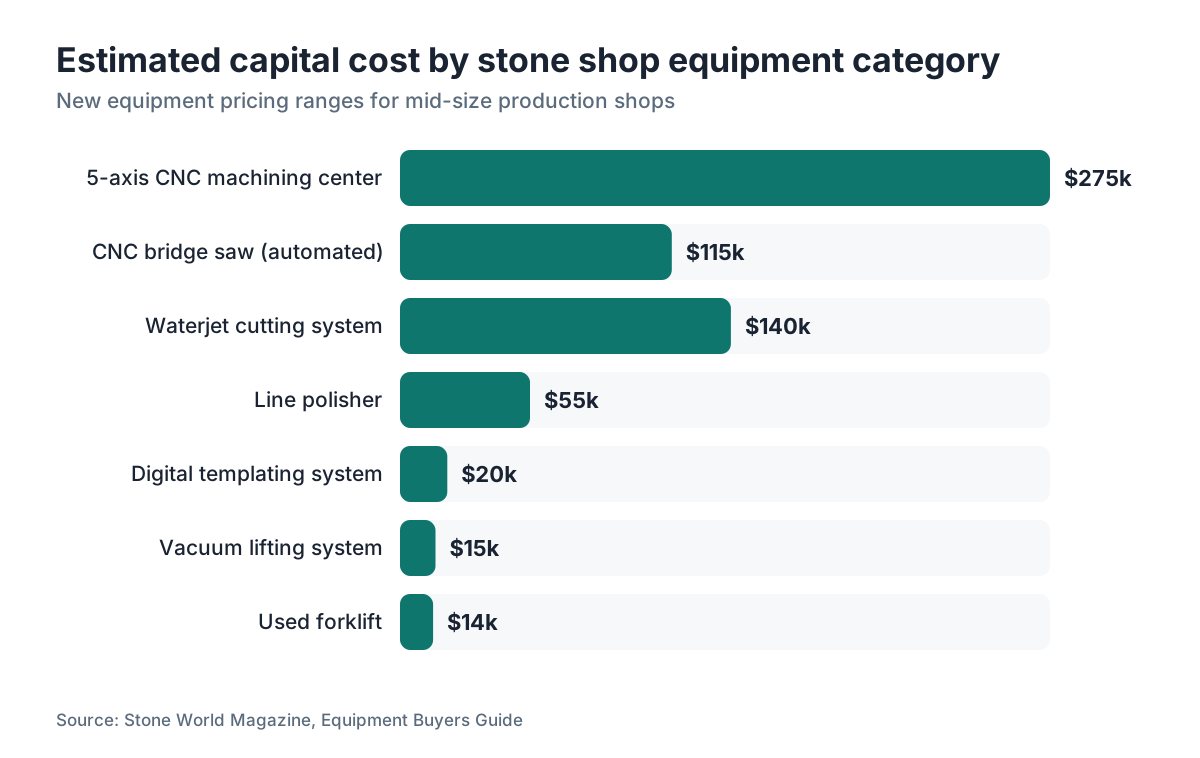
Price range is wide. A used manual saw from a name like Park Industries, Donatoni, or Prussiani runs $15,000 to $40,000. A new mid-range CNC bridge saw with automated head movement runs $80,000 to $150,000. Fully automated five-axis sawing centers from Italian builders top $300,000 [2].
Cutting capacity matters. Most shops need a machine that handles at least a 130-inch by 65-inch slab, which is close to standard slab size for granite countertops and marble countertops. Blade diameter runs 14 to 16 inches for countertop work. Spindle power goes from about 10 HP on entry machines to 25 HP or more on production saws, and that power sets how fast you can push through hard stone without chipping.
Water systems matter more than most buyers expect. Bridge saws use a constant water stream to cool the blade and knock down silica dust. Shops in states with strict discharge rules need to confirm their recirculating water system meets local requirements [3].
How does a CNC router change what a shop can produce?
A CNC (computer numerical control) router built for stone is a different animal from a woodworking CNC. Stone CNCs spin diamond tooling at lower speeds, flood the cut with water, and hold the slab flat on heavy granite tables or vacuum pods while the spindle moves overhead.
What they do is shape. Edge profiles, sink cutouts, faucet holes, cooktop openings, and decorative inlays all come off the CNC. A skilled hand-profiler with an angle grinder can match CNC quality on a simple eased or bullnose edge. The moment you need 40 identical ogee edges in one day, the CNC wins on speed and consistency.
Entry-level 3-axis machines built for stone start around $70,000 to $90,000 new. Mid-range 5-axis machining centers that undercut, cut 3D relief, and handle complex miters run $150,000 to $400,000. The 5-axis machines also cut down on fixture setups, which saves real time on hard jobs [2].
Tooling is the cost buyers forget. Diamond profile wheels, core bits, and router bits all wear out. A shop running heavy production spends $2,000 to $5,000 a month on CNC tooling, and granite and quartzite chew through it faster than softer stones.
Software matters as much as the machine. Every CNC runs on CAM (computer-aided manufacturing) software that turns a DXF drawing or a file from your templating system into machine paths. Shops that feed template data straight into CNC programming kill a manual redraw step and the errors that come with it. That's where digital shop tools like SlabWise touch the production floor: template data flows into cut files instead of getting keyed in by hand.
What is a waterjet cutter used for in stone fabrication?
A waterjet cutter fires a stream of water and abrasive garnet through a jeweled nozzle at about 60,000 PSI, cutting stone cold. No heat means no micro-cracking at the edge and no thermal shock when a diamond blade heats up inside a difficult vein [4].
Waterjets are built for curves. A corbel cutout, a farmhouse sink opening with radiused corners, a custom medallion inlay, a curved island end cap: all of these are tedious or impossible on a bridge saw and slow on a CNC. A waterjet traces them in one pass straight from a DXF file, holding tolerance within about 0.005 inches.
The machines are not cheap. A new stone waterjet table (Flow, OMAX, and WARDJet show up most in fabrication shops) runs $80,000 to $200,000 depending on table size and pump capacity [5]. Garnet abrasive costs roughly $0.25 to $0.50 per pound, and the high-pressure pump maintenance adds up.
Many smaller shops skip owning one and send those cuts to a regional service center. That adds a day or two of turnaround and a per-cut charge (often $50 to $200 depending on complexity), but it beats carrying $150,000 in equipment that runs a few hours a week.
Shops that do own a waterjet often turn it into a revenue line, cutting jobs for other local fabricators who lack the machine. That service work can offset a real chunk of the ownership cost.
What polishing and finishing machines do stone shops need?
After cutting and shaping, stone gets polished to whatever finish the customer picked: honed, semi-polished, or full mirror gloss. Shops handle this three ways.
A line polisher (or edge polisher) is a conveyor-fed machine for polishing the exposed long edges of countertop pieces. The piece rides through on a belt while a row of heads with progressively finer diamond pads work the edge. Throughput is high. A good line polisher finishes a typical kitchen set in 20 to 30 minutes of machine time, and new units run $30,000 to $80,000 [2].
A flat-bed polisher handles surface re-finishing, scratch removal, and polishing of custom pieces that don't fit a line machine. Slower, but more flexible. Smaller shops often run just an angle grinder with a backer pad and a set of Velcro-attached diamond pads, which works fine at low volume.
Hand polishing with angle grinders is still common for edge work at small shops. A good operator with a 4-inch grinder and a full set of resin pads from 50 to 3000 grit produces excellent results. The catch is throughput. Hand-polishing one ogee edge takes real skill and 15 to 30 minutes per linear foot depending on stone hardness.
Chemical enhancers and sealers go on after polishing, usually by hand or spray, not by a dedicated machine. That step matters for porous stones. If you're reading this because you own marble countertops or quartzite countertops, the sealer applied in the shop is your first line of protection.
What material handling equipment does a stone shop need?
Granite slabs weigh 18 to 20 pounds per square foot at 3cm thickness [6]. A typical full slab at roughly 55 square feet clears 1,000 pounds. Moving those without proper gear is how people get hurt and slabs get cracked.
A-frame carts (also called slab racks) are the basic storage unit. Slabs lean at a slight angle against padded supports. A good steel A-frame holds 2,000 to 6,000 pounds and costs $500 to $2,500. Most shops need several, sorted by material.
Forklifts or telehandlers move slab bundles from the delivery truck to storage. Most shops run a used sit-down counterbalanced forklift rated for at least 5,000 pounds. Budget $8,000 to $20,000 for a decent used unit [7]. Electric forklifts win indoors because of fumes. Propane forklifts win outside.
Vacuum lifters are how slabs actually move once they're in the shop. The lifter clamps suction cups to the slab face while a hoist or articulating arm carries the weight, so one or two people can set a heavy slab on a saw table safely. New systems run $5,000 to $25,000 depending on capacity and reach [2].
Overhead cranes and gantry systems in larger shops move slabs across the whole floor without a forklift. They cost real money to install ($30,000 to $100,000) but they change how a high-volume shop works.
OSHA's general industry standards (29 CFR Part 1910) and construction standards (29 CFR Part 1926) both reach stone shops depending on how the work gets classified, so review your compliance regularly [11].
How much does it cost to equip a stone fabrication shop from scratch?
It depends on your volume target and how much used gear you're willing to hunt down. Here's a realistic breakdown for three common setups.
| Shop size | Key equipment | Estimated total |
|---|---|---|
| Small (1-10 jobs/week) | Used bridge saw, angle grinders, basic A-frames, used forklift | $50,000 to $120,000 |
| Mid-size (10-30 jobs/week) | New or near-new bridge saw, entry CNC, line polisher, vacuum lifter, A-frames, forklift | $250,000 to $450,000 |
| High-volume (30+ jobs/week) | CNC bridge saw, 5-axis CNC, waterjet, line polisher, overhead crane, full material handling | $600,000 to $1,200,000+ |
These ranges come from aggregated dealer pricing and industry reporting [2]. They don't include facility buildout: a concrete floor rated for slab storage, water drainage, 3-phase electrical service, and slurry management. Those costs can add $50,000 to $200,000 for a purpose-built shop.
Financing is normal in this trade. Equipment lenders who specialize in stone machinery exist, and plenty of regional banks finance manufacturing equipment. Terms of 5 to 7 years are typical. Used gear from fabricators upgrading or closing shows up at auction through houses like Hilco and Heritage Global.
One hard-won lesson: undersized equipment is expensive in a different way. A shop that buys a manual bridge saw to save $60,000, then runs it flat out 10 hours a day, spends more on blade wear, maintenance, and lost production than the price gap it dodged. Buy to your projected volume at 18 months out, not to today's volume.
What is the silica dust hazard in stone fabrication and how do machines address it?
Silica is the serious health story of this trade. Granite, quartzite, and engineered stone all contain crystalline silica. Cutting and grinding them without controls throws off respirable dust that causes silicosis, an irreversible and progressive lung disease [9].
OSHA's respirable crystalline silica standard (29 CFR 1910.1053 for general industry, 29 CFR 1926.1153 for construction) set a permissible exposure limit of 50 micrograms per cubic meter as an 8-hour time-weighted average, effective June 23, 2018 [8]. Engineered stone often runs 90% or more silica by weight and has been tied to accelerated silicosis in fabrication workers, which pushed OSHA and NIOSH to issue a hazard alert aimed specifically at countertop shops [9].
Machinery fights this two ways. Wet cutting floods the blade or tooling with water and suppresses dust at the source. Bridge saws, CNC machines, and waterjet cutters all run wet by design. The second control is local exhaust ventilation on dry operations that still happen in some shops.
NIOSH backs wet methods as the primary engineering control. In its hazard alert, NIOSH describes water suppression as reducing dust generation by more than 90% compared to dry cutting [9]. Even so, the system has to be maintained. A clogged water nozzle on a bridge saw leaves an operator exposed while he thinks he's protected.
Homeowners should know this too. The countertop installation at your house usually involves a circular saw or angle grinder making field cuts, and that generates the same hazard. Ask your fabricator how their installers control silica dust on site.
What is digital templating equipment and how does it connect to fabrication machines?
Digital templating replaced cardboard templates in most modern shops. A laser templater (brands include Proliner from Prodim and units from Laser Products Industries) scans the actual countertop space, recording every dimension, angle, and obstacle in minutes [10].
The output is a DXF or proprietary CAD file that captures exactly what needs to be cut. That file drops into the bridge saw's control software and the CNC's CAM program. No redrawing, no hand transcription of measurements, no 1/8-inch error compounding through the workflow.
A Proliner digital templating system runs $15,000 to $25,000 new [10]. Shops templating 10 or more jobs a week usually earn that back within a year through fewer remakes and faster programming. A remake (a piece cut wrong that needs a fresh slab section) costs $500 to $2,000 each in material and labor.
The software between templating and machine programming is where operations go smooth or sideways. Nesting software arranges cut pieces on a slab to minimize waste. Good nesting cuts slab consumption by 8 to 15% on typical jobs, which matters when marble countertops or exotic stones run $150 to $300 per square foot at wholesale. Quoting software that pulls slab usage from the nest hands fabricators an accurate material cost before they commit to a price.
Shops still running this flow on paper or in spreadsheets leave real money on the table. That's the problem tools like SlabWise solve: connecting template data to quoting and nesting in one workflow.
How do shops maintain stone fabrication machinery?
Stone machinery runs in a rough environment: constant water, stone dust, vibration, heavy loads. Maintenance isn't optional. It's the difference between a machine that runs 15 years and one that needs replacing at year 6.
Bridge saw maintenance centers on the blade, the spindle bearings, and the water system. Inspect blades every 50 to 100 linear feet of cutting depending on material. A worn blade chips edges and loads up the spindle. Spindle bearings last 3 to 5 years in production and cost $500 to $2,000 to replace [2]. Water filters and pump seals want monthly attention.
CNC machines add software and servo motor upkeep. Servo drive calibration, ball screw inspection, and vacuum table seal replacement are annual tasks in most shops. Tooling replacement never stops. Track tool life by material type and swap proactively instead of running to failure, which trashes cut quality and can wreck the spindle.
Waterjet pumps are the high-cost maintenance item. High-pressure seals and check valves need replacement every 500 to 1,000 operating hours. Intensifier pump rebuild kits run $2,000 to $5,000. Orifice jewels (the cutting nozzle) are cheap at $20 to $60 each but need swapping every 50 to 100 hours [5].
Forklift maintenance follows the standard industrial schedule: fluid changes, tire and fork inspection, mast chain lube. OSHA requires pre-shift inspection of powered industrial trucks and documentation of any defects found [11]. Vacuum lifter cups get inspected before every lift, because a failed cup on a 1,000-pound slab is a serious incident.
Shops running two shifts or moving into high production should look at a preventive maintenance contract with a local industrial dealer. The monthly cost is real but predictable, and predictable beats an emergency repair that shuts down production for a week.
What should a homeowner understand about fabrication machinery when getting a countertop quote?
The machinery a fabricator runs shapes what you pay and what you get. A shop with a CNC produces consistent edge profiles on every linear foot. A hand-profiling shop may show slight variation. Neither is automatically better, but the CNC shop usually charges more per linear foot for complex profiles and delivers them faster.
Turnaround is mostly a function of machine capacity and queue. A shop with one bridge saw running full days might be 3 to 5 weeks out. A shop with two saws and a CNC might be 1 to 2 weeks. When you're pricing kitchen countertops or granite countertops, ask about current turnaround directly. It tells you how loaded the shop is.
Complexity costs money because it eats machine time. A straight-edge countertop with a simple profile is quick on a saw and line polisher. The same top with an ogee edge, a farmhouse sink cutout, a cooktop opening, and a waterfall island is a multi-machine, multi-hour job. If a quote comes in low for a complex job, one likely reason is the fabricator underbid the machine time.
Field cuts at installation cost too. When an installer cuts a piece at your house, they're usually on an angle grinder, which is slower and harder to control than shop equipment. Fewer field cuts (from accurate digital templating) means less install time and less dust in your home. Ask whether your fabricator uses digital templating and how they handle field cuts during countertop installation.
For materials like laminate countertops or butcher block countertops, the machinery is completely different: table saws, routers, and sanders instead of wet diamond-tooled machines. The cost structure is different too, which is part of why these materials cost less to produce.
Frequently asked questions
What is the most essential machine for a new stone fabrication shop?
A bridge saw is the non-negotiable first machine. Without it you can't make the straight cuts that turn raw slabs into countertop blanks. Everything else (CNC, waterjet, polisher) can be outsourced or done by hand at low volume. A bridge saw can't. Budget $15,000 to $40,000 for a used entry-level unit to start.
How long do stone fabrication machines last?
With regular maintenance, a quality bridge saw runs 15 to 20 years in a typical shop. CNC machines have similar mechanical longevity but may need software or control upgrades after 10 years. Waterjet pumps have shorter service intervals because of the extreme pressures involved. Material handling gear like forklifts and A-frames can last 20 or more years if nobody abuses it.
Can a stone shop run profitably without a CNC machine?
Yes, especially at lower volume. Plenty of successful shops produce 10 to 20 jobs a week with a bridge saw and skilled hand-profilers on angle grinders. The tradeoff is that edge consistency varies more, complex profiles take longer, and throughput is capped by labor rather than machine speed. The CNC math usually starts working at 20 to 30 jobs a week.
What brands make the most common bridge saws in the US?
Park Industries (US-based, strong dealer network), Donatoni, Prussiani, and Brembana (all Italian, widely distributed here) are the names you see most in American shops. GMM and Pedrini show up too. Park is popular with mid-size shops partly because US-based support is faster and parts are easier to source.
What is the OSHA silica rule for stone fabrication shops?
OSHA's respirable crystalline silica standard (29 CFR 1910.1053 for general industry) sets a permissible exposure limit of 50 micrograms per cubic meter as an 8-hour time-weighted average. Shops must use engineering controls like wet cutting, monitor exposure, provide medical surveillance for at-risk workers, and train employees. The rule has been in effect since June 23, 2018.
How does digital templating reduce material waste?
Digital templates produce exact DXF files that feed straight into nesting software. The nesting program arranges every piece for a job on the available slab area mathematically, cutting leftover. Shops report 8 to 15% material savings versus manual layout. On expensive stone at $150 to $300 per wholesale square foot, that savings adds up fast over a year of jobs.
What is a vacuum lifter in a stone shop?
A vacuum lifter uses suction cups on a hoist or articulating arm to grip and move heavy stone slabs without workers bearing the load. It protects backs from injury and slabs from cracking during handling. Most vacuum lifters in stone shops handle 500 to 2,000 pounds. They cost $5,000 to $25,000 new and are standard in any shop moving full slabs regularly.
What is the difference between a 3-axis and 5-axis CNC for stone?
A 3-axis CNC moves in X, Y, and Z, which covers most edge profiling and cutout work. A 5-axis machine adds two rotational axes, so the spindle can approach the stone at any angle. That enables undercuts, compound miters, 3D relief carving, and complex miter joints without repositioning the slab. Five-axis machines cost a lot more but reduce setup time and open up harder products.
How much does CNC tooling cost per month for a stone shop?
It varies by volume and material hardness, but a shop running a CNC full days on a mix of granite and quartz typically spends $2,000 to $5,000 a month on diamond profile wheels, core bits, and router bits. Harder materials like quartzite or ultra-hard granite burn through tooling faster. Tracking tool life per material type helps a shop budget and replace before quality drops.
Do stone fabrication shops need 3-phase electrical power?
Most production stone machinery needs 3-phase power. Bridge saws, CNC machines, and waterjet pumps all run 3-phase motors, typically at 208 to 480 volts. Building in a location without existing 3-phase service means either running a phase converter (cheaper, less ideal) or having the utility bring in 3-phase, which can cost $10,000 to $50,000 or more depending on distance.
What happens to the water and slurry from wet cutting?
Wet cutting produces a slurry of water, stone dust, and abrasive. Most shops run recirculating water systems where settling tanks separate solids from water, and the water gets reused. The settled solids must be managed under local wastewater and solid waste rules. Some municipalities allow it as fill; others require disposal as solid waste. Verify local requirements with your environmental regulator.
Can engineered stone like quartz be cut on the same machines as granite?
Yes. The same bridge saws and CNCs cut both. Engineered quartz contains resin binders that can gum up tooling a bit differently than natural stone, and because quartz products often exceed 90% silica by weight, wet cutting discipline matters even more. OSHA and NIOSH have both published specific warnings about silica exposure from engineered stone fabrication.
What is a line polisher and when does a shop need one?
A line polisher is a conveyor-fed machine with a row of heads carrying progressively finer diamond pads, polishing a stone edge in one continuous pass. Shops running more than about 15 to 20 jobs a week usually find the throughput justifies the $30,000 to $80,000 purchase. Below that volume, skilled operators with angle grinders produce comparable quality at lower capital cost.
How does waterjet cutting affect the cost of a countertop job?
For plain countertops with rectangular sink cutouts and simple edges, waterjet adds little. For jobs with curves, tight radius corners, medallion inlays, or precise notches, waterjet is often the only practical method and adds $50 to $200 or more per cut. Fabricators who own waterjets absorb this into overhead; those who outsource pass the cost through to you.
Sources
- Park Industries, Bridge Saw Overview: Diamond blade bridge saws are the primary cutting tool in stone fabrication, using water cooling and a traveling bridge to make straight cuts through granite and similar materials.
- Stone World Magazine, Equipment Buyers Guide: Equipment price ranges for bridge saws, CNC machines, line polishers, and vacuum lifters in the stone fabrication industry.
- U.S. Environmental Protection Agency, National Pollutant Discharge Elimination System (NPDES): Stone fabrication shops that discharge process water may be regulated under NPDES stormwater or industrial discharge permits depending on state and local rules.
- OMAX Corporation, Waterjet Cutting Technology: Waterjet cutters operate at approximately 60,000 PSI and cut stone without heat, preventing thermal micro-cracking. Precision is typically within 0.005 inches.
- Flow International, Waterjet Systems for Stone: Waterjet system pricing ranges from $80,000 to $200,000 for stone fabrication applications; high-pressure seal replacement is required every 500 to 1,000 operating hours.
- Natural Stone Institute (formerly Marble Institute of America), Stone Weight Reference: Granite slabs weigh approximately 18 to 20 pounds per square foot at 3cm thickness.
- EquipmentWatch, Used Forklift Market Values: Used counterbalanced forklifts with 5,000-pound capacity typically sell in the $8,000 to $20,000 range depending on age, hours, and condition.
- Occupational Safety and Health Administration, Respirable Crystalline Silica Standard (29 CFR 1910.1053): OSHA's silica rule sets a permissible exposure limit of 50 micrograms per cubic meter as an 8-hour TWA and requires engineering controls including wet cutting; effective June 23, 2018.
- NIOSH (CDC), Hazard Alert: Worker Exposure to Silica During Countertop Manufacturing, Finishing and Installation: NIOSH states that wet cutting methods suppress airborne stone dust generation by more than 90% compared to dry cutting, and issued specific warnings about engineered stone containing 90%+ silica.
- Occupational Safety and Health Administration, Powered Industrial Trucks (29 CFR 1910.178): OSHA requires pre-shift inspection of powered industrial trucks and documentation of any defects found during inspection, applicable to forklifts used in stone shops.
- U.S. Bureau of Labor Statistics, Industries at a Glance: Stone product manufacturing, including stone countertop fabrication, is classified under NAICS 3279 and tracked for employment, wages, and injury rates by BLS.
Last updated 2026-07-09