TL;DR
- Stone fabrication is the process of cutting, shaping, edging, and finishing raw stone slabs to fit a specific kitchen or bath layout.
- A full job covers templating, CNC or hand cutting, edge profiling, sink cutouts, and polishing.
- Installed cost runs $40 to $150 per square foot depending on material and complexity.
- Lead time is typically one to three weeks from template to install.
What is stone fabrication, exactly?
Stone fabrication is the trade of turning a rough quarried slab into a fitted, finished surface. That sounds simple. It is not.
A slab leaves a quarry as a rough block, then gets gang-sawn into slabs roughly 3/4 inch (2 cm) or 1.25 inches (3 cm) thick. Those slabs reach a fabrication shop still oversized, sometimes with natural fissures or voids, and with no edges dressed. The fabricator cuts each piece to the exact dimensions of a specific countertop layout, profiles the edges, cuts any sink or cooktop openings, polishes or hones the surfaces to the specified finish, and delivers pieces that go together on site without gaps or lippage.
The term covers every material processed this way: granite, marble, quartzite, soapstone, engineered quartz, porcelain, and sintered stone. Each one has a different hardness, porosity, and brittleness that changes how the shop picks blades, cools the cut, sets feed rates, and places seams.
Top shops add a layer of precision most homeowners never see. They photograph every slab, lay out cuts digitally to carry veining across seams, and run water-jet or CNC bridge saws that hold tolerances under 1/16 inch. A budget shop might still hand-scribe templates and run a manual bridge saw. Both can produce a fine countertop. The difference shows up at the seams and on complex shapes.
What are the steps in the stone fabrication process?
Most shops follow the same sequence, even when their equipment differs.
1. Templating A crew comes to the job site and captures the exact shape of the cabinets or substrate. Older shops use luan plywood strips and hot glue. Most shops today use a laser templating device (Laser Products Industries' LT-2D3D and Prodim's Proliner are common) that captures a point cloud accurate to about 1 mm [1]. The digital template feeds straight into the shop's CAD and CNC software, which kills the transcription errors that plagued paper templates.
2. Layout and nesting Back at the shop, the fabricator overlays the template onto a digital image of the actual slab. This step, called nesting, decides which pieces come from which part of the slab. It matters for two reasons. Material yield is one: a slab can cost $400 to $2,000 or more, so every offcut is money. Looks are the other: you want the vein to continue across a seam, or to land a natural feature on the sink centerline. Software like SlabWise automates nesting to squeeze out yield while letting the fabricator override for aesthetics.
3. Cutting The primary cut almost always happens on a bridge saw, a gantry-mounted circular blade (typically 14 to 18 inches in diameter, diamond-segment) that rides over the slab on a flat cutting table. Feed rates vary by material. Granite typically cuts at 6 to 10 inches per minute, a softer marble goes faster, and a hard quartzite crawls [2]. CNC-equipped shops run the saw on programmed paths. Manual shops rely on the operator to guide every cut.
For curves and complex cutouts, shops reach for angle grinders, CNC routers, or 5-axis water-jet machines. A water jet cuts by forcing a stream of water mixed with garnet abrasive at up to 60,000 psi. It puts almost no heat stress on the stone, which matters for inlays and very thin pieces [3].
4. Edge profiling Edge profiles (eased, beveled, bullnose, ogee, laminated, and so on) get ground and polished on a CNC edge machine or by hand with angle grinders and polishing pads, stepping through grits from about 50 up to 3,000 or more for a mirror finish. This takes longer than most homeowners guess. A detailed ogee on a hard quartzite can eat 20 to 30 minutes per linear foot by hand.
5. Sink and cooktop cutouts Most shops make these cuts with a plunge router or angle grinder guided by a template, or on a CNC. Undermount sink cutouts also need the bottom edge finished and angled slightly inward (called an undercut) so the sink clips flush from below. A sloppy undercut is the fastest way to earn a callback.
6. Finishing and sealing Polishing and honing happen throughout the process, but final surface prep comes right before delivery. Many natural stones get a penetrating sealer applied in the shop. The Natural Stone Institute recommends testing absorbency with a water-drop test: if water soaks in under four minutes, the stone needs sealing [4].
7. Delivery and installation Slabs are heavy. A 3 cm granite slab runs about 18 to 20 pounds per square foot. Finished pieces travel on padded A-frames and get set with silicone adhesive, with color-matched epoxy at the seams. See our countertop installation guide for what install day looks like.
How much does stone fabrication cost?
Fabrication almost always gets quoted together with material, so pulling the two apart takes some effort. Here is how the numbers break down.
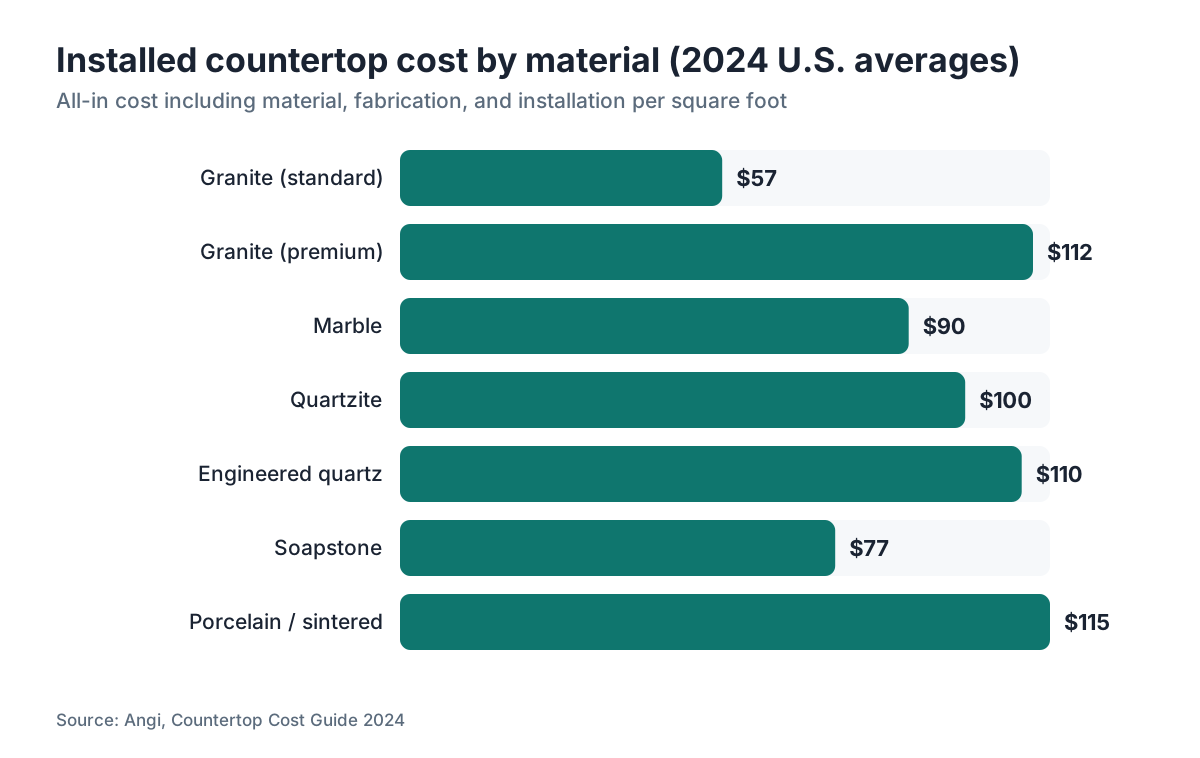
For natural stone like granite or marble, raw slab material runs $5 to $15 per square foot wholesale for commodity patterns, and $20 to $60 per square foot or more for premium, exotic, or book-matched slabs. Fabrication and installation labor (cutting, edging, delivery, install) typically adds $35 to $85 per square foot depending on region, edge complexity, and cutout count [5].
Engineered quartz (Cambria, Silestone, Caesarstone) usually arrives with fabrication baked into the installer's quote, because the manufacturer sells through certified fabricators. All-in installed cost for quartz runs $70 to $150 per square foot in most U.S. markets as of 2024 [5].
Cost per square foot by material:
| Material | Material only ($/sq ft) | Installed all-in ($/sq ft) |
|---|---|---|
| Granite (standard) | $5, $15 | $40, $75 |
| Granite (premium/exotic) | $15, $60 | $75, $150 |
| Marble | $10, $40 | $50, $130 |
| Quartzite | $15, $50 | $60, $140 |
| Engineered quartz | $15, $40 (material) | $70, $150 |
| Soapstone | $10, $30 | $55, $100 |
| Porcelain/sintered | $15, $50 | $70, $160 |
Those ranges run wide because regional labor rates swing hard. A shop in rural Iowa charges less than a shop in San Francisco. Expect a 15 to 30 percent premium in high cost-of-living metros.
Upcharges catch homeowners off guard. Non-standard edge profiles add $10 to $30 per linear foot. A sink cutout typically adds $100 to $200. A cooktop cutout adds $75 to $150. Mitered edges for waterfall islands add $30 to $60 per linear foot. Any radius or arc cut on a CNC adds time, and time is cost.
For granite countertops specifically, the cheapest stones get called 'level 1' or 'entry-level' and tend to be thinner slabs (2 cm) in common patterns. Want the drama of a Calacatta or Blue Bahia? Plan to spend more.
What equipment does a stone fabrication shop use?
A modern shop's equipment list looks intimidating. Here is what each machine actually does.
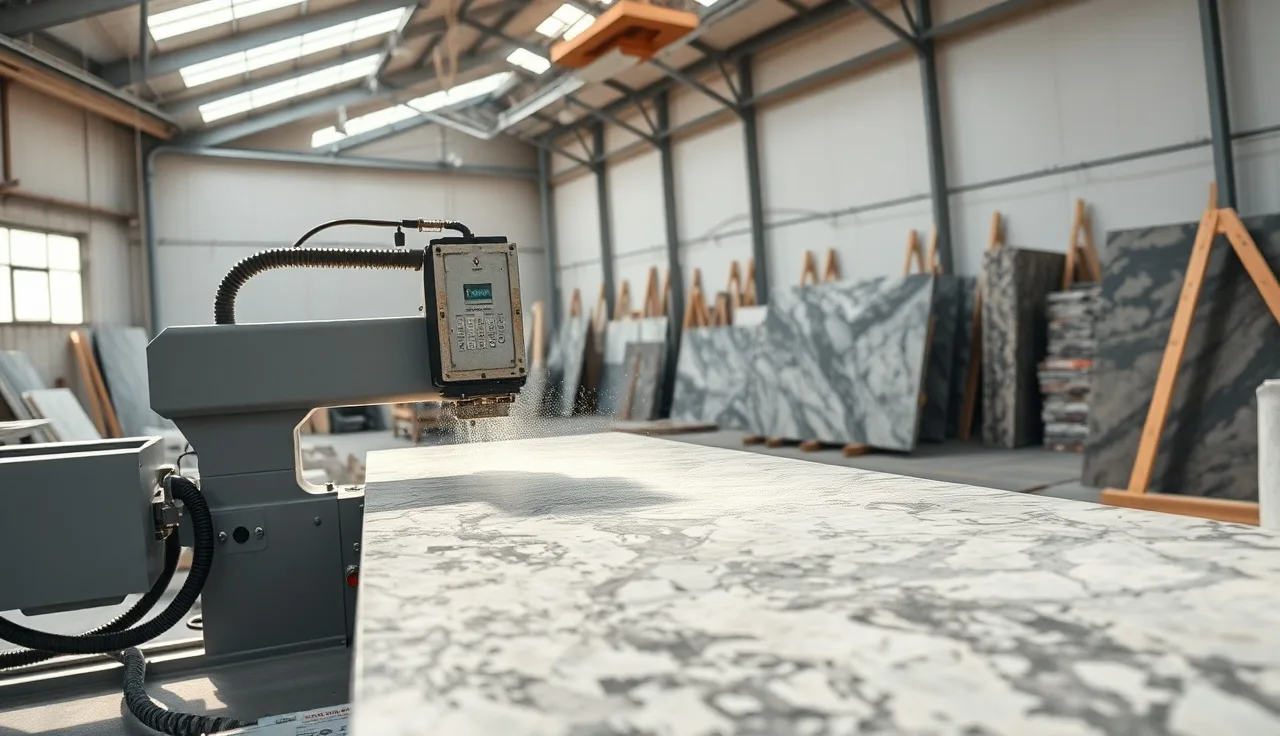
The bridge saw is the workhorse. It looks like a very large tile saw, with the blade on a gantry that travels the length of a flat table. The slab sits on the table, water sprays constantly to cool the blade and knock down silica dust, and the cut follows a programmed or hand-guided path. A basic manual bridge saw costs $15,000 to $40,000. A CNC-controlled bridge saw runs $80,000 to $200,000 or more.
A CNC router (sometimes called a CNC machining center) handles edge profiling, sink cutouts, and surface carving with a rotating spindle and interchangeable diamond tooling. A mid-range CNC edge machine costs $50,000 to $150,000.
A water-jet cutter uses high-pressure water and abrasive for detailed cuts with no heat. These machines run $100,000 to $300,000 and show up in high-end shops doing inlay work or complex radius cuts.
A laser templating system captures job-site dimensions digitally and records coordinates to within about 1 mm. The Proliner by Prodim and the LT-2D3D by Laser Products Industries are the common brands in the U.S. [1].
A polishing machine (flat lap or profile wheel) steps through abrasive grits to hit the specified finish. Honed finishes stop around 400 grit. Polished finishes run to 1,500 or 3,000 grit, sometimes with a final buffing compound.
Smaller shops without CNC gear are not automatically worse. An experienced fabricator with an angle grinder gets excellent results. What CNC buys you is repeatability and speed, not a higher quality ceiling.
What materials can be fabricated, and how do they differ to work with?
The process shifts a lot by material. Hardness (measured on the Mohs scale), porosity, and brittleness all drive blade choice, feed rate, cooling, and how gently you handle the piece.
Granite scores 6 to 7 on the Mohs scale, one of the harder materials on the shop floor [6]. It cuts cleanly with a good diamond blade and takes moderate feed rates. It forgives rough handling.
Marble sits at 3 to 5 on the Mohs scale. It cuts easily and chips just as easily. Fabricators slow down on marble edge profiles and watch every corner. See our marble countertops article for care issues that start at the fabrication stage.
Quartzite (the natural metamorphic rock, not engineered quartz) can hit 7 or above on the Mohs scale, which makes it harder than granite and brutal on tooling. Blade life drops fast. Feed rates have to slow, especially on quartzites with mica or iron-oxide bands that machine unpredictably.
Engineered quartz is a composite: roughly 90 to 94 percent ground quartz bound with polymer resin [7]. It machines more like a synthetic. It is isotropic (uniform in every direction), so fewer surprises, but the resin melts if a blade runs too slow or overheats and leaves a gummy smear.
Porcelain and sintered stone (Dekton, Neolith) are very hard, very brittle, and quick to chip at cut edges if the blade dulls or the feed rate drifts. Many shops run a fresh blade for every porcelain job. Some add a scoring pass before the through-cut.
Soapstone is soft (Mohs 1 to 2) and easy to cut, but it can smear instead of chipping, which changes the surface finish. Our guide on how to clean soapstone countertops covers the finish traits that trace back to fabrication choices.
Comparing materials as a homeowner? kitchen countertops has a broader look at how material choice shapes daily life, beyond fabrication.
How does silica dust exposure get managed in stone fabrication?
Cutting, grinding, and polishing stone throws off respirable crystalline silica dust, and how a shop handles it is the single biggest safety question in the trade. Silica is the mineral that makes up most of the quartz in granite, engineered quartz, and many other stone types. Inhaled as fine particles (smaller than 10 microns), it causes silicosis, an irreversible and sometimes fatal lung disease [8].
This part of the job gets the least airtime in homeowner guides and the most regulatory attention in the industry. There is a reason for that.
OSHA's permissible exposure limit for respirable crystalline silica is 50 micrograms per cubic meter of air as an 8-hour time-weighted average, set in the final rule published June 23, 2016 (29 CFR 1910.1053 for general industry, 29 CFR 1926.1153 for construction) [8]. The agency's stated goal in the rule was to prevent about 600 deaths and 900 new cases of silicosis per year.
Engineered quartz has drawn the sharpest concern. A 2019 report in JAMA Internal Medicine on artificial stone countertop workers found earlier disease onset and faster progression to advanced silicosis compared with workers exposed to other stone types, and tied it to the high silica content (90 to 94 percent) in engineered quartz [9].
Compliant shops wet-cut (water suppresses airborne dust at the blade), run local exhaust ventilation over grinding stations, put workers in supplied-air respirators or N95/P100 masks, and clean up with HEPA vacuums. California's Cal/OSHA has gone beyond federal OSHA, adopting an emergency temporary standard for engineered stone in 2023 [10].
As a homeowner, you face no silica risk from a finished countertop sitting in your kitchen. The danger lives entirely in the fabrication shop. Still, ask a shop whether they wet-cut and whether their crew wears respiratory protection. A shop that skips both is cutting corners in more places than one.
How do fabricators keep seams from showing?
Seams are unavoidable on most projects. A standard slab is about 55 to 65 inches wide and 110 to 130 inches long [2]. Any run longer than that needs a seam. L-shaped kitchens almost always carry one at the corner.
Making a seam disappear comes down to placement, color-matching, and execution.
Placement comes first. Good fabricators put seams where they hide best (away from the cook's main work zone, not under a window, not at eye level on an island end) and where the stone's pattern buries the joint. On a heavily veined marble or quartzite, the fabricator may carry the vein across the seam, which takes careful slab selection and layout, sometimes called vein matching.
Color-matched epoxy bonds the seam faces. Most shops mix a two-part polyester or epoxy on site, tinted to match the stone's dominant color and background. Getting the tint wrong is the most common seam complaint. Some fabricators blend four or five colors to nail a busy background.
Execution means both faces cut perfectly square and flush. A 0.5 mm misalignment at the face leaves a ridge you feel every time you wipe the counter. CNC-cut seam faces come out more consistent than hand-cut ones, but a skilled fabricator with a good fence produces an excellent seam by hand.
For engineered quartz like Cambria countertops, the uniform manufactured pattern makes matching easier than a natural stone with wild veining. The tradeoff: quartz seams can still show because the surface bounces light differently at the joint.
How long does stone fabrication take from template to install?
One to three weeks for most residential jobs, and most of that clock is shop queue, not production time. That is the honest answer.
Templating takes two to four hours on site for a typical kitchen. Digital template data is ready immediately. The actual cutting and fabrication for a standard kitchen (30 to 50 square feet, no exotic materials, standard edges) takes four to eight hours of shop time once the job hits the floor.
The gap between those two facts is the shop's backlog. A busy shop in spring or summer, during peak remodel season, might sit on a two-week queue. A slow shop in January might turn a job in five business days.
Some things stretch the lead time. Exotic materials that ship from a distributor add one to two weeks. Book-matched slabs force the fabricator to source adjacent slabs from the same lot. Complex edge profiles need CNC programming. Any structural work at the site that delays install readiness pushes everything back.
If your contractor says the countertops go in the same week as your cabinets, push back. Most fabricators need the cabinets level, shimmed, and fully installed before they will template. From cabinet install to countertop install is almost always at least two weeks once you add the template appointment, shop time, and install scheduling.
What should you look for when choosing a stone fabricator?
This is where a satisfying result and a frustrating one usually get decided.
Start with the seams. Ask to see physical samples, or better, a finished job in person. A good seam is nearly invisible from standing height.
Ask what templating method they use. Digital laser templating beats hand templates on accuracy. If a shop still runs luan strips and hot glue, that is not disqualifying on its own, but ask how they hold accuracy.
Ask whether they run CNC equipment or hand-cut everything. Either answer can be fine. You just want the shop honest about its capabilities relative to your job's complexity.
Read reviews for the pattern of complaints. One bad review about scheduling is noise. Three reviews mentioning chipped edges or visible seams is a signal.
Ask about silica safety. A shop that dry-cuts without respiratory protection is gambling with its workers' lungs, and it is probably cutting corners elsewhere too.
Get the warranty in writing. Most fabricators warrant workmanship for one year. Material warranty comes from the slab supplier, not the fabricator.
Fabricators who want tighter quoting and less waste can lean on tools like SlabWise (slabwise.com) for the nesting and layout math that otherwise eats estimating time.
Finally, ask whether they stock slabs or work through a distributor. A shop with a full yard lets you see and approve your exact pieces before cutting. A shop ordering on your behalf works from catalog photos, which is how surprises happen.
How does stone fabrication differ from other countertop materials?
Stone fabrication is a lot more involved than fabricating laminate, wood, or solid surface, and that is part of why it costs more.
Laminate countertops and Formica countertops get cut with standard woodworking tools (circular saw, router) from sheet goods. They are light, easy to handle, and need no specialized shop. A skilled carpenter can do the work on site.
Butcher block countertops also get cut with woodworking tools and finished with food-safe oils. The fabrication is simpler, though the finishing and acclimation requirements differ.
Corian countertops and other solid surface materials also get fabricated with woodworking tools, but they carry one big advantage: heat-weldable seams that are nearly invisible. Solid surface fabricators get certified by the manufacturer and follow a set process.
Stone is different because of weight, hardness, and brittleness. A 3 cm granite slab at 18 pounds per square foot cannot be carried by one person and will crack if flexed or left unsupported. The specialized equipment, the water cooling, the silica safety, and the skill in matching natural veining across a seam all justify the price premium over other materials.
Comparing the full range? Our kitchen countertops guide lines up every material type side by side.
How do you care for a countertop after stone fabrication?
Fabrication sets the starting point. Maintenance decides the long run.
Most natural stone needs a penetrating sealer reapplied on a schedule that depends entirely on the stone's porosity and how hard the surface gets used. The Natural Stone Institute recommends a water-drop test: pour a few tablespoons of water on the surface, wait about 30 minutes, and check whether it soaked in and left a dark mark. If it did, reseal [4].
Granite in typical kitchen use wants resealing every one to three years. Marble and limestone may need it yearly. Dense quartzite and soapstone may need it rarely or never. Engineered quartz needs no sealer at all, because the resin binder leaves it essentially non-porous [7].
Day to day, use a pH-neutral cleaner. Acidic cleaners (vinegar, citrus-based) etch marble and limestone. Our how to clean stone countertops guide runs through what is safe and what wrecks the finish the fabricator worked to build.
For quartzite, see how to clean quartzite countertops, because quartzite gets mislabeled at the quarry and slab-yard level all the time, and some stones sold as quartzite are actually marble and will etch.
The finish the fabricator applied (polished, honed, leathered, brushed) drives the maintenance. A leathered finish hides fingerprints and light scratches better than a polished one. A honed finish on marble shows etching less than a polished finish, because an etch cannot dull a surface that already reads matte.
Frequently asked questions
What is the difference between stone fabrication and stone installation?
Fabrication is the shop work: cutting slabs to size, profiling edges, making sink cutouts, and polishing. Installation is the site work: delivering the finished pieces, setting them on cabinets with adhesive, joining seams with epoxy, and attaching sinks. The same company usually handles both, but they are distinct phases. Fabrication happens in the shop over several days. Installation typically takes two to four hours on site.
How thick should a stone countertop be?
The two standard thicknesses are 2 cm (about 3/4 inch) and 3 cm (about 1.25 inches). Most residential countertops today use 3 cm because it is strong enough to cantilever a few inches without a substrate and looks more substantial at the edge. Two-centimeter slabs are lighter and cheaper but usually need a plywood substrate for support and look thin without a laminated edge buildup.
Can a cracked stone countertop be repaired after fabrication?
Minor cracks and chips fill with color-matched polyester or epoxy and re-polish. The repair is usually visible up close but acceptable at normal viewing distance. A crack running all the way through a piece is harder to fix and structurally risky. Prevention beats repair: fabricators should transport pieces face-up on padded supports, and install crews should never flex or torque a piece while setting it. A full crack often means replacement.
What edge profiles are available and which is most popular?
Common profiles include eased (square with a softened corner), bevel, half bullnose, full bullnose, ogee, dupont, waterfall, and laminated mitered edges. Eased and beveled edges dominate modern residential work because they suit contemporary cabinets. Ogee is traditional and more ornate. Mitered waterfall edges on island ends are the current high-end trend and add real cost because of the precision they demand.
What is book-matching in stone fabrication?
Book-matching uses two adjacent slabs from the same block, opened like a book, so their veining mirrors across a seam or join. The result looks intentional and dramatic instead of coincidental. It requires the fabricator to source consecutive slabs (usually numbered sequentially at the quarry) and orient them carefully during layout. It adds cost in both material sourcing and layout time, but produces a stunning result on islands and feature walls.
Does engineered quartz fabrication differ from natural stone fabrication?
Mostly no, but a few things change. Engineered quartz has uniform composition, so there is no need to inspect for natural fissures or voids before cutting. The resin binder is sensitive to heat, though, so blade speed and water cooling matter more. The high quartz content (90 to 94 percent) also means more silica exposure per cut, which is why OSHA and Cal/OSHA have aimed enforcement at quartz shops specifically.
How do I know if a stone fabricator is reputable?
Look for membership in the Natural Stone Institute (naturalstoneinstitute.org), which runs accreditation programs for fabrication shops. Check Google and Houzz reviews for any pattern of seam or chip complaints. Ask to see a completed job, in person if you can. Confirm they wet-cut and use respiratory protection. Get a written workmanship warranty. A reputable shop answers all of these without hesitation.
What causes countertop seams to crack after installation?
Seam cracks after install usually trace to one of three things: inadequate support under the seam (no clip or substrate bridging the joint), movement in the substrate or cabinet (a settling house or un-leveled cabinets), or a seam joined with too little epoxy or the wrong adhesive. A well-made seam in a stable installation lasts indefinitely. A seam that cracks within the first year is almost always a workmanship or installation problem, not a material failure.
What is a typical fabrication shop's minimum square footage charge?
Most shops set a minimum of 15 to 25 square feet per job, even when your actual countertop is smaller. That covers setup, template, delivery, and install overhead that does not scale with slab size. A small bathroom vanity with only 6 square feet of stone might still bill at the 20-square-foot minimum. Ask about minimums upfront so a small job does not come with a surprise invoice.
How much material waste should I expect from stone fabrication?
The rule of thumb is that 15 to 25 percent of a slab ends up as unusable offcuts for the current job. That percentage climbs with irregular layouts, lots of cutouts, and heavily veined material that forces careful placement. Good nesting software pushes waste toward 15 percent or below on standard layouts. Leftover pieces often sell as remnants, so ask your fabricator if you want a piece for a bathroom or laundry room.
Can I get a countertop made from a remnant slab?
Yes, and it can save real money. Remnants are offcut pieces from a previous job that the shop keeps in stock. Most shops sell them at a steep discount, sometimes 30 to 50 percent below full-slab price. The catch is selection: you take what is available. Remnants work well for small bathrooms, laundry rooms, or bar tops. A full kitchen needs full slabs unless you are fine with multiple seams.
Do fabricators seal stone before delivery or do I need to do it?
Most fabricators apply an initial penetrating sealer before delivery, but they do not always advertise it and application quality varies. Ask specifically whether sealing is included. Even when they seal it, you will need to reseal periodically over the life of the countertop. Frequency depends on the stone (dense granite may go three years, softer marble may need it annually) and how hard you use the surface.
What is sintered stone and is fabrication different?
Sintered stone (Dekton, Neolith, Lapitec) is made by applying extreme heat and pressure to a mix of raw minerals, creating a very dense, low-porosity slab. It is UV-stable, heat-resistant, and non-porous. Fabrication resembles porcelain: very hard, very brittle, and quick to chip at cut edges. Shops run fresh blades, slow feed rates, and sometimes score before the through-cut. It is among the more demanding materials to fabricate well.
What questions should a homeowner ask before signing a fabrication contract?
Ask: What templating method do you use? Will I see and approve my exact slabs before cutting? How are seams placed and how do you match the epoxy color? What is your lead time right now? What does the warranty cover and for how long? Are sink and cooktop cutouts included in the quote or extra? Do you seal the stone before delivery? What happens if a piece chips or cracks during install? Written answers to all of these prevent most post-job disputes.
Sources
- Natural Stone Institute, Technical Manual Vol. 2: Standard slab dimensions and bridge saw feed rates for granite fabrication.
- OSHA, Water Jet Cutting: Hazards and Controls (Safety and Health Information Bulletin): Water-jet cutting operates at pressures up to 60,000 psi and produces minimal heat stress on material.
- Natural Stone Institute, Care and Cleaning of Natural Stone: The water-drop test: if water absorbs into stone in under 4 minutes, the surface requires a penetrating sealer.
- Angi, Countertop Installation Cost Guide 2024: Installed countertop costs range from $40 to $150 per square foot depending on material, with engineered quartz averaging $70 to $150 installed.
- U.S. Geological Survey, Mineral Resources Program: Granite scores 6 to 7 on the Mohs hardness scale.
- Natural Stone Institute, engineered stone product composition overview: Engineered quartz countertop surfaces contain approximately 90 to 94 percent ground quartz bound with polymer resin.
- OSHA, Occupational Exposure to Respirable Crystalline Silica Final Rule (29 CFR 1910.1053 and 1926.1153), June 23, 2016: OSHA's permissible exposure limit for respirable crystalline silica is 50 micrograms per cubic meter as an 8-hour TWA; the final rule was published June 23, 2016.
- JAMA Internal Medicine, 'Silicosis in Artificial Stone Countertop Workers' (2019): Artificial stone countertop workers showed earlier disease onset and faster silicosis progression than workers exposed to other stone types, attributed to high silica content.
- Natural Stone Institute, NSI Accreditation Program for Stone Fabricators: The Natural Stone Institute operates an accreditation program for stone fabrication shops that evaluates equipment, safety, and workmanship standards.
Last updated 2026-07-10