TL;DR
- Big Apple Masonry Supply is a New York distributor of natural stone, brick, mortar, and masonry materials, selling to contractors and homeowners.
- It sells raw material, not finished countertops.
- A fabricator does the cutting and installing.
- Knowing where a regional yard sits in the chain from quarry to kitchen helps you buy smarter and skip the common, expensive mistakes.
What is Big Apple Masonry Supply and what do they sell?
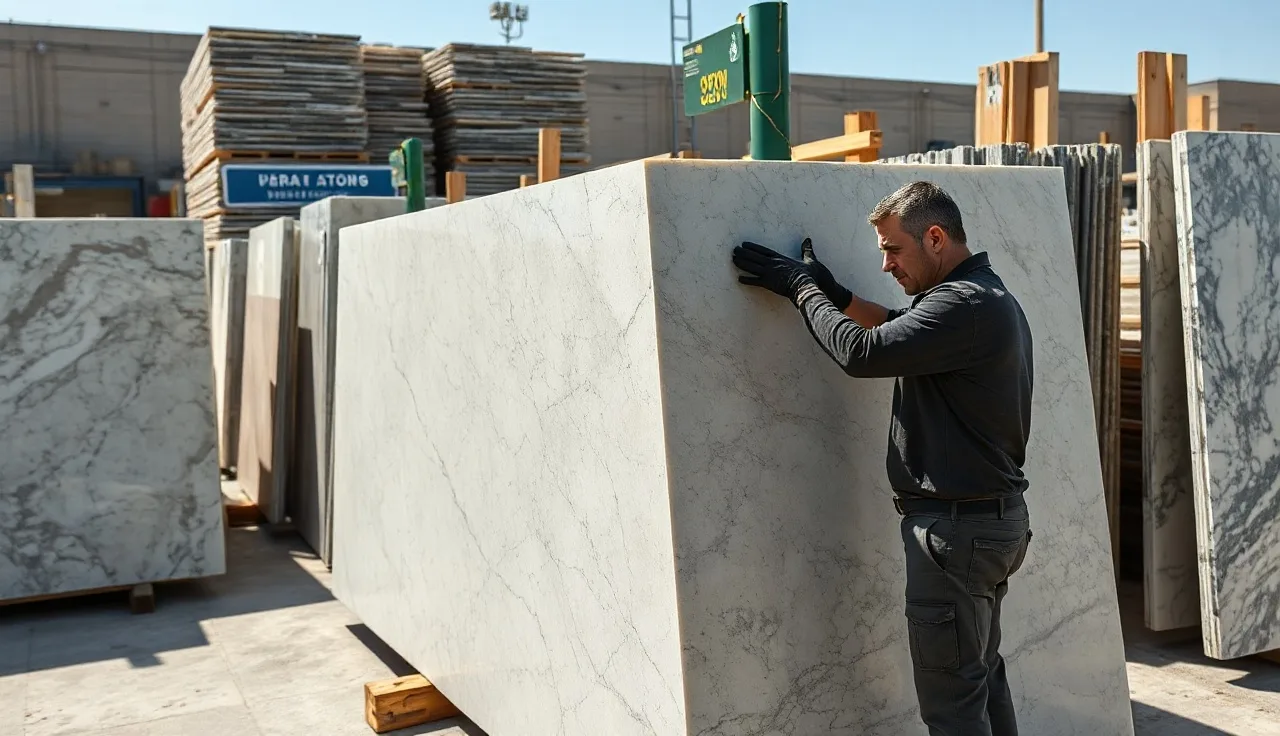
Big Apple Masonry Supply is a masonry and stone supply company in the New York metro area. They stock natural stone slabs, brick, block, mortar, setting materials, and a mix of hardscape and masonry products aimed at contractors, landscapers, tile setters, and homeowners taking on big projects.
The company sits in a spot in the supply chain that confuses a lot of buyers: they are a distributor and materials yard, not a fabrication shop. That difference matters. A distributor sells you raw or semi-finished material. A fabricator takes that material, cuts it to your kitchen's exact dimensions, polishes the edges, cuts the sink opening, and installs the finished countertop. Some companies do both. Most pick one lane and stay in it.
New York City has an unusually dense stone supply scene because of how much building happens here. The five boroughs and the close suburbs generate enough demand to support dozens of yards, importers, and fabricators within a short drive of each other. Big Apple Masonry Supply is one materials source in that mix, which means the quality of what you end up with depends heavily on the fabricator or contractor you hire to work the stone.
Most homeowners never deal with a supplier like this directly. Fabricators buy their slabs wholesale from distributors, mark them up inside the installed price, and handle the sourcing logistics for you. Walking into a stone yard yourself can save money in some cases, but it adds work: you have to move the slab, coordinate with your fabricator, and eat the risk if the material gets damaged on the way.
How does a masonry supplier fit into the countertop fabrication supply chain?
A granite slab makes at least four stops between a quarry in Brazil or India and your kitchen: the quarry, an importer or broker, a regional distributor (a masonry supply company), and a fabricator. Every stop adds cost, handling risk, and time.
Quarries sell in bulk container loads. Importers buy those containers, warehouse the slabs, and sell to regional yards. Regional yards like Big Apple Masonry Supply buy from importers or straight from overseas suppliers, hold slabs for local access, and sell to fabricators, contractors, and sometimes directly to homeowners.
Here is why the chain matters for your budget:
| Supply Chain Stage | Typical Markup Over Quarry Price | Who Buys Here |
|---|---|---|
| Quarry / Mine | Baseline | Importers only |
| Importer / National Distributor | 40-80% over quarry | Regional yards, large fabricators |
| Regional Yard (e.g., masonry supply) | 20-50% over importer | Local fabricators, contractors |
| Fabricator to Homeowner | 50-150% over slab cost | Homeowners |
Those ranges are rough industry estimates. Nobody publishes audited margin data at each step. The fabricator markup covers cutting, edge profiling, templating labor, installation, and overhead, so it is not pure profit. But the cumulative math is real: the slab you fall in love with in a showroom might carry three to four times the quarry price by the time it is bolted to your cabinets.
Fabricators who buy closer to the importer level, skipping the regional yard, squeeze those margins in their favor. For homeowners, a regional yard like Big Apple Masonry Supply sells convenience and local stock, not price savings against a fabricator who already has supplier accounts.
Want to see how these pieces line up into a finished kitchen? The countertop installation guide walks the sequence from template to install in practical detail.
What types of stone and masonry products does a supply company like this carry?
A full-service masonry supply yard in a major metro usually stocks several overlapping product categories. Natural stone is the one countertop buyers care about, but it is a small slice of total inventory at most yards.
Natural stone slabs for countertops include granite, marble, quartzite, limestone, travertine, and soapstone. Slab sizes shift by material and origin, but most full slabs run roughly 55 to 65 inches wide and 100 to 120 inches long, and jumbo slabs can pass 130 inches in length [1]. Thickness is typically 2 centimeters or 3 centimeters. The 3 cm slab is the current countertop standard because it does not need a plywood substrate underneath.
Beyond countertop slabs, a masonry yard carries:
- Masonry units: brick, concrete block (CMU), natural stone pavers, retaining wall block
- Setting materials: thinset mortar, grout, tile adhesive, epoxy mortars
- Sand and aggregate: mason's sand, coarse aggregate, polymeric sand
- Hardscape products: flagstone, bluestone, fieldstone, tumbled pavers
- Waterproofing and sealers: stone sealers, concrete waterproofers, efflorescence treatments
- Tools and accessories: trowels, spacers, grout floats, mixing paddles
If you are a homeowner hunting for a countertop slab, the section you care about is the slab yard. Tile-format stone (usually 12x12 or 18x18 inch pieces) sits at most yards too and works for DIY countertops, though tile counters have mostly lost out to solid slab surfaces.
What does natural stone cost when buying from a regional supplier?
Slab prices at a regional distributor swing hard by material, origin, thickness, and the current market. The numbers below reflect general 2024-2025 ranges for the New York metro area. They are not quotes from any specific company.
| Material | Price per Square Foot (slab only, uninstalled) | Notes |
|---|---|---|
| Granite, standard colors | $5 - $15 | Brazilian and Indian origins most common |
| Granite, exotic/rare | $20 - $60+ | Book-matched, unusual movement |
| Marble (Carrara, etc.) | $15 - $40 | Prone to etching; verify finish |
| Quartzite | $20 - $65 | Hardness varies significantly by source |
| Limestone / Travertine | $10 - $30 | More porous; needs sealing |
| Soapstone | $25 - $50 | Dense, non-porous |
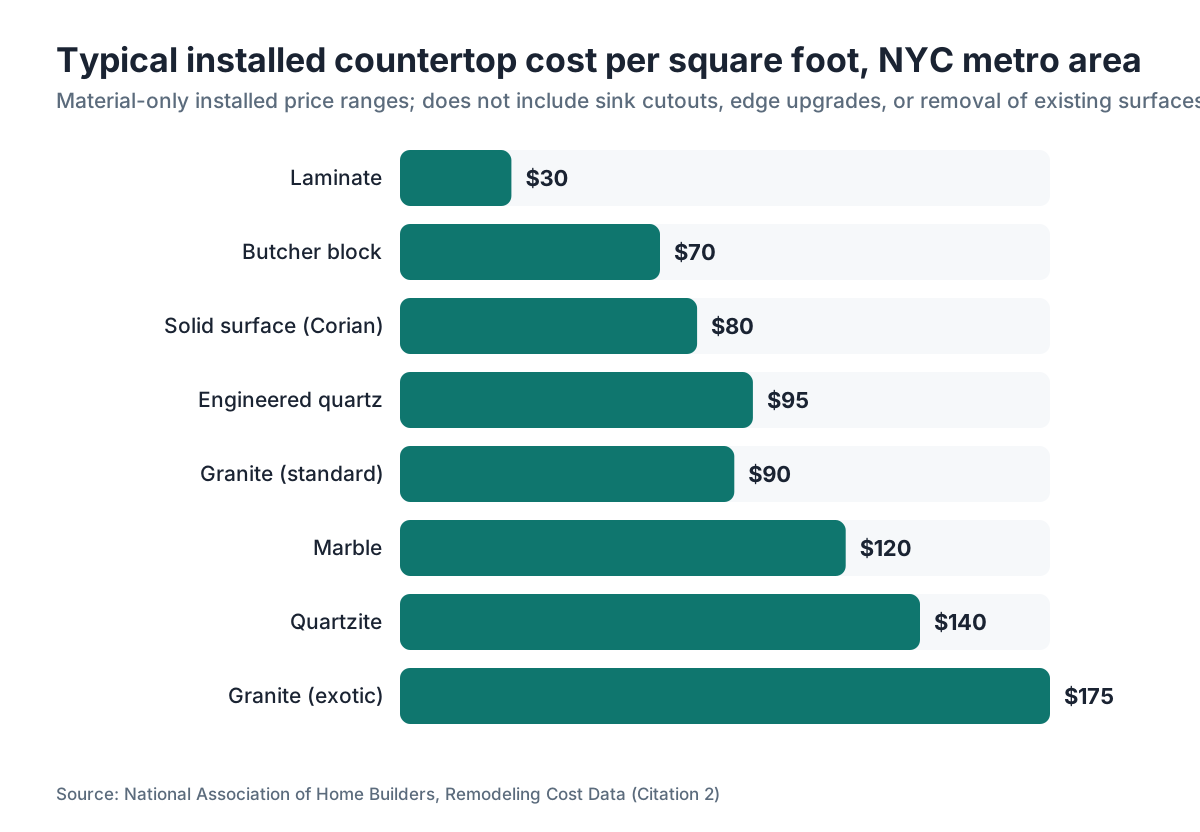
Those are raw slab costs. Once a fabricator adds cutting, edge work, templating, and installation, installed granite in the New York area typically runs $60 to $120 per square foot for standard materials, and it can pass $200 per square foot for exotic stone with complex edge profiles [2].
Thinking about sourcing your own slab to save money? Do the math first. Most fabricators charge a processing fee or surcharge when you supply your own material, because they lose the slab markup that normally covers overhead. That surcharge runs $10 to $30 per square foot, which can erase whatever you saved buying direct.
For a shop, the calculus flips. A direct account with a regional supplier drops your per-slab cost and gets you priority on new shipments. If you template and install dozens of jobs a month, even a few dollars per square foot of margin adds up fast. Tools like SlabWise help shops track material cost per job and see exactly where the margin leaks, which matters most when you juggle several suppliers at different price tiers.
How do you evaluate a stone slab in person at a yard?
Most homeowners walk into a yard, glance at a display sample the size of a dinner plate, and pick a color. That is the wrong way to do it, and it causes more project regret than almost any other single mistake.
Look at slabs standing vertically, under light close to what your kitchen has. A pattern that reads as subtle on a small horizontal chip can look loud once it is cut and laid flat across a counter. Ask the yard to tilt the slab or pull it from the rack so you see the whole face.
Check these before you buy:
Fissures vs. cracks. Fissures are natural separations that formed during the stone's geology. They sit at the surface and are acceptable in most materials. Cracks run through the slab and are actual breaks. Drag a fingernail across a line you spot: if you feel a ridge or the nail catches, it may be a crack. A fissure sits flush with the surface [3].
Pitting. Some granites and limestones have natural pits or voids. Small pits are normal, and a fabricator can fill them with epoxy. Large or numerous voids can cause trouble during polishing or sealing.
Color and veining consistency. Natural stone is not uniform. If you need two slabs for a big kitchen, ask the yard to pull them from the same bundle. Slabs cut in sequence from the same block are a bundle, and they match closest. Book-matching, where two neighboring slabs mirror each other into a symmetrical vein, is possible but needs planning with your fabricator up front.
Surface finish. Most slabs arrive polished, but honed, leathered, and brushed finishes exist too. How to clean stone countertops changes by finish: honed surfaces stain more easily and need sealing more often than polished ones.
Quartzite deserves extra suspicion. True quartzite is metamorphosed sandstone and very hard, roughly 7 on the Mohs scale [4]. But the trade slaps the word quartzite on materials that are actually soft marbles or dolomitic stones. A scratch test with a steel key (about 5.5 Mohs) gives you a rough field check: if the key scratches the surface, it is not true quartzite. More on this in the how to clean quartzite countertops guide.
What should homeowners know about buying stone in New York specifically?
New York City throws some constraints at buyers that other markets do not.
Access and delivery logistics are a serious problem. Getting a 600-pound slab through a Manhattan brownstone or up a narrow Queens driveway is a different job than dropping one in a suburban garage. Ask any supplier or fabricator about their delivery setup before you commit. Some NYC fabricators will not take jobs in certain buildings without a freight elevator or a loading dock.
The New York City building code requires permits for certain renovation work, though countertop replacement by itself usually does not trigger a permit as long as nothing structural changes [5]. Check with your borough's Department of Buildings if the project involves moving plumbing, altering cabinets, or any structural change alongside the countertop.
New York sales tax hits stone materials and fabrication services in most cases. As of 2025, New York State sales tax is 4%, and New York City adds another 4.5%, for a combined rate of 8.875% [6]. That is real money on a $5,000 countertop job.
Labor in NYC runs among the highest in the country. Fabricators in the five boroughs and close suburbs pay more for skilled CNC operators, installers, and shop staff than shops elsewhere, and that cost lands on the customer. A job that runs $80 per square foot installed in Atlanta can easily hit $120 to $150 per square foot in Brooklyn or Manhattan, same material, same edge profile.
If your budget is tight, look hard at laminate countertops or formica countertops as honest alternatives. Modern laminate has gotten much better and can fake stone at a fraction of the price. No shame in that for a rental, a tight budget, or a second kitchen.
What is the fabrication process from slab to installed countertop?
Most homeowners have no idea what happens between picking a slab and getting a finished countertop. There are more steps than people expect, and knowing them helps you ask sharper questions and dodge delays.
-
Template. After your cabinets are set and any plumbing rough-in is done, a fabricator sends a templater to measure. Modern templating uses digital laser tools (Proliner, LT-55, or similar) that capture exact dimensions and build a digital file [7]. Old-school shops still cut wood or cardboard templates. Digital is faster and more accurate.
-
Layout. The digital template gets laid over a digital scan of your slab. The fabricator, or their layout software, decides how to position each piece to use material well and land the best part of the stone's pattern on your counter. This is called nesting.
-
Cutting. A CNC waterjet or bridge saw cuts the slab to the templated shapes. Sink cutouts, cooktop openings, and faucet holes get cut at this stage.
-
Edge profiling. Exposed edges get shaped on a CNC edge machine or by hand: eased, beveled, bullnose, ogee, mitered, and dozens more. Fancier profiles cost more.
-
Finishing. Surfaces are polished to the specified finish, joints get checked, pieces get cleaned.
-
Installation. Installers bring the cut pieces to your home, dry-fit them, apply adhesive or silicone to the cabinet tops, set the stone, caulk joints and backsplash seams, and clip in any undermount sink.
The whole run from template to install usually takes 7 to 14 days for a standard residential job, though busy shops in peak season (spring and fall) run longer [8].
For shops running many jobs at once, the nesting and layout step is where software earns its keep. How you cut pieces from a slab drives material yield, and yield drives whether the job made money.
How do stone countertops compare to engineered and solid surface options?
Natural stone from a supplier like Big Apple Masonry Supply is one category among several. It helps to know where it sits against the alternatives, because the right material depends on how you use the kitchen, your budget, and how much maintenance you will tolerate.
Marble countertops look elegant but etch and stain more easily than granite or quartzite. Cook with citrus or wine often and marble will show it. Soapstone is non-porous and shrugs off acids, but it scratches and darkens with mineral oil over time, which plenty of owners actually like.
Engineered quartz (Cambria, Silestone, Caesarstone) is made from roughly 90 to 94 percent ground quartz bound with polymer resin [9]. It needs no sealing, looks highly uniform, and resists staining better than most natural stone. The tradeoff is heat: set a hot pan straight on quartz and you can discolor the resin binder. Cambria countertops are made in the US (Eden Prairie, Minnesota) and carry a lifetime warranty, which is a genuine difference.
Solid surface like Corian countertops is acrylic-based, fully repairable by sanding, and joins with no visible seam when installed right. It is softer than stone and will scratch, but the scratches sand out. Good pick for healthcare settings and secondary surfaces where you value repairability.
Butcher block countertops are wood, need regular oiling, and should not sit wet for long. They work well for prep areas and islands.
My honest take: for a primary kitchen that sees daily cooking, granite or quartzite from a reputable supplier is a strong long-term choice. It is durable, a stone restoration pro can repair it if it gets damaged, and it holds value at resale. The premium natural stones (rare marbles, exotic granites) are aesthetic calls, not performance upgrades.
How do fabricators build relationships with stone suppliers, and why does it matter?
For a fabricator, the supplier relationship is a real business asset. Shops that run steady volume through a regional yard get several perks: first look at new slab arrivals, better payment terms, a supplier willing to hold slabs for ongoing jobs, and sometimes remnants at a cut price.
Remnants are the pieces left over after a job is cut. A full slab might yield a kitchen countertop and leave a piece 30 by 60 inches. That remnant has real value for small jobs (bathroom vanities, laundry counters, small islands), and a supplier who gives you first crack at remnants hands you a real cost edge.
Building that relationship takes consistent ordering, paying invoices on time, and being an easy customer. Sounds obvious. Plenty of small shops still torch their supplier relationships with slow payment, disputed invoices, or endless slab returns.
On the operational side, shops that track material cost carefully can see what each supplier actually costs versus delivers. Spend $40,000 a month in stone at a regional yard, run only 65% yield from bad nesting, and you are throwing away roughly $14,000 of material. Push yield to 78% (a realistic target with good software) and you save over $5,000 a month on the same spend. That math is why software tying quoting, templating, and shop production together matters for fabricators serious about margin.
If you are sizing up those tools, SlabWise has a demo that shows how quoting and nesting connect to real job costs. Worth a look if you run more than a handful of jobs a week.
What questions should you ask before buying stone from any supplier?
Homeowner walking into a yard or fabricator vetting a new supplier, the same basic questions separate good sourcing calls from ones you regret.
For homeowners:
Can I see the actual slab I am buying? Not the sample. Not a photo. The slab. Patterns vary within a bundle and vary a lot between bundles. You are buying this specific piece of stone.
What is the return or exchange policy if the fabricator finds a crack during cutting? Fabricators sometimes do not find internal defects until the saw hits the stone. Know in advance who eats that cost.
Is this material what it says it is? Mislabeling in the stone trade happens often enough that the Federal Trade Commission has flagged fraud concerns in imported natural stone products [10]. If a slab is tagged quartzite but looks a lot like marble and carries a suspiciously low price, ask for a scratch test or Mohs check.
What sealer do you recommend for this material? A supplier who knows their stock gives you a specific answer, not a wave toward a shelf of bottles.
For fabricators:
What is the lead time to restock popular colors? If you are mid-project and one slab breaks, can you get a match in time?
Do you offer bundle purchasing? Keeping a bundle together guarantees matching material for large kitchens or future repairs.
What are your credit terms? Net 30 is standard. Some yards run net 15 or want prepayment for new accounts.
Do you have digital inventory I can browse before driving out? Some yards now photograph every slab and post it online, which saves a ton of time.
What is your remnant policy? Can I buy remnants, and how are they priced?
How do you care for natural stone countertops after installation?
Stone from a supplier like Big Apple Masonry Supply lands in kitchens and bathrooms that see daily use. Care is simpler than most people think, but a few common mistakes cause real damage.
Sealing. Granite, marble, quartzite, limestone, and travertine are porous to varying degrees and benefit from sealing. Quick test: drop a little water on the surface and wait 10 minutes. Water beads, the sealer works. Water absorbs, time to reseal [11]. Most granite counters want sealing once every one to three years depending on the stone's porosity and the sealer. Quartz and soapstone need no sealing.
Cleaning. Use pH-neutral dish soap and warm water for daily cleaning on all natural stone. Skip vinegar, lemon juice, bleach, and ammonia-based cleaners. They are acidic or caustic and will etch polished marble and limestone. The how to clean stone countertops guide has material-specific steps.
Heat. Natural stone handles heat better than engineered quartz, but thermal shock (a cold slab hit suddenly with a very hot pan) can crack thin or already-stressed spots. Use trivets anyway. Not worth the gamble.
Cutting. Do not cut directly on stone. It dulls your knives before it visibly hurts the stone, but it is still bad practice. Use a board.
Stain response. If something spills, blot it right away rather than wiping, which spreads it. For oil-based stains on porous stone, a poultice of baking soda and hydrogen peroxide left on for 24 hours often pulls the stain out [12]. For etches (dull spots on polished marble from acid), a marble polishing powder can bring back the shine without a pro in minor cases.
What are the alternatives if natural stone is outside your budget?
Natural stone is a long-term buy. Installed granite or quartzite in a New York kitchen might run $8,000 to $15,000 for a full kitchen, fabrication and installation included. For a lot of projects, that is not the right spend.
Engineered quartz is usually the first alternative people weigh. It prices slightly below premium natural stone in most markets and asks less of you on maintenance. A 2024 analysis of remodeling data from the National Kitchen and Bath Association found engineered quartz was the most commonly specified countertop material in North American kitchen remodels, ahead of natural stone by volume [13].
Laminate countertops have come a long way. Modern high-pressure laminate with stone-pattern printing installs for $20 to $40 per linear foot, against $150 to $300 per linear foot for premium natural stone in NYC. For a rental or a tight renovation budget, that gap is hard to argue with.
Butcher block countertops run $40 to $100 per square foot installed depending on wood species and thickness, and they are a genuinely warm, functional surface for prep areas.
The trick is matching material to use. A polished marble island in a kitchen that mostly hosts dinner parties and light cooking is a defensible choice. That same marble in a kitchen used for daily family cooking with young kids will look beaten up inside two years. Honest expectations kill buyer's remorse better than any amount of sealing.
Frequently asked questions
Is Big Apple Masonry Supply open to the public, or only to contractors?
Most regional masonry supply yards in the New York area sell to both contractors and the general public, though pricing tiers often differ. Contractors with accounts may get trade pricing; walk-in retail customers typically pay a higher per-unit price. Call ahead to confirm current policies, hours, and whether they require a minimum purchase for certain products like full stone slabs.
Can I bring my own slab to a fabricator in New York, and will they work with it?
Most fabricators in New York will work with customer-supplied slabs, but expect a surcharge of roughly $10 to $30 per square foot above their normal fabrication rate. Fabricators lose their material margin when you supply the slab, and they also take on some liability risk if the material has defects that only appear during cutting. Get the policy in writing before committing to any slab purchase.
What is the difference between a masonry supply company and a stone fabricator?
A masonry supply company sells raw or semi-finished materials: slabs, brick, mortar, pavers. A fabricator takes a stone slab and cuts, shapes, finishes, and installs it as a countertop. Some companies do both. If you are buying a countertop, you need a fabricator; the supply company is just one possible source for the raw material the fabricator uses.
How much does a granite countertop cost installed in New York City?
Installed granite countertops in the New York City metro area typically run $60 to $150 per square foot for standard materials, and can exceed $200 per square foot for exotic granites with complex edge profiles. A typical NYC kitchen of 40 to 50 square feet of countertop surface runs $3,000 to $7,500 for standard granite fully installed, depending on material grade and fabricator.
Do masonry supply companies sell remnants, and are they a good deal?
Some masonry yards sell remnants, though their primary business is full slabs and bulk masonry materials. Dedicated stone fabricators are more likely to have a remnant inventory. Remnants can be excellent value for small projects like bathroom vanities or laundry counters, often priced 30 to 60 percent below full-slab per-square-foot rates. The limitation is that you cannot choose the exact piece size.
What stone materials are best for kitchen countertops in a busy household?
Granite and quartzite are the most practical natural stone choices for high-use kitchens. Both are hard (granite around 6 to 7 Mohs, true quartzite around 7), resist scratching and heat reasonably well, and can be sealed to resist staining. Marble is beautiful but etches from acids and is better suited to kitchens with lighter use. Soapstone is non-porous and acid-resistant but softer and will show knife marks.
How long does it take from picking a stone slab to having countertops installed?
From slab selection to installed countertop typically takes two to four weeks. Template measurement happens after cabinets are set, usually one day. Fabrication takes five to ten business days for a standard residential job. Installation takes one to two days. Busy shops in spring and fall can extend lead times. Always ask for a written schedule before signing a fabrication contract.
Do I need a permit to replace countertops in New York City?
Countertop replacement alone, with no changes to plumbing, electrical, or structural elements, generally does not require a permit in New York City. If your project involves moving a sink, altering cabinetry that affects structure, or changing electrical outlets, permits may be required. The NYC Department of Buildings is the authoritative source; check with your borough office for your specific project.
What is the best way to seal granite countertops, and how often is it needed?
Apply a penetrating stone sealer (siloxane or silicone-based) to a clean, dry surface and let it absorb for the time specified by the manufacturer, then buff off the excess. Most granite surfaces need resealing every one to three years. Test by placing a few drops of water on the surface: if they absorb within a few minutes rather than beading up, it is time to reseal. High-porosity granites may need annual sealing.
Is mislabeling of stone materials a real problem when buying from suppliers?
Yes, it is a real and documented issue in the natural stone trade. Softer materials, especially dolomitic stones or soft marbles, are sometimes sold as quartzite at quartzite prices. The Federal Trade Commission has flagged fraud concerns related to imported natural stone labeling. A simple field test is scratching the surface with a steel key: true quartzite (7 Mohs) will not scratch; softer mislabeled materials will show a mark.
What edge profiles are available for stone countertops, and do they cost extra?
Common edge profiles include eased (slightly softened square edge), beveled, bullnose (fully rounded), ogee (S-curve), and mitered (for thick-looking edges with a 45-degree joint). Simple profiles like eased or standard bevel are usually included in fabrication pricing. Complex profiles like ogee or full bullnose add $10 to $25 per linear foot. Mitered edges that create a 2-inch thick visual profile can add $30 to $50 per linear foot or more.
How do fabricators calculate countertop pricing, and what should be on a quote?
A proper fabrication quote should itemize: square footage of material at a per-square-foot rate, edge linear footage at a per-foot rate by profile, sink cutout costs, faucet hole charges, removal of existing countertops if applicable, delivery, and installation. Material and fabrication are sometimes bundled as one per-square-foot price. Get quotes broken out so you can compare accurately across shops; a low total price can hide a thin material choice or excluded charges.
What should I look for when choosing a stone fabricator in the New York area?
Look for a shop that does digital templating (laser measurement, not cardboard), has CNC cutting equipment, and can show you recent comparable completed projects. Ask whether they fabricate in-house or subcontract cutting to another shop. Confirm they carry liability insurance and offer a written warranty on fabrication work. Check their Google and Yelp reviews specifically for mentions of installation quality and communication, more than the initial sale experience.
Are engineered quartz countertops better than natural stone for most homeowners?
For maintenance-averse homeowners, engineered quartz is often the better practical choice: it needs no sealing, is highly stain resistant, and is more consistent in appearance. Natural stone wins on heat resistance, long-term repairability (a damaged stone surface can be honed and repolished by a pro), and the irreplaceable variation of genuine geology. The choice comes down to how much maintenance you are willing to do and whether visual uniqueness matters to you.
Sources
- Marble Institute of America (MIA+BSI), Dimension Stone Design Manual: Standard full stone slabs typically measure 55-65 inches wide and 100-120 inches long; jumbo slabs exceed 130 inches.
- National Association of Home Builders, Remodeling Cost Data: Installed stone countertop prices in major northeastern metros commonly range $60-$200+ per square foot depending on material and complexity.
- Marble Institute of America (MIA+BSI), Consumer Stone Care Resources: Fissures are natural features flush with the stone surface; cracks represent through-breaks and are structurally different.
- U.S. Geological Survey, Mohs Hardness Scale Reference: True quartzite rates approximately 7 on the Mohs hardness scale, reflecting its metamorphosed sandstone composition.
- New York State Department of Taxation and Finance, Sales Tax Rates: New York State sales tax is 4%; New York City adds 4.5%, for a combined rate of 8.875% as of 2025.
- National Kitchen and Bath Association, Project Timeline Guidelines: Standard residential countertop fabrication and installation takes 7-14 days from template to install under normal shop load conditions.
- Marble Institute of America (MIA+BSI), Engineered Stone Standards: Engineered quartz countertop products contain approximately 90-94% ground quartz bound with polymer resin binders.
- Federal Trade Commission, Import Fraud and Consumer Protection: Stone Products: The FTC has flagged fraud concerns related to mislabeling of imported natural stone, including materials sold under incorrect trade names.
- Marble Institute of America (MIA+BSI), Stone Sealing and Maintenance Guide: A simple water bead test indicates sealer effectiveness: water that absorbs into the stone surface within minutes indicates resealing is needed.
- Marble Institute of America (MIA+BSI), Stain Removal Procedures: A poultice of baking soda and hydrogen peroxide applied for 24 hours can draw oil-based stains from porous natural stone.
- National Kitchen and Bath Association, 2024 Design Report: Engineered quartz was the most commonly specified countertop material in North American kitchen remodels in 2024, ahead of natural stone by volume.
Last updated 2026-07-09