TL;DR
- Centralized fabrication (large regional or national shops) usually prices stone countertops 15-30% lower than small local shops, thanks to bulk slab buying and automated CNC lines.
- Local fabricators turn jobs faster, talk to you directly, and handle odd custom work without a minimum-order headache.
- Pick based on your timeline, how complex the job is, and how much hands-on control you want.
What does 'centralized' vs 'local' fabrication actually mean?
The countertop trade has split into two pretty distinct models over the last decade. Knowing the difference matters before you take a single quote.
A centralized fabricator is a high-volume shop, sometimes a national chain, sometimes a large regional operation, that runs slabs through automated bridge saws and CNC waterjet machines in a facility that might process hundreds of jobs a week. Companies like MSI, Pental Granite, and Home Depot's fabrication network (run through third-party contractors) work this way. They buy slabs in truckload quantities, which drops their material cost hard, and they spread fixed machine costs across a huge job count.
A local fabricator is usually a smaller, often family-owned shop with one to three saw tables, a manual or semi-automated CNC router, and a crew that handles everything from templating to install. They might process 20 to 60 jobs a week. Their slab-buying power is lower. Their overhead per square foot isn't necessarily higher, because they run lean.
The line isn't perfectly sharp. Some regional shops are enormous but still family-owned. Some chains use local subcontractors. What matters in practice is the volume of the facility, how it sources slabs, and how much direct human hands go into your specific job.
How much cheaper is centralized fabrication, really?
This is the first question most homeowners ask, and the honest answer is: it depends on the material and the job, but the gap is real.
For standard granite or quartz in popular colors (think Uba Tuba, Bianco Romano, or a mid-range quartz like MSI Calacatta Gold), a centralized shop buying at container-load prices from quarries in Brazil or India can undercut a local shop's material cost by 15 to 30 percent [1]. That's maybe $8 to $15 per square foot on a finished, installed countertop that a local shop might quote at $55 to $85 a square foot for the same material.
For exotic or book-matched stone, the math flips around. A centralized shop running a standardized line may not want to slow down for a $400 slab of Patagonia quartzite that needs hand-finishing. A local fabricator who does high-end custom work all day may quote that exotic stone more competitively, because it's their bread and butter.
Engineered quartz from Cambria or Silestone is a different story again. Cambria countertops sell through authorized dealers, and a large-volume dealer network often gets better pricing than a single small shop, so centralized installers can have a real edge on premium branded quartz.
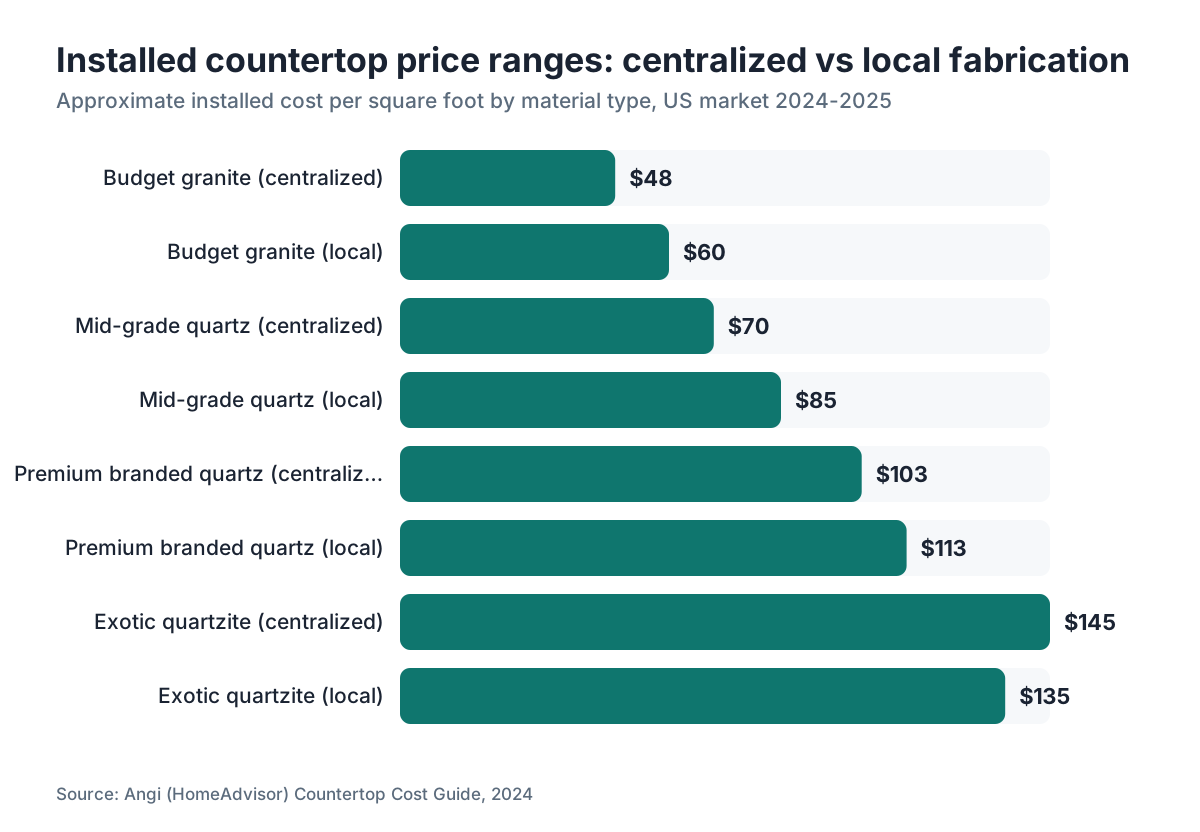
The table below shows approximate installed price ranges pulled from market surveys and contractor databases, comparing typical centralized and local pricing for common materials as of 2024 to 2025. These are ranges, not promises, and your local market will move them. [2]
| Material | Centralized avg (installed $/sq ft) | Local shop avg (installed $/sq ft) |
|---|---|---|
| Budget granite | $40-55 | $50-70 |
| Mid-grade granite | $55-75 | $65-90 |
| Mid-grade quartz | $60-80 | $70-100 |
| Premium branded quartz | $85-120 | $95-130 |
| Exotic quartzite/marble | $110-180 | $100-170 |
| Soapstone | $90-140 | $80-130 |
Notice the flip at the exotic end. A shop that does custom work daily is often faster and cheaper on unusual pieces than a high-volume line built for rectangles.
How does lead time compare between centralized and local shops?
Lead time is where local fabricators often win outright, even when they lose on price.
A high-volume centralized operation runs a tightly scheduled production queue. They might have 300 jobs ahead of yours. Standard lead times at large national-style fabricators run 2 to 5 weeks from template to install, and during remodel season (spring through early fall), 6 to 8 weeks is common [3]. If your contractor has a tight finish schedule, that's a real problem.
A local shop with lower volume can sometimes template on Tuesday and install the next week for a simple job. Their constraint is the saw and installer calendar, not a 300-job backlog. For a small kitchen or a bathroom vanity top, many local fabricators turn the job in 5 to 10 business days.
Here's the catch. A very busy local shop in a hot market can have waits that rival or beat the big operations. So ask. Don't assume anything. Get an exact count of business days from signed contract to template, and from template to install.
On a remodel where a general contractor is holding a schedule together, this lead-time gap can cost or save more money than the price-per-square-foot difference once you count the contractor's downtime waiting on stone.
Which type of fabricator handles custom work and unusual cuts better?
Simple rectangle with a standard edge profile? Centralized fabrication is fine. Curved island, a sink cutout that needs hand-finishing, or a stone that has to be book-matched across a seam? The calculus shifts.
High-volume shops are built for throughput. Complex custom work slows the line and eats margin, so some of them tack on surcharges for unusual edge profiles, non-standard sink cutouts, or multi-piece layouts that need precise alignment [4]. Others just decline the work.
Local fabricators who specialize in custom kitchens handle irregular cuts and exotic materials every week. They're also likelier to come back out for a second template visit if a measurement is off, without billing you a trip charge. Their whole business runs on solving weird problems instead of pushing rectangles.
If you're working with marble countertops that need careful vein matching, or a granite countertops slab with a natural fissure you have to route around, a local custom shop is usually the better call. The relationship bends more.
For a fabricator reading this: the jobs centralized shops turn away or penalize are exactly the jobs where a local shop builds margin and reputation. Investing in templating accuracy and custom CNC capability is how a smaller shop stays competitive on work that volume lines can't or won't touch.
What happens when something goes wrong, and who fixes it?
This might be the most underrated factor in the whole decision.
With a centralized or big-box-affiliated fabricator, your warranty and repair process often runs through a customer service phone line, then a ticket, then a dispatched contractor who may or may not be the person who installed your top. If a seam opens up six months after install, or an edge chips on installation day, getting someone physically back to your house can take weeks. The Home Depot and IKEA countertop programs have drawn steady consumer complaints about post-install service, and Better Business Bureau records show high complaint volumes in this category for large-volume countertop operations [5].
A local owner-operator knows their name is on your countertop. Chip an edge on install day and they'll usually fix it same-day or next-day, because their reputation in a small market is the whole business. That's not guaranteed, and bad local shops exist, but the accountability chain is shorter.
Before you sign with anyone, ask two things. Who specifically is doing my installation? And what is the written process if I find damage within 30 days of install? Get both answers in writing. A fabricator who hedges on either one is telling you something.
How does slab selection work differently at each type of shop?
Slab selection is one of the more tangible differences you'll notice upfront.
A centralized shop often works from a curated inventory of its highest-volume materials. They might list 50 colors but stock only a few dozen slabs of each. For popular quartz colors, fine. For natural stone, where every slab is genuinely different, a thin on-hand selection means you may be choosing from photos or small samples instead of the actual slab going into your kitchen. Some large shops will bring a slab in on request, but that adds lead time and sometimes a restocking risk if you don't buy.
A local fabricator usually works with one or two nearby slab distributors. The selection is whatever those distributors carry, which can be huge (major distributors like Arizona Tile, M S International, and Pental often keep hundreds of options at their local yards) [6]. Here's the part that matters most: a local shop will usually take you to the yard to pick your actual slab. You see the real veining, the real color swing, the true size of the pieces. For any stone over $80 a square foot, picking your specific slab is worth the time.
Going with something cheaper like laminate countertops or formica countertops? Slab selection is moot, and a centralized installer's pattern library may actually hand you more choices.
Does centralized fabrication affect quality control and precision?
Modern CNC bridge saws and waterjet machines cut within 1/16 inch or better, whether the shop is large or small [7]. On pure dimensional accuracy, neither model has an edge.
Where quality control splits is in the human calls. How carefully a templater records edge conditions and plumb issues. How a fabricator orients a slab to hide a natural fissure. Whether seam placement gets discussed with the homeowner before the saw runs. High-volume operations can be excellent at all of this. They can also be rushed.
A useful proxy: ask to see the shop's templating process. Do they use digital tools (LT-55 or Prodim systems are common) or hand measurement? Digital templating cuts human error and is worth asking about at any shop size [8]. Shops running SlabWise or similar fabrication management software for quoting and nesting tend to keep better job documentation and waste less material, which tracks with more careful practices overall.
The variable that matters isn't shop size. It's whether the person who templates your job, the person who cuts it, and the person who installs it are all working from the same accurate information, and whether anyone checks for mistakes before the stone gets cut.
Is centralized fabrication better for new construction or large developments?
Yes, clearly. Putting countertops in 40 units of a condo project? A centralized fabricator is almost certainly the right choice.
The economics work completely differently at scale. Volume discounts on both material and fabrication get large. A centralized shop with the queue capacity to run a 40-unit project on a sequential schedule, coordinated with the GC's floor-by-floor finish plan, is exactly what that job needs. A small local shop might not have the bandwidth or the material inventory to touch it.
The National Kitchen and Bath Association reports that new residential construction accounts for a large share of countertop volume, and that segment runs on volume-oriented fabricators [9]. Makes sense. Builders buy on price and schedule predictability, not on the ability to book-match a rare quartzite.
For a single custom home or a kitchen remodel, that builder-track logic doesn't apply. One homeowner won't get contractor pricing from a centralized shop. They'll usually get the same retail number a local shop charges, minus the service advantages.
How should a fabricator decide whether to compete with centralized shops or differentiate from them?
This is a real strategy question for shop owners, and the answer is not to beat high-volume shops at their own game.
A local shop running 30 jobs a week cannot buy slabs at the price a shop running 300 jobs a week pays. That gap is structural, not a management failure. Trying to match centralized pricing by shaving labor or skipping steps is a race to the bottom that wrecks quality and margin at the same time.
What local shops do better: custom complexity, faster service, the slab-yard experience, direct accountability, and relationships with designers and GCs who care about those things. The homeowner willing to pay $80 to $120 a square foot for natural stone almost always prefers working with someone who knows stone cold and will stand behind the job in person.
Operations matter here too. A local shop juggling quoting, templating, nesting, and scheduling on paper or scattered spreadsheets burns hours per job that could go into quality work or talking to the customer. Software built for shop-scale operations (SlabWise is one example made specifically for fabricators) closes part of the efficiency gap with the big operations without needing volume a small shop will never have.
Differentiation, not price-matching, is the only sustainable play for most local fabricators.
What should homeowners ask before choosing a fabricator?
Whatever type of shop you're weighing, the same questions matter. Ask them before you sign anything.
First: who specifically templates, who cuts, and who installs? In a large centralized operation, these may be three different subcontractors. In a local shop, it might be the same two people. Neither is automatically better, but you want to know how communication happens when the installer finds a problem the templater missed.
Second: can I see the actual slab that goes into my job? If the answer is no, understand the stone delivered may look different from the sample or photo.
Third: what is your lead time right now, not in a slow week? Get a specific number of business days from signed contract to template, and from template to install.
Fourth: what is your written warranty, and who handles warranty service? Some large retailers pass warranty work to third parties. Some local shops handle it directly.
Fifth: do you have references for jobs like mine (custom shape, exotic material, specific edge profile)? A shop that does good custom work will have photos and references ready.
For countertop installation generally, the quality of the template is the single biggest predictor of how well the finished stone fits. Ask about templating method regardless of shop type.
If you're comparing kitchen countertops options and haven't settled on a material before you even get to the fabricator question, sort that out first. It narrows your fabricator choice naturally, since some shops specialize by material.
Environmental and sustainability considerations: does shop type matter?
Here the data is thin, and honest uncertainty is the right posture.
Centralized fabricators with high-volume production can in theory get better material utilization, because running many similar-sized jobs lets nesting software squeeze remnant waste across a large slab inventory. In practice, how well any shop nests comes down to its software and process discipline, not its size.
Transportation emissions are a fair thing to weigh. A regional centralized shop may have slabs trucked from a distant distribution center, while a local shop pulls from a yard down the road. Or the reverse, depending on geography. There's no universal answer.
Water reclamation in stone cutting is regulated differently by state. California's water quality rules for industrial operations, including stone fabrication shops, apply equally to large and small facilities under the State Water Resources Control Board's general permits [10]. Some large facilities have put in closed-loop water systems that small shops may not afford. Asking a shop how it handles water is a reasonable environmental question.
Stone cutting generates silica dust, a serious occupational health hazard. OSHA's respirable crystalline silica standard (29 CFR 1926.1153) applies to all employers who cut stone regardless of size, and the rule requires engineering controls to limit worker exposure [11]. A shop of any scale that cuts stone dry or without proper controls is a red flag on both worker safety and regulatory compliance.
Frequently asked questions
Are Home Depot or IKEA countertop programs centralized fabrication?
Yes, in structure. Both use third-party fabricator networks coordinated centrally. Home Depot's countertop program runs through regional contractors who handle templating and installation under the Home Depot brand. You get retail pricing without the slab-yard selection experience, and post-install service runs through the retailer's customer service system. Some homeowners are happy with this. Others find the service chain too long when problems come up.
Can I get a cheaper price by going directly to a stone distributor and skipping the fabricator?
You can buy a raw slab directly from distributors like MSI or Pental in most markets, but you still need a fabricator to cut, edge, and install it. Some fabricators won't work on stone they didn't supply because they can't control quality. Others will, and may charge a separate fabrication-only fee that, added to the slab cost, lands close to their full-service price. Worth asking, but don't assume skipping the middle step saves money.
Do centralized fabricators use better equipment than local shops?
Not necessarily. Equipment quality depends on investment, not shop size. Both large and small shops use CNC bridge saws from brands like Intermac, Park Industries, or Brembana. A well-maintained five-year-old machine at a local shop cuts as accurately as a newer machine at a large facility. What matters more than brand is calibration, maintenance discipline, and whether digital templating is feeding accurate data to the machine.
What is the typical warranty on fabricated stone countertops?
Industry standard is one year on workmanship, though it varies. Material warranties depend on the manufacturer: quartz brands like Cambria offer lifetime limited warranties on the material itself, but fabrication defects (seam quality, edge chips, cutout issues) fall on the fabricator, not the material brand. Get the fabrication warranty in writing and confirm who physically handles warranty calls, especially with large retailers where the brand and the contractor are different entities.
Is there a difference in seam quality between centralized and local fabricators?
Seam quality depends on the skill of the person doing the seam, the accuracy of the template, and the type of stone. Neither model guarantees better seams. What you can ask about: do they use epoxy color-matched to the stone, do they use seam setters for alignment, and will they show you where seams fall before cutting? A fabricator who brings up seam placement on their own is a good sign, regardless of volume.
How far will a local fabricator travel for a template and install?
Most local shops have a service radius of roughly 30 to 60 miles from the facility, with travel charges (often $50 to $150) for jobs past a certain distance. Centralized operations with regional hubs may cover larger areas. In rural markets, a local fabricator may be the only option within 50 miles regardless of price, which effectively makes the decision for you. Always confirm service area and trip fees before requesting a quote.
Can a local fabricator handle a large project like a whole-house countertop renovation?
Many can, depending on shop capacity. A local shop running 30 to 40 jobs a week can often handle a 10-room project if it's scheduled right. The real constraint is usually slab sourcing: can your local distributor supply enough of a matching material? For very large projects (50-plus kitchens for a developer), a centralized shop with direct slab inventory is more practical. For a single custom home with 8 to 10 countertop surfaces, a local shop handles it routinely.
Does the type of stone affect whether centralized or local fabrication is better?
Yes, a lot. Quartz from major brands, budget granite in standard colors, and simple materials suit high-volume centralized shops well. Exotic natural stone (rare quartzites, book-matched marble, leathered finishes, soapstone) is better in the hands of shops that do custom work regularly. For soapstone specifically, see our guide on how to clean soapstone countertops for material care context; fabrication quality matters a lot for how well the surface ages.
What are the main reasons homeowners regret choosing a centralized fabricator?
Most complaints center on post-install service: trouble reaching a person when a problem shows up, delays on warranty repairs, and the sense that no single person owns the outcome. A secondary gripe is not getting to pick the actual slab. On price and basic cut quality, centralized fabricators generally get reasonable marks. Regret tends to track with complex jobs or post-install issues, not with simple installs that go smoothly.
Are there countertop materials where the centralized vs local question doesn't matter much?
For non-stone surfaces, yes. Laminate (Formica), solid surface (Corian), and butcher block lean far less on the slab-selection and stone-handling expertise that separates shop types. These materials are more standardized and the fabrication is less variable. For those products, price, lead time, and installer quality matter more than whether the shop is high-volume or independent.
How do I find a reputable local stone fabricator?
The Natural Stone Institute (naturalstoneinstitute.org) keeps a fabricator locator of member shops. Beyond directories, ask a local kitchen designer or GC who they use: trade referrals reveal real performance data. Check Google reviews specifically for comments about install day and post-install service, more than the showroom visit. Three to five quotes from different shop types gives you honest market pricing for your area.
Do local fabricators offer financing or payment plans like big-box stores do?
Rarely as a built-in option. Most local fabricators want a deposit (often 50 percent) at contract signing and the balance at delivery or install. Large retailers like Home Depot offer consumer financing through their credit programs, which is a genuine advantage if you need to spread payment. If financing matters to you, ask local shops whether they take CareCredit or similar third-party financing; some do, though it's not universal.
What questions should a fabricator ask me (the homeowner) before quoting?
A thorough fabricator should ask: what material are you considering? Do you have existing countertop dimensions, or will you need a template? What edge profile? What sink type, and how many cutouts? Do you want seam location discussed? What's your target install date? If a fabricator quotes you without asking most of these, the quote is probably incomplete and the final number will move.
Sources
- Natural Stone Institute, Dimension Stone Industry Data: Large-volume stone buyers purchasing in container quantities from Brazil and India achieve material cost reductions that translate to 15-30% lower finished countertop pricing versus small independent fabricators buying from local distributors.
- Angi (HomeAdvisor), Countertop Cost Guide 2024: Installed countertop price ranges by material for the US market, showing budget granite from $40-70/sq ft and premium quartz from $85-130/sq ft depending on region and fabricator type.
- National Kitchen and Bath Association, NKBA Industry Outlook: Lead times for kitchen countertop fabrication and installation at high-volume shops commonly run 2-5 weeks and extend to 6-8 weeks during peak remodeling season (spring through early fall).
- Natural Stone Institute, Fabrication Standards and Guidelines: High-volume fabrication operations may add surcharges for non-standard edge profiles, unusual sink cutouts, and complex multi-piece layouts that require additional handling time outside normal production workflows.
- Better Business Bureau, Home Improvement Category Complaint Data: Large-volume countertop installation operations affiliated with major retailers show significant complaint volumes in the BBB database related to post-install service responsiveness and warranty repair delays.
- MSI Surfaces, Distributor and Product Information: Major stone distributors like MSI carry hundreds of natural stone and quartz options at regional distribution yards, making full slab selection available to local fabricators through distributor yard visits.
- Park Industries, CNC Stone Fabrication Equipment Specifications: Modern CNC bridge saws and waterjet machines used in stone fabrication achieve dimensional cutting accuracy within 1/16 inch or better under standard operating conditions.
- National Kitchen and Bath Association, NKBA Market Size and Trends Report: New residential construction accounts for a substantial share of total countertop volume in the US, and that segment is dominated by high-volume fabricators optimized for price and schedule predictability.
- California State Water Resources Control Board, Industrial General Permit Program: California's water quality regulations for industrial operations including stone fabrication shops apply equally to large and small facilities under the State Water Resources Control Board's general permit requirements.
- U.S. Occupational Safety and Health Administration, Respirable Crystalline Silica Standard 29 CFR 1926.1153: OSHA's respirable crystalline silica standard applies to all employers who cut stone, regardless of facility size, and requires engineering controls to limit worker exposure to silica dust generated during fabrication.
- Natural Stone Institute, Fabricator Locator and Member Directory: The Natural Stone Institute maintains a searchable directory of member fabricators that homeowners and industry buyers can use to identify qualified local stone shops.
Last updated 2026-07-09