TL;DR
- Commercial natural stone fabrication turns raw slabs of granite, marble, and quartzite into finished surfaces for hotels, offices, restaurants, and multifamily buildings.
- Jobs run bigger, tolerances tighter, and lead times shorter than residential work.
- Installed costs start near $40 per square foot and top $200 for premium stone.
- Shop capacity, CNC equipment, and project management overhead drive the price.
What is commercial natural stone fabrication?
Commercial natural stone fabrication turns raw stone slabs into finished surfaces for non-residential and large-scale residential projects. Think hotel lobbies, restaurant bars, hospital nurses' stations, office reception desks, multifamily kitchens, and retail buildouts. The stone starts as a quarried slab, usually 110 to 130 inches long and 60 to 75 inches wide, then moves through a shop that cuts it, profiles the edges, polishes it, and preps it for install.
Volume isn't the whole difference. Commercial projects carry architectural drawings with named tolerances, need coordination with general contractors and project managers, and often demand install across dozens of units or floors at once. A hotel renovation might need 400 vanity tops all within 1/16 inch of the same dimension, delivered to a site with a two-week install window before the next trade shows up.
Shops that win at commercial work treat it like manufacturing. Repeatability beats artistry. A fabricator building one custom kitchen can hand-fit a piece on site. A fabricator building 80 identical apartment kitchens can't.
Design happens early. Slab selection starts months before production, and vein-matching across adjacent surfaces on a big installation takes real planning, more than picking a stone color.
What types of stone are most common in commercial projects?
Granite is the workhorse. It's hard, fairly consistent slab to slab, shrugs off heat and scratches, and has been the default commercial countertop for decades [1]. You'll find it in hotel bathrooms, corporate kitchens, and breakrooms at every price tier. Commercial-grade granite starts around $40 to $60 per square foot installed for common varieties.
Marble shows up in lobbies, reception desks, and upscale hospitality almost by default. Designers love the look, but commercial marble comes with a maintenance bill. It etches from acidic cleaners and stains from standing water, which means service calls and upkeep costs owners rarely budget for. Sealed and maintained, marble countertops hold up fine in lower-traffic commercial spaces.
Quartzite is climbing in commercial specs because designers want the marble look with more durability. True quartzite is harder than granite and handles acids better than marble. The catch is a labeling problem: plenty of stone sold as quartzite is actually a softer dolomitic marble [2]. Get that wrong on a high-use surface and you're looking at warranty claims.
Soapstone and slate turn up now and then in commercial kitchens and labs. Both are dense and nonporous without sealer, which appeals to operators who care about health codes.
| Stone | Hardness (Mohs) | Porosity | Typical installed cost (commercial) |
|---|---|---|---|
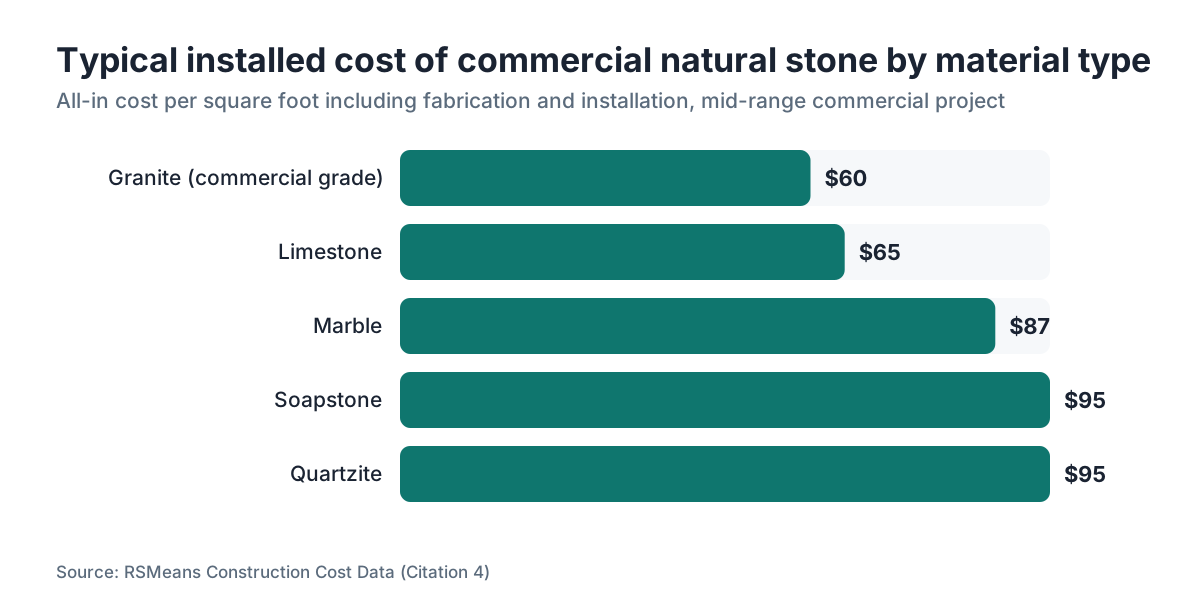
| Granite | 6-7 | Low | $40-$80/sq ft |
| Marble | 3-5 | Medium-high | $55-$120/sq ft |
| Quartzite | 7+ | Low-medium | $60-$130/sq ft |
| Soapstone | 1-2 | Very low | $70-$120/sq ft |
| Limestone | 3-4 | High | $40-$90/sq ft |
How does a commercial stone fabrication shop operate?
A commercial shop is built around throughput. The production flow goes: slab receiving and inspection, layout and nesting, CNC sawjet or bridge saw cutting, CNC routing for edge profiles and cutouts, hand finishing and polishing, quality check, crating, and delivery. Each station keeps material moving forward without backtracking.
The big equipment spend is the CNC waterjet or bridge saw. A mid-range CNC bridge saw with digital templating integration runs $150,000 to $300,000, and a five-axis CNC machining center runs $400,000 to $700,000 or more [3]. Shops doing serious commercial volume run multiple saws so one breakdown doesn't blow a deadline.
Nesting matters enormously here. Efficient nesting, fitting as many parts as possible from each slab while respecting grain direction and dodging defects, can cut waste from 35 percent to under 20 percent on a typical job. On a project using 500 square feet of $80 stone, that gap is real money. Some shops still nest by hand on paper templates. Others run dedicated software to optimize layouts before the saw touches anything. This is exactly where tools like SlabWise fit for fabricators who want to automate nesting and tie it into their quoting.
Labor is split by specialty. Saw operators, CNC programmers, edge polishers, and field installers are often separate people in commercial shops. Cross-training happens, but the production-line model means people go deep in one area instead of touching every step.
Quality control is more formal than in a residential shop. Dimensional checks with digital calipers, surface-finish comparisons against approved samples, and documentation for submittals to the GC all take time owners need to build into the schedule.
What does commercial stone fabrication actually cost?
Break the cost into three buckets, because each has its own variables: material, fabrication, and installation.
Raw slab material at wholesale runs $8 to $30 per square foot for commodity granite, $20 to $60 for standard marble, and $25 to $80 or more for premium quartzite or exotic stone. Fabrication labor and overhead add $25 to $60 per square foot depending on edge complexity, thickness, and cutouts for sinks or cooktops. Install adds another $10 to $30 per square foot, though on big multifamily or hotel jobs installers often negotiate a per-unit rate instead.
All-in, a realistic installed range for commercial natural stone is $40 to $200 per square foot. Most mid-grade commercial hotel or office work lands between $60 and $110 [4].
What drives costs up fast: exotic materials from limited sources, complex edge profiles needing multiple CNC passes, tight tolerances demanding hand finishing, and job sites that slow the crew down (no freight elevator, staged access, restricted hours). Expedited scheduling costs too. A shop running double shifts to hit a compressed deadline bills for it.
Overhead on commercial work is genuinely higher. Shops carry commercial general liability at bigger limits, often $2 million per occurrence or more depending on the contract [5]. Bonds, submittals, shop drawings, and project management add 8 to 15 percent to a commercial bid that never shows up in a residential quote.
Here's the honest part most fabricators won't say out loud: the first job for a new commercial client is almost always the least profitable. Learning the GC's process, the architect's submittal expectations, and the site conditions eats hours that don't get billed.
How do commercial tolerances and specs differ from residential work?
Residential fabricators usually work to plus or minus 1/8 inch, sometimes looser on field-fit pieces where a bead of caulk hides small gaps. Commercial work, especially healthcare, hospitality, and high-end retail, often calls for plus or minus 1/16 inch or tighter. Drawings reference standards from bodies like the Marble Institute of America (now part of the Natural Stone Institute) or follow project-specific specs written by the architect of record [6].
The Natural Stone Institute publishes dimensional tolerances for finished stonework in its Dimension Stone Design Manual. Architects and fabricators use that document industry-wide. It specifies maximum bow, warp, and thickness variation allowed for calibrated stone. Citing it in submittals is standard on commercial jobs.
Edge profiles in commercial work often get called out by profile number from a fabricator's catalog, matched to an approved sample. Stray from the approved sample's appearance and a piece can get rejected even if it's dimensionally within tolerance. This is where CNC consistency pays off. A programmed profile comes out the same every time.
Seam placement gets locked down in shop drawings that need approval before fabrication starts. On large reception desks or feature walls, seam locations follow rules about minimum distance from corners, visual impact, and structural support. Those drawings bounce between the fabricator, the GC, and sometimes the owner's rep before anyone cuts a slab.
What are the lead times for commercial stone fabrication?
Commercial lead times stack from three parts: material procurement, shop production, and installation scheduling.
Material procurement is the wild card. Standard commercial granite in stock at a regional distributor might arrive in a week. An architect-specified exotic marble quarried in Italy, shipped to a U.S. distributor, then allocated to your job can take 12 to 20 weeks or more. Supply chain problems have made this worse. U.S. natural stone imports run heavily through Italy, Brazil, India, and Spain, and they ride the same port congestion and shipping-rate swings as everything else [7].
Shop production for a mid-size commercial job, say 200 to 500 square feet across 30 to 80 pieces, runs 2 to 4 weeks in a well-equipped shop with no competing priorities. A shop at capacity might push that to 6 to 8 weeks. Ask a shop for its current backlog before you commit a schedule. That one question saves surprises.
Installation scheduling is almost never flexible. The GC has a critical path, and stone usually goes in after rough plumbing and electrical, before finish painting. Miss that window and you might wait another two weeks for site access. Good commercial fabricators build buffer into production specifically to absorb late shop-drawing approvals.
Realistically, a commercial stone project from signed contract to installed material takes a minimum of 6 to 8 weeks for stocked material and a clean process, and 4 to 6 months for imported specialty stone with full submittal review cycles.
How does templating work on large commercial jobs?
Templating is the measurement step where the fabricator captures exact field dimensions before cutting stone. On a residential job it's one visit with a laser templater or physical template. Commercial jobs complicate that in a few ways.
On new construction, templating can't always wait until surfaces are fully ready. Fabricators sometimes template off rough framing or substrate dimensions, then verify and adjust before cutting. That takes tight coordination with the GC to know what's built to spec and what might drift.
Multifamily is the hard case. Every unit is supposed to be identical and rarely is. A 200-unit building might have kitchen dimensions varying by 1/4 inch across units because of how walls got framed. Fabricators either template every unit (expensive) or template a sample and track variances (risky). Most experienced commercial shops template a representative sample and build in trim cuts.
Digital templating changed the math. A skilled templater with a laser system feeding straight into CAD can capture a unit in 15 to 20 minutes instead of the 45 minutes to an hour physical templates take. That gap decides whether you template 80 apartments in a week.
The template data feeds straight into nesting and cutting. Accurate templates cut down remakes, and on commercial work remakes are schedule-killers. A remake on a residential job is annoying. A remake on a 120-room hotel bathroom job means renegotiating the install schedule with a GC who has no interest in hearing about it.
What licenses, insurance, and compliance issues apply to commercial stone fabrication?
Licensing rules vary by state and sometimes by city. Many states require a contractor's license for install work above a dollar threshold. California, for example, uses classifications like C-54 (Ceramic and Mosaic Tile) or D-12 (Synthetic Products) for related finish work, and fabricators doing their own install typically need a C-2, C-6, or similar classification depending on scope [8]. The specifics vary enough that anyone working across state lines has to check each jurisdiction.
Silica dust is the biggest occupational safety issue in this trade. Cutting, grinding, and polishing stone throws off respirable crystalline silica, which causes silicosis, an irreversible and sometimes fatal lung disease. OSHA's silica rules for construction (29 CFR 1926.1153) and general industry (29 CFR 1910.1053) set a permissible exposure limit of 50 micrograms per cubic meter as an 8-hour time-weighted average, down from the old 250 [9]. Wet cutting, local exhaust ventilation, and respirators are required controls. Engineered stone (quartz composite) carries even higher silica content than most natural stone, which has pulled extra regulatory attention its way.
On commercial projects, fabricators usually have to hand the GC or owner proof of insurance before work starts. Typical asks: commercial general liability at $1 million to $2 million per occurrence, auto liability, workers' compensation, and sometimes an umbrella at $5 million or more on large public jobs [5].
NSF/ANSI 51 certification applies to food-zone surfaces. Stone used in restaurant prep or food-service counters may need to meet it, since the standard governs materials touching food. Properly sealed granite generally meets the requirements, but confirm with the owner or health authority for the jurisdiction [10].
How do fabricators quote and win commercial stone jobs?
Commercial quoting is harder than residential. The scope is bigger, the drawings are denser, change-order risk is higher, and payment terms are usually net-30 or net-60 instead of a 50 percent deposit. A residential fabricator used to getting paid before cutting a single piece has to rethink cash flow for commercial work.
A solid quote starts with a careful takeoff from the drawings. Square footage alone lies. Edge linear footage, cutout count, thickness specs, profile complexity, and material tier all feed the number. Shops that bid on square footage alone lose money on commercial work with grim regularity.
Material allowances are a trap. Some commercial bids carry a material allowance per square foot, and the owner or GC picks the actual stone later. If the allowance is $20 per square foot and the selected stone costs $45, the fabricator either eats the difference or fights a change-order battle. Lock in material selection before signing. It's worth the effort.
The sharpest commercial fabricators build a database of their real job costs over time. They know their production rate per piece, their waste percentage by material, and their overhead per square foot of output. Without that data, pricing is a guess. This is where commercial-focused quoting software earns its keep, tying takeoff, material cost, shop labor, and overhead into one bid. SlabWise was built for exactly this kind of job costing and quoting. If you want to see how it handles commercial job structure, the demo takes about 20 minutes.
Payment terms and retainage are negotiating points, not fixed givens. Commercial GCs often hold 5 to 10 percent retainage until project completion, which can land 6 months after your work is done. Price that financing cost in.
What maintenance do commercial stone surfaces require after installation?
Commercial stone takes heavier use than residential, and the maintenance plan has to match. The first question for any commercial install: who owns maintenance, and do they actually know what they're doing?
Sealing comes first. Most natural stone in commercial spaces should be sealed at install and resealed on a schedule that tracks use. A hotel vanity top with a penetrating impregnating sealer might need resealing every 2 to 3 years. A restaurant bar top might need it yearly. Polished marble in a busy lobby might need professional restoration every 5 to 7 years. These aren't precise numbers, since porosity and sealer chemistry vary, but they're reasonable planning figures.
For property managers and facility staff, the rules that matter: no acidic cleaners on marble or limestone, no abrasive pads on polished surfaces, and wipe up spills fast. How to clean stone countertops covers the specifics, including which products are safe and which will etch or discolor common stone types.
Granite is more forgiving. Sealed granite in a breakroom or hotel bathroom handles the cleaning chemicals housekeeping typically uses without much damage. The real threat to commercial granite is physical wear, edge chipping from carts, equipment, and cleaning tools. That's a fabrication spec issue as much as a maintenance one. Spec a beveled or eased edge instead of a sharp 90-degree edge on any surface that sees cart traffic.
Restoration and honing services exist for commercial stone that's been damaged or worn dull. Professional contractors can re-hone and re-polish marble and granite in place, far cheaper than replacing a large installation.
How does commercial fabrication differ from residential for fabricators thinking about expanding?
Fabricators eyeing a move from residential into commercial should size up the differences before committing.
The upside is real. Commercial work brings bigger jobs, longer contractor relationships, and repeat volume from GCs and developers who build project after project. One good relationship with a hotel developer or multifamily builder can generate more volume than 50 residential clients.
So are the downsides. Commercial jobs need more capital. You may buy materials weeks before you're paid, carry work-in-progress inventory, and wait on retainage. Your shop may need better equipment to hit commercial tolerances and throughput. You'll need project management capability that a purely residential operation just doesn't have.
The competition works differently too. Commercial bids often run through a formal process where three to five shops submit prices. Relationships matter, and so does price. The winning bid usually isn't the lowest. It's the one that best balances price, proven experience, and the GC's confidence that you'll hit the schedule.
Start small. Tenant improvement projects, restaurant remodels, smaller multifamily work, all let you build your process before you take on a 300-room hotel. The learning curve is steep and the stakes are high.
For residential fabricators weighing the comparison, kitchen countertops and countertop installation cover the residential side in detail, including the tolerances and fitting approaches that differ from commercial work.
Frequently asked questions
How much does commercial stone fabrication cost per square foot?
All-in installed costs for commercial natural stone typically run $40 to $200 per square foot depending on material choice, edge complexity, project volume, and site conditions. Mid-grade commercial work in hotel or office settings usually lands between $60 and $110 per square foot. Exotic materials, complex profiles, or difficult site access push costs toward the higher end. Overhead for submittals, shop drawings, and insurance adds 8 to 15 percent compared to residential bids.
What is the difference between commercial and residential stone fabrication?
Commercial fabrication involves larger volumes, tighter dimensional tolerances, formal shop drawing approval processes, and coordination with general contractors. Residential work is typically one-off, measured in single-digit hours per job, and tolerates more hand-fitting on site. Commercial jobs often require certified payroll, insurance at higher limits, and submittal documentation that residential clients never ask for. Cash flow differs too: residential shops collect deposits upfront, while commercial work often pays net-30 or net-60.
What stone is best for commercial countertops?
Granite is the most widely used commercial stone because of its hardness, consistency, and availability in large volume. For high-end hospitality or retail, marble and quartzite are common designer choices, though both need more maintenance than granite. Soapstone and dense limestone work well in laboratory or food-service applications. The best choice depends on traffic level, cleaning protocols, and budget. True quartzite rates 7-plus on the Mohs scale and outperforms marble in high-use settings.
How long does a commercial stone fabrication project take?
From signed contract to installed material, commercial stone projects take a minimum of 6 to 8 weeks for readily available domestic stone and a smooth approval process. Jobs with imported stone from Italy, Brazil, or India can run 4 to 6 months including procurement. Shop production for a 200 to 500 square foot commercial scope runs 2 to 4 weeks in a well-equipped shop. GC schedule constraints and submittal review cycles add time that is largely outside the fabricator's control.
Do commercial stone fabricators need a license?
Licensing requirements vary by state. Most states require a contractor's license to perform installation above a defined dollar threshold. California, for example, uses specific classifications like C-54 or D-12 for related finish trades. Fabricators doing their own installation need to verify the applicable license category in each state where they operate. Some jurisdictions require separate licensing for fabrication versus installation work. Operating without the required license on a commercial project can void insurance coverage and expose the shop to liability.
What OSHA rules apply to stone fabrication shops?
OSHA's respirable crystalline silica standards are the most significant compliance requirement for fabrication shops. The general industry standard (29 CFR 1910.1053) and the construction standard (29 CFR 1926.1153) both set a permissible exposure limit of 50 micrograms per cubic meter as an 8-hour time-weighted average. Required controls include wet cutting, local exhaust ventilation, and respiratory protection. Shops must also conduct air monitoring and maintain medical surveillance records for exposed employees.
How do fabricators nest stone slabs for commercial jobs?
Nesting is the process of fitting cut parts onto slabs to minimize waste. On commercial jobs with many identical pieces, efficient nesting can cut material waste from 35 percent down to under 20 percent, which makes a big cost difference when using expensive stone. Many shops use digital nesting software that integrates with their CNC programming to optimize layouts before cutting. Good nesting also accounts for grain direction, natural defects in the slab, and seam placement requirements from shop drawings.
What insurance does a commercial stone fabricator need?
Commercial general liability insurance at $1 million to $2 million per occurrence is the baseline requirement on most commercial projects. Auto liability and workers' compensation are almost universally required. Larger public projects often require umbrella or excess liability coverage at $5 million or more. Fabricators are typically required to name the general contractor and owner as additional insureds on the CGL policy. Bonds may be required on public-sector projects above certain dollar thresholds depending on state law.
Can natural stone be used in food service or restaurant commercial kitchens?
Yes, with caveats. Stone surfaces in food contact zones may need to comply with NSF/ANSI 51 standards for food equipment materials. Properly sealed granite is widely used in restaurant prep and bar surfaces and generally meets health authority requirements. Porous stones like unsealed limestone or some marbles are harder to justify in a food-prep inspection. Always confirm acceptability with the local health authority before specifying stone in a regulated food service environment.
What is retainage and how does it affect stone fabricators on commercial projects?
Retainage is a percentage of each payment, typically 5 to 10 percent, that the general contractor withholds until the project reaches substantial completion. For a fabricator who finishes their scope early, retainage can sit unpaid for months. On a $200,000 stone contract, 10 percent retainage means $20,000 tied up until the GC signs off on the full project. Fabricators need to account for this in cash flow planning, and negotiating to reduce or release retainage early is worth attempting on larger jobs.
What is the Natural Stone Institute and why does it matter for commercial fabrication?
The Natural Stone Institute is the primary trade association for the stone industry in North America. It publishes the Dimension Stone Design Manual, which architects and fabricators reference for tolerances, installation details, and specification language. The Institute also runs accreditation programs for fabrication shops. Accreditation from the Natural Stone Institute signals shop quality to commercial clients and can be a differentiator in bid evaluations, particularly on hospitality and institutional projects.
How does vein matching work on large commercial stone installations?
Vein matching means selecting and positioning adjacent slabs so natural veining flows continuously across a surface or a series of surfaces. On large feature walls, reception desks, or hotel lobbies, this requires purchasing consecutive slabs from the same block at the quarry, called book-matching or sequence matching. The fabricator and designer review slabs together to plan which pieces go where before any cutting happens. Mistakes in vein matching on commercial work get expensive, because matched material from the same quarry block may not be available for replacement.
What edge profiles are standard on commercial stone countertops?
Eased and beveled edges are the most common in commercial work because they're durable and fast to produce consistently with CNC equipment. Bullnose edges appear frequently in hospitality and healthcare because there's no sharp corner to chip or injure someone. More complex profiles like ogee or dupont edges exist in commercial specs but cost more to produce and are more common in high-end residential. For surfaces that will see cart or equipment traffic, beveled or eased is the practical choice regardless of aesthetics.
Sources
- U.S. Geological Survey, Mineral Commodity Summaries (Dimension Stone): Granite is one of the most durable and commonly specified dimension stones for commercial countertop applications due to its hardness and availability.
- U.S. Geological Survey, Mineral Resources Program: Quartzite and dolomitic marble are distinct materials with significantly different hardness and acid resistance, and the stone industry has documented widespread mislabeling of dolomitic marble as quartzite.
- U.S. Small Business Administration, Equipment Financing Guidance: CNC bridge saws and five-axis machining centers for commercial stone fabrication represent capital investments ranging from roughly $150,000 to over $700,000 depending on capability.
- RSMeans Construction Cost Data, Stonework and Countertop Cost Benchmarks: Installed commercial natural stone countertop costs range from approximately $40 to over $200 per square foot depending on material grade, edge complexity, and project conditions.
- Associated General Contractors of America, Subcontractor Insurance Requirements: Commercial general contractors commonly require subcontractors to carry commercial general liability insurance at $1 million to $2 million per occurrence, with umbrella policies for larger projects.
- Natural Stone Institute, Dimension Stone Design Manual: The Dimension Stone Design Manual specifies dimensional tolerances for finished stonework including maximum bow, warp, and thickness variation for calibrated stone used in commercial applications.
- U.S. International Trade Commission, Trade DataWeb: U.S. natural stone imports originate heavily from Italy, Brazil, India, and Spain; supply chain disruptions have extended procurement lead times for specified commercial stone materials.
- California Contractors State License Board, License Classifications: California requires specific contractor license classifications for finish trades including stone and tile installation; fabricators performing installation must hold the appropriate CSLB license.
- OSHA, Respirable Crystalline Silica Standard for General Industry (29 CFR 1910.1053): OSHA's silica standard sets a permissible exposure limit of 50 micrograms per cubic meter as an 8-hour time-weighted average, reduced from the prior limit of 250 micrograms, covering stone fabrication operations.
- NSF International, NSF/ANSI 51 Food Equipment Materials Standard: NSF/ANSI 51 governs materials acceptable for use in food equipment and food-contact surfaces; properly sealed natural stone is widely used in commercial food service environments subject to local health authority confirmation.
- OSHA, Respirable Crystalline Silica Standard for Construction (29 CFR 1926.1153): OSHA's construction silica standard requires wet cutting, local exhaust ventilation, and respiratory protection as exposure control methods in stone cutting and fabrication operations.
- Natural Stone Institute, Accreditation Program: The Natural Stone Institute is the primary North American trade association for the stone industry and runs accreditation programs for fabrication shops.
Last updated 2026-07-10