TL;DR
- CNC stone fabrication uses computer-controlled routers, waterjet cutters, and saws to cut, shape, and polish stone countertops with tolerances as tight as 0.005 inches.
- Shops typically charge $300 to $600 more for CNC work than hand-cut equivalents, but the precision cuts callbacks sharply.
- Most slabs go from digital template to finished edge in two to four hours of machine time.
What is CNC stone fabrication and how does it actually work?
CNC stands for Computer Numerical Control. A CNC machine reads a digital file, usually a DXF or SVG drawing, and moves a cutting head along X, Y, and Z axes to cut stone exactly where the software says. The operator does not guide the blade by hand. The file does.
A typical shop runs the job through three stages. First, a technician draws the slab layout in CAD software, placing each countertop piece on a digital version of the actual slab, accounting for veining, edge buildup strips, and material waste. Second, a CNC saw or bridge saw rough-cuts the pieces from the slab. Third, a CNC router or five-axis machining center profiles the edges, cuts sink cutouts, and drills faucet holes to exact diameter and position.
Five-axis machines add two rotational axes to the standard three, letting the cutting spindle tilt and rotate. That capability matters for mitered edges, curved shapes, and decorative molding profiles that would take multiple setups on a three-axis machine.
The whole workflow is sometimes called digital fabrication or automated stone processing. The output is a piece that fits the countertop template within tolerances tighter than most human hands can hold consistently.
What types of CNC machines do stone shops use?
Four machine types show up in most commercial stone shops, and they are not interchangeable.
Bridge saws carry a circular diamond blade on a gantry. The blade drops through the slab in a straight line. These make the initial rough cuts that break the slab into individual countertop blanks. A CNC bridge saw can also make miter cuts at precise angles for waterfall edges.
CNC routers and machining centers do the detail work: edge profiling (bullnose, ogee, bevel, eased), sink cutouts, and surface carving. The spindle spins at high RPM and moves at programmed feed rates. A three-axis machine covers most residential countertop work. A five-axis machine handles complex decorative edges and architectural shapes.
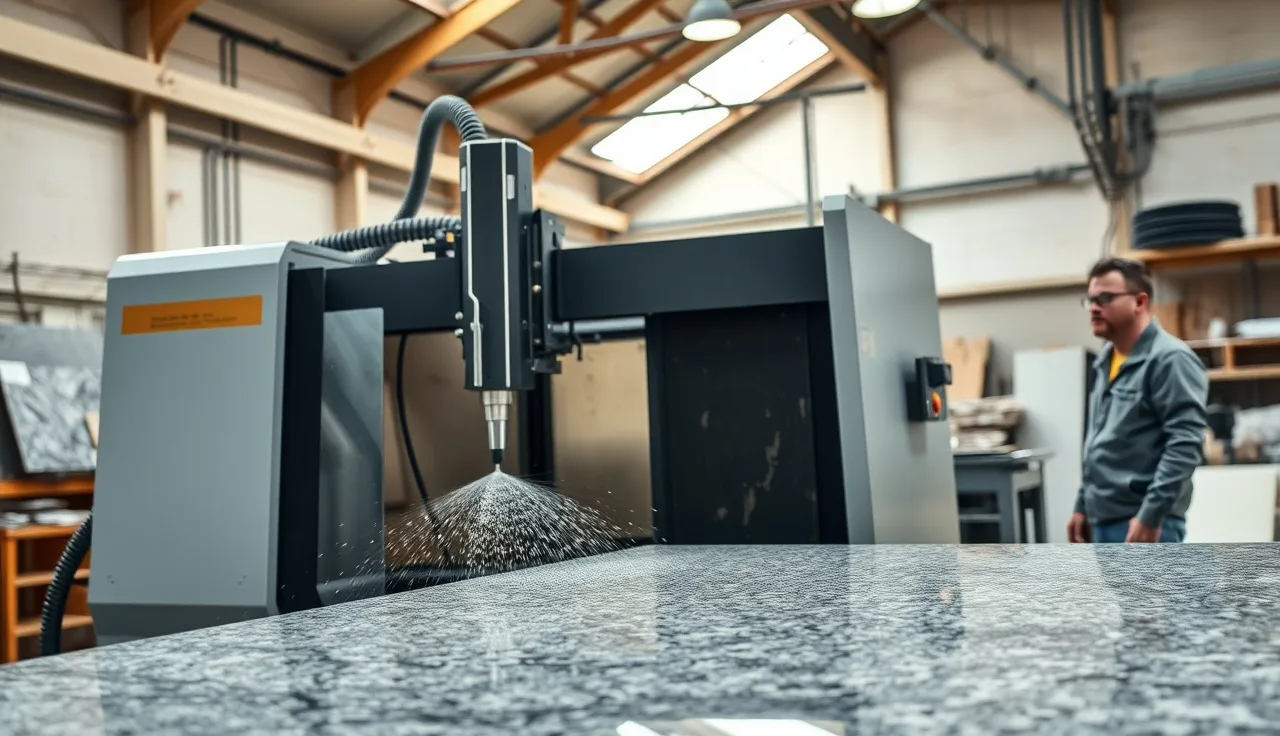
Waterjet cutters use a high-pressure stream of water mixed with abrasive garnet particles to cut stone without heat. Operating pressure typically runs between 40,000 and 90,000 PSI [1]. Waterjets are the right call for detailed inlays, radius curves, and cutting fragile material that would crack under the thermal stress of a blade. They are slower than saws for straight cuts and more expensive to run per linear foot.
CNC polishing machines finish the edge or surface after cutting, running polishing pucks through a sequence of progressively finer grits automatically. Some combination machines integrate cutting and polishing in one pass.
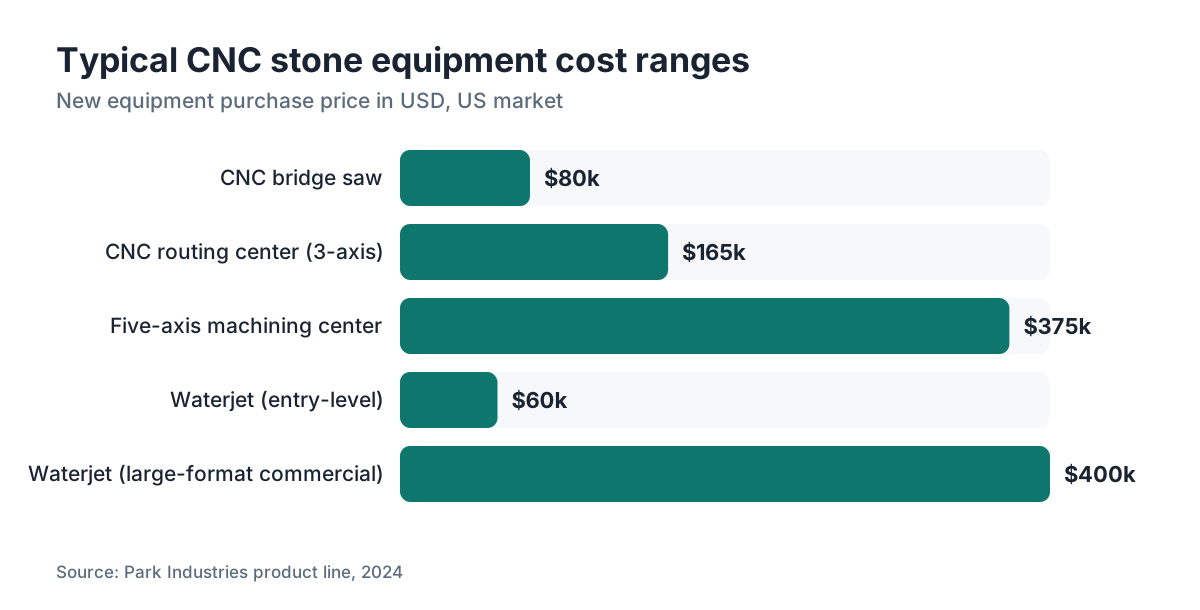
Most mid-sized fabrication shops own a CNC bridge saw, at least one routing center, and contract waterjet work to a specialist when needed. A full five-axis machine can run $250,000 to $500,000 new [2], which is why smaller shops often lease time at a regional waterjet service bureau instead.
How precise is CNC fabrication compared to hand-cutting stone?
CNC machines hold tolerances of plus or minus 0.005 inches (about 0.13 mm) on a properly calibrated machine [1]. A skilled hand-cutter working with a handheld angle grinder might hold plus or minus 1/16 inch on a good day, and variation creeps up on long runs or complex shapes.
That gap sounds small until you think about a kitchen with multiple pieces that need to meet at a seam. A 0.005-inch error across a 96-inch countertop is invisible. A 1/16-inch error across the same run creates a seam that catches the eye and traps crumbs.
For granite countertops and marble countertops, the precision also cuts callbacks. When pieces are cut from a confirmed digital template, they should drop into place without field adjustment. A 2020 industry survey by the Marble Institute of America found that fabricators who adopted digital templating and CNC cutting reduced field remakes by roughly 50 percent compared to shops still using hand-cut methods [3].
Hand-cutting is not dead, though. Decorative hand-carving, site repairs, and small one-off jobs are often faster and cheaper to do by hand than to program a machine for. The skill still matters.
What materials can CNC machines cut?
Almost any stone or stone-like countertop material goes through a CNC machine, but the settings, tooling, and feed rates change a lot by material hardness.
| Material | Mohs Hardness | CNC Approach | Notes |
|---|---|---|---|
| Quartzite | 7 | Slower feed, diamond tooling | Harder than granite; wears blades faster |
| Granite | 6-7 | Standard diamond tooling | Workhorse material for most shops |
| Quartz (engineered) | ~7 | Diamond tooling, slower speeds | Silica dust risk; requires wet cutting |
| Marble | 3-4 | Faster feed possible | Softer; more chip risk at high speed |
| Soapstone | 1-2 | Fast feed | Very soft; easy to over-cut |
| Porcelain tile/slabs | 6-7 | Diamond blade, waterjet preferred | Brittle; prone to cracking near edges |
| Sintered stone (Dekton, Neolith) | ~8 | Waterjet or specialized diamond | Hard and brittle; high blade wear |
| Travertine/Limestone | 3-4 | Standard routing | Porous; dust management critical |
Engineered quartz from brands like Cambria countertops is one of the more demanding materials because it contains roughly 90 to 94 percent ground quartz by weight [4]. That hardness speeds up diamond tool wear and throws off silica dust that is a serious health hazard. OSHA's silica standard, 29 CFR 1910.1053, sets a permissible exposure limit of 50 micrograms of respirable crystalline silica per cubic meter of air (as an 8-hour time-weighted average) and requires engineering controls such as wet methods or local exhaust ventilation [5].
Materials like butcher block countertops and laminate countertops run on entirely different machines, generally woodworking routers and panel saws, so CNC stone shops do not usually handle those.
How much does CNC stone fabrication cost?
Pricing varies by region, material, and edge complexity, but you can build a reasonable estimate from published ranges.
For residential countertops, fabrication labor (CNC cutting, edge profiling, sink cutout, and polish) typically runs $15 to $45 per square foot on top of the material cost [6]. That range is wide because a simple eased edge on a straight kitchen run sits at the low end, while a full five-axis mitered waterfall edge with decorative ogee routing sits at the high end.
Sink cutouts add $80 to $200 each. Faucet holes run $20 to $40 each. A cooktop cutout with radii corners typically costs $150 to $250.
Waterjet cutting is priced separately at most shops, usually $10 to $20 per linear inch for detailed inlay work, or a flat rate of $150 to $400 per hour of machine time [6].
For fabricators thinking about buying equipment: a new CNC bridge saw runs $40,000 to $120,000. A CNC routing center capable of edge profiling and cutouts runs $80,000 to $250,000. A five-axis machining center starts around $250,000 and can top $500,000 for full-featured systems [2]. Waterjet systems capable of stone work range from $60,000 for a small entry-level machine to $400,000 for a large-format commercial system [2].
Lease or finance terms for CNC equipment often land at $1,500 to $4,500 per month depending on machine cost and term length, which is why the equipment purchase decision is really a volume decision. Most shops need to process at least 150 to 200 square feet per day consistently before a full CNC routing center pencils out against a lower-overhead hybrid setup.
What is the CNC fabrication workflow from template to installed countertop?
The process is more connected than most homeowners realize, and the handoff between each step is where errors historically creep in.
Step 1: Templating. A tech measures the kitchen or bath, either with a physical template (plywood or cardboard strips) or a digital laser measuring system. Digital templating tools like Laser Products Industries' LT-2D3D or the Prodim Proliner capture points and generate DXF files directly. Digital templates cut transcription errors compared to paper.
Step 2: Programming. A shop programmer opens the DXF in CAD/CAM software (common packages include Alphacam, Mastercam, or machine-specific software from manufacturers like Intermac or Park Industries). The programmer places each piece on a digital slab layout, called nesting, to minimize material waste. Optimized nesting can reduce slab waste by 10 to 15 percent compared to manual layout [7].
Shops that run high volumes often use dedicated countertop quoting and nesting tools to connect the estimate directly to the shop floor. SlabWise, for example, links the quote to an automated nesting layout so the fabricator sees material cost and yield in the same workflow before the job is approved.
Step 3: Rough cutting. The CNC bridge saw cuts blanks from the slab. Workers flip and reposition the slab on the cutting table between passes.
Step 4: Edge and detail machining. Blanks move to the CNC routing center for edge profiling, sink cutouts, and faucet holes. A typical residential countertop takes 45 minutes to two hours of machine time at this stage.
Step 5: Polish and QC. Edges run through the polishing machine. A QC check measures critical dimensions against the original template file.
Step 6: Installation. Pieces ship to the job site. See countertop installation for what happens on the other end of that truck.
What edge profiles can CNC machines produce?
Here is one of the strongest selling points of CNC fabrication: repeatability across a full kitchen run. A hand-grinder can produce most profiles, but keeping the height and radius identical across 20 linear feet takes real skill. A CNC machine runs the same G-code on every linear inch.
Common profiles CNC shops produce routinely:
- Eased edge (flat top with a slight bevel, 0.125-inch radius)
- Beveled edge (45-degree cut, typically 0.25 or 0.5 inch)
- Bullnose (full rounded top)
- Half-bullnose
- Ogee (S-curve, one or two passes)
- Dupont (flat with a small bullnose on the lower portion)
- Waterfall miter (45-degree miter on both the countertop and the vertical panel)
- Chiseled or rough edge (CNC can simulate this with a programmed roughing pass)
Decorative profiles like triple ogee or carved apron fronts require a five-axis machine and add real cost, typically $25 to $75 per linear foot more than a standard eased edge.
For most residential kitchens, the eased edge or mitered waterfall profile makes up the bulk of CNC edge work done nationally. The ogee profile peaked in popularity around 2005 to 2012 and is less common in new construction today, though it remains a standard offering at every shop.
How do silica dust regulations affect CNC stone shops?
This is not a minor compliance footnote. Silica dust from cutting engineered quartz, granite, and sintered stone is a genuine occupational health issue, and regulators have tightened standards a lot since 2016.
OSHA's final rule on occupational exposure to respirable crystalline silica (29 CFR 1910.1053 for general industry, effective June 23, 2016, with full compliance for most employers required by June 2018) set the permissible exposure limit at 50 micrograms per cubic meter of air (8-hour TWA) and an action level of 25 micrograms per cubic meter [5]. The previous limit was 100 micrograms under the earlier OSHA PEL, so the 2016 rule cut the allowed exposure in half.
OSHA's standard names stone cutting operations, including countertop fabrication, as a covered high-risk task. Table 1 of the standard lists engineering and work practice controls for covered tasks, including using tools equipped with integrated water delivery or local exhaust ventilation [5].
For a CNC shop, compliance usually means wet cutting (running coolant or water at the blade during all cuts), local exhaust ventilation on routing centers, enclosed CNC machining cells where feasible, and air monitoring to confirm exposure stays below the action level.
Californian fabricators face extra requirements. Cal/OSHA's Division of Occupational Safety and Health adopted the federal standard with added enforcement specifics, and California has proposed further restrictions on dry stone cutting in recent rulemaking [8].
The practical shop implication: CNC machines built for stone should include wet-cutting capability as a baseline. Shops that dry-cut engineered quartz or granite face both serious OSHA exposure and real worker health liability.
How does CNC fabrication compare to waterjet cutting for stone?
Fabricators often treat these as competing methods, but they do different jobs better.
CNC routing is strongest at edge profiling, high-volume straight and curved cuts, and sink cutouts. It is fast, the tooling (diamond router bits and blades) is relatively cheap to replace, and every shop with a routing center can handle the majority of residential work.
Waterjet cutting wins on detailed shapes, full-slab through-cuts without any heat, very hard or brittle materials like sintered stone, and inlay work where you are cutting two pieces to interlock. There is no blade flex, no heat-affected zone, and the kerf (cut width) is consistent to about 0.015 inches [1]. The downside is cut speed. A waterjet cutting granite at 90,000 PSI might move at 4 to 8 inches per minute on a through-cut, compared to a diamond blade running 20 to 40 inches per minute on the same material.
Abrasive cost is real too. Waterjet systems eat garnet abrasive at roughly 0.5 to 1.5 pounds per minute of cutting at full production [1], and garnet abrasive runs $0.20 to $0.40 per pound in bulk. On a long production run, that adds up.
For a typical kitchen countertops job with a straight run, an apron sink cutout, and eased edges, a CNC routing center is faster and cheaper. For a medallion inlay in a marble foyer floor, waterjet is the right tool. Most commercial shops own the router and outsource the waterjet.
Does CNC fabrication work for all countertop thicknesses?
Standard residential stone countertops come in three thicknesses: 3/4 inch (2 cm), 1.25 inches (3 cm), and sometimes 1.5 inches for specialty applications. CNC machines handle all three with tooling changes, but 3 cm is by far the most common today and takes the least handling complexity.
The move from 2 cm to 3 cm as the US residential standard happened gradually through the 2000s and was largely complete by 2015. Thicker slabs hold up better during transport and installation, and 3 cm pieces do not need lamination strips along the visible edges for visual thickness, which saves labor.
For extra-thick countertops (2 inches or more, popular in commercial applications and some architectural details), the machine must make multiple passes or the bridge saw must tilt to cut at an angle, and feed rates slow to avoid blade deflection.
Ultra-compact sintered surfaces like Dekton come in thicknesses from 4 mm to 30 mm, and the thinner formats need specialized CNC handling because the material is brittle. Many fabricators cut thin-format sintered stone only with waterjet rather than a routing spindle to avoid the cracking risk at the edge.
How should fabricators evaluate whether to buy CNC equipment or outsource?
This is the real operational question for small and mid-sized shops, and the math is harder than equipment vendors make it sound.
A CNC routing center producing 200 square feet per day at a net fabrication labor margin of $20 per square foot generates $4,000 per day in margin on that machine, roughly $80,000 to $90,000 per month at five days per week. At that volume, even a $200,000 machine on a five-year note makes sense. A shop running 40 square feet per day does not have the volume to justify it.
Beyond the purchase price, count these: operator wages (a CNC programmer/operator earns $22 to $38 per hour in most US markets [9]), tooling replacement (router bits and diamond blades run $200 to $2,000 depending on type, and a set of polishing pucks runs $500 to $3,000 [6]), machine maintenance contracts (typically 2 to 5 percent of machine purchase price per year), and the learning curve. A shop that buys its first CNC machine often loses three to six months of efficiency while the operator learns the software and the machine's quirks.
The middle path many shops take: outsource waterjet and specialty work to a service bureau, own a CNC bridge saw for rough cutting, and own a mid-tier routing center for edge work. That combination covers 90 percent of residential jobs without the capital commitment of a full five-axis system.
Fabrication shops looking to tighten the connection between their quote, their nesting layout, and their shop floor often start with software before buying more hardware. Getting the digital workflow right is cheaper than buying a machine to solve a process problem. Tools like SlabWise connect quoting to slab layout digitally, which cuts programming time and material waste before a single cut is made. (See the demo if that workflow sounds familiar.)
For shops that do outsource stone cutting to a service bureau, the key quality check is tolerances: confirm the bureau holds plus or minus 0.010 inches or better on your specific material before committing production volume to them.
What are the most common CNC fabrication mistakes and how do you avoid them?
Experience from the fabrication community points to a consistent set of errors, almost all of which trace back to the digital-to-physical handoff.
Template error propagation. If the original template measurement is wrong, the CNC machine cuts that wrong measurement perfectly. The machine does not fix bad input. Digital laser templating cuts this risk, but the operator still needs to verify critical dimensions like window sill overhangs, appliance cutouts, and cabinet irregularities by hand.
Wrong slab loaded. A programming team that nests a layout on Slab A cannot have Slab B loaded on the cutting table. Shops with multiple slabs in the same material and color need a clear slab-tagging system tied to the job number.
Ignoring vein direction. CNC software places pieces wherever they fit to minimize waste. A programmer who doesn't manually orient pieces to match vein direction ends up with countertops that look disconnected at seams. This is a human judgment call the software cannot make on its own.
Feed rate errors on brittle materials. Running sintered stone or porcelain at granite feed rates cracks corners near cutouts. Every new material needs test cuts with measured feed rates before production.
Silica exposure from dry running. Skipping the coolant system to speed up the job is an OSHA violation and a real health risk. It also shortens diamond tool life a lot.
Not accounting for slab bow. Natural stone slabs are not perfectly flat. A slab with 3/16-inch bow across its length causes the CNC to cut shallower on the high spot and deeper on the low spot if the hold-down system doesn't compensate. Vacuum hold-downs help, but operators should check for excessive bow before programming.
Frequently asked questions
How long does CNC fabrication take from template to finished countertop?
For a typical kitchen, the full cycle from digital template to finished, polished pieces is two to five business days at most shops. The machine time itself is two to four hours per job. The lag is usually scheduling: shops queue jobs, and a busy shop might run three to five days of backlog. Rush fees of $150 to $400 are common if you need same-week turnaround.
Can CNC machines cut curved or radius countertops?
Yes, and this is one of CNC's clearest advantages over hand-cutting. A CNC router follows any curve programmed in the CAD file, including island radii, peninsula curves, and custom arcs, with consistent edge profile along the full arc. A handheld grinder struggles to keep an ogee or bullnose profile perfectly consistent through a 90-degree curve. CNC handles it in one pass.
What is the kerf width on a CNC stone saw?
A standard diamond blade on a CNC bridge saw has a kerf of 0.125 to 0.187 inches (3 to 4.8 mm), depending on blade thickness and diameter. Waterjet cutting produces a kerf of about 0.040 to 0.060 inches. The programmer accounts for kerf width when nesting pieces on a slab; ignoring it makes pieces come out slightly short.
Do CNC machines work on thin porcelain slabs?
They can, but porcelain slab fabrication requires specialized diamond tooling, slower feed rates, and usually waterjet for complex shapes. Thin-format porcelain (6 mm to 12 mm) is brittle and prone to chipping or cracking near cutouts if routing speed is too high. Most experienced shops use a waterjet for sink cutouts in porcelain and reserve the CNC router for straight edge profiling only.
How do I know if a fabricator is actually using CNC equipment?
Ask to see the shop, or at least photos of the equipment. A legitimate CNC shop has a bridge saw or a five-axis machine visible on the floor. Also check seam quality: CNC-cut seams on a straight run should be nearly invisible when properly installed, with gaps under 1/16 inch. Wider gaps, uneven edge profiles, or inconsistent polish along the edge suggest the work was done by hand or on poorly calibrated equipment.
Is CNC fabrication standard for engineered quartz like Silestone or Cambria?
Yes, CNC is effectively the industry standard for engineered quartz fabrication in the US. Engineered quartz is hard, uniform, and demands consistent feed rates and sharp diamond tooling to avoid edge chipping. Most quartz manufacturers, including Cambria and Silestone, require their certified fabricators to use CNC equipment as part of their warranty programs. A shop hand-cutting quartz voids most manufacturer warranties.
What software do CNC stone shops use to program their machines?
The most common packages are Alphacam, Mastercam, and machine-specific software bundled with equipment from manufacturers like Intermac (part of Biesse Group) and Park Industries. Some shops use Stone App or Slabsmith for slab visualization integrated with their CAD workflow. Dedicated countertop quoting and nesting tools handle the pre-programming workflow before jobs are sent to the machine.
How often do CNC diamond tools need to be replaced?
Diamond router bits last roughly 300 to 800 linear feet of edge profiling on granite before they need reconditioning or replacement, depending on grit and material hardness. Engineered quartz wears tooling about 20 to 30 percent faster than granite at comparable feed rates. A set of polishing pucks for edge finishing lasts 1,000 to 3,000 linear feet. Shops track tool life per job to control per-square-foot costs.
What is nesting in CNC stone fabrication?
Nesting is the process of digitally arranging all the countertop pieces from a job onto a virtual version of the actual slab to minimize waste. Good nesting keeps offcut to a minimum, which matters when the material costs $70 to $200 per square foot. Automated nesting algorithms can reduce slab waste by 10 to 15 percent compared to manual placement, according to fabrication software studies.
Are there OSHA requirements specific to CNC stone cutting?
Yes. OSHA's respirable crystalline silica standard (29 CFR 1910.1053) covers stone fabrication operations and sets a permissible exposure limit of 50 micrograms per cubic meter of air over an 8-hour shift. Table 1 of the standard lists wet cutting and local exhaust ventilation as required engineering controls for stone cutting tasks. Non-compliance carries citations up to $15,625 per violation for serious violations.
Can homeowners visit a CNC stone shop to see work in progress?
Most shops welcome homeowner visits, especially during the programming and layout stage before cutting starts. Seeing the digital slab layout is useful because you can confirm vein direction and seam placement before anything is cut. Call ahead; shops run on production schedules and cutting noise makes conversation difficult when machines are running.
Does CNC fabrication cost more than hand fabrication?
Not necessarily more in total, but the cost structure is different. CNC machines carry high fixed costs (equipment, maintenance, programming labor) that get spread across volume. On a simple straight-run kitchen with eased edges, CNC and skilled hand-cutting often come out similar in total job price. On complex shapes, long runs, or repeat production, CNC is usually cheaper and faster because machine time scales better than hand labor.
What is a five-axis CNC machine and do I need one for countertops?
A five-axis CNC machine adds two rotational axes (A and B) to the standard X, Y, Z setup. The cutting spindle can tilt and rotate, which is necessary for mitered waterfall edges, carved architectural details, and some sink apron profiles. For a standard residential kitchen, a three-axis routing center handles 95 percent of work. Five-axis machines matter most for high-end custom work and architectural stone projects.
Sources
- Flow International Corporation, Waterjet Technology Overview: Waterjet operating pressures of 40,000 to 90,000 PSI; kerf width of approximately 0.040 to 0.060 inches; garnet abrasive consumption of 0.5 to 1.5 pounds per minute
- Park Industries, CNC Stone Machinery Product Line: Five-axis CNC machining centers for stone start around $250,000; waterjet systems for stone range from $60,000 to $400,000
- Natural Stone Institute (formerly Marble Institute of America), Digital Fabrication Survey: Fabricators using digital templating and CNC cutting reduced field remakes by approximately 50 percent compared to hand-cut shops
- Cambria Company LLC, Product Specification: Engineered quartz contains 90 to 94 percent ground quartz by weight
- OSHA, Occupational Exposure to Respirable Crystalline Silica, 29 CFR 1910.1053: PEL of 50 micrograms per cubic meter of air (8-hour TWA); action level of 25 micrograms; Table 1 engineering controls for stone cutting including wet methods and local exhaust ventilation; effective June 23, 2016
- HomeAdvisor / Angi, Countertop Installation Cost Guide: Fabrication labor for CNC countertops runs $15 to $45 per square foot; sink cutouts $80 to $200; waterjet cutting $10 to $20 per linear inch for inlay work
- Intermac (Biesse Group), Digital Nesting and CAM Software for Stone: Optimized nesting software reduces slab material waste by 10 to 15 percent compared to manual layout
- U.S. Bureau of Labor Statistics, Occupational Employment and Wage Statistics, Grinding, Lapping, Polishing, and Buffing Machine Tool Setters (SOC 51-4033): CNC programmer/operators in stone fabrication earn $22 to $38 per hour in most US markets
- OSHA, Serious Violation Penalty Schedule: Serious OSHA violations carry penalties up to $15,625 per violation as of current penalty schedule
Last updated 2026-07-10