TL;DR
- Architectural stone fabrication is the process of cutting, shaping, finishing, and installing natural or engineered stone for surfaces like countertops, cladding, flooring, and stair treads.
- It spans templating, CNC or waterjet cutting, edge profiling, and final polish.
- Costs typically run $40 to $200 per square foot installed, depending on stone type, edge complexity, and shop overhead.
What is architectural stone fabrication?
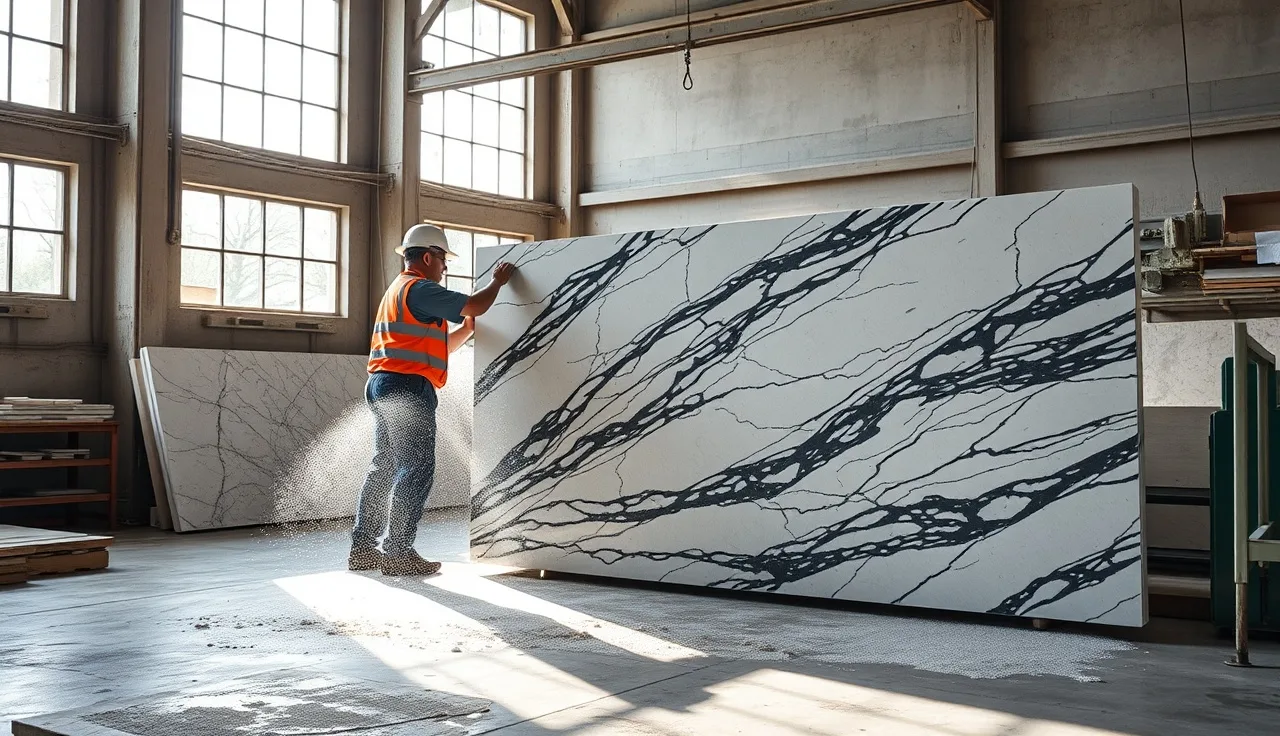
Architectural stone fabrication is the full chain of work that turns a raw stone slab into a finished building component. A quarry blasts or saws blocks of granite, marble, quartzite, limestone, or engineered quartz out of the ground or a manufacturing plant. Those blocks get sliced into slabs, usually 3/4 inch (2 cm) or 1-1/4 inch (3 cm) thick for countertop use, and thinner for wall cladding. Then fabricators take over: they template the space, lay out cuts on the slab to reduce waste and match veining, cut with a bridge saw or waterjet, profile edges, finish surfaces, and install.
The word "architectural" separates this from purely structural stonework like masonry walls or foundations. Architectural stone is meant to be seen. The tolerances are tighter, the finishes more refined, and the material cost high enough that a bad cut wastes thousands of dollars.
Modern shops run a mix of CNC bridge saws, waterjet cutters, CNC edge profilers, and hand tooling. A shop doing residential countertops might run three or four jobs a day on a single saw. A shop cutting stone panels for a commercial tower might process hundreds of square feet per shift. The equipment sits in the same category. The scale and complexity differ.
Fabrication is distinct from installation, though most shops do both. Some large commercial projects split the trades, with a fabrication shop delivering finished panels that a stone setter installs. For residential countertops, the fabricator almost always does the template, cuts, and installation as a single contract [1].
What types of stone are used in architectural fabrication?
The short list: granite, marble, quartzite, soapstone, limestone, travertine, slate, onyx, and engineered quartz. Each behaves differently under a saw blade, reacts differently to finishes, and performs differently in service.
Granite countertops are the workhorse of residential fabrication. Granite is hard (Mohs 6 to 7), fairly uniform in composition, and saws cleanly. It takes a high polish and resists scratching well. Most fabricators have tuned their tooling and feed speeds around granite, so the work is efficient.
Marble countertops are softer (Mohs 3 to 4) and etch from acid contact, but the veining drives enormous demand in kitchens and baths. Cutting marble takes slower feed rates and sharper blades to keep the polished face from chipping.
Quartzite is where homeowners get confused. True quartzite is a metamorphic rock, harder than granite, and it will dull a blade fast if the fabricator isn't careful. Some material sold as quartzite is actually marble or dolomite, which are softer. That difference changes both fabrication cost and long-term performance. If you're being quoted on quartzite, ask your fabricator whether they've confirmed the material with a hardness test or acid test.
Engineered quartz (brands like Cambria, Silestone, Caesarstone) is about 90 to 94 percent ground quartz bound in polymer resin [2]. It saws like granite but runs more consistent because there are no natural voids or soft inclusions. Cambria countertops are made in the US and marketed on pattern repeatability, which makes matching pieces across a big installation easier.
Soapstone is soft enough (Mohs 1 to 2) to cut with woodworking tools in a pinch, but professional shops still reach for a wet saw to get clean edges. It doesn't chip the way marble does. See our guide on how to clean soapstone countertops for what maintenance looks like after installation.
| Stone Type | Mohs Hardness | Typical Thickness | Polish Options | Relative Fab Difficulty |
|---|---|---|---|---|
| Granite | 6-7 | 2 cm, 3 cm | Polished, honed, leathered | Moderate |
| Marble | 3-4 | 2 cm, 3 cm | Polished, honed | Moderate (chips easily) |
| Quartzite | 7-8 | 2 cm, 3 cm | Polished, honed | High |
| Engineered Quartz | ~7 | 2 cm, 3 cm | Polished, honed | Moderate |
| Soapstone | 1-2 | 3 cm | Honed | Low |
| Limestone | 3-4 | 2 cm, varied | Honed, brushed | Moderate |
| Travertine | 4-5 | 2 cm, varied | Honed, filled/unfilled | Moderate |
How does the stone fabrication process work, step by step?
Most residential and light commercial jobs follow the same sequence. Knowing it helps you ask sharper questions and catch problems before they cost you money.
Slab selection. The customer or designer visits a stone yard and picks specific slabs. Natural stone varies within a single quarry lot, so choosing your exact slab matters. For bookmatch patterns (two consecutive slices mirrored to create a symmetrical vein), fabricators pull matched slab pairs from inventory.
Templating. A fabricator or their templater measures the space exactly. Modern shops use laser templaters (tools like the Proliner by Prodim) that capture a digital file of the countertop footprint including sink cutouts, cooktop cutouts, and edge conditions. Older shops use hardboard or cardboard physical templates. Laser templates are faster and more accurate, with reported tolerances under 1 mm [3].
Layout and nesting. Back at the shop, the fabricator lays the template over the slab, on screen or physically, to plan where each piece gets cut. Good nesting cuts material waste, which matters because stone sells by the slab or the square foot and scrap is largely unrecoverable cost. Shops using digital layout software can often pull 10 to 15 percent more usable yield from a slab than manual layout gets [4]. SlabWise is one platform fabricators use to handle quoting and digital nesting in one place, which shrinks the gap between what a job is quoted at and what it actually costs in material.
Sawing. A bridge saw makes the primary straight cuts with a water-cooled diamond blade. Curved cuts (around a farmhouse sink apron, for example) go to a waterjet or get done by hand with an angle grinder. Waterjet cuts stone with a high-pressure stream of water and abrasive garnet, and it makes nearly any shape without heat stress on the material [5].
Edge profiling. Raw saw cuts leave a square edge. Most installations specify a finished profile: eased, beveled, bullnose, ogee, or others. A CNC edge profiler runs the piece through diamond-tipped shaping wheels in sequence to produce the profile, then polishes it. Complex profiles like ogee or dupont take more wheel passes and cost more.
Finishing. The face of the slab usually arrives polished from the importer or manufacturer. Honed, leathered, or brushed finishes require the fabricator to run the surface through diamond abrasive pads. Some fabricators apply impregnating sealer at the shop before delivery. Natural stone often needs sealing before first use [6].
Installation. The finished pieces ship to the job site. For countertops, installers set pieces on cabinets, shim for level, apply silicone adhesive at the substrate and seams, epoxy with color-matched pigment at stone-to-stone seams, and cut holes for plumbing if the shop didn't. Seams are ground and polished by hand on site.
The full cycle from template to installation runs 5 to 10 business days for a typical residential kitchen [1].
What does architectural stone fabrication cost?
Cost ranges swing wider than most people expect, and "per square foot" numbers need context to mean anything.
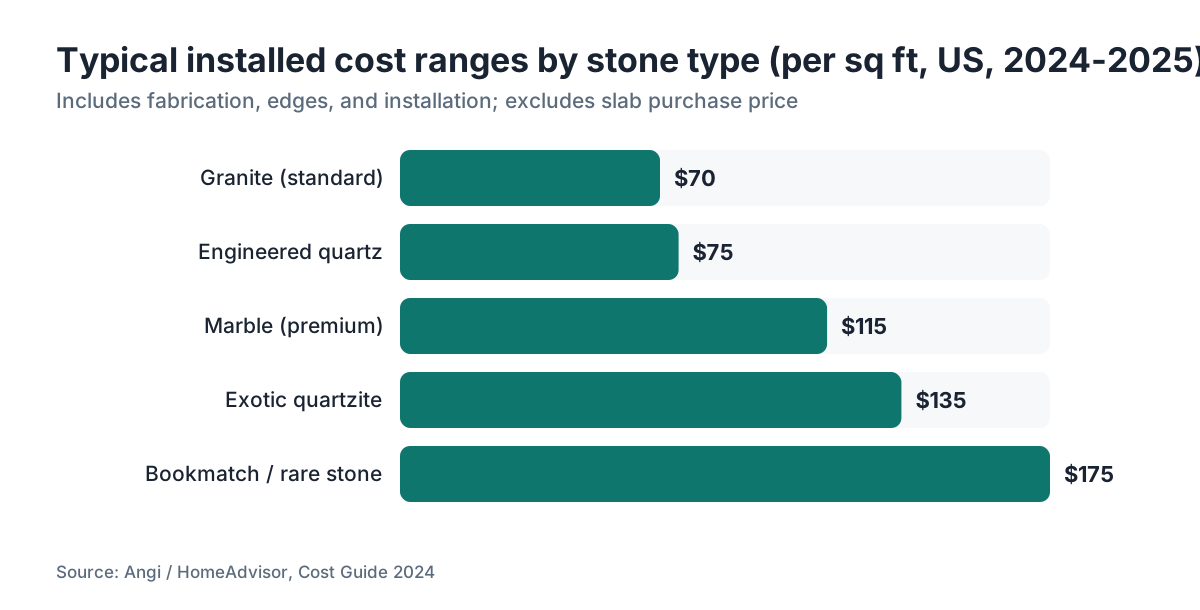
For residential countertops, all-in fabrication and installation (not counting the slab) typically runs $25 to $65 per square foot in most US markets as of 2024 to 2025. Add the slab and the total installed price lands around $40 to $100 per square foot for granite and standard engineered quartz, $75 to $150 per square foot for premium marble or exotic quartzite, and $120 to $200-plus per square foot for large-format bookmatch panels or heavily veined rare materials [7].
Several line items push cost up fast.
Edge profiles: a simple eased edge is usually in the base price. An ogee or waterfall mitered edge can add $15 to $30 per linear foot over that base.
Cutouts: sink cutouts run $100 to $300 depending on sink type (undermount vs. farmhouse vs. integrated). Cooktop cutouts add $75 to $200.
Delivery and installation: on jobs more than an hour from the shop, travel time and fuel get factored in. Some shops charge a flat trip fee. Others build it into the square footage price.
Material waste: fabricators typically add 10 to 20 percent to the measured square footage to cover saw cuts, voids around sinks, and slab edge defects. That's standard. Confirm the waste factor in any quote anyway.
On the commercial side, fabrication for lobby cladding, stair treads, or exterior facade panels can run $80 to $400 per square foot installed depending on panel size, structural requirements (back-rod or anchor systems), and stone thickness. Large architectural projects often require ASTM testing of the specific stone lot for flexural strength and absorption [8].
The biggest driver of fabrication cost isn't the stone type. It's the number of pieces, the number of cutouts, and the edge linear footage. A small bathroom vanity top with an undermount sink costs more per square foot than a large kitchen island with a straight edge, because fixed setup costs (templating, delivery, installation crew time) get spread over fewer square feet.
How do fabricators quote stone jobs?
Most residential fabricators quote by measuring square footage, then adding line items for edges, cutouts, and extras. The quote starts with the measured area of each piece, adds a waste factor, multiplies by a material cost per square foot, then stacks on fabrication labor, edge linear footage at a per-foot rate, each cutout, and installation.
A common homeowner frustration: you get a quote in square feet, then the invoice comes in higher because of "extras." The cleanest quotes itemize. Material cost separate from fabrication, edge at a named rate per linear foot, each cutout named and priced, delivery and installation as their own line. Ask for that format and you can compare two fabricator quotes directly.
For fabricators, accurate quoting depends on tight control of material cost (what you paid for the slab, per square foot of usable area) and labor cost per operation. Shops that track actual versus quoted waste on each job quote more accurately over time. The gap between a 12 percent waste assumption and actual 18 percent waste on a complex job can erase the margin entirely.
Digital quoting and nesting tools close that gap. When the layout happens on screen before the saw runs, the fabricator knows the real waste before committing to a price. For fabricators who want to tighten this loop, a platform like SlabWise connects the quote to the actual slab layout so material cost is grounded in real yield instead of an average.
Commercial projects run more involved: shop drawings, ASTM material certifications, bond and insurance requirements, and often bid bonds. The markup structure differs too, with fabrication shops usually working as subcontractors under a general contractor or stone-setting sub.
What equipment do stone fabrication shops use?
A working shop needs, at minimum: a wet bridge saw, a CNC edge profiler or hand polisher, a way to move heavy slabs (an A-frame cart or vacuum lifting system), and a vehicle for delivery and installation.
Bridge saws range from entry-level manual models around $15,000 to CNC bridge saws with tilting heads (for miter cuts) in the $80,000 to $200,000 range. CNC saws make compound miter cuts for waterfall edges and mitered aprons automatically, work that used to take hours by hand [9].
Waterjet cutters cost more, typically $100,000 to $300,000, and need a high-pressure pump (often 60,000 to 90,000 PSI) plus a garnet abrasive supply. Not every shop has one. Shops without a waterjet outsource curved cuts or charge a premium and send the piece out.
CNC edge profilers run $30,000 to $150,000. Smaller shops use angle grinders with diamond cup wheels and hand-held polishers, which works fine but takes more skilled labor per piece.
Laser templating devices (Prodim Proliner and similar) cost $15,000 to $30,000 and pay back quickly in fewer remakes. A single remake on a slab that costs $800 wholesale, plus four hours to recut and reinstall, is an expensive lesson.
For a small residential shop doing 5 to 10 jobs per week, realistic equipment investment is $150,000 to $400,000 in capital for a functional, efficient operation. Larger shops add CNC saws with automatic tool changers, polishing lines, and automated material handling, pushing total equipment value past $1 million.
Shop safety is not optional. OSHA's Silica Standard (29 CFR 1926.1153 for construction, 29 CFR 1910.1053 for general industry) requires engineered quartz fabricators to use wet cutting, local exhaust ventilation, or both to keep respirable crystalline silica exposures below the permissible exposure limit of 50 micrograms per cubic meter as an 8-hour TWA [10]. Dry cutting stone is a citable violation in most shop environments under these rules.
What are the health and safety requirements in stone fabrication?
Silica exposure is the defining safety issue in stone fabrication, and it has been for decades. Cutting stone throws fine respirable dust that carries crystalline silica. Breathing it causes silicosis, a progressive, irreversible lung disease. Engineered quartz is the highest-risk material because its quartz content sits at 90 percent or more, far above granite (around 25 to 30 percent) or marble (near zero percent) [11].
OSHA published its final Silica Standard for construction in 2016 (effective for most employers in 2017) and for general industry in 2017 (effective 2018). The rule requires employers to keep worker exposures below 50 micrograms per cubic meter (action level: 25 mcg/m3), put engineering controls in place before relying on respirators, provide medical surveillance for workers exposed above the action level for 30 or more days per year, and keep exposure records [10].
For countertop fabricators, the practical compliance path is wet cutting (blade continuously flooded with water), local exhaust ventilation at the cutting point, or enclosed saw cabinets. OSHA enforcement has intensified since 2019, and several fabrication shops have taken citations with penalties over $100,000 for dry cutting or weak controls.
Beyond silica, stone fabricators work with heavy slabs (a 3 cm granite slab runs roughly 13 pounds per square foot, so a full 6-by-10-foot slab is nearly 800 pounds), diamond blades spinning at high RPM, and wet floors. Back and shoulder injuries from manual slab handling are common. Vacuum lifting systems and A-frame carts cut that risk a lot.
For homeowners, the main safety point is sealing. Natural stone is porous to varying degrees and can hold bacteria if left unsealed on food-prep surfaces. The FDA doesn't regulate countertop stone specifically, but the general food-contact surface guidance under 21 CFR Part 117 (which replaced Part 110 under FSMA) requires food-contact surfaces to stay in a cleanable condition [12]. A properly sealed and maintained stone countertop meets that requirement.
How does stone fabrication differ for countertops versus commercial architectural applications?
Residential countertops and commercial architectural stone share the same core operations, but the requirements split sharply on scale, documentation, and structural engineering.
For countertops, the concerns are aesthetics, seam placement, and fit. Tolerances of plus or minus 1/16 inch at the wall are fine because caulk and backsplash cover any gap. The stone sits on cabinet substrate and carries no structural load.
For exterior cladding, stair treads, flooring in high-traffic areas, or large lobby walls, engineering comes into it. Panels must be thick enough and the stone species strong enough to carry their own weight plus imposed loads. ASTM International publishes the key test standards: ASTM C615 for granite dimension stone, ASTM C503 for marble, ASTM C568 for limestone [8]. These tests define minimum flexural strength, absorption, and abrasion resistance. Architects write stone compliance with these standards into project specifications.
Anchorage for vertical cladding is a discipline in itself. Thin stone veneer panels (typically 3/4 inch to 1-1/4 inch thick) on building exteriors need engineered anchor systems, usually stainless steel pins or kerfs cut into panel edges with back-rod in horizontal joints. The Marble Institute of America (now the Natural Stone Institute) publishes technical manuals on anchor design that most commercial fabricators and stone setters reference [13].
Lead times differ too. A residential kitchen countertop takes 5 to 10 business days from template. A commercial cladding package for a 10,000-square-foot lobby might take 8 to 16 weeks from shop drawing approval to delivery, with the stone lot imported specifically for the job and held for full ASTM testing before fabrication starts.
For homeowners weighing kitchen countertops or countertop installation, the commercial context is mostly background. But if you're renovating a historic building or specifying stone for a commercial tenant improvement, understanding that the same material needs a different specification process is genuinely useful.
What finishes can stone fabricators apply, and how do they affect performance?
The finish is what you see and feel every day, and it drives maintenance more than most homeowners expect.
Polished is the most common: a high-gloss mirror finish produced by progressively finer diamond abrasive pads up to 3,000 grit or higher. Polished surfaces show veining and color depth dramatically. They also show fingerprints, water spots, and scratches more visibly than other finishes.
Honed is a matte or satin finish, typically 400 to 800 grit, stopped before the polishing stage. Honed marble is less likely to show etch marks (acid attack on calcium carbonate) because there's no gloss to destroy. Honed granite or quartzite hides scratches better. The tradeoff: honed surfaces feel slightly more porous and may need sealing more often.
Leathered (also called brushed or antiqued) uses flexible diamond brushes to make a lightly textured surface with low sheen. The texture hides minor imperfections and some homeowners prefer how it feels. It's done on site with handheld tooling or on a polishing line.
Flamed finish uses a high-temperature propane or oxy-acetylene torch to spall the surface of granite, creating a rough, slip-resistant texture. You see this on exterior paving and stair treads, not countertops.
Sandblasted and water-jet-etched finishes show up on decorative panels and signage in architectural work.
For sealed natural stone, the sealer type matters as much as the stone type. Impregnating sealers (also called penetrating sealers) work below the surface and let moisture vapor escape while blocking liquid. Topical sealers sit on top, can change the look, and need stripping when they wear. Most fabricators and stone care pros recommend impregnating sealers for countertops [6]. See our guides on how to clean stone countertops and how to clean quartzite countertops for maintenance specifics.
What are common fabrication defects and how can you spot them before installation?
Bad fabrication is expensive to fix after the fact. Most problems are visible at delivery if you know what to look for.
Chipped edges happen when feed rates run too fast, blades go dull, or the operator doesn't support the offcut as it separates. Small chips under 1/8 inch on the underside of an eased edge take a color-matched epoxy repair. Large chips on the top face or along a visible edge profile usually mean remaking the piece.
Poor seam alignment is the most common complaint in residential countertop installation. Two pieces meeting at a seam should be flush (no height difference, also called lippage), tight (gap under 1/16 inch or filled with color-matched epoxy), and matched in vein direction if the slab allows. Lippage over 1/32 inch is noticeable to the touch. Over 1/16 inch, it catches crumbs and is a legitimate defect.
Out-of-square or wrong-dimension cuts mean the piece doesn't fit the space. Catch this at installation before setting the piece, not after. If a piece is cut short, backsplash or a filler strip may cover the gap. If it's too long, the piece goes back to the shop.
Cracks through the stone are either pre-existing in the slab (called fissures when natural, cracks when stress-induced during fabrication) or from rough handling. Natural fissures are part of the stone and structurally fine if the stone is intact. A crack that runs all the way through a piece is not acceptable for installation.
Inclusion loss is when a soft mineral pocket (clay or calcite in granite, for example) breaks out during cutting and leaves a void. Small voids fill with epoxy. A void larger than a quarter on a countertop face is worth discussing with the fabricator before you accept the piece.
Inspect pieces at the shop or at delivery, before they go on the cabinets. Once silicone has cured and the plumber has connected the sink, your standing to demand a remake drops hard.
How is stone fabrication changing with technology and sustainability concerns?
The biggest operational shift in shops over the past decade is digital templating tied to CNC integration. Shops that ran purely on hand-measured templates in 2010 now mostly use laser templaters. The template file feeds straight into nesting software, which feeds straight into the CNC saw's cutting program. The result is faster turnaround, less human error, and measurable material savings.
Waterjet cutting has opened up design work that used to cost too much to consider. Inlays, curved aprons, mosaic borders, and radius cuts that once meant hours of hand grinding now take minutes on a waterjet. The abrasive garnet leaves waste that gets disposed of as a non-hazardous solid waste stream, but it's far safer than silica-laden saw dust.
On sustainability, stone's position is genuinely complicated. Natural stone is a mined resource with real quarry impacts: land disturbance, water use, diesel fuel for extraction equipment. But stone is extremely durable (a well-maintained granite countertop can last 50 or more years), gives off no VOCs, and at end of life can be crushed and reused as fill or aggregate. Engineered quartz uses polymer resin binders that come from petroleum and don't recycle. How it compares to materials like laminate countertops or Corian countertops depends heavily on what you weight: embodied carbon, durability, or end-of-life recyclability.
The silica regulation push is also driving material change. Some manufacturers are rolling out lower-silica or silica-free engineered surfaces built specifically to cut worker exposure risk. Whether these take real market share from established quartz brands is still an open question.
For fabricators, the economic pressure is real. Equipment costs are rising, labor is tight, and margins on residential work are thin. Shops that put money into digital workflows tend to move more square feet per employee and remake fewer pieces. Shops running manual processes increasingly compete on price alone, which is a hard place to stay.
Frequently asked questions
How long does stone countertop fabrication take from template to installation?
Most residential jobs take 5 to 10 business days from the template appointment to installation. Commercial architectural projects with custom imported stone can take 8 to 16 weeks. The variables are shop backlog, whether your slab is in stock, and complexity of cuts. Shops with CNC equipment and digital templating generally turn jobs faster than those relying on manual processes.
What is the difference between a stone fabricator and a stone installer?
A fabricator cuts and finishes the stone. An installer sets it in place. For residential countertops, the same company usually does both under one contract. On commercial architectural projects, a fabrication shop sometimes delivers finished panels to a separate stone-setting subcontractor. If you're getting bids, confirm whether the quote covers both fabrication and installation or just one.
What does a stone fabricator's waste factor mean, and is 20 percent normal?
The waste factor accounts for saw kerfs, slab edge defects, and the unusable stone around sink and cooktop cutouts. A 10 to 15 percent waste factor is typical for straightforward layouts. Complex jobs with many cuts, odd angles, or vein-matching requirements can run 20 to 25 percent. Ask your fabricator what factor they're using and why. A higher factor isn't necessarily padding; it can reflect real job complexity.
Is engineered quartz fabricated the same way as natural stone?
Mostly yes. CNC bridge saws, edge profilers, and waterjet cutters handle engineered quartz the same way they handle granite. The material is more consistent than natural stone, with no voids or soft inclusions, which reduces surprises. The key difference is silica content: engineered quartz is 90-plus percent quartz, making silica dust exposure a serious concern. Wet cutting and ventilation are required under OSHA's Silica Standard.
Can a stone fabricator do curved countertops or radius edges?
Yes, with the right equipment. Curved outer edges (radius corners, for example) are cut on a waterjet or with a handheld angle grinder. Curved inner corners get similar treatment. A full radius countertop, like a curved kitchen island, is absolutely doable but adds fabrication cost and requires careful templating. Confirm your fabricator has waterjet capability or a subcontractor relationship before designing tight radius work into the plan.
What ASTM standards apply to architectural stone?
ASTM C615 covers granite dimension stone, C503 covers marble, C568 covers limestone, and C629 covers slate. These define minimum flexural strength, absorption, and abrasion resistance for each stone type. Commercial architectural projects typically specify compliance with the relevant standard. Residential countertops are not usually tested against ASTM standards, though the same stone types benefit from the same material properties the standards measure.
What is bookmatching and when does it make sense for stone fabrication?
Bookmatching uses two consecutive slab slices opened like a book so their mirror-image grain faces each other. The result is a symmetrical vein pattern that's dramatic on a kitchen island, fireplace surround, or feature wall. It requires purchasing matched slab pairs, which costs more and limits how you can nest cuts. Fabricators need to carefully align the vein at the seam. It makes sense when visual impact justifies the extra material and labor cost.
How do I compare two stone fabrication quotes?
Ask both quotes to itemize the same line items: material cost per square foot, fabrication labor separately, edge profile at a per-linear-foot rate, each cutout named and priced, delivery and installation as a named line, and the waste factor stated explicitly. Once both are in that format, you can compare apples to apples. A low total with vague line items often means surprises on the invoice.
Do I need to seal a stone countertop after fabrication and installation?
Most natural stones benefit from sealing before first use and periodically after. Marble and limestone are especially absorbent. Granite varies widely: some granites are dense enough to need sealing only every few years; others need annual application. Engineered quartz doesn't require sealing. A simple water test (does water bead up, or does it darken the stone?) tells you whether the existing sealer is still working. Impregnating sealers are generally preferred over topical coatings.
What are the silica safety rules for stone fabrication shops?
OSHA's Silica Standards (29 CFR 1926.1153 for construction, 29 CFR 1910.1053 for general industry) set a permissible exposure limit of 50 micrograms per cubic meter as an 8-hour TWA. Fabricators must use engineering controls, primarily wet cutting or local exhaust ventilation, before relying on respirators. Medical surveillance is required for workers exposed above the action level (25 mcg/m3) for 30 or more days per year. Dry cutting stone without controls is a citable violation.
What is the typical thickness of stone used for countertops versus cladding?
Countertops most commonly use 3 cm (about 1-1/4 inch) slabs, which are sturdy enough to cantilever short overhangs without support. Some applications use 2 cm (3/4 inch) with a built-up laminated edge to give the appearance of thickness. Exterior cladding panels are typically 3/4 to 1-1/4 inch thick with engineered anchors, though some ultra-thin (4 to 6 mm) panels are used for interior feature walls on lightweight backing.
What is the difference between honed and polished stone, and which should I choose?
Polished stone has a mirror-gloss surface that shows color depth and veining dramatically but shows every water spot and fingerprint. Honed stone has a matte or satin finish that hides daily marks better and is forgiving on marble (etch marks from acid are less visible without the gloss). Polished is easier to wipe clean. For marble in a busy kitchen, honed is usually the more practical choice. For granite, it's mostly a style preference.
Can stone fabrication shops handle outdoor or exterior applications?
Yes, but material selection and anchoring requirements change. Exterior stone must handle freeze-thaw cycles without spalling, which means low absorption is critical. Limestone and travertine, which are highly absorbent, are risky in cold climates unless specifically rated for exterior use. Granite and quartzite perform better outdoors. ASTM C615 and C568 set absorption limits that serve as a guide. Anchoring exterior panels requires engineered stainless steel systems, more than adhesive.
Sources
- Natural Stone Institute, Technical Handbook for Stone Installation: Residential countertop fabrication and installation is typically handled by the same contractor, with lead times of 5 to 10 business days from template to installation.
- USGS, Mineral Commodity Summaries: Quartz Crystal and Industrial Sand: Engineered quartz surfaces contain approximately 90 to 94 percent ground quartz bound in polymer resin.
- Natural Stone Institute, Fabrication Operations Benchmarking Report: Digital nesting software can improve usable yield from a slab by 10 to 15 percent compared to manual layout.
- American Waterjet Technology Association, Waterjet Cutting Fundamentals: Waterjet cutters use high-pressure water (60,000 to 90,000 PSI) mixed with garnet abrasive to cut stone without heat stress.
- Natural Stone Institute, Care and Maintenance of Stone Surfaces: Impregnating (penetrating) sealers are the recommended sealer type for natural stone countertops; they allow vapor transmission while blocking liquid penetration.
- HomeAdvisor / Angi, Cost to Install Stone Countertops 2024: Installed stone countertop costs range from approximately $40 to $200 per square foot depending on stone type and complexity.
- ASTM International, Standards C615, C503, C568 for Dimension Stone: ASTM C615 covers granite, C503 marble, and C568 limestone dimension stone, setting minimum flexural strength, absorption, and abrasion standards.
- Stone World Magazine, CNC Technology in Countertop Fabrication: CNC bridge saws with tilting heads can make compound miter cuts for waterfall edges automatically, reducing hand-grinding time substantially.
- OSHA, Final Rule on Occupational Exposure to Respirable Crystalline Silica (29 CFR 1926.1153 and 1910.1053): OSHA's Silica Standard sets a PEL of 50 micrograms per cubic meter (8-hr TWA) and requires engineering controls including wet cutting or local exhaust ventilation for stone fabricators.
- OSHA, Hazard Communication Guidance for Silica in Stone Fabrication: Engineered quartz contains 90-plus percent crystalline silica, making it higher risk than granite (approximately 25 to 30 percent silica) for worker dust exposure.
- FDA, Current Good Manufacturing Practice in Manufacturing, Packing, or Holding Human Food (21 CFR Part 117): FDA regulations require food-contact surfaces to be maintained in a cleanable condition; properly sealed stone countertops meet this standard.
- Natural Stone Institute, Dimension Stone Design Manual (Anchor Systems): The Natural Stone Institute's Dimension Stone Design Manual provides technical guidance on engineered stainless steel anchor systems for vertical exterior stone cladding panels.
Last updated 2026-07-10