TL;DR
- Automated stone fabrication uses CNC bridge saws, waterjet cutters, CNC edge polishers, and robotic arms to cut, shape, and finish countertops with almost no hand labor.
- A full line costs $300,000 to $1.5 million.
- Shops report 40 to 60% labor reductions and near-zero kerf waste with digital nesting.
- The tech is now reachable for mid-size fabricators, not only big production houses.
What is automated stone fabrication and how does it differ from hand fabrication?
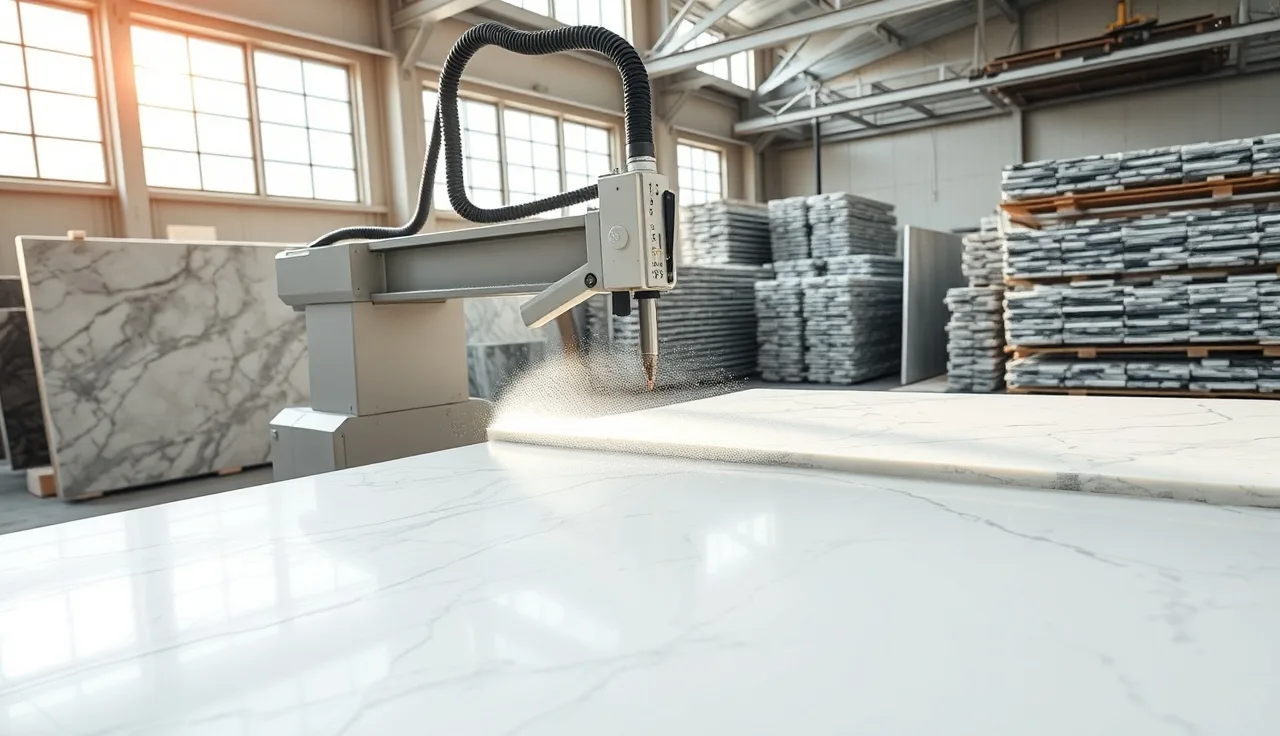
Automated stone fabrication is the use of CNC (computer numerical control) machinery, waterjet cutting systems, robotic material handling, and digital templating to cut, shape, and finish natural and engineered stone with software-driven precision rather than hand-guided tools. A skilled hand fabricator with an angle grinder and a bridge saw can produce beautiful countertops. But the process is slow, hard on the body, and dependent on one person's skill. One distracted cut on a $400-per-square-foot quartzite slab is a very expensive mistake.
The core difference is repeatability. A CNC bridge saw reads a DXF or DWG file and executes the same cut to within 0.1 millimeters every single time [1]. A human sawyer working an eight-hour shift gets tired. The machine does not.
There are also waste implications. Hand layout on a slab is a visual judgment call. Digital nesting software reads every job in the queue and positions each cutout to shrink offcuts, sometimes squeezing 15 to 20% more yield out of the same slab than hand layout. For shops buying marble or exotic quartzite at $150 to $600 per slab, that math adds up fast.
Automation does not delete skilled workers. It moves them. Instead of running a hand grinder for eight hours, a fabricator with CNC skills programs jobs, loads slabs, watches tool wear, and handles the edge details and sink cutouts that still want human judgment. The job changes. It does not vanish.
What machines make up a modern automated fabrication line?
A fully automated shop usually strings together four or five machine categories. You rarely need all of them on day one, and most shops build up one machine at a time.
CNC bridge saw. This is the workhorse. A bridge saw moves a diamond blade on a gantry over a fixed or tilting table. CNC versions read a cut file and run straight cuts, miter cuts, and radius cuts on their own. Entry-level CNC bridge saws from brands like Park Industries or Intermac start around $80,000 to $150,000. High-production machines with automated slab loading run past $400,000 [2].
Waterjet cutter. A waterjet uses a high-pressure stream of water mixed with abrasive garnet (typically 60,000 to 90,000 PSI) to cut stone without heat or mechanical stress [3]. It handles curves, cutouts, inlays, and complex shapes that would be slow or impossible on a blade saw. A stone-capable waterjet runs $100,000 to $350,000. Operating cost matters: garnet abrasive runs roughly $0.50 to $1.00 per pound, and a machine can eat 1 to 2 pounds per minute of cutting.
CNC edge polisher / shaper. After the slab is cut to shape, the edges need profiling and polishing. CNC edge machines run the slab past a series of diamond tooling heads that grind and polish the edge to a programmed profile: eased, bevel, ogee, bullnose, and so on. These machines cost $80,000 to $250,000 and can polish 30 to 50 linear feet per hour compared to 8 to 12 feet per hour by hand [4].
CNC router / machining center. A 5-axis CNC machining center does sink cutouts, cooktop cutouts, decorative carving, and surface work. For most countertop shops, a dedicated router or a bridge saw with routing capability handles this. Prices range from $60,000 to $200,000 depending on axis count and table size.
Robotic material handling. Slab handling is one of the most dangerous tasks in a fab shop. Slabs weigh 400 to 1,000 pounds. Robotic vacuum lifters and articulating arms move slabs from storage to saw table to polisher without manual lifts. Vacuum lifter systems start under $20,000, but full robotic gantry systems for automated slab libraries run $200,000 to $800,000.
Digital templating. Not a machine on the shop floor, but part of the automation chain. Laser templaters (like the Proliner from Prodim or the LT-2D3D from LT Systems) capture a kitchen layout in 15 to 20 minutes and export a precise DXF file straight to the CNC [5]. That file drives every downstream machine. Without accurate digital templates, the precision of the CNC machinery is wasted.
How much does automated fabrication equipment cost?
The honest answer: a lot, and it swings hard with what you're automating and at what volume.
| Equipment | Entry price | High-end / production price |
|---|---|---|
| CNC bridge saw | $80,000 | $400,000+ |
| Waterjet cutter | $100,000 | $350,000 |
| CNC edge polisher | $80,000 | $250,000 |
| CNC router / machining center | $60,000 | $200,000 |
| Laser templater | $15,000 | $50,000 |
| Robotic slab handler | $20,000 | $800,000 |
| Digital nesting software | $3,000/yr | $15,000/yr |
A shop wanting a basic CNC upgrade (one CNC bridge saw plus a laser templater) can start around $100,000 to $200,000. A mid-size shop adding waterjet and CNC edge polishing might spend $400,000 to $600,000. A full lights-out automated line with robotic handling is $1.2 million to $1.8 million, and that's before the facility upgrades (reinforced floors, compressed air, water reclamation) those machines need [2].
Financing changes the picture. Most fabrication equipment qualifies for Section 179 expensing and bonus depreciation under the current U.S. tax code, which lets you deduct the full cost in the year of purchase rather than spreading it over seven years [6]. In 2024, the Section 179 deduction limit is $1,220,000 with a phase-out beginning at $3,050,000 in total equipment purchases. That can move your first-year cash picture a lot.
Used equipment is a real option. A three-year-old Breton or Intermac CNC bridge saw in good shape sells for 40 to 60% of new price. The risk is calibration drift, worn tooling, and software compatibility. If you buy used, budget another $5,000 to $15,000 for a factory service visit before the machine goes into production.
How does digital nesting reduce material waste and cost?
Stone slab waste is one of the biggest cost leaks in fabrication. A typical countertop job uses 60 to 75% of a slab, leaving offcuts that either go back into inventory (taking up space) or get scrapped. With natural stone like granite countertops or marble countertops, every scrap piece still cost real money.
Digital nesting software (sometimes called layout optimization) takes the cut list for many jobs and finds the best arrangement of every piece across available slab inventory. It weighs grain direction, color matching, and slab dimensions at once. The software can test millions of arrangement permutations in seconds. A human laying out jobs by eye can't come close.
Studies on CNC nesting in panel and stone industries consistently find material yield gains of 10 to 20% over manual layout [7]. For a shop doing $2 million in revenue at a 40% material cost, a 15% yield gain is $120,000 a year. That pays for a lot of software and then some.
The nesting file also becomes the job traveler. It carries the cut dimensions, edge profile, sink location, and material spec all the way through the shop. That kills the transcription errors that creep in when a template goes from paper to measure sheet to cut list to saw operator. One file, one source of truth.
Shops running kitchen countertops at high volume see the biggest gains, because they keep optimizing similar rectangular pieces. Custom work with lots of curves and radii is harder to nest tightly, but the gains are still real.
What labor savings can shops actually expect from automation?
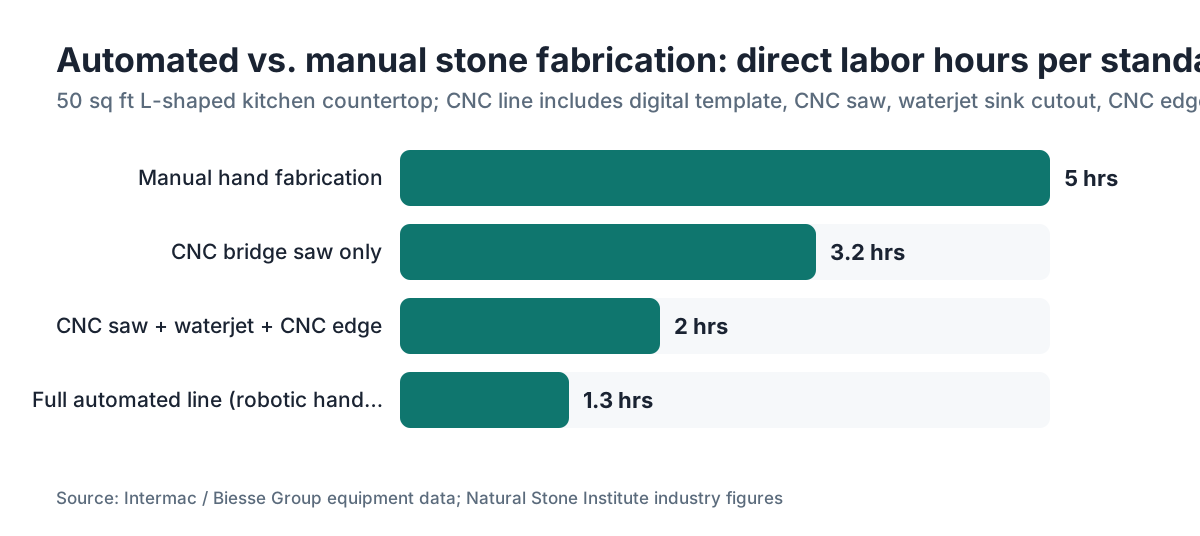
Industry surveys and equipment manufacturer data consistently cite 40 to 60% cuts in direct labor hours per job when a shop moves from fully manual to CNC production [4]. The range is wide because it depends on what the baseline looked like and which machines you add.
A manual shop cutting and polishing a standard L-shaped kitchen (roughly 50 square feet) might spend 4 to 6 hours of direct labor. A shop with a CNC saw, waterjet for the sink cutout, and CNC edge polisher might finish the same job in 1.5 to 2.5 hours of direct labor. Machine run time might be similar, but the operator can program the next job while the machine runs.
The savings show up two ways. First, throughput: the same crew pushes more jobs per day. Second, the wage mix shifts. When the machine does the precision work, you can hire more operators at mid-range wages instead of leaning on a small number of high-skill hand fabricators who command premium pay and are hard to replace.
There's a real offset cost: machine maintenance, tooling replacement, and operator training. Diamond blades and polishing heads wear out and need replacing. A CNC bridge saw blade runs $300 to $800 and lasts roughly 1,000 to 3,000 linear feet of cutting depending on material hardness. Waterjet garnet is a nonstop consumable. Budget 8 to 12% of equipment purchase price per year for maintenance and tooling on a well-run CNC operation [2].
OSHA recordable injury rates in stone fabrication run above the manufacturing average, partly from manual slab handling and cutting [8]. Automation that pulls workers away from slab movement and repetitive grinding cuts that exposure. Workers' comp cost is a real line item that improves with automation, though shops rarely put a number on it.
How does CNC fabrication affect finished quality and tolerances?
A CNC bridge saw working from a precise digital template holds tolerances of plus or minus 0.5 millimeters on a typical countertop cut [1]. A skilled hand sawyer might hold plus or minus 2 to 3 millimeters on a good day. That gap sounds tiny, but at a sink cutout or a miter joint, half a millimeter versus three millimeters is the difference between a tight fit and a gap you're trying to hide with caulk.
Edge consistency is where CNC polishing really pulls ahead of hand work. When you run a bullnose or ogee profile by hand with a router and polishing pads, the profile depth and radius drift slightly along the run. A CNC edge polisher with properly calibrated tooling makes a profile that's geometrically identical from the first inch to the last. On a long island that wraps a corner, that consistency shows.
Still, CNC is not a stand-in for material knowledge. The machine doesn't know that a particular vein in a quartzite slab is a weak point, or that a piece of bookmatched marble should face a certain way to match its companion. That judgment stays with an experienced fabricator. The machine executes. The human decides.
For materials like cambria countertops and other engineered quartz, CNC tolerances matter even more, because the material is dimensionally consistent and the maker's installation specs want tight fits. Engineered stone has no natural variation to hide a minor gap the way hand-applied grout might.
What is the ROI timeline for CNC equipment investment?
Most shops that buy CNC equipment report break-even inside 18 to 36 months, from a mix of labor savings, more throughput, and less material waste [2]. That's a wide range, and the real number turns on job volume, what you were doing before, and how well the shop is run.
Here's a rough framework. Say a shop buys a $180,000 CNC bridge saw plus a laser templating system. Annual financing cost at 6% over 7 years is roughly $30,000 a year. If the machine lets the shop process 2 more kitchens per week (conservative for a busy shop) at an average job revenue of $3,500, that's $364,000 in added annual revenue capacity. Even after material and overhead, the margin contribution covers the equipment well inside two years, if the volume is there.
The volume caveat is real. A shop doing 3 to 4 jobs per week may not have the throughput to justify a $400,000 waterjet. A shop doing 15 to 20 jobs per week almost certainly does. The crossover point moves, but most equipment advisors put the minimum volume for a CNC bridge saw at 8 to 10 jobs per week to justify it over a 5-year horizon.
Software like the job management and nesting tools at SlabWise can help a shop measure real slab yield and labor hours per job before committing to a purchase, which at least gives you actual data to anchor the ROI model instead of guessing.
Section 179 and bonus depreciation can pull the tax benefit forward hard [6]. A $180,000 machine expensed in year one at a 25% effective tax rate saves $45,000 in taxes right away, which drops the net cost to $135,000 before any revenue benefit.
How does waterjet cutting work and when is it better than a blade saw?
A waterjet cutter pressurizes water to 60,000 to 90,000 PSI with an intensifier pump and forces it through a tiny orifice (0.010 to 0.015 inches across) mixed with abrasive garnet [3]. The stream cuts through granite, marble, quartzite, and engineered stone up to 4 inches thick without generating heat. No heat means no thermal cracking, and no heat-affected zone that can change the material's properties.
The blade saw wins on straight cuts, speed, and cost per linear foot. For a standard 25-inch-deep countertop cutout running parallel to the slab edge, a blade saw is faster and cheaper to run. Waterjets are slower: a typical stone-cutting waterjet moves at 1 to 6 inches per minute on 3/4-inch granite, versus a blade saw at 10 to 30 inches per minute on straight cuts.
Waterjet earns its place in three spots. Complex curves: a radius corner, an oddly shaped sink cutout, or a decorative inlay that would need multiple blade setups. Fragile or highly figured stone where blade vibration risks cracking along a natural fissure. And matched-vein work on materials like book-matched marble, where a tiny kerf error ruins the visual match. The waterjet's kerf is only about 0.030 to 0.060 inches, against a blade saw at 0.110 to 0.135 inches, which matters when you're keeping vein patterns continuous.
Some shops run a hybrid: the CNC bridge saw for all straight cuts and rectangular shapes, and the waterjet only for curves, cutouts, and detail work. That balances speed with geometric freedom and keeps waterjet operating costs (garnet, water) under control.
What training and skills do CNC operators need?
Running a CNC stone machine is not the same as running a hand grinder, and treating it that way is how shops create expensive crashes. A competent CNC operator needs a working grasp of G-code (the language CNC machines execute), the specific CAM (computer-aided manufacturing) software their machine uses, stone material properties, and basic machine maintenance.
Formal training paths are still thin in this industry. Some equipment makers include training at installation (usually 3 to 5 days) plus follow-up support. The Natural Stone Institute runs fabrication training programs and a Certified Fabricator designation that covers CNC operation among other skills [9]. Community colleges in stoneworking regions sometimes offer manufacturing or CNC machining courses that carry over to stone equipment, though stone-specific content is rare.
Realistically, most CNC operators in stone shops learn on the job from an experienced operator or the machine maker's field tech. Expect 3 to 6 months before an operator is fully independent on a CNC bridge saw, and 6 to 12 months before they can troubleshoot tool wear, calibration issues, and file problems without supervision.
The pay premium for CNC skill is real. Bureau of Labor Statistics data puts CNC machinists across manufacturing at a median wage of $24.50 an hour, against $18 to $20 an hour for general production workers [10]. Stone fabrication wages vary by region, but the skill premium holds: shops that invest in CNC training tend to keep those operators longer, partly because the work is more mentally engaging and easier on the body than grinding all day.
One thing shops underestimate: the software side. A CNC operator who can also troubleshoot DXF file imports, fix broken arcs, and clean up toolpaths is worth a lot more than one who can only load pre-built programs.
How does automation change the quoting and scheduling process?
Manual shops usually quote by experience: a veteran estimator eyeballs a template and names a price from years of knowing how long things take. That works until the estimator leaves, or the job mix changes, or you want to grow past what one person can hold in their head.
CNC shops get a different opening. Because every job spits out a digital cut file with exact dimensions and a nesting result with exact material use, the shop piles up real data: square feet of material per job, minutes of machine time, feet of edge. That data closes the loop on quoting. You stop guessing and start measuring.
Scheduling changes too. A hand shop schedules by gut: the foreman knows who's good at sink cutouts and assigns accordingly. A CNC shop can schedule by machine capacity, queue depth, and material availability, because those constraints show up in the software. A job that needs a specific slab can get flagged automatically if that slab is already committed elsewhere.
For a homeowner getting a quote, the downstream effect is faster turnaround and more accurate delivery dates. A shop with digital scheduling can promise a 10-day lead time and actually hit it, where a hand shop might quote two weeks and then scramble. From your side, asking a fabricator whether they use CNC and digital templates is a decent proxy for how organized the shop is. It isn't perfect, but it correlates.
If you want to see how countertop installation fits after the shop process, the fabrication timeline sets the install window, and CNC shops generally compress it.
What are the safety and environmental considerations with automated stone equipment?
Silica dust is the central safety issue in stone fabrication, manual or automated. Cutting and grinding granite, engineered quartz, and quartzite makes respirable crystalline silica dust, which causes silicosis (a progressive, incurable lung disease) with chronic exposure. OSHA's permissible exposure limit (PEL) for respirable crystalline silica is 50 micrograms per cubic meter of air as an 8-hour time-weighted average, with an action level of 25 micrograms [11].
Automated machines can complicate silica control in some ways. A CNC bridge saw running an unattended cut cycle in an enclosed area can throw off a high concentration of airborne dust if wet-cutting systems fail or go unmaintained. The upside is that the operator isn't standing over the cut, which slashes personal exposure. Waterjet cutting, wet by definition, makes almost no airborne dust and is the lowest silica-exposure option there is.
OSHA's silica standards for construction (29 CFR 1926.1153) and general industry (29 CFR 1910.1053) require fabricators to run engineering controls (wet cutting, local exhaust ventilation), provide respiratory protection when engineering controls alone fall short, and conduct air monitoring [11]. The Natural Stone Institute publishes Table 1 compliance guidance built for fabrication operations [9].
Water reclamation is an environmental and operational requirement for any wet-cutting shop. CNC machines and waterjets use a lot of water. Most municipalities require slurry water (which carries fine stone particles, metals from tools, and garnet abrasive) to be treated before discharge. A water reclamation and filtration system for a mid-size shop runs $20,000 to $80,000 and is often required for the operating permit. Budget for it before you buy the machine.
Noise is a secondary issue. CNC bridge saws with diamond blades run at 85 to 95 dB, above OSHA's 85 dB action level for hearing conservation programs [12]. Enclosed machine guarding and a real hearing protection program are required.
Is automated fabrication worth it for small shops or custom work?
The honest answer: it depends on the work type, and the math is less friendly for very small or very custom shops than equipment sales teams will tell you.
A shop doing 3 to 5 jobs a week of mostly standard granite and quartz is borderline. The machine capacity sits idle much of the week, and the fixed costs of financing, maintenance, and a trained operator may not be covered by the throughput gains. That shop is often better off outsourcing CNC work to a regional cutting center (they exist in most major metros) and keeping a small hand operation for finishing and installation.
A shop built around high-end custom work, unusual materials, and complex geometry is a stronger candidate for waterjet specifically, because the precision and geometric freedom directly enable work that competitors without waterjet can't easily take on. If your edge is doing things nobody else locally can, the machine justifies itself by opening a market, more than by efficiency.
Mid-size shops doing 10 to 20 jobs a week are the clearest candidates for a phased CNC buildout. Start with laser templating (low cost, immediate accuracy gain), then add a CNC bridge saw, then waterjet or edge polishing as volume grows. Each step has a defensible ROI before the next.
For homeowners reading this: a fabricator with CNC gear is not automatically better than a skilled hand shop, especially for simple standard jobs. But for marble countertops with book-matched seams, complex waterfall edges on an island, or tight-tolerance miter corners, the CNC shop has a real edge. Ask fabricators what equipment they run and how they handle templating. The answers tell you a lot about how the shop is organized.
What does the future of stone fabrication automation look like?
The direction is toward more integration and fewer manual handoffs between steps. Even well-automated shops have gaps today: the template is digital, but someone still types dimensions into the nesting software; the nesting file is correct, but someone still hand-loads the right slab onto the saw table. Every manual handoff is a spot where errors sneak in.
The tech closing these gaps includes slab inventory systems that use cameras and AI to identify slabs by appearance and tag them to a digital library, robotic gantry systems that fetch the correct slab automatically from a job order, and machine-to-machine communication that lets the saw know the edge polisher is backed up so it should hold a piece rather than cut it.
Artificial intelligence is entering stone layout in a specific way: AI-assisted vein matching that reads slab photography and suggests which slabs from inventory will make the best visual match for a given kitchen. Companies like Aristotle (Stone Profit Systems) and others are working here. The technology is early but real.
For engineered materials like quartz and porcelain panels, the uniformity of the material makes full automation more tractable than for natural stone. Porcelain slabs up to 126 by 63 inches in 6mm and 12mm thicknesses are now common, and cutting them without cracking takes precise CNC technique and specific tooling. Shops that master porcelain have a growing market as ultra-thin panels gain ground in residential and commercial work.
The shops likely to struggle are the ones that wait too long to make any move toward digital templating and CNC. The gap between an automated shop's cost structure and a manual shop's tends to widen over time, not narrow, because each efficiency gain in an automated shop compounds into lower bids, faster turnaround, and higher margin, while the manual shop's cost base stays roughly flat. That's not a comfortable path for shops on the manual side.
For more on material considerations in fabrication and finish, see our guides on how to clean stone countertops and countertop installation.
Frequently asked questions
How accurate is CNC stone cutting compared to hand cutting?
CNC bridge saws working from a digital template hold tolerances of plus or minus 0.5 millimeters on a typical countertop cut. A skilled hand sawyer typically holds plus or minus 2 to 3 millimeters. For most straight cuts that gap is invisible, but at miter joints, sink cutouts, and seam locations it's the difference between a tight fit and a visible gap.
What is the minimum shop size or job volume that justifies CNC equipment?
Most equipment advisors put the minimum sustainable volume for a CNC bridge saw at 8 to 10 jobs per week on a 5-year payback. Below that, outsourcing cuts to a regional CNC cutting center often costs less than owning and maintaining the machine. Laser templating has a lower threshold and is worth adding at 4 to 5 jobs per week.
Can small fabricators outsource CNC cutting without buying equipment?
Yes. Regional stone cutting centers exist in most major U.S. metros. A shop sends a DXF file and a slab; the cutting center returns the cut pieces. Pricing typically runs $15 to $40 per linear foot of cut depending on material and complexity. This gives small shops CNC-quality cuts without the capital, and it's a reasonable path for shops growing toward owning their own machine.
What is digital templating and why does it matter for CNC fabrication?
Digital templating uses a laser measuring device (such as a Prodim Proliner) to capture the exact dimensions of a kitchen in 15 to 20 minutes and export a DXF file straight to CNC software. Without a precise digital template, the CNC machine's accuracy is wasted, because the input dimensions are wrong. Digital templates also kill the transcription errors that happen when paper measurements get typed into a cut file.
How does automated fabrication handle natural stone with veins and natural variation?
CNC machines execute the cut file precisely no matter what the stone looks like. Vein direction, fissures, and visual matching stay human decisions made before the file is generated. A skilled fabricator or estimator reviews the slab, sets orientation, and marks grain direction before the digital layout is locked. The machine then runs that layout with precision. AI-assisted vein matching tools are emerging but not yet mainstream.
What does waterjet cutting cost per job compared to blade saw cutting?
Waterjet operating costs run higher: garnet abrasive is $0.50 to $1.00 per pound, and a machine eats 1 to 2 pounds per minute, so a 10-minute sink cutout costs $5 to $20 in abrasive alone, plus water and power. A blade saw sink cutout costs mostly in blade wear, roughly $1 to $5 per cutout. For straight cuts, blade saws are cheaper and faster. Waterjet earns its cost on curves, fragile materials, and tight-tolerance work.
Does OSHA require anything specific for automated stone cutting operations?
Yes. OSHA's crystalline silica standards (29 CFR 1910.1053 for general industry and 29 CFR 1926.1153 for construction) require fabricators to use engineering controls like wet cutting and local exhaust ventilation, conduct air monitoring, and provide respiratory protection when controls fall short. The permissible exposure limit is 50 micrograms of respirable silica per cubic meter as an 8-hour average. These rules apply to CNC and hand operations alike.
What does Section 179 mean for fabricators buying CNC equipment?
Section 179 of the U.S. tax code lets businesses deduct the full cost of qualifying equipment in the year of purchase rather than depreciating it over 7 years. In 2024, the deduction limit is $1,220,000. For a shop buying a $180,000 CNC saw, expensing the full cost at a 25% effective tax rate saves $45,000 in taxes right away, improving first-year cash flow on the buy.
How long does it take to train a CNC operator in stone fabrication?
Most shops report 3 to 6 months before a new CNC operator is fully independent on a bridge saw, and 6 to 12 months before they can troubleshoot calibration, tool wear, and file problems without supervision. Equipment makers typically provide 3 to 5 days of on-site training at installation. The Natural Stone Institute's Certified Fabricator program covers CNC operation and gives a formal training path.
What is the typical ROI timeline for CNC stone fabrication equipment?
Most shops report break-even on CNC equipment inside 18 to 36 months through labor savings, more throughput, and less material waste. The range is wide because it depends on your pre-automation baseline and job volume. A shop doing 10+ jobs per week with a CNC bridge saw and digital templating generally hits the favorable end. Section 179 expensing can front-load a meaningful chunk of the return.
How does nesting software reduce stone waste?
Nesting software arranges cut pieces from many jobs across available slabs to maximize yield. Studies on CNC nesting in stone and panel industries find 10 to 20% yield gains over manual layout. For a shop with 40% material costs and $2 million in revenue, a 15% yield gain is roughly $120,000 a year in saved material. The software also kills layout transcription errors across the job file.
Are automated fabrication shops safer than hand fabrication shops?
Generally yes, for the specific risks of slab handling and repetitive cutting. Robotic slab movers remove manual lifts of 400 to 1,000 pound slabs, cutting back injury and crush risk. Operators standing away from an automated CNC cut have lower personal silica exposure than hand grinders. OSHA recordable injury rates in stone fabrication run above the manufacturing average, and automation targets the highest-risk manual tasks.
What water reclamation requirements apply to CNC and waterjet stone shops?
Most municipalities require slurry water from stone cutting, which carries fine stone particles, metal from tooling, and (for waterjet) garnet abrasive, to be treated before discharge. Water reclamation and filtration systems for a mid-size shop cost $20,000 to $80,000. This is frequently a condition of the operating permit, so budget it before buying equipment, not after.
Can CNC fabrication handle porcelain and ultra-thin slab materials?
Yes, but it takes material-specific tooling and technique. Large-format porcelain panels up to 126 by 63 inches in 6mm and 12mm thicknesses need continuous-rim diamond blades at specific feed rates, full slab support to prevent cracking, and waterjet is often preferred for cutouts to avoid vibration cracking at edges. CNC shops that master porcelain have a growing market as the material gains residential and commercial traction.
Sources
- Park Industries, CNC Bridge Saw Technical Specifications: CNC bridge saws hold cutting tolerances of plus or minus 0.1 millimeters when executing from a digital cut file
- Natural Stone Institute, Stone Industry Education Resources: Full automated fabrication lines cost $1.2 million to $1.8 million; annual maintenance and tooling budgets typically run 8–12% of equipment purchase price
- OMAX Corporation, Waterjet Technology Overview: Stone-capable waterjet cutters operate at 60,000 to 90,000 PSI with a 0.010–0.015 inch orifice diameter and garnet abrasive consumption of 1–2 pounds per minute
- Intermac / Biesse Group, Stone Edge Processing Equipment: CNC edge polishers process 30–50 linear feet per hour compared to 8–12 feet per hour by hand, reducing direct labor 40–60% per job
- IRS, Section 179 Deduction: Section 179 deduction limit is $1,220,000 for 2024 with a phase-out threshold of $3,050,000 in total equipment purchases; qualifying equipment is fully deductible in year of purchase
- ScienceDirect / Journal of Manufacturing Systems, CNC nesting optimization studies: Digital nesting software produces 10–20% material yield improvements over manual layout in CNC panel and stone cutting applications
- U.S. Bureau of Labor Statistics, Occupational Injury and Illness Summary: OSHA recordable injury rates in stone product manufacturing are above the overall manufacturing average, partly due to manual slab handling and cutting operations
- Natural Stone Institute, Certified Fabricator Program and OSHA Table 1 Silica Compliance Guidance: The Natural Stone Institute publishes Table 1 silica compliance guidance specifically for fabrication operations and administers the Certified Fabricator training program covering CNC operation
- U.S. Bureau of Labor Statistics, Occupational Employment and Wage Statistics, CNC Machinists (SOC 51-4011): CNC machinists across manufacturing earn a median hourly wage of $24.50, compared to $18–$20 for general production workers
- OSHA, Respirable Crystalline Silica Standard for General Industry (29 CFR 1910.1053) and Construction (29 CFR 1926.1153): OSHA's permissible exposure limit for respirable crystalline silica is 50 micrograms per cubic meter as an 8-hour TWA, with an action level of 25 micrograms; engineering controls, air monitoring, and respiratory protection are required
- OSHA, Occupational Noise Exposure Standard (29 CFR 1910.95): OSHA's hearing conservation action level is 85 dB over an 8-hour TWA; CNC bridge saws with diamond blades operate at 85–95 dB, requiring hearing conservation programs and hearing protection
Last updated 2026-07-10