TL;DR
- Sparrow Peak is a butcher block countertop brand sold mainly through Home Depot in unfinished and pre-oiled hardwood slabs of maple, walnut, and acacia.
- Prices run roughly $12 to $40 per square foot depending on species and thickness.
- They work well in kitchens once properly sealed, but they ask for more maintenance than stone or quartz.
What is Sparrow Peak and who makes these countertops?
Sparrow Peak is a private-label butcher block countertop brand carried by Home Depot. You won't find a standalone Sparrow Peak website or factory tour. It's a retail brand name applied to a product line, similar to how other big-box stores sell house-label building materials. The countertops are manufactured to Home Depot's specifications and sold in pre-cut standard widths, typically 25 inches and 38 inches, in lengths up to 10 feet.
The brand covers a range of wood species. Maple is the most common (and cheapest). Walnut and acacia cost more and show more visual character. A few multi-species checkerboard or edge-grain configurations exist in the lineup. Most are edge-grain construction, meaning the boards run horizontally and the long edge faces up. True end-grain (the cutting-board checkerboard pattern) is not widely available in this line.
If you've priced out custom butcher block from a specialty supplier like John Boos or Craft Art, Sparrow Peak is the budget alternative. That isn't a knock. For a DIY kitchen remodel or a rental property upgrade, getting a decent wood countertop off a shelf without a 4-week lead time has real value. The trade-off is that you're working with a standard thickness (usually 1.5 inches) and a fixed profile rather than specifying your own.
What does a Sparrow Peak butcher block countertop cost?
Prices at Home Depot (as of mid-2025) generally run from about $12 per square foot for unfinished maple up to $38, $40 per square foot for pre-oiled walnut in wider configurations [1]. A standard 25-inch-by-96-inch maple section lands around $130, $160. A comparable walnut section in the same footprint can be $280, $330. These are shelf prices before any shipping or installation labor.
Here's a rough breakdown of where the cost goes:
| Species | Edge style | Approx. $/sq ft | Notes |
|---|---|---|---|
| Maple | Edge-grain | $12, $18 | Unfinished, most popular |
| Acacia | Edge-grain | $20, $28 | Pre-oiled, more color variation |
| Walnut | Edge-grain | $28, $40 | Pre-oiled, darker tone |
| Multi-species (maple/walnut) | Edge-grain | $22, $32 | Decorative striped look |
For comparison, a custom butcher block from a specialty fabricator typically runs $45, $80 per square foot installed, before template and cutout fees [2]. The Sparrow Peak price is genuinely competitive for DIY work, though you'll spend time on finishing and possibly a fair amount of material on cutouts since you're buying in fixed lengths.
One thing homeowners often miss: the shelf price covers the raw slab only. You'll also need food-safe oil or finish ($20, $35 a quart), sandpaper, a circular saw or jigsaw for sink cutouts, and mounting hardware. Budget an extra $75, $150 in supplies for a typical kitchen run.
What wood species options does Sparrow Peak offer?
The three main species are maple, walnut, and acacia. Each behaves differently in a kitchen.
Maple is the workhorse. It's a hard, closed-grain wood (Janka hardness around 1,450 lbf) [3] that resists surface dents reasonably well, takes oil evenly, and sands back to clean when it gets scratched. The natural color is pale cream to light tan, which brightens a kitchen. It's also the safest choice for cutting directly on the surface, since the tight grain doesn't harbor bacteria the way open-grain woods can.
Walnut runs softer than maple (Janka around 1,010 lbf) [3] but the color payoff is big. Deep chocolate brown with purple undertones that photograph beautifully. It dents a little more easily. If you're using this as a dedicated prep surface and plan to cut on it, walnut will show marks faster. If it's more decorative (island with a prep sink, bar top), that trade-off is reasonable.
Acacia is the wild card. It's hard (1,700 lbf and up depending on species) [3], which sounds great, but acacia has high natural moisture movement [8]. That means it's more prone to gapping or warping if you get the humidity balance wrong. Pre-oiling from the factory helps, but acacia countertops need consistent maintenance in dry climates, especially near heating vents.
All three species are sold in both unfinished and pre-oiled versions. Pre-oiling saves you a step, but you still need to apply additional coats before the surface is truly water-resistant for daily kitchen use.
How does Sparrow Peak compare to other butcher block brands?
The main comparisons homeowners make are Sparrow Peak vs. John Boos, vs. Lumber Liquidators (BuildDirect), and vs. Ikea's butcher block.
John Boos is the standard for restaurant-grade butcher block. They offer end-grain in multiple thicknesses, custom lengths, and genuine food-service certifications. Their standard 1.5-inch maple countertop runs $60, $90 per square foot from specialty kitchen dealers [2]. The joinery is better and the slabs are more stable. If you're a professional chef or you want a lifetime-investment countertop, Boos is worth the price. For a standard home kitchen, the difference in daily function is modest.
Ikea's butcher block options (sold as part of their kitchen system) are priced similarly to Sparrow Peak and made from solid birch or oak. The advantage of Ikea is that their countertops match Ikea cabinet sizing. The disadvantage is you're buying in a showroom format with fewer species choices, and you often need to order in sets.
Lumber Liquidators and BuildDirect offer similar price-per-square-foot ranges for unfinished hardwood countertops, sometimes with more species options. But you're typically ordering online and waiting for freight shipping rather than picking up same-day at a store.
For a butcher block countertops breakdown of how wood generally stacks up against stone surfaces, that article covers the full landscape. The short version on Sparrow Peak specifically: it's a solid mid-tier option for DIY homeowners who want real wood without a custom fabricator's lead time or price.
Is butcher block sanitary and safe to cut on?
Yes, wood is sanitary to cut on when you keep the surface maintained, and some research suggests it beats plastic. The answer is more nuanced than either camp admits.
Early research from UC Davis (Dean Cliver's lab) found that wooden cutting boards do not harbor bacteria at higher rates than plastic when properly maintained. Bacteria on wood surfaces died off and became harder to recover over time compared to plastic [4]. The mechanism isn't fully understood, but the wood's natural compounds appear to draw bacteria below the surface where they don't survive. The USDA confirms that either wood or plastic boards are acceptable for cutting, with cleaning and surface condition mattering more than the material [5].
The practical concern isn't the wood itself. It's cracks and deep knife scores. Once the surface gets deep grooves you can't easily clean out, bacteria can accumulate. That's why sanding back a butcher block countertop every few years makes hygiene sense, more than aesthetic sense.
For raw meat and poultry, most food safety guidance still recommends a dedicated cutting board (not your countertop) so you can sanitize it in the sink or dishwasher. Using a butcher block counter for vegetables, bread, cheese, and general prep is fine. Using it as your primary surface for breaking down raw chicken is where the hygiene conversation gets real.
One caution on finish: don't cut on a surface sealed with polyurethane. That coating eventually chips, and then you're getting plastic fragments in your food. The correct finish for a cutting surface is pure food-safe mineral oil, beeswax, or a dedicated butcher block oil. For a surface that's purely decorative (bar top, island), polyurethane is fine and much more durable.
How do you seal and finish a Sparrow Peak butcher block countertop?
The finishing approach depends entirely on how you plan to use the surface.
For a cutting surface: use food-safe mineral oil applied liberally and often. The first time you finish new or unfinished wood, apply oil every day for a week, then once a month, then a few times a year as needed. The wood tells you. When it looks dry or ashy, it needs oil. Mineral oil alone doesn't fully waterproof the surface, so you'll also want a beeswax or butcher block cream on top every few months. Howard Products makes a widely used butcher block conditioner that combines mineral oil and carnauba wax [6].
For a decorative surface where you won't cut directly on it: polyurethane or a hardwax oil finish gives much better water resistance. Two to three coats of oil-based polyurethane creates a hard, glossy or satin surface that handles spills well. The downside is that when it eventually scratches or chips (and it will), you can't just sand and re-oil. You have to strip and recoat the whole thing.
The Rubio Monocoat system is popular among woodworkers for kitchen countertops right now. It's a single-coat reactive hardwax oil that bonds at the molecular level rather than forming a film on top. It's easier to spot-repair than polyurethane and looks more natural. It costs more than mineral oil ($40, $80 for a kit) but less than refinishing labor.
For sink areas, no finish is a miracle. Water sitting around a sink cutout will eventually raise grain and darken wood. Caulking the sink perimeter carefully and wiping standing water promptly do more than any finish alone.
If you're comparing wood maintenance to other surfaces, how to clean stone countertops shows why sealed granite asks for far less ongoing attention, which is a real trade-off to weigh.
Can you install a Sparrow Peak countertop yourself?
Yes, and most people do. This is a DIY-friendly product.
The slabs arrive pre-cut to standard lengths and widths. Your job is to cut them down to fit your cabinet run, make the sink cutout if needed, and attach them. You need a circular saw or jigsaw, clamps, wood glue if you're joining sections end-to-end, and either countertop bolts or silicone for attachment.
Sink cutouts are the part that makes first-timers nervous. Use the sink template (usually taped inside the sink box), trace it on the underside of the wood, drill a starter hole, and cut with a jigsaw. Go slow. Support the cutout so it doesn't drop and crack the kerf. A drop-in sink is easier than an undermount. Undermount on wood is doable, but the exposed edge needs careful sealing. It's the most water-vulnerable part of the whole installation.
For L-shaped or U-shaped kitchens, you'll join sections at corners. The standard method is a mitered joint reinforced with countertop bolts and waterproof glue. Take your time here. A gap at the miter will trap water and blacken fast.
For a countertop installation overview that covers the general process across materials, that article has the full how-to. Wood is one of the more forgiving materials for DIY because you can fill minor mistakes with wood filler and sand them out.
What are the real drawbacks of a butcher block countertop?
Let's be honest about what you're signing up for.
Wood moves. It expands in summer humidity and contracts in winter dryness [8]. Cracks along the glue lines are possible in very dry environments, especially near heating vents. This is less a failure of Sparrow Peak specifically and more a property of wood generally. End-grain butcher block moves more than edge-grain, so edge-grain (what Sparrow Peak mostly sells) is the safer call for a kitchen installation.
Water is the enemy near sinks. No sealing system makes wood impervious. The area around a sink will darken over time with consistent moisture. Some people like this. It reads as a well-used, lived-in kitchen. Others find it looks like neglect. If you want a countertop that stays looking new with minimal effort, butcher block isn't that material. Granite countertops or quartz would be better fits.
Heat resistance is moderate. Wood will scorch if you put a hot pan directly on it. Trivets are not optional here. Marble gets etched by acids. Butcher block gets scorched by heat. Both are materials with personality that require some behavioral adjustment.
Refinishing takes effort. Sanding out a significant scratch or stain in butcher block takes time and an orbital sander, more than a wipe. The upside is that it's fixable, something you can't say about chips in laminate countertops or edge chips in quartz.
Finally, it's a surface that shows its age. Some homeowners find this charming (patina, character, the whole story). Others regret not choosing something lower-maintenance. Be honest with yourself about which kind of person you are before you buy.
How long does a Sparrow Peak butcher block countertop last?
With proper maintenance, edge-grain butcher block in a home kitchen should last 20 or more years [7]. Some well-maintained wood countertops outlast the houses they're in.
The lifespan variable is almost entirely maintenance. An unmaintained butcher block that dries out, cracks, and takes water damage near the sink can look terrible in 5 years. The same product oiled regularly and protected from standing water can look beautiful for decades.
Sanding is the reset button. When the surface has accumulated enough scratches, stains, or dullness that oiling alone doesn't help, a rental orbital sander and an 80-to-150-grit progression will take the surface back to bare wood. Re-oil from scratch and you've got essentially a new countertop. You can do this 3 or 4 times before you've sanded down enough material to weaken the joint structure.
Comparison point: kitchen countertops made from quartz typically come with 10- to 15-year warranties and don't require any refinishing, but they're also not renewable the way wood is. A chipped quartz edge stays chipped. A scratched butcher block can be made whole again.
Where can you buy Sparrow Peak butcher block and what sizes are available?
Home Depot is the primary retailer. Most stores carry a selection in person, typically maple in 25-inch and 38-inch widths at 6-foot and 8-foot lengths. Walnut and acacia may be in-store or in-aisle order at some locations. The full catalog is on homedepot.com with ship-to-store or home delivery.
Standard thickness is 1.5 inches. Some SKUs are available in 2-inch thickness for an island application or extra visual weight.
If your kitchen run is longer than 10 feet, you'll join sections. Joining is not hard, but it does add a seam. For very long runs (12 feet plus), custom-length ordering from a specialty fabricator might actually save you money against the waste from joining two standard lengths.
For fabricators quoting kitchen remodels with wood options, platforms like SlabWise can help you price out jobs that mix materials, for example a stone island with a wood perimeter run, so you're not hand-calculating waste and seam positions across different product types.
Lead time for in-stock items is same-day (pickup) or 3 to 7 days (delivery). Custom lengths from specialty fabricators run 2 to 6 weeks.
How does Sparrow Peak butcher block compare to solid surface and laminate alternatives?
If you're weighing Sparrow Peak against non-stone alternatives, here's the honest comparison.
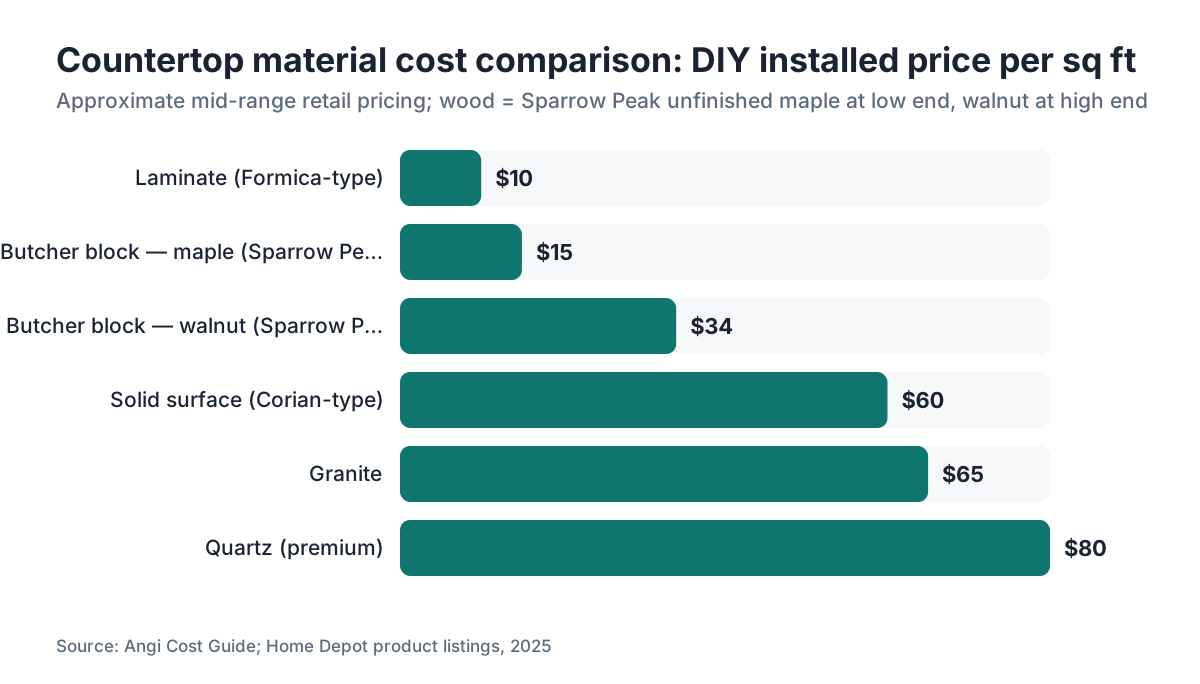
Laminate countertops (and Formica countertops specifically) are cheaper, $5, $15 per square foot installed, and more water-resistant [10]. They can be made to look like stone or wood. But they can't be refinished, the seams show more over time, and they lack the tactile warmth of real wood. For a tight budget, laminate is the sensible choice. For someone who values the feel of natural material, wood wins. One footnote: solid wood carries none of the composite-core off-gassing concerns tied to some laminate substrates [9].
Corian countertops and other solid surface materials sit in an interesting middle ground. They're fully non-porous, repairable by sanding (like wood), and come in continuous runs with hidden seams. They cost $40, $80 per square foot installed [10]. They don't look like wood, and they don't have the warmth of wood, but the maintenance comparison is closer than most people expect.
Quartz (like Cambria countertops) is the most durable everyday surface. Zero maintenance beyond wiping, no sealing, no staining. Costs $60, $100 per square foot installed for premium brands [10]. If low-maintenance is your top requirement, quartz is the straightforward pick.
The case for butcher block specifically: it's warm, it's real, it's repairable, and at $12, $40 per square foot DIY it's one of the most affordable ways to get a natural material in your kitchen. It requires a commitment to maintenance that other surfaces don't. That's the honest trade-off.
Frequently asked questions
Is Sparrow Peak butcher block available at stores other than Home Depot?
Not reliably. Sparrow Peak is a private-label brand tied to Home Depot's retail channel. You may find individual resellers listing Sparrow Peak SKUs online, but Home Depot (in-store and homedepot.com) is the primary source. If Home Depot doesn't have the size or species you need, specialty suppliers like John Boos, Craft Art, or Lumber Liquidators carry comparable edge-grain butcher block at similar or higher price points.
What's the difference between edge-grain and end-grain butcher block?
Edge-grain butcher block has boards laid side-by-side so the long edge of each board faces up. It looks like parallel stripes. End-grain shows the cross-section of each board, creating the classic checkerboard pattern. End-grain is better for cutting because knife edges press between the wood fibers rather than across them. Edge-grain is more stable, less prone to warping, and less expensive. Sparrow Peak sells primarily edge-grain.
Can you use Sparrow Peak butcher block as a cutting surface?
Yes, if you finish it with food-safe mineral oil rather than polyurethane. Oiled edge-grain maple is a safe cutting surface for vegetables, bread, and general prep. For raw meat and poultry, USDA guidance recommends using a separate cutting board that can be sanitized in the sink or dishwasher. Deep knife scores that accumulate over time should be sanded out periodically to prevent bacterial buildup in the grooves.
How often does butcher block need to be oiled?
For a new or freshly sanded surface, oil daily for the first week, then once a month for three months, then every 2 to 3 months or when the wood looks dry. The wood absorbs what it needs and rejects the rest. Food-safe mineral oil is the standard choice. A butcher block conditioning wax applied on top every few months adds water resistance that mineral oil alone doesn't fully provide.
Does Sparrow Peak butcher block come pre-finished?
Some SKUs are sold as pre-oiled, meaning the factory applied a coat of mineral oil before packaging. This is a helpful head start but not a complete finish. You should still apply additional oil coats before installation and again after the countertop is in place. Unfinished versions (the plain maple especially) are also available and cost slightly less. Either way, plan to do your own finishing work before exposing the surface to kitchen use.
What thickness does Sparrow Peak butcher block come in?
Most standard Sparrow Peak countertop pieces are 1.5 inches thick, which is the industry standard for residential butcher block. Some SKUs, particularly in island or breakfast bar configurations, are available in 2-inch thickness for a more substantial visual profile. If you need a non-standard thickness (1 inch for overlays, 3 inches for a thick statement edge), you'll need a custom fabricator rather than an off-the-shelf product.
Can butcher block countertop be installed over existing countertops?
Sometimes. If your existing countertop is flat, structurally sound, and the added height won't cause problems with your appliances or sink, a thin butcher block panel (1 inch or slightly under) can be glued over laminate or tile. The risk is that adhesive and substrate flatness issues can telegraph through. For anything thicker than 1 inch, removing the old countertop and starting fresh is the better approach for a clean, supported installation.
How do you make a sink cutout in Sparrow Peak butcher block?
Use the paper or cardboard template that comes in your sink box. Trace it on the underside of the countertop, adding the offset dimension specified by the template. Drill a starter hole inside the cut line, then cut with a jigsaw. Keep your speed moderate and support the cutout piece so it doesn't drop and crack the last inch of the cut. Immediately seal the exposed cut edge with mineral oil or finish to block water absorption.
Does butcher block work near a stove or will it burn?
Wood countertop directly adjacent to a range is fine. Wood countertop used as a landing spot for hot pans is not. Direct heat contact above about 150°F can scorch or char butcher block. Use trivets or a stainless steel landing pad near your cooktop. The wood won't spontaneously combust from a nearby burner, but sliding a cast iron skillet directly from burner to wood is a bad habit that will leave burn marks within a few weeks.
Can you stain or paint Sparrow Peak butcher block a different color?
You can stain it, but there are trade-offs. A food-safe stain or dye can shift the color of maple or acacia. Oil-based stains need to cure fully before the surface is food-safe. Painting wood countertops is generally not recommended because paint sits on the surface rather than penetrating, and kitchen wear will peel it fast. If you want a darker countertop, starting with walnut and oiling it is a better path than staining maple.
Is butcher block good for a bathroom vanity?
It can work well in a bathroom, where the water exposure is lower than a kitchen sink area and the heat concerns don't apply. The same maintenance rules apply: keep it oiled, wipe up standing water, and caulk around the sink. Bathrooms often have lower humidity variation than kitchens, which can actually be better for the wood's stability. The look is warm and natural, which translates well to bathroom design.
How does Sparrow Peak butcher block hold up to resale value?
Wood countertops are generally well-received by homebuyers when they're in good condition. A well-maintained butcher block kitchen reads as a thoughtful, warm design choice. A neglected one with dark staining around the sink and visible cracking reads as deferred maintenance. The material itself is not a negative for resale. The condition is what matters. A quick sand and re-oil before listing can change a buyer's perception fast.
Sources
- Home Depot, Sparrow Peak Butcher Block Countertop product listings: Sparrow Peak butcher block countertops are sold at Home Depot in a price range from approximately $12 to $40 per square foot depending on species and configuration
- Angi, Butcher Block Countertop Cost Guide: Custom butcher block from specialty fabricators typically runs $45, $80 per square foot installed; John Boos standard maple countertops run $60, $90 per square foot from kitchen dealers
- USDA Forest Service Forest Products Laboratory, Wood Handbook: Wood as an Engineering Material: Janka hardness values for common wood species: hard maple approximately 1,450 lbf, black walnut approximately 1,010 lbf, acacia species range from roughly 1,700 to 2,300 lbf
- University of California, Davis, Dean O. Cliver, research on cutting board bacteria (wood vs. plastic): UC Davis research found bacteria on wooden cutting boards died off and became harder to recover over time compared to plastic boards, with no higher bacterial retention on properly maintained wood
- USDA Food Safety and Inspection Service, cutting board and kitchen safety guidance: USDA FSIS confirms that both wood and plastic cutting boards are acceptable for cutting food, with cleaning and surface condition being the key safety factors
- Howard Products, Butcher Block Conditioner product information: Howard Butcher Block Conditioner combines food-grade mineral oil and carnauba wax for wood countertop conditioning and is widely used for periodic maintenance
- National Kitchen and Bath Association, kitchen design and countertop material guidance: Wood countertops require periodic oiling and refinishing; edge-grain construction is more dimensionally stable than end-grain in kitchen applications
- USDA Forest Products Laboratory, Wood Handbook chapter on moisture, shrinkage, and swelling: Wood expands and contracts with seasonal moisture changes; acacia species have higher tangential shrinkage than maple, making them more prone to movement in variable humidity environments
- U.S. EPA, formaldehyde emissions from composite wood products: Solid wood countertops like butcher block do not carry the composite-wood formaldehyde off-gassing concerns associated with some laminate core products
- Angi, Countertop Cost Guide: Laminate countertops cost $5, $15 per square foot installed; quartz countertops (including premium brands) cost $60, $100 per square foot installed; solid surface (Corian type) costs $40, $80 per square foot installed
Last updated 2026-07-09