TL;DR
- Butcher block works in a bathroom if you seal it right and stay on top of maintenance.
- Expect $30 to $100 per square foot installed.
- Edge-grain hardwood with a film-forming waterproof finish beats end-grain in humidity.
- The biggest risk isn't water on the surface.
- It's water sneaking under the sink cutout when caulk fails.
What is a butcher block bathroom countertop?
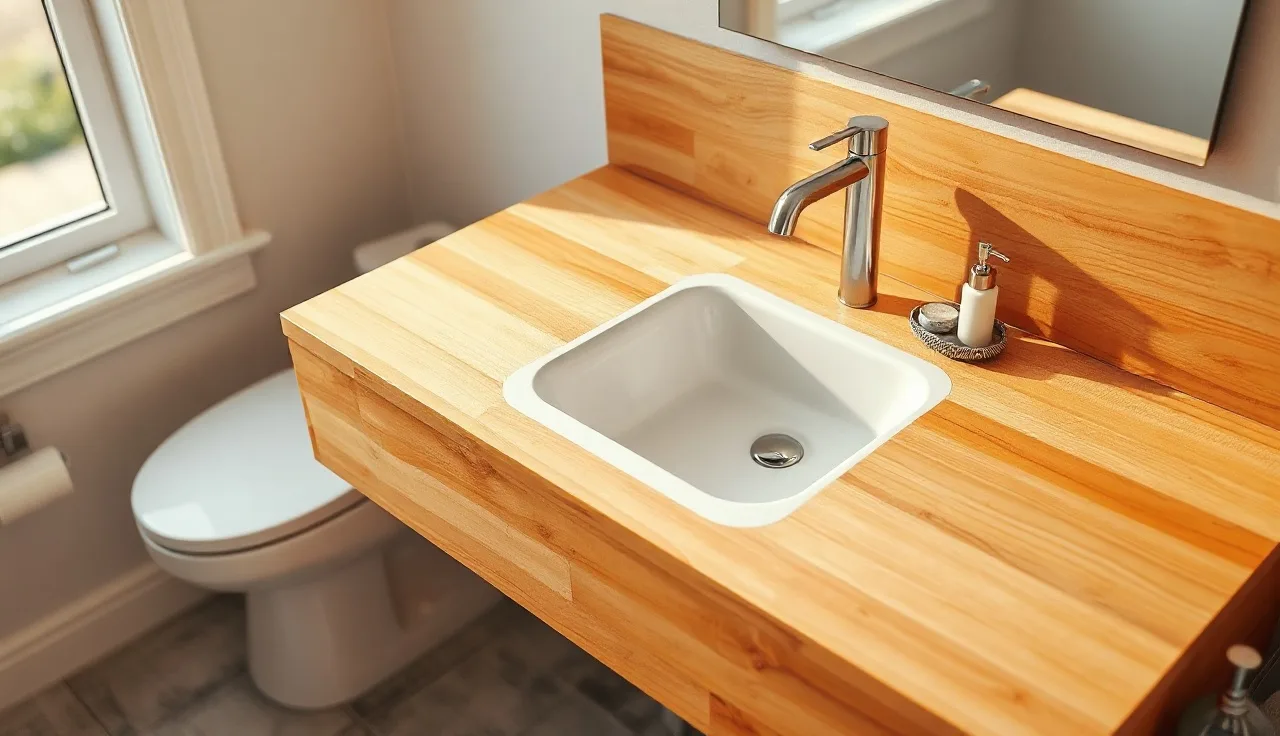
A butcher block countertop is a panel made from strips of hardwood glued together, then sanded flat and finished. In kitchens, the appeal is obvious: a working surface you can cut on, oil repeatedly, and refinish when it gets beat up. In a bathroom, the draw is warmth. Wood adds a texture and color that feels alive next to tile and fixtures, something stone and engineered quartz just don't have.
Three construction types exist, and they behave differently in a wet room. Edge-grain panels (wood strips with the long grain facing up) are the most common and most water-resistant. Face-grain panels look like wide planks and are better for looks than durability. End-grain panels (the checkerboard cutting-board look, grain facing up) are beautiful but absorb water fastest and need the most babysitting. For a bathroom, edge-grain is the right call almost every time.
Species matters too. Teak is the best pick for wet spaces because its natural oils resist moisture without much help from you [1]. Hard maple, walnut, and white oak are common and do fine with proper sealing. Softer woods like pine dent easily and aren't worth the trouble here.
Browse big-box options and you've probably seen butcher block at Menards, Home Depot, or IKEA. The Menards line runs mostly maple and oak, sold in standard widths and lengths that fit a bathroom vanity with minimal cutting. These are edge-grain panels and a reasonable starting point. Just know they ship unfinished or with a light oil coat, and a bathroom needs a harder waterproof topcoat before installation.
How does butcher block hold up to bathroom humidity?
This is the real question, and the honest answer is that it depends on the finish, the ventilation, and how obsessive you're willing to be.
Wood is hygroscopic. It swells when it absorbs moisture and shrinks when it dries out. A bathroom with no exhaust fan and no window creates a steam-and-dry cycle that eventually causes checking (small surface cracks), warping, or joint separation in any wood panel. The USDA Forest Products Laboratory Wood Handbook puts indoor wood at 6 to 8% moisture content in typical conditioned spaces, but bathrooms with frequent hot showers push surfaces into the 10 to 15% range on and off [2]. That cycling is what wears wood down over time.
The finish is your first line of defense. Penetrating oils (tung oil, danish oil, mineral oil) soak into the wood and protect from the inside but leave almost no surface barrier. They work in a kitchen where the counter dries between uses. In a bathroom, they're marginal. A film-forming finish (polyurethane, conversion varnish, or marine-grade spar varnish) sits on top and blocks moisture from getting in at all. Two to three coats of a waterproof polyurethane is the floor for a bathroom.
The caulk line around the sink and backsplash does as much work as the finish. If water sneaks under the counter through a failed bead at the sink cutout, the underside wicks moisture continuously, and you'll watch the surface buckle from below before you ever notice the caulk gave out. Check and re-caulk every 12 to 18 months.
Ventilation is the variable homeowners underestimate most. The Home Ventilation Institute recommends bathroom exhaust fans sized at a minimum of 1 CFM per square foot of floor area, or 50 CFM for bathrooms under 50 square feet [3]. Run a right-sized fan during every shower and for 15 minutes after, and a well-sealed wood counter can go a decade or more without real trouble.
What does a butcher block bathroom countertop cost?
Butcher block panels run $15 to $60 per square foot depending on species, thickness, and construction. A standard bathroom vanity top covers 10 to 15 square feet, so that's $150 to $900 in materials before finishing or install.
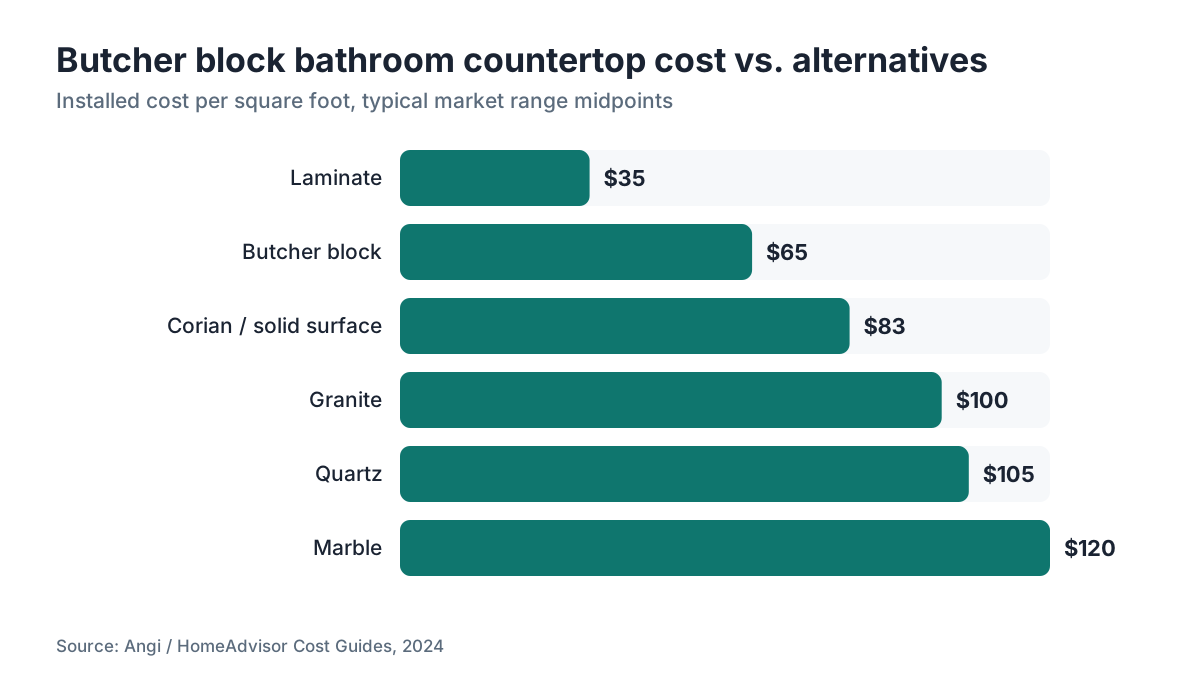
Installed cost runs $30 to $100 per square foot all-in, depending on your market, cutout complexity, and whether you hire a fabricator or do it yourself [4]. A simple vanity top with a single undermount cutout and a basic edge sits at the low end. A double-sink top with a mitered backsplash, custom edge, and pro finish runs toward the high end.
DIY is genuinely doable here in a way it isn't with granite or quartz. A jigsaw, a router for the edge, and a sander cover the woodworking. The finish is the part people rush and regret. Three coats of polyurethane, sanded lightly between coats with 220-grit, takes a full weekend and a dry, dust-free room.
For big-box pricing, Menards butcher block typically runs $10 to $30 per linear foot for standard 25-inch-deep panels in maple or oak, roughly $5 to $14 per square foot for the raw panel before finishing [5]. That's among the lowest raw material costs of any solid-surface countertop option. The trade-off: you're doing more finish prep than you would with a prefinished panel from a specialty supplier.
Here's how butcher block stacks up against the other common bathroom surfaces:
| Material | Installed cost (per sq ft) | DIY-friendly? | Water resistance |
|---|---|---|---|
| Butcher block (edge-grain) | $30, $100 | Yes | Good with proper seal |
| Laminate countertops | $20, $50 | Yes | Good (avoid edge moisture) |
| Granite countertops | $50, $150 | No | Excellent |
| Marble countertops | $60, $180 | No | Fair (etches/stains) |
| Corian countertops | $45, $120 | Sometimes | Excellent |
| Quartz | $60, $150 | No | Excellent |
What finish should you use on a butcher block bathroom countertop?
Finish selection is where most butcher block bathroom projects live or die. You have four real options.
Waterborne polyurethane is the most practical choice for most homeowners. It dries clear, doesn't yellow, has low VOCs compared to oil-based products, and lays down a hard film that blocks moisture. Apply three coats minimum, sand lightly between coats with 220-grit, and hit the end grain and the inside edge of sink cutouts hard. Wipe-on formulas (like Minwax Wipe-On Poly) are easier for amateurs. Brush-on builds thicker per coat.
Oil-based polyurethane builds a harder, more durable film than waterborne, and it's a good pick if you don't mind the amber tone it adds to lighter woods. The catch is the longer dry time between coats (8 to 24 hours versus 2 to 4 for waterborne) and the higher VOCs.
Marine spar varnish is worth a look for a bathroom that gets truly heavy steam, because it's built to flex with wood movement through humidity cycles. It costs more and is harder to find in a hardware store, but it's what boatbuilders put on teak decks that sit in ocean air all year.
Penetrating oils (tung oil, danish oil, mineral oil, hardwax oil) are not recommended as a standalone finish for a bathroom counter. They're beautiful and food-safe, but they leave the wood's pores mostly open to water vapor. In a kitchen you get away with it because the surface dries completely between uses. In a bathroom with daily shower steam, you don't. If you love the matte, natural feel of an oil finish, use a hardwax oil like Rubio Monocoat or Osmo Polyx. They handle more moisture than traditional oils, though they still don't match a film finish for outright water resistance. The Forest Products Laboratory is blunt on this point: film-forming finishes cut moisture exchange between wood and its surroundings far more than penetrating oils do [9].
Whatever you pick, apply at least one coat to the underside and all edges before installation. The underside never gets refinished after the counter is mounted, and sealing it cuts moisture absorption from below. That matters in a bathroom, where humidity rises out of the cabinet interior too.
Can you use butcher block with an undermount sink?
Yes, and it looks great. But the sink cutout is the most vulnerable part of the whole install. When you cut into wood, you expose end grain around the entire perimeter of the hole. End grain is basically a bundle of tiny straws. It wicks water far faster than face or edge grain. If that cutout edge isn't sealed perfectly, water migrates in from below the sink rim, and you get rot, swelling, and eventually mold.
Here's the process for a watertight undermount install:
- Cut the sink hole with a jigsaw. Sand the cutout edge through 180-grit.
- Apply three coats of waterproof finish (polyurethane or epoxy) to the inside edge of the cutout, letting each coat dry fully. Some fabricators brush straight epoxy here for maximum protection.
- Mount the sink with a high-quality silicone sealant between the sink rim and the underside of the wood. Use 100% silicone, not latex.
- After install, run a bead of silicone along the top seam where the sink rim meets the counter surface. Smooth it and let it cure 24 hours before running water.
- Inspect and re-caulk every 12 to 18 months.
A drop-in (self-rimming) sink is actually a worse choice for butcher block than an undermount for long-term water resistance, because the rim catches water and holds it against the wood. If the silicone around a drop-in fails, water pools right at the seam.
A vessel sink is arguably the best pairing with butcher block. No cutout goes through the full panel depth. You just drill a smaller hole for the drain, which is far easier to seal completely.
How do you install a butcher block bathroom countertop?
Installation is within reach for a competent DIYer, though getting the finish right matters as much as the woodworking.
Start with a dry-fit before any finish goes on. Set the panel on the vanity cabinet, check for level (shim under the cabinet if needed, never the countertop itself), and scribe to the wall if the wall isn't flat. Most bathroom walls have some bow or lean, and a gap at the backsplash looks terrible. A belt sander or small hand plane fixes most scribing problems in wood faster than they would in stone.
Once the fit is right, pull the panel off and apply all your finish coats to the top, bottom, and four edges before installing. Let it cure fully. Polyurethane needs at least 72 hours to reach working hardness, even though it's dry to the touch much sooner.
Secure the countertop to the cabinet with figure-eight fasteners or clip brackets screwed into the cabinet frame, not through the top of the wood. This lets the panel expand and contract seasonally without cracking. Skip construction adhesive. It stops movement and can split the wood at glue joints when it expands.
Caulk the backsplash seam with 100% silicone in a color that matches either the grout or the wood. Paintable silicone-latex caulk tools easier cosmetically but holds up worse in a wet room.
For a step-by-step look at general countertop installation across materials, that guide covers substrate prep and leveling that applies to wood too.
Planning to quote the job through a fabricator instead of DIY? Know that most stone fabricators don't cut or finish wood. You'll need a millwork shop or a cabinetry company, or you'll buy a pre-made panel and finish it yourself. Shops running countertop quoting software like SlabWise usually handle stone and engineered materials. Wood is a separate trade.
How do you maintain and refinish butcher block in a bathroom?
Maintenance is real and ongoing. This isn't a set-it-and-forget-it surface. If that's what you want, a Cambria countertop or quartz is the better answer.
Day to day: wipe up standing water fast, don't let wet towels or soap bottles sit long-term, and dry the area around the sink after each use if you can manage it. Use a mild pH-neutral cleaner. Dish soap diluted in water works fine. Avoid anything ammonia- or bleach-based, which breaks down a polyurethane finish over time.
Every 3 to 5 years (sooner if the finish looks dull or water stops beading), you'll refinish. Sand through progressively finer grits, starting at 80 or 100 to strip the old finish, then 150, then 180 or 220 for the final pass. Wipe with a tack cloth and apply fresh coats. This is a half-day project if the surface is in decent shape and a full weekend if there's real damage to fix.
Minor scratches and water rings in a polyurethane surface are harder to spot-repair than in an oiled one, because you can see the line between old and new finish. On an oiled surface, you sand the spot and re-oil, and the repair blends invisibly. That's one genuine advantage of oil finishes for people who hate refinishing projects: easier routine repair, even though the moisture protection is lower.
Get mold under the finish (dark staining that won't wipe off) and that's a sign water got through, usually at the sink caulk line. Remove the sink, let the wood dry completely (a week or more in a warm room with a fan), sand out the staining as deep as it goes, treat with a wood bleach or oxalic acid solution if the stain runs deep, then refinish. The EPA is direct about the root cause here: controlling indoor moisture is the way to stop mold growth on building materials, wood included [8]. Catching a caulk failure early beats mold remediation every time.
Where should you not use butcher block in a bathroom?
Butcher block is a bad idea in a few specific spots, and it's worth being blunt about them.
No exhaust fan and no operable window? Don't do it. The steady high humidity breaks down even a good finish faster than you can keep up.
Kids' bathroom where the counter gets soaked constantly, with water fights at the sink, wet hands everywhere, and cups left in puddles? Butcher block shows wear fast. It refinishes fine, but you'll be doing it every couple of years instead of every five.
Rental property, or a bathroom where the next occupant won't know to check the caulk? Skip it. The window for catching a failing caulk bead before it causes rot is short, and an inattentive user will miss it.
Master bath with a steam shower that exhausts into the room instead of outside? The humidity load is simply too high for wood.
For these situations, a laminate countertop in a wood-look finish gets you most of the look for a fraction of the maintenance. Modern Formica countertops have gotten genuinely good at faking wood grain. Or go the other way and use a material that likes moisture, like soapstone. Here's a guide on how to clean soapstone countertops if you want to understand that material's trade-offs.
What are the best wood species for a bathroom countertop?
Not every hardwood handles a bathroom equally well. Here's an honest ranking.
Teak is the best choice if budget allows. Its high silica and oil content make it inherently water-resistant, the same properties that make it the default for boat decks and outdoor furniture [1]. It's also one of the few woods where an oil-only finish is defensible in a wet room. The downsides: it's expensive (expect a big premium over maple or oak), the silica dulls cutting tools faster, and sustainable sourcing takes more diligence.
White oak is a strong second. The tyloses that seal its cell structure make it much more water-resistant than red oak. It's the wood used in wine barrels for exactly that reason. A properly finished white oak counter handles bathroom moisture well and has a beautiful open grain that looks sophisticated.
Hard maple is the most common butcher block species because it's cheap, machines cleanly, and has a tight grain that takes finish well. It has no special moisture resistance but performs fine under a good film finish. Menards sells maple most often for exactly this reason: reliable and cost-effective.
Walnut adds a richness that's hard to match with any other species. It's softer than maple (Janka hardness around 1010 versus maple's 1450) [6], so it dents and scratches more easily. For a low-traffic guest bath or powder room, that's a fair trade for the look.
Avoid exotic species from unknown sources without checking sustainability certifications. The Forest Stewardship Council certification marks wood from responsibly managed forests [7]. That matters partly for the environment and partly for a practical reason: some uncertified exotic wood isn't what the seller claims, so the moisture performance you expect may not match what you get.
Is butcher block a good choice for a powder room versus a full bath?
The distinction matters more than people realize.
A powder room (half bath with toilet and sink, no shower or tub) is the single best home for butcher block in a bathroom. No steam. Moisture comes from hand-washing only. The humidity swings are nothing like a full bath. Here, butcher block behaves almost exactly like it does in a low-traffic kitchen, and a good polyurethane finish will run 10 years without major intervention. This is where I'd put it without hesitation.
A full bath with one or two daily showers takes more commitment. It can work, and plenty of people have pulled it off, but you need the exhaust fan, the good finish, the annual caulk checks, and the willingness to refinish every few years. Think of it like natural stone with high maintenance needs: the payoff is real and so is the upkeep.
A master bath where a steam shower exhausts into the room is the wrong place for butcher block. Full stop. The moisture load is too high, and the damage comes faster than you can maintain against it.
How does butcher block compare to other bathroom countertop materials?
Short version: butcher block is the warmest, most DIY-friendly option and the highest maintenance. Every other mainstream material takes less work to keep looking good.
Quartz and solid surface materials (like Corian countertops) are essentially waterproof. No sealing, no oiling, no caulk vigilance beyond the sink edge. They're the right choice for anyone who wants to stop thinking about the counter after installation.
Granite and quartzite need periodic sealing (once a year or so) but they're stone. They don't rot or warp. A failed caulk line on a granite counter is a cabinet problem, not a countertop problem. See our guides on how to clean stone countertops and how to clean quartzite countertops for a sense of what stone upkeep actually involves.
Marble is arguably more maintenance-intensive than well-sealed butcher block in one sense: it etches from acids (toothpaste, mouthwash, plenty of common bathroom products), and those etches don't come out with a simple refinish the way wood scratches do. Butcher block at least sands back to new.
Laminate is the most underrated budget option for bathrooms. Modern high-pressure laminate is more water-resistant than it was 20 years ago, handles edge moisture with proper edge banding, and comes in convincing wood looks. Its main drawback next to butcher block: you can't refinish it. When it's done, it's done.
For fabricators quoting bathroom projects, the job mix matters. Butcher block countertops get priced and fabricated differently from stone, and most CNC stone shops won't touch wood. If you're quoting mixed-material bathroom projects, tools like SlabWise help keep material costs and margins separated cleanly across different countertop types in one bid.
Where can you buy butcher block for a bathroom vanity?
Big-box stores are the most accessible source. Home Depot carries acacia and birch panels from John Boos and their own house brand. Menards butcher block runs in standard 25-inch-deep panels (the typical vanity depth) in maple and oak at competitive prices. It's one of the few places you can walk in, buy an unfinished panel, and be sanding it at home the same afternoon.
IKEA's kitchen island tops get repurposed for vanities all the time. They're cheap, solid-wood-core, and the factory finish is minimal, which means you're doing the waterproofing yourself regardless.
Specialty online suppliers like LL Flooring (formerly Lumber Liquidators), Boardwalk Hardwood, and Plyboo (for bamboo, which is technically a grass but behaves like a dense hardwood) offer wider species selection and better quality control on the panel glue-up. For teak specifically, suppliers that focus on marine woodworking often have better quality and verified sourcing than general hardwood dealers.
Custom millwork shops and cabinet companies cut a panel to exact vanity dimensions, finish it in-shop, and deliver something ready to drop in. This costs more than big-box but saves the finish work and takes away the risk of laying down a bad finish yourself. For a complex vanity with custom dimensions or an integrated backsplash detail, this is usually the right call.
For most homeowners doing a standard 48-inch or 60-inch vanity in a guest or powder room, the big-box route (buy a standard panel, finish it yourself) is plenty and saves $200 to $500 over custom-cut options.
Frequently asked questions
How long does a butcher block bathroom countertop last?
With a film-forming finish (polyurethane or similar) and proper maintenance, a butcher block bathroom countertop realistically lasts 10 to 20 years before you'd replace rather than refinish it. In a low-humidity powder room with careful upkeep, it can last longer. In a high-humidity full bath with neglected caulk lines, you could have serious problems in 3 to 5 years. Species and finish quality matter more than almost anything else.
Can you put butcher block around a bathroom sink?
Yes, but the sink cutout is the highest-risk zone. End grain exposed at the cutout wicks water aggressively. Seal the cutout edge with three coats of waterproof finish (or a coat of epoxy) before mounting the sink. Use 100% silicone at the sink-to-wood joint and re-inspect the caulk annually. An undermount or vessel sink done right is more water-resistant than a drop-in, because there's no rim collecting water on the wood surface.
Do you need to seal butcher block in a bathroom?
Yes. A penetrating oil alone is not enough for a bathroom. You need a film-forming waterproof finish: waterborne or oil-based polyurethane, marine spar varnish, or a hardwax oil like Rubio Monocoat. Apply two to three coats on the top and at least one coat on the underside and all edges before installation. Re-apply when water no longer beads on the surface, typically every 3 to 5 years.
Is butcher block sanitary in a bathroom?
A properly sealed butcher block counter is sanitary for bathroom use. The finish creates a non-porous surface that resists bacteria. Unlike a kitchen counter where raw meat might touch wood, a bathroom counter's main hygiene concern is soap residue, toothpaste, and cosmetics, none of which penetrate a good polyurethane finish. If the finish breaks down and the wood turns porous again, re-seal it before bacteria have a place to live.
What thickness of butcher block should I use for a bathroom vanity?
1.5-inch (standard butcher block thickness) is the most common and works well for most vanities. It's heavy enough to feel substantial and thin enough to stay in proportion over standard 34.5-inch base cabinets. Some homeowners use 1-inch panels to save weight or cost. The 1.5-inch is noticeably more warp-resistant and easier to seal uniformly across the thickness. Go thicker than 1.5 inches only for a specific design reason.
Can butcher block in a bathroom get mold?
Yes, if moisture gets through the finish. Mold on a butcher block counter almost always comes from failed caulk at the sink cutout or backsplash, not from surface humidity alone. It shows up as dark staining below the finish. To remediate: remove the sink, let the wood dry fully, sand out the stain (often deeper than it looks), treat with oxalic acid if needed, and refinish. Prevention means inspecting caulk lines every 12 to 18 months and recaulking at the first sign of shrinkage or cracking.
How do you clean a butcher block bathroom countertop?
Use a mild dish soap diluted in water and a soft cloth. Wipe dry after. Avoid ammonia-based cleaners, bleach, or abrasive scrubbers, which break down polyurethane faster than normal wear does. For disinfecting, a diluted hydrogen peroxide solution (3% over-the-counter) is gentler on finishes than bleach and still effective. Don't use multi-surface sprays with citrus extracts; they degrade some finishes over time.
Is a butcher block bathroom countertop good for resale value?
Neutral to slightly positive in most markets, but only if it's in good condition at sale time. A well-maintained butcher block vanity reads as intentional and warm to buyers. A scratched, water-stained, or caulk-failed one reads as a deferred maintenance problem and can hurt the bathroom's perceived condition. If you're selling in the next 1 to 2 years and can't commit to a refinish, a lower-maintenance surface is the safer investment.
What's the difference between edge-grain, end-grain, and face-grain butcher block for bathrooms?
Edge-grain has the long wood fibers running along the surface: most water-resistant, best choice for bathrooms. End-grain has the cut ends of the fibers facing up (the checkerboard look): beautiful but absorbs water fastest, highest maintenance, not ideal for bathrooms unless you're committed to obsessive sealing. Face-grain looks like wide planks with the flat face up: the most attractive grain pattern but the most prone to cupping and warping in high humidity.
Can I buy butcher block countertop at Menards for a bathroom?
Yes. Menards carries unfinished and lightly oiled edge-grain butcher block panels, typically in maple and oak, in standard widths that fit bathroom vanities. Pricing is among the lowest at any big-box retailer. The panels ship with minimal finish, so you'll apply a proper waterproof topcoat yourself before bathroom use. For a powder room or low-humidity full bath, this is a perfectly reasonable source.
How do I prevent my butcher block bathroom counter from warping?
Seal all six sides (top, bottom, and four edges) before installation to equalize moisture absorption. Secure the panel with figure-eight fasteners that allow seasonal wood movement rather than rigid adhesive. Run a right-sized exhaust fan during and after every shower. Don't set hot styling tools directly on the surface; repeated heat cycling stresses the finish and can cause localized cupping. Inspect caulk lines annually so water can't enter from below.
Is teak the best wood for a bathroom countertop?
For moisture resistance, yes. Teak's natural oil content and silica resist water, rot, and warping, the same properties that make it standard on boat decks and outdoor furniture. It performs well even with less aggressive sealing than other species need. The trade-offs are cost (much higher than maple or oak) and the need to verify sustainable sourcing via FSC certification. For a budget-conscious bathroom, properly finished white oak is the next-best choice.
Can a fabricator cut and install butcher block countertops?
Most stone fabricators don't work with wood. It takes different tooling and finishing skills. You'll typically need a millwork shop, a cabinetry company, or a woodworking contractor. Some kitchen and bath dealers offer butcher block as part of a full countertop package. For DIY, a jigsaw, router, and orbital sander handle most of the cutting and edging. The finishing (multiple coats of polyurethane, sanded between coats) is the skill-intensive part.
Sources
- Forest Products Laboratory, USDA, Wood Handbook: Wood as an Engineering Material: Teak's naturally high oil and silica content provides inherent moisture and decay resistance compared to most other hardwood species.
- Forest Products Laboratory, USDA, Wood Handbook: Chapter 4, Moisture Relations and Physical Properties of Wood: Indoor wood products stabilize at 6 to 8% moisture content in typical conditioned spaces; higher humidity environments push wood toward 10 to 15% moisture content, causing repeated expansion and contraction.
- Home Ventilation Institute (HVI), Residential Ventilation Standards: HVI recommends bathroom exhaust fans sized at a minimum of 1 CFM per square foot of bathroom floor area, with a minimum of 50 CFM for bathrooms under 50 square feet.
- Angi, Butcher Block Countertop Installation Cost Guide: Installed butcher block countertop costs range from approximately $30 to $100 per square foot depending on species, region, and installation complexity.
- Menards, Butcher Block Countertop Product Listings: Menards butcher block countertop panels in maple and oak typically retail in the range of $10, $30 per linear foot for standard 25-inch-deep panels.
- Wood Database, Janka Hardness Rating Reference: Black walnut has a Janka hardness of approximately 1010 lbf; hard maple rates approximately 1450 lbf, making maple significantly more dent-resistant.
- Forest Stewardship Council, FSC Certification Standards: FSC certification indicates wood products sourced from responsibly managed forests meeting defined environmental and social standards.
- EPA, Indoor Air Quality: Moisture Control: The EPA notes that controlling indoor moisture is essential to preventing mold growth on building materials, including wood surfaces.
- USDA Forest Products Laboratory, Finishing of Wood: Film-forming finishes such as polyurethane provide a surface barrier that reduces moisture exchange between wood and the surrounding environment significantly more than penetrating oil finishes.
- American Institute of Architects, Bathroom Design Best Practices: Proper bathroom ventilation and material selection are cited as primary factors in long-term bathroom surface durability and indoor air quality.
Last updated 2026-07-09