TL;DR
- Solid maple butcher block countertops run $40 to $100 per square foot installed, depending on edge-grain versus end-grain construction and finish.
- Maple is the most common wood choice because it's hard (1,450 Janka), affordable, and food-safe when properly sealed.
- The trade-off: maple scratches and stains more visibly than darker woods, and it needs oil or varnish every 6 to 12 months to stay watertight.
What exactly is a solid maple butcher block countertop?
A solid maple butcher block countertop is a thick wood slab made from strips or blocks of hard maple (Acer saccharum, sugar maple, and close relatives) glued together under pressure. The name goes back to the chopping blocks butchers used in the 1800s. Today it covers three constructions that look and perform very differently.
Edge-grain maple is the common type. The strips run lengthwise, showing the long grain on top. It's stable, resists knife marks reasonably well, and costs the least of the three. Most of the maple counters at big-box stores are edge-grain.
Face-grain maple shows the wide, flat face of each board. It looks striking. But the open grain cups more with moisture changes, and most woodworkers tell you to skip it for heavy daily use. Save face-grain for a breakfast bar that won't see standing water.
End-grain is the classic checkerboard, where you're staring down the length of each strip. It's the priciest option, usually 30 to 50% more than edge-grain at the same thickness, and it genuinely heals itself: a knife cut compresses the fibers instead of slicing across them. The catch is that end-grain drinks water and oil like a sponge, so it needs more upkeep. [1]
Thickness runs from 1.5 inches for light residential use up to 4 inches for a true commercial block. For a normal kitchen counter, 1.75 or 2 inches hits the sweet spot between durability and cost.
How much do solid maple butcher block countertops cost?
Material for solid maple butcher block runs roughly $20 to $60 per square foot for unfinished slabs, depending on thickness, construction, and supplier. Finished and installed, figure $40 to $100 per square foot. Island tops with sink cutouts or odd dimensions push toward the top of that range. [2]
Here's how the main options stack up:
| Construction | Material (unfinished) | Installed (finished) |
|---|---|---|
| Edge-grain maple, 1.5" | $18 to $30/sq ft | $40 to $65/sq ft |
| Edge-grain maple, 2.25" | $25 to $40/sq ft | $50 to $80/sq ft |
| End-grain maple, 2.25" | $45 to $75/sq ft | $80 to $120/sq ft |
| Face-grain maple, 1.5" | $20 to $35/sq ft | $40 to $70/sq ft |
For comparison, a plain run of granite starts around $40/sq ft installed for simple edges [3], so edge-grain maple and granite sit in the same neighborhood. Quartz and engineered stone usually run $55 to $100/sq ft installed.
Labor adds $20 to $40 per square foot for a pro install, including the template, cutouts, and fitting. DIY is genuinely doable with maple in a way it isn't with stone. You can cut it with a circular saw, and it weighs a fraction of a granite slab. A 30-square-foot run of 1.5-inch edge-grain weighs roughly 90 to 100 pounds total. The same area in 3-cm granite is closer to 300 pounds.
The biggest price driver beyond construction is whether you buy pre-made panels from a maker like John Boos or order custom-fabricated slabs. A John Boos maple countertop in a standard 25-inch depth ships in fixed lengths and typically costs $15 to $35 per linear foot for the slab alone, depending on length and thickness. [4] Custom fabrication for an island with unusual dimensions adds 20 to 40% over stock pricing.
Finishing costs matter too. Buy unfinished and hire someone to apply food-safe oil or a conversion varnish, and you'll add $5 to $15 per square foot for labor and materials.
Is maple the best wood for butcher block countertops?
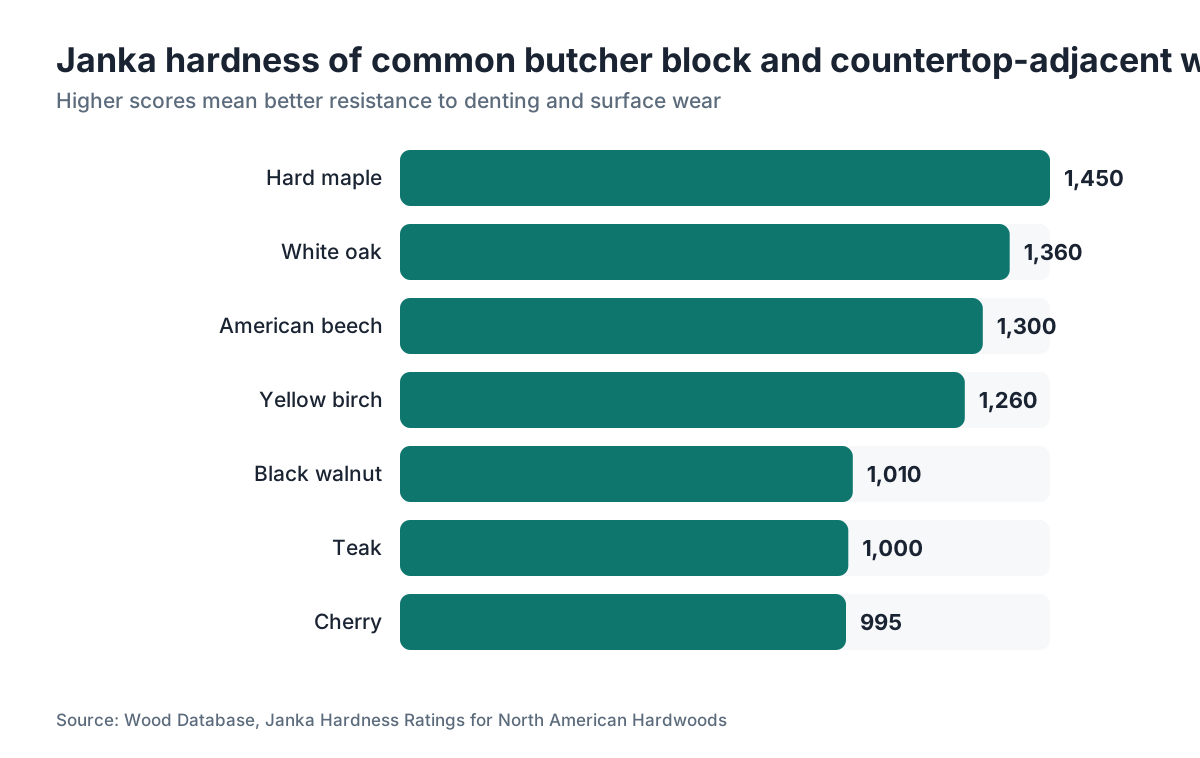
Maple is the dominant choice for a reason. It's hard, tight-grained, cheap, and easy to find. Hard maple scores 1,450 on the Janka hardness scale, against 1,010 for black walnut, roughly 1,000 for cherry, and 1,300 for American beech. [5] That hardness means it shrugs off dents from dropped pots and holds up under daily cutting better than softer species.
The tight grain also helps with food safety. Maple's closed pores don't trap bacteria the way open-grained oak can. The USDA Forest Products Laboratory has published research showing tight-grained wood surfaces can kill bacteria over time from natural wood compounds, though the same research is clear the effect is inconsistent and shouldn't replace real cleaning. [6]
Maple isn't perfect for every kitchen, though.
It shows scratches and water rings more than darker species. Walnut hides scratches because its natural color masks them. If your counter goes in a busy prep zone where looks matter and you don't want to sand and re-oil constantly, walnut's darker tone is more practical. Expect to pay 20 to 40% more for it.
Teak is another option, mostly for spots near a sink. Its natural oils make it more water-resistant out of the box, but it costs more and is harder to source from verified sustainable forestry. Bamboo gets marketed alongside butcher block but isn't a wood at all. It's a grass laminate with different expansion behavior and some adhesive off-gassing concerns that maple doesn't have.
For fabricators quoting these jobs, what your supplier actually stocks in the right thicknesses and widths matters more than the theoretical best species. Edge-grain maple in 1.75-inch thickness ships from a dozen domestic suppliers. A 2.25-inch end-grain walnut top can take 4 to 6 weeks to source.
For how wood stacks up against the rest of the field, the butcher block countertops overview covers the full category.
What finish should you use on maple butcher block, and does it matter?
Finish is the decision that makes or breaks the counter after construction type. Get it wrong and you either have a top that stains badly within months or one you can't cut on at all.
There are two camps: penetrating oils and film-forming finishes.
Penetrating oils (mineral oil, cutting board oil, tung oil, danish oil) soak into the fibers instead of sitting on top. They're food-safe once cured, easy to apply, easy to reapply when the surface looks dry. The downside is minimal protection against standing water and stains. An oiled maple counter next to a sink will drink water and grow dark rings if you're not wiping it down. Reapply every 4 to 8 weeks early on, tapering to every few months once the wood is saturated. [7]
Pure mineral oil is the safest starting point. It's cheap, food-safe, everywhere, and has no additives that cause reactions. Beeswax blends (mineral oil plus beeswax) add a slight surface barrier. Skip olive oil, coconut oil, and any nut-based oils. They go rancid inside the wood.
Film-forming finishes (polyurethane, conversion varnish, hardwax oil) sit on top and build a moisture barrier. They beat oil finishes on water and stain resistance. The trade: you can't cut on the counter anymore. Slicing through the film exposes raw wood, and the finish peels at the cuts. Film finishes are right for decorative counters, bar tops, and anything near the sink where you're not chopping.
Waterlox is a popular middle ground, a tung-oil-based finish that penetrates and builds a slight film. Plenty of fabricators recommend it for residential kitchens. It's more water-resistant than straight mineral oil and doesn't chip like polyurethane.
For end-grain maple, the USDA Forest Products Laboratory recommends saturating thoroughly with mineral oil before any other finish, because end-grain wicks oil so fast the first several coats vanish in hours. [6]
Most John Boos maple counters ship with a board cream (mineral oil and beeswax) and a note to oil before first use. Their care instructions call for oiling every 3 to 4 weeks for the first three months. [4]
How do you maintain a solid maple butcher block countertop?
Maintenance is what separates a maple counter that looks great at 15 years from one that's warped and stained at 3. It's not hard. It is regular.
For oiled counters, the routine is simple. Wipe the surface dry after it touches water. Don't leave a wet dish cloth sitting on it. Oil whenever it starts to look gray or dry, usually every 4 to 12 weeks depending on how much water it sees. Sanding out scratches is quick: 120-grit to remove the damage, 180 to 220 to smooth, then reapply oil. Being able to sand and refinish in place is one of the real advantages maple holds over stone. You can bring a maple counter back to like-new with a random orbital sander. You cannot do that with granite or quartz.
For varnished or film-coated counters, the job is keeping the finish intact. Don't cut directly on the surface. Use trivets for hot pans. Most butcher block scorches at brief contact around 350°F, and direct heat from a cast iron pan can crack a film finish. Clean with mild dish soap and water, then dry it promptly.
Here's what most guides skip: humidity. Maple moves. Below 30% relative humidity, a wide slab can crack along the glue joints. In a wet environment, it cups and swells. Most makers spec 35 to 65% relative humidity indoors. If you run forced-air heat all winter in a dry climate, this is a real problem, not a theoretical one. [7]
Sink cutouts are the toughest maintenance spot no matter the finish. Water gets in at the cut edges, and that's where maple counters fail first. Seal the cutout edges thoroughly before installation, use a sink with an integral overflow, and check the sealant every year.
How does maple butcher block compare to other countertop materials?
The honest comparison depends on what you're optimizing for.
| Material | Cost installed | Durability | Maintenance | Heat resistance | DIY-friendly |
|---|---|---|---|---|---|
| Maple butcher block (edge-grain) | $40 to $80/sq ft | Good | High | Moderate | Yes |
| Granite | $40 to $100/sq ft | Excellent | Low | Excellent | No |
| Quartz (engineered) | $55 to $100/sq ft | Excellent | Very low | Moderate | No |
| Laminate | $15 to $40/sq ft | Moderate | Low | Poor | Yes |
| Corian/solid surface | $45 to $85/sq ft | Moderate | Low | Poor | No |
Maple wins on warmth, renewability, and the fact that you can cut right on it. It loses on heat resistance, stain resistance, and how much upkeep it demands.
A common setup in remodeled kitchens is mixed materials: stone or quartz on the perimeter runs near the sink and stove, maple butcher block on an island or prep zone. You get low-maintenance stone where the water lives and a knife-friendly surface where you actually prep.
On a tight budget, laminate countertops and Formica countertops come in wood-look patterns that mimic butcher block at $15 to $40/sq ft installed. They don't behave like wood, though, and you can't sand or refinish them.
For a shop, maple butcher block is fast to quote and cut but needs different tooling than stone. Carbide-tipped blades and router bits handle it. No waterjet or CNC stone bridge saw required. If your shop already quotes stone, pricing software that handles both saves real time. Platforms like SlabWise let you quote wood and stone from the same interface, which matters when a customer wants a mixed-material kitchen.
Is maple butcher block food-safe and sanitary for a kitchen?
Yes, with the right finish and regular cleaning. Properly oiled or sealed maple is a safe food-contact surface under FDA guidelines for food equipment. [8]
The research on wood and bacteria is more nuanced than the flat claim that wood is either safe or dangerous. A widely cited series of studies by Dean Cliver at UC Davis found bacteria that soak into wood surfaces die relatively quickly and don't re-emerge to contaminate food, while bacteria on plastic cutting surfaces can survive in knife cuts. [9] The FDA Food Code treats wood as acceptable for certain food-contact applications, especially surfaces that get refinished regularly.
A few practical rules still apply. Don't let raw meat juice sit; wipe it up right away. Sanitize periodically with a dilute white vinegar solution, not bleach, which can wreck the wood and the finish. Let the surface dry fully after washing instead of leaving it soaking. And keep the finish in good repair, because raw, cracked wood is harder to clean than a smooth, oiled surface.
NSF International, which certifies food equipment, does certify some butcher block products for commercial food service. If you're outfitting a commercial kitchen and your health department requires NSF-certified surfaces, look for that certification specifically rather than assuming any wood counter qualifies. [10]
How is a maple butcher block countertop installed?
Installation is simpler than stone but has its own failure modes. The big one is fastening the counter so rigidly it can't move with humidity, which cracks it.
Maple needs elongated mounting holes or figure-eight clips that let the slab expand and contract across the grain. Never screw through fixed brackets straight into the underside. A 30-inch-wide counter can move 1/4 inch or more across its width between summer and winter in a swinging climate. Stone fabricators sometimes get this wrong on wood jobs, because stone doesn't move.
The basic sequence: measure and cut the slab (circular saw with a fine-tooth blade, or a track saw for cleaner cuts), dry-fit and check overhangs, cut the sink and faucet holes, sand to 150 or 180 grit, apply sealer or a first coat of oil to all six faces and edges before installation, then fasten with figure-eight clips or elongated screws. Sealing every face before installation, including the underside and cutout edges, is the step most DIYers skip and then regret.
For sink cutouts: use a jigsaw with a sharp blade, support the drop piece from below so it doesn't splinter as it falls, and seal the raw edges immediately with several coats of finish before the sink goes in. On an undermount sink, the exposed wood at the cutout sees more water than any inch on the counter, so extra sealing there pays off.
Butcher block overhangs can run up to 12 inches without support on a 1.5-inch slab. Past that, you need corbels or a supporting ledger. The rule of thumb from most millwork sources is that unsupported overhangs beyond 1/3 of the total countertop depth need extra support, though slab thickness and species shift that number. [1]
For a full walkthrough on any material, countertop installation covers the process end to end.
How long does a maple butcher block countertop last?
A well-maintained maple butcher block counter can last 20 to 30 years or more, and plenty of commercial kitchens still run maple blocks from the 1970s and 1980s. The honest caveat: that lifespan assumes regular maintenance. Neglect it for a few years and you can end up with a warped, cracked, or badly stained slab that's beyond saving.
The failure modes are predictable. Water infiltration at sink cutouts causes swelling and eventual delamination of glue joints, and it's the most common reason these counters get replaced early. Over-sanding, where someone removes more than 1/2 inch of thickness over decades of refinishing, eventually thins the slab enough to lose structural integrity. And UV exposure fades maple fast. If part of your counter sits in direct sun, it yellows noticeably ahead of the shaded sections.
Compare that to granite, which lasts the life of the building with almost no maintenance. Or quartz, which is similar. Wood is a different relationship: more alive, more responsive, more work.
If you hate maintenance, marble or granite is probably the better fit. If you like the idea of a surface that improves with care and can be renewed with a weekend of sanding and oiling, maple butcher block is genuinely satisfying. That's not a sales pitch. It's a personality fit.
Fabricators should set honest expectations at the point of sale. Customers who understand the commitment upfront are happy at year five. Customers who didn't are calling to complain at year two.
What are the most common problems with maple butcher block countertops?
Splitting and cracking along glue joints is the top structural failure, almost always from too-low humidity or rigid fastening that stops the wood from moving. A crack running parallel to the strips is usually a glue joint failing under stress. Small cracks can be filled with food-safe wood glue and clamped. Large or recurring cracks usually mean the fastening is wrong.
Warping and cupping happens when one face of the slab gets a lot more moisture than the other. Nine times out of ten it traces back to skipping the underside seal at install. The top gets oiled regularly, the raw underside dries out unevenly, and the slab curls. Seal all faces.
Dark stains around the sink are nearly universal on oiled maple that sees regular water. Prevention beats cure: seal the area around the sink harder than the rest of the counter, consider a film finish just for that zone, and install the sink with minimal gap between the rim and wood.
Blackening at the surface is usually mold, which means the finish has failed and water is getting in. Sand back to bare wood and treat with a dilute hydrogen peroxide solution (1 part 3% hydrogen peroxide to 1 part water) to bleach out mild surface mold. Anything that's penetrated deeper than 1/4 inch is usually structural, and the slab may need replacing.
Off-gassing and odors from new maple are normal for the first few weeks, especially if the counter was finished with an oil blend containing solvents. It's not a defect. Ventilate the kitchen well and it fades.
Where can you buy maple butcher block countertops, and what should you look for?
You have three sourcing paths: big-box retail, specialty online suppliers, and custom fabricators.
Big-box stores (Home Depot, Lowe's) carry pre-made edge-grain maple panels, mostly in 25-inch depths and standard lengths from 4 to 12 feet. Prices are competitive, quality is fine for most residential work, and you can take it home the same day. The limit is fixed dimensions. If your kitchen doesn't match a standard size, you're either cutting it down (fine) or wasting material.
John Boos is the most recognized brand here. Their maple counters are made in Effingham, Illinois, and come in edge-grain and end-grain across a range of thicknesses. Long track record in commercial and residential kitchens. They also make counters in walnut, cherry, and beech. Boos products sell through kitchen specialty retailers and online. Expect a modest premium over generic panels for the brand and quality control.
Online specialty suppliers (The Hardwood Lumber Company, BoardSmith, and others) offer more variety in species, construction, and thickness, shipped to your door. The risk is you can't inspect the slab before it arrives, so read the return policy.
Custom fabrication from a local shop is best for unusual dimensions, unusual species, or thick end-grain work. You pay more but get exactly what you need plus a warranty. When comparing local quotes, ask about the glue (look for Type II or Type III waterproof PVA for kitchens), the moisture content at fabrication (ideally 6 to 8% for interior use), and whether the underside is pre-sealed.
For fabricators quoting these jobs, wood has very different yield math than stone. Software that handles rectangular panel optimization instead of stone slab nesting makes those quotes faster and more accurate.
If you're also weighing stone, granite countertops and marble countertops are worth a look on the cost and durability side.
How do fabricators and shop owners quote and install maple butcher block?
Quoting maple butcher block is faster than quoting stone because the material pricing is more predictable and panels come in standard sizes. The variables that move the number most are linear feet of run, number of sink or cooktop cutouts, edge profile complexity, and finish spec.
Edge profiles for wood cost less to fabricate than stone edges because you route them instead of grinding on a CNC or waterjet. A simple roundover or eased edge adds almost nothing. A complex ogee or cove takes more time but still beats the same work in granite.
Build material waste into quotes at 10 to 15% for rectangular kitchens and 20 to 25% for L-shaped or U-shaped layouts with multiple seams. Think about joints carefully: edge-grain maple looks best with seams aligned to a natural break, like an inside corner, rather than a visible butt joint mid-counter.
Some shops run dedicated countertop quoting software instead of spreadsheets. SlabWise handles both stone and wood quoting, which helps on mixed-material projects. The workflow mirrors stone: measure, select material and finish, add cutout fees, output a client-facing proposal.
Install labor for butcher block typically runs $15 to $30 per square foot, under stone because there's no heavy lifting equipment and the material is easier to cut and adjust on-site. Lead times for custom maple usually run 2 to 4 weeks from order to ship, against 2 to 3 weeks for custom stone at a busy shop, though this swings a lot by supplier and shop volume.
Frequently asked questions
How often do you need to oil a maple butcher block countertop?
For the first three months after installation, oil every 3 to 4 weeks to saturate the wood. After that, oil when the surface looks dry or gray, typically every 6 to 12 weeks for a counter that sees regular kitchen use. Areas near the sink may need attention more often. John Boos recommends their Mystery Oil or a food-grade mineral oil applied generously and wiped off after 20 minutes. [4]
Can you use a maple butcher block countertop as an actual cutting surface?
Yes, if the counter is finished with a penetrating oil rather than a film finish like polyurethane. Oiled maple is safe to cut on directly. If you've used a film-forming finish for water resistance, cutting on it damages the coating and exposes raw wood beneath. Most people with film-finished counters keep a separate cutting board for prep and leave the countertop surface intact.
What is the difference between edge-grain and end-grain maple butcher block?
Edge-grain shows the long side of each strip on the surface, like a standard hardwood floor. End-grain shows the cut ends, producing the classic checkerboard. End-grain costs more (typically 30 to 50% more), heals knife cuts better, and needs more oil because it absorbs liquid faster. Edge-grain is more stable, easier to maintain, and better for most residential kitchens. [1]
Is maple or walnut better for butcher block countertops?
Maple is harder (1,450 Janka vs 1,010 for walnut) and costs 20 to 40% less. Walnut is darker and hides scratches and stains better, which matters in a heavily used kitchen where you're not eager to sand and re-oil constantly. Maple is the practical, economical pick; walnut is worth the premium if looks are a priority and budget allows. Both are tight-grained, food-safe hardwoods.
Can you put hot pans directly on a maple butcher block countertop?
Not recommended. Maple can scorch above 300 to 350°F, and a hot cast iron pan can crack a film finish or leave permanent marks in an oil finish. Always use a trivet or hot pad. Butcher block has far less heat tolerance than granite or quartz, which handle pans straight off the stovetop. That's one of the main reasons some homeowners use butcher block for a prep island and stone for the perimeter near the stove.
How do you remove black stains or mold from maple butcher block?
Sand the affected area with 80 to 120 grit until the discoloration is gone. For surface mold, a solution of equal parts 3% hydrogen peroxide and water on a cloth can bleach out residual staining. Let it dry completely, then reapply oil finish. If the blackening goes deeper than 1/4 inch or covers a large area, the slab likely has structural moisture damage that's beyond refinishing.
Does maple butcher block work for bathroom vanity countertops?
It can work but is riskier than in a kitchen. Bathroom vanities see standing water from a sink daily and often higher average humidity. A film finish like Waterlox or conversion varnish is almost mandatory instead of mineral oil, and the sink cutout edges must be sealed carefully. Many designers use maple or walnut for guest bath vanities that see light use; master bath vanities with daily use are harder to keep in good shape long-term.
What edge profiles are available for maple butcher block countertops?
Standard options include eased edge (slightly broken corners), roundover, bullnose, bevel, cove, and ogee. Because edges are routed rather than ground, most profiles cost less than the same profile on stone. A simple eased or roundover edge is included in most standard pricing. Custom profiles cost $5 to $15 more per linear foot depending on complexity. End-grain counters usually use simple edges to avoid an awkward grain transition at a complex profile.
How do you seal a maple butcher block countertop around the sink?
Before the sink drops in, apply three to four coats of a waterproof film finish (Waterlox, exterior-grade polyurethane, or Rubio Monocoat) to all exposed cut edges at the sink opening, letting each coat dry fully. After installation, apply silicone sealant in the gap between the sink rim and the wood. Inspect the seal annually and reapply silicone if there's any gap. This area sees more water than anywhere else on the counter.
Can you sand and refinish a maple butcher block countertop in place?
Yes, and this is one of the biggest advantages over stone or quartz. A random orbital sander with 80 or 120 grit removes deep scratches, stains, and old finish. Work up to 150 or 180 grit to smooth it, then apply your finish of choice. The practical limit is total thickness: most counters start at 1.5 to 2.25 inches, and you shouldn't remove more than about 1/2 inch over the counter's lifetime. Most homeowners never come close.
What is the best finish for maple butcher block if you want it to look like new for years?
For durability and low ongoing upkeep, a penetrating hardwax oil like Rubio Monocoat or Osmo Polyx-Oil is the current consensus favorite among woodworkers and fabricators. It penetrates like an oil but resists water and stains better than straight mineral oil, and it's repairable in place without full sanding. It costs more upfront (around $40 to $80 for a countertop application) but holds up noticeably better near a sink.
How much does a John Boos maple butcher block countertop cost?
John Boos sells maple counters in standard panel sizes starting around $350 to $600 for shorter runs (4 to 6 feet) and $800 to $1,500 or more for longer 10 to 12 foot runs at 1.5-inch thickness, depending on the retailer. [4] End-grain Boos blocks cost significantly more. Prices vary by retailer and shift with lumber markets, so treat these as rough reference points and confirm current pricing with a supplier.
Is maple butcher block good for a kitchen island?
It's one of the best island applications. Islands usually aren't next to a sink, which removes the biggest water-exposure problem. They're used for prep, which is exactly what butcher block does well. And the warmth of wood in the center of the kitchen plays off stone perimeter counters nicely. Size the overhang carefully: past 12 inches of unsupported overhang on a 1.5-inch slab, add corbels or a knee-wall for support.
Does maple butcher block add resale value to a home?
There's no reliable study that isolates butcher block's effect on resale from a full kitchen remodel. General remodel data from the National Association of Realtors suggests midrange kitchen remodels recoup about 67% of costs at resale. [11] Butcher block appeals strongly to a slice of buyers but can put off others who don't want to maintain wood. In a competitive market, a well-kept maple counter reads as a premium detail; a neglected one is a negative.
Sources
- USDA Forest Products Laboratory, Wood Handbook: Wood as an Engineering Material (General Technical Report FPL-GTR-282): Wood construction types (edge-grain, end-grain, face-grain) and structural behavior including movement with humidity changes and overhang guidelines for wood panels.
- HomeAdvisor (Angi), Butcher Block Countertop Cost Guide: Installed cost range of $40 to $100 per square foot for butcher block countertops in residential kitchens.
- HomeAdvisor (Angi), Granite Countertop Cost Guide: Granite countertops cost roughly $40 to $100 per square foot installed for typical residential kitchens.
- John Boos & Co., Butcher Block Care and Maintenance Instructions: John Boos recommends oiling their maple butcher block countertops every 3 to 4 weeks for the first three months; also the source for standard panel pricing and product specifications.
- Wood Database, Janka Hardness Ratings for North American Hardwoods: Janka hardness ratings: hard maple 1,450; black walnut 1,010; cherry roughly 950 to 1,010; American beech 1,300.
- USDA Forest Products Laboratory, Research Note FPL-RN-0286: Bacteria on Wood and Plastic Cutting Surfaces: Wood surfaces can kill bacteria over time due to natural compounds; end-grain maple should be saturated with mineral oil before other finishes because it absorbs liquids rapidly.
- USDA Forest Products Laboratory, Wood Handbook Chapter 4: Moisture Relations and Physical Properties of Wood: Wood products perform best in interior environments maintained at 35 to 65% relative humidity; extremes cause dimensional movement and glue-joint stress.
- U.S. Food and Drug Administration, Food Code 2022, Section 4-101.17 Wood: FDA Food Code specifies conditions under which wood is an acceptable food-contact surface material, including hard maple and properly maintained butcher block.
- Cliver, D.O., University of California Davis, 'Cutting Boards in Salmonella Cross-Contamination', Journal of Food Protection, 1994: Research showing bacteria that penetrate wood surfaces die and do not re-emerge to contaminate food, while bacteria survive in plastic cutting board grooves.
- NSF International, Certification for Food Equipment and Surfaces: NSF certifies wood butcher block products for commercial food service use; certification is required by many health departments for commercial kitchen applications.
- National Association of Realtors, 2023 Remodeling Impact Report: Midrange kitchen remodels recoup approximately 67% of project costs at resale according to NAR survey data.
- Forest Stewardship Council, Chain of Custody Certification for Wood Products: FSC certification for sustainably sourced hardwoods including maple; relevant for buyers seeking verified sustainable butcher block sourcing.
Last updated 2026-07-10