TL;DR
- Solid surface countertops are a man-made material (usually acrylic or polyester resin blended with mineral fillers) sold under brands like Corian, Avonite, and HI-MACS.
- They run roughly $40 to $120 per square foot installed, sand back to factory finish, and join with joints you can't see.
- They're softer than stone, so heat and heavy chopping mark them, but in the right kitchen they're a genuinely practical choice.
What is solid surface and what is it made of?
Solid surface is a manufactured countertop material built from a blend of acrylic or polyester resins combined with mineral fillers, typically aluminum trihydrate derived from bauxite ore. The ratio matters. Higher acrylic content produces a tougher, more repairable slab, while polyester-heavy blends cost less but scratch more easily and yellow faster under UV light. Either way, the mineral filler typically makes up 65 to 70 percent of the total mass by weight [1].
The "solid" part is literal. The color and pattern run all the way through the material, more than across the surface. That's different from laminate, where a printed paper layer sits on top of particleboard. Sand a 2mm gouge out of solid surface and the material underneath looks the same as the top. Sand laminate and you destroy it.
DuPont introduced Corian, the first commercial solid surface product, in 1967 after researchers working on astronaut helmet visors discovered the material's properties [2]. The patent expired decades ago, which is why there are now dozens of manufacturers globally: Avonite, Staron, HI-MACS, Meganite, and others. They all behave roughly the same way despite the brand names.
The sheets come from factories in standard thicknesses: 6mm (1/4 inch) for vertical applications like backsplashes, 12mm (1/2 inch) as a common countertop thickness, and 19mm (3/4 inch) for a more substantial feel. Fabricators glue multiple layers together to build up thickness or create integrated edges and sinks.
How much do solid surface countertops cost?
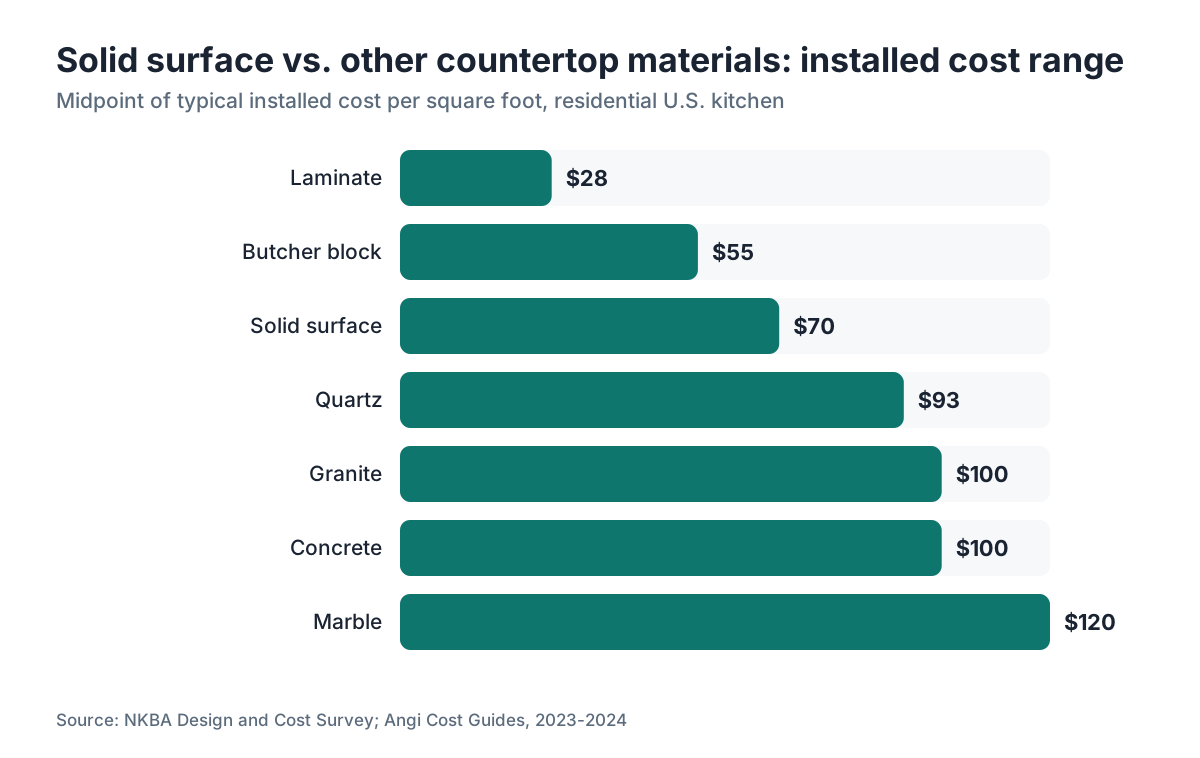
Installed solid surface countertops run $40 to $120 per square foot depending on brand tier, color complexity, and your region. The midpoint you'll actually pay at most kitchen showrooms lands between $55 and $85 per square foot installed [3]. Material alone (slab only, no labor or fabrication) typically runs $25 to $60 per square foot.
Here's what drives the range. Entry-level polyester-blend products from smaller brands sit at the low end. Mid-tier acrylic products like Corian's standard colors land in the $55 to $75 range installed. Translucent or special-effect colors, large-format slabs, and integrated sinks push you toward the top. The integrated sink is one of the more compelling upsells in countertops: the sink bowl and counter are one piece with no joint to harbor bacteria or crack, and that fabrication adds $300 to $600 over a dropped-in sink [4].
For comparison, laminate countertops run $15 to $40 installed, quartz countertops typically cost $55 to $130, and granite countertops run $45 to $200 depending on slab rarity. Solid surface sits right in the middle of the market.
The one cost advantage solid surface has over stone is repairability. When quartz or granite chips, repair means a color-matched epoxy fill that's almost never invisible. When solid surface chips or scratches, a skilled fabricator or even a careful homeowner can sand it back to factory finish. That lowers lifetime ownership cost meaningfully if you cook hard and are rough on surfaces.
| Material | Installed cost (sq ft) | Repair difficulty | Joint visibility |
|---|---|---|---|
| Solid surface | $40, $120 | Low (sandable) | Low (bondable) |
| Laminate | $15, $40 | High (not sandable) | Medium |
| Quartz | $55, $130 | Medium (epoxy fill) | Medium |
| Granite | $45, $200 | Medium (epoxy fill) | Medium, High |
| Concrete | $65, $135 | Medium | Low |
| Butcher block | $30, $80 | Low (sandable) | Low |
What are the real advantages of solid surface countertops?
The invisible joint is the most-cited selling point, and it's legitimate. Fabricators bond two sheets with a color-matched adhesive, then sand the joint flush. Done well, you genuinely cannot find it. This matters most in large kitchens where a run of countertop spans two slabs, and in bathrooms with long vanity runs.
Repairability is the second real advantage. Scratches, shallow cuts, and even burns from hot pans sand out with progressively finer grits of sandpaper and buff back to the original sheen. You do not need a professional for minor damage. A hardware store sells wet-dry sandpaper: 120 grit to start, then 220, then 400, then a Scotch-Brite pad and polish. The same repair on a natural stone counter means calling someone.
The material is non-porous. Unlike granite, which needs periodic sealing, solid surface has no open pores for bacteria or moisture to enter [5]. The NSF International certification program tests kitchen surfaces for food safety, and solid surface products commonly carry NSF/ANSI 51 certification, which the standard defines as materials safe for food equipment [6]. Hospitals, commercial kitchens, and school cafeterias use it for this reason.
Design flexibility is genuinely broader than stone. Fabricators can thermoform solid surface, meaning they heat the sheets and bend them around curved edges or sculpt them into shapes that would take expensive hand-carving in stone. Integrated sinks, drainboards, coved backsplashes that turn up the wall with no grout line, curved kitchen islands: all doable at modest cost.
The material is also lighter than natural stone. A 3/4-inch solid surface slab weighs around 3.5 to 4 pounds per square foot, versus 6 to 7 pounds for granite at similar thickness. For upper cabinet shelves or cabinetry not built for heavy stone, that matters.
What are the disadvantages and failure modes?
Heat is the biggest problem. Solid surface has a heat deflection temperature in the range of 150 to 175 degrees Fahrenheit depending on the formulation [1]. A cast-iron pan pulled from a 500-degree oven will scorch the surface if you set it down without a trivet. The damage shows as a dull, slightly discolored patch. You can sand it out, but it takes effort, and if it happens repeatedly in the same spot you'll start to see a depression.
Hardness is the second limit. On the Mohs scale, solid surface rates around 1 to 2, compared to granite at 6 to 7 and quartz composite at roughly 7. A ceramic coffee mug dragged across the counter leaves a mark. Keys, rings, and abrasive cleaners scratch it. In a working kitchen with kids, you will see wear. Sanding it out helps, but it's not a material that ages gracefully if you ignore maintenance.
Sharp knives will cut it. This sounds obvious, but some homeowners expect countertop durability to match stone. Always use a cutting board.
UV exposure yellows polyester-blend products over time, especially in colors with white or cream tones. High-acrylic formulations show it far less, but ask your fabricator specifically about UV stability before buying a light-colored product for a kitchen with direct sun.
And solid surface looks like what it is. It doesn't have the natural variation, depth, or veining that makes a marble or quartzite slab interesting to look at. Newer products have improved a lot, and some of the translucent and aggregate-filled options are genuinely attractive, but if you want the look of real stone, the marble countertops or quartz countertops pages cover materials that satisfy that better.
How is solid surface installed, and can you DIY it?
Professional installation is strongly recommended, with one partial exception covered below. Here's why. Solid surface must be routed (not scored and snapped like tile), joints require a color-matched two-part adhesive applied in a specific sequence, and the adhesive has a working time of roughly 15 to 25 minutes before it sets. Get the timing wrong and the joint shows. Get the routing wrong and the edge chips.
The install sequence for a typical kitchen goes like this: cabinets inspected and leveled, countertop templated (measured either by hand with a template kit or with a digital templating device), fabrication in the shop, delivery of finished pieces, dry fit on site, adhesive at seams, screwing through cabinet corner blocks into the slab (not from above, to allow thermal movement), silicone at the wall.
Solid surface expands and contracts with temperature more than stone does. A 10-foot run can move as much as 3/16 inch over a 50-degree temperature swing [1]. Fasten it too rigidly and it cracks. Fabricators know to leave the gap. A first-time DIYer often doesn't.
The partial DIY exception is repair. If you already have solid surface counters and need to sand out scratches or small burns, a homeowner can absolutely do that without calling anyone. Manufacturers and fabricators publish sanding instructions. Stick to the grit progression, don't skip steps, and finish with a polish that matches your original sheen (matte, satin, or gloss). Corian's technical guidance addresses homeowner repair directly [2].
For fabricators quoting solid surface jobs, material waste runs higher than quartz because integrated sinks and coved backsplashes consume sheet material that ends up as offcuts. Accurate nesting cuts that waste down a lot, which is one reason shops that do volume solid surface work often use dedicated quoting tools like SlabWise to price jobs correctly from the start.
How do you clean and maintain solid surface countertops?
Everyday cleaning needs dish soap and a damp cloth. Solid surface is non-porous, so it doesn't absorb spills, and there's no sealer to strip or damage with acidic cleaners.
Most stains respond to a paste of baking soda and water left for a few minutes, then wiped. Stubborn ones (dried food, tea, coffee) come off with a diluted household bleach solution (roughly 1 part bleach to 16 parts water), applied and rinsed within a few minutes. Manufacturers explicitly permit this. The non-porous structure means bleach doesn't penetrate and damage the material the way it would with porous stone [7].
What to avoid: abrasive scrub pads scratch a polished finish. Any cleaner marketed as "heavy-duty" or "industrial" that contains a strong solvent (acetone, paint thinner, MEK) can cloud or damage the surface. Oven cleaner in particular chemically attacks solid surface, and that damage sanding won't fix.
Over years, the finish dulls with normal use. A periodic buff with a Scotch-Brite pad (following the grain of the surface, not in circles) refreshes a matte or satin finish. Gloss finishes take more careful abrasive work to restore without swirl marks, which is where calling a fabricator for a countertop refresh makes sense. Many fabricators offer this, typically priced at $5 to $15 per square foot.
Solid surface does not need sealing. Ever. That's a real reduction in upkeep next to natural stones like granite or soapstone. For more on how stone surfaces need different cleaning protocols, the guide on how to clean stone countertops covers that territory.
How does solid surface compare to quartz, laminate, and Corian?
Corian is a solid surface brand, not a separate material. DuPont created it, it's now owned by Corian Design (spun out in 2018), and it remains the market share leader in the category [2]. Comparing "solid surface vs Corian" is like comparing "athletic shoes vs Nike." If you're looking at Corian countertops specifically, you're looking at a solid surface product.
Solid surface versus quartz: quartz composite is harder, more heat-resistant, and generally more scratch-resistant. It also looks more like stone. Solid surface is more repairable, cheaper on average, and can form integrated features with joints you can't see, which quartz can't do. For a bathroom vanity with an integrated sink, solid surface wins on both price and performance. For a heavy-use kitchen with a gas range and frequent large-format cooking, quartz is the more forgiving choice.
Solid surface versus laminate: laminate is cheaper, full stop. Laminate countertops and Formica countertops (Formica being the dominant laminate brand, same relationship as Corian to solid surface) run $15 to $40 installed versus $40 to $120 for solid surface. The real trade-off is that laminate can't be repaired once the surface is damaged, shows its seams, and can't form integrated sinks. If budget is the controlling factor and the countertop gets careful use, laminate is a rational choice. If you want something that lasts longer and repairs well, solid surface earns the premium.
Solid surface versus concrete countertops: both are highly customizable, both can be shaped and formed. Concrete is harder, more heat-resistant, and has a look all its own, but it needs sealing, can crack, and typically costs $65 to $135 per square foot installed. Solid surface is lower maintenance.
Solid surface versus butcher block countertops: butcher block is also sandable and repairable, costs less, and has a warmth solid surface lacks. But wood needs regular oiling to prevent drying and cracking, is damaged by standing water at seams, and has real food safety limits in wet areas. Each has its place, and many kitchens mix them.
What brands and product lines are worth knowing?
Corian by Corian Design is the category standard. Its 100-plus color offering and global fabricator network mean your installer has almost certainly worked with it before, which lowers installation risk. Pricing sits in the middle of the market.
Staron, made by Samsung, is a high-acrylic formulation with strong UV stability and a wide color range [10]. It's common in commercial settings and well-regarded by fabricators for its consistency.
HI-MACS, produced by LG Hausys, competes directly with Corian on color variety and pricing. It offers an "acrylic marble" line with more realistic stone appearance than standard solid surface colors.
Avonite Surfaces and Meganite are mid-market options typically priced slightly below Corian. Both have respectable warranties (10 to 15 years on manufacturing defects, depending on the product line and installer certification).
Wilsonart Solid Surface is worth mentioning for North American markets. It's well-distributed through home improvement retailers.
One purchase decision matters more than brand in most cases: the fabricator's experience with the material. A less-experienced shop working with Corian will produce worse results than an experienced shop working with a generic brand. Ask fabricators how many solid surface jobs they've done, whether they have an in-house router and polishing setup, and whether they'll show you photos of joints and integrated sinks they've completed. Those questions separate the capable shops from the ones who treat solid surface as an afterthought to their stone work.
For homeowners getting quotes across multiple fabricators, knowing how different shops price material and labor is where a tool like SlabWise provides real value to fabrication businesses, helping them price solid surface jobs accurately rather than guessing.
What colors and finishes are available, and do they affect price?
Solid surface manufacturers hold color more consistently across batches than any natural stone will, which matters for large installations and for future repairs where you need to match existing material. Colors range from solid whites, creams, and blacks to aggregated products that mimic granite, sandstone, or terrazzo, to translucent options (lit from below, they glow) used in commercial bars and reception desks.
Finishes come in three levels: matte (sometimes called "suede" or "satin matte"), satin, and high gloss. High gloss shows fingerprints, scratches, and water spots more readily than matte. Most residential kitchens use satin or matte for that reason. Commercial and healthcare jobs often specify matte because it's easier to keep looking good.
Color affects price when it involves translucent aggregates, metallic particles, or special-order formulations. A standard Corian color in Glacier White or Designer White is priced as a commodity by most fabricators because it's the highest-volume SKU. A translucent color like "Ice" or a deep-field aggregate color may carry a 15 to 30 percent material premium.
Finish can be changed after installation. Buy a satin finish today, want matte in five years, and a fabricator can re-sand the whole counter to shift the sheen. That's essentially impossible with natural stone at reasonable cost.
How long does solid surface last, and what warranty should you expect?
With reasonable care, solid surface countertops last 20 to 30 years in residential use. Commercial installations see harder wear and may need a refinish at 10 to 15 years, but the substrate itself doesn't fail.
The limiting factors are accumulated deep scratches in a high-use kitchen that were never sanded out, UV yellowing in polyester blends exposed to direct sun, and heat damage that wasn't addressed early enough. None of these cause structural failure. They cause cosmetic degradation.
Warranty terms depend on the manufacturer and on whether you use a certified fabricator. Corian's warranty offers 10 years on residential installations performed by Corian-certified fabricators [2]. Installing with a non-certified shop voids that warranty. HI-MACS and Staron offer similar terms. The certification requirement is the manufacturer's way of confirming the fabricator knows what they're doing, which is a fair trade-off.
For homeowners: always ask the fabricator whether they're certified with the brand you're buying, and ask to see the warranty documentation before you sign the contract. A warranty handed to you after installation is less useful than one you've read in advance.
For fabricators: the certification programs train on adhesive technique, router speeds, and thermoforming. The training is genuinely useful. Shops that have gone through it produce noticeably better joints and integrated sink quality than shops that haven't.
Is solid surface a good choice for bathrooms and commercial applications?
Bathrooms may be where solid surface makes the most sense of any application. An integrated sink and countertop in one piece with no visible joint kills the grout ring, the undermount caulk line, and the gap behind a drop-in sink that collects soap scum. The material shrugs off common bathroom chemicals: hair dye, acetone-based nail polish remover (though prolonged exposure is still inadvisable), and cleaning products. And it's warm to the touch in a way stone isn't, which matters in a room where you stand barefoot.
Healthcare and commercial food service make up a large share of solid surface's installed base. The material's NSF/ANSI 51 certification means it meets food equipment standards [6], and the U.S. General Services Administration specifies solid surface for federal healthcare and food service counters because of its non-porous, repairable properties [11]. Hospital nurse stations, school cafeteria counters, dental operatory surfaces, and laboratory casework all commonly use it.
Office break rooms, hotel vanities, and retail display counters are other high-volume commercial applications. The repairability pays off commercially: a hotel can have a maintenance tech sand out damage during a scheduled room refresh instead of replacing the counter.
For kitchens specifically, solid surface works well in medium-use residential kitchens, rental properties (the repairability is landlord-friendly), and second kitchens or wet bars. Heavy-cooking households that regularly hit high heat should pair solid surface with disciplined habits around trivets and cutting boards, or run quartz on the main prep area and solid surface on the perimeter or island.
For how kitchen countertops compare across all material types, that guide covers the full spectrum of options at a similar level of detail.
How do fabricators quote and cut solid surface jobs?
Solid surface is quoted differently from stone in a few ways. Sheet material typically comes in 30-by-144-inch or 36-by-144-inch sheets, depending on manufacturer and product line, compared to the irregular shape of stone slabs. That regular geometry makes material yield easier to calculate, but integrated sinks, coved backsplashes, and edge build-ups add fabrication labor that's easy to underprice.
A standard flat-lay job (no integrated features, simple edges) might take 2 to 3 hours of fabrication time per 20-square-foot section. Add an integrated sink and you're adding 3 to 5 hours of router work, sanding, and polishing. A coved backsplash that wraps up the wall adds 1 to 2 hours for thermoforming. Fabricators who quote by the square foot without tracking those labor components lose money on solid surface jobs.
Cutting is done with a router, not a wet saw. That means the shop needs router templates for cutouts and edge profiles, and it means dust management is a different problem than stone fabrication (fine acrylic dust versus silica). OSHA's rules on engineering controls for respirable dust apply in both cases, but the specific hazard differs [8].
Shop owners doing volume solid surface work need accurate nesting to hold down sheet waste. Because the sheets are rectangular and predictable, nesting software handles them more cleanly than irregular stone slabs, and small gains in yield add up fast at these material prices. Joint placement planning matters too: the fabricator's layout drives both material use and where joints land, and you want them hidden from primary sightlines.
Frequently asked questions
What is solid surface made of?
Solid surface is a blend of acrylic or polyester resins and mineral fillers, primarily aluminum trihydrate. The mineral filler typically makes up 65 to 70 percent of the material by weight. The color and pattern run throughout the thickness of the sheet, which is why scratches can be sanded out without changing the appearance of the surface.
Is Corian the same as solid surface?
Yes. Corian is a brand of solid surface, not a separate material category. DuPont invented it in 1967, and it's now produced by Corian Design. Other solid surface brands include Staron, HI-MACS, Avonite, and Meganite. They're all made from acrylic or polyester resin blended with mineral fillers and behave similarly, though acrylic-dominant formulations are generally tougher and more repairable than polyester-dominant ones.
How much does solid surface countertop installation cost per square foot?
Installed solid surface countertops typically cost $40 to $120 per square foot, with most residential kitchen jobs landing between $55 and $85. Material alone runs $25 to $60. Integrated sinks add $300 to $600 to a job. Entry-level polyester blends sit at the lower end, name-brand acrylic products like Corian in the middle, and specialty translucent colors at the top.
Can solid surface countertops be repaired if they scratch or chip?
Yes, and it's one of the best features. Scratches, shallow cuts, and heat marks sand out with progressively finer grits of wet-dry sandpaper (typically 120, 220, then 400 grit) followed by a polish matching the original sheen. This works because the color runs throughout the material. Deep gouges may need a fabricator, but everyday wear is a homeowner repair.
Is solid surface heat-resistant?
No, not meaningfully. Solid surface has a heat deflection temperature around 150 to 175 degrees Fahrenheit depending on formulation. A hot pan from the oven or stovetop placed directly on the surface will scorch or discolor it. Always use trivets. Heat damage is usually repairable by sanding, but repeated damage in the same spot eventually creates a depression.
Does solid surface need to be sealed?
No. Solid surface is non-porous, so it doesn't absorb moisture or bacteria and needs no sealing. That's a clear maintenance advantage over natural stone surfaces like granite, marble, or soapstone, all of which need periodic sealing to prevent staining and moisture absorption. Clean solid surface with dish soap and water for everyday use, or diluted bleach for stains.
How does solid surface compare to quartz countertops?
Quartz composite is harder (Mohs 7 vs. 1 to 2 for solid surface), more heat-resistant, and more scratch-resistant. Solid surface is more repairable, somewhat cheaper on average, and can form integrated sinks and joints you can't see, which quartz can't match. For bathrooms and light-use kitchens, solid surface often wins. For a heavy-use cooking kitchen, quartz handles daily abuse better.
Can you cut on solid surface countertops?
Technically yes, but you shouldn't. Knives scratch and eventually cut into solid surface. Always use a cutting board. The good news is that knife scratches sand out, so occasional accidents aren't catastrophic. Still, treating solid surface as a cutting surface will visibly degrade it within a year in a working kitchen.
How long does solid surface last?
With reasonable maintenance, solid surface countertops last 20 to 30 years in residential settings. Commercial installations in high-traffic environments may need a refinish at 10 to 15 years, but the material itself doesn't structurally fail. The main aging issues are UV yellowing in polyester blends (avoid in sunny kitchens), accumulated unaddressed scratches, and repeated heat damage.
What is the best cleaner for solid surface countertops?
Dish soap and water handle everyday cleaning. Baking soda paste removes most stains. Diluted household bleach (1 part bleach to 16 parts water, rinsed promptly) tackles tougher stains safely. Avoid solvent-based cleaners like acetone, paint thinner, or oven cleaner: these chemically damage the surface in a way that can't be sanded out. Abrasive scrub pads scratch polished finishes.
Is solid surface good for bathrooms?
Bathrooms may be solid surface's strongest application. Integrated sink-and-countertop pieces kill the grout lines and caulk seams that accumulate soap scum around undermount or drop-in sinks. The material resists common bathroom chemicals, is warm to the touch, and keeps its non-porous surface without sealing. It's widely used in hospitals and hotels for exactly these reasons.
What's the difference between matte and gloss solid surface finishes?
Matte and satin finishes show fewer fingerprints, water spots, and minor scratches in daily use, making them the practical choice for most kitchens and bathrooms. High gloss looks striking but shows everything. The finish can be changed after installation: a fabricator can re-sand the whole surface to shift from gloss to matte or vice versa, which isn't easily possible with natural stone.
Do I need a certified fabricator for solid surface installation?
If warranty coverage matters to you, yes. Brands like Corian require installation by a certified fabricator to honor their 10-year residential warranty. Beyond the warranty angle, certification indicates the shop has training in adhesive technique and joint work specific to the material. An experienced solid surface fabricator produces noticeably better joints and integrated sink quality than an inexperienced one.
Is solid surface more hygienic than other countertop materials?
Its non-porous structure means bacteria and moisture can't penetrate the surface, which is why it's NSF/ANSI 51 certified for use in food equipment and common in commercial kitchens, hospitals, and school cafeterias. It doesn't require sealing to maintain this property. Natural stone surfaces that are porous or improperly sealed can harbor more bacteria in the surface texture.
Sources
- International Surface Fabricators Association (ISFA), Solid Surface Fabrication Standards: Mineral filler (primarily aluminum trihydrate) comprises 65 to 70 percent of solid surface by weight; heat deflection temperature 150 to 175 degrees Fahrenheit; thermal expansion requires clearance in fastening
- Corian Design, Product and Warranty Information: DuPont invented Corian in 1967; 10-year residential warranty requires certified fabricator installation; homeowner repair guidance published by manufacturer
- National Kitchen and Bath Association (NKBA), Design and Cost Survey: Solid surface countertops installed cost range $40 to $120 per square foot with midpoint in the $55 to $85 range for residential kitchen installations
- HomeAdvisor (Angi), Countertop Cost Guide: Integrated solid surface sink fabrication adds $300 to $600 over a standard dropped-in or undermount sink installation
- U.S. Food and Drug Administration (FDA), Food Code 2022, Section 4-101: Non-porous surfaces required in food contact applications; solid surface qualifies under food equipment standards due to its impermeable composition
- NSF International, NSF/ANSI 51 Food Equipment Materials Standard: NSF/ANSI 51 certifies materials safe for food equipment; solid surface products commonly carry this certification confirming materials are safe for food contact applications
- Corian Design, Care and Maintenance Guide: Diluted household bleach (approximately 1:16 bleach-to-water) is manufacturer-permitted for stain removal on solid surface; non-porous structure prevents penetration
- U.S. Occupational Safety and Health Administration (OSHA), Silica and Dust Standards for General Industry, 29 CFR 1910.1053: OSHA engineering controls for respirable dust apply to countertop fabrication shops; solid surface routing produces acrylic dust distinct from stone silica but subject to general industry dust control requirements
- Samsung Staron, Fabrication and Technical Guide: Staron is a high-acrylic solid surface formulation with strong UV stability; widely used in commercial settings
- U.S. General Services Administration (GSA), Federal Facilities Standards for Interiors, PBS-P100: Solid surface specified in federal facility healthcare and food service counter applications due to non-porous and repairable properties
- University of California Cooperative Extension, Food Safety and Surface Materials: Non-porous solid surface materials maintain food safety without sealing; porous materials including unsealed granite can harbor surface bacteria
Last updated 2026-07-09