TL;DR
- Solid surface countertops (Corian, Wilsonart, Avonite, and similar) typically run $45 to $150 per square foot installed in 2025, with most kitchens landing between $2,000 and $5,500 total.
- Material grade, edge profiles, cutouts, and your region all move that number.
- High-end custom colors or thick slabs push closer to $200 per square foot.
What does solid surface countertop installation actually cost in 2025?
The honest installed price range for solid surface countertops is $45 to $150 per square foot, and that spread is real, not padding. At the low end you're getting a builder-grade color, a simple eased edge, and a straightforward rectangular layout. At the high end you're buying a premium color or pattern, a complex edge like a full bullnose or dupont, integrated sink cutouts, and fabrication labor in a high-cost metro.
For a typical kitchen with 30 to 40 square feet of countertop, that works out to roughly $1,350 to $6,000 installed. Most homeowners in mid-cost markets end up in the $2,000 to $4,500 range [1]. Bathroom vanities are smaller, so the math gets kinder: a 15-square-foot vanity might run $675 to $2,250 installed, but minimum job charges often apply, meaning a tiny powder room can still cost $600 to $800 even if the square footage math says less.
Labor alone, separate from material, usually runs $10 to $30 per square foot depending on complexity and region. That's meaningful. Labor is rarely less than 20 percent of your total bill and can climb to 40 percent on complicated layouts.
One thing to know going in: solid surface is priced and sold by the fabricated square foot of finished countertop, not by the sheet size the fabricator purchases. Fabricators buy 30-by-144-inch sheets (about 29.2 sq ft per sheet) and their material cost is roughly $8 to $35 per square foot at wholesale depending on brand and grade. The markup from material cost to what you pay covers cutting, edging, seaming, templating, and a reasonable margin.
What factors make the price go up or down?
Several things move the needle more than most people expect.
Material grade and brand. Entry-level solid surface (generic brands, basic palettes) starts around $8 to $12 per square foot at wholesale. Mid-tier brands like Wilsonart or Avonite run $15 to $22 per square foot. Premium DuPont Corian, LG HI-MACS, and Staron can hit $25 to $35 per square foot at the shop level [2]. That difference compounds once fabrication markup is applied.
Edge profiles. A simple eased or beveled edge costs almost nothing extra, sometimes $0 to $5 per linear foot. A built-up dupont, waterfall, or ogee can add $15 to $40 per linear foot because the fabricator is gluing laminations and routing multiple passes. A 25-linear-foot kitchen perimeter with a fancy edge adds $375 to $1,000 to the job.
Cutouts. Each sink cutout runs $75 to $200. Cooktop cutouts are similar. An integrated, coved, or undermount sink in solid surface (a genuine selling point of the material) costs $150 to $400 to fabricate because the bowl is formed and joined into the slab with no visible seam rather than just dropped in.
Seam count and layout complexity. L-shapes, U-shapes, islands with overhangs, and peninsula layouts all require more seams. Each joint in solid surface disappears when done well, but it takes time. Expect $50 to $150 per seam in labor.
Tearout and disposal of old countertops. Most installers charge $50 to $150 per linear foot to remove laminate, or a flat $200 to $500 for a kitchen demo. Stone tearout costs more because of weight.
Region. Labor costs in San Francisco or New York run 30 to 50 percent above the national average. Rural areas can be 20 to 30 percent below. This is the single biggest variable between quotes you see online and what a local shop actually bids.
Overhangs and breakfast bars. A standard 1.5-inch overhang is included in most quotes. A 12-inch or greater breakfast bar overhang requires underlayment support and adds $50 to $150 per linear foot.
How does solid surface compare to other countertop materials by price?
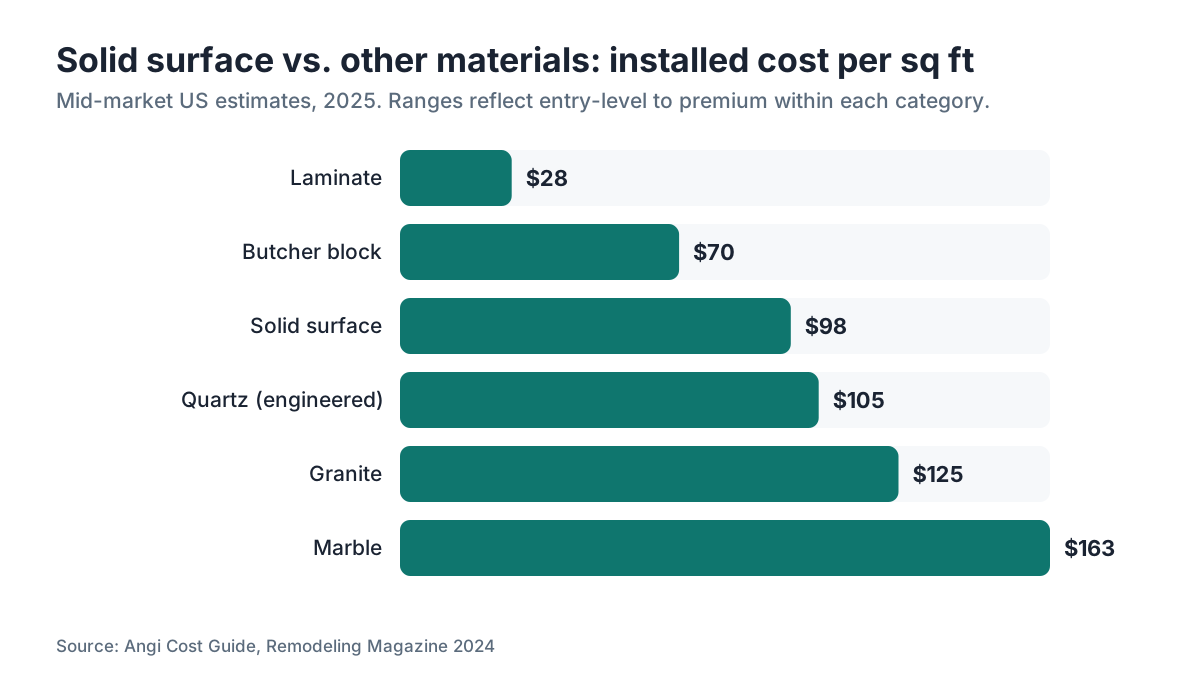
Here's a realistic side-by-side for an average kitchen (35 square feet installed, mid-cost market, 2025 pricing). These are installed totals including material, fabrication, and basic installation:
| Material | Installed cost per sq ft | 35 sq ft total (est.) | Notes |
|---|---|---|---|
| Laminate | $15, $40 | $525, $1,400 | Lowest cost, limited edge options |
| Solid surface | $45, $150 | $1,575, $5,250 | Integrated sinks, repairable scratches |
| Butcher block | $40, $100 | $1,400, $3,500 | Warm look, needs oiling |
| Granite | $50, $200 | $1,750, $7,000 | Natural variation, heavy |
| Quartz (engineered) | $60, $150 | $2,100, $5,250 | Consistent pattern, hard |
| Marble | $75, $250 | $2,625, $8,750 | High maintenance, luxury look |
Solid surface sits squarely in the mid-tier. It costs more than laminate but competes well with granite and quartz on value once you factor in the ability to form integrated sinks and repair surface damage without replacement [3].
For homeowners comparing solid surface to quartz: quartz is harder and shrugs off scratches better, but it can't be repaired in the field. A deep scratch in solid surface can be sanded out by a fabricator in an hour. That's a real functional advantage, especially in busy kitchens.
What does solid surface installation actually involve, step by step?
Understanding the process helps you ask better questions of your fabricator and avoid surprises.
First comes templating. A fabricator visits your kitchen, measures the countertop area precisely (usually with a physical template or digital templating tool), and notes the locations of the sink, cooktop, and any unusual angles. Templating typically costs $50 to $150 if charged separately, though many shops roll it into the job.
Back at the shop, sheets are cut to rough size on a panel saw, then profiled on a CNC router or by hand with a trim router. Edges are routed to the specified profile. Seams are cut so they mate precisely. For an integrated sink, a coved bowl is routed and the material is heated and formed, or a separate preformed sink is joined in.
Installation day: the fabricator brings finished pieces, installs support blocking or brackets if needed, dry-fits everything, then bonds the joints with color-matched adhesive. Seams cure under clamps for 30 to 60 minutes. Plumbing reconnection is typically excluded from the countertop quote. Your plumber handles that, usually 1 to 2 hours of time.
Total install time for a kitchen is usually 3 to 6 hours. A bathroom vanity runs 1 to 2 hours. You can use the countertops same day after the joints cure, though most fabricators recommend waiting 24 hours before heavy water exposure at seam locations.
For fabricators quoting solid surface jobs: accurate sheet nesting is where margin lives. A 30x144-inch sheet is about $250 to $1,000 at wholesale depending on brand. Poor nesting wastes expensive material. Software like SlabWise handles automated nesting and quote generation to reduce offcut waste and speed up your bid process.
How much does Corian specifically cost to install?
Corian is the brand that put solid surface on the map. DuPont introduced it in 1967, and the brand is now owned by Corian Design (a standalone company after DuPont divested it). It remains one of the more premium solid surface lines.
Corian installed runs $65 to $150 per square foot in most markets, with a 35-square-foot kitchen totaling $2,275 to $5,250 [2]. The brand carries a premium over generic solid surface but sits in roughly the same range as mid-tier quartz. Corian has about 100 colors and patterns, including their Venaro and Lava series that mimic stone fairly convincingly.
One thing that matters here: Corian requires Corian-certified fabricators for the warranty to be valid. DuPont (and now Corian Design) runs a certified fabricator program. Using an uncertified shop may save 10 to 20 percent but voids the 10-year residential warranty [4]. If warranty coverage matters to you, ask for certification before signing.
For more detail on this specific brand, see our Corian countertops guide.
Are there ways to reduce solid surface installation costs without getting burned?
Yes. Some of these actually work. Others are traps.
Stick to stock colors. Premium and custom colors add 20 to 40 percent to material cost. Most fabricators have 15 to 30 colors that move fast and price lower. If you're not attached to a specific look, ask which colors your fab shop buys in volume.
Simplify your edge. An eased or slightly beveled edge looks clean and modern. The dupont or ogee profiles that cost extra aren't structurally superior. They're aesthetic. Saving $15 per linear foot across 25 feet of kitchen edge is $375 back in your pocket.
Get three quotes. Price variation between fabricators in the same market commonly runs 20 to 35 percent for identical jobs. The highest quote isn't always best quality, and the lowest isn't always a red flag. Ask each shop how they price seams, what templating costs, and whether plumbing reconnect is included.
Do your own tearout. If your old countertops are laminate, you can remove them yourself in an afternoon with a utility knife and a pry bar. Just confirm with your fabricator that you won't void any warranty or create a liability issue before they arrive.
Skip the integrated sink upcharge if you don't need it. Integrated solid surface sinks are a genuine benefit, but if you have a stainless steel sink you love and want to keep, an undermount or drop-in approach costs $75 to $150 for the cutout versus $150 to $400 for a full integrated bowl. The integrated version isn't worth it for everyone.
Time your project. Many fabrication shops have slower periods in late January and February. Some shops offer 10 to 15 percent discounts during slow season to keep crews busy. It doesn't hurt to ask.
What should you look for in a solid surface installer?
Solid surface fabrication is a trade skill, not a commodity. The difference between a good seam and a visible one comes down to technique, properly colored adhesive, and the patience to clamp correctly.
Ask specifically: do they template in person or rely on your measurements? Shops that use client-provided measurements are cutting corners. Do they have photos of seam work? A reputable shop should be able to show you a joint you genuinely can't find by looking at it.
For Corian or LG HI-MACS, ask for brand certification. For other brands, ask how long they've worked with solid surface specifically. Stone fabricators who also do solid surface on the side sometimes cut it fine, but solid surface has different tooling requirements (carbide bits, not diamond) and different adhesive chemistry than stone.
Check reviews specifically for countertop jobs, not general contractor reviews. The National Kitchen and Bath Association maintains a professional directory that includes fabricators and remodelers who have met minimum qualification standards [5].
Get everything in writing: square footage measured, edge profile, seam locations, sink treatment, timeline, and what happens if a piece cracks during installation (it happens, and good shops replace it at no charge).
How long does solid surface last, and does it affect the cost calculation?
Solid surface has a strong durability record. When properly maintained, it realistically lasts 20 to 30 years in residential kitchens [6]. That lifespan puts it on par with quartz and well above laminate.
The repairability factor is where solid surface has a genuine economic edge. A deep scratch or burn on quartz means replacement, which runs $1,500 to $4,000 for a kitchen. The same damage on solid surface can usually be sanded and buffed out by a professional in one to two hours for $150 to $300, or done yourself with 120- to 400-grit sandpaper and a random orbital sander.
Heat resistance is moderate. Solid surface can handle brief contact with warm pots, but sustained heat above 212 degrees Fahrenheit (100 degrees Celsius) can cause discoloration or warping [7]. That's weaker than granite or quartz, so trivets matter.
For cleaning and ongoing care, the surface needs nothing special: warm water, mild dish soap, and occasional use of an abrasive household cleaner like Soft Scrub to restore sheen. No sealing required, ever. That's a real maintenance advantage over natural stone like granite, which typically needs resealing every 1 to 3 years.
If you're weighing surface types for a kitchen that sees hard daily use, the durability math favors solid surface over laminate, and its repairability edge over stone and quartz is real, not marketing.
What are the total project costs beyond just the countertop?
The countertop itself is the biggest line item, but a real project budget has more to it.
Plumbing reconnect: $100 to $250 for a simple P-trap and supply line reconnect. More if you're also upgrading your faucet or garbage disposal at the same time.
New sink: $150 to $1,500 depending on material and style. If you're going integrated solid surface, the sink cost is bundled into the countertop fabrication quote.
Backsplash: often replaced at the same time as countertops. Tile backsplash installation runs $15 to $40 per square foot installed.
Permits: for countertop replacements in an existing home, most jurisdictions do not require a permit as long as plumbing and electrical aren't being moved. Confirm with your local building department. The International Residential Code (IRC) is adopted in most states and does not mandate permits for cosmetic countertop replacement [8].
Cabinet leveling: if your cabinet tops are out of level, shimming and scribing during installation adds $50 to $200 to the labor bill. This is more common in older homes.
A realistic budget for a full kitchen countertop replacement in solid surface, mid-grade material, mid-cost US market:
| Line item | Low | High |
|---|---|---|
| Solid surface material + fabrication | $1,800 | $4,500 |
| Templating (often included) | $0 | $150 |
| Old countertop tearout | $150 | $400 |
| Plumbing reconnect | $100 | $250 |
| New faucet (optional) | $75 | $500 |
| Backsplash (optional) | $300 | $1,200 |
| Total | $2,425 | $7,000 |
Most homeowners finish between $2,800 and $5,500 for a complete kitchen countertop project.
How do solid surface costs vary by region in the US?
Regional cost variation is real and significant. A mid-grade solid surface kitchen that costs $3,200 in Indianapolis might run $4,800 in Seattle or $5,100 in Boston. Three factors drive this: labor rates, shop overhead, and local market competition.
The Bureau of Labor Statistics tracks wages for production workers in the stone, glass, and concrete products sector (NAICS 327) across metropolitan areas [9]. In 2023, mean hourly wages for this category ranged from roughly $17 in lower-cost markets to over $28 in coastal metros. That $11 per hour difference, spread over a 6-hour kitchen installation with a two-person crew, adds $132 to the labor portion alone before shop overhead.
Beyond wages, shop overhead (rent, equipment, insurance) is higher in dense urban markets. A fabrication shop in suburban Ohio pays far less per square foot for their facility than one in suburban New Jersey.
What this means practically: if you're in a high-cost metro and the quotes feel punishing, some homeowners in border areas drive 45 to 60 minutes to a lower-cost suburban shop and save 15 to 25 percent. Just make sure that shop will still handle the installation, since templating and install require two trips to your home.
For context on countertop installation costs across all material types, regional variation patterns are consistent: coastal metros run 30 to 50 percent above Midwest and Southeast markets.
Is solid surface a good choice for bathrooms and how does that affect cost?
Solid surface works particularly well in bathrooms for a few reasons: it's nonporous (so no mold concerns at joints), it can form integrated sinks, and it handles the humidity of a bathroom with no issues whatsoever. Stone in bathrooms requires more attention to sealing.
Bathroom vanity tops typically run 15 to 25 square feet. At $45 to $150 per square foot installed, that's $675 to $3,750 for the surface itself. But minimum job charges matter here. Most fabrication shops have a minimum invoice of $400 to $700 regardless of size. A small powder room vanity of 4 to 6 square feet might hit that minimum, so the effective cost per square foot on tiny jobs is higher than the range suggests.
Integrated sink tops (the vanity top and bowl formed as one piece) are a strong application for solid surface. These are sold as prefabricated units by brands like Swanstone and Corian for $200 to $600 for standard sizes, or can be custom fabricated for $400 to $1,200. Prefab units are worth considering for standard-size vanities. Custom fabrication makes sense for unusual dimensions or when you need a specific color match.
For homeowners comparing this to other low-maintenance bathroom surface options, laminate countertops are cheaper but require careful moisture management at seams, while Cambria countertops and other engineered quartz options are harder and similarly nonporous but cost more and can't form integrated sinks.
How do fabricators price and quote solid surface jobs?
If you're a shop owner or fabricator reading this, the pricing structure that works in solid surface is slightly different from stone.
Most solid surface shops price by the fabricated square foot of finished surface, not by the sheet. This matters because solid surface sheets have a fixed size (most commonly 30x144 inches) and a known cost, so nesting efficiency directly affects margin. Tight nesting on a complex kitchen with an island might fit on two sheets. Poor nesting wastes half a sheet at $300 to $900 in wasted material.
A standard industry approach: price the job by square foot (material + fabrication labor), then add line items for edge upgrades, cutouts, seams over a base count, and tearout. This makes quotes readable for clients and easier to compare.
Markup on material typically runs 50 to 100 percent over wholesale cost to cover cutting waste, tooling wear, and the sheet-buying overhead. Labor is usually priced separately or bundled into a square-foot rate that assumes a normal layout.
Shops quoting more than five or six solid surface jobs per week often benefit from software that automates the square footage takeoff, sheet nesting, and line item pricing. SlabWise is built specifically for this: it takes a layout, calculates material requirements, runs nesting, and outputs a quote. Worth a look if manual quoting is eating your estimating time.
Frequently asked questions
How much does it cost to install solid surface countertops in a small kitchen?
A small kitchen with 20 to 25 square feet of countertop typically runs $900 to $3,750 installed for solid surface, depending on material grade and edge profile. Minimum job charges at most shops run $400 to $700, so very small kitchens don't save proportionally. Budget $1,500 to $2,500 for a realistic small kitchen in a mid-cost market with a mid-grade material.
Is solid surface cheaper than granite countertops?
They overlap heavily. Solid surface runs $45 to $150 per square foot installed; granite runs $50 to $200. Entry-level granite from a high-volume shop can undercut entry-level solid surface, but mid-tier solid surface is usually comparable to or slightly cheaper than mid-tier granite. Solid surface has lower long-term maintenance costs since it never needs sealing.
Can I install solid surface countertops myself to save money?
DIY installation is technically possible but genuinely difficult. An invisible seam requires color-matched adhesive, precise joint cuts, and clamping technique that takes practice. Most homeowners who attempt it end up with visible seams. Material is sold to consumers by some distributors, but the labor savings rarely justify the risk of a visible seam or a cracked piece. Professional installation is strongly recommended.
How long does solid surface countertop installation take?
Templating takes 30 to 90 minutes. Fabrication in the shop runs 1 to 3 days after templating. Installation day for a kitchen takes 3 to 6 hours; a bathroom vanity runs 1 to 2 hours. Total project time from first appointment to usable countertops is typically 5 to 14 business days depending on shop workload.
Does solid surface countertop installation include plumbing?
No, almost never. Fabricators install the countertop surface and make the sink cutout. Disconnecting and reconnecting the P-trap, supply lines, and garbage disposal is plumbing work, done by a licensed plumber or handyman as a separate service. Budget $100 to $250 for simple plumbing reconnection.
What is the cheapest solid surface countertop brand?
Generic or store-brand solid surface from building supply distributors runs $8 to $12 per square foot at wholesale, making it the cheapest entry point. Named brands like Wilsonart's Gibraltar line are mid-tier at $14 to $20 per square foot. Corian, LG HI-MACS, and Staron are premium at $22 to $35 per square foot wholesale. The cheapest installed option is usually a local fabricator using a generic material.
How much does an integrated solid surface sink add to the cost?
A custom-fabricated integrated sink (bowl formed directly into the countertop) adds $150 to $400 to a fabrication quote compared to a standard cutout. Prefabricated integrated vanity tops run $200 to $600 for standard sizes. The integrated option eliminates the seam at the sink rim where water and bacteria collect, which is a real hygiene and maintenance benefit.
Can solid surface countertops be repaired, and what does that cost?
Yes. Scratches, minor burns, and surface stains can be sanded out and buffed. A professional repair visit runs $150 to $300 and typically takes one to two hours. Homeowners can sand out light scratches themselves using 150- to 400-grit sandpaper and a random orbital sander. This repairability is one of solid surface's genuine advantages over stone or quartz.
Do solid surface countertops add home resale value?
There's no large-scale study that isolates solid surface specifically. General kitchen remodel data from the NAR and Remodeling Magazine's Cost vs. Value report shows kitchen updates return 50 to 80 percent of cost at resale on average. Solid surface reads as a quality mid-tier material to buyers, which is fine for most markets. It won't command the premium of slab marble or high-end quartz in luxury markets.
Is a permit required to replace countertops?
In most US jurisdictions, no permit is required for countertop replacement as long as you're not moving plumbing or electrical. The International Residential Code, adopted in most states, doesn't require permits for cosmetic surface replacements. Always confirm with your local building department; rules vary by municipality and some areas have stricter local amendments.
How do I get an accurate quote for solid surface installation?
Have at least two fabricators template in person rather than quoting from your measurements. Measure your countertop area yourself first (length times width in inches, divided by 144 for square feet) so you can sanity-check quotes. Ask for itemized pricing showing square footage, edge type, cutout count, seam count, and tearout separately. Three quotes from local shops is the minimum for a kitchen job.
What's the difference between solid surface and laminate countertops on cost and performance?
Laminate costs $15 to $40 per square foot installed, making it significantly cheaper than solid surface at $45 to $150. Laminate can't be repaired when scratched or chipped, can't form integrated sinks, and is vulnerable at seams to water damage. Solid surface is more durable, fully repairable, and joins cleanly at sinks with no visible line. For a budget kitchen, laminate is hard to beat; for a long-term install, solid surface is worth the premium.
What edge profiles are available and how much do they cost?
Common options: eased or slightly beveled ($0 to $5 per linear foot extra), rounded bullnose ($5 to $15 per linear foot), ogee or full dupont ($15 to $40 per linear foot). Built-up or double-laminated edges cost more because material is glued and routed in layers. Simple edges look clean and modern; ornate edges add cost without adding durability. Most fabricators show a sample board.
Sources
- HomeAdvisor (Angi), Countertop Installation Cost Guide: Average installed countertop cost ranges and typical kitchen totals for solid surface and comparable materials
- Corian Design, Product and Pricing Information: Corian brand positioning, product line breadth, and certified fabricator program details
- U.S. Environmental Protection Agency, Building and Construction Materials: Comparative material characteristics and repairability of synthetic solid surface versus natural stone surfaces
- Corian Design, Warranty Documentation: 10-year residential warranty requires installation by a Corian-certified fabricator
- National Kitchen and Bath Association, Professional Directory: NKBA maintains a directory of qualified kitchen and bath professionals including fabricators
- U.S. Department of Housing and Urban Development, Residential Construction and Materials Guidance: Expected service life ranges for residential countertop surfacing materials including solid surface
- LG HI-MACS, Technical Data and Care Guide: Solid surface heat resistance thresholds and care recommendations including avoidance of sustained high heat
- International Code Council, International Residential Code (IRC): IRC does not require permits for cosmetic countertop replacement where plumbing and electrical are not relocated
- U.S. Bureau of Labor Statistics, Occupational Employment and Wage Statistics, NAICS 327: Mean hourly wages for production workers in stone and glass products manufacturing vary by metropolitan area, ranging from roughly $17 to over $28 in 2023
- Remodeling Magazine, Cost vs. Value Report 2024: Kitchen remodel projects return 50 to 80 percent of cost at resale on average across US markets
- National Association of Realtors, Remodeling Impact Report: Kitchen upgrades among top remodeling projects for resale value recovery
- Wilsonart, Solid Surface Product Specifications: Wilsonart Gibraltar solid surface wholesale pricing tier and sheet dimensions (30x144 inches)
Last updated 2026-07-09