TL;DR
- Solid surface countertops (Corian, LG Hi-Macs, Wilsonart) sand and shape like wood, so they take almost any edge profile.
- Upcharges run from $0 for a flat eased edge to $15, $30 per linear foot for a double ogee.
- Pick based on kitchen style, safety around kids and older adults, cleaning effort, and budget.
- Get the edge quoted as its own line item.
What makes solid surface edges different from stone or laminate?
Solid surface is an acrylic or polyester resin cast into sheets, usually 1/2 inch thick, though some lines run 3/4 inch. It has no grain, no cleavage planes, and no pores. A router bit or belt sander cuts almost any profile into it without chipping, cracking, or exposing a rough interior. That's the plain reason solid surface gives you more edge choices than any other countertop material.
Laminate is a different animal. With laminate countertops or formica countertops, the edge is stuck to a substrate. You're gluing on a banded strip or post-forming a flat sheet, so complex shapes aren't possible without a visible seam. Stone can take a profile, but any undercut or thin detail risks a fracture, and tooling wear pushes the price up fast. Solid surface skips all of that.
The material is also thermoformable. Fabricators heat it and bend it around curves, which is how you get a waterfall edge or a coved backsplash that flows into the countertop with no joint. Most stone shops can't do that at all.
One detail to hold onto before you compare quotes: the factory sheet is 1/2 inch. To make the edge look thicker, a fabricator glues a second strip of material under the front edge. That buildup adds material and labor, but done right it disappears completely because the seam sands flush and polishes out. A "1.5-inch thick edge" and a "1/2-inch edge" are two different line items, and knowing that keeps you from getting surprised.
What are all the standard solid surface edge profiles?
Here's the full menu, simple to complex. Most shops sort these into tiers that map to pricing.
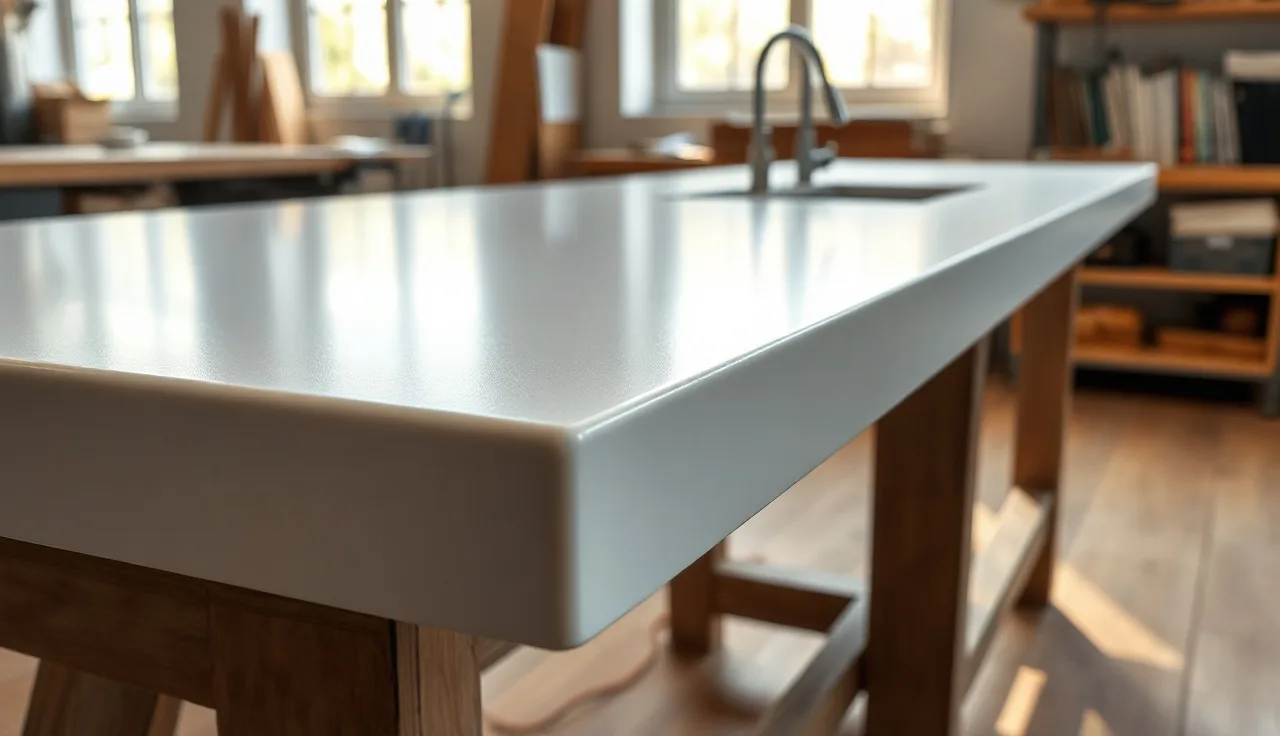
Eased edge (also called square or flat) A 90-degree corner with a slight break to kill the sharpness. No real shaping, almost no labor. This is the default on most quotes and usually carries no upcharge. Clean, modern, fits anything.
Beveled edge A flat angled cut across the top corner, usually 45 degrees, sometimes shallower. Geometric, slightly industrial. Tier 1 pricing, so figure $0, $5 per linear foot over eased.
Bullnose (full and half) Full bullnose rounds the whole top-to-bottom thickness into a semicircle. Half bullnose rounds only the top corner. Both are everywhere in traditional and transitional kitchens. A full bullnose on a built-up edge looks heavy and soft at once. Tier 1 to tier 2, roughly $5, $12/LF depending on shop.
Dupont edge A flat top that drops into a small ogee curve at the front face. Think of a squared-off waterfall with a little cove at the bottom. Popular in contemporary kitchens because it reads modern but carries more weight than a plain eased edge. Tier 2.
Cove edge (or coved) A concave curve along the top edge, like an inward scoop. Less common than bullnose. It catches crumbs and water, so treat it as the compromise for people who want curve but hate buildup in the corners.
Ogee (single and double) An S-shaped profile, convex on top and concave below or the reverse. Classic, ornate, tied to traditional and formal kitchens. Double ogee adds a second S-curve. This is the most labor-heavy standard profile, usually $15, $25/LF.
Waterfall edge The countertop face drops straight to the floor, a vertical sheet with no profile at all. It needs thermoforming or a miter-glued panel. It's an architectural move, mostly on islands. Price swings a lot, but expect $20, $40/LF or a flat labor add depending on how the shop bills mitered panels.
Chiseled or hand-carved Made to look rough and organic. Rare in solid surface, since the point of the material is uniformity. Some designers spec it for rustic or farmhouse work. High labor, shop-dependent pricing.
Laminated (built-up) edges This is a thickness, not a shape. A second or third layer of solid surface glues to the underside of the front edge for a 1-inch, 1.5-inch, or thicker look. Any profile above can be cut into a laminated edge. The buildup alone adds $8, $18/LF for material and gluing, before any profile upcharge. [1]
The table in the next section lines all of these up with typical pricing.
How much does each edge profile add to the total cost?
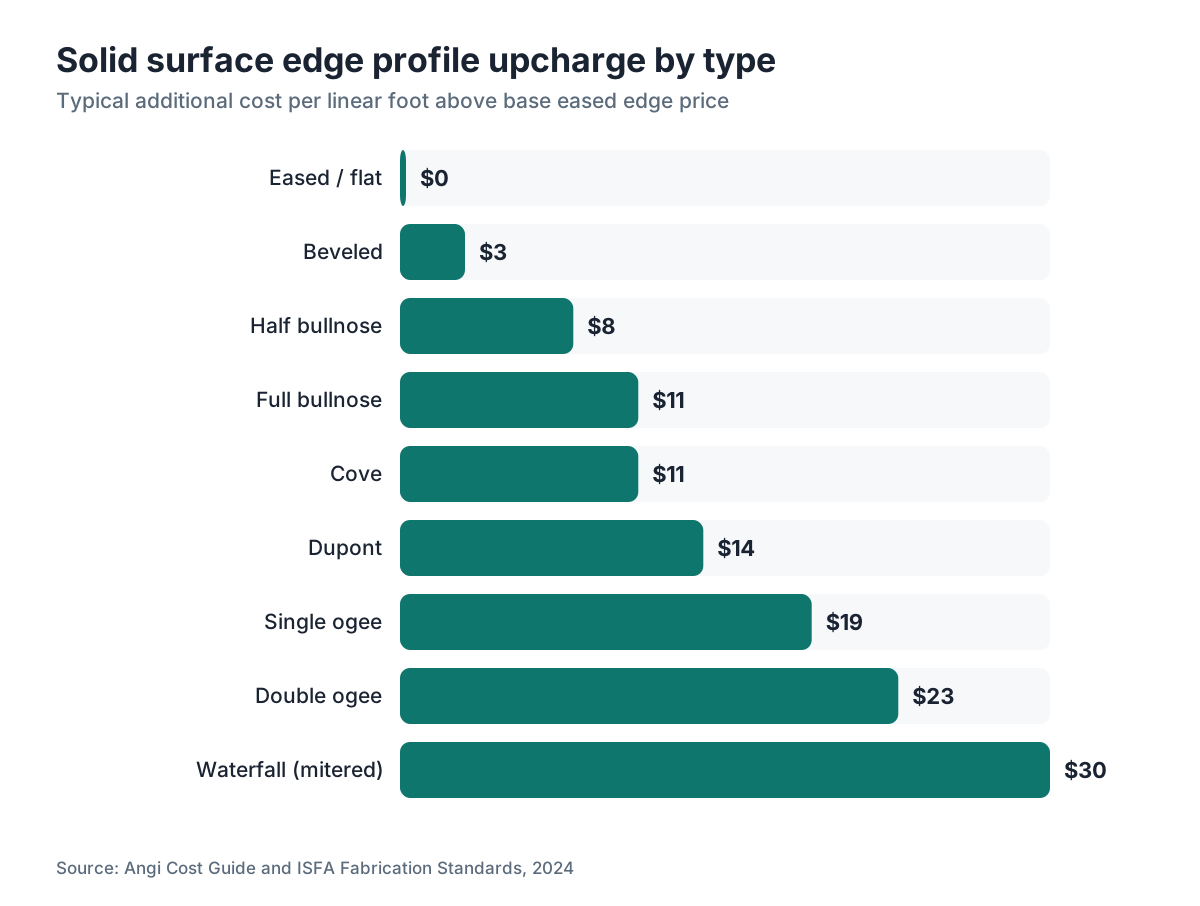
Edge upcharges range from $0 for an eased edge to $40 or more per linear foot for a mitered waterfall. These are national ranges pulled from fabricator pricing guides and supplier data. Your region, your shop's labor rate, and the size of the job (bigger runs spread setup cost) all move the numbers. Treat them as ballparks, not quotes.
| Profile | Typical upcharge (per LF) | Relative complexity | Best style fit |
|---|---|---|---|
| Eased / flat | $0 | Low | Modern, industrial |
| Beveled | $0 to 5 | Low | Modern, transitional |
| Half bullnose | $5 to 10 | Low-med | Traditional, transitional |
| Full bullnose | $8 to 14 | Medium | Traditional |
| Cove | $8 to 14 | Medium | Transitional |
| Dupont | $10 to 18 | Medium | Contemporary |
| Single ogee | $15 to 22 | High | Traditional, formal |
| Double ogee | $18 to 28 | High | Traditional, formal |
| Waterfall (mitered) | $20 to 40+ | Very high | Modern, high-design |
| Laminated buildup (add-on) | $8 to 18 | Medium | Any |
Those upcharges sit on top of the base countertop price, which for solid surface runs about $55, $120 per square foot installed depending on brand, color, and market. [2] A 20-linear-foot kitchen perimeter with a double ogee and a 1.5-inch laminated buildup can add $460, $920 in edge cost alone. That's real money, and most homeowners never see it in the first quote.
Shop software like SlabWise itemizes the edge as its own line with a per-LF rate. That's the only way a homeowner sees what they're paying for. If your quote shows one blended square footage number, ask for the edge breakout.
Here's the counterintuitive part. Longer edge runs cost more in total dollars but often less per linear foot, because setup time gets spread out. A waterfall edge on a 10-foot island is expensive. The same profile on a 3-foot bar top needs nearly the same setup, so your cost per foot is worse.
Which edge profile is best for a modern kitchen?
For a modern kitchen, an eased edge or a beveled edge almost always looks right, and the dupont edge is the best mid-complexity pick. Flat-front cabinets, minimal hardware, and a clean palette want sharp geometry. A full bullnose in a flat-panel Shaker kitchen reads a little off, like furniture that doesn't match.
The dupont edge is the most popular mid-complexity choice in contemporary kitchens right now. It stays clean from the front but adds weight and a hint of detail without going ornate. If you want something that photographs well and doesn't look cheap, dupont is a safe bet.
Waterfall edges have run design media for a decade and still look strong at large scale. The catch: the vertical panel has to meet the countertop at a precise 90-degree miter. Solid surface pulls this off because the seam sands invisible. On natural stone, that miter usually shows, because the grain never lines up perfectly across the joint. That's a real edge solid surface has over marble countertops or granite countertops for this one detail.
Which edge profile is safest for households with young children or older adults?
Full bullnose is the safest standard profile for a mixed-age household, because it removes every sharp corner. Square and eased edges keep a 90-degree corner. At counter height (usually 36 inches off the floor), that corner sits near toddler face level and adult hip level. Bumps and falls into square edges cause more injury than rounded ones. The Consumer Product Safety Commission tracks furniture and fixture edge injuries in its national injury data. [3]
Half bullnose is a fair compromise. The top corner rounds off, so an item sliding off the counter won't hit a sharp point, but the bottom corner stays fairly square.
For accessible kitchens built to ADA standards, the ADA Accessibility Guidelines require that protruding objects on an accessible route not create a hazard, and countertop edges get reviewed under that provision depending on the install. [4] A bullnose or cove edge is the safe call there.
Cove edges sound good for safety but cut a small valley along the top surface that holds water and crumbs. In a household where sanitation matters (anyone with allergies, older adults with weaker immune systems), that groove is a real nuisance even though the shape itself is rounded.
Can solid surface edges be repaired or changed after installation?
Yes. Solid surface is repairable in a way stone and laminate just aren't, and this is one of its most underrated traits. If a chip or scratch shows up on an eased edge, a fabricator sands it out and re-polishes to factory finish. The repair vanishes because there's no pattern or grain to match.
Changing the profile after install is also doable, though not trivial. A fabricator brings a router to the installed countertop and cuts a new profile. The limits: you can't add material (so you can't jump from eased to a laminated bullnose without gluing on new strips), and routing in place is slower than working on a shop table. Expect shop rates for a service call plus the edge work.
For light rounding or scratch removal, Corian's own care guidance says light damage clears up with a damp cloth and a mild abrasive cleaner, and deeper damage can be sanded with 180 to 400 grit paper and buffed out. [5] That applies to the edge as much as the countertop field.
This repairability is one reason solid surface makes sense in heavy-use commercial spaces like healthcare, schools, and restaurants, where stone would need a full slab swap for serious damage.
How does edge profile choice affect cleaning and maintenance?
The flatter the edge, the faster it wipes clean. An eased or beveled edge has almost no surface variation. One pass and you're done.
Ogee profiles have convex and concave curves. The concave parts hold soap scum, grease, and water. Not a disaster, but you need a cloth or sponge that reaches into the groove instead of a flat wipe. A double ogee has two grooves. Over years of daily use, that cleaning time adds up.
Built-up laminated edges have a seam line, usually at the bottom of the buildup strip. On solid surface, that seam sands flush and is genuinely invisible when done right, so there's no groove for grime. A poorly done seam can open slightly over time with thermal cycling, and that crack collects debris. Ask your fabricator how they seam and look at real examples.
For overall care, the manufacturer guidance for solid surface comes down to a few rules: avoid sustained high heat (thermal shock can crack it), use a cutting board instead of the surface, and clean with non-abrasive household cleaners. The edge is the same material, so the same rules apply. [5]
What do fabricators need to know about pricing and quoting solid surface edges?
Edge profiles are where a lot of margin lives on a solid surface job, and where a lot of customer arguments start. The root problem: edge pricing almost never gets explained clearly in residential quotes.
Structure it clean. Base price per square foot (material, fabrication, install), then edge profile as a per-linear-foot line with the profile named, then laminated buildup as its own line if it applies. That makes the upsell simple and kills disputes. When a customer sees "single ogee, 22 LF x $18 = $396," they can decide to step down to bullnose at $10 and save $176.
Timekeeping from solid surface shops shows a simple eased edge runs 0.5 to 1 minute per linear foot on a shaper. A double ogee with a laminated buildup runs 4 to 6 minutes per linear foot once you count the glue-up, clamping, sanding, and polish. [1] That spread is why tier pricing exists.
On large commercial jobs (healthcare countertops, school labs, hospitality), the edge spec usually rides on the architect's sheet. Match it exactly and confirm with the GC if it calls for something unusual like a "sanitary cove," a specific profile used in food service and healthcare where the edge meets the backsplash with no gap, per NSF requirements. [6]
Nesting matters here too. A laminated buildup needs a 1.5-inch wide strip of material for every linear foot of edge. On a tight sheet, that strip has to be planned in. Shops that leave edge strips out of their nesting run short on material or buy extra sheets they didn't need. [7]
How does solid surface compare to quartz or stone for edge profiles?
Quartz and natural stone offer a similar profile menu, but the process differs, and solid surface is the only one a small shop can shape entirely by hand. Both quartz and stone use CNC routers or hand tools on hard, brittle material, so some profiles (thin overhanging lips, deep undercuts) are riskier to cut without chipping.
Solid surface edges can be hand-worked with routers and sanders by a skilled fabricator with no CNC at all. That opens it up to smaller shops and one-off custom profiles. Stone almost always needs CNC for complex work, which means a shop that put down that capital.
On cost, an ogee edge on quartz from a mid-market fabricator runs about $10, $25/LF, close to solid surface. The difference: quartz usually comes in thicker stock (often 3/4 inch or 1.25 inch slabs), so the laminated buildup problem shows up less, but the base material costs more.
Corian countertops, the DuPont/Trinseo brand of solid surface, publishes a profile menu for certified fabricators that lists over 25 standard profiles. [8] Wilsonart and LG Hi-Macs run similar libraries, and Wilsonart's fabrication guide confirms the material is thermoformable and that mitered waterfall edges seam invisibly thanks to the uniform composition. [9] Most lines support custom profiles beyond the menu, subject to shop skill.
For the broad material comparison, kitchen countertops covers the full field.
What questions should you ask a fabricator before choosing an edge profile?
Ask to see physical samples first, and get the edge quoted as a named line item. Those two questions save you from the most expensive surprises. Photos lie. Lighting and angle can make a flat edge look soft and a bullnose look huge. A sample held at your counter height, in your kitchen light, is the only reliable preview.
Second, ask whether the quote includes the edge profile or adds it separately. "Installed price" sometimes covers an eased edge only, with the upsell to your chosen profile as a separate line. Some shops quote it inclusive, some don't. Either is fine, but you need to know which you're reading.
Third, ask about laminated buildup. If the design shows a 1.5-inch thick edge and the base sheet is 1/2 inch, how do they get there? What does the seam look like after finishing? Can they show you an example?
Fourth, ask about lead time. Complex profiles on large jobs add shop hours. If your countertop installation is on a tight calendar, a double ogee on 30 linear feet can push your date.
Fifth, if you have an odd application (next to a range, at a sink with a heavy undermount, in a bathroom where the edge gets bumped a lot), ask the fabricator which profile they'd put in their own house. An honest answer tells you plenty.
And if you're a homeowner hunting a fast ballpark before you call shops, the SlabWise instant quote tool takes your dimensions and edge profile and returns a rough range before you burn an afternoon on showroom visits.
Are there edge profiles that work for both countertops and integrated sinks?
The front edge profile has almost no effect on an integrated sink, so pick the perimeter edge on looks and pick a sanitary cove at the backsplash junction for hygiene. Integrated sinks are a genuine strength of solid surface. Because the material shapes and seams invisibly, a sink bowl can be built from the same material as the counter with no visible joint. The sink sits in the field of the counter, not at the edge, so your bullnose or ogee choice doesn't touch it.
The profile that occasionally causes trouble is the cove used at the backsplash junction, not the front edge. A sanitary cove, where the backsplash meets the counter in a smooth rounded transition instead of a sharp inside corner, is easier to clean and is called for in NSF/ANSI 2 for food service equipment surfaces. [6] In a kitchen where hygiene is the priority, that inside-corner treatment matters more than the front edge shape.
For anyone comparing materials on this point, butcher block countertops and solid surface are the two most often spec'd for integrated food prep, for different reasons. Solid surface wins on hygienic seaming. Butcher block wins on knife feel and sand-out repairability.
Frequently asked questions
What is the most popular edge profile for solid surface countertops?
Full bullnose and eased edges are the two most commonly ordered profiles on residential solid surface jobs. Bullnose dominates traditional and transitional kitchens because the rounded corner reads soft and finished. Eased (flat with a slight break) is the default for modern and contemporary styles. Dupont has gained ground in contemporary kitchens over the past several years as an in-between option with more visual interest than a plain flat edge.
Can I get a custom edge profile on solid surface that isn't on the standard menu?
Yes. Because solid surface machines like dense hardwood, a fabricator with a router table and the right bit can cut nearly any profile. Custom bits can be ordered for unusual shapes. Cost is higher because there's no production efficiency, and you'll usually pay for the bit if it's a one-off. Ask the shop early, since custom bits can need a 1 to 2 week lead time.
Does edge profile affect how long solid surface countertops last?
Not much for material lifespan, but profile changes where wear shows first. Thin, sharp edges (very thin bevels or pencil-thin eased edges with minimal break) chip more easily from impacts. A full bullnose spreads impact across a curved surface instead of concentrating it at a corner. In a busy kitchen or a commercial setting, a rounded profile tends to look better longer.
Is a waterfall edge possible in solid surface without visible seams?
Yes, and this is one of solid surface's clearest wins over stone for the look. The vertical panel meets the countertop at a mitered joint. Because the material is uniform with no pattern, the seam sands and polishes to near-invisibility. On granite or marble, the grain never matches at the miter, so the seam always shows. Waterfall edges in solid surface get priced by the shop, usually $20, $40 per linear foot of the vertical drop, or as a flat labor add.
What edge profile do hospitals and commercial kitchens use on solid surface?
Healthcare and food service usually spec a sanitary cove at all inside corners (where the counter meets the backsplash or wall) rather than an ornate front edge. NSF/ANSI 2, the standard for food equipment construction, requires smooth, easily cleanable surfaces with no crevices. The front edge in these settings is usually a simple eased or half-bullnose, putting cleanability ahead of looks.
How much does a built-up (thick) edge add to the cost of solid surface countertops?
A laminated buildup strip, a second layer of material glued under the front edge to create a 1-inch or 1.5-inch thick look, typically adds $8, $18 per linear foot. That's on top of any profile upcharge. On a 20-linear-foot kitchen, that's $160, $360 just for the buildup. Whether it's worth it depends on the design: a waterfall island almost always needs it, a simple galley counter usually doesn't.
Can I change my solid surface edge profile after the countertop is installed?
You can change to a simpler profile by having a fabricator router the installed edge in place. You can't add material (no going from flat to laminated bullnose) without gluing on new buildup strips. The work is slower than in-shop because the fabricator is in a finished space, so expect a service-call rate plus the edge work. For minor rounding or scratch repair, a fabricator can hand-sand and polish the edge on-site.
What edge profile is easiest to clean?
Eased and flat edges are easiest, since there are no curves or grooves to clean into. Full bullnose is easy too, because the convex curve wipes clean without trapping debris. Ogee profiles (especially double ogee) have concave grooves that hold grease and soap scum and need a cloth that reaches into the curve. If daily cleaning effort matters, stay with eased, bevel, or full bullnose and skip the ogee.
Do edge profiles cost more on a larger countertop project?
In total dollars, yes, because you pay per linear foot. Per foot, a large project often costs slightly less, because setup and tooling time spreads across more footage. A small bathroom vanity with 6 linear feet of ogee costs more per foot than a 30-foot kitchen run of the same profile. Ask your fabricator if they have a minimum edge charge. Many do.
How do I know if a solid surface edge profile is included in my quote?
Ask directly and ask for a line-item breakdown. Many residential quotes bundle everything into a per-square-foot price that assumes an eased edge. If you chose a different profile in the showroom but the quote shows no edge upcharge, the quote may not reflect your actual selection. Get the profile named in writing (more than 'bullnose,' but the specific tier and whether a laminated buildup is included).
What is a dupont edge on a solid surface countertop?
A dupont edge has a flat top that transitions into a small ogee or waterfall curve on the front face, then returns flat at the bottom. It looks more substantial than a plain flat edge but far less ornate than a full ogee. The name comes from DuPont, the original maker of Corian. It's popular in contemporary kitchens because it adds visual weight without traditional ornamentation.
Does the edge profile choice affect the countertop's resale value?
There's no reliable data tying edge profile to resale value, so any hard claim would be speculation. Broadly, a dated-looking profile (a heavy ornate ogee in a modern home, or a flat eased edge in a formal traditional space) can make a counter look out of place, which hurts overall kitchen appeal. A neutral choice like full bullnose or eased edge offends no one and reads well across buyer tastes.
Is solid surface a good choice for bathroom vanity edge profiles?
Yes, and bathrooms are a common application. Solid surface handles moisture well since it's non-porous. For vanities, a half bullnose or eased edge is typical. If the vanity has an integrated sink (a popular choice in solid surface), the front edge profile has no effect on the sink. Bathroom edge runs are usually short (4 to 8 linear feet), so even a premium profile adds modest total cost.
Sources
- International Surface Fabricators Association (ISFA), Solid Surface Fabrication Standards: Edge fabrication time ranges from 0.5 to 1 minute per LF for simple profiles to 4 to 6 minutes per LF for complex laminated profiles, supporting tier pricing structures used in the industry.
- HomeAdvisor / Angi, Solid Surface Countertop Cost Guide: Solid surface countertops typically cost $55, $120 per square foot installed depending on brand, color, and regional labor rates.
- U.S. Consumer Product Safety Commission, National Electronic Injury Surveillance System (NEISS): CPSC tracks injuries related to furniture and fixture edges including countertop corners as a documented injury category in its national injury surveillance data.
- U.S. Access Board, ADA Accessibility Guidelines, protruding objects provisions: ADA Accessibility Guidelines require that protruding objects on accessible routes not create hazards; countertop edges in applicable settings are reviewed under this provision.
- Corian Design (Trinseo), Care and Maintenance Guide for Corian Solid Surface: Corian documentation states that light scratches and most stains can be removed with a damp cloth and a mild abrasive cleaner, and that deeper damage can be sanded and buffed out.
- NSF International, NSF/ANSI 2: Food Equipment: NSF/ANSI 2 requires food equipment surfaces to be smooth, easily cleanable, and free of crevices; sanitary cove profiles at inside corners satisfy this requirement for solid surface installations.
- International Surface Fabricators Association (ISFA), Material Yield and Nesting Practices: Laminated edge buildup strips must be planned in sheet nesting layouts; failure to account for them leads to material shortages or unnecessary sheet purchases.
- Corian Design, Certified Fabricator Edge Profile Library: Corian's certified fabricator program lists over 25 standard edge profiles available in Corian solid surface, with custom profiles available subject to fabricator capability.
- Wilsonart, Solid Surface Fabrication and Installation Guide: Wilsonart's fabrication guide confirms that solid surface is thermoformable and that mitered waterfall edges can be seamed invisibly due to the homogeneous material composition.
- U.S. Consumer Product Safety Commission, home safety guidance: CPSC home safety guidance identifies sharp furniture and fixture corners as a fall and impact injury risk for young children and older adults.
Last updated 2026-07-09