TL;DR
- Most granite needs sealing every 1 to 3 years, though some dense stones never do.
- A bottle of impregnating sealer runs $35 to $100 and handles a full kitchen.
- Run the water-drop test first: if water soaks in within 4 minutes, seal now.
- If it beads for 30 minutes, wait.
- Professional sealing costs $200 to $600 per kitchen.
Does granite actually need to be sealed?
Most granite does. Not all of it, and that difference is the whole game. Granite is a porous igneous rock, and porosity ranges from nearly zero in dense black stones like Absolute Black to fairly high in lighter stones like Baltic Brown or Giallo Ornamental [1]. A sealer doesn't make granite waterproof. It buys you time. It fills the micro-pores with resin so a spill sits on top long enough for you to wipe it up before the stone drinks it in.
The honest answer to "does my granite need sealing" is: run the test, then decide. Don't assume your installer sealed it, because plenty don't. Don't assume it needs annual sealing because a product label says so. Some dense granites from Brazil and India are tight enough that a good fabricator will tell you sealing is optional.
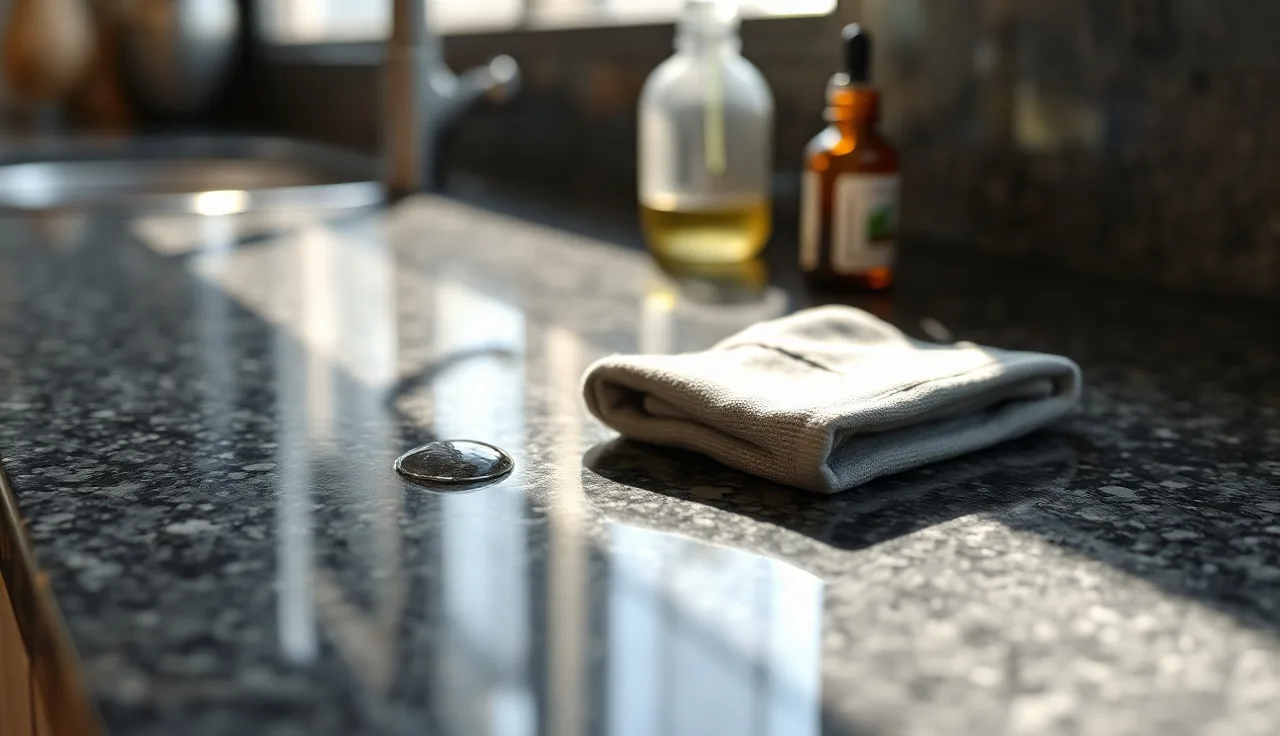
The water-drop test takes two minutes. Pour a tablespoon of water on the surface and watch it for 30 minutes. If it beads and the stone underneath stays the same color, your sealer is holding or the stone is naturally dense. If the water soaks in and darkens the granite within 4 to 10 minutes, you need to seal. If it darkens within 1 to 2 minutes, you needed to seal a while ago. The Marble Institute of America treats this absorption behavior as the main indicator of when to seal [2].
How often should you seal granite countertops?
Plan on every 1 to 3 years for kitchen counters and every 3 to 5 years for bathroom vanities. That range is wide on purpose [2]. Frequency depends on the porosity of your specific slab, the sealer you pick, and how hard the surface gets used.
Lighter granites tend to run more porous and may want sealing every 12 to 18 months. Darker, denser stones can go 3 to 5 years, or effectively never. The National Terrazzo and Mosaic Association notes that lighter granite colors generally carry higher feldspar and quartz content, which shapes the pore structure [3]. That's a rough proxy, not a rule.
Skip the calendar. Run the water-drop test once a year and let your actual slab give you the answer. Counters near the cooktop or sink take more abuse from cooking oils, citrus, and cleaners, and those chemicals wear down sealer faster than anything a guest bathroom vanity ever sees. Re-seal when the test says to, not because twelve months went by.
What types of sealer work best on granite?
Two broad families exist: topical sealers and impregnating (penetrating) sealers. For granite countertops, impregnating sealers win almost every time.
Topical sealers sit on top and form a film. They look plasticky, they peel, and they need stripping before you can re-apply. Hardware stores sell them as "granite polish" or "surface guard." Skip them for countertops.
Impregnating sealers soak in and bond with the silica structure, leaving a water- and oil-repellent barrier below the surface you can see [4]. They don't change the look, they don't peel, and they breathe, which matters because some moisture always moves through stone. The Marble Institute of America recommends fluoropolymer or silane/siloxane-based impregnating sealers for food-contact stone [2].
Inside the impregnating family, solvent-based products usually penetrate deeper and last longer than water-based ones. The trade-off is odor and dry time. A well-ventilated kitchen handles solvent-based sealers fine. For anyone sensitive to fumes or in a hurry to use the counter again, water-based options perform well enough in a home.
| Sealer Type | Penetrates Stone | Appearance Change | Typical Lifespan | Food Safe After Curing |
|---|---|---|---|---|
| Impregnating (solvent-based) | Yes | None | 3 to 5 years | Yes |
| Impregnating (water-based) | Yes | None | 1 to 3 years | Yes |
| Topical/Film | No | Glossy or hazy | 6 to 12 months | Varies |
| Color-enhancing impregnating | Yes | Deepens color | 3 to 5 years | Yes |
Color-enhancing sealers are worth a note. They're a subset of impregnating sealers carrying agents that deepen the stone's color, close to how granite looks wet. Some people love it on dark stones. Fabricators should confirm the customer wants it before applying, because you can't easily undo it.
How much does sealing granite countertops cost?
DIY sealing runs $35 to $100 for a full kitchen, which covers one or two bottles of a good impregnating sealer. Tenax Hydrex, StoneTech BulletProof, and Miracle Sealants 511 sell for $30 to $60 per quart at tile or stone supply stores, and a quart covers 100 to 300 square feet depending on porosity [5].
Professional sealing by a stone care company runs $200 to $600 for a typical kitchen. Price tracks square footage, stone condition (a badly etched or stained surface may need cleaning or honing first), and regional labor [6]. Some fabricators fold one sealing application into the install price. Many don't. Ask before you sign.
The math is clean. Granite in good shape plus a willingness to follow label directions equals a DIY job. Pay a pro when you have heavy staining that needs treatment first, or a surface so large that even coverage genuinely gets hard to hit by hand.
Slate costs more to maintain than granite. Slate often needs an impregnating sealer plus a separate topical finish to stop flaking, and some varieties want annual professional attention. If you're still choosing materials, factor that in.
For further reading on other natural stone options, the granite countertops article covers base material costs and performance, and marble countertops covers a stone that needs sealing even more often than most granites.
How do you seal granite countertops yourself, step by step?
The process is simple. A few specific steps separate a sealer that lasts two years from one that lasts five.
Step 1: Clean the surface thoroughly. Use a pH-neutral stone cleaner. Not dish soap (it leaves a film) and not vinegar (acid degrades sealer and etches stone). Let it dry completely. Most manufacturers say to wait 24 hours after cleaning before sealing. New installs should sit 24 to 48 hours so installation debris and moisture settle.
Step 2: Test a small area. Put a dime-sized drop of sealer in a hidden spot and let it sit 5 minutes. Wipe it off and confirm no darkening or residue. This matters most with color-enhancing formulas.
Step 3: Apply the sealer. Lay down a thin, even coat with a clean, lint-free cloth or foam applicator. Work in sections of 2 to 3 square feet. It should look wet but never pooled. Keep it off backsplash grout lines when you can, since many sealers temporarily haze grout.
Step 4: Wait for absorption, then wipe off the excess. This is the step people blow. The sealer needs dwell time to soak in, usually 3 to 15 minutes depending on the product, but you have to wipe off all excess before it dries on the surface. Sealer that dries on top leaves a hazy film that only comes off with solvent. Set a timer.
Step 5: Apply a second coat if needed. Porous stones benefit from a second coat after the first dries, usually 20 to 60 minutes later. Check the label.
Step 6: Cure before use. Most impregnating sealers are fully cured and water-resistant within 24 to 48 hours. Some say light use is fine in 2 to 4 hours. Keep standing water off the surface for 48 hours after sealing [4].
A standard kitchen takes about 45 minutes. It's a Saturday-morning job.
What happens if you don't seal granite countertops?
Unsealed granite won't crack or fail overnight. The damage is slower and more aggravating: stains from oil, wine, and acidic liquids sink into the pores and get harder to pull out the longer they sit [1].
Oil is the usual culprit. Cooking oil that splashes near the range and sits on unsealed granite darkens the stone into a permanent-looking ring. Oil stains often respond to a poultice (a paste of baking soda and acetone, or a commercial drawing compound, left on for 24 to 48 hours), but that's far more work than sealing ever was.
Wine, coffee, and fruit juice leave tannin stains. Acidic cleaners and foods can etch granite too, though granite shrugs off acid much better than marble or limestone. A stain that gets into unsealed stone is harder to fight because the open pores work against every cleaning effort.
The real risk is cumulative. One missed cycle is nothing. Five years of no sealing on a stone that wants it every 18 months is how you end up with permanently discolored granite that looks like it needs replacing, when $40 every few years would have kept it fine.
Can you over-seal granite, and is it possible to seal too often?
Yes, you can over-seal granite, and nobody talks about it enough. Apply sealer to a granite that's already fully saturated from a recent coat and the new sealer has nowhere to go. It dries as a hazy residue on the surface. You'll see blotchiness or a milky cloudiness, and pulling it off takes a solvent-based stripper.
This is why the water test beats a schedule every time. If water still beads after 30 minutes on your existing surface, skip sealing this round. You don't need it. Sealing a stone every year that doesn't want it wastes $40 and risks leaving residue.
Watch out for one more thing. Some cheap sealers marketed as "one-time permanent" or "lifetime" make claims that fall apart under real kitchen use. There is no credible permanent sealer for porous granite under normal cooking conditions. If a product promises lifetime protection, read the fine print twice.
Does sealing granite make it safe for food contact?
Most impregnating sealers are food-safe once fully cured, meaning the sealer has dried and finished off-gassing. The USDA publishes guidance on food-contact surface materials in commercial settings, and granite sealed with a cured fluoropolymer or silane-based impregnating sealer is generally considered acceptable [7].
The practical worry at home is cure time. While curing, solvent-based sealers off-gas chemicals you don't want near food. Most products are fully cured and food-safe after 24 to 48 hours. Water-based sealers off-gas less and get to food-safe faster, often within 2 to 4 hours. Check the product's safety data sheet for the manufacturer's food-contact statement.
The cautious play is easy: seal in the evening, keep the kitchen ventilated overnight, and go back to normal food prep the next morning. No granite installer worth trusting would tell you to avoid the stone long-term after sealing.
What's the difference between sealing and polishing granite?
Sealing and polishing are two different jobs that marketing loves to blur. One protects the inside of the stone. The other changes the surface finish.
Sealing protects the interior structure from liquid absorption. The sealer penetrates below the surface and does almost nothing to the visible look of the granite, beyond a slight color deepening in some cases.
Polishing is about the surface finish, specifically how much light bounces off the stone. Granite leaves a fabrication shop in a range of finishes: polished (high gloss), honed (matte), or leathered (textured matte). A polish comes from running progressively finer abrasive pads across the surface during fabrication. SlabWise's quoting and nesting software tracks slab finish type on the job order, which matters here because honed finishes soak up more sealer than polished surfaces of the same stone.
Spray-on granite polishes from the grocery store are mostly cosmetic. They carry mild surfactants and sometimes waxes that make the surface look shiny for a while. They do nothing against absorption, and they aren't impregnating sealers.
For stone surface care beyond sealing, the articles on how to clean stone countertops and how to clean quartzite countertops cover maintenance that works alongside good sealing.
How do you know when sealed granite needs to be re-sealed?
The water-drop test is still your best diagnostic. Run it once a year, or any time the surface starts acting different (water spreading fast, a subtle darkening when wet).
A few visual cues help too. If small dark wet-looking spots form where you set down a glass and the ring lingers instead of evaporating, the sealer is compromised in that spot. If spills spread into the pore structure instead of beading on top, re-seal the whole surface, more than the patch.
Acid damage looks nothing like sealer failure. An etch is a dull patch in the stone's surface, usually from a lemon, a vinegar-based cleaner, or wine. Etching is mechanical damage to the surface, not a porosity problem. Re-sealing won't fix an etch. That needs professional honing. Homeowners mix up the two constantly, so this distinction is worth holding onto.
The Marble Institute of America notes that polished granite resists etching better than honed granite because the crystalline surface at high polish gives acid less contact area [2]. Even so, enough acid will eventually etch most stones no matter the finish or sealer.
Tips for fabricators: how sealing fits into shop operations
Sealing usually rides along as an afterthought on the install ticket. That's a missed revenue line and a missed quality-of-life win for your customers. Offer a paid sealing service at install, or bundle it into higher countertop tiers, and you create real value for almost no labor cost.
The operational side is practical. Sealing adds 30 to 45 minutes to an install and needs a 2 to 4 hour hold before the customer touches the surface. Time it with the customer so the kitchen is back in service by end of day. Most residential jobs with a sane workflow absorb this fine.
On the shop side, slab finish type (polished vs. honed vs. leathered) should already live on your job order because it drives how the stone gets processed. It also drives sealer consumption: honed stone can eat 20 to 40% more sealer per square foot than the same polished stone, since the open surface pulls in more product. Build that into your material estimates if sealing is a line item. Shops running high volume can track sealer status per job in fabrication software like SlabWise, which flags finish type right next to the cut list.
For pricing on the full install, the countertop installation article covers regional labor rates and what's usually included in a fabricator quote.
How does granite compare to other countertop materials for sealing needs?
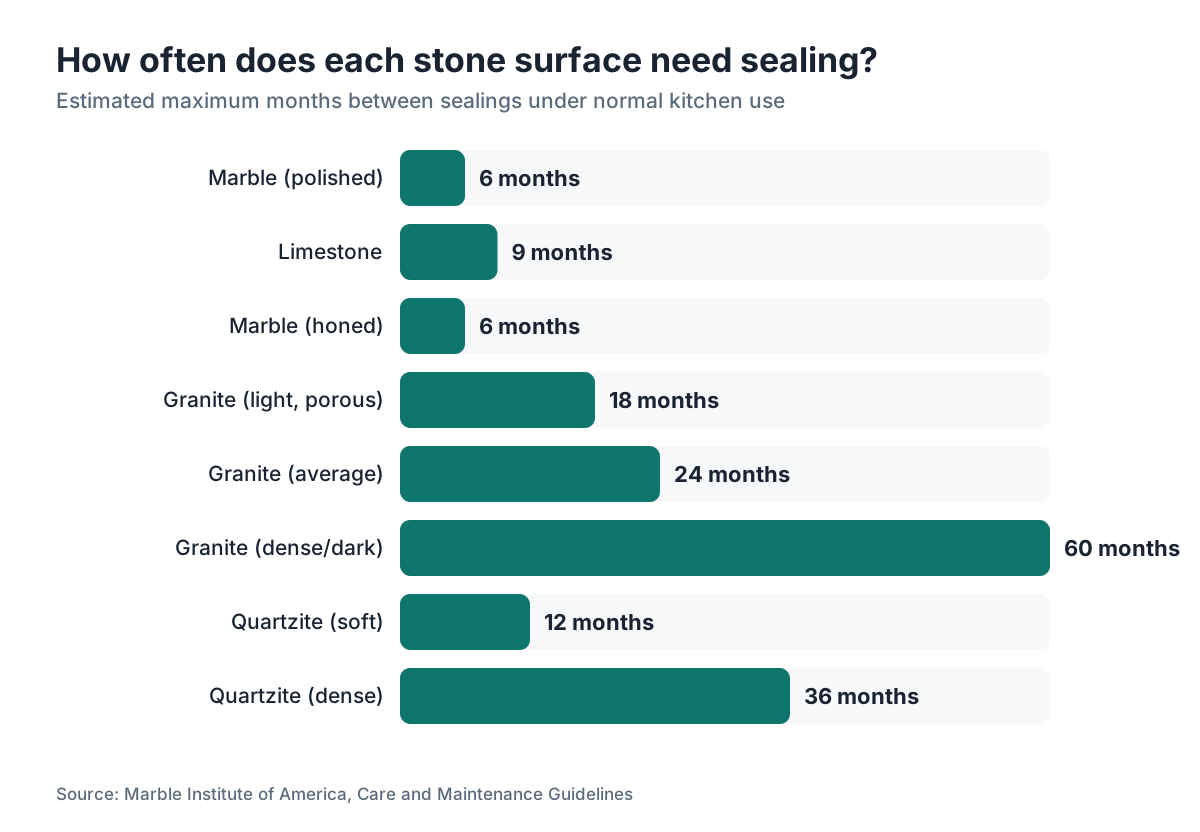
Granite sits in the middle of the stone sealing spectrum. Marble and limestone run more porous and need sealing more often, often every 6 to 12 months in kitchens [2]. Quartzite is all over the map: some quartzites are denser than most granites, others behave more like marble.
Engineered quartz (Cambria, Silestone, Caesarstone) needs no sealing at all. The resin binders make the surface non-porous. If maintenance burden weighs on your decision, that's a genuine edge for engineered stone, though Cambria countertops carry their own care rules.
Butcher block, soapstone, and slate play by other rules. Butcher block countertops need regular oiling, not stone sealer. Soapstone develops a natural patina and gets mineral oil rather than an impregnating sealer. Slate may want both an impregnating sealer and a topical finish, and that upkeep is one reason slate costs more to maintain over time than granite.
Laminate, Formica, and Corian-type solid surfaces skip sealing entirely. If low maintenance is your top priority, those materials have a real argument, different look and all. See laminate countertops, formica countertops, and corian countertops for comparison.
For the full field of kitchen countertop options and their trade-offs, the kitchen countertops guide covers everything.
Frequently asked questions
How long does sealer take to dry on granite?
Most impregnating sealers are touch-dry in 20 to 60 minutes and ready for normal use in 24 hours. Full cure, meaning maximum water resistance, takes 24 to 48 hours. Solvent-based sealers take a little longer to off-gas but often penetrate better. Keep standing water off the surface for the first 48 hours after application.
Can I seal granite myself or do I need a professional?
You can absolutely do it yourself. Clean the surface, apply a thin coat of impregnating sealer, wait 5 to 15 minutes for absorption, then wipe off the excess before it dries. Professional sealing ($200 to $600) earns its cost only when the stone needs stain removal or honing first, or when the installation is very large.
What happens if sealer dries on the granite surface?
It leaves a hazy, blotchy film, sometimes called sealer haze. You'll need a solvent-based sealer remover to dissolve it. The fix isn't hard, but it adds an hour of work. Avoid it by wiping all excess sealer within the dwell time on the label, typically 5 to 15 minutes. Set a timer.
Does sealing granite change its appearance?
Standard impregnating sealers don't change granite's look. They work below the surface and stay invisible once cured. Color-enhancing sealers are a different animal: they deepen and saturate the stone's color, close to how it looks wet. That effect is permanent, so confirm the customer wants it before applying a color-enhancing product.
Is granite sealer safe for children and pets?
Yes, once cured. During application and curing, solvent-based sealers off-gas fumes, so ventilate and keep kids and pets out of the room. After full cure, typically 24 to 48 hours, the sealed surface is safe for normal food prep and contact. Check the product's safety data sheet for the specific off-gassing window.
Can you seal granite countertops around a sink?
Yes, and the area around a sink needs it most because water exposure never stops. Keep sealer off the sink rim and any caulk lines, since sealer can stop caulk from bonding if you ever re-caulk. Apply carefully with a small brush around the sink cutout and wipe off promptly.
How much sealer do I need for a kitchen countertop?
A quart of impregnating sealer covers 100 to 300 square feet depending on how porous the stone is. A typical kitchen counter runs 30 to 60 square feet. For most kitchens a single quart handles two coats. Sealing very porous stone? Budget for a second quart or a larger size.
Does new granite from a fabricator come pre-sealed?
Sometimes, not always. Ask your fabricator directly. Many shops apply a factory sealer at the end of fabrication, others leave it to the homeowner. Either way, re-test with the water-drop method about 6 months after installation to see if the factory sealer still holds. Don't assume it lasts forever.
Can sealing fix an etched or scratched granite surface?
No. Sealing addresses porosity, not surface damage. An etch is a dull patch where acid stripped the polish off the stone. Scratches are physical abrasions. Both need professional honing or polishing to fix. Sealing after honing protects the freshly opened surface, but it doesn't repair the damage itself.
Does outdoor granite need to be sealed differently than kitchen granite?
Outdoor granite (kitchen islands, barbecue surrounds) faces UV exposure, freeze-thaw cycling, and harsher cleaning. Use a sealer rated for exterior stone. The application process is the same, but you'll re-seal more often, sometimes annually, because outdoor conditions wear sealer down faster than a protected indoor kitchen.
What's the best sealer brand for granite countertops?
A few products get named again and again by stone pros: StoneTech BulletProof, Tenax Hydrex, and Miracle Sealants 511 Impregnator. All three are fluoropolymer or silane-based impregnating sealers. In a home setting the differences between them are minor. Buy from a stone or tile supply store, not a grocery store display.
How long does professional granite sealing last vs. DIY?
A professional application using the same impregnating sealer doesn't inherently last longer than careful DIY. The pro's edge is thorough surface cleaning first and even coverage over large areas. With good prep and careful application, DIY sealing lasts just as long, typically 1 to 3 years depending on the stone.
Does granite in a bathroom need sealing as often as kitchen granite?
No. Bathroom vanities see far less acid exposure and none of the cooking contamination kitchen counters deal with. A bathroom granite vanity typically needs sealing every 3 to 5 years, and some dense stones in low-use bathrooms go longer. Use the water-drop test rather than a fixed schedule.
Sources
- U.S. Geological Survey, National Minerals Information Center: Granite porosity varies widely by quarry origin and mineral composition, affecting absorption rates
- Marble Institute of America, Care and Maintenance Guidelines: Water absorption test and sealing frequency guidance; fluoropolymer or silane/siloxane-based impregnating sealers recommended for food-contact stone; polished granite resists etching better than honed
- National Terrazzo and Mosaic Association, Stone and Tile Maintenance Technical Reference: Lighter granite colors correlate with higher feldspar content, affecting pore structure and absorption
- Ceramic Tile Distributors Association, Sealer Technology Guide: Impregnating sealers bond below the surface and require 24-48 hours cure time; excess must be wiped before drying
- Miracle Sealants Company, Product Data Sheet: 511 Impregnator: One quart covers 100-300 square feet depending on porosity; price range $30-$60 per quart at retail
- Angi, Granite Countertop Sealing Cost Guide: Professional granite sealing costs $200-$600 for a typical kitchen depending on square footage and regional labor
- U.S. Department of Agriculture, Food Safety and Inspection Service: Granite sealed with cured impregnating sealers is acceptable for food-contact surfaces once fully cured
- Tile Council of North America, TCNA Handbook for Ceramic, Glass, and Stone Tile Installation: Sealer application standards and cure time requirements for stone tile and countertop surfaces
- Laticrete (StoneTech Professional), BulletProof Sealer Technical Data Sheet: Fluoropolymer-based impregnating sealer; listed coverage and application dwell time guidance
- Occupational Safety and Health Administration, Hazard Communication Standard: Manufacturers required to provide SDS for sealer products covering off-gassing and safe use guidance
Last updated 2026-07-09