TL;DR
- River white granite is a natural granite quarried mostly in India, with a white to light gray background and flowing dark gray, black, and sometimes burgundy veins.
- Installed cost runs $40 to $100 per square foot depending on thickness, edge profile, and region.
- Seal it once a year.
- It holds up well in kitchens with normal care.
What exactly is river white granite?
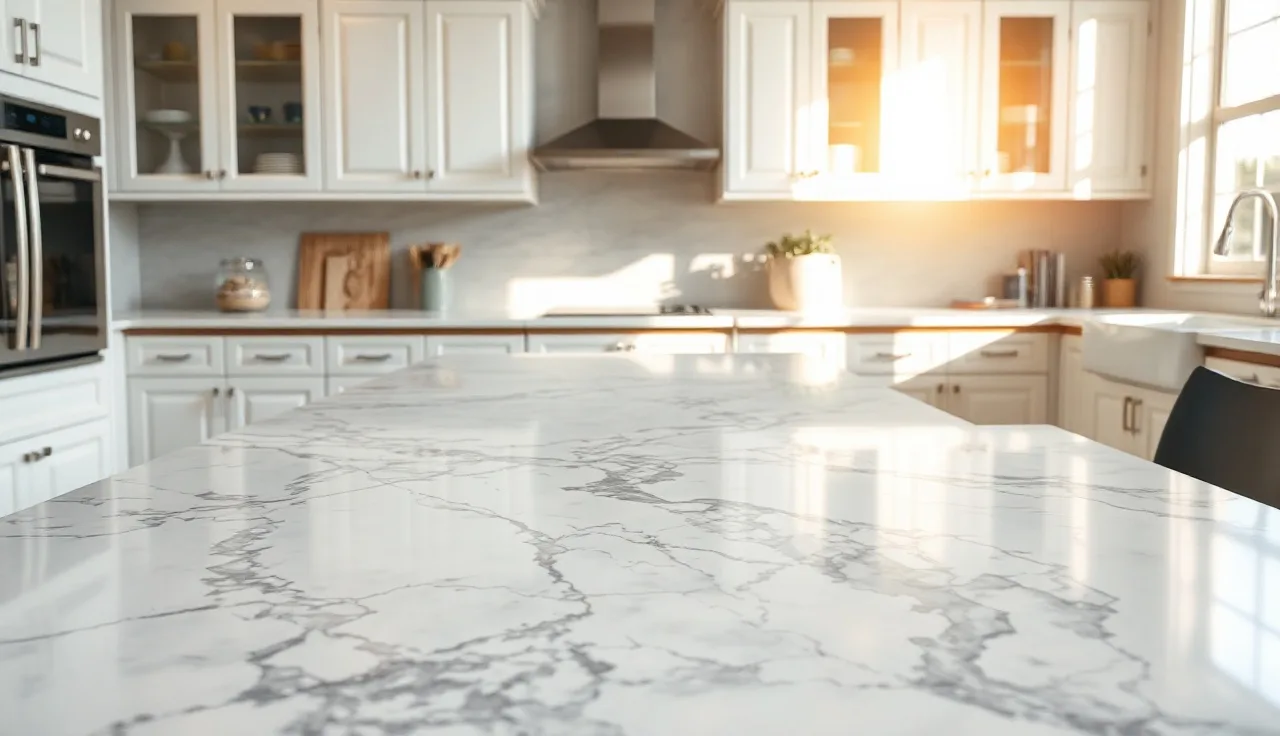
River white granite is a natural igneous rock quarried mainly in the Rajasthan and Andhra Pradesh regions of India. The background runs from bright white to soft cream or light gray, and it carries flowing veins of dark charcoal, black, and sometimes muted burgundy or rust. The veining is where the name comes from. The dark lines move across the slab in long river-like sweeps rather than tight speckles.
It sits in the medium-fine grain category. You will not see the coarse, sugary crystals common in absolute black or Kashmir white. From across the room the look is clean and calm, with just enough pattern to hide the smudges that show up between cleanings. Homeowners like that part.
One thing to know upfront. "River white" is a trade name, not a geological classification. The same stone gets sold under similar names at different yards, and color batches vary from quarry to quarry, even between slabs from the same quarry run. Pick your specific slab in person, or get slab photos with a scale reference before you commit. What you see on a four-inch chip is not what fills 30 square feet of counter.
Geologically, river white is a granite in the true petrographic sense: mostly quartz and feldspar with some mica and hornblende. That composition puts it around 6 to 7 on the Mohs hardness scale, harder than marble (usually 3 to 4) and about even with most other commercial granites [1].
How does river white granite compare to other white granites?
The white granite category is crowded. River white, Dallas white, Alaska white, colonial white, white ice, and a handful of others all overlap on price and look. Knowing where river white sits tells you whether it is the right call for your kitchen.
| Stone name | Background | Dominant veining | Typical installed cost ($/sq ft) | Hardness (Mohs) |
|---|---|---|---|---|
| River white | White to light gray | Dark gray, black, burgundy sweeps | $40, $100 | 6 to 7 |
| Dallas white | White to off-white | Fine black and gray speckling | $35, $80 | 6 to 7 |
| Alaska white | Cream to light beige | Gray and charcoal speckle | $40, $85 | 6 to 7 |
| Colonial white | White | Gray and burgundy speckle/vein | $45, $90 | 6 to 7 |
| White ice | White | Fine gray veining, mica flash | $45, $95 | 6 to 7 |
Dallas white granite gets confused with river white constantly, so it earns its own comparison. Dallas white has a finer, more uniform speckle, the background reads brighter white with less gray undertone, and the movement is subtle. River white has longer, more dramatic veins and often reads slightly warmer. Want a stone that looks like marble from across the room? River white. Want something quieter and more consistent slab to slab? Dallas white is the safer bet.
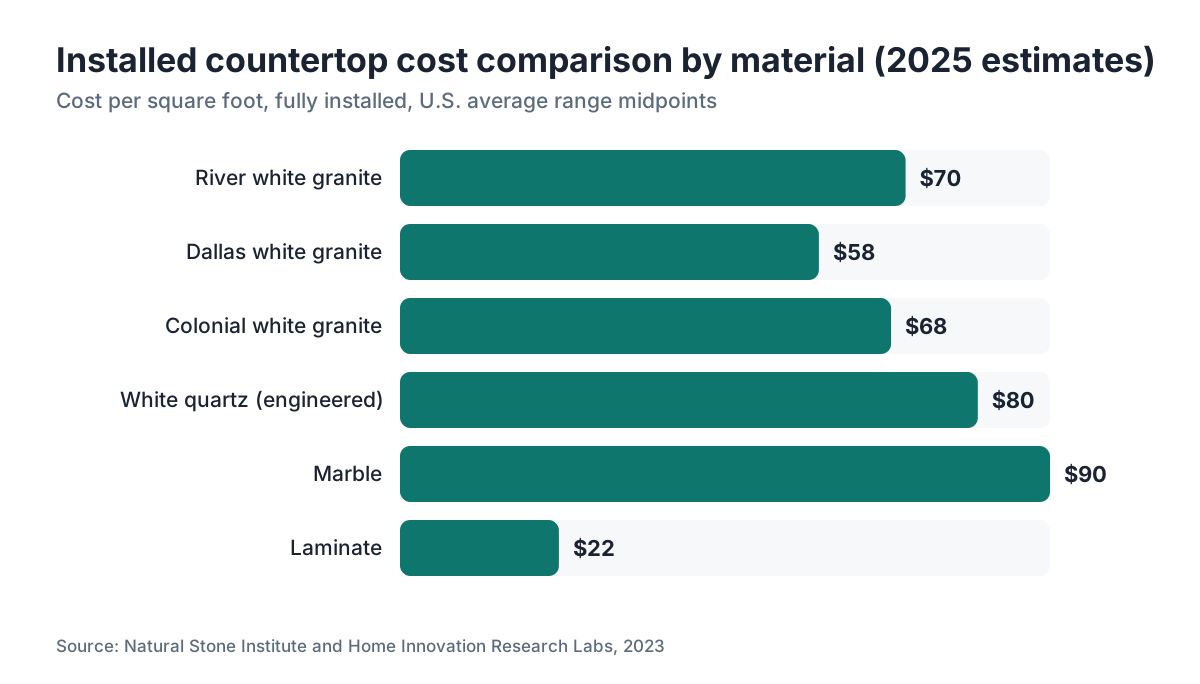
River white runs a bit higher than Dallas white on average, mostly because the dramatic veining makes it popular right now. Popularity moves price at the distribution level, and fabricators pass that along.
For how granite stacks up against every other counter material, the granite countertops guide covers the whole category.
What does river white granite cost per square foot?
Installed river white granite runs $40 to $100 per square foot in most U.S. markets as of 2025. The range is wide because it folds in slab cost, fabrication, edge profile, cutouts, and labor, and every one of those moves.
The slab itself at a distributor runs roughly $8 to $18 per square foot for standard 3/4-inch (2 cm) material and $12 to $25 per square foot for 1.25-inch (3 cm) material. Most residential kitchens use 3 cm because it looks substantial and does not need a buildup under the overhang edge [2].
Fabrication (cutting, polishing edges, sink and cooktop cutouts) usually adds $15 to $35 per square foot. Installation labor runs $10 to $20 per square foot depending on region. High-cost metros like Seattle, San Francisco, and New York push toward the top of those bands. Mid-size Midwest and Southern cities land in the lower half [10].
Edge profiles are where the final quote surprises people. A basic eased or beveled edge is usually baked into the fabrication price. An ogee, waterfall, or triple pencil edge can add $15 to $30 per linear foot, and a kitchen with 25 linear feet of edge adds up fast.
Sink cutouts usually run $100 to $200 each. Cooktop cutouts run $150 to $250. Faucet holes are $25 to $50 each.
Complex geometry, lots of seams, or a waterfall island pushes you toward the top of the range. A simple galley kitchen with a single L-shape counter tends to land at $50 to $70 per square foot installed for river white.
For pricing across every material, the kitchen countertops overview breaks down what drives cost.
Is river white granite hard to maintain?
No. River white is one of the easier natural stones to live with. It is dense enough that most liquids do not soak in fast, and the dark veining hides minor staining better than pure white quartzite or marble.
Sealing is the main job. Granite is porous at the microscopic level, and an impregnating sealer fills those pores to slow absorption. Most installers seal at install. After that, reseal every 12 months for a kitchen in daily use [3]. The water-drop test tells you when: drip a tablespoon of water on the counter. Beads up, seal is holding. Absorbs in a minute or two, reseal.
For daily cleaning, warm water and a mild dish soap are fine. Skip acidic cleaners (vinegar, lemon sprays), because repeated acid exposure etches the polished surface over time. Skip abrasive scrubbers for the same reason. Wipe spills fast, especially red wine, coffee, and cooking oil.
Here is a real advantage: granite does not etch from acids the way marble does. A splash of lemon juice left on marble for ten minutes dulls the polish. The same splash on river white granite does nothing.
Heat resistance is good. You can set a hot pan directly on granite without hurting the stone. The concern is the sealer and any epoxy at seams, both of which degrade under repeated extreme heat. A trivet is still a smart habit.
The how to clean stone countertops guide has a full cleaning protocol you can bookmark.
Does river white granite need to be sealed, and how often?
Yes. All true granites are porous to some degree, and river white is no exception. The real question is how often, and that depends on the stone's density and how hard the surface gets used.
The Natural Stone Institute recommends resealing kitchen countertops annually [3]. Some denser granites go two years between sealings. Some more porous ones need it every six months. River white sits in the middle. Annual sealing is a safe default.
Doing it yourself is easy. Buy a penetrating impregnator sealer from any home improvement store, wipe it onto a clean dry surface, let it sit for the dwell time on the label (usually 15 to 30 minutes), then buff off the excess. A typical kitchen takes about 30 minutes.
Skip the spray sealers marketed as daily-use countertop sprays. Those are surface coatings, not penetrating sealers, and they do not protect against staining the way an impregnator does [9]. Spend $15 to $30 on a real penetrating sealer from a stone-industry brand.
A note for fabricators quoting jobs: sealer cost and application time belong as line items on any granite quote. Leave them out and you get friction when the homeowner reads the invoice.
What are the pros and cons of river white granite countertops?
River white has plenty going for it, and it is not right for every kitchen. Here is the honest accounting.
Start with the strengths. Durability is excellent. Granite shrugs off scratches from kitchen knives (though cutting directly on it dulls your blades fast). It handles heat better than engineered quartz. The movement gives kitchens a natural, upscale look that holds up over the years. Resale is a plus too. The National Association of Realtors 2022 Remodeling Impact Report found that kitchen upgrades with stone countertops recoup a meaningful share of cost at resale, though the exact figure swings by market [4].
Now the limits. Color inconsistency between slabs is real. Need multiple slabs for a large kitchen? You may not get a perfect match even from the same lot. Seams are always visible to some degree in river white, because the veining rarely lines up across a seam.
River white chips at edges if struck hard. Polished granite edges are more brittle than the slab face. Tight inside corners and thin overhangs are the weak spots. Fabricators should reinforce those areas, and homeowners should not hang heavy pots off corner cabinet hardware sitting right above a thin overhang.
The color is white-forward, so it shows water spots and light mineral deposits from hard water pretty clearly. Hard water means you will be wiping the counter more than someone in a soft-water city.
Against marble countertops, river white is harder to stain and more acid-resistant. Against engineered options like Cambria countertops, it needs more maintenance but gives you a natural look quartz cannot fully fake.
How is river white granite fabricated and installed?
River white follows the same fabrication steps as any natural granite, but the dramatic veining forces a few decisions worth understanding before the saw fires up.
Slab selection and layout come first. A good fabricator studies your slab and plans the cuts so the veining flows in a logical direction across your run. On an island, you want veins running parallel to the long axis if possible. On perimeter counters, veins usually run parallel to the wall. The goal is visual continuity, even when a seam is unavoidable.
Seam placement matters more here than with uniform granites. A seam through a dark vein hides far better than a seam across the white background. Your fabricator should walk you through the seam plan before cutting. If they do not bring it up, ask.
Digital templating is standard at most shops now. A technician captures your counter geometry with a laser or structured-light tool, and the template file drives the CNC saw and waterjet. That cuts waste and sharpens seam accuracy compared to hand-cut templates [5].
Edge polishing on a high-movement stone can show transition lines where the polish direction changes, especially on shaped edges like ogee. A good finisher hand-blends those transitions. Ask to see samples of their edge work on similarly veined stone before you commit to a complex profile.
Install day starts with level cabinets. Granite does not flex. Cabinets that are out of level leave the slab sitting unevenly, and it can crack at low-support points over time. A fabricator who arrives and finds cabinets out by more than 1/8 inch should fix that before setting stone.
For the full day-of walkthrough, the countertop installation guide covers the whole process.
For shops: software that handles both quoting and nesting layouts helps a lot on veined stones like river white, where slab yield and seam positioning drive material cost directly. SlabWise was built for that workflow, and you can see a demo at slabwise.com.
How does river white granite hold up in kitchens vs. bathrooms?
River white performs well in both, with slightly different concerns for each.
In kitchens, the stressors are heat, acidic foods, cooking oil, and heavy daily use. River white handles all of it with proper sealing. The one spot to watch is right around the sink. Standing water from dishwashing or prep exhausts the sealer faster there, so reseal the sink surround more often if you notice water starting to soak in.
Bathrooms shift the concerns. Toothpaste (mildly abrasive), makeup, and personal care products with acids or alcohols are the main risks. The upside is that bathroom counters take far less thermal and mechanical stress than kitchens. A river white vanity top can easily last decades with little attention beyond an annual seal.
River white has a spa-like quality in bathrooms that works well with frameless glass shower enclosures and wall-hung vanities. The white background bounces light around in a way darker stones do not.
One practical note: polished river white shows water spots readily on the white background. Hard water? A honed finish (matte rather than polished) hides spots better, though it wants a slightly tighter sealing schedule because honed surfaces are more porous than polished ones.
What finishes are available for river white granite?
You have four main finishes for river white, each with real trade-offs.
Polished is the default and the most common. High-gloss polish makes the colors pop, the whites look whiter, the dark veining looks deeper. It cleans the easiest because the surface is dense and smooth. The downside is it shows fingerprints and water spots clearly.
Honed is a matte or satin finish, achieved by stopping the polish before it hits full gloss. Softer look, pairs well with transitional and contemporary kitchens. It hides smudges better than polished but is more porous, so it needs sealing more often. On river white, honing pushes the whites toward a warmer cream tone.
Leathered (also called brushed) is a textured finish that raises the natural crystalline surface slightly. It hides fingerprints best of the four and has a distinct feel under the hand. Not every fabricator offers it, and it runs 10 to 20 percent more than polished because of the extra processing time.
Flamed finish uses a high-temperature torch to open the surface, creating a rough, slip-resistant texture. It is almost never used on countertops. It belongs on flooring and exterior surfaces. Mention it only to rule it out for river white counters.
For most homeowners, polished is the right call. It shows the stone at its best, cleans the easiest, and is what most designers and resale markets expect.
How do you pick a good river white slab in person?
Buy the slab, not the sample. That is the single most important piece of advice for anyone buying river white granite.
At the yard, ask them to wet the slab. Water pulls out the true color and pattern far better than the dry surface, which looks dusty and muted. Your polished counter at home will always look wetter and more saturated than a dry slab, so wetting it gives you a better preview.
Check the full slab for voids, pits, and fill. Natural granites sometimes have small voids that fabricators fill with color-matched epoxy. A little fill is normal and fine. A slab with heavy fill, or fill that is not color-matched well, is worth passing on.
Look at the back. Netting (a fiberglass mesh bonded to the stone) is common on thinner or more fragile slabs. Some netting is fine. Heavy netting covering most of the back face can flag a structurally questionable slab.
For large kitchens, pull two adjacent slabs from the same lot and stand them side by side. The color and movement should be close enough that the seam will not jar. Slabs from different lots often shift color noticeably.
Buying remotely? Ask for slab photos shot in natural daylight with a tape measure or known object for scale. Request the main face plus any areas that land near seams or edge profiles.
What kitchen styles work best with river white granite?
River white is one of the more versatile granites because a neutral white-and-gray palette does not fight with much. It still reads best in certain contexts.
White or off-white shaker cabinets with river white counters is the classic. The stone adds pattern and depth without color competition. This is probably the most popular pairing for river white in North American kitchens right now.
Dark navy, forest green, or charcoal cabinets work well too, because the white background provides contrast and brightens the whole palette. River white with two-tone cabinetry (dark lowers, white uppers) is a look designers have pushed hard for a few years.
Warm wood tones pair nicely if the slab has burgundy in the veining. A slab with purely cool gray and black veins can feel disconnected from warm wood, so slab selection matters when you are working around an existing wood floor or open shelving.
On backsplash, keep it simple. Subway tile, large-format porcelain in white or light gray, or a plain brick pattern lets the counter be the feature. Busy patterned tile behind a busy-veined stone just makes noise.
Lighting changes everything. River white reads distinctly different under warm incandescent versus cool LED. The white background shifts toward cream under warm lights and cooler gray under daylight-balanced LEDs. Bring a photo of your actual kitchen lighting when you choose a slab, or take a sample home overnight if the yard allows it.
What do fabricators need to know when quoting river white granite jobs?
River white is a well-behaved granite to fabricate, but a few factors inflate material cost and should be priced in from the start.
Yield is lower than on uniform stones because you have to respect vein direction when cutting. On a badly oriented slab you can lose 20 to 30 percent of usable area just keeping the veining directional across the run [5]. Build that into your slab count. A kitchen that needs 1.2 slabs of a uniform stone might need 1.5 slabs of river white.
Seam fill color matters. River white has both white and very dark elements, so a standard gray epoxy may not blend everywhere. Keep white, gray, and dark-tinted epoxy on hand and mix to match the specific seam location on each slab.
Edge polish time on heavily veined stone runs higher than on uniform granite, because the transition between light and dark areas takes more hand finishing to avoid color-shadow artifacts in the polish. If you bill edge work by the hour instead of the linear foot, account for this.
For shops running quoting software: tracking slab yield and remnant value on veined stones is where the margin quietly leaks. A structured quoting workflow that logs actual usage versus estimated usage over several jobs shows you exactly where river white runs over budget. SlabWise has a remnant tracking module built into its nesting workflow, worth a look if your shop handles a lot of natural stone (slabwise.com/demo).
Delivery and handling: river white in 3 cm typically weighs 18 to 22 pounds per square foot. A full 120 x 65-inch slab runs 900 to 1,100 pounds. Factor that into delivery logistics and crew sizing for install day.
Frequently asked questions
Is river white granite the same as Dallas white granite?
No, they are different stones. River white has a white to light gray background with long, flowing dark gray, black, and burgundy veins that give it a dramatic, marble-like look. Dallas white has a finer, more uniform speckle with a brighter white background and subtle movement. Dallas white tends to run slightly cheaper and looks more consistent slab to slab. River white has more visual drama and is the better pick if you want something that reads like natural marble.
How much does it cost to install river white granite countertops?
Installed river white granite typically costs $40 to $100 per square foot, covering the slab, fabrication, edge profiling, cutouts, and labor. Simple kitchens in mid-size markets land around $50 to $70 per square foot. Complex layouts with waterfall islands, multiple sink cutouts, or specialty edges push toward the top of the range. High-cost metros like New York or San Francisco add another 20 to 30 percent.
How often does river white granite need to be sealed?
Once a year is the standard recommendation for kitchen countertops, per Natural Stone Institute guidance. The easy test: drip a tablespoon of water on the counter. If it absorbs within a minute or two instead of beading up, it is time to reseal. The sink surround wears through sealer faster than other areas, so check that spot more often. Resealing takes about 30 minutes with a penetrating impregnator sealer from any home improvement store.
Does river white granite stain easily?
Not easily, as long as it is sealed. Granite is porous at the microscopic level, so oil, red wine, and coffee can penetrate and stain if left to sit on an unsealed surface. With a fresh seal, you have several minutes to wipe spills before absorption starts. The dark veining also hides minor staining better than pure white stones. Keep it sealed annually, wipe spills promptly, and staining will not be a problem.
Can you cut food directly on river white granite countertops?
Technically yes, the stone will not be damaged. Granite is harder than most knife steel, so the counter survives fine. Your knives do not. Cutting directly on granite dulls blades fast. Use a cutting board. That advice has nothing to do with protecting the countertop and everything to do with protecting your knives.
Is river white granite heat resistant?
Yes. Natural granite handles high temperatures without cracking or discoloring, so you can set a hot pan on it without hurting the stone. The more practical concern is the sealer and any epoxy fill at seams, which can degrade under repeated direct heat. A trivet is a sensible habit, but forgetting once will not ruin the counter.
What is the best edge profile for river white granite?
An eased edge (a straight cut with a light bevel on top) or a beveled edge works for most kitchens and is usually included in the fabrication price. Bullnose shows more of the stone's edge and displays the natural layering nicely. Ogee and more ornate profiles suit traditional kitchens but add $15 to $30 per linear foot. On a stone with dramatic veining, simple edges often look better anyway, because the face does the visual work.
How does river white granite compare to white quartz?
River white granite is natural stone with unique variation between slabs. White quartz is engineered from crushed stone and resin, with a very consistent look slab to slab. Quartz needs no sealing and resists staining better. Granite handles heat better and has a look engineered stone cannot fully replicate. Granite usually costs slightly less than premium quartz. If consistency and zero maintenance appeal to you, quartz is logical. If you want natural variation and a lower price ceiling, granite wins.
What colors pair well with river white granite in a kitchen?
White and off-white shaker cabinets are the classic pairing. Dark navy, charcoal, and forest green cabinets work well too, because the white stone provides contrast. Warm honey wood tones pair best with river white slabs that carry burgundy veining rather than purely cool gray veins. For backsplash, keep it simple: subway tile, large-format porcelain, or natural stone in a neutral tone lets the counter carry the pattern without competing.
Where is river white granite quarried?
Most commercial river white granite sold in the U.S. comes from quarries in Rajasthan and Andhra Pradesh, India. India is among the world's largest granite exporters by volume, and a large share of the white and light-colored granites in American stone yards start there [6]. The stone is quarried in large blocks, wire-sawed into slabs, polished, and shipped in containers to U.S. distribution hubs in cities like Dallas, Atlanta, Chicago, and Los Angeles.
Is river white granite good for bathroom vanity tops?
Yes, it works very well in bathrooms. Vanity tops take less thermal and mechanical stress than kitchen counters, so river white is easy to maintain there. The white background with dark veining creates a clean, spa-like look that suits many bathroom styles. If you have hard water, consider a honed finish to hide water spots better, though honed surfaces need sealing slightly more often than polished ones.
How do fabricators price river white granite jobs differently than uniform granites?
Veining direction cuts slab yield by 20 to 30 percent on a typical kitchen layout, so material estimates have to account for that. Seam placement takes more planning, because you want seams to fall within dark veins rather than across the white background. Edge polishing runs slightly longer on high-contrast stones because color transitions in the polish need hand finishing. All three add real cost that uniform-stone pricing templates undercount.
What is the difference between polished and honed river white granite?
Polished is a high-gloss surface that makes colors pop and cleans the easiest. It shows fingerprints and water spots clearly on the white background. Honed is a matte finish that hides smudges better and looks softer, but it is more porous and needs sealing more often. On river white, honing gives the white areas a warmer, creamier tone. For heavy daily kitchen use, polished is the practical choice. For bathrooms or lower-use surfaces, honed is worth considering.
Can river white granite countertops crack?
Yes, though it is uncommon with proper support. Granite can crack if a heavy object strikes an unsupported span, if cabinets are significantly out of level before installation, or if the slab has a natural fissure that was missed during fabrication. Thin overhangs (more than 10 to 12 inches without corbel support) are the most common crack location in installed kitchens. A reputable fabricator flags these risks and recommends corbels or other reinforcement during design.
Sources
- U.S. Geological Survey, National Minerals Information Center: Granite is composed primarily of quartz and feldspar and registers approximately 6 to 7 on the Mohs hardness scale.
- Natural Stone Institute, Technical Bulletin on countertop thickness and fabrication standards: 3 cm (1.25-inch) granite is the standard residential countertop thickness and does not require a buildup at unsupported edges.
- Natural Stone Institute, Care and Maintenance Guidelines: The Natural Stone Institute recommends resealing granite countertops annually in kitchen applications.
- National Association of Realtors, 2022 Remodeling Impact Report: Kitchen upgrades including stone countertops recoup a meaningful share of project cost at resale, per NAR 2022 survey data.
- Natural Stone Institute, fabrication best practices guidance: Directional veining requirements in natural stone can reduce usable slab yield by 20 to 30 percent compared to uniform stones; digital templating improves yield and seam accuracy.
- U.S. Geological Survey, National Minerals Information Center, dimension stone data: India is among the world's largest granite exporters by volume, supplying a significant share of the white and light-colored granite slabs sold in the U.S. market.
- Home Innovation Research Labs, Annual Builder Practices Survey: Natural stone countertops remain among the most specified countertop materials in new single-family home construction, alongside quartz engineered stone.
- Natural Stone Institute, stone hardness and durability reference: Marble typically registers 3 to 4 on the Mohs scale, significantly softer than granite at 6 to 7, making granite more scratch-resistant in kitchen use.
- Natural Stone Institute, sealers and protective treatments technical guidance: Penetrating impregnator sealers outperform surface coating sealers for stain protection in kitchen countertop applications.
- U.S. Bureau of Labor Statistics, Producer Price Index: Fabrication and installation labor costs for cut stone products vary significantly by region, with high-cost metros tracking 20 to 30 percent above national averages.
Last updated 2026-07-10