TL;DR
- Colonial white granite is a light-gray-to-white Brazilian granite with dark biotite flecks and occasional burgundy or rust inclusions.
- It costs roughly $40 to $100 per square foot installed, depending on slab thickness, edge profile, and your market.
- It's a reliable mid-range granite that seals well, hides daily grime better than pure white stones, and pairs with almost any cabinet color.
What does colonial white granite actually look like?
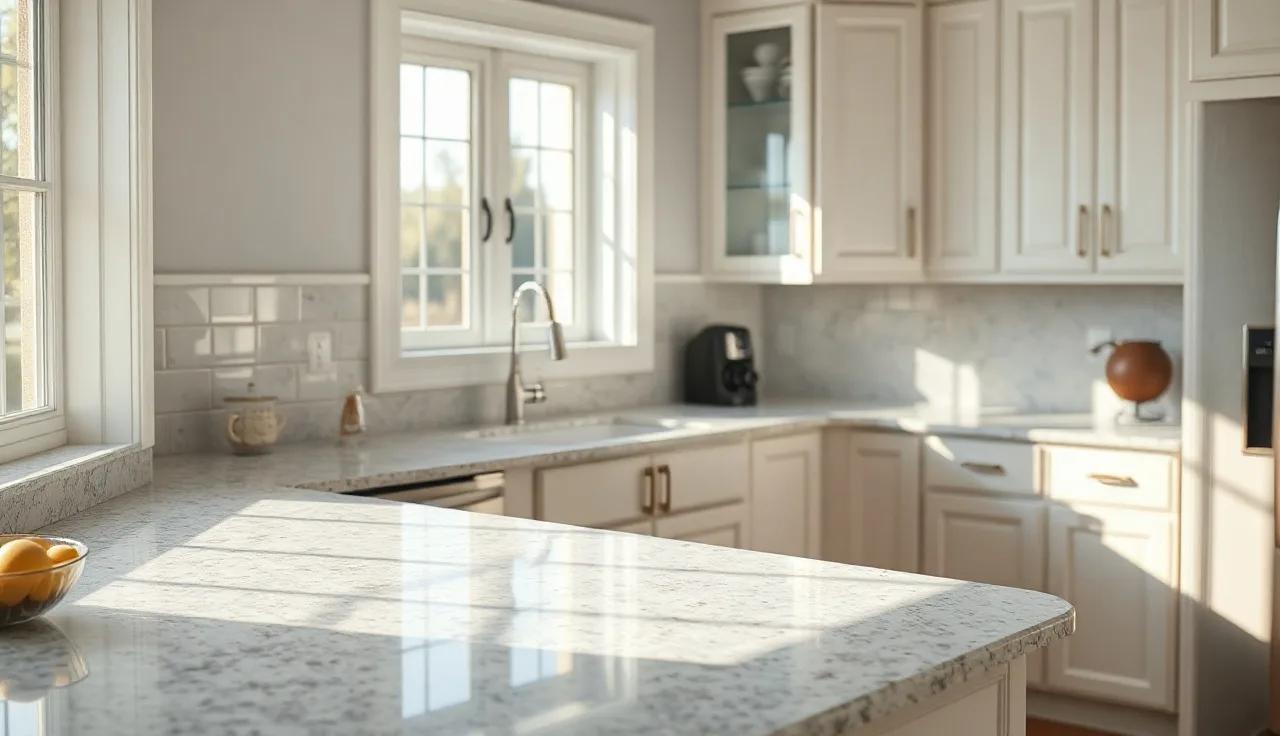
Colonial white granite has a white to pale gray background scattered with small-to-medium black biotite crystals and occasional garnet or rusty-red feldspar inclusions. From across a kitchen it reads light, speckled, and neutral. Get close and the movement is busy rather than dramatic, more freckled than veined.
The pattern is fairly consistent from slab to slab compared to something like Blue Bahia or Calacatta marble, which matters a lot during templating. You're less likely to get a jarring mismatch between two slabs on an L-shaped kitchen. That said, individual slabs still vary, and the burgundy inclusions can range from barely visible to fairly prominent depending on the quarry block. Always inspect the actual slab, not a sample tile.
Colonial white comes almost entirely from quarries in Espírito Santo and Minas Gerais, Brazil [1]. It sells under alternate trade names too: Branco Colonial, Colonial Cream, or occasionally mislabeled as Alaskan white granite. Alaskan white granite is a different stone, typically lighter and more consistently white with less visible dark spotting, quarried from different sources. If a supplier uses those names interchangeably, ask to see the material origin documentation.
Thickness runs 2 cm and 3 cm in most U.S. fabrication yards. For countertops, 3 cm is the industry standard now. 2 cm slabs need a laminated edge or substrate support, which adds labor cost.
How much does colonial white granite cost?
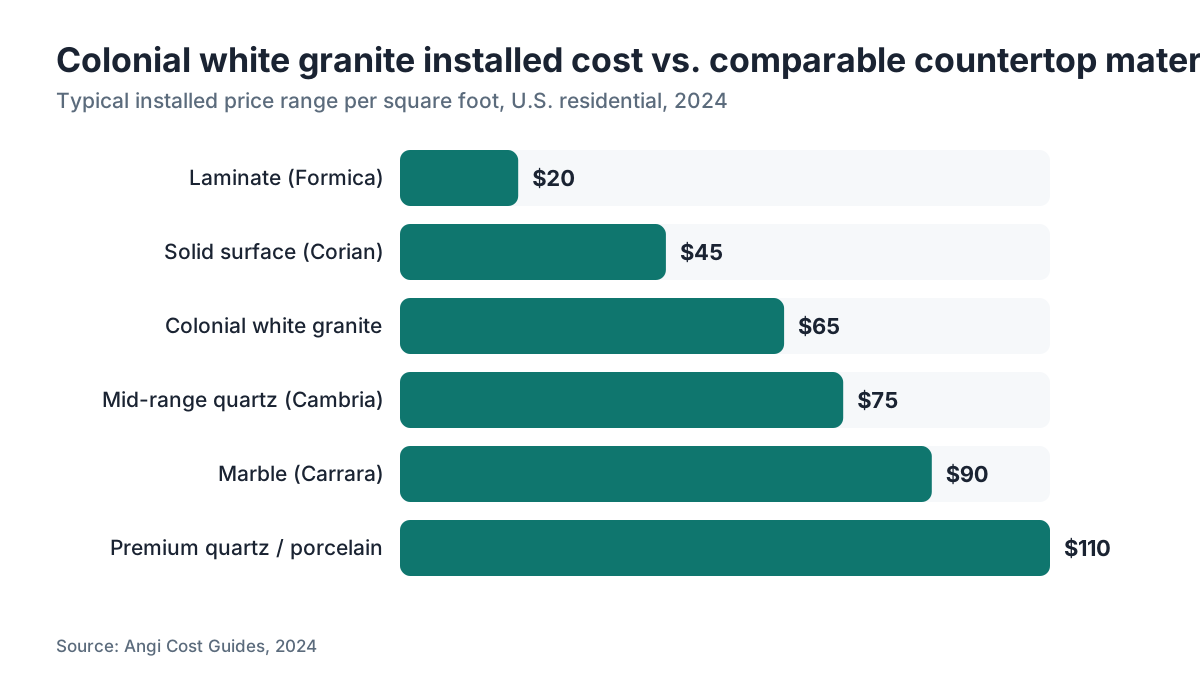
Installed price across the U.S. ranges from about $40 to $100 per square foot, with the national midpoint closer to $55, $70 for a typical residential kitchen [2]. That range is wide because fabrication labor, slab yard markup, edge complexity, and regional cost of living all move the number.
Here's how the cost stack breaks down for a typical 40-square-foot kitchen (including the peninsula overhang):
| Cost component | Low estimate | High estimate |
|---|---|---|
| Slab material (3 cm) | $600 | $1,200 |
| Fabrication (cutting, polishing, edge) | $400 | $900 |
| Sink cutout | $100 | $200 |
| Installation | $200 | $500 |
| Sealer (first application) | $50 | $100 |
| Total for 40 sq ft | $1,350 | $2,900 |
Edge profiles add real money. A basic eased edge is usually included in fab quotes. An ogee or waterfall edge can add $15, $40 per linear foot. If your counter has 25 linear feet of exposed edge, that's a $375, $1,000 swing just from the profile choice.
Colonial white sits in what fabricators call Level 1 or Level 2 granite, meaning it's widely available and doesn't command the premium of rare exotics. That's good news for homeowners, and it means your fabricator likely has it in stock rather than needing a special order. If a quote feels high, compare it against the granite countertops baseline for your region before you assume the stone itself is expensive.
For fabricators, colonial white is high-volume, easy-to-template material. It cuts predictably, the veining doesn't require the precise bookmatching labor of marble, and callbacks are rare if the slab is sealed properly before delivery. Quoting it accurately mostly comes down to getting edge linear footage right, which is where estimating tools earn their keep.
How hard and durable is colonial white granite?
Granite sits at 6 to 7 on the Mohs hardness scale [3]. Colonial white, a typical medium-grained biotite granite, lands solidly in that range. Your kitchen knives won't scratch it. Steel pots dragged across it won't leave marks. What scratches granite is another piece of granite or a diamond blade, and you're unlikely to meet either in a kitchen.
Heat resistance is excellent in practice. Granite forms at temperatures above 700°C in the Earth's crust [4], so a hot pan from the oven is no threat to the stone itself. The risk is thermal shock if a very cold stone gets an extremely hot object placed on it suddenly, but honest experience in residential kitchens says this is a theoretical concern more than a real one. Trivets are still a good habit because they protect the sealer, not the stone.
Impact is where granite surprises people. Drop a cast iron pan on the edge of a countertop near the sink cutout, a structurally thin area, and you can chip the stone. Colonial white isn't more or less brittle than other granites, but chips at corners and sink edges are the most common damage fabricators get called back about. Bullnose and eased edges chip more cleanly and are easier to repair than an ogee, which is worth knowing before you choose a fancy profile.
For durability, colonial white is one of the more practical choices in the granite category. Compare it to marble countertops, which scratch and etch from acids, and colonial white looks nearly bulletproof for a busy family kitchen.
Does colonial white granite need to be sealed?
Yes, and this is not optional. Granite is a porous stone. Colonial white, despite its density, will absorb cooking oils, wine, and acidic liquids if left unsealed. The result is staining that's difficult or impossible to pull out of the stone.
The standard test: put a few drops of water on the surface and watch. If the water beads for several minutes, the sealer is working. If it soaks in and darkens the stone within 10 to 15 minutes, you need to reseal [5].
For most colonial white installations, a penetrating (impregnating) sealer applied at the fabrication shop before delivery, plus a homeowner reapplication every 1 to 3 years depending on use, is enough. Spray-on penetrating sealers from brands like Miracle Sealants or StoneTech (Laticrete) are widely available at home centers. Follow the manufacturer's dwell time exactly. Wiping too early leaves a hazy residue.
Acids are the enemy even when the stone is sealed. Lemon juice, vinegar, tomato sauce, and wine left sitting on granite will slowly etch the sealer and eventually the stone surface if not wiped promptly. Colonial white's speckled pattern does a reasonable job hiding minor etching compared to a pure white or very dark stone, but the damage is still there.
If you want a stone that needs zero sealing, granite is not it. Cambria countertops (engineered quartz) are non-porous by nature and require no sealing. That's a genuine trade-off worth knowing.
What cabinet colors work best with colonial white granite?
Colonial white is one of the more forgiving stones for cabinet pairing. The white-gray background is neutral, and the speckled pattern absorbs color relationships rather than fighting them.
White cabinets are the most popular pairing, and they work, though the combination can read flat if you're not careful with the hardware and backsplash. Warm whites and cream whites pair better than stark bright whites, which can make the burgundy inclusions in the granite look muddy.
Navy, charcoal, and forest green lower cabinets with white uppers are a strong combination right now, and colonial white holds its own in those kitchens because the dark flecks in the stone echo the dark cabinet color. Medium-toned woods like natural maple or white oak work well too.
What doesn't work: very yellow or orange-toned wood cabinets. The rust inclusions in colonial white fight those warm tones rather than complement them. If your cabinets are golden oak or honey pine, a granite with less iron oxide content (think white fantasy or moon white) is a safer choice.
For backsplash, the speckled stone doesn't need a busy tile behind it. A simple subway tile in white or soft gray, or a large-format porcelain in a matte finish, lets the stone read clearly. An all-stone slab backsplash of the same material is a clean look fabricators are doing more often.
How does colonial white compare to similar granites?
This is where buyers get confused most often, because a half-dozen stones are marketed similarly. Here's a direct comparison:
| Stone | Background | Pattern | Price tier | Acid resistance |
|---|---|---|---|---|
| Colonial white granite | White/gray | Black speckle + rust inclusions | Level 1 to 2 | Good (with sealer) |
| Alaskan white granite | White to off-white | Fine gray/black speckle, less rust | Level 1 to 2 | Good (with sealer) |
| White ice granite | White | Fine black/gray speckle | Level 1 | Good (with sealer) |
| White fantasy granite | White | Gray veining, minimal speckle | Level 2 to 3 | Good (with sealer) |
| Kashmir white granite | Off-white/cream | Pink and gray speckle | Level 2 | Good (with sealer) |
| Bianco Romano granite | White | Gray/charcoal speckle | Level 2 | Good (with sealer) |
Alaskan white granite deserves a longer note because it's the most common confusion. Alaskan white typically has a cleaner, more uniform white background with finer, less prominent dark spotting, and the rust inclusions are minimal to absent. If you want maximum whiteness with very little warmth, Alaskan white is the better pick. Colonial white reads warmer and busier, which some people love and others don't.
Kashmir white is the other frequent comparison. It's quarried in India (Tamil Nadu specifically), has a cream base with distinctive pink orthoclase feldspar crystals, and costs slightly more on average. If your kitchen has warm wood tones or cream cabinets, Kashmir white often integrates better than colonial white.
If you like the light-speckled granite look but want zero maintenance, compare any of these stones against Cambria countertops or other engineered quartz. The look is different up close but similar at room scale, and you give up sealing entirely.
What should you inspect before buying a colonial white slab?
Never buy granite from a sample chip. Samples are typically 4x4 inches and cut from a single polished piece. Your actual slab could look markedly different.
When you visit the slab yard (and you should, before signing anything), look for these things:
Fissures vs. cracks. Fissures are natural linear features in the crystal structure, present in most granite. They're not structural problems. Cracks run through the slab and compromise it. The test: run your finger across the line. A fissure is flush. A crack has a perceptible edge or catches your fingernail. Fabricators are trained to route sink cutouts away from fissures near the sink area, but if a slab has a major fissure crossing the center of a long run, discuss it with your fabricator before committing [6].
Color consistency. Colonial white slabs from the same quarry block are fairly consistent, but batch variation happens. If your kitchen needs two slabs, pull them both from the same bundle (same pallet or adjacent slab numbers), which means they came from the same block. Ask the yard to stand them side by side so you can see the match.
Backside pitting. Flip a corner edge and look at the raw underside. Granites from some quarries have voids or soft mineral pockets that can compromise polished edges. A few small pits are normal. Large soft spots are not.
Mesh backing. Some imported slabs arrive with a fiberglass mesh bonded to the back to stabilize weak material. This isn't always a dealbreaker, but it warrants a conversation with your fabricator about whether it affects the installation.
Fabricators who run quoting and job tracking through a platform like SlabWise can attach slab photos and defect notes to the job file at templating, so the install crew knows exactly what was flagged and where the fissures sit relative to the cutout lines. It's a small thing that prevents expensive surprises.
How is colonial white granite fabricated and installed?
Fabricating colonial white is standard granite work. The stone cuts well with a wet diamond blade bridge saw. CNC routers handle edge profiles and sink cutouts. Because colonial white has no dramatic veining that needs matching across a seam, layout is simpler than marble or heavily veined exotics, and experienced shops can template and produce it in 3 to 7 business days under normal workload [7].
Templating is the first step that decides everything downstream. A digital template (laser or photogrammetry) captures the exact cabinet footprint including out-of-square walls, which are more common than homeowners expect in houses older than 20 years. Analog (cardboard or luan) templates still work fine but add a margin-of-error step. Ask your fabricator which method they use.
Seam placement matters more than most homeowners realize. On a standard kitchen, the fabricator places seams where the stone naturally breaks (at inside corners or over cabinet supports) and where the pieces are a manageable weight for two installers. A 3 cm slab runs roughly 13 pounds per square foot [8], so a 25-square-foot piece weighs over 300 pounds. Seams at inside corners are normal and correct. Demanding a single unbroken countertop on a large L-shape is usually not physically possible from one piece.
Installation itself takes 2 to 4 hours for a typical kitchen depending on complexity. The stone is set in silicone adhesive on the cabinet substrate, seams are joined with color-matched epoxy, and the whole surface is cleaned and finished. Most jobs finish in one day. See our countertop installation guide for what to expect on the day.
For homeowners comparing granite to cheaper options, laminate countertops and Formica countertops cost far less to install and a skilled DIYer can handle them. Granite installation is not a DIY project in most cases, given the weight and the precise seam work.
How do you clean and maintain colonial white granite?
Day-to-day cleaning is simple. Warm water and a few drops of dish soap on a microfiber cloth, then a dry wipe. That covers 95% of cleaning tasks. Fabricators and stone associations keep hammering this point because people switch to the wrong products and cause the exact damage they were trying to prevent.
Never use vinegar, lemon juice, or any acid-based cleaner on granite. Even diluted, acid strips the sealer and can etch the surface. Never use bleach at full strength (diluted bleach on a sealed surface occasionally is less catastrophic, but the Marble Institute of America still doesn't recommend it) [9]. Avoid ammonia-based cleaners (most glass cleaners) for the same sealer-stripping reason.
For stubborn stains, the method depends on the cause. Oil-based stains (cooking oil, grease) respond to a poultice of baking soda and water left on the stain for 24 hours under plastic wrap. Organic stains (coffee, tea, wine) respond to a 12% hydrogen peroxide solution, also applied as a poultice. The Marble Institute of America publishes specific poultice instructions by stain type [9].
For a deeper look at cleaning stone surfaces, the principles in our how to clean stone countertops guide apply directly to colonial white granite.
Resealing frequency: every 1 to 3 years is the typical recommendation, but the water bead test tells you more than a calendar. Do the test once a year and reseal when needed. A high-traffic kitchen with heavy cooking may need annual resealing. A guest bathroom vanity might go 5 years without any issue.
Is colonial white granite a good choice for bathrooms and outdoor kitchens?
Bathrooms, yes. Colonial white granite is popular for vanity tops, and it handles moisture well when sealed properly. The patterning hides water spots better than a pure white stone, which is a practical win in a high-splash spot. It cuts down to smaller bathroom dimensions without wasting much material, which keeps costs proportionally lower than in a full kitchen.
Outdoor kitchens, with caveats. Granite resists UV fading (it doesn't bleach in sunlight the way some engineered stones do), handles temperature extremes reasonably well, and doesn't degrade in rain. The concern outdoors is sealing frequency. A surface exposed to weather, bird droppings, tree sap, and direct rain needs resealing more often, probably annually. It also needs to be installed with proper drainage so water doesn't pool on the surface or wick into the substrate.
Under a full cover, colonial white granite is a solid choice. Fully exposed to weather, some fabricators recommend a denser, lower-porosity granite for longevity, or a porcelain slab surface that needs no sealing at all.
Fireplace surrounds are another occasional use. Colonial white works well here because the stone doesn't get hot enough in a surround application (the surface temperature at a typical residential fireplace face stays well below 100°C) to be a concern, and the neutral coloring pairs with most hearth designs.
What are the common complaints about colonial white granite?
The most frequent complaint is staining around the sink, which traces almost entirely to poor or infrequent sealing. The porosity at the sink cutout edge is the most vulnerable point. Fabricators who seal the underside of the stone at the sink perimeter during fabrication, more than the top surface, cut this problem way down.
The second common complaint is that the stone looked different on installation than in the showroom sample. This goes back to buying from chips and photos rather than seeing the actual slab. The burgundy inclusions can be a surprise if the sample the homeowner approved had very little of them.
Etching from acidic foods is the third complaint. Colonial white etches the same as any granite, but the busy pattern makes mild etching harder to see than on a polished pure-black or solid-color stone. Still, people who cook with a lot of citrus or make their own vinaigrette and don't wipe spills fast will notice dull spots over time.
One complaint comes up specifically against engineered quartz: granite is not perfectly flat. Natural stone has slight surface variation. Most people never notice. Someone coming from a factory-perfect quartz surface who runs a palm across granite slowly will feel it. This is not a defect. It's the nature of the material.
For homeowners who want lower maintenance than any natural stone, Corian countertops or kitchen countertops in solid surface materials might be worth a look before committing to granite.
How do fabricators price and quote colonial white granite jobs accurately?
Colonial white is a simple stone to price on material, which is why it's often the baseline when fabricators build their first quoting templates. The challenges live in the details: edge linear footage, cutout count, and seam placement.
Material cost in the yard typically runs $8, $20 per square foot for 3 cm colonial white slabs purchased wholesale, depending on supplier relationship, volume, and market [2]. Fabrication labor (cutting, CNC edge work, polishing, seam prep) typically runs $15, $35 per square foot in U.S. shops, with higher labor markets like the Northeast and California skewing toward the top. Installation adds another $5, $15 per square foot depending on site access and job complexity.
Edge profile pricing matters here. A standard eased or beveled edge is often priced into the base fabrication rate. Ogee, dupont, chiseled, or waterfall profiles are line-item additions. In a competitive market, some shops price these at cost to win the job and regret it later. Quoting software that enforces a standard edge matrix stops that margin bleed.
Shops using SlabWise can template the job digitally, attach the colonial white slab dimensions directly to the quote, and calculate remnant yield before cutting. For a stone as consistent as colonial white, accurate nesting means less waste per job, which is a real profit lever on higher-volume work.
Splash areas, corbels, and specialty shapes (curved islands, farmhouse sink cutouts with apron clearance) get underquoted most often. Time each of those explicitly rather than rolling them into a square-foot rate.
Frequently asked questions
Is colonial white granite out of style?
No. Light, speckled granites move in and out of trend cycles, but colonial white specifically has held consistent demand in the U.S. market for over two decades. The neutral coloring is one reason: it doesn't lock a kitchen into a specific design era the way a more dramatic stone can. Real estate staging professionals still use it regularly because it photographs neutrally and appeals broadly to buyers.
Can colonial white granite be used for a kitchen island?
Yes, and it's one of the better choices for islands. The light background keeps the island feeling open rather than visually heavy. The speckled pattern hides crumbs and prep mess reasonably well between cleanings. If the island is large enough to need two slabs, bundle-match them at the yard before purchase so the seam reads cleanly.
How does colonial white granite handle hard water stains?
Hard water deposits (calcium carbonate) sit on top of a sealed granite surface and come off with a damp cloth and a little dish soap. For heavy buildup, a paste of baking soda applied briefly loosens it without the acidity that would damage the sealer. Do not use Lime-A-Way or CLR on granite. Both are acidic and strip the sealer immediately.
What is the difference between colonial white and Alaskan white granite?
Colonial white is a Brazilian granite with a gray-white background, prominent black biotite speckle, and often visible rust or burgundy feldspar inclusions. Alaskan white granite typically has a cleaner white background, finer and less prominent dark spotting, and minimal warm-colored inclusions. Alaskan white reads cooler and more uniformly white at room distance. They are different stones from different origins and should not be substituted without seeing both.
How long does colonial white granite last?
Installed and sealed properly, granite countertops last decades. Colonial white shows no unusual durability issues compared to other granites. The limiting factor in real kitchens is usually the sealer maintenance schedule, not the stone. Neglected sealing leads to staining that may eventually require professional honing and resealing to address, but the stone underneath stays structurally sound.
Does colonial white granite chip easily?
No more or less than other granites. The most vulnerable areas are thin sections near sink cutouts and sharp corner edges. A slightly rounded edge profile (eased or beveled) over a sharp square edge reduces chip risk. If a chip happens, a color-matched epoxy repair is the standard fix. Results depend on how well the epoxy matches the background color and the pattern density in that spot.
Can I cut food directly on colonial white granite?
You can, but you shouldn't. The granite won't scratch from a steel knife, but cutting on granite dulls knife edges fast because the stone is harder than the steel. More practically, cutting on an unsealed or worn section puts food directly on a porous surface. Use a cutting board. It protects your knives, keeps food off the raw stone at any sealer-worn spots, and costs nothing.
How often does colonial white granite need to be resealed?
Most residential colonial white installations need resealing every 1 to 3 years. The most reliable test is the water bead test: drip a tablespoon of water on the surface and see if it still beads after several minutes. If it soaks in and darkens the stone within 10 to 15 minutes, reseal now. High-use kitchens with frequent acidic food prep skew toward annual resealing. A low-use bathroom vanity may go 3 to 5 years.
What thickness of colonial white granite slab should I get?
3 cm (about 1.25 inches) is the current residential standard in the U.S. and the right choice for countertops. 2 cm slabs are thinner and need either a laminated edge buildup or a continuous plywood substrate for support, which adds labor cost and usually ends up costing similar to or more than 3 cm once fabricated. Unless you have a specific design reason for 2 cm, specify 3 cm.
Is colonial white granite more expensive than quartz?
At the mid-range, they're comparable. Mid-grade quartz like Silestone or Cambria runs $50, $90 per square foot installed. Colonial white at $40 to $100 installed overlaps that range heavily. The bottom of the colonial white market (Level 1 slabs in low-cost-of-living areas) can beat most engineered quartz on price. Premium quartz lines from Cambria or Dekton can exceed the top of the colonial white range. Neither material is categorically more expensive.
Does colonial white granite work with a farmhouse sink?
Yes. An apron-front (farmhouse) sink needs an undermount-style cutout with the front edge of the stone cut back to clear the sink apron face. This is standard fabrication work, but it removes a strip of material that would otherwise cover the front cabinet face. The cutout has to be planned in the slab layout early, which means the fabricator needs the sink's rough-in dimensions at templating, not at installation.
Will colonial white granite increase my home's resale value?
Granite countertops generally contribute positively to appraisal value in kitchens, but the National Association of Realtors does not publish a specific dollar-per-square-foot return figure for individual stone types. The practical answer is that granite is expected in mid-to-upper price-point homes, and its absence is noticed more than its presence is praised. Colonial white is neutral enough that it won't alienate buyers the way a very bold stone might.
Can you put hot pans on colonial white granite?
The stone tolerates heat well, given how it formed under extreme geological temperatures. A hot pan won't crack or discolor the granite. What heat can do is degrade the sealer over time if you routinely set very hot items directly on the surface, leaving dull spots or reducing the sealer's effectiveness. Trivets are a cheap habit that protects the sealer finish, not the stone. Most fabricators recommend them as standard practice.
Sources
- USGS Minerals Yearbook, Stone (Dimension) chapter: Colonial white granite quarried primarily in Espírito Santo and Minas Gerais, Brazil; Brazil is a major dimension stone exporter to the U.S.
- HomeAdvisor (Angi) Cost Guide: Granite Countertops: Installed granite countertop prices average $40, $100 per square foot in the U.S. market.
- USGS Mineral Resources Program, Hardness reference: Granite tests at 6 to 7 on the Mohs hardness scale.
- USGS Volcano Hazards Program, Magma and Granite Formation: Granite forms from magma crystallizing at temperatures above 700°C in the Earth's crust.
- Marble Institute of America, Care and Maintenance of Natural Stone: Water bead test recommended to assess sealer effectiveness; water soaking in within 10 to 15 minutes indicates resealing is needed.
- Marble Institute of America, Technical Manual for Natural Stone: Distinction between fissures (natural crystal features, not structural) and cracks (structural breaks) in granite slabs.
- National Kitchen and Bath Association, Project Timeline Guidelines: Standard granite fabrication and installation timeline of 3 to 7 business days after templating for residential projects.
- Occupational Safety and Health Administration, Ergonomics for Stone Handling: 3 cm granite slab weight approximately 13 pounds per square foot, relevant to two-person installation limits.
- Marble Institute of America, Stain Removal Guide for Natural Stone: MIA recommends poultice methods for oil and organic stains on granite; advises against acid and bleach-based cleaners.
- National Association of Realtors, 2023 Remodeling Impact Report: Kitchen remodels including countertop upgrades contribute positively to home appraisal; specific ROI varies by market.
Last updated 2026-07-09