TL;DR
- Refinishing kitchen countertops means resurfacing, recoating, or repainting an existing surface instead of replacing it.
- Costs run $200, $1,200 for DIY kits and $300, $2,500 for professional work depending on material and square footage.
- Results last 2 to 10 years depending on method.
- Laminate, tile, and solid surface respond best.
- Natural stone and engineered quartz rarely benefit from refinishing.
What does 'refinishing' a kitchen countertop actually mean?
The word gets used loosely, and that causes a lot of confusion. In practice, refinishing covers four different things: resealing (applying a new protective coat), resurfacing (bonding a new skin over the existing top), repainting with a specialty coating, and polishing or honing (mechanical grinding to restore a stone surface). Each one applies to different materials and produces very different results.
Resealing is maintenance, not renovation. It does not change color or hide damage. Resurfacing is the dramatic transformation you see in before-and-after photos, typically using epoxy or polyurethane coatings to make old laminate or tile look like stone. Repainting with countertop-specific paints sits somewhere between the two. Polishing and honing are professional stone operations that genuinely restore a worn granite or marble surface.
Knowing which category you need determines everything else: cost, durability, and whether the result will embarrass you in six months.
Which countertop materials can actually be refinished?
Not every surface is a good candidate. Here is a plain breakdown:
| Material | Refinishing method | Realistic result | Worth it? |
|---|---|---|---|
| Laminate (Formica, etc.) | Epoxy/acrylic coating, paint | New color, hides minor wear | Yes, if sound substrate |
| Tile | Epoxy or enamel coating | Covers grout lines, new color | Sometimes, prep is hard |
| Solid surface (Corian) | Sanding, polishing, re-buffing | Removes scratches, restores gloss | Yes, strong candidate |
| Butcher block | Sanding + oil or polyurethane | Like-new appearance | Yes, very well |
| Granite | Honing or polishing, resealing | Restores shine, fixes minor etch | Yes for stone work |
| Marble | Honing/polishing, resealing | Removes etch marks, restores finish | Yes, professional only |
| Engineered quartz | Limited, mostly resealing | Minimal improvement | Rarely |
| Concrete | Resealing, new topcoat | Good if existing coat failed | Yes |
| Cultured marble | Polishing, new gel coat | Can look good | Maybe |
Laminate countertops are the most popular refinishing target because the substrate (particleboard with a laminate face) is structurally sound even when the surface looks terrible. Butcher block countertops are almost uniquely rewarding: you sand them down to bare wood and finish fresh, and the result is genuinely as good as new if the wood itself is not rotted.
Engineered quartz is the hard case. The polymer surface is dense and non-porous, which sounds ideal until you realize that same density means coatings barely grip it. Most epoxy kits will peel off quartz within a year. If your marble countertops or granite countertops have etch marks, scratches, or dullness, professional honing or polishing is effective. That is a different trade than general refinishing, and the results are excellent.
How much does refinishing kitchen countertops cost?
Cost depends heavily on method, material, and whether you hire a pro.
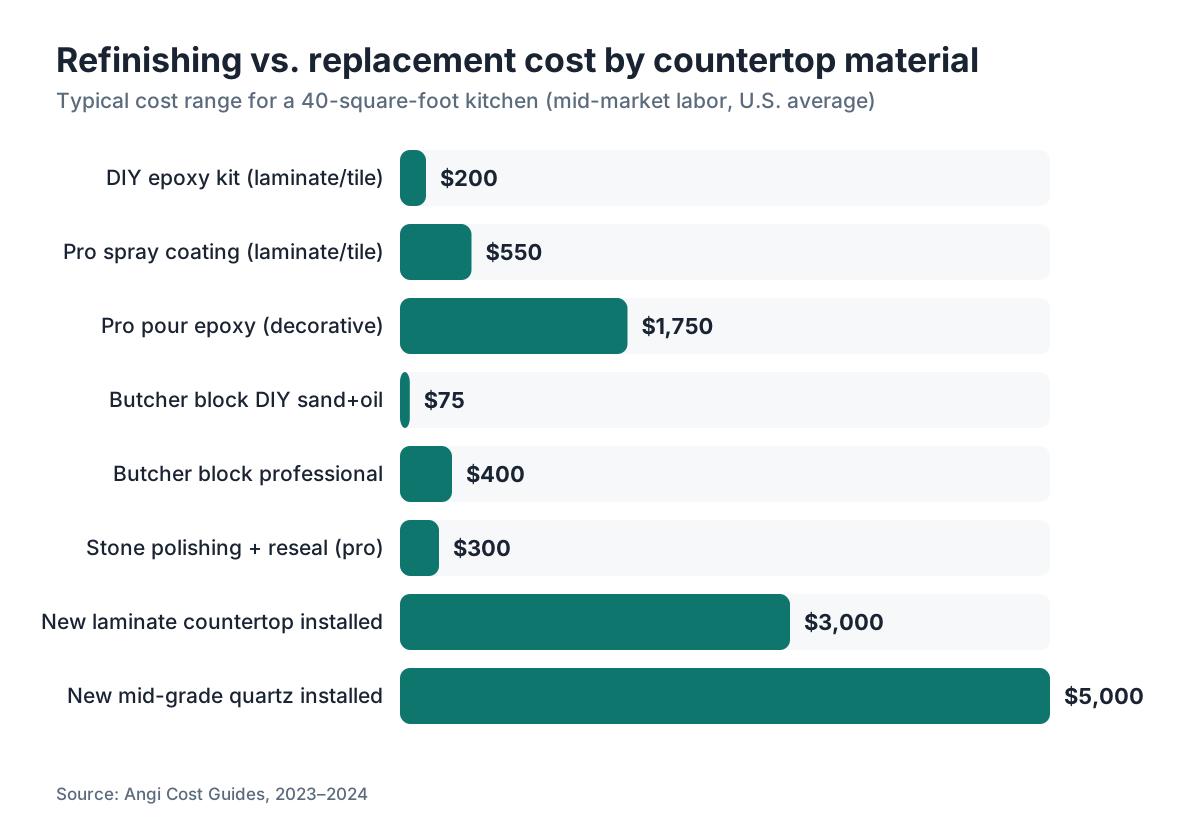
DIY epoxy or acrylic coating kits: $70, $300 for a standard kitchen (roughly 30 to 50 square feet of countertop). Rust-Oleum's Countertop Transformations kit retails around $70, $100 at home centers for a small kitchen. Higher-end pour-on epoxy systems like Stone Coat Countertops run $150, $400 depending on coverage needed. Add $50, $100 for tools, tape, and prep supplies if you don't have them.
Professional spray or spray-and-roll coating: $300, $800 for a typical kitchen. Professional contractors use industrial two-part urethane or epoxy systems not available at retail. Labor is the main cost.
Professional stone polishing or honing: $4, $10 per square foot on average, according to contractor pricing surveys, so a 40-square-foot kitchen runs $160, $400 [1]. Resealing granite or marble professionally runs $2, $5 per square foot.
Butcher block sanding and refinishing: $200, $600 professional, or roughly $50, $100 DIY if you already own or rent a random orbital sander.
High-end professional epoxy countertop coating (full pour with color mixing and metallic effects): $1,000, $2,500 for a kitchen, and some contractors charge more in high-cost markets.
For reference, full countertop replacement in mid-range laminate runs $1,500, $4,500 installed for a typical kitchen [2]. That gap is why refinishing is tempting. But factor in longevity. A quality replacement will last 15 to 25 years. A refinished surface lasts 2 to 10 years before you're back at the decision again.
How long do refinished countertops last?
Durability varies a lot by method and how hard you use the kitchen. Here are honest ranges based on what contractors report:
DIY epoxy coating kits: 2 to 5 years with careful use. These coatings scratch and chip more easily than factory-applied laminate surfaces. Heat is their enemy. Set a hot pan on a DIY-coated counter and you'll see the burn mark.
Professional two-part urethane or epoxy: 5 to 10 years is a reasonable expectation in a normal kitchen. Commercial systems bond better and resist abrasion better than consumer kits. They still aren't impervious to heat.
Butcher block refinishing: the wood itself can last decades if you refinish it every 3 to 5 years when needed. Unlike coatings, wood refinishing is fully renewable, which makes it one of the best long-term values in countertop ownership.
Stone polishing and resealing: polishing results are essentially permanent (the surface is physically changed, not coated). Sealer on granite typically needs refreshing every 1 to 3 years depending on stone porosity [3]. Some denser granites barely need sealing at all.
The honest truth about durability: no refinishing method matches a new countertop made of the same material. If you have 5 more years before a kitchen renovation, refinishing can be a smart bridge. If you plan to stay in the house for 15 years, the math often favors replacement.
What is the DIY epoxy countertop kit process, step by step?
Epoxy kits vary by brand but the core process is consistent. The biggest factor determining success is prep.
Step 1: Clean aggressively. Grease, wax, soap residue, and old sealer all prevent adhesion. Most kits include a degreaser or specify TSP (trisodium phosphate) cleaning. Degrease twice if the surface has years of cooking residue.
Step 2: Sand or abrade the existing surface. You are creating mechanical adhesion. A 120-grit scuff over laminate takes 15 minutes and dramatically improves how the coating holds. Skip this and your kit will peel within months.
Step 3: Repair damage. Fill chips in laminate with wood filler or the kit's patch compound. Refinishing coats do not bridge gaps well, they just follow the surface topography underneath.
Step 4: Tape off everything. Epoxy that gets on cabinet faces, floors, or sinks is very difficult to remove once cured.
Step 5: Mix and apply per instructions. Most consumer kits use a two-part system (resin plus hardener) with a working time of 15 to 45 minutes. You cannot rush curing; temperature and humidity matter. Most manufacturers specify 65 to 80°F and below 60% relative humidity.
Step 6: Optional decorative layers. Some kits let you broadcast colored chips or create a marbled look with tinted swirls before a clear topcoat.
Step 7: Apply the topcoat. This is what determines scratch and stain resistance.
Step 8: Cure time before use. Most consumer epoxy kits require 24 to 72 hours before light use and 7 days before full use (placing heavy objects, using as a cutting surface). Rushing this is the most common DIY mistake.
Realistically: a first-time DIYer should budget a full weekend for a kitchen. The prep alone takes half a day if done properly.
Can you refinish laminate countertops without replacing them?
Yes, and laminate is genuinely the best refinishing candidate of any countertop material. The particleboard or MDF substrate is stable as long as it has not been water-damaged. If your laminate is delaminating (bubbling, peeling at edges, or lifting near the sink), refinishing is a band-aid at best. Fix the cause first or replace.
But if the laminate surface is just worn, scratched, or dated in color, an epoxy or acrylic coating will bond to it reasonably well, especially if you scuff the surface first. The Formica countertops you've had since 1995 that are structurally perfect but ugly brown? Good candidate.
One option people miss: laminate reskinning, where a fabricator applies new laminate over the old surface. This costs $20, $35 per square foot installed, which is more than a coating but still less than a full replacement, and the result is an actual laminate surface with the full durability of new. Ask a local shop if they offer this. Most don't advertise it heavily but will do it.
For homeowners planning to sell in the near term, even a well-done epoxy coating rarely impresses buyers the way new countertops do. A real estate agent's pricing advice on this is worth seeking if resale is the driver.
How do you refinish butcher block countertops?
Butcher block refinishing is one of the more satisfying DIY countertop projects because wood is genuinely forgiving and the results are striking. The process:
Remove everything from the surface. Sand with a random orbital sander: start at 80-grit if there are deep scratches or stains, then 120-grit, then 150-grit or 180-grit to finish. Sand with the grain, not across it, especially on your final passes. If the surface has a polyurethane film finish, you need to remove all of it before applying oil; two different finish systems on the same surface will not coexist.
For food-contact surfaces (anything used as a cutting surface), food-safe oils are required. Mineral oil is the cheap reliable option. Pure tung oil cures harder. Waterlox and other tung oil-based finishes are popular with fabricators and wood countertop suppliers. The FDA considers fully cured tung oil finishes safe for food contact [4].
For a non-food-contact surface or one where you want more durability and gloss, polyurethane is fine. It builds a harder film that resists moisture better.
Apply thin coats. Flood the wood, let it soak in, wipe off excess. Repeat three to five times over several days for an oil finish. For polyurethane, sand lightly between coats with 220-grit.
Once done, a well-oiled butcher block is honestly beautiful and costs you maybe $30, $60 in materials for a standard kitchen counter. You'll need to repeat the oiling every 1 to 3 years depending on use, but that maintenance is quick.
Can professionals refinish granite or marble to remove scratches and etching?
Yes, and this is one of the highest-value professional services in the stone trade. Granite and marble get physically abraded with progressively finer diamond abrasive pads to remove a thin layer of the surface, eliminating etch marks, scratches, and dullness. The process is called honing (which produces a matte finish) or polishing (which produces gloss).
Etch marks on marble are chemical damage, not scratches. An acid (lemon juice, vinegar, wine) reacts with the calcite in the stone and dissolves a tiny amount of the surface. Mechanical polishing removes the damaged layer and restores the surface. This is not a DIY project unless you own professional diamond polishing equipment.
For granite, deep scratches are rare because granite is so hard (typically 6 to 7 on the Mohs scale). What usually needs polishing on granite is just a worn or water-spotted finish that has lost its original factory polish. Professional polishing restores it well.
Resealing is the follow-up step. A good sealer penetrates the stone and slows moisture absorption, which reduces staining risk. The Marble Institute of America notes that sealer does not make stone stain-proof, it just buys you time to wipe up a spill [5]. Most fabricators recommend testing sealer effectiveness with a few drops of water: if it beads, you're fine; if it soaks in within a few minutes, it's time to reseal.
For full care guidance on different stone types, how to clean stone countertops covers the ongoing maintenance picture.
What are the risks and common failures with countertop refinishing?
DIY coating failures are common, and they almost all trace back to the same causes:
Poor adhesion from inadequate prep. The coating peels, often within weeks. There's no fix except stripping and redoing the whole process.
Bubbles in the epoxy. Usually from applying too thick, from air in the mixed product, or from ambient temperature being too cold or warm. Thin coats and proper temperature control prevent this.
Yellowing over time. Many consumer epoxy products yellow with UV exposure. If your countertops get direct sun, use a UV-resistant topcoat or expect discoloration in sunny areas.
Heat damage. No coating on the market withstands a hot pan the way real stone or even factory laminate does. A cast iron skillet fresh off the stove will damage virtually any refinished surface.
Mismatched color expectations. Epoxy kits vary widely in how realistic their stone looks are. Photographs look different from the in-person reality. Order samples if you can.
For professional work, the main risk is paying for something that fails early. Ask any contractor for references and photos of 2-to-3-year-old jobs, more than fresh installations. Fresh epoxy always looks good. What matters is how it ages.
One honest observation: in high-traffic kitchens with multiple cooks, heavy cutting, or frequent hot pan use, refinished surfaces rarely last as long as manufacturer claims. These coatings are built for light to moderate residential use.
When does refinishing make financial sense versus replacing countertops?
Run this comparison clearly before deciding:
If your countertops have structural damage (delaminating laminate, rotted butcher block, cracked stone, water-damaged substrate), refinishing is not the answer. The underlying damage will telegraph through any coating and the work will fail early.
If your kitchen is dated and you plan to sell the house in 1 to 3 years, replacement with mid-range material usually delivers better return on investment than refinishing. A National Association of Realtors report found that minor kitchen remodels recoup roughly 77% of cost at resale on average, with new countertops often cited by agents as one of the highest-visibility upgrades [6].
If you plan to renovate the full kitchen in 3 to 7 years and just want the counters to look decent in the meantime, a $200, $600 refinish job buys you that time. This is where refinishing earns its keep: as a bridge strategy.
If you're renting and want to upgrade your space without a major investment, a DIY kit (with landlord permission) is one of the more reversible investments, though stripping a coating cleanly can be difficult.
For a shop or fabricator thinking about offering refinishing as a service, the economics are thin unless you have a coating applicator trained in two-part systems and efficient job sequencing. Fabricators typically earn better margins on full installs. SlabWise's quoting tools can help shops accurately price small refinishing or stone polishing jobs alongside full slab replacements, keeping margins clear.
For full replacement pricing context and material comparisons, kitchen countertops and countertop installation cover what you'd be comparing against.
What products and brands are commonly used for countertop refinishing?
A few product categories dominate the market:
Consumer epoxy kits: Rust-Oleum Countertop Transformations (chip system, widely available at home centers), Rust-Oleum RockSolid (pour-on epoxy), Stone Coat Countertops (pour-on with strong DIY community), Leggari Products. All are two-part systems. Prices range from $70 to $400 depending on kit size and system.
Professional-grade coatings: Many professional contractors use Tnemec, Sherwin-Williams industrial coatings, or Napco/Rhino-based systems. These are not available at retail and require professional mixing ratios.
Countertop paint (not epoxy): Rust-Oleum Countertop Paint is a water-based product that applies much like regular paint. It's easier to apply than epoxy but less durable. Good for low-traffic bathrooms, not recommended for heavy kitchen use.
Butcher block finishes: Howard Products butcher block conditioner, Waterlox Original, General Finishes Salad Bowl Finish, pure food-grade mineral oil. These are all available at hardware stores and online.
Stone polishing and sealing: Tenax Marble Polishing Powder, Miracle Sealants 511 Impregnator, Aqua Mix Sealer's Choice Gold are widely used by stone professionals. These are not DIY refinishing products in the same sense, they're maintenance products.
For Corian countertops and other solid surface materials, DuPont and Corian-certified fabricators can sand and buff them without any coating at all, which is the cleanest approach.
How do you prepare countertops before refinishing?
Prep is where most DIY refinishing jobs succeed or fail. Budget at least half your total project time on this step.
Clean: Use a dedicated degreaser, not dish soap. Dish soap leaves a residue that interferes with adhesion. TSP (trisodium phosphate) is a traditional pre-paint cleaner that works well [7]. Some refinishing kits include a proprietary cleaner; use it.
Abrade: For laminate or tile, mechanical scuffing with 120-grit sandpaper creates tooth for the coating. You are not trying to sand through the surface, just roughen it slightly. A random orbital sander makes this fast. For stone, professional diamond abrasives are used, not household sandpaper.
Repair: Fill chips, cracks, and gaps. Laminate patching compounds are available; some kits include filler. If a laminate seam is lifting, press and re-glue it with contact cement before coating.
Protect: Tape off sinks, backsplash tile, cabinet faces, floors. Use canvas drop cloths, not plastic, under work areas. Epoxy drips are nearly impossible to remove from flooring once cured.
Dry time: The surface must be completely dry before coating. Even a slightly damp surface will cause adhesion failure. If you have a sink, remove the caulk around the sink perimeter and let it dry for a day.
Temperature and humidity: Check the kit's specifications. Most require 65 to 85°F and under 85% relative humidity. Cold or humid conditions dramatically affect curing and adhesion.
Are there alternatives to refinishing that are worth considering?
Before committing to a refinishing project, consider a few options that often get overlooked:
Overlay tiles or contact paper: Peel-and-stick countertop overlays and thick contact papers have improved dramatically. They're not durable, but for a rental or a 1-year bridge solution they cost $1, $3 per square foot and can look reasonable. Durability is 1 to 3 years with careful handling.
Newly manufactured laminate reskinning: As mentioned above, a fabricator can laminate over existing laminate in many cases. The result is a real laminate surface. Cost is $20, $35 per square foot installed, compared to $40, $80 or more for a full natural stone replacement.
New countertops altogether: If your cabinets are solid and the kitchen layout works, new countertops are often worth the jump. Laminate countertops have improved enormously in texture and realism. Modern high-definition laminate from brands like Formica and Wilsonart can pass for stone in many settings. Cambria countertops and other engineered quartz products offer durability that no coating can match.
For specific material questions, see the guides on how to clean quartzite countertops and how to clean soapstone countertops, which cover what ongoing maintenance actually looks like for natural stone surfaces you might be considering as replacements.
If you get quotes for both refinishing and replacement, SlabWise's instant quote tool can help you compare what new stone countertops would actually cost from local fabricators, giving you a real number for the comparison.
Frequently asked questions
How long does a DIY epoxy countertop refinishing job last?
Consumer epoxy coating kits typically last 2 to 5 years in a normal kitchen with careful use. Durability drops significantly with heavy heat exposure, abrasive cleaning, or aggressive chopping directly on the surface. Professional two-part systems applied by contractors can last 5 to 10 years. No coating matches the durability of the original factory surface or a new countertop.
Can you refinish countertops without sanding?
Technically yes, but results are poor. Adhesion is the main reason refinishing fails, and abrasion creates the mechanical grip that holds coatings. Skipping sanding is the most common cause of early peeling. Some kits market themselves as sand-free, but independent reviews consistently show better longevity with even a light 120-grit scuff before application.
How do you refinish countertops around a sink?
The sink area is the hardest part. Remove all old caulk from around the sink perimeter and let the surface dry completely for at least 24 hours. Tape off the sink carefully. Apply the coating up to the sink edge but not over it. Once fully cured (usually 7 days), re-caulk with a silicone rated for kitchen use. Skipping the drying step causes adhesion failure right at the seam.
What is the best countertop refinishing kit for laminate?
Rust-Oleum Countertop Transformations is the most widely used consumer kit for laminate and has the broadest color library. Stone Coat Countertops has a stronger enthusiast community and allows more creative effects. Both require thorough prep for good results. For the most durable outcome on laminate, a professional contractor using an industrial two-part urethane is better than any consumer kit.
Can you refinish tile countertops?
Yes, though prep is harder. The main challenge is getting epoxy to bond to both the tile glaze and the grout lines, which have very different surface energies. You must abrade all tile surfaces, degrease thoroughly, and accept that grout lines will remain visible as a slight texture variation. Results look reasonable and can last 3 to 6 years professionally. DIY tile refinishing is hit-or-miss.
Can granite countertops be refinished or polished back to new?
Yes. Professional diamond honing and polishing physically removes a thin layer of the stone surface, eliminating scratches and restoring gloss. Cost runs $4, $10 per square foot. This is a stone-specific professional service, not a coating job. After polishing, a fresh penetrating sealer is applied. Results are excellent and this is genuinely worth doing on good-quality granite rather than replacing it.
How long does countertop refinishing take from start to finish?
A DIY epoxy project takes one full weekend: a day for prep and first coats, a day for additional coats and detail work, then 24 to 72 hours before light use and 7 days before full use. Professional coating jobs are typically done in 1 to 2 days of shop time plus a 3 to 7 day cure wait. Stone polishing by a professional usually completes in a few hours per kitchen.
Does refinishing countertops increase home value?
Minimally, and primarily by raising perceived cleanliness rather than appraised value. Buyers and appraisers generally treat refinished countertops the same as original worn surfaces; neither scores as 'updated.' If resale value is the goal, new countertops in an appropriate material typically add more perceived value than any refinishing approach, though you'll spend more.
Can you refinish countertops yourself if they have burns or deep scratches?
Burns and deep scratches can be partially addressed but not fully hidden. For laminate, sand burns and deep damage with 80-grit, fill with laminate repair compound, sand smooth, then coat. The area will be sealed but may show texture variation. For wood, sanding removes most burns. For stone, professional diamond honing removes surface scratches. Deep cracks in stone require epoxy fill by a fabricator, not a coating.
Is countertop refinishing safe? Are the fumes dangerous?
Two-part epoxy and urethane systems have significant VOC (volatile organic compound) levels during application and curing. Ventilate thoroughly: open windows, run fans, leave the kitchen during curing. The EPA classifies some epoxy hardeners as respiratory sensitizers [8]. DIYers should wear a respirator rated for organic vapors, more than a dust mask. Once fully cured (7 days for most systems), the surface is considered inert.
How do you maintain refinished countertops to make them last longer?
Use a pH-neutral cleaner, never abrasive scrubbers or acidic cleaners like vinegar. Always use trivets for hot pans; heat is the number one cause of early failure. Use cutting boards; knives will scratch the coating. Wipe spills quickly, especially oils. Reapply a compatible topcoat if the surface shows dull spots. Most manufacturers offer a maintenance topcoat that extends life by 1 to 2 years when applied at year 3 or 4.
What's the difference between refinishing and resurfacing countertops?
These terms are often used interchangeably, which causes confusion. Refinishing typically means applying a new coating or finish to the existing surface. Resurfacing can mean the same thing, or it can mean bonding a physical new layer (new laminate skin, concrete overlay, thin stone veneer) over the existing substrate. Resurfacing tends to be more durable and more expensive than coating-based refinishing.
Can you put epoxy over Corian or other solid surface countertops?
You can, but you probably shouldn't. Solid surface like Corian can be sanded and buffed back to new by a fabricator at relatively low cost, which produces a result that looks and functions like the original material. Coating it with epoxy buries that advantage and gives you a less durable surface. If the Corian is badly damaged beyond repair, a certified fabricator can often join replacement sections with a barely visible seam.
Sources
- HomeAdvisor (Angi), Stone Countertop Polishing Cost Guide: Professional stone polishing and honing runs $4, $10 per square foot on average
- HomeAdvisor (Angi), Countertop Installation Cost Guide: Full countertop replacement in mid-range laminate runs $1,500, $4,500 installed for a typical kitchen
- Marble Institute of America, Care and Maintenance of Natural Stone: Sealer on granite typically needs refreshing every 1 to 3 years depending on stone porosity
- U.S. Food and Drug Administration, Code of Federal Regulations Title 21, Sec. 175.300 (Resinous and polymeric coatings): Fully cured tung oil-based finishes are considered safe for food contact under FDA regulations
- Marble Institute of America, Sealing Natural Stone: Sealer does not make stone stain-proof; it slows moisture absorption to give time to wipe up spills
- National Association of Realtors, 2022 Remodeling Impact Report: Minor kitchen remodels recoup roughly 77% of cost at resale on average
- U.S. Environmental Protection Agency, Safer Choice: Trisodium Phosphate: TSP (trisodium phosphate) is a traditional pre-paint cleaner effective for surface degreasing
- U.S. Environmental Protection Agency, Epoxy Resins: Chemical Hazard Summary: The EPA classifies some epoxy hardeners as respiratory sensitizers requiring organic vapor respirator protection
- U.S. Consumer Product Safety Commission, Indoor Air Quality and VOC Emissions: Two-part epoxy and urethane systems emit significant VOCs during application and curing, requiring ventilation
- USDA Forest Products Laboratory, Wood Handbook: Wood as an Engineering Material (Chapter on Wood Finishing): Food-grade mineral oil and pure tung oil are appropriate penetrating finishes for wood food-contact surfaces
Last updated 2026-07-09