TL;DR
- Cambria is American-made engineered quartz.
- Installed, it runs roughly $60 to $110 per square foot depending on the design tier and your local labor market.
- The surface is non-porous, never needs sealing, and carries a lifetime warranty to the original owner.
- It holds up well day to day but costs more than generic quartz and far more than laminate.
What exactly is Cambria, and how is it different from other quartz?
Cambria is a family-owned American company in Le Sueur, Minnesota, and it makes every one of its quartz surfaces at a single plant in that state [1]. That's rare here. Most competing brands pull slabs from factories in China, India, or Spain.
The product is engineered quartz: roughly 93 percent ground natural quartz crystals held together with polymer resins and pigments, then pressed under heat and pressure into slabs [2]. The mix shifts a little brand to brand, but Cambria's 93 percent quartz content matches the standard formulation used by Silestone, Caesarstone, and MSI Q.
What actually separates Cambria from commodity quartz is a few things stacked together. The design library runs past 200 patterns, and several of them copy marble veining at a level of detail cheaper quartz doesn't reach. Cambria also sells only through authorized fabricators and dealers, so you can't grab a slab at a big-box store and hand it to a friend with a wet saw. That controlled distribution protects fabricator margins and gives Cambria tighter quality oversight. It also leaves you with fewer install options than generic engineered stone.
Cambria is NSF/ANSI 51 certified for food safety [9], which matters in a kitchen. NSF describes the standard as covering "materials used in the construction of commercial food equipment." The non-porous surface won't harbor bacteria the way unsealed natural stone can.
How much do Cambria countertops cost?
Installed, plan on $60 to $110 per square foot for Cambria in most U.S. markets [3]. That's a wide spread, and a few variables drive it.
Design tier moves the number most. Cambria sorts patterns into lines that roughly track price. Solid or low-movement designs sit at the bottom. The large-format, heavy-veined designs (Brittanicca Gold, Skara Brae) sit at the top. A plain design like Swanbridge might land near $65 installed. A statement pattern like Ironsbridge can push $105 or more.
Fabricator markup and your local labor market matter too. Shops in expensive metros (New York, San Francisco, Chicago) charge more for labor and overhead than shops in smaller markets. Edge profiles add cost: a standard eased or beveled edge is usually included, but a thick mitered waterfall or an ogee can add $15 to $25 per linear foot.
A typical 50-square-foot kitchen runs $3,000 to $5,500 installed. An 80-square-foot kitchen runs $4,800 to $8,800.
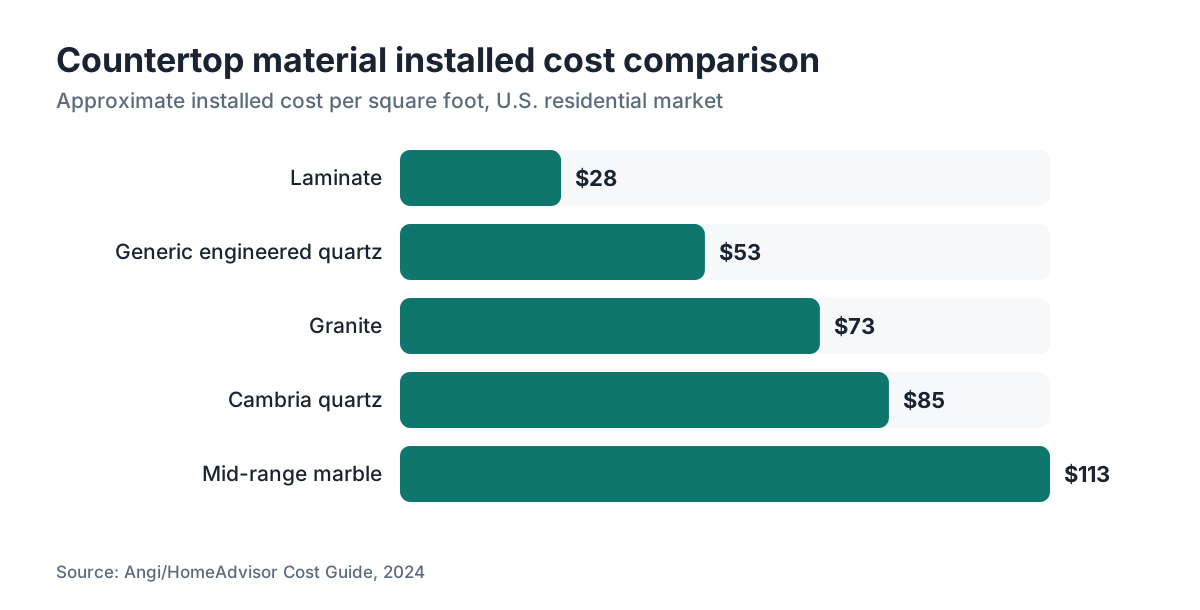
That's well above generic engineered quartz from a fabricator's remnant bin ($40 to $65 installed) or laminate countertops at $15 to $40 installed [4]. It lands near mid-range marble countertops, though top-shelf Italian marble climbs higher.
| Material | Installed cost range (per sq ft) |
|---|---|
| Laminate | $15, $40 |
| Generic engineered quartz | $40, $65 |
| Cambria quartz | $60, $110 |
| Mid-range marble | $75, $150 |
| Granite (fabricated) | $45, $100 |
Sources: Angi/HomeAdvisor cost data [3] and Cambria dealer pricing surveys.
Is Cambria actually more durable than other countertop materials?
On the numbers that matter in a kitchen, engineered quartz including Cambria does well. The material scores 7 on the Mohs hardness scale, against granite at 6 to 7 and marble at 3 to 4 [2]. That hardness means dragging cast iron, sliding ceramic plates, and dropping utensils won't scratch it under normal use.
The non-porous structure is the other main claim. Marble and unsealed granite soak up liquids once the sealer wears off, which leads to staining and possible bacterial growth. Quartz needs no sealing and won't stain from wine, coffee, or acidic foods the way marble does. Cambria points to its NSF certification here [9].
Two real weaknesses you should know before you buy.
Heat is the first. The polymer resin binder can discolor or crack under sustained direct heat. Cambria's care guidelines say to keep hot pots and pans off the surface [1]. That's a limit compared to granite countertops, which take heat far better because they're pure stone with no resin.
UV is the second. Resin-bound quartz can fade or yellow over time under direct sun. Cambria warns against outdoor use, and even an indoor spot by a south-facing window with long sun exposure can shift the color on some patterns. If your kitchen gets a lot of direct sun, ask your fabricator which patterns have held up in their local installs.
Impact resistance is good, not bulletproof. A hard enough blow to an unsupported edge or corner can chip it. Repairs are doable but visible up close.
What does Cambria's lifetime warranty actually cover?
Cambria offers a lifetime warranty to the original purchaser, and it's one of the stronger warranties in engineered stone [1]. It covers defects in manufacturing and material under normal residential use.
It does not cover damage from misuse. That includes thermal shock from hot pots, chips from impacts, damage from bad installation, or staining from chemical exposure (paint stripper, oven cleaner, high-pH drain cleaners). It also doesn't transfer to a new owner if you sell, which matters if you're a flipper or you plan to move within a few years.
Claims go through Cambria's customer service directly, not the fabricator. That's different from most natural stone, where there's no manufacturer warranty at all. The upshot is simple: Cambria has reputational skin in the game on every slab it ships.
For fabricators, coverage depends on installing to Cambria's published guidelines, including span and support requirements. An install that violates those specs and then fails won't be covered, and the fabricator may end up holding the liability.
How do you clean and maintain Cambria countertops?
Cleaning Cambria is easier than maintaining most natural stone. Daily, warm water and a mild dish soap on a soft cloth does it [1]. No stone cleaners, no sealing, no oiling.
For tougher residue like dried food or light scale, a non-abrasive cleaner (Cambria pushes its own branded cleaner, but any pH-neutral surface cleaner works) and a plastic scraper are fine. Skip anything abrasive: scrubbing pads with a rough side, steel wool, powdered cleansers. Those dull the polished surface.
Keep these off the counter: nail polish remover (acetone), paint removers, oven cleaners, and anything with methylene chloride. They attack the resin and cause permanent damage.
The no-sealing rule saves real time and money over a countertop's life. Granite and quartzite need resealing every one to three years depending on use and the stone [6]. Marble asks for more. For the natural stone side of this, how to clean stone countertops covers it well.
One thing catches people off guard. A polished Cambria finish shows fingerprints and water spots more than honed or matte finishes do. If you run a busy kitchen with kids, think about whether standard polished is what you want, or whether a matte Cambria finish (available on some designs) fits your day better.
How does Cambria compare to other quartz brands like Silestone and Caesarstone?
Cambria, Silestone, and Caesarstone are the three most-specified premium engineered quartz brands in U.S. homes. They use similar formulations and perform about the same under normal use, but the differences are real.
Origin is the clearest one. Cambria is made in Minnesota [1]. Silestone is made by Cosentino in Spain, with a U.S. distribution network [10]. Caesarstone runs plants in the U.S. (Georgia), Israel, and India [7]. If domestic manufacturing matters to you or your clients, Cambria is the only fully American-made option.
Design depth varies. Cambria's catalog is strong in the marble-look category and has grown fast. Silestone's N-Boost surface treatment gives a slightly different texture and depth. Caesarstone leans restrained and design-forward, which suits contemporary kitchens.
Warranty terms track close across all three: lifetime for residential use, limited to the original purchaser, with the usual carve-outs for misuse.
Retail price is roughly comparable. In practice, which brand your local fabricator stocks and has a dealer relationship with drives the comparison more than any catalog spec. A shop that moves a lot of Cambria will price it sharply. One that rarely runs Cambria jobs may tack on a margin.
For fabricators running quoting software, the operational difference is slab size. Cambria slabs run up to 132 inches by 65.5 inches (about 56 square feet) on standard designs, and 132 by 132 inches on some jumbo formats. Nesting software that reads slab dimensions accurately cuts real waste on Cambria jobs. SlabWise handles Cambria slab sizes natively in its quoting and nesting tools.
Granite countertops and marble countertops are the natural stone alternatives people weigh most against Cambria. Both trade more maintenance for more visual uniqueness, since every natural slab is one of a kind.
Is Cambria quartz worth the premium over generic engineered quartz?
Honest answer: for a lot of homeowners, yes, but not for the reasons they expect.
The durability gap between Cambria and a mid-tier quartz brand (say, MSI Q or Viatera) is thin in normal residential use. Both are 93 percent quartz. Both are non-porous. Both carry lifetime warranties. The material science is close enough that performance claims shouldn't carry the price.
Where Cambria earns the premium is design consistency and support. Its quality control on veining and pattern is tight. When you order two slabs for a big island and want the veining to match, Cambria makes that easier than pulling from a commodity yard where every slab is a loose take on a color. The company also runs a slab reservation program through authorized dealers, so you can hold specific slabs that match.
The warranty backstop is real value. With a generic engineered stone brand, warranty claims often stall because the importer or distributor has limited accountability. Cambria is a direct manufacturer with the scale and brand equity to honor claims.
For a budget kitchen where someone is comparing Cambria to laminate countertops or Formica countertops, a $50-per-square-foot gap is hard to close with design and warranty arguments alone. That's a real $2,500 difference on a 50-square-foot kitchen. If money is tight, there are good quartz options at lower price points.
For a full remodel where countertops are 10 to 15 percent of the total project cost, the Cambria premium is easy to justify. The surface stays put for 20 or 30 years, the upkeep is close to nothing, and the visual quality is genuinely good.
What are the most popular Cambria kitchen designs right now?
Cambria doesn't publish sales data by design, so any "most popular" list is anecdotal. Fabricators and designers keep naming the same cluster of designs that move well in kitchens.
Brittanicca and Brittanicca Gold are probably the most referenced in design media. They copy Calacatta marble with white or warm-white backgrounds and dramatic gold or gray veining. They show up heavily in transitional and contemporary kitchens.
Skara Brae is a frequent pick for a dark, dramatic kitchen without going to actual black granite. Deep charcoal background, subtle movement.
Swanbridge and Ella are entry-tier designs. Simpler patterns that work for budget-conscious projects or secondary surfaces where a strong visual statement isn't the point.
For a quieter natural stone look, Inverness (white with thin soft gray veining) reads almost like a quartzite and has been popular in farmhouse and transitional kitchens.
Cambria releases new designs regularly, so the catalog keeps moving. Check with your local authorized dealer or Cambria's website for current offerings and local stock, since availability shifts by region.
From a fabrication standpoint, the large-format veining on statement designs like Brittanicca Gold or Skara Brae needs careful template and layout planning. Bookmatch effects aren't native to manufactured quartz the way they are to natural stone, but planning the layout to keep veining consistent across joints is worth the extra templating time.
How does the fabrication and installation process work for Cambria?
Cambria goes through the same steps as any engineered stone: template, cut, edge, polish, install. The material cuts and polishes with the same diamond tooling used for other quartz, and its density wears tooling about the same as other high-quartz products.
Because Cambria sells only through authorized fabricators and dealers, your install has to go through an approved shop. Find one through Cambria's dealer locator. The authorization process makes fabricators complete training and meet minimum standards, which sets a quality baseline.
Template digitally. For a countertop installation with complex corners, integrated sinks, or decorative edge profiles, a laser or structured-light template cuts the risk of remakes, and remakes are expensive on Cambria. A wasted Cambria slab is a $500 to $1,000 hit.
For fabricators who want a clean quoting workflow on Cambria jobs, getting slab dimensions and pricing into your estimating system accurately is the starting point. SlabWise's quoting module supports custom slab sizes and pricing tiers, which maps well to how Cambria's design tiers price. That cuts the back-and-forth between estimating and the shop floor.
Weight is comparable to natural stone: Cambria at 3 centimeter thickness runs about 18 to 20 pounds per square foot [2]. Standard cabinet construction handles that without modification for most kitchens, but confirm cabinet box condition before installing over old or damaged cabinetry.
Seam placement deserves attention on complex veined designs. On marble, seams on high-movement material are expected and accepted. On engineered quartz, clients expect near-invisible seams, which takes good placement and color-matched epoxy.
What should homeowners ask before buying Cambria?
A few questions save headaches later.
Is my fabricator actually Cambria-authorized? This matters for warranty validity and for getting genuine Cambria material, not a knockoff with a similar pattern name. Verify authorization on Cambria's dealer locator [1].
Can I see the actual slabs I'm buying? Samples and website photos are approximations. Natural variation in the raw quartz means two slabs of the same design can differ in background tone and vein intensity. Ask to see and approve the specific slabs before fabrication starts.
What edge profile is in the quote? Edge profiles swing widely in price. Get clarity on what's included so you're comparing apples to apples across quotes.
What's the fabricator's policy on seam placement? For large kitchens or islands, you'll likely have at least one seam. Ask where it goes and whether you have any say.
What install conditions would void my warranty? Ask directly about span lengths, support requirements, and sink cutout specs. A sink cutout too close to an edge can crack, and Cambria's warranty won't cover that if the install was outside spec.
For homeowners collecting quotes, the most useful comparison is cost per installed square foot with a specific design and edge profile named. Quotes that don't name the design are hard to compare.
How does Cambria compare to natural stone alternatives?
The comparison that comes up most is Cambria versus marble, specifically the white marbles like Carrara or Calacatta that Cambria's designs reference.
Marble is softer (Mohs 3 to 4 versus quartz's 7), etches on contact with acids (lemon juice, wine, coffee), and needs regular sealing [6]. Cambria doesn't etch or stain under normal kitchen conditions. If you want the marble look without the maintenance, Cambria Brittanicca is a reasonable stand-in, though purists will tell you the visual depth of real marble is unmatched.
Granite is a closer durability match. It's harder than marble, takes heat better than quartz, and every slab is genuinely unique. The downsides: granite is porous and needs periodic sealing, and the current market has moved away from the heavy visual patterns you saw in older granite installs. For the maintenance side in detail, how to clean quartzite countertops gives a good model for the upkeep natural stone needs.
Quartzite (not quartz) is natural stone with high silica content that looks like marble but runs harder and more durable. It's become a popular premium alternative to both marble and engineered quartz. On price it sits in the same range as Cambria or higher.
Butcher block countertops sometimes pair with Cambria in the same kitchen: butcher block on the island, Cambria on perimeter runs, adding warmth while keeping a low-maintenance primary surface.
Corian countertops and other solid surface materials cost a lot less and repair more easily (scratches sand out), but they feel different under your hand and don't carry the visual weight of stone.
For a broader kitchen countertops comparison across every material category, the variables that usually decide it are maintenance tolerance, visual preference, and budget, in roughly that order for most households.
Frequently asked questions
Does Cambria need to be sealed?
No. Cambria is non-porous engineered quartz and never needs sealing. That's a direct edge over granite, marble, and quartzite, all of which need periodic resealing to prevent staining. You clean Cambria with soap and water, and that's genuinely the full maintenance routine for most kitchens.
Can you cut directly on Cambria countertops?
The material is hard enough to resist scratching from knives, but cutting directly on any quartz or stone dulls your blades fast. Cambria's own care guidelines recommend a cutting board. The surface won't show immediate damage from occasional cutting, but repeated direct cutting can eventually leave fine marks on the polished finish.
Can you put hot pots and pans on Cambria?
No. Cambria's polymer resin binder can discolor or crack under sudden or sustained heat, a problem called thermal shock. The company explicitly advises against placing hot cookware directly on the surface. Always use a trivet or hot pad. This is a real limit compared to granite, which takes heat without damage because it contains no resin.
How long does Cambria last in a kitchen?
Under normal residential use, Cambria should last the life of the home without meaningful degradation. It won't corrode, rust, or need structural maintenance. The main risks to longevity are thermal shock damage (hot pots), impact chipping on edges, and UV fading from long direct sun. None are likely with normal care, and Cambria backs residential installs with a lifetime warranty.
Is Cambria made in the USA?
Yes. Cambria is manufactured entirely at a facility in Le Sueur, Minnesota, making it the only major quartz countertop brand that is fully American-made. The parent company is family-owned. Competing brands like Silestone (Spain) and Caesarstone (Israel, India, and the U.S.) make at least some of their product outside the country.
What thickness does Cambria come in?
Cambria comes in 2 centimeter (about 3/4 inch) and 3 centimeter (about 1-1/4 inch) thicknesses. Three centimeter is the residential standard for countertops; it's structurally sound across typical spans without a plywood substrate. Two centimeter slabs are thinner and lighter, used for things like furniture or vertical surfaces, but they need a full plywood backer as a horizontal countertop.
Does Cambria add value to a home?
Stone and quartz countertops generally recoup a meaningful part of their cost at resale, though the exact return depends heavily on local market expectations. In markets where buyers expect stone surfaces, moving from laminate to quartz can lift the sale price. Remodeling Magazine's Cost vs. Value data pegs minor kitchen remodels at 72 to 86 percent return in recent years, with countertop quality as a factor [8].
Can Cambria be installed outdoors?
No. Cambria explicitly does not recommend outdoor installation. The polymer resin in engineered quartz is vulnerable to UV degradation, which causes yellowing and surface breakdown over time with direct sun and weather. For an outdoor kitchen surface, natural granite or porcelain slab are better choices.
How do I find a Cambria authorized fabricator near me?
Cambria keeps a dealer and fabricator locator on its official website (cambriasurfaces.com). Buying through an authorized dealer keeps your warranty valid, confirms you're getting genuine Cambria material, and means the fabricator has met Cambria's installation standards. Buying through an unauthorized shop voids the manufacturer warranty.
What's the difference between Cambria and regular quartz countertops?
Cambria is a specific brand of engineered quartz. The base material (roughly 93 percent ground quartz bound in resin) is similar to other quartz brands. What sets Cambria apart is American manufacturing, exclusive dealer distribution, a broad catalog with strong marble-look options, and a manufacturer-backed lifetime warranty. Generic quartz is often cheaper and may perform comparably, but with less design consistency and weaker warranty support.
Can Cambria countertops chip or crack?
Yes, under the right conditions. Cambria is hard and impact-resistant under normal use, but a heavy direct blow to an edge or corner can chip it. Unsupported spans that run too long can crack over time, especially around sink cutouts. Thermal shock from hot pots is the other cracking risk. Chips can be repaired with color-matched epoxy by a stone restoration pro, but the repair is visible up close on polished surfaces.
How do I get an accurate quote for Cambria countertops?
Start with measured square footage of your countertop run (length times depth of each section, added together). Then pick the specific Cambria design and thickness, since pricing varies by design tier. Get at least two quotes from authorized fabricators with the same design, edge profile, and sink cutout specs named. Quotes that just say 'Cambria quartz' aren't comparable. For a fast ballpark before contacting fabricators, online instant quote tools can give a range based on square footage and material tier.
Does Cambria stain from coffee or wine?
Under normal conditions, no. Cambria's non-porous surface resists liquid penetration, so coffee, red wine, and acidic foods don't absorb the way they would into unsealed marble or granite. Wiping up spills promptly is still good practice. Prolonged exposure to strong pigments (turmeric, concentrated dyes) combined with surface micro-abrasion could theoretically leave a tint, but that's rare with a well-maintained polished surface.
Is Cambria quartz or quartzite?
Cambria is engineered quartz, not quartzite. Quartzite is a natural metamorphic rock mined from the earth, and it needs sealing and more careful maintenance. Engineered quartz like Cambria is a manufactured product made from ground quartz crystals and polymer resin. The two look similar in some patterns but have different maintenance requirements, pricing, and performance.
Sources
- Minnesota Department of Employment and Economic Development, Minnesota manufacturers directory: Cambria is a Minnesota-based, family-owned manufacturer producing engineered quartz surfaces at a facility in Le Sueur, Minnesota; care guidance advises against direct heat and outdoor use, with a lifetime warranty to the original purchaser.
- U.S. Geological Survey, National Minerals Information Center: Engineered quartz products use approximately 93 percent ground natural quartz crystals; quartz scores 7 on the Mohs hardness scale. 3 cm quartz slabs weigh approximately 18 to 20 lbs per square foot.
- Angi (formerly HomeAdvisor), Countertop Installation Cost Guide: Installed Cambria quartz countertops range from approximately $60 to $110 per square foot; installed laminate ranges from $15 to $40 per square foot.
- HomeAdvisor, Laminate Countertop Cost Guide: Laminate countertop installation costs $15 to $40 per square foot installed in most U.S. markets.
- University of Minnesota Extension: Natural stone countertops including granite and quartzite require resealing every one to three years depending on use and porosity.
- Caesarstone, Company Overview and Manufacturing Locations: Caesarstone manufactures quartz surfaces in Israel, the United States (Georgia), and India.
- Remodeling Magazine, Cost vs. Value Report: Minor kitchen remodels returned 72 to 86 percent of project cost at resale in recent reports, with surface material quality as a contributing factor.
- NSF International, NSF/ANSI 51 Food Equipment Materials Standard: NSF/ANSI 51 covers materials used in the construction of commercial food equipment and confirms a surface material is safe for contact with food; Cambria quartz holds this certification.
- Cosentino (Silestone), Silestone Product Overview: Silestone is manufactured by Cosentino in Spain and distributed through authorized dealers in the U.S.
Last updated 2026-07-10