TL;DR
- Concrete kitchen countertops cost $65, $135 per square foot installed by a professional, or $10, $25 per square foot in materials if you pour them yourself.
- They're durable, fully custom, and heat-resistant, but they need sealing every 1 to 3 years and will crack without proper reinforcement and curing.
- This guide covers cost, construction, sealing, DIY feasibility, and how concrete compares to stone.
What are concrete kitchen countertops?
Concrete countertops are cast slabs made from portland cement, sand, aggregate, and water, formed in molds and cured before installation. They're not the gray sidewalk stuff people picture. A fabricator controls the mix design, pigment loading, fiber or rebar reinforcement, and finishing method, so the end product can look anywhere from raw industrial to polished near-stone.
The material has been used in residential kitchens since at least the 1980s, when designer Fu-Tung Cheng popularized the technique in the San Francisco Bay Area and eventually published a book on the craft [1]. Since then it's gone from niche art-project to a recognized option you'll find in fabricator price lists alongside quartz and granite.
Concrete countertops come in two forms: cast-in-place (poured directly onto the cabinets) and precast (poured in a shop mold, cured fully, then installed). Most professionals prefer precast because shop conditions are controlled, but cast-in-place is the method most DIYers use because moving a 200-pound precast slab without cracking it is genuinely hard.
If you're weighing all your kitchen countertops options before committing, concrete sits in an unusual niche: it's one of the few materials that's highly custom by nature and workable by skilled homeowners, but it has real maintenance requirements that easier surfaces don't.
How much do concrete countertops cost?
Professional installation of concrete countertops runs roughly $65, $135 per square foot, with most kitchens landing in the $75, $100 range depending on complexity, region, and the fabricator's mix design [2]. A typical 40-square-foot kitchen countertop project sits at $3,000, $5,400 fully installed. Custom integral sinks, decorative edge profiles, inlaid objects, and extensive color work push the number higher.
That price breaks down roughly like this:
| Cost component | Estimated share of total |
|---|---|
| Materials (cement, aggregate, pigment, sealer) | 20 to 30% |
| Labor (forming, pouring, finishing, sealing) | 50 to 60% |
| Template / design / delivery | 10 to 15% |
| Overhead and profit | 10 to 15% |
DIY concrete countertops bring the cash outlay way down. Materials for a basic pour run $10, $25 per square foot depending on mix, pigment, and sealer quality [2]. A 40-square-foot kitchen in materials alone is $400, $1,000. That math ignores three real costs though: your time (budget 40 to 80 hours for a first project including mistakes), the rental or purchase of tools, and the risk of a crack or pinhole failure that forces a full redo.
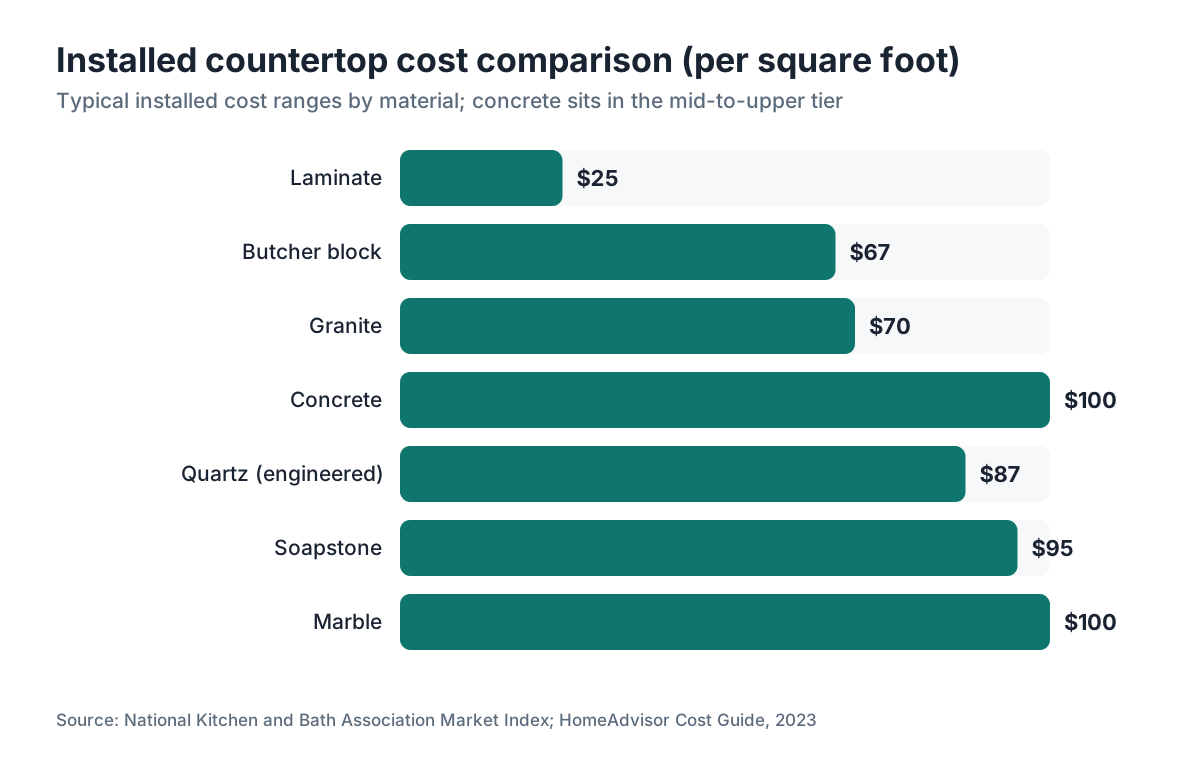
Compared to granite countertops at $40, $100 per square foot installed, or laminate countertops at $10, $40 per square foot, concrete sits in the mid-to-upper tier on price. It offers something neither material does: a completely one-of-a-kind surface you design from scratch.
How durable are concrete countertops in a kitchen?
Concrete is genuinely hard. Compressive strength in a well-made mix runs 5,000 to 7,500 psi, comparable to structural concrete used in bridges [3]. It won't burn, melt, or scratch from ordinary knife use. A properly reinforced slab can last decades.
The failure modes are specific though, and you should know them before you buy.
Cracking is the most common complaint. Concrete shrinks as it cures, and any restraint, uneven support, or thermal shock can cause hairline cracks. Good fabricators use fiber reinforcement (polypropylene or alkali-resistant glass fiber), wire mesh, or rebar, and they design mix water-to-cement ratios carefully to minimize shrinkage [3]. A surface crack in a sealed slab is mostly cosmetic. A through-crack in an unsupported area near a sink cutout is structural.
Staining is the second issue. Concrete is porous and will absorb red wine, coffee, citrus juice, and oil if left unsealed or if the sealer degrades. The sealer is not optional. It's the whole game.
Etching from acids is less severe than on marble countertops because the sealer takes the hit rather than the stone, but an acidic spill sitting for hours on compromised sealer will still dull the finish.
Heat resistance is a real strength. You can set a hot pan on concrete without damaging the surface, which is not something you can say about laminate or most quartz products.
How to make concrete kitchen countertops (step-by-step process)
This is the full process, whether you're hiring a fabricator or doing it yourself. The steps are the same. The skill and equipment requirements are where they differ.
Step 1: Design and templating Measure the countertop footprint precisely, accounting for sink cutouts, range cutouts, overhangs, and any inside or outside corners. For precast work, the template drives the mold. Mistakes here cascade forward. Professional fabricators use digital templates or physical template boards. For DIY concrete countertops, a cardboard template traced onto melamine-coated particleboard is the standard low-cost approach.
Step 2: Build the mold Melamine-faced particleboard is the industry standard for mold-making because concrete doesn't stick to it. The mold is built upside-down: the bottom of the mold becomes the top (show) face of the finished slab. Edge forms define the countertop thickness (typically 1.5 to 2 inches) and edge profile. Sink knockouts go in now. All seams get caulked with silicone to stop cement paste from seeping and creating surface defects.
Step 3: Mix design A basic countertop mix is portland cement, fine sand, and aggregate in roughly a 1:1.5:2 ratio by weight, with a water-to-cement ratio of 0.35 to 0.45 [3]. Lower water means higher strength and less shrinkage, but the mix gets stiffer and harder to consolidate around reinforcement. Pigments (iron oxide is most common) are added to the mix or applied as integral color. Fiber reinforcement goes in during mixing. Many fabricators use admixtures like pozzolans (fly ash, silica fume) to increase density and reduce porosity.
Step 4: Pour and consolidate Pour the mix into the mold in lifts, consolidating each layer with a vibrator or by tapping the mold with a rubber mallet. Air pockets left in the mix show up as pinholes or voids on the finished face. This is the step most DIYers underdo. Lay in any mesh reinforcement halfway through the pour depth.
Step 5: Curing Cover the poured slab with plastic sheeting immediately after screeding. Concrete gains most of its strength in the first 28 days, but for countertop work, a 7-day cure is the practical minimum before demolding and 14 days before sealing [3]. Keep the slab moist and at a stable temperature. Rapid drying causes surface cracking.
Step 6: Demolding and grinding After curing, strip the mold. The bottom face (now the top) gets ground and polished with diamond tooling, starting at a coarse grit (50 to 100) and working up to the desired finish (400 to 800 for a matte hone, 1500 to 3000 for a mirror polish). This step removes the cream layer and exposes aggregate if you want that look.
Step 7: Sealing This is not optional. Unsealed concrete in a kitchen will stain within days. Two sealer families dominate:
| Sealer type | How it works | Reapplication frequency | Notes |
|---|---|---|---|
| Penetrating / impregnator | Fills pores, doesn't change surface | Every 3 to 5 years | Better for matte finishes |
| Film-forming (epoxy, polyurethane, wax) | Coats the surface | Every 1 to 2 years | More stain protection, can yellow |
| Hybrid topical | Penetrates and builds a thin film | Every 2 to 3 years | Most common professional choice |
Two to three coats of a high-quality concrete sealer applied with a foam applicator, buffed in between, is the baseline. Your fabricator should document what sealer they used so you can match it at reapplication.
Fabricators who price and track concrete jobs at scale often use quoting software to manage the variable mix costs, labor time, and sealer quantities. SlabWise is one tool built for this, letting fabricators build concrete jobs into their quoting workflow alongside stone and engineered surfaces.
Is DIY concrete countertops a realistic project for homeowners?
Honest answer: yes, for patient and handy homeowners, but it's a real project, not a weekend afternoon.
The cast-in-place method is the realistic DIY approach. You build forms on top of the existing cabinets (or substrate) and pour in place, which avoids the logistics of moving a 150 to 300 pound cured slab. The tradeoff is that you can't grind and polish the top face as aggressively, because you're working in a fixed position.
What you actually need for a basic DIY concrete kitchen countertop:
- Melamine-coated particleboard for forms
- Portland cement, sand, and aggregate (or a bagged countertop mix)
- Fiber reinforcement and/or wire mesh
- Mixing vessel or rented paddle mixer
- Concrete vibrator (inexpensive rental, highly recommended)
- Diamond hand pads or an angle grinder with diamond discs for finishing
- Concrete sealer appropriate for kitchen use
- Time and patience
Total tool and material cost for a 30-square-foot kitchen: expect $600, $1,200 depending on tool purchases versus rentals and the sealer quality.
Where DIYers consistently go wrong: not enough vibration (leads to pinholes), too much water in the mix (leads to weak, shrink-cracked slabs), and thin sealing. A first-time DIY concrete countertop will almost certainly have some pinholes and hairline surface cracks. If those bother you, hire a pro or choose a different material. If you find them characterful, concrete might be your material.
For comparison, butcher block countertops are a DIY-friendly alternative that needs fewer specialized skills and carries less risk of a costly redo.
How do you seal and maintain concrete countertops?
Sealing is what makes concrete kitchen countertops practical. The surface itself is just porous stone. The sealer is the barrier between your countertop and every acidic, oily, or staining thing that lands on it.
For initial sealing after fabrication, most professional fabricators apply 2 to 4 coats of a penetrating or hybrid topical sealer, letting each coat cure fully before the next. Wax is sometimes added as a final layer for extra water repellency and a soft sheen.
Ongoing maintenance is simple but non-negotiable:
- Clean spills immediately, especially wine, citrus juice, oil, and coffee.
- Clean daily with a pH-neutral dish soap and a soft cloth. Avoid bleach, ammonia, and abrasive pads, which degrade the sealer faster.
- Reapply sealer on a schedule based on your sealer type (see the table in the previous section). A simple water-bead test tells you when it's time: drip water on the surface. If it beads and stays on top, you're fine. If it soaks in within 60 seconds, reseal [4].
- Use cutting boards. Concrete won't scratch from a knife, but repeated cutting eventually works through the sealer.
A well-sealed and well-maintained concrete countertop does not need more upkeep than soapstone or honed marble. The difference is the kind of work. Soapstone's maintenance is oiling, which you can spot-do in five minutes. Concrete's maintenance is a full re-coat when the sealer wears through, which takes a few hours but isn't technically hard.
Do concrete countertops crack, and can you fix them?
Cracking is the main reason people hesitate. And yes, concrete can crack. The question is how likely it is and what it means if it happens.
Hairline surface cracks (under 0.1mm) are extremely common, especially in DIY pours with higher water-to-cement ratios. They're cosmetic in a properly sealed slab. You fill them with a matching concrete filler or colored epoxy, reseal, and move on.
Structural cracks, meaning cracks that run through the full thickness of the slab, are serious but preventable. They typically come from inadequate reinforcement, an unsupported span (like over a wide cabinet opening), a void in the cabinet base, or a drop or impact during installation. A well-designed precast slab with fiber reinforcement and proper cabinet support is genuinely unlikely to crack structurally in service.
Professional fabricators design mix and reinforcement to hit specific tensile strength requirements. The Portland Cement Association notes that fiber reinforcement can reduce plastic shrinkage cracking by up to 80% compared to unreinforced mixes [3]. That's a meaningful number.
If you get a structural crack, repair options exist (epoxy injection, filler, and re-grinding), but a through-crack near a sink is realistically a replacement situation. This is one argument for precast over cast-in-place: a cracked precast section can be swapped out without demoing your whole kitchen.
How does concrete compare to other countertop materials?
Concrete occupies a specific spot in the countertop market: high customization, moderate durability with maintenance, mid-to-high cost, and real DIY potential. Here's how it stacks up against common alternatives.
| Material | Installed cost ($/sq ft) | Heat resistance | Stain resistance | Maintenance | DIY feasible? |
|---|---|---|---|---|---|
| Concrete | $65, $135 | Excellent | Moderate (sealed) | Moderate | Yes (cast-in-place) |
| Granite | $40, $100 | Excellent | Good (sealed) | Low | No (heavy/specialized) |
| Quartz (engineered) | $55, $120 | Moderate | Excellent | Very low | No |
| Laminate | $10, $40 | Poor | Moderate | Low | Yes |
| Butcher block | $35, $100 | Poor | Moderate (oiled) | Moderate | Yes |
| Marble | $50, $150 | Excellent | Poor | High | No |
| Soapstone | $70, $120 | Excellent | Good | Low (oiling) | No |
Sources: National Kitchen and Bath Association cost survey [5], HomeAdvisor cost data [2].
Concrete's real advantages are full custom sizing (no seams if the run is under about 10 feet), any color you can imagine, integral sinks cast in one piece, and the ability to embed objects (glass, stone, fossils) directly in the surface. No other material does all of that.
Its main competitor for a custom look is Corian and other solid surfaces, which also get fabricated to shape and can hide their seams well. They don't carry the same raw material aesthetic though, and they aren't DIY-pourable.
For a broader look at how to evaluate materials side by side, the countertop installation guide covers the structural and substrate considerations that apply no matter which surface you pick.
What are the design options for concrete countertops?
This is where concrete beats every other countertop material. The design latitude is enormous.
Color: Iron oxide pigments added to the mix produce earth tones (tans, browns, terra cottas, charcoals) reliably and permanently. Acid staining after curing adds variegated color that looks more organic. Water-based stains and dyes are applied topically. You can also leave concrete its natural gray and let the aggregate and finishing do the visual work.
Aggregate exposure: Grinding the surface to different depths exposes more or less of the coarse aggregate. A light grind leaves a smooth, creamy face. A deep grind exposes pebbles, glass, or whatever you put in the mix. Seeded aggregate, where decorative stones or recycled glass get pressed into the top face of the mold before pouring, creates a terrazzo-like effect.
Edge profiles: Unlike natural stone where edge profiles are cut by CNC, concrete edge profiles are formed in the mold. You can make an edge profile out of wood molding and set it into the form. Waterfall edges, ogee profiles, live edges, and chamfers are all achievable.
Integral sinks: Concrete's single most impressive trick. A sink can be cast as part of the countertop slab in one monolithic pour, killing the undermount seam entirely. This takes careful mold work and is not a beginner DIY task, but professional fabricators do it regularly.
Inlays: Tile, glass, stone, fossils, coins, bottle caps, you name it. Objects go in the mold before pouring and end up embedded in the surface. The only real constraint is that anything organic (wood, bone) will eventually rot if water gets under the sealer.
What are the drawbacks of concrete countertops that nobody talks about?
The honest drawbacks, beyond the staining and cracking already covered.
Weight. A 1.5-inch concrete slab weighs roughly 18 to 20 pounds per square foot [6]. A 40-square-foot kitchen countertop is 720 to 800 pounds. Standard cabinets are built to handle countertop load, but older or lighter cabinet boxes may need reinforcement. That weight also makes concrete genuinely dangerous to move without help or proper equipment.
Installation logistics. Precast slabs need a crew and often specialty equipment to lift. Even a small bathroom vanity slab at 60 pounds per linear foot is awkward for two people. Cracking during installation is a real risk, which is one reason professional quotes carry a higher margin for concrete than for laminate or tile.
Long curing time. A precast slab needs 7 to 28 days to cure before it can be installed. If you're on a kitchen renovation timeline, that's a real constraint. Cast-in-place skips the move but still needs full cure time before you can use the surface.
Variability. Every concrete pour is slightly different. Even an experienced fabricator cannot guarantee an exactly identical color or finish between two slabs, or between a slab poured today and a replacement poured two years from now. If exact uniformity matters to you, concrete is the wrong choice.
Ongoing relationship with the material. Concrete asks for a level of attention that granite or Cambria quartz does not. You need to reseal it. You need to be reasonably careful with acidic foods. You need to accept that it will develop a patina over time. Some people love this. Others find it annoying. Know which camp you're in before you commit.
Fabricators pricing concrete work often underestimate labor time on complex jobs, which is where accurate quoting matters. Getting the hours and material quantities right on a 70-square-foot island with an integral sink is genuinely hard without a structured system. SlabWise's quoting tools handle exactly this kind of variable-cost fabrication job.
How do you find and vet a concrete countertop fabricator?
Concrete countertop work is a specialty. Not every granite or quartz shop does it, and not every shop that says they do concrete has made more than a handful of slabs. The skill gap between an experienced concrete fabricator and someone who poured their first countertop last month is enormous.
What to look for:
Portfolio breadth. Ask to see 15 to 20 completed projects, not three glamour shots. You want different colors, different finishes, sinks, corners, complex cutouts. Look for pinholes, color consistency, edge quality.
References who've lived with the countertop. Ask for references from jobs completed at least two years ago. Fresh countertops look good. You want to know how the sealer held up, whether any cracking happened, and how the fabricator responded to problems.
Mix documentation. A serious fabricator can tell you their mix design, w/cm ratio, fiber type, and reinforcement method. If they can't answer those questions, they're winging it.
Sealer specifics. They should be able to tell you exactly what sealer they use and hand you the product information so you can reapply it yourself later.
Contract terms. A good contract covers the scope, the deposit (typically 40 to 50%), what counts as acceptance of the finished slab, and what happens if there's a crack during installation or a defect found after curing. Get this in writing.
Price alone is a poor signal in concrete. A $60/sq ft quote might come from someone fast and skilled, or from someone cutting corners on mix design and sealer. Ask the questions above and judge the answers.
Frequently asked questions
How long do concrete countertops last?
A properly made and sealed concrete countertop can last 20 to 40 years or longer. The limiting factor isn't the concrete itself, which is extremely durable, but the sealer maintenance. If the sealer is allowed to fail and the surface takes repeated acid or oil contact without resealing, you'll see permanent staining and surface damage. Annual inspection and resealing every 1 to 3 years depending on sealer type keeps the surface in good condition indefinitely.
Can you put hot pans directly on concrete countertops?
Yes. Concrete itself handles heat easily, and a properly cured slab won't be damaged by a hot pan from the stove or oven. The caveat is the sealer: some film-forming sealers (especially wax-based) can show heat marks from very hot pots. A high-quality penetrating or hybrid topical sealer handles everyday cooking heat fine. Using a trivet is still good practice, but concrete is one of the more heat-tolerant countertop materials available.
Do concrete countertops stain easily?
Unsealed concrete stains almost immediately from wine, coffee, oil, and citrus. Sealed concrete is reasonably stain-resistant, but sealer quality and condition matter a lot. A high-quality penetrating sealer properly applied and maintained means red wine wiped up within a few minutes won't leave a mark. A degraded sealer on the same surface means the same spill could stain permanently. Resealing on schedule is what keeps concrete practical in a kitchen.
How thick should a concrete countertop be?
Standard concrete countertop thickness is 1.5 to 2 inches. Thinner pours (under 1.25 inches) are possible with fiberglass reinforcement or GFRC (glass fiber reinforced concrete) but require more technical precision. Thicker pours add weight without adding meaningful strength. Most residential kitchen countertops are poured at 1.5 inches, which balances weight, strength, and the visual proportion of the edge. GFRC mixes can achieve 0.75-inch finished thickness for dramatic weight reduction.
What is GFRC and is it better than regular concrete for countertops?
GFRC stands for glass fiber reinforced concrete. It uses alkali-resistant glass fibers and a portland cement slurry sprayed or cast into molds, producing slabs that are 75 to 80% lighter than conventional concrete at the same thickness. GFRC is the professional standard for large precast countertop sections because the weight reduction makes handling and installation far easier. The tradeoff is that GFRC needs different equipment and technique, so it's less accessible for DIY projects than standard cast-in-place mixes.
How much does it cost to have concrete countertops resurfaced or refinished?
Light refinishing, meaning cleaning, light grinding of surface damage, and fresh sealer application, typically runs $8, $20 per square foot depending on the severity of the work and the fabricator's rates. Full resurfacing with grinding back to raw concrete and repigmenting costs more, in the $20, $40 per square foot range. In many cases, a full refinish is cheaper than replacement, which is one of concrete's long-term advantages: it's a restorable surface, not a disposable one.
Can you make an integral sink from concrete?
Yes, and it's one of the best applications of the material. An integral concrete sink is cast as part of the countertop slab in the same pour, creating a smooth transition with no caulk line or undermount gap to trap bacteria. It needs a careful knockout form for the sink basin, which must be precise to allow drain and plumbing access. This is an advanced fabrication technique, not a beginner DIY task. Expect to add $300, $800 to the fabricator's cost for an integral sink.
How do you make concrete kitchen countertops at home without special equipment?
The minimum viable DIY setup for cast-in-place concrete countertops: melamine board for forms, a bag of countertop-specific concrete mix, a drill with a mixing paddle, polypropylene fibers, diamond hand-polishing pads, and a quality penetrating sealer. A concrete vibrator is strongly recommended and available at equipment rental shops for under $50/day. You don't need a CNC machine or spray equipment. The biggest investment is time: budget 3 to 5 days spread across 2 to 3 weeks to allow for curing before finishing.
Are concrete countertops good for outdoor kitchens?
Concrete is one of the best outdoor countertop materials available. It handles UV, rain, temperature swings, and heat from grills without the degradation that harms quartz or laminate. You do need a sealer formulated for exterior use, since standard interior sealers break down faster under UV. Freeze-thaw cycles in cold climates require a mix with adequate air entrainment to prevent spalling. Properly built and sealed, a concrete outdoor countertop can last decades with minimal intervention.
Do concrete countertops add value to a home?
Honest answer: the data is thin. Concrete countertops are a niche preference, and polarizing aesthetics don't automatically translate to appraisal value. In a market where buyers expect quartz or granite, concrete may not move the needle. In design-forward markets or renovation-savvy buyer pools, a high-quality custom concrete installation can read as a premium upgrade. The safer view is that concrete adds value to your use of the kitchen, but don't count on a dollar-for-dollar return at resale.
How do you repair cracks in concrete countertops?
Hairline surface cracks (under 0.1mm, no depth) get filled with a color-matched concrete repair filler or thin epoxy, sanded flush, and resealed. Wider cracks that go through part of the thickness get cleaned out, filled with a structural epoxy or cement-based filler matched to the original pigment, and refinished. True through-cracks in load-bearing areas are more serious: epoxy injection can stabilize them, but a significant structural crack near a sink cutout often warrants section replacement.
What sealer should I use on concrete countertops?
For kitchen countertops, a penetrating silane-siloxane sealer as a base coat, followed by a water-based polyurethane or hybrid topical sealer, gives good stain protection without the yellowing risk of solvent-based polyurethane. Pure wax sealers offer nice aesthetics but wear quickly and need monthly buffing in heavy-use kitchens. Whatever you use, match it at reapplication: layering incompatible sealer chemistry causes adhesion failure. Ask your fabricator for the specific product they used and keep the can.
Can you pour concrete countertops over existing laminate or tile?
Cast-in-place concrete can be poured over a substrate, but not directly over existing laminate or tile in most cases, because the bond is unreliable and the existing surface may not be level or stable enough. The standard approach is to remove the existing countertop, verify the cabinet boxes are level and structurally sound, and pour over a plywood substrate if needed for height. Microcement or concrete overlay products (thin-coat systems) do adhere to existing surfaces and are a separate category from structural concrete countertops.
Sources
- Fu-Tung Cheng and Monte Burch, 'Concrete Countertops: Design, Forms, and Finishes for the New Kitchen and Bath', Taunton Press, 2002: Designer Fu-Tung Cheng is credited with popularizing concrete countertops in residential kitchens starting in the 1980s and publishing the foundational trade book on the craft.
- HomeAdvisor, 'Concrete Countertop Cost Guide': Professional concrete countertop installation costs $65, $135 per square foot; DIY materials run $10, $25 per square foot.
- Portland Cement Association, 'Design and Control of Concrete Mixtures': Well-made countertop concrete reaches 5,000 to 7,500 psi compressive strength; fiber reinforcement reduces plastic shrinkage cracking by up to 80%; minimum practical cure before demolding is 7 days.
- Concrete Countertop Institute, 'Sealing Concrete Countertops': The water-bead test (water soaks in within 60 seconds) indicates the sealer needs reapplication; reapplication frequency ranges from 1 to 5 years depending on sealer type.
- National Kitchen and Bath Association, 'NKBA Kitchen & Bath Market Index': Installed cost ranges for granite ($40, $100/sq ft), marble ($50, $150/sq ft), quartz ($55, $120/sq ft), and soapstone ($70, $120/sq ft) from industry survey data.
- American Concrete Institute, ACI 211.1, 'Standard Practice for Selecting Proportions for Normal, Heavyweight, and Mass Concrete': Normal-weight concrete weighs approximately 145 to 150 lb/cu ft, yielding roughly 18 to 19 lb/sq ft at 1.5-inch thickness.
- U.S. Environmental Protection Agency, 'Volatile Organic Compounds' Impact on Indoor Air Quality': Solvent-based sealers emit VOCs that affect indoor air quality; EPA guidance covers ventilation requirements during application of coating products.
- Concrete Countertop Institute, 'GFRC Countertops': GFRC (glass fiber reinforced concrete) produces slabs 75 to 80% lighter than conventional concrete at the same thickness, making large precast sections practical to handle and install.
- National Institute of Standards and Technology, 'Guide to Concrete Repair' (FHWA-RD-97-030): Epoxy injection and structural fillers are established repair methods for cracks in concrete; hairline cracks under 0.1mm are considered cosmetic.
- U.S. Geological Survey, 'Iron Oxide Pigments': Iron oxide is the dominant pigment used in concrete coloring applications due to its UV stability, chemical resistance, and compatibility with portland cement chemistry.
Last updated 2026-07-09