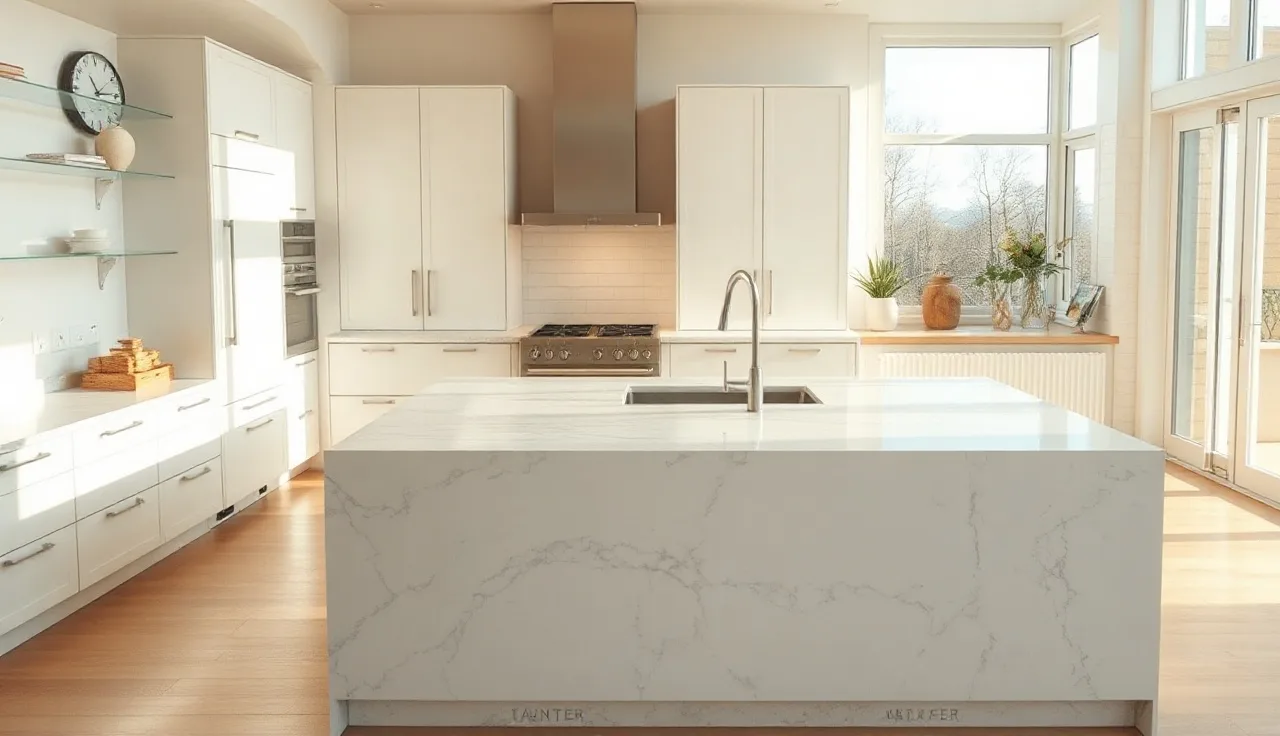
TL;DR
- Contemporary kitchen countertops lean toward flat-profile edges, minimal veining or solid color, and materials that hide daily mess.
- Quartz dominates the category at $50-120 per square foot installed.
- Porcelain slabs are growing fast.
- Natural stone still earns its place if you can accept the maintenance.
- Budget realistically: a typical 40-square-foot kitchen runs $2,000-$4,800 for quartz, more for stone.
What makes a countertop 'contemporary' in the first place?
Contemporary design is not the same as modern. Modern is a period style rooted in the early-to-mid twentieth century. Contemporary means what's current right now, which means it shifts every few years. In 2025, contemporary kitchen countertops share a few consistent traits: clean lines, minimal ornamentation, flat or waterfall edges rather than ogee or bullnose profiles, and a color palette that runs toward white, gray, warm greige, or dramatic dark slabs.
The surface itself usually does visual work without competing with other elements. Thick veining in a Calacatta pattern can be contemporary if the rest of the kitchen is quiet. A solid-surface matte black is contemporary. A busy, multi-color granite in a kitchen full of ornate cabinets is not, even if the granite is technically beautiful.
Edge profiles tell the story quickly. A flat eased edge or a thin mitered edge reads contemporary. An ogee edge reads traditional. A beveled edge sits somewhere in between. If you're building or remodeling toward a contemporary look, your edge choice matters almost as much as your material choice.
The other defining feature is integration. Contemporary kitchens often fold the countertop into the cabinetry visually, using waterfall edges that drop to the floor or keeping grout lines and seams as invisible as possible. That's an installation and fabrication problem as much as a material one.
Which countertop materials fit a contemporary kitchen?
The short list is quartz, porcelain slab, quartzite, marble, concrete, and (in the right context) stainless steel or ultra-compact surfaces like Dekton. Each has a real use case and real drawbacks.
Quartz engineered stone is the dominant choice for contemporary kitchens right now, and the reason is practical: it's non-porous, so it doesn't need sealing, it's dimensionally consistent across a large slab, and manufacturers have gotten very good at producing veined looks that approximate marble without the maintenance. Brands like Cambria sit at the premium end; entry-level engineered quartz from big-box stores sits at the low end. Installed costs run $50-120 per square foot depending on material grade and fabricator market. [1]
Porcelain slab is the fastest-growing category, especially in ultra-thin 6mm and 12mm formats. Porcelain is fired at extremely high temperatures, which makes it essentially impervious to staining and scratch-resistant at the surface. A 2022 survey by the National Kitchen and Bath Association found porcelain/ceramic slab countertops went from 8% of projects in 2017 to 15% in 2022. [2] The trade-off is brittleness at corners and edges, and cuts require a skilled fabricator.
Quartzite (natural quartzite, not to be confused with quartz) is a metamorphic rock that reads like marble but is significantly harder. It still needs sealing. It's expensive, typically $80-140 per square foot installed, but it holds up well in heavy-use kitchens. A guide on how to clean quartzite countertops covers the maintenance side in detail.
Marble is the classic high-end choice and polarizes people sharply. It etches from acids (lemon juice, vinegar, wine) and it scratches. It also looks extraordinary and develops a patina that some homeowners actively want. White Carrara or Calacatta on an island in a contemporary kitchen is a legitimate design choice if you go in with open eyes. Marble countertops are covered in depth separately.
Concrete had a big moment in the 2010s and has settled into a niche choice. It requires sealing, can crack, and takes a skilled fabricator to install well. It does offer truly custom shapes and integral sinks that no other material matches.
Ultra-compact surfaces (Dekton, Neolith, Lapitec) are sintered stone composites fired at extremely high pressure and temperature. They resist heat, UV, and scratching better than most materials. Cost is high, typically $90-150 per square foot installed, and they can chip at edges if subjected to impact. [3]
Laminate countertops deserve mention because modern laminate is not your grandmother's laminate. Manufacturers now produce realistic stone-look surfaces with matte finishes that hold up in low-traffic situations and cost $20-40 per square foot installed. If budget is the constraint, it's a legitimate option, though the seams and visible substrate at the edge are hard to disguise.
How much do contemporary kitchen countertops cost?
The cost of countertops has three components: the material itself (slab cost), fabrication (cutting, edge profiling, sink cutouts), and installation. Most quotes bundle these together, which is fine, but you should ask your fabricator to break them out so you can compare bids fairly.
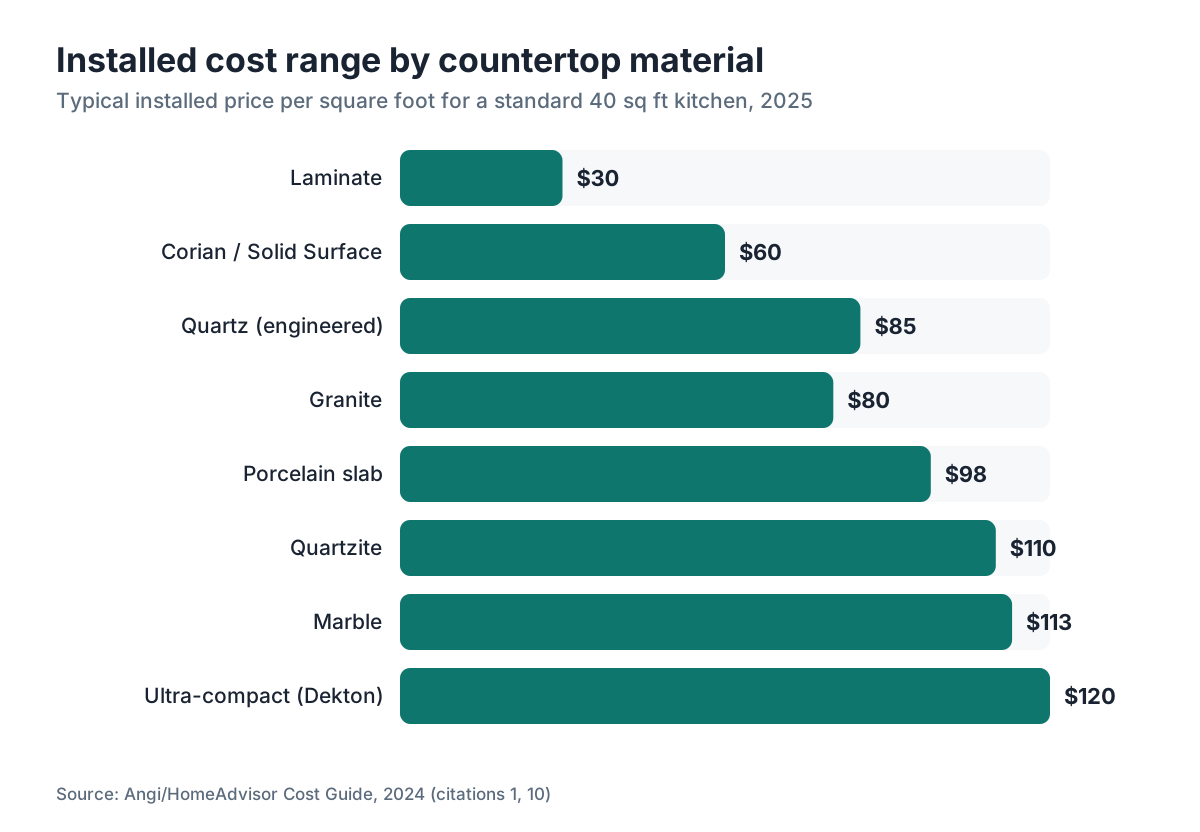
A standard kitchen has somewhere between 30 and 50 square feet of countertop surface. A typical American kitchen has about 36-40 square feet of countertop, per U.S. Census Bureau American Housing Survey data. [4] At those dimensions, here's what realistic installed cost looks like:
| Material | Low ($/sq ft installed) | High ($/sq ft installed) | 40 sq ft total low | 40 sq ft total high |
|---|---|---|---|---|
| Laminate | $20 | $40 | $800 | $1,600 |
| Quartz (engineered) | $50 | $120 | $2,000 | $4,800 |
| Granite | $50 | $110 | $2,000 | $4,400 |
| Quartzite | $80 | $140 | $3,200 | $5,600 |
| Marble | $75 | $150 | $3,000 | $6,000 |
| Porcelain slab | $65 | $130 | $2,600 | $5,200 |
| Ultra-compact (Dekton, etc.) | $90 | $150 | $3,600 | $6,000 |
| Concrete | $80 | $140 | $3,200 | $5,600 |
These ranges reflect real fabricator pricing but vary significantly by region. Labor costs in San Francisco or New York run 30-40% above national average; rural Midwest fabricators can come in well below the low end. [5]
Fabrication add-ons that inflate the quote: waterfall edges (cutting and mitering the slab to drop vertically adds $300-800 per waterfall), undermount sink cutouts ($100-250), cooktop cutouts ($100-200), and eased vs. mitered edges (mitered adds cost due to labor). If a fabricator quote seems low, check what's included.
For homeowners who want a fast sanity check on their quote, the SlabWise instant quote tool runs through material, edge, and cutout options and shows you a price range before you ever talk to a fabricator. It doesn't replace a real templating visit, but it tells you whether you're in the right ballpark.
What are the most popular countertop colors for contemporary kitchens in 2025?
White and off-white still lead, but the story has gotten more nuanced. Pure white quartz peaked around 2018-2020. The current direction is toward warm whites and creamy tones, sometimes with soft warm-gray veining rather than stark gray veining. Think Calacatta Gold patterns rather than Carrara-style cool grays.
The second dominant direction is the opposite: dramatic dark countertops. Nero Marquina-style black marble looks, deep charcoal quartzite, and black-veined white porcelain slabs are all popular, especially on islands paired with lighter perimeter counters. The contrast creates a two-zone kitchen that reads very contemporary.
Taupe, greige, and brown-veined materials are rising steadily. Manufacturers started introducing more beige and warm brown tones around 2022, and they're now a meaningful share of sales. These pair well with the white oak and natural wood cabinetry trend.
Solid flat colors (no veining) remain a contemporary option in some kitchens, particularly those influenced by Scandinavian or Japanese minimalist design. Matte concrete-look finishes, either actual concrete or porcelain mimics of concrete, show up in kitchens with an industrial or loft-style character.
Where does color go wrong in contemporary kitchens? Busy multicolor patterns (lots of browns, reds, blacks mixed together) are the most common mismatch. They read as outdated quickly. Heavy cream or ivory tones with heavy beige cabinetry can feel dated too. The general rule contemporary designers work with: one dominant tone, one accent or veining color, and let the material speak.
What edge profiles work for a contemporary look?
Edge profile is the detail fabricators talk about constantly and homeowners underestimate constantly. The edge is the visual transition between the countertop surface and the cabinet or wall below. In contemporary design, the profile should do as little as possible visually.
The eased edge (a slightly softened square edge) is the default contemporary choice. It's the most common profile on new construction and remodels in the $50-120 per square foot range. It's clean, it doesn't collect crumbs the way an ogee does, and it reads modern.
The mitered edge (two pieces of stone joined at 45 degrees to create the illusion of a much thicker slab) is the premium contemporary choice. A 3cm slab mitered to look like a 6cm slab has real visual weight without being fussy. Mitered edges cost more, sometimes significantly more, because they require extremely precise cuts and polishing. Budget $20-50 additional per linear foot.
The waterfall edge, where the countertop material continues vertically down the side of an island or peninsula to the floor, is distinctly contemporary. It requires careful grain or pattern matching on natural stone (called book-matching), which takes extra slab inventory and fabricator skill. On engineered quartz or porcelain, the consistency across pieces makes waterfall edges more forgiving.
Profiles to avoid if you want contemporary: ogee, dupont, cove, and anything with a raised or decorative edge detail. These have their place in traditional and transitional kitchens and look out of place in a contemporary one.
How durable are contemporary countertop materials for everyday kitchen use?
Durability is where marketing gets dishonest and where a little specificity matters a lot. Here's what actually holds up and where.
Quartz engineered stone is non-porous, so it doesn't harbor bacteria or stain the way marble or granite can. It's heat-resistant to a point, around 150 degrees Fahrenheit by most manufacturer specs, but a hot pan straight off the burner can scorch the resin binders in the material. Always use a trivet. Quartz is hard and scratch-resistant but not scratch-proof; dragging a cast-iron pan across it will leave marks.
Porcelain slab is probably the most durable surface material available for kitchen countertops. It's extremely scratch-resistant, UV-stable, acid-resistant, and heat-resistant to well over 400 degrees Fahrenheit. The weak point is impact at corners and edges, where chips can occur. Once it chips, repair is very difficult.
Natural quartzite is harder than marble and harder than most granites, rating 7 on the Mohs hardness scale compared to marble at 3-4. [6] It seals better than marble and resists acids far better. It's a genuinely good choice for a busy kitchen that wants natural stone.
Granite has a long track record in kitchens and holds up well. It's porous, so it needs sealing once a year or so, but it's forgiving of heat and resistant to scratching. Granite countertops have their own full guide.
Marble etches. Full stop. An etched marble surface has a dull spot where the acid ate the polish. This is chemistry, not a quality defect. Honed marble hides etching better than polished marble because the finish is already matte. Some people love the lived-in character of etched marble. Others find it maddening. Be honest with yourself before you commit.
For maintenance specifics across natural stone types, the how to clean stone countertops guide covers daily care and sealing schedules.
Is quartz or quartzite better for a contemporary kitchen?
This is the question fabricators hear constantly, partly because the names are so easy to confuse. Quartz (engineered) and quartzite (natural stone) are completely different products.
Engineered quartz is roughly 93-95% ground quartz crystals bound with polymer resins. It's manufactured, so the color and pattern are consistent across a production run. You can order multiple slabs and they'll match. It's non-porous and never needs sealing. It's the lower-maintenance choice.
Quartzite is a natural stone, formed when sandstone is subjected to extreme heat and pressure. Each slab is unique. It's porous and needs sealing, typically once a year or when water stops beading on the surface. It's harder than marble and generally harder than engineered quartz, rating 7 on the Mohs scale compared to engineered quartz's 7-8. [6]
For contemporary kitchens, engineered quartz is the more practical choice in most cases. The consistency of pattern across large surfaces suits the clean, controlled aesthetic of contemporary design. Quartzite makes sense when you want genuine natural stone movement and you're willing to maintain it.
Cost-wise, they're surprisingly close. Premium engineered quartz (Silestone, Caesarstone, Cambria) costs $80-120 per square foot installed. Good quartzite is $80-140 per square foot installed. The budget advantage of engineered quartz only shows up clearly at the entry or mid-level tier.
Can you use wood or butcher block in a contemporary kitchen?
Wood countertops in contemporary kitchens divide people. The honest answer is: yes, with intention.
The scenario where it works best is a mixed-material kitchen where wood appears on a prep area, island, or desk section while the main perimeter runs quartz or stone. A bleached or white oak butcher block panel alongside white or gray quartz reads warm-contemporary, particularly in kitchens influenced by Scandinavian design.
A full kitchen in butcher block can work if the cabinets, hardware, and lighting are genuinely contemporary. The surface itself has to be maintained (oiled or sealed, depending on the finish) and it will show wear. Whether that wear reads as character or damage is a personal call.
Butcher block countertops covers the maintenance side in detail, including the real difference between sealed and unsealed wood surfaces in kitchen environments.
What doesn't work in contemporary design is heavily stained or dark-toned traditional wood species (dark walnut with a thick poly finish, for example) in a kitchen that's otherwise light and minimal. The material reads as a period choice rather than a contemporary one.
What's the difference between contemporary and transitional countertop choices?
Fabricators and designers use these terms and homeowners sometimes use them interchangeably, which causes real confusion at the quote stage.
Transitional design borrows from both traditional and contemporary camps. It accepts some ornament (a beveled or eased edge rather than a flat eased edge), tolerates more material variation (busy granite, for instance), and pairs natural stone with classic cabinet styles. A transitional kitchen might have Shaker cabinets with a marble island and a classic apron sink. It's a very popular choice because it photographs well and holds value.
Contemporary design commits harder to minimalism and current trends. The risk of a fully contemporary kitchen is that current trends shift. A strongly contemporary kitchen from 2015 looks dated in 2025 in a way that a transitional kitchen from 2015 does not.
For countertop choices, the practical implication is this: if you're planning to sell within 5-7 years, transitional tends to have broader buyer appeal. If you're remodeling for yourself with a long horizon, contemporary can be the right call if you love it.
The countertop materials with the widest appeal across both styles are quartz in neutral tones (white, gray, greige) and quartzite with soft movement. Pure white quartz or a quiet marble look is as close to a universal safe choice as the category offers.
How do you get an accurate quote for contemporary kitchen countertops?
Getting a real quote requires a few things that most homeowners skip, and skipping them is how you end up with a $500 surprise at installation.
First, know your square footage. Measure the length of each counter run and multiply by the depth (standard kitchen counter depth is 25.5 inches, which rounds to about 2.1 feet). Add up all runs. Don't forget the island if you have one. Waterfall edges on the island add square footage because the material wraps down the side.
Second, know what edge profile you want before you talk to a fabricator. Edge profile changes the per-linear-foot cost, not the per-square-foot cost. A basic eased edge might be included in the base price; a mitered edge might add $25-50 per linear foot.
Third, know your sink cutout and whether it's undermount or drop-in. Undermount requires the fabricator to cut and polish the cutout from below. This adds $100-250 to the quote. A drop-in sink is cheaper to accommodate.
Fourth, ask about seam placement. For a long run, where the fabricator places the seam matters aesthetically. On a veined stone, a poorly placed seam is visible. A good fabricator discusses seam location with you before fabrication; a bad one doesn't.
Fabrication software has gotten good at automating this. Tools like SlabWise let fabricators produce itemized quotes that break out material, edge, cutouts, and installation, which means you can actually compare two bids apples to apples instead of guessing which one left something out. For fabricators reading this: accurate quoting is where shops lose and gain margin more than anywhere else in the process.
For general countertop installation process and what to expect on installation day, countertop installation walks through the full sequence.
Are there budget-friendly options that still look contemporary?
Yes, genuinely. The contemporary aesthetic lends itself to budget-friendly choices in a way that traditional design doesn't, because contemporary design values restraint rather than ornamentation.
Modern laminate is the strongest case. Formica countertops and laminate countertops have improved significantly. Current matte-finish laminates in concrete-look or stone-look patterns cost $20-40 per square foot installed and hold up fine in low-to-medium traffic situations. The limitations are edge visibility (the substrate shows at cuts), heat sensitivity, and the fact that they can't be undermounted cleanly.
Corian countertops and solid surface materials (Corian, Avonite, and similar) are another budget-to-mid path. They cost $40-80 per square foot installed, they can have integrated sinks (a very contemporary look), and they can be sanded and repaired if they scratch. They don't look like stone, but a matte solid surface in a contemporary kitchen can look intentional and clean.
The honest truth about budget contemporary countertops: the look you're going for rewards confident material choices. A matte black laminate executed well reads more contemporary than a mid-grade quartz in an indecisive beige. Commit to your choice.
Frequently asked questions
What countertop material is most popular in contemporary kitchens right now?
Engineered quartz is the most common choice for contemporary kitchens in 2025, used in roughly half of new kitchen installations according to NKBA data. It's non-porous, consistent in pattern, and available in the neutral tones and veined looks that contemporary design favors. Porcelain slab is growing fast and may close that gap by the end of the decade.
How thick should countertops be in a contemporary kitchen?
Standard slab thickness is 3cm (about 1.2 inches), which is the default for quartz, quartzite, granite, and most natural stone. Some contemporary kitchens use mitered edges to make the countertop appear 5-6cm thick without using extra material. Porcelain slab comes in 6mm, 12mm, and 20mm formats. Thicker looks heavier and more substantial; thinner reads more refined.
Do contemporary kitchen countertops increase home value?
Stone and quartz countertops do contribute to resale value, but the return varies a lot by market. Remodeling Magazine's Cost vs. Value report consistently shows kitchen remodels recoup 50-80% of costs on average, with countertops being a significant factor. Neutral-toned contemporary countertops tend to have broader buyer appeal than bold or polarizing choices, which matters if you sell within 5-10 years.
What countertop finish is most contemporary: polished, honed, or leathered?
Matte and honed finishes are more distinctly contemporary than polished. A honed marble or quartzite reads quieter and more design-forward than a high-gloss polished version of the same stone. Leathered finish (a textured matte surface created by brushing the stone) is popular on dark granites and quartzites in contemporary kitchens and hides fingerprints and water spots better than polished.
Can you use two different countertop materials in one contemporary kitchen?
Yes, and mixed-material kitchens are a well-established contemporary approach. The most common combination is quartz or quartzite on the perimeter and a contrasting material (marble, wood, or a different stone) on the island. The key is to connect the two materials through a shared tone or undertone. Two very warm materials or two very cool materials look intentional; a warm material next to a cool one looks like an accident.
How long does it take to get new countertops installed?
The timeline from signed contract to installation typically runs 10-21 days for in-stock quartz or granite. Custom or special-order materials take longer, sometimes 4-8 weeks. The fabricator templates the kitchen first (measures precisely), then cuts and finishes the slabs, then installs. The installation itself usually takes one day for a standard kitchen. Porcelain and ultra-compact surfaces sometimes take longer because they require more careful fabrication.
What countertop colors make a small kitchen look bigger?
Light colors and low-contrast patterns make small kitchens feel larger. White, soft gray, or pale greige countertops reflect more light and don't visually break up the space. A continuous surface with minimal seams helps too. Dark countertops can work in small kitchens when paired with light cabinetry and good lighting, but they read as a deliberate design choice rather than a space-expanding one.
Is it possible to DIY contemporary countertop installation?
Laminate and some lightweight solid surface materials can be DIY-installed with the right tools and patience. Stone, quartz, porcelain, and ultra-compact surfaces are not realistic DIY projects. Slabs weigh 15-20 pounds per square foot or more, require precision cuts with diamond tooling, and need two or more people to handle safely. A botched cut on a $2,000 quartz slab is an expensive mistake. Hire a fabricator for stone and engineered surfaces.
How do you keep contemporary countertops looking clean?
The maintenance routine depends on the material. Engineered quartz and porcelain just need mild soap and water or a pH-neutral cleaner. Natural stone (granite, marble, quartzite) needs the same daily routine plus annual sealing. The biggest mistake people make is using acidic cleaners (vinegar, citrus-based products) on natural stone, which etches the surface over time. Use pH-neutral products across the board and you'll have fewer problems.
What backsplash goes with contemporary countertops?
Contemporary backsplashes favor large-format tile (12x24 or bigger), slab material that matches or complements the countertop, or simple subway tile in a stacked (not offset) pattern. Full-height backsplashes that run from counter to cabinet bottom read very contemporary. Mosaic tile and decorative tile borders are traditional choices and tend to clash with the clean aesthetic of contemporary countertops.
Does porcelain slab chip easily?
Porcelain slab chips at edges and corners more easily than granite or quartz because it's brittle under impact loading. The surface itself is extremely hard and scratch-resistant. The risk comes from dropping heavy objects at the edge or from impact during fabrication. Skilled fabricators know to leave slightly rounded micro-edges rather than perfectly sharp 90-degree edges to reduce chip risk. Ask your fabricator how they handle edges on thin porcelain.
What's the difference between quartz and Corian for contemporary kitchens?
Quartz engineered stone is harder, more scratch-resistant, and looks more like natural stone. Corian and solid surface materials are softer but can be thermoformed (bent), repaired by sanding, and made with integrated sinks that have no visible joint. Quartz costs $50-120 per square foot installed; Corian runs $40-80. For a genuinely contemporary joint-free sink look, solid surface has an advantage quartz can't match.
Are dark countertops practical in a real kitchen?
Dark countertops look extraordinary in photos and show every water spot, crumb, and smudge in person. If you cook regularly, you'll be wiping the surface constantly to keep it looking like the showroom. Honed or leathered finishes hide this better than polished dark surfaces. Many designers recommend dark islands (where the visibility is part of the drama) paired with lighter perimeter counters that show less daily mess.
Sources
- HomeAdvisor (Angi), Quartz Countertop Cost Guide: Installed quartz countertop costs range from approximately $50 to $120 per square foot depending on material grade and market.
- National Kitchen and Bath Association, 2022 Design Report: Porcelain and ceramic slab countertops grew from 8% of NKBA projects in 2017 to 15% in 2022.
- Cosentino Group, Dekton Technical Data Sheet: Ultra-compact sintered surfaces like Dekton resist heat, UV, and scratching and are typically installed at $90-150 per square foot.
- U.S. Census Bureau, American Housing Survey: The typical American kitchen has approximately 36-40 square feet of countertop surface.
- Bureau of Labor Statistics, Occupational Employment and Wage Statistics: Labor costs for skilled trades in San Francisco and New York City run 30-40% above national average rates.
- U.S. Geological Survey, Mineral Resources Program: Quartz and Quartzite: Natural quartzite rates approximately 7 on the Mohs hardness scale; marble rates 3-4.
- Remodeling Magazine, Cost vs. Value Report 2024: Kitchen remodels recoup 50-80% of costs on average, with countertops a significant contributing factor.
- National Kitchen and Bath Association, Kitchen and Bath Market Index: Engineered quartz is used in roughly half of new kitchen countertop installations tracked by NKBA surveys.
- Natural Stone Institute, Care and Maintenance Guidelines: Marble etches when contacted with acids including lemon juice, vinegar, and wine due to the calcite mineral content reacting to pH below 7.
- HomeAdvisor (Angi), Countertop Installation Cost Guide: Granite countertops installed cost $50-110 per square foot; quartzite and marble run $75-150 per square foot installed.
- Tile Council of North America, Porcelain Tile Technical Standards: Porcelain tile fired at high temperatures achieves water absorption below 0.5% and surface hardness that resists most common kitchen acids.
Last updated 2026-07-09