TL;DR
- Custom kitchen countertops are cut and finished to your exact cabinet layout, sink cutout, and edge profile.
- Installed costs run $45, $95 per sq ft for granite or quartz, $75, $160+ for marble or quartzite.
- Material choice, edge complexity, and backsplash returns drive most of the price swing.
- Lead times run 1 to 3 weeks from template to install.
What does 'custom' actually mean for kitchen countertops?
Custom means a countertop fabricated for your kitchen specifically, from a slab you usually picked in person, cut to match every corner and cutout in your layout. Stock countertops are the opposite: pre-cut to standard sizes and sold off the shelf, usually laminate or butcher block in 25-inch depths and 4-, 6-, or 8-foot lengths.
The custom process gives you control that stock products can't. A fabricator templates your actual cabinets, cuts a slab (or several) to match every peninsula and appliance opening, and finishes the exposed edges to whatever profile you specify. You decide color, veining, seam placement, edge shape, and thickness.
The word covers a lot of ground. At the basic end it's a straight granite slab with an eased edge. At the high end it's bookmatched marble panels with a hand-chiseled leather finish, a waterfall side panel, and a mitered 4-cm edge. Both are custom. The price gap between them is enormous.
For fabricators, custom also means more complex quoting, more material waste to price in, and more templating time. A shop running countertop quoting software can cut quoting time by auto-calculating square footage, kerf waste, and edge-profile upcharges from a digital template instead of doing it by hand.
What materials are used for custom kitchen countertops?
The materials worth serious thought: granite, quartz (engineered stone), marble, quartzite, soapstone, porcelain slabs, concrete, stainless steel, butcher block, and laminate. Each sits in a different spot on price, maintenance, and looks.
Granite countertops are still the volume leader. A typical granite job runs $45, $75 per sq ft installed for mid-grade material, though rare imported granites go higher. Granite is hard, heat-resistant, and needs sealing roughly once a year depending on porosity.
Marble countertops are softer (Mohs 3 to 4 vs. granite's 6 to 7), etch from acids, and will show use. That's not a dealbreaker. Plenty of kitchens have marble and the owners love it. But go in knowing the surface will change. Expect $75, $150+ per sq ft installed for Carrara or Calacatta grades.
Engineered quartz (Caesarstone, Silestone, Cambria) is ground quartz bound with polymer resin, typically 90 to 95% stone by weight [1]. It's non-porous, skips sealing, and the color runs consistent through the batch. Installed cost lands around $55, $95 per sq ft for standard slabs. Two tradeoffs: it can yellow under long UV exposure, and the resin scorches if you set a hot pan directly on it.
Quartzite is a metamorphic stone, not engineered, and people confuse it with quartz constantly. It's harder than marble and gives you the dramatic white-and-grey veining without the etching problem, though it does need sealing. Installed costs typically run $80, $160 per sq ft.
Porcelain slabs are a newer category. They're fired ceramic panels, 12mm thick, nearly impervious to heat and staining, printed with convincing stone patterns. Fabricators need diamond tooling and extra care at cutouts because porcelain chips more easily than stone. Installed cost runs $65, $120 per sq ft.
Concrete countertops are cast in place or precast. They're heavy (up to 18 lbs/sq ft), need sealing and waxing, and crack over time if the substrate shifts. Cost: $75, $150 per sq ft depending on the shop and complexity. Mostly a design choice. The maintenance burden is real.
Butcher block stays popular for islands and prep zones. It's warm, repairable with sanding, and runs $35, $70 per sq ft installed. Keep it away from the sink unless you're ready to oil it often.
| Material | Installed cost range (per sq ft) | Needs sealing? | Heat resistant? | Hardness (Mohs) |
|---|---|---|---|---|
| Granite | $45, $75 | Yes, annually | Yes | 6 to 7 |
| Quartz (engineered) | $55, $95 | No | Moderate | 7 |
| Marble | $75, $150+ | Yes | Poor (etches) | 3 to 4 |
| Quartzite | $80, $160 | Yes | Yes | 7 |
| Porcelain slab | $65, $120 | No | Yes | 6 to 7 |
| Butcher block | $35, $70 | Yes (oil) | No | Varies |
| Concrete | $75, $150 | Yes | Moderate | 3 to 5 |
| Laminate | $15, $40 | No | No | N/A |
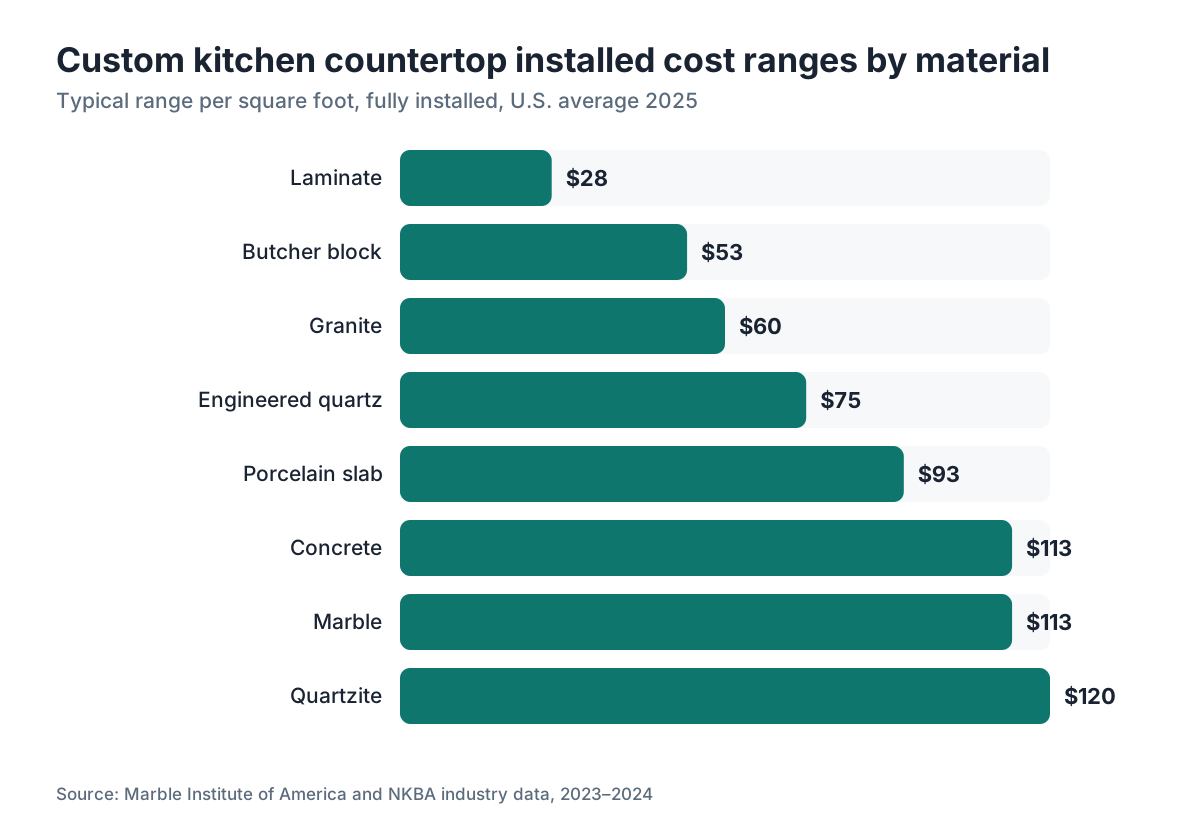
How much do custom kitchen countertops cost in 2025?
A typical kitchen (40 to 60 sq ft of counter surface) with granite or quartz, a standard edge, and one sink cutout runs $2,000, $5,000 installed. The range is wide because material grade, shop location, and edge profile all move the number.
Break it down by line item and it makes more sense. Fabricators price by the square foot of finished stone, then add line items: edge profiles (a standard eased edge is often included; an ogee or miter can add $15, $40 per linear foot), sink cutouts ($75, $200 each), cooktop cutouts ($50, $150), seam count, and delivery plus installation.
The National Kitchen and Bath Association reported in its 2023 Design + Industry Survey that countertops and backsplashes together averaged around $4,200 in kitchen remodels. That figure mixes stock laminate jobs with high-end stone projects, so treat it as context, not a benchmark [2].
Labor alone, separate from material, typically runs $10, $30 per sq ft depending on region and complexity. A shop in a high cost-of-living metro charges more than one in a rural county. California, New York, and Massachusetts rates sit at the top of that range.
Thickness moves the price too. The standard has shifted toward 3 cm (1.2 inches) slabs because they're stronger and look more substantial than the older 2 cm standard, but 3 cm slabs weigh more and cost more per sq ft. A 3 cm slab at $65/sq ft vs. a 2 cm slab at $50/sq ft adds up fast across a big kitchen.
Waste factor is the line homeowners rarely see quoted. Stone gets cut from rectangular slabs, and every angled corner or curved island creates cutoff that can't be reused on the job. Fabricators typically price in 15 to 25% waste on a standard kitchen. If your quote doesn't mention it, ask. That's where a lot of low-ball quotes fall apart.
Want to check a quote before you sign? Tools like the SlabWise instant quote calculator take your measurements and material choice and return a market-rate range in minutes.
What edge profiles are available, and which should you choose?
Edge profiles are cut into the exposed front edge by a CNC router or hand router. They run from nearly flat to elaborately carved, and they change cost, cleaning ease, and how heavy the counter looks.
Here are the profiles you'll actually meet:
Eased (or straight): A 90-degree edge with a slight break to kill the sharpness. Standard on most quotes, no upcharge. Clean lines, easy to wipe. Good for modern kitchens.
Beveled: A flat angled cut on the top edge, usually 45 degrees. Adds interest without much complexity. Usually no upcharge or a small one ($5, $10/linear ft).
Bullnose: The top edge rounds into a half-circle. Soft, traditional look. Easy to clean, no sharp edge. Common upcharge: $5, $15/linear ft.
Half bullnose: Only the top half rounds; the bottom stays square. Common on 3 cm slabs where a full bullnose would look heavy. Pricing tracks bullnose.
Ogee: An S-curve with a concave and convex section. Traditional and ornate. Harder to clean in the detail. Upcharge: $15, $30/linear ft. In quartz, an ogee can crack if the stone carries internal stress, so it shows up more in granite.
Waterfall edge: The material runs vertically down the side of an island to the floor. This is a design choice, not a router profile. It needs extra slab and careful seam work. Cost adds $500, $2,000+ depending on height and material.
Mitered edge: Two pieces cut at 45 degrees and joined to fake a 6 cm or 8 cm slab from a 3 cm one. Heavy visual weight, high-end look, labor-heavy. Upcharge: $30, $60/linear ft in many shops.
Laminated edge: A strip of matching stone glued to the front face to fake thickness. Less precise than mitered but faster and cheaper. Common in granite, less clean in quartz because the seam can show.
Comparing edge profiles for quartz specifically, keep two things in mind. Quartz is engineered, and some router bits leave micro-chips on aggressive profiles like ogee, so a good fabricator polishes the edge by hand after routing. And the real deciding factor is almost always cleaning: an eased or beveled edge wipes fast; an ogee collects grime in its crevices. If the kitchen sees heavy daily use, simpler is genuinely better.
| Edge profile | Visual style | Cleaning ease | Typical upcharge (per lin ft) | Best material match |
|---|---|---|---|---|
| Eased | Modern/minimal | Easiest | None | Any |
| Beveled | Modern/transitional | Easy | $5, $10 | Any |
| Bullnose | Traditional | Easy | $5, $15 | Any |
| Ogee | Traditional/ornate | Harder | $15, $30 | Granite |
| Mitered | Contemporary luxury | Easy | $30, $60 | Quartz, quartzite |
| Waterfall | Modern/dramatic | Easy | $500, $2,000+ total | Quartz, marble |
How does the fabrication process work from template to install?
Pick a slab, get a countertop. That's how most people picture it. The real sequence has more steps, and knowing them keeps you from getting blindsided by delays.
Step 1: Design and material selection. You choose the material and slab, usually at a stone yard or distributor. For natural stone this matters more than people expect: two slabs of the same granite from the same quarry can look completely different. View the actual slab, not a sample chip.
Step 2: Template. After cabinets are fully installed and the flooring is done (flooring first matters because it sets the finished counter height), the fabricator sends a templater. Modern shops use digital templating with a laser measure or Proliner; older shops still cut luan wood templates. Digital is faster and more accurate. The template captures every wall angle, cabinet-box measurement, and appliance opening. This visit takes 1 to 2 hours for a standard kitchen.
Step 3: Fabrication. Back at the shop, the template becomes cut files run on a CNC waterjet or bridge saw. Edge profiles get routed. Sink cutouts and faucet holes get cut. Edges get polished. For a standard kitchen, shop time is usually 2 to 5 business days after templating.
Step 4: Seam review (if applicable). For kitchens needing multiple slabs, the fabricator should show you a seam diagram before cutting. Seam placement affects both looks and strength. Seams should never fall at cooktop cutouts, sink corners, or high-traffic spots.
Step 5: Installation. A crew brings the finished pieces, removes the old counter, sets the new pieces with adhesive and shims, caulks the wall joint, and reconnects the sink (plumbing is usually a separate trade call for the drop-in or under-mount reconnection). Install for a standard kitchen takes 3 to 6 hours.
Total timeline from template to install runs 5 to 14 business days at most shops. Spring and fall remodeling peaks can push that to 3 weeks. If a shop promises delivery in 24 hours, ask which steps they're skipping.
For a full walk-through of what happens on install day, the countertop installation guide covers it in detail.
How do you measure your kitchen for a countertop quote?
You don't need a professional template to get a ballpark. A tape measure and 20 minutes gets you a reasonable number.
Measure the length of each counter run in inches, then the depth (typically 25.5 inches for a standard base cabinet with a 1.5-inch overhang). Multiply length by depth, divide by 144 for square feet. Add up all runs. Don't subtract for sink cutouts. Most shops charge for the full rectangle and bill the cutout as a separate fee.
For an L-shaped kitchen, measure each leg of the L on its own. For an island, measure length and width separately. Note the number of sink cutouts, cooktop cutouts, and how many linear feet of edge profile you need (exposed edges only, not the edges against walls).
A common miss: forgetting the front edge of peninsulas and islands. A 6-foot island has 6 linear feet of exposed front edge, both end caps, and possibly a waterfall side, all carrying edge-profile upcharges.
Check your wall angles too. Almost no kitchen has perfectly square corners. If you measure a 10-foot run and the walls are 2 degrees out of square, the slab has to be cut to match, which eats more material. A digital template catches this. A tape-measure quote from a homeowner can miss it by enough to change the final price.
For a deeper look at the whole process and what drives your final number, the kitchen countertops overview is a good companion read.
What thickness should custom countertops be?
Three centimeters (roughly 1.25 inches) is the current standard for stone countertops. Before about 2010, 2 cm slabs were common, but they need a plywood substrate for support and look thin. Three-centimeter slabs are self-supporting over standard cabinet spans and look more substantial.
You'll still see 2 cm material in some imported granites and in porcelain slabs, where 12mm (about 0.47 inches) is standard because the material is so dense and strong. Some fabricators run 2 cm stone with a laminated front edge to fake the look of 3 cm without the full slab cost.
Four-centimeter profiles exist but usually come from mitering two 2 cm pieces or laminating a strip, not from actual 4 cm slabs, which are specialty items. The visual difference is real. A 4 cm or mitered edge reads notably more solid.
For bathroom vanities the same material is cut to 3 cm but the square footage is smaller, so the per-project cost is lower. Don't price a kitchen off a bathroom quote. The fabrication complexity is different.
How do seams work, and can they be made invisible?
Any countertop run longer than the slab's length needs a seam. Standard stone slab lengths run 100 to 120 inches (roughly 8 to 10 feet); engineered quartz slabs from major manufacturers run 120 to 132 inches. A 14-foot run will have at least one seam.
Seam quality varies enormously by fabricator. A well-done seam in a consistent material like quartz is nearly invisible. A seam in heavily veined marble or granite is harder to hide because the veining won't match across a cut. Bookmatching (mirroring adjacent slabs so the veining meets symmetrically) is a high-end technique that makes seams in dramatic stones look intentional, but it means buying matched slab sets.
The seam is held together with color-matched epoxy and sometimes a metal seam clip underneath for extra strength. A proper seam is flat (no lip between sections), tight (gap under 1/16 inch), and filled flush. You'll feel a seam even when you can barely see it. That's normal.
Where the fabricator places the seam matters. Avoid seams directly over a sink, at a 90-degree corner, or at a cooktop, because those are stress concentration points. The best seam locations sit in straight runs, away from cutouts, ideally where they're less prominent.
Using natural stone and your kitchen needs seams? Ask to see the actual slabs laid out at the shop before they're cut. Serious fabricators will show you exactly how the pieces will land.
What should you ask a fabricator before signing a quote?
Two shops quoting the same kitchen can land $1,500 apart. Some of that gap is legitimate cost difference. Some of it is scope difference that doesn't show until you compare line items.
Questions worth asking:
Is the slab I'm choosing included in this price, or is it an allowance? Some quotes include a material allowance and charge more if you pick a premium slab. Know which you're buying.
What is your waste percentage, and how do you handle remnants? A shop that builds 20% waste into the price is not the same as one that skips waste and bills it later as an overage.
Who does the template, and what method do you use? Digital templating cuts errors. Ask when the template visit happens relative to cabinet completion.
What edge profile is included, and what are the upcharges for others? Many quotes include an eased edge; any other profile costs more. Get the per-linear-foot upcharge in writing.
Who handles the plumbing disconnect and reconnect? Most fabricators don't do plumbing. With an under-mount sink, you'll need a plumber for reconnection. Some shops coordinate it; many won't.
Is there a warranty? Reputable shops offer a workmanship warranty of 1 to 2 years on fabrication. Material defects fall under the distributor or manufacturer.
What happens if a piece cracks during installation? Stone can crack during transport or setting. Ask the shop's policy before it happens.
For fabricators pricing jobs, tools that auto-calculate edge-profile upcharges, waste factors, and slab yield per job (like SlabWise's quoting module) cut the risk of underquoting complex kitchens with multiple cutouts and non-standard edges.
How do you maintain and clean custom stone countertops?
Maintenance splits cleanly between porous and non-porous surfaces. Know which camp your material sits in and the rest is simple.
Natural stone (granite, marble, quartzite, soapstone) is porous to varying degrees and needs sealing to resist staining. The Marble Institute of America recommends testing porosity by placing a few drops of water on the surface: if the stone darkens within 4 minutes, it's time to reseal [3]. Most granite and quartzite should be sealed once a year; marble more often. Soapstone is the exception. It's treated with mineral oil, not a penetrating sealer.
For daily cleaning of stone, mild dish soap and water work fine. Skip acidic cleaners (vinegar, lemon-based products) on marble or limestone because they cause etching. For details on specific stone types, the how to clean stone countertops guide and the more specific how to clean quartzite countertops guide cover the nuances.
Engineered quartz needs no sealing and cleans with mild soap. Skip abrasive pads and bleach-heavy cleaners, which dull the finish over time. The biggest maintenance risk with quartz is heat. The resin binder softens at sustained high temperatures, so trivets matter.
Porcelain slabs and laminate are the most maintenance-free options. Both are non-porous and clean with almost anything. Laminate countertops still scratch and can't be repaired the way stone can be re-polished, but the cleaning burden is genuinely minimal.
For how to clean soapstone countertops, the routine is simpler than most natural stones, which makes soapstone appealing for busy kitchens despite its higher material cost.
What are the most common mistakes homeowners make when ordering custom countertops?
The biggest one: scheduling the template before cabinets are fully installed and leveled. The template has to capture the final position of the cabinet boxes. If even one cabinet shifts after the template is taken, pieces won't fit.
Second most common: choosing an edge profile that looks beautiful in a showroom photo but is impractical in the kitchen. An ornate ogee on an island collects crumbs and grease in its grooves. People pick it for looks and regret the cleaning for years.
Third: skipping the seam diagram. Let the shop place seams wherever is convenient for them and you may get one in the most visible spot in the kitchen. You're allowed to ask for it elsewhere, and the fabricator should accommodate reasonable requests.
Fourth: ordering off a sample chip. A 2x2 inch chip of Calacatta marble tells you the base color. It tells you nothing about how heavily the grey veining runs in the slab you'll actually get. View the full slab, ideally wet (wetting stone simulates the finished polished look).
Fifth: forgetting backsplash returns in the quote. The short piece of stone that returns up the wall behind the range is included at some shops and quoted separately at others. Ask which.
Is custom always better than stock, or are there cases where stock wins?
Stock wins in rentals, budget flips, and short-horizon projects where the goal is functional and clean, not beautiful. A laminate or Formica countertop installed fast at $15, $30 per sq ft is a reasonable call when the renovation cycle is 5 to 7 years and the margin won't support stone.
Stock also wins on lead time when a project is urgent. A laminate post-form counter can install same-week; a custom granite job typically takes 2 weeks from template. If a client has a hard move-in date, that gap is real.
For a primary kitchen in an owner-occupied home, custom stone almost always carries better long-term value. It lasts 20 to 50 years with normal care. It adds perceived value to the home, though quantifying that ROI precisely is hard; Remodeling Magazine's Cost vs. Value report doesn't break out countertops as a standalone line item [4]. And it's the one surface in the kitchen you touch every single day, which makes the daily experience of using it worth something.
Corian countertops sit in an interesting middle position. They're not stock (they're custom-fabricated), but they're not stone either. Solid surface like Corian routes into shapes stone can't match, repairs with sanding, and integrates with under-mount sinks cleanly, with no visible joint. For kitchens with complex shapes, it's genuinely the best answer.
Frequently asked questions
How much does a custom kitchen countertop cost per square foot installed?
Installed costs run $45, $75 per sq ft for mid-grade granite, $55, $95 for engineered quartz, $75, $150+ for marble, and $80, $160 for quartzite. A typical 40 to 60 sq ft kitchen totals $2,000, $5,000 installed including edge profile, sink cutout, and labor. Premium materials, complex edges, or a high cost-of-living area push toward the top of those ranges.
What is the most durable material for custom kitchen countertops?
Quartzite and engineered quartz are the most durable for everyday kitchen use. Quartzite is a natural stone with a Mohs hardness around 7, resists scratching, and handles heat. Engineered quartz scores similarly on hardness but the resin binder can scorch under direct heat. Granite runs close behind both. Marble is beautiful but soft (Mohs 3 to 4) and etches from kitchen acids like lemon juice or vinegar.
How long does it take to get custom countertops made and installed?
The typical timeline is 5 to 14 business days from template to installation. Template happens after cabinets are fully set; fabrication takes 2 to 5 shop days; installation usually takes a half day. Busy seasons (spring and fall) can stretch the window to 3 weeks. Same-week turnaround is occasionally possible for simple jobs but is not standard.
Which edge profile is most popular for quartz countertops?
The eased edge is the most popular choice for quartz, especially in contemporary and transitional kitchens. It's clean, easy to wipe, and usually included in the base price with no upcharge. Beveled edges come second. Mitered edges are gaining ground in higher-end installations for their thick, substantial look. Ogee profiles are less common in quartz because the router can micro-chip the material.
Can I get a waterfall edge on any countertop material?
Technically yes, but engineered quartz and marble are the most common choices because their fairly consistent patterning makes matching the vertical panel to the horizontal top easier. Heavily veined granite or quartzite can look stunning as a waterfall but requires careful slab selection and bookmatching. The added cost runs $500, $2,000+ depending on material price, slab availability, and the height of the waterfall panel.
Do custom countertops need to be sealed?
Natural stone (granite, marble, quartzite) generally does. The Marble Institute of America's water-drop test is the simplest check: if water darkens the stone in under 4 minutes, reseal. Engineered quartz and porcelain slab are non-porous and need no sealing. Butcher block needs food-safe mineral oil rather than a stone sealer. Laminate and solid surface (Corian) don't need sealing.
What is the difference between quartzite and quartz countertops?
Quartzite is a natural metamorphic rock mined from the earth. Quartz (engineered) is a manufactured product made from ground quartz crystals bound with polymer resin. Quartzite needs sealing; engineered quartz does not. Quartzite handles heat well; engineered quartz can scorch. Both score around Mohs 7 for hardness. The names are confusingly similar; always confirm which product a supplier is quoting.
What causes countertop seams and how can I minimize them?
Seams happen when a counter run is longer than the slab. Standard slabs top out around 120 to 132 inches; anything longer needs at least one seam. To minimize them, design counter runs within slab length where possible, or choose a material with a consistent pattern (like solid-color quartz) where seams are nearly invisible. Always review the seam diagram before fabrication starts and ask for seam placement away from cutouts and high-visibility areas.
Can I install custom countertops myself to save money?
Stone and engineered quartz slabs are very heavy (15 to 20 lbs per sq ft at 3 cm), require specialized lifting equipment, and crack if improperly supported during installation. DIY installation voids most fabricator warranties. Laminate post-form and butcher block are reasonably DIY-friendly. For stone, the labor portion of the quote ($10, $30/sq ft) is worth it; an installer error on a $1,500 slab costs far more than it saves.
How thick should custom kitchen countertops be?
Three centimeters (about 1.25 inches) is the current standard for stone and quartz countertops. It's self-supporting over standard cabinet spans and looks proportionally right. Two-centimeter slabs are still available and cost slightly less but need a plywood substrate. Porcelain slabs are typically 12mm and are strong enough at that thickness. Mitered edges can simulate 4 to 6 cm thickness from standard 3 cm slabs.
What questions should I ask a fabricator before getting a countertop quote?
Ask whether the quoted material is included or an allowance, how waste is factored in, what edge profile is included vs. upcharged, who handles plumbing reconnection, what templating method they use, and what their policy is if a piece cracks during installation. Get all upcharges in writing. Compare quotes at the line-item level rather than the total; a lower number often means something is missing from scope.
Does the edge profile affect countertop price significantly?
Yes, on large kitchens the difference is real. A standard eased edge typically costs nothing extra. An ogee profile adds $15, $30 per linear foot. A mitered edge adds $30, $60 per linear foot. A 30-linear-foot kitchen with a mitered edge pays $900, $1,800 more than the same kitchen with an eased edge. On a peninsula with 15 feet of exposed edge, the edge-profile upcharge can easily hit $600, $900.
What is the best countertop for a busy kitchen that gets heavy daily use?
Engineered quartz is the most practical choice for high-traffic kitchens: non-porous (resists staining from cooking), no sealing needed, hard enough to resist most scratching, and available in many colors and patterns. Granite is a close second and handles heat better. Avoid marble as a primary surface in a busy kitchen unless you accept that it will show wear; etching from everyday cooking acids is essentially inevitable.
How do I pick a countertop color that works with my cabinets?
The most reliable rule: contrast beats match. White or light cabinets pair well with dark granite or a veined stone. Dark cabinets look clean under light quartz or marble. Mid-tone wood cabinets are the most flexible and work with almost any stone. View the full slab (not a sample chip) next to a cabinet door sample in natural light before committing. Showroom lighting is often flattering in ways daylight is not.
Sources
- Marble Institute of America, Quartz Surfaces Technical Manual: Engineered quartz is typically 90 to 95% ground quartz by weight bound with polymer resin
- National Kitchen and Bath Association, 2023 Design + Industry Survey: Countertops and backsplashes together averaged around $4,200 in kitchen remodels across the survey sample
- Marble Institute of America, Care and Cleaning for Natural Stone Surfaces: If water placed on the stone darkens the surface within 4 minutes, the stone needs sealing
- Remodeling Magazine, 2024 Cost vs. Value Report: Major kitchen remodels and midrange kitchen remodels are tracked for cost and resale value; countertops are not broken out as a standalone line item
- U.S. Geological Survey, Mineral Commodity Summaries: Stone, Dimension: Granite and marble are classified as dimension stone in USGS commodity tracking; the U.S. imports a significant share of dimension stone slabs from Brazil, Italy, and China
- Occupational Safety and Health Administration, Silica in Construction: OSHA's permissible exposure limit for respirable crystalline silica is 50 micrograms per cubic meter as an 8-hour TWA; engineered stone fabrication is a regulated silica exposure source
- Caesarstone, Technical Data Sheet for Quartz Surfaces: Caesarstone quartz slabs are available in 120 x 55 inch and 126 x 63 inch formats; standard thickness is 2 cm and 3 cm
- Silestone by Cosentino, Product Specifications: Silestone engineered quartz slabs run up to 132 x 65 inches in jumbo format; standard slab thickness options are 1.2 cm, 2 cm, and 3 cm
- National Institute of Standards and Technology, Weights and Measures for Natural Stone: 3 cm granite weighs approximately 18 to 19 lbs per square foot; relevant for structural load considerations in cabinetry and island design
- Marble Institute of America, Natural Stone Industry Statistics: The Marble Institute of America publishes quarry, import, and fabrication statistics for the natural stone industry in the United States
- Home Innovation Research Labs, 2023 Builder Practices Report: Engineered quartz continued to grow as a countertop material choice in new residential construction, with granite retaining the largest share among stone options
Last updated 2026-07-09