TL;DR
- Recycled glass countertops cost roughly $65 to $125 per square foot installed.
- The binder drives the price and the behavior: cement-based slabs are heavier, porous, and need sealing every 1 to 3 years, while resin-based slabs are lighter, non-porous, and need none.
- Both hold 75 to 100% recycled glass, both resist heat and scratches, and both chip at the edges more than granite does.
What are recycled glass countertops made of?
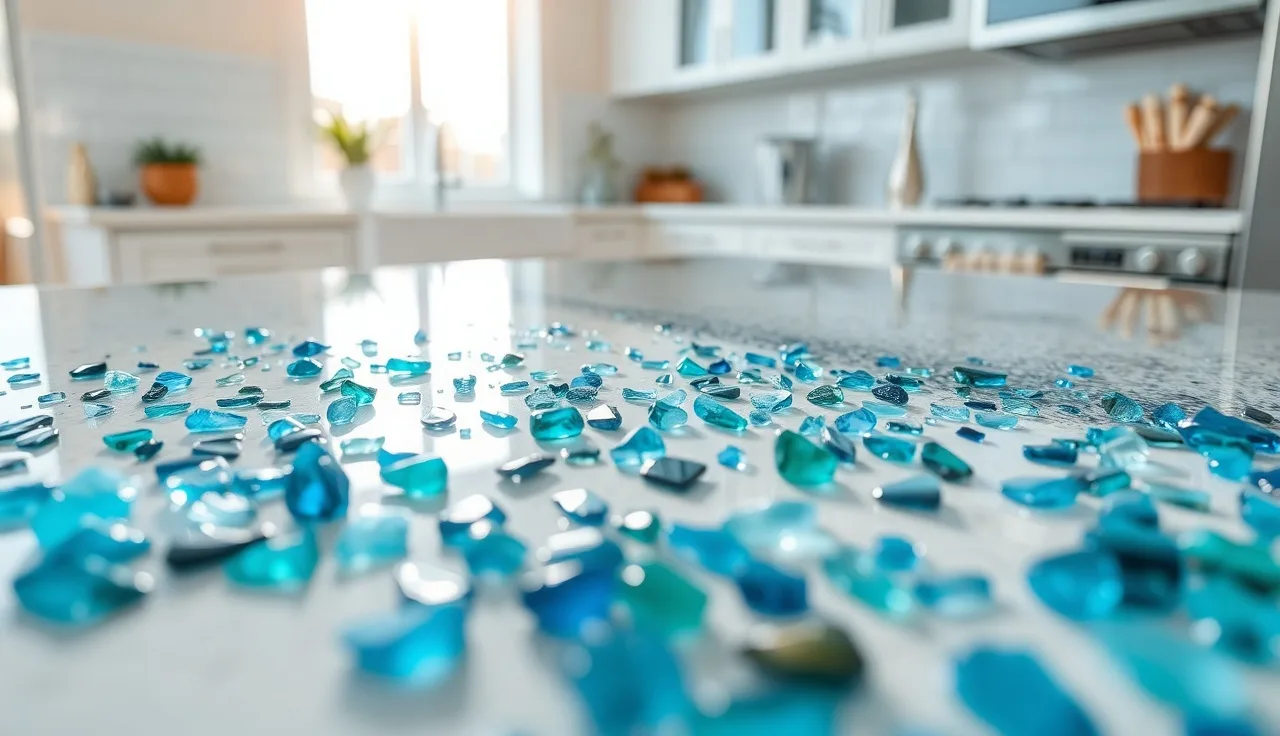
Recycled glass countertops are chunks, chips, or ground glass suspended in a binder and cast into slabs. The glass is usually post-consumer (wine bottles, windows, plate glass, traffic lights) or post-industrial (factory cullet), and the better manufacturers publish the exact percentage. Most products run 75 to 100% recycled glass by weight [1].
The binder is where products split, and it matters more than the glass for how the counter behaves.
Cement-based countertops use Portland cement or a modified cementitious mix as the matrix. Picture terrazzo with a much higher glass ratio. They're heavy, usually 18 to 20 lbs per square foot, and porous until sealed. They pick up a fine patina over time, the same way concrete countertops do, and they want resealing every 1 to 3 years depending on how hard the kitchen works.
Resin-based countertops are the more common residential pick today. They use polyester or epoxy resin as the binder. They're lighter, non-porous straight from the factory, and never need sealing. The catch is heat. Some resin formulations are less heat-tolerant than cement, and a hot pan set directly on certain resin products leaves a mark. Read the temperature rating before you buy.
A few manufacturers make a hybrid that blends modified Portland cement with polymer additives, chasing the cement look with lower porosity. Results vary by brand, so treat those claims as brand-specific until you see a spec sheet.
How much do recycled glass countertops cost?
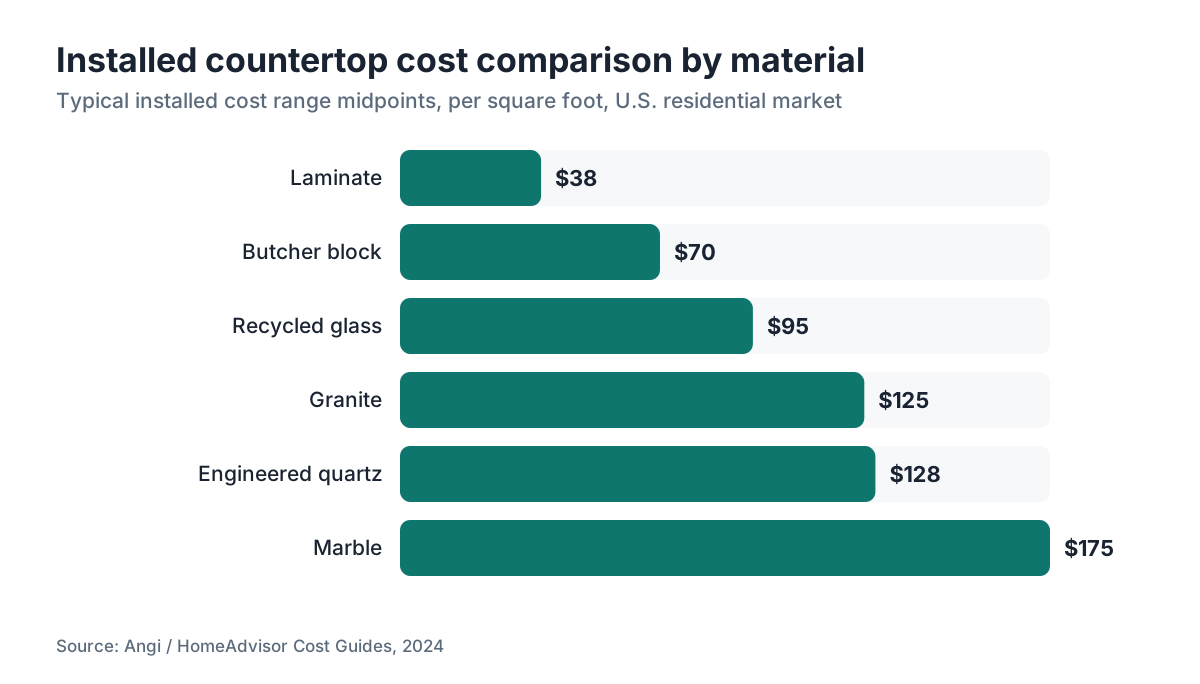
Fully installed, recycled glass kitchen countertops run $65 to $125 per square foot [2]. A mid-range project with a standard edge lands around $85 to $95 per square foot in most U.S. markets. That's before cutouts (each sink or cooktop cutout adds roughly $100 to $200) and any specialty edge work.
Cement-based products lean toward the low end because more fabricators already know how to work cementitious materials. Resin slabs with high glass density and custom colors push toward the top.
Here's how recycled glass sits next to other surfaces at typical installed cost:
| Material | Installed cost (per sq ft) | Notes |
|---|---|---|
| Laminate | $25, $50 | Laminate countertops, lowest upfront cost |
| Tile | $30, $65 | Grout maintenance |
| Butcher block | $40, $100 | Butcher block countertops |
| Recycled glass | $65, $125 | Cement or resin binder |
| Granite | $75, $175 | Granite countertops, wide range by origin |
| Quartz engineered | $80, $175 | |
| Marble | $100, $250+ | Marble countertops |
Labor is a real chunk of that number. Recycled glass slabs chip at the edges more than granite if they're dropped or struck, so most shops handle them like quartz, not natural stone. Budget at least $40 to $60 per square foot for labor and installation materials in most regions [3].
Custom color orders (where you name a specific glass color or source material) add lead time and usually a 15 to 25% premium over stock colorways. Want a specific hue? Get a physical sample shipped first. Color reads differently in your kitchen than it does on a screen.
How does recycled glass compare to granite and quartz?
Recycled glass is harder to scratch than marble and most wood, softer than granite, and roughly on par with engineered quartz for surface hardness depending on the binder.
Glass sits around 5.5 to 6.5 on the Mohs scale. That puts it below granite (6 to 7) and above soapstone (roughly 3 to 4). Knife marks are the practical concern. Don't cut directly on recycled glass, especially resin-based products. The chips won't fly, but the surface scores.
Heat is the stronger suit, mostly for cement versions. The glass handles heat fine; the binder is the limit. Cement-based counters usually take brief contact with pots up to 400°F without damage. Resin products vary widely: some are rated to 350°F, others want a trivet for anything above 150°F. Get the spec sheet.
Stains split along the same line. Resin is non-porous and shrugs off nearly every kitchen spill with no sealing. Cement is porous and will drink up oil, wine, and acid if it isn't sealed. An unsealed cement counter next to the stove is asking for a stain.
Maintenance on resin is genuinely easy: mild soap, water, done. No sealer, no special cleaners. Cement wants the same care as concrete. If you want even simpler upkeep, Corian countertops or Cambria countertops are worth a look.
Weight matters for the cabinets underneath. At 18 to 20 lbs per square foot, cement-based recycled glass outweighs granite (roughly 16 to 18 lbs/sq ft) and towers over laminate or wood. Older cabinet boxes may need reinforcement. Your installer should check this before templating, not after.
What's the environmental case for recycled glass countertops?
The environmental argument is real, but it comes with fine print.
Glass is infinitely recyclable without quality loss [9]. The EPA reports that about 12.3 million tons of glass entered the municipal solid waste stream in 2018, and only about 31.3% of it got recycled [4]. Most of the rest goes to landfills. A countertop drawing from that stream diverts glass that would otherwise sit underground forever.
Cement is the counterweight. Portland cement manufacturing accounts for roughly 8% of global CO2 emissions [5]. A cement-based recycled glass counter spends some of the glass-recycling benefit on that cement footprint. Resin products swap in petroleum-derived polymers, which carry their own load. No binder here is carbon-neutral.
Some manufacturers work the problem. A few use fly ash (a coal combustion byproduct) to replace part of the cement, which trims the carbon number. Others use bio-based resins. If footprint matters to you, ask for embodied carbon data before you buy. A manufacturer that can't produce it probably hasn't thought hard about the question.
Where the glass comes from matters too. A counter made from locally collected cullet carries a very different transport footprint than one built on glass shipped from overseas. The two most-cited domestic makers, Vetrazzo and IceStone, source meaningful portions of their glass regionally [1].
So: recycled glass beats virgin-material surfaces on lifecycle impact, but it isn't zero. Against granite countertops quarried overseas and barged across an ocean, recycled glass likely wins. Against stone quarried down the road from you, the math gets murkier [10].
What colors and styles are available?
Color is where recycled glass earns its keep. The palette runs wider than almost any natural stone, and the look is unlike anything else on a kitchen counter.
Glass density sets the character. Sparse layouts (a few chips floating in a cement or resin field) show more matrix color. Dense layouts (nearly solid glass) catch light and throw it around the room. The binder color is the second lever: white cement, gray cement, black resin, and clear resin all read completely differently under the same glass.
Stock colorways cluster into a few families. Ocean blues and greens come from bottle and plate glass. Warm ambers and browns come from wine and spirits bottles. Neutral grays come from plate glass or industrial cullet. Then there are the bright multicolor mixes. Custom orders can name a color family or even a specific source: traffic light glass, beer-bottle green, cobalt from old pharmaceutical bottles.
Edges usually stay standard. Eased, beveled, and bullnose are typical. Ogee and fancier profiles are possible, but chip risk climbs with complexity on cement-based versions, so most fabricators steer you toward simple edges here.
Finishes come in three flavors. Polished reflects light and shows the chips most dramatically. Honed is matte and hides fingerprints better. Textured is uncommon and mostly a commercial thing. Polished is the residential default.
Want to see how your room reads with different surfaces before you commit? Fabricators running quoting software like SlabWise can generate quick cost estimates across several materials in one sitting, which makes an honest side-by-side comparison much faster.
How are recycled glass countertops made and who makes them?
Most recycled glass countertops are cast, not sawn from a quarried block. Manufacturers mix glass cullet with the binder, pour it into forms, cure it (ovens for resin, ambient or steam for cement), then grind and polish the surface to expose the glass. The result is a solid slab, typically 1.5 inches thick for residential work.
A few makers own most of the U.S. market. Vetrazzo, now part of Polycor, is the best-known cement-based product and has been in production since 1996 [6]. IceStone casts cement-based slabs in Brooklyn, New York, using 100% recycled glass, and holds B Corp certification [7]. EnviroGLAS makes both countertop and flooring products from recycled glass and porcelain. Oceanside Glasstile makes glass tile rather than slabs, but it shows up in searches often enough to cause confusion.
Because these slabs are cast, not quarried, size is manufacturer-controlled. Standard slabs run about 24 x 48 inches or 24 x 60 inches. That matters for long runs: a 10-foot island will seam, and the seams can show more than they would on a large-format granite or quartz slab. Ask your fabricator to place seams before you order, not during install.
Fabrication tracks quartz closely: template, CNC or hand-cut, polish the edges, set with silicone adhesive. Most shops that run quartz can handle recycled glass. The one real caution is blade choice. The glass is abrasive and dulls blades faster than natural stone does, and a good fabricator builds that into the quote. See countertop installation for how the process generally goes.
What are the real downsides of recycled glass countertops?
Chips happen. The edge of a recycled glass counter, especially a polished cement-based one, is more vulnerable to impact than granite or quartz. Drop a cast-iron pan on the edge of a cement slab and you'll likely see a chip. Not a deal-breaker, but not the surface for a kitchen full of young kids or heavy cookware users who set things down hard.
Seams show more than on large-format stone. Slabs top out around 60 inches in most product lines, so a 10-foot island gets at least one seam. Good fabricators fade it with color-matched epoxy, but the seam is still there.
The cost is real. At $65 to $125 per square foot installed, recycled glass runs far above laminate countertops or Formica countertops and lands right in premium granite and quartz territory. You're paying for the look and the environmental story, not for durability that beats stone.
The fabricator network is thin. Plenty of shops have never touched recycled glass. In a smaller market you may struggle to find a local shop with real experience, which means shipping slabs farther or letting a shop learn on your job. Neither option is great.
Cement versions want maintenance. Sealing every 1 to 3 years isn't hard, but it's a task, and if you skip it and the surface soaks up cooking oil or wine, pulling that stain back out takes real work. Resin versions sidestep the whole thing.
Batch-to-batch color can drift more than engineered stone does. If you run a phased renovation and need to match a counter installed two years ago, you may not be able to.
How do you clean and maintain recycled glass countertops?
The cleaning routine hangs entirely on which binder you have.
Resin-based counters take warm water and mild dish soap for almost everything. Skip abrasive scrubbers, which dull the finish over time, and skip harsh chemicals like bleach or acetone, which can attack some resin formulations. Wipe acidic spills (lemon juice, vinegar, wine) fairly soon, though resin doesn't etch the way marble does.
Cement-based counters get the same daily wipe-down, plus sealing. Most manufacturers want a penetrating sealer once a year in a normal kitchen, more often if you cook hard. Clean and dry the surface fully before you seal, apply per the instructions (usually two coats), then buff off the excess. Skip the sealer and the cement will absorb oil and stain. There's no shortcut.
Both types hate abrasive objects dragged across them. The polished finish is tough but not bulletproof. Use a cutting board. Use trivets or hot pads, especially on resin. Clean spills before they dry and crust on.
If you keep natural stone elsewhere in the kitchen, the same habits that keep stone countertops clean carry straight over to the cement-based glass products. Same gentle-cleaner, avoid-acid logic.
Are recycled glass countertops good for kitchens specifically?
For most kitchens, yes, with a few caveats worth knowing up front.
The look thrives on light. Window light and pendants catch the glass chips and make the surface come alive. In a dim basement bar or a windowless laundry room, that payoff drops off fast. Recycled glass earns its premium in well-lit rooms.
Cooking style matters. If you're an active cook who parks hot pots straight on the counter, resin-based versions give you less margin than cement or granite. If you cook once a week in a kitchen that's more showroom than workshop, either version holds up fine.
Islands and lower-traffic zones are strong candidates. The chip risk is real but manageable, and the edge is most exposed during installation and to falling objects. Once it's set and left alone, chips are rare in normal use.
Bathroom vanity tops are one of the best uses for the material. Less traffic, no heavy pots, easier seam hiding across smaller spans. On the fence about a whole kitchen? Start with a vanity and live with the material for a while.
For full kitchen countertops planning, recycled glass pairs cleanly with painted or natural wood cabinets and stainless appliances. It fights with busy patterned tile backsplashes. Keep the surroundings calm and let the glass carry the room.
What questions should you ask a fabricator before ordering?
Ask these before you sign anything.
Start with experience: how many recycled glass projects have they finished in the past year? One or two is fine. Zero means you're the training run. That's not automatically a dealbreaker if the price reflects it, but walk in knowing.
Ask about slab size for the exact product you want. Get the seam plan sketched before you approve the template, including where each seam falls and how it gets finished.
Get the binder type in writing, and ask for the manufacturer's care and maintenance guide. Don't accept "just treat it like granite" for a resin product or "just treat it like quartz" for a cement one. The real spec sheet is the thing that matters.
Ask about their blades and tooling for recycled glass. A shop running standard granite tooling burns through blades fast and may quote low but deliver slow or sloppy. Some shops add a material surcharge for glass, and that's an honest line item.
For cement products, ask whether the slab arrives sealed or if sealing falls on you. Some ship factory-sealed. Others ship raw and expect the fabricator or homeowner to seal on-site.
If the shop uses digital quoting tools (some run platforms like SlabWise that handle material pricing and layout together), ask to see the cut layout. You want to see the seams and how much of each slab gets used. On premium material, waste feeds straight into your price.
Get a firm lead time in writing. Custom colorways on cast products can run 8 to 12 weeks from order to delivery. Stock colorways from a distributor can be 2 to 4 weeks. On a tight renovation schedule, that gap decides your whole timeline.
Frequently asked questions
How long do recycled glass countertops last?
With decent care, a recycled glass countertop should last 20 years or more. The glass itself doesn't degrade. The failure modes are edge chips from impact, finish dulling from abrasive cleaning, and, for cement versions, staining from skipped sealing. Resin products forgive more in daily use. No industry study pins an exact lifespan; the 20-year figure comes from product histories at makers like Vetrazzo, in production since 1996.
Do recycled glass countertops chip easily?
The edges are the weak point, especially on cement-based slabs. A hard hit from a dropped cast-iron pan or a bump during installation can chip an edge. The flat surface is far tougher, and chips there are rare in normal use. Resin products take edge impacts a little better because the matrix flexes slightly. If you want near-zero chip risk, polished granite or engineered quartz is the safer bet.
Are recycled glass countertops heat resistant?
Cement-based recycled glass handles brief heat well, usually up to about 400°F for the glass, and the cement binder tolerates heat too. Resin products vary: some are rated to 350°F, others want a trivet above 150°F. Always check the manufacturer's temperature spec before you set a hot pot directly on the surface. When in doubt, use a trivet. That advice fits nearly every countertop material.
Do recycled glass countertops need to be sealed?
Cement-based recycled glass is porous and must be sealed, usually every 1 to 3 years in a kitchen. Use a penetrating sealer made for cementitious surfaces. Resin-based recycled glass is non-porous and needs no sealing. Want to skip sealing entirely? Choose a resin product and confirm the non-porous claim on the manufacturer's spec sheet before you buy, not on a showroom salesperson's word.
How heavy are recycled glass countertops?
Cement-based recycled glass runs roughly 18 to 20 pounds per square foot, heavier than granite (about 16 to 18 lbs/sq ft) and far heavier than laminate or wood. Resin versions are lighter, closer to engineered quartz at roughly 12 to 16 lbs/sq ft. For older cabinet boxes or long spans, confirm the structure can carry the weight before installation. Your fabricator or a carpenter can check this during templating.
Can recycled glass countertops be repaired if chipped?
Small chips can be filled with color-matched epoxy or cement filler by an experienced fabricator. The repair shows on close inspection but disappears more easily on busy, glass-dense patterns than on solid colors. Major chips or cracks are harder to hide. For cement products, a fabricator who works in concrete usually blends repairs well. Prevention beats repair: pad edges during installation and use cutting boards and trivets afterward.
What's the difference between Vetrazzo and IceStone?
Both are cement-based recycled glass slab makers. Vetrazzo, now owned by Polycor, started in 1996 in California, sources glass from multiple regions, and distributes nationally through stone distributors. IceStone manufactures in Brooklyn, New York, uses 100% recycled glass, and holds B Corp certification, with a heavier emphasis on local sourcing and domestic manufacturing. Both require sealing. Pricing and availability vary by region; your local distributor usually carries one or the other, rarely both.
Are recycled glass countertops safe for food prep?
Resin-based recycled glass is non-porous and food-safe once installed. Cement versions are safe too when properly sealed; an unsealed or poorly sealed surface can harbor bacteria in the pores, the same worry that hits unsealed concrete or marble. Use a cutting board regardless of surface. The glass components are inert and food-safe. No FDA or USDA classification applies specifically to countertop materials, so the sealing is what protects you.
Do recycled glass countertops increase home value?
There's no appraisal data specific to recycled glass countertops. Remodeling Magazine's Cost vs. Value report tracks kitchen remodel ROI broadly, not by surface material [8]. Anecdotally, unusual premium materials draw buyers who care and repel buyers who want something conventional. In markets that reward sustainability, recycled glass may read as added value. In conservative markets, standard granite or quartz is easier to sell against.
Can I install recycled glass countertops myself?
Not realistically. These slabs need a wet saw with diamond blades, careful edge support during cutting to prevent chips, and precise template work. They're heavy and fragile at the edges during handling. Unlike tile, there's no consumer-friendly DIY format. Most manufacturers void the warranty on slabs not installed by an experienced fabricator. Budget for professional installation as part of the total cost from the start.
How do recycled glass countertops compare to concrete countertops?
They're close cousins. Cement-based recycled glass and poured concrete both use cementitious binders, both need sealing, and both gain surface character over time. The differences: recycled glass carries the visual pop of the glass chips, while concrete takes pigments and integral forms. Concrete can pour in place with no seam limits; recycled glass comes as slabs. Both sit in the $65 to $125 per square foot range. Fabricators who do concrete often handle recycled glass too.
What thickness are recycled glass countertops?
Most residential recycled glass slabs are 1.5 inches (roughly 38mm) thick, the standard for granite and quartz. Some makers offer 1.25-inch versions to save cost. Thicker builds (2 inches or more) exist for waterfall edges or special jobs. Confirm thickness with your fabricator during the template phase, since edge profiles and overhang support both change with thickness.
Sources
- Vetrazzo, Product and Materials Overview: Most recycled glass countertop products contain 75 to 100% recycled glass by weight from post-consumer and post-industrial sources
- HomeAdvisor / Angi, Recycled Glass Countertop Cost Guide: Recycled glass countertops installed cost roughly $65, $125 per square foot in U.S. residential markets
- HomeAdvisor / Angi, Countertop Installation Cost: Labor and installation materials for countertops typically run $40, $60 per square foot in most U.S. markets
- U.S. EPA, Facts and Figures about Materials, Waste and Recycling (Glass): The EPA reports approximately 12.3 million tons of glass entered the municipal solid waste stream in 2018 with only about 31.3% recycled
- IEA, Cement Sector Analysis: Portland cement manufacturing accounts for approximately 8% of global CO2 emissions
- Vetrazzo, Company History: Vetrazzo has been producing cement-based recycled glass countertop slabs since 1996
- IceStone, About and B Corp Certification: IceStone manufactures cement-based recycled glass slabs in Brooklyn, NY, using 100% recycled glass and holds B Corp certification
- Remodeling Magazine, Cost vs. Value Report: National average kitchen remodel ROI data used as proxy for countertop material value contribution
- U.S. EPA, Facts and Figures about Materials, Waste and Recycling (Glass): Glass is infinitely recyclable without quality degradation, supporting the environmental case for recycled glass countertops
- USGS, National Minerals Information Center: Natural stone quarrying context for lifecycle comparison with manufactured recycled-content surfaces
Last updated 2026-07-09