TL;DR
- Allen + Roth is Lowe's private-label brand.
- Their butcher block countertops are solid-wood slabs sold in standard widths at $25 to $65 per square foot, depending on species and thickness.
- They're a real value for DIY kitchens.
- But they need regular oiling, show scratches and water rings, and don't come cut to custom sizes in-store.
- Here's the full line, honest maintenance, and how it stacks up.
What is Allen + Roth, and who actually makes these countertops?
Allen + Roth is a Lowe's house brand, full stop. Lowe's built the name to sell mid-range home products under a label that sounds like a furniture maker but isn't a company you can call. No factory website. No corporate headquarters. No phone number, because Allen + Roth doesn't exist outside of Lowe's shelves.
The wood itself comes from third-party fabricators who supply Lowe's on contract. The name that comes up most is Belanger Fine Woodworking (now part of the Bois Gervais group in Quebec), which makes pre-finished wood countertops for several North American retailers. Lowe's won't tell you which supplier made which SKU. If that matters to you, you're guessing.
What this means in practice: you get a real solid-wood countertop at a retail price, with Lowe's return and warranty policies behind it instead of a specialty shop. That's a plus if you want one number to call when something goes wrong. It's a limit if you need custom sizing, an odd species, or thicker stock.
The Allen + Roth line sits on Lowe's shelves next to John Boos, Cali Bamboo, and other named brands. It's almost always the cheapest thing in the aisle.
What sizes, species, and styles does Allen + Roth butcher block come in?
The line rotates by season, but the core offering as of mid-2025 breaks down like this.
| SKU type | Common widths | Lengths | Thickness | Species |
|---|---|---|---|---|
| Standard straight edge | 25 in, 36 in | 4 ft, 6 ft, 8 ft, 10 ft | 1.5 in | Hard maple, walnut, acacia |
| Island top | 36 in, 48 in | 4 ft, 6 ft | 1.5 in | Hard maple, acacia |
| Unfinished | 25 in | 4 ft, 6 ft, 8 ft | 1.5 in | Hard maple |
Hard maple is the workhorse. Tight-grained, hard (Janka rating around 1,450 lbf), takes finish well, and it's the cheapest in the line, usually $25 to $35 per square foot. [1]
Acacia is the showpiece. Its wild grain and color swings photograph beautifully, but it's softer than maple (Janka roughly 1,010 to 1,750 lbf depending on the variant) and reacts more to moisture. Expect closer to $40 to $55 per square foot.
Walnut is darker, softer than maple (Janka 1,010 lbf), and the priciest in the line, sometimes hitting $60 to $65 per square foot at full retail. [1]
None of these come cut to your cabinet run. You buy the closest standard size and trim it yourself, or pay a local shop to cut it. Lowe's runs an in-store cutting service for an extra charge, but the accuracy and finish on those cut edges depend a lot on the store.
Finished versions ship with a food-safe oil or a lacquer coat already on. Unfinished boards let you pick your own sealer but need more prep before install.
How much do Allen + Roth butcher block countertops cost?
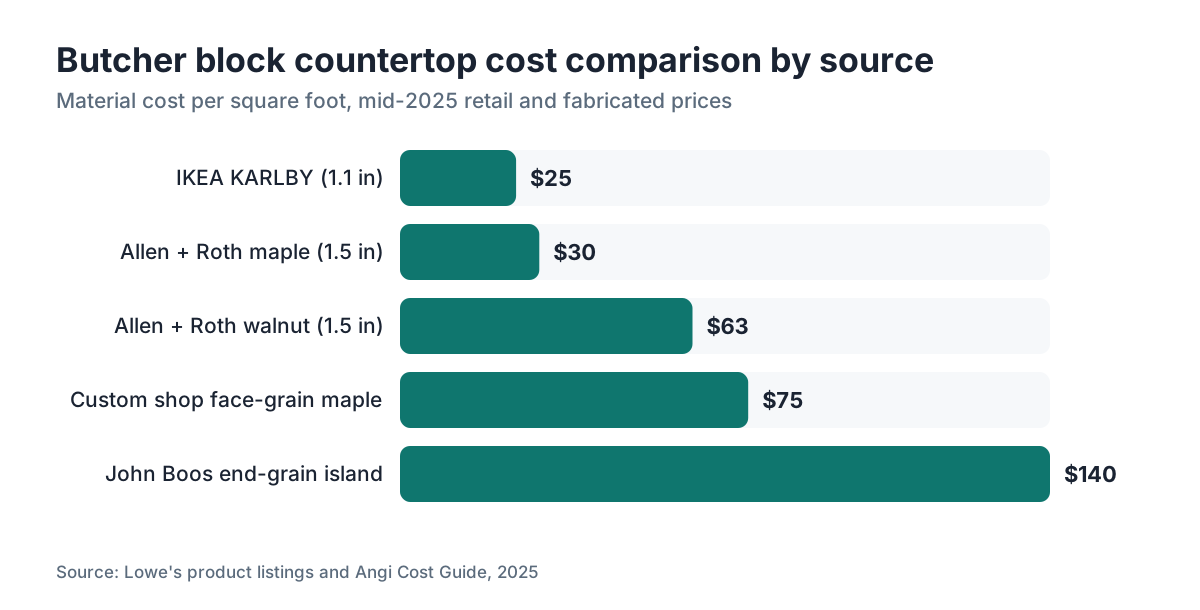
The honest number is $25 to $65 per square foot for the material itself. [2] That's the shelf price at Lowe's, before installation, edge work, or any sealing you add.
Here's how that lands against the wider butcher block market:
- Allen + Roth (Lowe's private label): $25 to $65/sq ft, material only
- IKEA KARLBY: roughly $20 to $30/sq ft, thinner stock (1.1 in)
- John Boos end-grain islands: $80 to $200+/sq ft depending on size
- Custom shop face-grain maple: $50 to $100+/sq ft, fabricated and installed
A typical 30-square-foot kitchen run (say a 25-inch-wide, 8-foot section plus a short return) runs $750 to $1,200 in Allen + Roth material. Add $200 to $500 for a basic DIY install (sink cutout, fasteners, finish coat) or $400 to $800 for a pro. Total installed cost for a modest kitchen lands around $900 to $2,000. [3]
That's a good bit less than granite countertops at $40 to $100 per square foot installed, and more than laminate countertops at the low end ($10 to $40 installed). Allen + Roth butcher block sits in a real middle ground: above budget laminate, below stone.
One thing to watch. Lowe's runs promotions constantly, heaviest around Memorial Day and Labor Day. Stack a sale with a Lowe's credit card discount and you can knock 10 to 30% off the shelf price. If your timeline is loose, waiting for a sale is a real strategy, not a gimmick.
How does Allen + Roth butcher block hold up in a real kitchen?
Butcher block is wood. Wood is organic, porous, and reactive to heat and moisture. No brand name changes any of that.
Hard maple Allen + Roth boards are dense enough to shrug off normal knife work if you keep the finish up. But that "if you keep the finish up" clause is carrying the whole sentence. An oiled surface sheds water. A neglected one drinks it in, swells a little at the seams, and can grow black mold rings near the sink inside 12 to 18 months if water keeps pooling there. [4]
Hot pots are the other problem. Wood is a weak insulator at countertop thickness. A 1.5-inch maple slab takes brief contact with a warm pan fine, but it scorches and dries out from repeated direct contact with anything over 300 degrees F. Use trivets. Every time.
Scratch resistance is fair, not great. Maple's Janka hardness of 1,450 lbf beats pine or walnut at resisting dents, but a dropped cast iron pan will still leave a mark. The upside: surface scratches and small dents sand out with 120-grit and a fresh coat of oil. You can't do that with quartz or granite. [5]
A note for fabricators and shop owners. If a customer is circling butcher block, tell them straight: wood carries the highest ongoing maintenance of any surface they can buy. The material is cheap. The commitment is not. Some homeowners love the oiling ritual. Others quit inside a year and then call to complain about water damage that no warranty covers.
Allen + Roth's warranty covers manufacturing defects, not damage from bad maintenance, water, or heat. Standard for the category.
How do you seal and maintain Allen + Roth butcher block?
Pre-finished boards ship with either a mineral oil coat or a lacquer/polyurethane finish already on. Your maintenance path depends on which one you got.
Oil-finished boards want re-oiling every 1 to 3 months the first year, then 2 to 4 times a year after that, depending on how much water the surface sees. Food-safe mineral oil is the standard pick, around $8 to $15 per quart at any hardware store. Flood it on, let it soak 20 minutes, wipe the excess. Howard Butcher Block Conditioner (mineral oil plus beeswax) is a popular step up that adds a little surface repellency. [6]
Lacquer or polyurethane boards resist water better out of the box and need less attention. But you can't cut on them (the finish chips), and when the finish finally fails you have to sand to bare wood and start over instead of just re-oiling.
Around sinks, caulk the seam between countertop and sink hard, and re-check that seal every year. That seam is where most butcher block failures start. Seal the underside near the sink cutout too, with a coat of oil or finish. A lot of installers skip it.
Clean with mild soap and water. Skip bleach (it dries the fibers and strips oil finish). Don't soak the surface, and dry spills fast.
Deep stain? A light sand with 150-grit and a re-oil usually pulls it out. That's one of the genuinely great things about wood countertops.
Can you use Allen + Roth butcher block around a sink?
Yes, but it takes more care than the product descriptions let on.
The slab itself isn't the problem. The sink cutout edges are. When you cut into a butcher block panel to drop in a sink, you expose fresh grain that drinks water like a sponge. That edge needs sealing before the sink goes in. Three to four coats of a penetrating oil, or two coats of a film-forming finish like polyurethane, on every cut surface before installation. [6]
Undermount sinks are riskier than drop-ins with wood, because the wood edge sits right against the sink lip and in the water path. It can work. But the sealing has to be perfect, and you re-caulk that joint every 1 to 2 years.
Drop-in (overmount) sinks forgive more. The rim covers the cut edge and gives you a second water barrier.
Some fabricators won't do undermount on wood at all, and that's a defensible line to hold. If a customer insists on undermount with butcher block, put the maintenance requirements in writing before you install a thing.
Here's a practical middle path for homeowners with a heavy-use kitchen: run butcher block away from the sink and put a stone or quartz section at the sink itself. The wood gives you the warm look and the prep surface. The stone handles the wet zone. Everybody wins.
How does Allen + Roth butcher block compare to other countertop materials?
This is where the honest trade-offs live. Wood isn't the best material for every kitchen. Neither is stone.
| Material | Installed cost/sq ft | Heat resistance | Scratch resistance | Water resistance | DIY-friendly | Repairability |
|---|---|---|---|---|---|---|
| Allen + Roth butcher block | $30, $80 | Poor (scorch risk) | Fair | Low (needs sealing) | High | High |
| Granite | $40, $100 | Excellent | Very high | Very high | Low | Low |
| Quartz | $50, $120 | Good | High | Very high | Low | Low |
| IKEA butcher block | $20, $45 | Poor | Fair | Low | High | High |
| Laminate | $10, $40 | Poor | Fair | Moderate | High | Low |
| Corian/solid surface | $45, $95 | Moderate | Moderate | Very high | Moderate | Moderate |
Sources: [2][3][5]
Want a food-prep surface that shows off real wood, and willing to maintain it? Allen + Roth butcher block is a solid pick. Want a carefree surface that survives a chaotic household with zero routine? Skip wood entirely and look at quartz or a solid-surface option like Corian countertops.
Laminate countertops cost less and are just as DIY-friendly, but you can't sand out damage and they tend to look cheaper as the years pile up.
Kitchen countertops as a category cover a huge range, and butcher block fills a specific slot: warm look, real wood feel, medium price, high upkeep. Figure out which of those four actually matters to your household before you commit.
Is Allen + Roth butcher block good for a kitchen island?
Islands are the best use case for butcher block, and Allen + Roth's island tops are built for exactly this.
Here's why islands beat perimeter runs. An island sees far less constant water than the counter next to the sink. It gets chopping, dough-rolling, plating. That's the work butcher block was made for. You're playing to the material's strengths instead of fighting its weaknesses.
Allen + Roth sells island tops in 36-inch and 48-inch widths. Need something bigger? Join two panels with a biscuit joint and wood glue, then sand flush. That's intermediate woodworking, not a beginner move, but it's doable in a weekend.
Thickness matters on an island. The standard 1.5-inch stock looks right on a standard 36-inch cabinet. Want the chunky, furniture-look slab that farmhouse kitchens love? Some fabricators glue and stack two panels to hit 3 inches. Allen + Roth doesn't sell thick stock pre-made.
For fabricators pricing island jobs: butcher block islands are usually mixed-material projects. You're doing the substrate work (leveling, shimming the cabinet) while the stone or tile comes from somewhere else. Or the customer buys the wood from Lowe's directly and hands you install-only. Nail down your scope before you quote a number.
If you run a shop and want to quote projects that combine a wood island with stone perimeter tops, tools like SlabWise let you handle multiple surface types in one quote. That's handy when a job mixes butcher block and stone.
Can you install Allen + Roth butcher block yourself?
Yes. It's one of the genuinely DIY-friendly countertop materials on the market.
The basic process: cut the panel to length (a circular saw with a fine-tooth blade works, a track saw gives cleaner results), cut the sink opening if you need one, seal all cut edges before the countertop goes down, run construction adhesive or silicone across the cabinet tops, set the panel, and fasten with wood screws up through the cabinet corner brackets from below. Give it 24 hours before you load the surface.
Difficulty: moderate. The cuts have to be accurate. The sink cutout wants a jigsaw and a steady hand, or a template. Sealing cut edges before install is the step people skip, and it costs them later. If you've done basic finish carpentry, you can handle this.
The most common DIY mistake: ignoring the wall. Walls are almost never straight. Scribing the back edge of the countertop to the wall gets you a tight fit. Skip it and you're left with gaps you'll caulk over and stare at.
Undermount sinks change the math. The support clips, the caulking, the tight cutout geometry, all of it gets harder. At that point, paying a pro for that portion of the job is a reasonable call.
Pro install labor for butcher block usually runs $150 to $400, depending on linear feet, sink type, and region. [3] That's less than stone install, because the material is lighter and doesn't need diamond tooling to cut.
What are the common complaints about Allen + Roth butcher block?
The negative reviews on Lowe's site and in home-improvement forums cluster around a handful of themes. These are real patterns, not cherry-picked one-offs.
Warping. Boards stored badly or set on an uneven substrate can cup or bow over time. Wood moves. If one face gets a lot more moisture than the other (the top gets oiled while the underside soaks up damp from the cabinet), the board cups toward the wetter side. Sealing both faces equally at install prevents most of it. [4]
Color variation. The natural character that makes butcher block attractive also means two boards from the same SKU can look noticeably different. Some buyers expected uniform and got surprised. It's not a defect. It's wood. But it catches people off guard.
Joint quality. On some runs, reviewers flag visible glue seams or color mismatches at the finger-joint seams in the stave construction. Cosmetic, not structural, but real.
Shipping damage. Pre-finished panels sometimes show up with nicks or dings on the face or edges from handling. Order online, inspect the second it arrives, and photograph any damage before you start a return.
Dimensional accuracy. A few reviews note that "25 inches wide" panels measure a hair under, which matters if your cabinets expect a precise overhang. Measure before you install. Don't assume.
None of these are unique to Allen + Roth. Most apply to retail wood countertops from any source. For its price tier, the brand holds its own.
Where does Allen + Roth butcher block fit in a fabricator's business?
Run a countertop shop and you probably don't stock Allen + Roth. You're either fabricating your own wood tops, buying from a wood-specific supplier, or sending customers to Lowe's for that category. All three are legitimate.
The scenario where Allen + Roth lands on your bench: a customer buys a Lowe's panel and asks you to install it, cut the sink, or tie it into stone you're fabricating for the same kitchen. This happens all the time.
If you take that work:
- Price the butcher block labor separately from your stone work. The skills and tooling overlap but aren't the same.
- Confirm who's supplying the sealer and which product it is. If the customer hands you a pre-finished board, you need to know what's on it before you cut edges and try to match the finish.
- Put it in writing that ongoing wood maintenance is the homeowner's job, and that water damage at the sink isn't your liability past a reasonable inspection window.
For shops quoting mixed-material kitchens (stone perimeter, wood island), a quoting system that handles multiple surfaces without spinning up a separate job for each saves real time. SlabWise is built for that kind of project, combining different countertop materials in one quote and tracking the job through to install.
The bigger point: butcher block is growing as a category. The NKBA has reported wood countertops showing up in roughly 10% of surveyed kitchen remodels in recent years, with year-over-year growth. [7] Knowing how to install and price wood work, even if you never fabricate it yourself, is worth the effort.
Is Allen + Roth butcher block worth buying, or should you get something else?
The honest answer depends on what you're optimizing for.
Buy Allen + Roth butcher block if you want real wood at a retail price, you're fine oiling a surface a few times a year, your kitchen doesn't have a permanent wet zone next to the counter, and you're doing the install yourself. For an island or a dry run, it's a genuinely good value. The maple options are honest hardwood at prices no custom shop can touch.
Skip it if you want low-maintenance, you have kids who leave wet glasses on every surface, you cook with high heat and don't want to think about trivets, or you need custom sizing the standard widths and lengths can't cover. For lower upkeep, marble countertops carry their own maintenance but handle heat differently, while quartz or Cambria countertops ask almost nothing of you day to day.
Comparing Allen + Roth to IKEA's KARLBY on price? IKEA's tops are thinner (1.1 inch vs 1.5 inch) and it shows. If the budget allows, the extra thickness on the Allen + Roth stock reads more substantial and holds up better at the edges. The IKEA tops are fine for light use but feel flimsier under your hand.
For the wider wood countertop story beyond this one brand, the butcher block countertops guide digs into grain orientation, species comparisons, and sealer chemistry.
Here's the bottom line on a genuinely useful product. Allen + Roth is not the best butcher block money can buy. It's the most accessible one, and that counts for a lot.
Frequently asked questions
Is Allen + Roth a real brand or just a Lowe's label?
It's a Lowe's private label with no independent company behind it. Lowe's owns the name and contracts manufacturing to third-party suppliers. You won't find an Allen + Roth factory or corporate phone number. The practical effect is that your warranty and return rights run through Lowe's, not a specialty manufacturer, which is fine for most homeowners and actually simplifies returns.
What wood species does Allen + Roth butcher block come in?
The standard line includes hard maple, acacia, and walnut. Hard maple is the most common and least expensive. Acacia has more dramatic grain variation. Walnut is darker and more expensive. Species availability varies by store and season. Bamboo occasionally appears in the lineup but isn't consistently stocked. Check Lowe's current inventory online before planning around a specific species.
How thick is Allen + Roth butcher block?
The standard thickness is 1.5 inches, which is the most common thickness for retail wood countertops and is proportionally right for standard 36-inch cabinet heights. IKEA's competing product runs 1.1 inches, noticeably thinner at the edges. Allen + Roth doesn't sell thicker stock; if you want a 3-inch look, you'd laminate two panels together.
Does Allen + Roth butcher block need to be sealed before use?
Pre-finished boards arrive with an oil or lacquer coat already applied and are technically ready to use. But any cut edges, sink openings, or trimmed ends you create during installation are bare wood and must be sealed before the countertop goes in. Three to four coats of food-safe mineral oil, or two coats of polyurethane, on all cut surfaces is the standard approach. Skipping this step is the most common cause of early water damage.
Can Allen + Roth butcher block be used as an actual cutting surface?
Oil-finished versions can be used as cutting surfaces and will develop the character marks many buyers want from wood. Lacquer or polyurethane-finished versions should not, because knife cuts chip the film finish and create edges that peel further. Check which finish type your board has before cutting directly on it. Most Allen + Roth boards are labeled for finish type on the packaging.
How often does Allen + Roth butcher block need to be oiled?
For the first year, plan on oiling every 4 to 8 weeks on an oil-finished board. Once the wood is well-saturated, 2 to 4 times per year is usually enough. A simple test: drop a little water on the surface. If it beads up, the oil is still working. If it soaks in within 30 seconds, re-oil. Near the sink, oil more often, because water exposure burns through the finish faster.
What is the warranty on Allen + Roth butcher block countertops?
Lowe's typically offers a one-year limited warranty on Allen + Roth countertops covering manufacturing defects. Water damage, heat damage, scratches, and staining from lack of maintenance are specifically excluded. The warranty runs through Lowe's customer service, not a separate manufacturer. Keep your receipt. Extended protection plans are sometimes available at checkout for an added fee.
Can Allen + Roth butcher block be cut down to a custom size?
Yes, and it's easy compared to stone. A circular saw with a fine-tooth blade (60+ teeth) gives a clean cut. A track saw or guide rail gets you the most accurate results. Lowe's offers in-store cutting for a fee, but finish quality on cut edges varies. Any cut you make exposes bare wood that needs sealing before installation. Length cuts are straightforward; sink cutouts want a jigsaw.
How does Allen + Roth butcher block compare to John Boos?
John Boos is an established American manufacturer with a 130-year history making professional-grade wood countertops and butcher blocks. Their products are generally thicker, have tighter quality control, and cost a lot more: $80 to $200+ per square foot for end-grain island blocks. Allen + Roth is a retail private label at $25 to $65 per square foot. For a food-prep island where quality really matters, Boos earns the premium. For a kitchen makeover on a budget, Allen + Roth is a legitimate choice.
Can you put an undermount sink under Allen + Roth butcher block?
Technically yes, but it's the riskiest combination in wood countertop installation. The wood edge around the cutout sits in constant contact with the wet zone, and any sealing failure leads to rot and swelling. If you go undermount, seal the cutout edges with 3 to 4 heavy coats of polyurethane before installation, use a high-quality silicone caulk at the sink-to-wood joint, and plan to re-caulk annually. Some installers refuse this setup on wood entirely, which is defensible.
Does Lowe's install Allen + Roth butcher block, or do you have to DIY?
Lowe's offers installation through third-party contractors, with availability and pricing that vary by region. As of 2025, basic butcher block installation through Lowe's contractors typically runs $200 to $600 for a standard kitchen depending on linear feet, sink type, and local labor rates. You can also buy the countertop and hire your own installer separately. DIY is realistic for most homeowners with basic carpentry skills.
What's the best oil to use on Allen + Roth butcher block?
Food-safe mineral oil is the standard recommendation and costs $8 to $15 per quart at any hardware store. It's odorless, colorless, won't go rancid, and is safe around food prep. Howard Butcher Block Conditioner adds beeswax for slightly better water beading. Avoid cooking oils like olive or vegetable oil; they go rancid in the wood and smell bad. Walnut oil works but isn't safe for households with nut allergies.
How do you remove stains or scratches from Allen + Roth butcher block?
Light scratches and surface stains respond well to sanding. Start with 120-grit, sand with the grain, move to 150-grit to smooth, then finish with 180 to 220 grit. Wipe clean and immediately apply food-safe mineral oil to the sanded area. Deeper gouges can be filled with wood filler before sanding, though color matching is imperfect. Mold stains near sinks sometimes need oxalic acid (wood bleach) before sanding and re-oiling.
Is Allen + Roth butcher block made from sustainable wood?
Lowe's has made broad sustainability commitments, including FSC-certified wood sourcing, but individual SKU certification status isn't consistently labeled on Allen + Roth products. If FSC certification matters to you, check the specific product page or ask in-store for the SKU's sourcing documentation before buying. Some boards are certified; others aren't. Lowe's publishes its responsible sourcing policy and wood procurement standards on its corporate responsibility page.
Sources
- Wood Database, Janka Hardness Ratings by Species: Hard maple Janka hardness approximately 1,450 lbf; black walnut approximately 1,010 lbf; acacia species range 1,010 to 1,750 lbf
- Lowe's, Allen + Roth Butcher Block Countertops product category: Allen + Roth butcher block countertops retail price range $25, $65 per square foot depending on species and size
- Angi, Butcher Block Countertop Installation Cost Guide: Professional butcher block installation labor typically $150, $400; total installed costs $900, $2,000 for modest kitchen runs
- USDA Forest Service, Forest Products Laboratory, Wood Handbook Chapter 4: Moisture Relations and Physical Properties of Wood: Wood is hygroscopic and responds to ambient moisture; differential moisture exposure on top vs bottom faces causes cupping
- USDA Forest Service, Forest Products Laboratory, Wood Handbook Chapter 5: Mechanical Properties of Wood: Janka hardness test measures resistance to indentation and is used to compare wood species suitability for countertop and flooring applications
- University of Minnesota Extension, Food Safety in the Home Kitchen: Cutting Boards and Food Contact Surfaces: Food-safe mineral oil is recommended for conditioning wood cutting surfaces and food-contact countertops; avoid vegetable and animal-derived oils that can go rancid
- National Kitchen and Bath Association (NKBA), Kitchen and Bath Market Index: Wood and butcher block countertops appeared in approximately 10% of kitchen remodels surveyed with year-over-year growth in the category
- EPA, Formaldehyde Emission Standards for Composite Wood Products (TSCA Title VI): Composite wood products used in furniture and countertops may emit formaldehyde; TSCA Title VI limits emissions from composite wood products sold in the US
- California Air Resources Board (CARB), Composite Wood Products Airborne Toxic Control Measure: CARB Phase 2 standards limit formaldehyde emissions from composite wood products including those used in countertop construction
- Lowe's Companies Inc., Responsible Sourcing and Wood Procurement Policy: Lowe's has committed to responsible wood sourcing including FSC-certified options across product categories including Allen + Roth
- USDA Food Safety and Inspection Service, Safe Food Handling Fact Sheet: Cutting Boards: Both wood and plastic cutting boards are considered safe for food contact when properly maintained and sanitized
- Journal of Food Protection, Bacterial attachment and penetration on wood vs plastic cutting surfaces: Research has shown wood surfaces can have antimicrobial properties due to absorption of bacteria into wood fibers where they die; plastic surfaces can harbor bacteria in knife grooves
Last updated 2026-07-09