TL;DR
- Quartzite is a naturally metamorphosed sandstone, harder than granite and genuinely acid-resistant when sealed, which makes it one of the best performing natural stones for kitchens.
- Installed costs run $60 to $200 per square foot depending on slab rarity and edge complexity.
- The catch: mislabeling is rampant, so always test the stone before you buy.
What is quartzite, and how is it different from quartz?
Quartzite starts as sandstone and gets cooked under intense heat and pressure deep in the earth, fusing the sand grains into an interlocking mosaic of quartz crystals. The result is a stone with a Mohs hardness of 7 to 7.5, harder than granite (6 to 6.5) and much harder than marble (3 to 4) [1]. Quartz countertops are a different animal entirely. They're an engineered product: crushed stone (usually 90 to 94% quartz mineral) bound with polymer resins and pigments. They're manufactured, not quarried as slabs [2].
Why does the distinction matter in a kitchen? Because hardness and acid resistance are genuinely different between the two. True quartzite shrugs off etching from lemon juice, tomato sauce, and vinegar far better than marble does, though no unsealed natural stone is fully immune. Engineered quartz resists etching too, but its resin binders can yellow from prolonged UV exposure, and they aren't repairable the way natural stone is.
The stone industry's loose labeling makes the confusion worse. Slabs sold as "White Macaubas quartzite" or "Sea Pearl quartzite" are sometimes dolomitic marble or a soft stone called quartzitic sandstone, neither of which performs like true metamorphic quartzite. This is not a niche problem. If your fabricator can't show you a petrographic report or at least point you toward an acid test, do the test yourself before signing a contract.
How can you tell if a quartzite slab is genuine?
The fastest field test is a scratch test paired with an acid drip. Genuine metamorphic quartzite scratches glass easily (Mohs 7+) and won't etch or fizz when you drop a little muriatic acid or even white vinegar on an inconspicuous edge. Marble and dolomite fizz immediately because they're carbonate rocks [1]. Softer imposters like quartzitic sandstone scratch glass but may still etch.
The scratch test alone isn't enough. Use a steel knife blade (Mohs ~5.5): it should leave a mark on the blade, not on the stone. If the stone scratches, it's likely marble or limestone. If it passes the scratch but fizzes on acid, it's probably dolomite, which is still a carbonate mineral and will etch over time in a working kitchen.
For a $5,000 to $15,000 countertop purchase, you can also request a petrographic thin-section analysis from a geological testing lab. That's overkill for most homeowners, but fabricators buying large quantities of a new slab variety should consider it. Some importers now provide third-party mineral analysis sheets with their premium slabs, so ask the distributor directly.
Slab origin offers a clue too. Most genuine quartzite comes from Brazil, India, or Norway. American suppliers get the bulk of their true quartzite from Brazilian quarries in Minas Gerais and Espírito Santo states [3]. If a slab is listed as quartzite but sources from regions better known for marble, press harder on verification.
What do quartzite countertops cost in 2026?
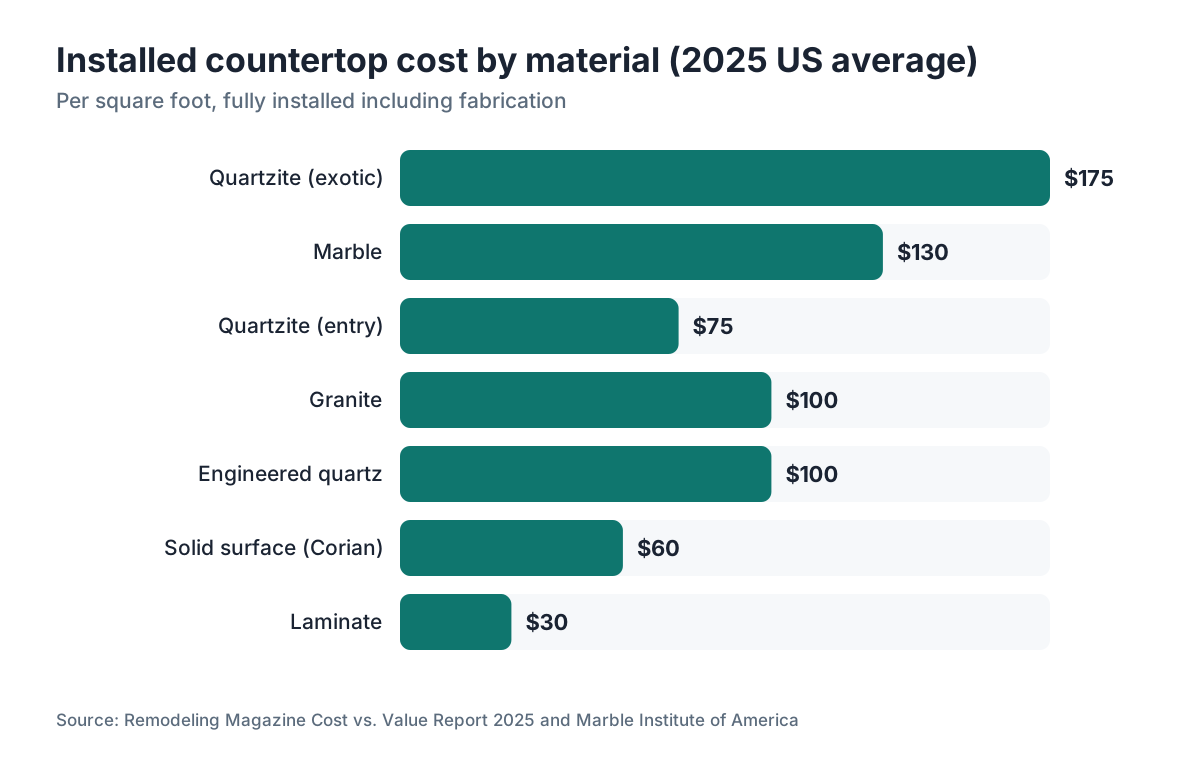
Installed quartzite countertops in the US run roughly $60 to $200 per square foot, and the wide spread comes almost entirely from slab rarity, color, and veining complexity [4]. Entry-level quartzites, usually white or light gray stones with minimal movement, land between $60 and $90 installed. Mid-range stones with more dramatic veining run $90 to $140. Rare varieties like Cristallo or Fantasy Brown (when it's genuine quartzite, which Fantasy Brown often isn't) push past $150 to $200 per square foot all-in.
That installed figure covers the slab, fabrication (cutting, edging, polishing), and basic installation. It does not cover plumbing disconnection and reconnection, removal of your old countertops, tile backsplash adjustments, or permit fees if your jurisdiction requires them for a full kitchen renovation.
Edge profiles add cost. A basic eased or beveled edge is usually baked into the fabrication quote. Ogee, waterfall, or mitered edges add $15 to $40 per linear foot. Cutouts for undermount sinks and cooktops typically run $100 to $250 each.
Sealing is usually included in installation, but ask explicitly. A professional-grade impregnating sealer costs $30 to $80 per quart at the supply level, and labor to apply it adds another $50 to $150 depending on job size [5]. Resealing every one to three years is a real ongoing cost. Budget for it.
For fabricators building quartzite quotes, material waste from unusual slab layouts eats margin fast on exotic stones. Nesting software that trims offcut waste protects real money on expensive slabs. SlabWise has a free instant quote tool homeowners can use to sanity-check fabricator bids.
See the cost comparison chart below for how quartzite stacks up against other popular kitchen countertop materials.
How does quartzite compare to granite, marble, and quartz for kitchens?
Here is a direct comparison across the materials most kitchen buyers weigh:
| Material | Hardness (Mohs) | Acid resistance | Installed cost ($/sq ft) | Needs sealing? |
|---|---|---|---|---|
| True quartzite | 7 to 7.5 | High | $60, $200 | Yes, every 1 to 3 years |
| Granite | 6 to 6.5 | High | $45, $150 | Yes, every 1 to 3 years |
| Marble | 3 to 4 | Low (etches easily) | $50, $180 | Yes, more frequently |
| Engineered quartz | 7 | High (resin may yellow) | $55, $150 | No |
| Quartzite sandstone (mislabeled) | 4 to 6 | Low to moderate | Varies | Yes |
Granite is the closest apples-to-apples natural stone comparison. Both granite and quartzite are hard, acid-resistant when sealed, and repairable by a stone professional. Granite generally costs a bit less for the same coverage because it's quarried more widely and its supply chain is more mature [4]. For kitchen countertops where you're working near heat, knives, and acidic foods, both hold up.
Marble countertops are genuinely beautiful, but if you cook regularly, acid etching is a real and constant problem, not a remote risk. A marble kitchen is a commitment to a living, patina-developing surface. Some people love that. Many do not once they live with it.
Engineered quartz (like Cambria countertops) gets recommended for its consistent pattern and low maintenance. Here's the downside nobody says plainly: if your engineered quartz cracks or chips, the repair is hard and rarely invisible. Quartzite repairs can be ground and repolished by a skilled fabricator with results that are close to undetectable. See the article on granite countertops for a parallel look at that material.
Is quartzite heat-resistant enough for a kitchen?
Yes, with one reasonable qualification. True metamorphic quartzite formed at temperatures well above 1,000°F, so a hot pan at 400°F won't hurt the stone itself [1]. The sealer is another story. Impregnating sealers are typically rated to 200°F to 400°F depending on the product, and sustained contact with a cast-iron skillet pulled from the oven can scorch the sealer, leaving a dull ring even though the stone underneath is fine [5].
The practical rule: use a trivet. It's not that quartzite can't take heat. It's that protecting the sealer is worth 30 seconds of reaching for a trivet. Setting a room-temperature pot on the counter is fine. Moving something straight from a 500°F oven is when the trivet earns its keep.
Thermal shock, meaning rapid temperature change rather than sustained heat, is the bigger cracking risk for any stone near a sink, where cold water runs right after something hot sat nearby. This worries me more with marble and softer stones than with quartzite, but tell your installer anyway so they reinforce the area around the sink properly.
Does quartzite scratch easily?
No. At Mohs 7 to 7.5, quartzite is harder than almost any kitchen tool you own. A steel chef's knife lands around Mohs 5.5 to 6.5. Ceramic knives run 8.5 to 9, so yes, a ceramic knife dragged across quartzite could theoretically leave a mark, but the stone still beats granite on scratch resistance.
The real-world issue isn't scratching, it's micro-abrasion of the sealer and polish over many years. A honed finish shows fewer marks than a polished finish, which can reveal fine scratches in raking light. Quartzite with a matte or leathered finish keeps gaining popularity in kitchens for exactly this reason: the texture hides daily wear far better than a mirror polish.
If you do put a genuine scratch in the stone surface (usually from dragging a cast-iron skillet across the counter), a stone restoration company can re-hone or re-polish that area. The repair isn't cheap ($150 to $400 depending on scope), but it's possible [4].
What maintenance does quartzite require in a kitchen?
Daily cleaning is simple: warm water and a pH-neutral cleaner or plain dish soap. That's it. Avoid acidic cleaners (vinegar-based products, citrus sprays), alkaline cleaners above pH 10, and anything abrasive. Those degrade the sealer faster than normal use [5].
For a full reference on cleaning methods and products to avoid, the how to clean quartzite countertops guide goes deeper. The how to clean stone countertops article covers the broader principles that apply across all natural stone.
Sealing frequency depends on the stone's porosity. A simple water bead test tells you when it's time: pour a tablespoon of water on the counter and wait 15 minutes. If it soaks in and darkens the stone, reseal. If it beads up, you're fine. Most quartzite kitchens need resealing every one to three years under normal cooking conditions [5].
Don't use cooking oil directly on the stone, and don't let it pool. Oil can penetrate an older or compromised seal and leave a stubborn stain that often needs a poultice to pull out. Wipe spills quickly. That's the most useful maintenance advice there is, and it applies to any natural stone.
What are the most popular quartzite colors and patterns for kitchens?
White and light gray quartzite dominates kitchen sales for the same reason white marble does: it photographs well, brightens small spaces, and pairs with almost any cabinet color. Taj Mahal quartzite (creamy white with soft gold veining) and White Macaubas (stark white with subtle gray movement) sit consistently at the top of stone distributor sales in the US [3].
When the countertop needs to be the design statement, Azul Macaubas (blue-gray with white veining) and Calacatta Macaubas (white with bold gray veins that mimic Italian marble) have grown a lot over the past five years. These command higher prices, typically $100 to $180 installed, because of lower quarry yields and higher import costs [4].
Finish choice matters as much as color. A polished finish shows the stone's depth and luster but telegraphs every water spot, fingerprint, and crumb. A honed finish (matte) forgives more in daily kitchen life but sits slightly more porous at the surface, so it may need sealing a bit more often. A leathered finish (textured) is the most forgiving of the three for busy kitchens and looks genuinely beautiful on darker quartzite.
One honest opinion: if you have young kids or run a high-volume household kitchen, lean toward honed or leathered. You'll spend far less time wiping and far less mental energy on the surface.
How thick should quartzite countertops be?
Standard kitchen countertop thickness is 3/4 inch (2 cm) or 1-1/4 inch (3 cm) slabs. For kitchens, 3 cm is almost always the better choice. It's structurally stronger, needs less laminating at edges, and gives a more substantial edge profile. The weight difference is real: 3 cm quartzite weighs roughly 18 to 20 pounds per square foot, which affects cabinet load but stays within standard cabinet specifications [4].
2 cm slabs cost less and work fine for smaller runs or laundry room counters, but they usually need a wood or plywood substrate for support over longer spans, which adds the cost right back. For a kitchen island over 36 inches long, 3 cm is the standard professional recommendation.
Mitered waterfall edges (where the slab wraps vertically down the cabinet side) demand careful fabrication on 3 cm stock. Done well, a waterfall edge with bookmatched quartzite is stunning. Done poorly, it's an expensive reminder to vet your fabricator's portfolio before you sign anything.
What questions should you ask a fabricator before ordering quartzite?
The most important question is deceptively simple: can you confirm this slab is metamorphic quartzite, and do you have any documentation from the distributor? A good fabricator won't take offense. A bad one gets defensive. If they don't know, ask whether you can bring a drop of muriatic acid to the yard and test an edge of the slab yourself before purchase.
Ask specifically about remnants. Quartzite remnants (leftover pieces from previous jobs) often sell for $200 to $600 flat for a piece large enough to cover a small kitchen, versus $1,500 to $3,000 for a fresh full slab. If your kitchen is under 30 square feet of counter space, remnants are absolutely worth exploring.
For the quote itself, ask the fabricator to show you the layout on the slab. How much material goes to waste? Where are the seams? On a dramatically veined stone, seam placement matters both structurally and visually. A good fabricator walks you through a slab layout and discusses seam options before cutting. Shops using nesting and layout software (the kind that optimizes slab cuts to reduce waste) generally produce more accurate quotes and fewer expensive surprises at install.
Also ask: what sealer do you use, and does it carry a warranty? Premium impregnating sealers from companies like Miracle Sealants or StoneTech offer 5-year warranties on some product lines [5]. That beats a generic aerosol can applied once and never mentioned again.
For the countertop installation side of the process, that article covers what to expect on the day of, how to prep your kitchen, and how to judge the finished install.
How does quartzite compare to cheaper alternatives like laminate or butcher block?
Fair question, and the answer depends entirely on how you use your kitchen and what you value.
Laminate countertops and Formica countertops cost $15 to $50 installed per square foot, a fraction of quartzite. Modern laminate is far better than it was 20 years ago: printed stone patterns read realistic at a glance, and quality laminate from brands like Wilsonart or Formica Group handles moisture, heat, and impact reasonably well for casual kitchens. The honest tradeoff: you can't repair laminate the way you can natural stone, and the surface doesn't carry the same resale value perception.
Butcher block countertops are a genuinely different product for genuinely different uses. Wood is soft and will scratch and stain, but plenty of cooks love it precisely because it's a working surface. A kitchen with quartzite on the perimeter and butcher block on the island is a popular hybrid, and it makes functional sense: stone for food prep near the sink, wood for cutting and working.
Corian countertops split the difference: a solid surface that's repairable, joined with invisible seams, and mid-priced at $40 to $80 installed. But it scratches much more easily than quartzite (Mohs 2.5 to 3) and looks obviously synthetic up close.
On resale value, the National Association of Realtors has tracked kitchen remodel returns, and stone countertops consistently show up among the improvements buyers pay for in home sales [6]. Quartzite markets well because educated buyers recognize its relative rarity next to granite.
Can quartzite countertops be repaired if they chip or crack?
Yes. Quartzite chips along edges and at cutouts (sinks, faucet holes) most often, and those repairs sit within the skill set of any experienced stone restoration company. Color-matched epoxy or resin fills handle chips; larger cracks may need a mix of resin injection and re-polishing. Results vary by damage severity and the stone's color and pattern. A white quartzite with a subtle chip near an undermount sink is a much simpler repair than a heavily veined stone with a crack across a high-visibility run.
Cracks from structural failure (cabinet settling, poor support at a span, or thermal shock) are more serious and sometimes force section replacement. This is why install quality matters so much: quartzite that isn't properly supported over a cabinet run longer than 36 inches without a support bracket is at risk of cracking under load.
If you're dealing with a stain rather than physical damage, a poultice (an absorbent powder mixed with a chemical solvent, applied and left to draw the stain out) handles most organic stains in 24 to 48 hours. The Marble Institute of America has published stain removal guides that specify the right poultice chemistry for oil, rust, organic, and ink stains on natural stone [7].
Frequently asked questions
Is quartzite good for kitchen countertops?
Yes, genuine metamorphic quartzite is one of the best natural stone options for kitchens. Its Mohs hardness of 7 to 7.5 resists scratching from knives and daily tools, and it holds up to acidic foods far better than marble does. It needs sealing every one to three years and routine pH-neutral cleaning, but those are manageable commitments for a surface that can last the life of the house.
How do I know if a slab sold as quartzite is real?
Do an acid test on an edge: place a few drops of white vinegar or dilute muriatic acid on the stone. True metamorphic quartzite won't fizz or etch. Marble, dolomite, and limestone fizz immediately because they contain carbonate minerals. Also try scratching the stone with a steel knife blade. If the stone scratches easily, it's not true quartzite. Ask your distributor for a mineral analysis or origin documentation from the quarry.
What is the average cost of quartzite countertops?
Installed quartzite countertops cost $60 to $200 per square foot in the US as of 2026. Entry-level varieties with minimal veining land at $60 to $90. Rarer slabs with bold patterns push toward $150 to $200 all-in. Edge upgrades, undermount sink cutouts, and sealer applications add to the base figure. Budget roughly $3,000 to $7,000 for a typical 40 to 50 square foot kitchen, more for premium stone.
Does quartzite need to be sealed?
Yes. Quartzite is porous enough that an impregnating sealer is necessary to resist oil, juice, and other kitchen stains. Most installations need resealing every one to three years depending on use and the stone's porosity. The water bead test is the easiest indicator: if water soaks in and darkens the stone within 15 minutes rather than beading up, it's time to reseal. Professional sealers with 5-year warranties are available.
What is the difference between quartzite and quartz countertops?
Quartzite is a natural metamorphic rock quarried as slabs and composed almost entirely of interlocked quartz crystals formed under geological heat and pressure. Quartz countertops are engineered: crushed stone (90 to 94% quartz mineral) bonded with polymer resins and pigments, then formed into slabs. Quartzite is repairable by stone restoration professionals. Engineered quartz doesn't need sealing, but its resin binders can yellow in direct sunlight over time.
How does quartzite compare to granite for kitchens?
Quartzite is slightly harder than granite (7 to 7.5 vs 6 to 6.5 on the Mohs scale) and similarly acid-resistant when sealed. Both are excellent kitchen stones. Granite costs a bit less on average because the global supply chain is more mature. Quartzite offers more dramatic veining that appeals to buyers who want the look of marble without marble's soft, acid-sensitive surface. For most kitchens, either material performs well long-term.
Can quartzite countertops handle heat from pots and pans?
The stone itself handles kitchen-level heat with no problem, having formed at temperatures well above 1,000°F. The sealer is the vulnerable part: sustained contact with a pan straight from a 500°F oven can scorch the sealer, leaving a dull ring. Using a trivet protects the sealer and keeps the surface looking sharp. Thermal shock near the sink, going from hot to cold fast, is a low but real cracking risk near cutouts.
What colors of quartzite are available for kitchens?
The most popular kitchen quartzites are white and light gray varieties: Taj Mahal (creamy white with gold veining), White Macaubas (stark white), and Calacatta Macaubas (white with bold gray veins). Blue-gray options like Azul Macaubas are available at higher price points. Finish options include polished, honed (matte), and leathered (textured). Honed or leathered finishes forgive more in busy kitchens because they hide fingerprints and daily wear better.
How thick should quartzite kitchen countertops be?
For kitchens, 3 cm (about 1-1/4 inch) is the standard professional recommendation. It's structurally stronger than 2 cm, needs no additional substrate for standard spans, and presents a more substantial edge profile. It weighs 18 to 20 pounds per square foot, which is within normal cabinet load ratings. The 2 cm thickness works for smaller or lighter-use applications but requires a wood sublayer for support in kitchen spans.
Where does most quartzite come from?
Most quartzite sold in the US comes from Brazil, particularly the states of Minas Gerais and Espírito Santo, which produce the bulk of commercial quartzite slabs including popular varieties like Taj Mahal and Macaubas. India and Norway also produce significant quantities. When verifying whether a slab is genuine quartzite, origin from a Brazilian quarry is a positive (though not conclusive) indicator, since Brazil's quartzite output is well-documented.
Is quartzite a good investment for resale value?
Stone countertops consistently appear in National Association of Realtors surveys as among the kitchen features buyers pay a premium for. Quartzite specifically benefits from being rarer than granite and carrying a higher perceived luxury tier than engineered quartz in buyer conversations. Exact resale ROI is hard to isolate from a full kitchen remodel, but high-quality natural stone countertops generally recoup 60 to 80% of their cost in resale value, according to remodeling cost-vs-value reports.
Can you cut food directly on quartzite countertops?
You can, physically: quartzite is hard enough that your knives won't scratch it under normal cutting. But you shouldn't. Cutting directly on any stone counter dulls your knives fast because the stone's hardness damages the blade edge far quicker than a wood or plastic board. Use a cutting board for knife work. Quartzite's hardness is an asset for durability, but it's an enemy of a good knife edge.
What cleaners should you avoid on quartzite?
Avoid anything acidic (vinegar-based sprays, citrus degreasers, or products containing hydrochloric or phosphoric acid) and anything with abrasives. These degrade the sealer and can eventually etch or dull the stone surface. Bleach and high-pH alkaline cleaners also damage the sealer over time. For daily cleaning, warm water with a few drops of dish soap or a pH-neutral stone cleaner is all you need. Dry the surface after to prevent water spots.
How long do quartzite countertops last?
With proper sealing and basic daily care, genuine quartzite countertops can last as long as the house. The stone itself doesn't degrade. What can fail over decades: the sealer (fixed by reapplication every one to three years), surface polish (restorable by a stone professional), and edge chips or cracks (repairable with color-matched epoxy). There are quartzite surfaces in historic buildings that are centuries old. Kitchen quartzite, cared for properly, is a permanent installation.
Sources
- USGS Mineral Resources Program, Quartz and Quartzite: Quartzite has a Mohs hardness of 7 to 7.5 due to interlocked quartz crystal structure formed by metamorphic heat and pressure; it does not contain carbonate minerals and thus does not react to acid.
- NSF International, Countertop Standards: Engineered quartz countertop products are composed of 90 to 94% crushed quartz mineral bound with polymer resins.
- USGS Mineral Commodity Summaries, Stone (Dimension): Brazil, particularly Minas Gerais and Espírito Santo states, is the primary source of quartzite dimension stone imported into the US.
- Remodeling Magazine, Cost vs. Value Report 2025: Installed natural stone countertop costs and average kitchen remodel return figures, including material cost ranges for granite and quartzite.
- Marble Institute of America, Care and Maintenance of Natural Stone: Impregnating sealers for natural stone require reapplication every one to three years and are typically rated to 200 to 400°F; cleaning should use pH-neutral products.
- National Association of Realtors, 2023 Remodeling Impact Report: Kitchen upgrades including stone countertops are among the top improvements buyers pay a premium for in home sales; remodeling cost recoupment for kitchen updates reported at 60 to 80%.
- Marble Institute of America, Stain Removal Guide for Natural Stone: Poultice formulations specific to oil, rust, organic, and ink stains on natural stone, including quartzite.
- USGS Open-File Report, Dimension Stone: Geology and Technology: Quartzite forms at temperatures above 1,000°F under geological metamorphic conditions, which underlies its heat tolerance as a countertop material.
- StoneTech Professional, Sealer Product Data Sheets: Premium impregnating sealers from StoneTech carry up to 5-year warranties for natural stone applications including quartzite.
- Marble Institute of America, Dimension Stone Design Manual: 3 cm (1-1/4 inch) slab thickness is the professional standard for kitchen countertops; quartzite weighs approximately 18 to 20 lbs per square foot at 3 cm.
Last updated 2026-07-09