TL;DR
- Quartzite edge profiles run from a plain eased edge (usually included in the base price) to decorative ogee or mitered waterfall profiles that add $10 to $30 or more per linear foot.
- Your best choice depends on slab thickness, room style, and how much traffic the edge takes.
- Hard quartzite holds a crisp profile better than softer stones like marble or soapstone.
What are countertop edge profiles and why does the stone type matter?
An edge profile is the shape cut into the exposed perimeter of a countertop. Every counter has one, whether the fabricator picks it deliberately or just knocks the sharp corner off and calls it done. The profile changes how the counter looks, how easy it is to wipe clean, how it feels under your palm, and how much you pay.
Quartzite is metamorphic rock. Sandstone gets buried under heat and pressure until the quartz grains recrystallize into an interlocking mosaic [1]. That process makes it harder than marble (usually 7 on the Mohs scale against marble's 3 to 4) and more resistant to chipping [1]. Hardness drives everything about edge work. Soft stones like soapstone and some marbles lose fine carved detail over years of normal use. Quartzite holds a crisp eased edge or a sharp mitered waterfall almost indefinitely.
The flip side is real. Quartzite is harder to cut and grind, so it eats more tooling. A complex profile on quartzite takes longer than the same profile on marble, and that time lands on your invoice.
Wood countertops run the logic backward. Wood is soft, so fabricators cutting edge profiles for wood countertops reach for router bits instead of CNC diamond tooling. The wood edge menu reads the same on paper (eased, bevel, ogee, roundover), but the execution and pricing are nothing alike. If you're weighing a butcher block countertop against quartzite for an island, price the edge separately for each material.
What are the most common quartzite edge profiles?
The industry has dozens of named profiles. Most shops work from a core list of eight to twelve. Here's what each one looks like and where it earns its place.
Eased (straight): The top corner gets softened to a slight roundover, maybe 1/8 inch. The face of the slab stays flat and vertical. Clean, modern, shows the full thickness of the stone. Usually included in the base slab price or adds under $5 per linear foot. Best for contemporary kitchens and anyone who wants the stone to do the talking.
Beveled: The top edge gets cut at a 45-degree angle, anywhere from 1/4 to 1 inch wide. It adds a thin shadow line and a little depth without fuss. Typically a $5 to $10 per linear foot upcharge.
Bullnose (full): The whole top edge rounds into a half-circle. Soft, family-friendly, no sharp corners. Good for bathroom vanities. One caution: a full bullnose on a 3 cm slab (roughly 1.25 inches) can look heavy. A demi-bullnose reads lighter.
Demi-bullnose: The top half rounds over, the bottom stays flat and vertical. More refined than a full bullnose, and slightly cheaper to cut because there's less material to remove. A favorite in transitional kitchens.
Ogee: The classic S-curve, borrowed from old architecture. Concave curve on top, convex below. Adds $10 to $25 per linear foot depending on the shop and the stone. Looks rich on thick quartzite and can feel dated in very modern rooms. It holds up beautifully on hard quartzite because the crisp curves don't wear away.
Dupont (waterfall or stacked): A 90-degree step down from the top surface, then a short vertical drop, then a curved or square return. People confuse it with the ogee, but the geometry is different. Common in traditional and transitional kitchens.
Mitered waterfall: Two slabs meet at a 45-degree miter at the corner, so the face of the island appears to be one continuous piece of stone running down to the floor. Dramatic. Expensive. It demands precise templating and skilled seam work. On quartzite, matching the vein across the miter is the whole point, so the slab you pick matters as much as the cut.
Chiseled or leathered edge: The edge is left rough or textured to match a leathered top surface. It adds visual weight. Bad for high-traffic zones where crumbs settle into the texture, but striking on a bar or a fireplace hearth.
Laminated (built-up): Two or three layers of stone stacked and bonded at the edge so a 3 cm slab reads like it's 6 cm thick. This is the move when someone wants a heavy edge presence without paying for a true thick slab. The seam where the pieces meet usually hides inside the profile shape.
How much do quartzite edge profiles cost per linear foot?
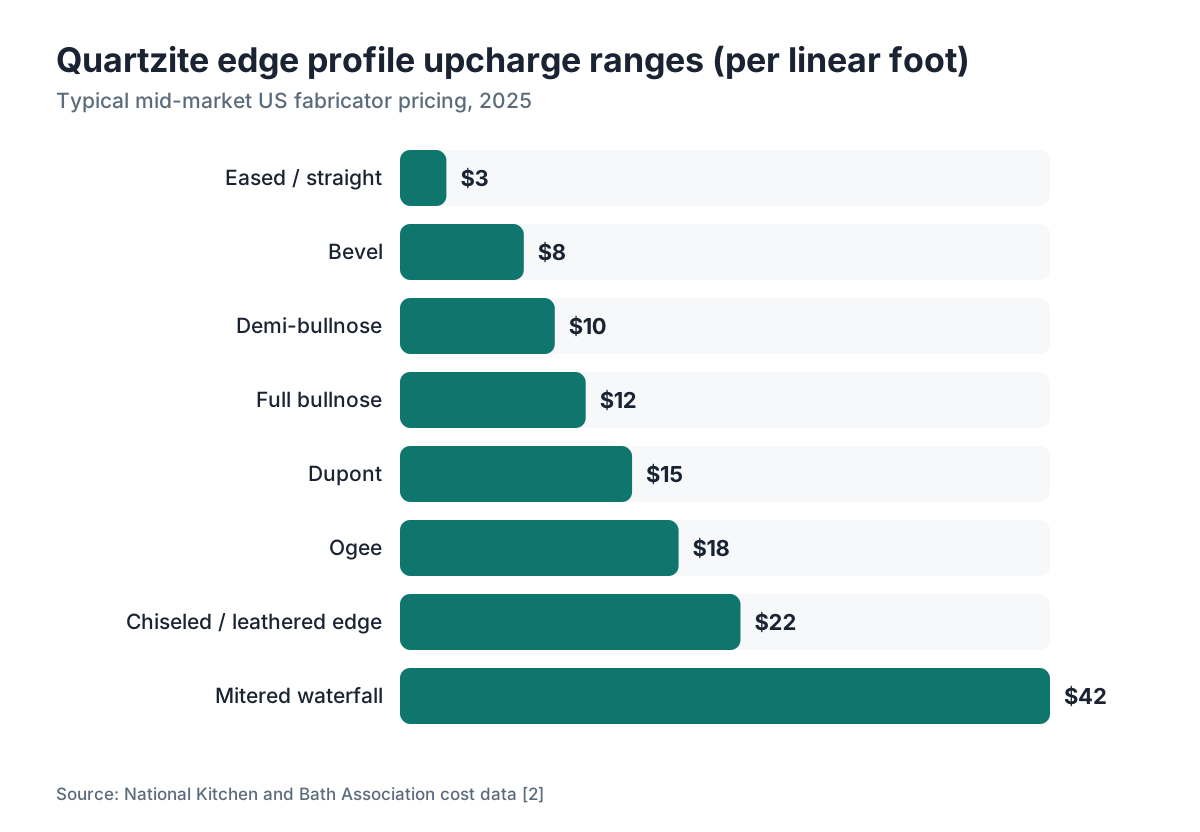
Pricing swings with region, shop overhead, and stone hardness. The numbers below reflect typical mid-market US fabricator pricing as of 2025. Your quote will differ, but these ranges are a fair benchmark for planning.
| Profile | Typical upcharge (per linear foot) | Notes |
|---|---|---|
| Eased / straight | $0 to $5 | Usually included |
| Bevel | $5 to $10 | |
| Demi-bullnose | $5 to $12 | |
| Full bullnose | $8 to $15 | More material removal |
| Ogee | $12 to $25 | Harder stone adds cost |
| Dupont | $10 to $20 | |
| Chiseled / leathered edge | $15 to $30 | Manual work |
| Mitered waterfall | $25 to $60+ | Seam work included |
| Laminated edge | $20 to $50+ | Two-piece fabrication |
A standard kitchen has roughly 30 to 50 linear feet of exposed edge (the perimeter minus the wall-attached sides). Upgrading from an eased edge to an ogee across 40 linear feet adds $480 to $1,000 to your invoice before installation [2]. That's real money, and it's one of the line items homeowners most often miss when they compare quotes.
Fabricators running quoting software that itemizes edge work can show you exactly what each profile choice adds. If your quote shows one lump sum, ask for the edge to be broken out. On quartzite especially, where the slab itself is pricey, edge work can be 8 to 15 percent of total fabrication cost [2].
For comparison, wood countertop edge profiles like a simple roundover usually cost less per foot because router work on wood beats diamond grinding on stone for speed. A simple roundover on butcher block often runs $3 to $8 per foot, roughly half what you'd pay for equivalent work on quartzite.
Which edge profile works best for quartzite specifically?
Short answer: eased or bevel for modern kitchens, demi-bullnose for family kitchens and bathrooms, ogee or dupont for traditional rooms. A few quartzite-specific factors change the math.
Start with the vein pattern. Quartzite often runs strong, dramatic veining. A flat eased or beveled edge shows that veining along the face of the slab. A full bullnose hides part of it by rounding the face away. If you paid extra for a dramatic slab, pick a profile that lets you see the stone on the edge face.
Next, the finish. Quartzite is commonly honed or leathered rather than polished, because polish can show wear on some varieties [3]. A leathered or chiseled edge on a leathered top reads as intentional and cohesive. A high-gloss ogee on a honed top looks like two different stones got married by accident. Ask your fabricator to match the edge finish to the top finish.
Third, thickness. Most quartzite comes in 2 cm (about 3/4 inch) or 3 cm (about 1.25 inch). A 2 cm slab almost always needs a laminated edge buildup to look substantial, especially on an island. A 3 cm slab carries most profiles without buildup and looks best with cleaner, less decorative cuts, because the thickness itself reads as luxury.
Fourth, where the counter lives. Outdoor kitchens and bar tops take more impact than interior counters. An eased edge with a slight roundover survives better than a fine ogee that can chip when someone drags a cast-iron pan across the lip. Quartzite is hard. No stone edge is indestructible.
How does quartzite edge pricing compare to granite and marble?
Quartzite is generally harder than both granite (Mohs 6 to 7) and marble (Mohs 3 to 4) [1]. More hardness means more tool wear and longer grinding for complex profiles. Expect quartzite edge work to cost 10 to 20 percent more than the same profile in granite, and sometimes 30 to 50 percent more than in marble, depending on the variety.
Some stone sold as "soft quartzite" is actually marble or dolomite that never fully metamorphosed [3]. If your supplier can't confirm the Mohs hardness, ask for a scratch test with a steel knife (roughly Mohs 5.5). If the stone scratches easily, it's probably dolomitic marble. That's a fine countertop stone, but it's softer and more acid-sensitive than true quartzite, and its edge pricing lands closer to marble [7].
Granite countertops and marble countertops use the same profile vocabulary, so you can compare apples to apples across competing quotes. The profile names, the linear-foot measurement, and the price tiers (eased cheapest, waterfall priciest) hold steady across stone types.
For engineered quartz like Cambria countertops, edge pricing tracks close to granite because the hardness is known and consistent [8]. The wild card with natural quartzite is that hardness varies by origin. Brazilian quartzite from certain quarries runs notably harder than some domestic or Indian material, and shops that work with it regularly will bake that into the quote.
Does the edge profile affect how you clean and maintain quartzite?
Yes, more than most people expect. A flat eased edge wipes clean in one pass. An ogee has two curve transitions that catch crumbs and grease. A chiseled edge has intentional texture that needs a stiff brush. If you wipe counters fast and move on, a complex profile becomes a small, steady annoyance.
Sealing gets harder too. Quartzite's needs vary by variety, but most true quartzites benefit from periodic sealing with a penetrating (impregnating) sealer [9]. Working that sealer into the inside curve of an ogee or the pits of a chiseled edge takes deliberate effort. Spray or wipe-on penetrating sealers handle it fine as long as you saturate the edge face directly.
For daily care, a pH-neutral stone cleaner covers every profile. Skip acidic cleaners (vinegar, citrus) on any quartzite edge, because the epoxy seam at a laminated edge can degrade faster than the stone itself. The full guidance in how to clean quartzite countertops applies to the edges as much as the top.
One practical tip. Ask your fabricator to run a bead of color-matched caulk at the wall joint instead of grout, no matter which profile you pick. Caulk flexes with thermal movement. Grout cracks at a countertop-to-backsplash joint.
What is a waterfall edge and is it worth the cost on quartzite?
A waterfall edge (also called a waterfall island or waterfall end panel) is when the slab continues vertically down the side of an island all the way to the floor, so the stone looks like it's pouring over the end. The visible end shows no cabinet face, just stone.
Fabrication runs high. It takes two slabs (or two pieces cut from one oversized slab), precise 45-degree miter cuts, structural support behind the vertical panel, and vein matching at the miter corner if the quartzite has a strong pattern. A matched waterfall on dramatic quartzite can run $1,500 to $4,000 extra for a single island end, depending on slab size, stone origin, and shop rates [2].
Is it worth it? Honestly, only if the veining rewards the spend. A waterfall in beige quartzite with quiet movement looks like a very expensive wall. A waterfall in bold quartzite, with veins that run continuously around the miter corner, looks extraordinary. Ask your fabricator to book-match the pieces before you commit.
Vein matching is where layout software earns its keep. Tools like SlabWise let fabricators simulate slab layout and vein positioning digitally before any stone gets cut, which cuts waste and lets you see the finished miter in advance. If your fabricator can't show you a digital layout preview for a waterfall, ask why not.
How does edge thickness and slab buildup affect the profile choice?
Most residential quartzite slabs are 3 cm (about 1.25 inches) thick. Some premium slabs come in 2 cm (about 0.75 inches) [11]. The difference matters a lot for edge profiles.
A 3 cm slab is heavy enough to stand alone with almost any profile, from a plain eased to a full bullnose to an ogee. The edge face is about 1.25 inches tall, which reads as substantial with no buildup.
A 2 cm slab has a thin edge face that can look delicate, especially on an island where visual weight sells the room. Fabricators fix this with a laminated edge: they bond a second strip of matching stone under the perimeter so the visible edge appears 4 cm (about 1.5 to 2 inches) thick. That thicker edge then takes the profile cut. From the front, it looks exactly like a thick slab.
Buildup costs more (extra material plus bonding labor) and adds weight to the cabinet perimeter. On a long run, laminated buildup can add 20 to 35 pounds per linear foot over the base slab weight [4]. Confirm your cabinet boxes are rated for the load, especially on runs over 8 feet.
Laminated edges take the same profiles as solid thick slabs, with one caveat. Very deep carving (a wide ogee that cuts deeper than the strip is thick) can expose the glue joint. A competent fabricator sizes the lamination strip to the profile depth. Run a 3 cm buildup strip on a 2 cm slab and most profiles fit with room to spare.
How does the edge profile selection process actually work with a fabricator?
The usual sequence: you pick your slab at the stone yard, the fabricator comes out to template your home (physical cardboard or a digital laser template), and somewhere in there you choose your edge profile. Some fabricators bring a physical sample board of routed or polished stone edges. Others show photos or a digital catalog.
Ask to see samples in your actual quartzite, not a stand-in stone. An ogee reads differently in granite than in a honed quartzite. If the shop has no edge sample in your material, ask if they'll cut a small sample piece before fabricating the full top. On a premium quartzite job, that's a reasonable request.
Pricing usually gets confirmed at the template appointment or right after. Some fabricators quote edge upcharges per profile, others fold it into a per-square-foot rate. Either way, get it in writing before fabrication starts. Changing the profile after the slab is cut can mean reordering material.
On the shop side, fabricators using integrated quoting software can generate edge pricing straight from a digital template instead of doing it by hand off a sketch. Accuracy matters here, because edge work on a kitchen with multiple radius corners is easy to price badly by hand. The countertop installation process rides on accurate pre-fabrication measurements, and edge profile details are part of that spec package.
If you're comparing quotes, make sure each one names the same profile, the same finish (polished vs. honed edge face), and the same linear footage. A cheaper quote may simply be pricing an eased edge while a competitor prices the ogee you actually discussed.
Are edge profile rules different for bathroom vanities vs. kitchen countertops?
Slightly. Kitchens take more daily abuse: pots, pans, heavy appliances sliding, kids leaning. Bathroom vanities see less impact but more standing water at the wall edge and the sink cutout.
In kitchens, protect the exposed corners (islands, peninsulas, bar extensions). A full or demi-bullnose forgives the person who walks into the corner. A sharp eased edge on a quartzite island is fine if the walking room is generous, but ask for a small radius on the top arris (1/8 inch or so) so it doesn't bite when you brush past it.
In bathrooms, looks usually outweigh durability because traffic is low. An ogee or dupont on a primary bath vanity reads intentional and finished. The real concern is the sink cutout edge: make sure the underside of the cutout is polished or at least smoothed, not left raw, because that's the edge you see and touch every time you reach under the faucet.
Quartzite is a genuinely good pick for both rooms. It handles bathroom moisture better than marble and looks more natural than engineered quartz. For a fuller comparison of materials and finishes, the kitchen countertops guide walks the tradeoffs.
What edge profiles work for other countertop materials, and how is quartzite different?
The same profile names show up across every countertop material. Execution and pricing change with material hardness and fabrication method.
Wood countertops, including butcher block, get their edges from router bits. Common wood countertop edge profiles include roundover, ogee, bevel, and cove. Wood ogees cut fast and cheap, often $3 to $8 per linear foot, because router work on wood moves quickly. The trade-off is that wood edges dent and scratch over time. Hard maple and walnut hold profiles better than softer woods, and local custom millwork shops sometimes offer profiles the big-box fabricators won't run.
Laminate countertops and Formica countertops have the tightest edge options, because the laminate layer is thin (about 1/16 inch) and can delaminate if the edge geometry builds up stress. A post-formed laminate counter (the kind with the rounded front edge molded into the sheet) is basically locked into a bullnose-adjacent shape. Self-edge laminate (a separate strip on the edge face) over a wood or MDF substrate can accept more complex shapes.
Corian countertops and other solid-surface materials can be thermoformed and routed, which opens up inlays and curved edges that stone can't touch. Material cost usually runs below quartzite, but the creative ceiling on fabrication is actually higher.
For how to clean stone countertops in general, the profile affects cleaning effort the same way across every stone: more curves, more time. That holds for quartzite, granite, soapstone (see how to clean soapstone countertops), and marble alike.
What should you ask a fabricator before finalizing your edge profile?
A handful of questions most homeowners never think to ask.
First: can you show me a physical sample of this profile in my specific quartzite, or at least in the same finish? Photos lie about texture.
Second: what radius do you put on the top arris of the eased edge? Some shops leave a near-sharp corner. Others put a generous 1/8-inch radius. For an island at hip height, that small radius matters for comfort and safety.
Third: will the edge face be polished, or will it match the top finish? A polished edge face on a honed top looks wrong. Ask specifically.
Fourth: for a laminated edge, what adhesive do you use and what's the warranty on the bond? Epoxy is standard. Polyester is cheaper and more brittle. A good bond lasts decades.
Fifth: how do you handle inside corners, like where a run meets a wall at a 90-degree return? Inside corners always get cut square, because a profile can't wrap an interior angle. Knowing this ahead of time kills the surprise.
Sixth: what's the lead time if I want to change the profile after seeing the template but before fabrication starts? Most shops can adjust digitally at zero cost if you catch it before the CNC program runs. Once cutting starts, you're locked in.
SlabWise quoting tools let fabricators generate itemized line items per profile choice, so you see the cost of each option in real time during the design talk instead of eating a surprise on the final invoice. If your fabricator's workflow can't do that, at least ask them to quote two or three profiles side by side.
Frequently asked questions
What is the most popular edge profile for quartzite countertops?
The eased edge and demi-bullnose are the most commonly specified profiles on residential quartzite jobs. Eased suits modern and contemporary kitchens. Demi-bullnose works in transitional spaces and wherever young kids are around. Ogee profiles stay popular in traditional kitchens but have faded in new construction over the last decade as design trends moved toward cleaner lines.
How much does an ogee edge profile add to a quartzite countertop quote?
Expect $12 to $25 per linear foot above the base eased-edge price for an ogee on quartzite. A typical kitchen with 40 linear feet of exposed edge adds $480 to $1,000 for the upgrade [2]. Quartzite's hardness increases tool wear compared to marble, so ogee pricing runs higher on quartzite than on softer stones.
Can you get a waterfall edge with a 2 cm quartzite slab?
Yes, but it takes careful structural planning. A 2 cm slab is thin for a vertical waterfall panel and usually needs a laminated or engineered support behind it. The visible miter joint has to be perfect or the seam shows. Most fabricators recommend 3 cm slabs for waterfall work. Budget an extra $1,500 to $4,000 depending on slab size, pattern, and vein matching.
Does the edge profile affect how often you need to seal quartzite?
The profile doesn't change how often you seal, but it changes the effort. A complex ogee or chiseled edge has more surface area and texture, so you apply sealer more deliberately to get full coverage. A penetrating sealer sprayed or wiped directly on the edge face handles most profiles. Sealing frequency for quartzite generally runs from once a year to every three to five years depending on porosity [9].
Is a bullnose edge safe for children?
A full bullnose is the safest standard profile because it removes sharp corners and creates a rounded edge that doesn't cut on impact. A demi-bullnose is also reasonably safe. An eased edge with a slight radius is fine for most family use, but a raw right-angle eased edge (no radius on the top arris) is a genuine bruising hazard at an island edge sitting near a small child's head height.
What edge profile should I use for a quartzite bathroom vanity?
Ogee, dupont, and demi-bullnose all work well on bathroom vanities, because lower traffic makes durability less of a concern. An ogee reads traditional and refined. A demi-bullnose is clean and versatile. The main practical point: finish the sink cutout edge (polished or honed to match the top) instead of leaving it raw, since you see and feel it every time you reach near the faucet.
How do wood countertop edge profiles compare to quartzite edge profiles?
Both use the same profile names (eased, bullnose, ogee, bevel), but the materials and tools differ. Wood edges get cut with router bits, faster and cheaper than diamond grinding on quartzite. A wood ogee might cost $3 to $8 per linear foot. The same profile on quartzite runs $12 to $25. Wood edges also dent and scratch over time, while quartzite keeps its profile shape almost indefinitely.
What is a laminated edge buildup and when do you need it?
A laminated edge is a strip of matching stone bonded under the slab perimeter to increase the visible edge thickness. You need it on 2 cm slabs that would otherwise have a thin, delicate edge face. The strip makes the edge look 4 cm or more thick, matching a premium thick slab. Laminated edges add 20 to 35 pounds per linear foot over the base slab alone [4].
Can any edge profile be done in quartzite, or are some too complex?
Most standard profiles (eased, bevel, bullnose, ogee, dupont) are fully doable in quartzite. Very deep relief carving or custom architectural profiles can be limited by stone thickness and the risk of cracking during grinding. Highly detailed carved profiles that work in wood or soft stone are impractical in hard quartzite. Ask your fabricator which profiles they run regularly in hard stone.
Does the edge profile change the structural strength of a quartzite countertop?
Slightly. Removing material from the edge reduces cross-sectional thickness at that point. A wide ogee cut into a 3 cm slab leaves less stone than a plain eased edge, so that edge is marginally more vulnerable to impact cracking. In practice this rarely causes trouble. The bigger structural risk is unsupported overhangs: quartzite can crack if an overhang exceeds about 10 to 12 inches without corbel or bracket support [5].
How long does it take a fabricator to cut edge profiles on quartzite?
A simple eased edge on a standard kitchen might add 30 to 60 minutes of CNC time. An ogee or dupont on a full perimeter can take 2 to 4 hours of grinding and polishing, because the inside curve gets finished by hand or with specialized tooling. Chiseled and leathered edges take longest because they need manual work. Lead time from template to installation is typically 5 to 14 business days total.
What does a mitered waterfall edge actually cost, all in?
Fabrication for a single mitered waterfall end panel on a kitchen island typically adds $1,500 to $4,000, depending on slab size, stone hardness, and vein matching complexity [2]. That range covers the extra stone, the precision 45-degree miter cuts, structural support hardware, and seam polishing. Dramatic quartzite with continuous veining across the miter sits at the top; plain stone with no vein matching sits at the low end.
Should the edge face finish match the top surface finish on quartzite?
Generally yes, for consistency. A honed top with a polished edge face looks mismatched and makes the edge read like a different stone. Most fabricators can finish the edge face to match the top (polished, honed, or leathered) at no extra charge if you specify it upfront. If you have a leathered top and want a chiseled edge, confirm the texture can be created in your specific quartzite, since some very hard varieties resist texturing.
Is there a standard way to measure linear footage for edge profile pricing?
Edge profiles are priced on the total length of exposed (non-wall) edges. For a kitchen, that means the front edges of counter runs, both ends of peninsulas or islands, and any cutout edges (sink cutouts, if specified). Inside wall corners aren't counted. A standard kitchen typically has 30 to 50 linear feet of exposed edge [10]. Measure along the outer face of the countertop, not the slab perimeter, for the most accurate count.
Sources
- U.S. Geological Survey, Mineral Resources Program: Quartzite is metamorphic rock formed from sandstone under heat and pressure; it typically rates around 7 on the Mohs hardness scale, harder than marble at 3-4.
- National Kitchen and Bath Association, cost and project data: Edge profile upcharges can represent 8 to 15 percent of total fabrication cost; upgrading from eased to ogee across 40 linear feet adds roughly $480 to $1,000.
- Natural Stone Institute, Natural Stone Reference Manual: Some material sold as quartzite is actually dolomitic marble that has not fully metamorphosed; true quartzite is significantly harder and more acid-resistant, and honed or leathered finishes are common for quartzite installations.
- Tile Council of North America, Handbook for Ceramic, Glass, and Stone Tile Installation: Laminated stone edge buildups can add 20 to 35 pounds per linear foot to the countertop perimeter weight, which must be accounted for in cabinet support design.
- U.S. Department of Housing and Urban Development: Unsupported stone countertop overhangs beyond 10 to 12 inches require corbel or bracket support to prevent cracking under point loads.
- Occupational Safety and Health Administration, Crystalline Silica standard: Stone fabrication including edge grinding generates crystalline silica dust; OSHA's silica standard for construction requires engineering controls and exposure limits during fabrication operations.
- Natural Stone Institute, quartzite identification guidance: A field scratch test with a steel blade (Mohs 5.5) can help distinguish true quartzite from softer dolomite marble; true quartzite resists scratching while dolomite marble shows a scratch.
- Cambria, product and edge profile specifications: Engineered quartz edge profile pricing is comparable to granite because of consistent material hardness; standard profiles like eased, beveled, and bullnose are included in base pricing with decorative profiles at upcharge.
- Natural Stone Institute, stone care and sealing guidance: Penetrating (impregnating) sealers are the standard recommendation for quartzite countertops; application to complex edge profiles requires direct saturation of the edge face to achieve full coverage.
- U.S. Census Bureau, American Housing Survey: Kitchen countertop replacement is among the most common home improvement projects; survey data supports the 30 to 50 linear feet of exposed edge typical of a residential kitchen.
- National Institute of Standards and Technology, Weights and Measures: Standard quartzite slab thicknesses of 2 cm (approximately 0.75 inches) and 3 cm (approximately 1.25 inches) are consistent with industry-standard metric-to-imperial conversion.
Last updated 2026-07-09