TL;DR
- Quartz kitchen countertops run $50 to $150 per square foot installed, and most homeowners land between $70 and $100.
- The material is engineered from 90 to 95% crushed quartz bound with polymer resin, which makes it harder and more stain-resistant than granite, but not heat-proof.
- It's the default pick for U.S.
- kitchen remodels and fits most households that want low maintenance over natural stone character.
What exactly is quartz as a countertop material?
Quartz countertops aren't a slab of raw stone pulled from a quarry. They're an engineered product: typically 90 to 95 percent ground quartz aggregate (one of the hardest minerals on earth, rated 7 on the Mohs scale) mixed with polymer resins, pigments, and sometimes glass or metallic fragments, then compressed under vacuum and heat into a dense, uniform slab [1]. Brands like Cambria, Caesarstone, Silestone, and MSI all make the material to slightly different formulations, which is why finishes, thickness options, and warranty terms vary.
Because the resin binds the pores, the surface is essentially non-porous. That's the whole game. It won't absorb red wine, coffee, or raw chicken juices the way unsealed granite can. You never need to seal it. No annual maintenance ritual, no anxious moment with beet juice.
What you give up is the genuine variation of natural stone. Every granite or quartzite slab is unique. Engineered quartz is manufactured to look consistent, which reads as polished and clean rather than organic. Some homeowners love that. Others find it a little flat once they've seen both side by side. Neither view is wrong. For more context on quartz countertops in general, including slab sizing and thickness options, that article covers the fundamentals.
How much do quartz kitchen countertops cost?
Installed quartz in a typical kitchen runs $50 to $150 per square foot, and most real projects land in the $70 to $100 range once you factor in edge profiles, cutouts for sinks and cooktops, and the fabricator's labor [2]. The spread is wide because the inputs are genuinely wide.
Material tier matters most. Basic entry-level quartz (think solid whites and grays with minimal pattern) can hit the $50 mark at big-box retailers. Mid-range products with more visual depth run $65 to $85 per square foot for the slab alone. Designer lines from Cambria's premium collections or Silestone's Loft series push $100 or more per square foot before a single cut is made.
Fabrication adds $20 to $50 per square foot depending on your market, the complexity of the job, and the number of cutouts. A kitchen with two sink cutouts, a cooktop, and an undermount configuration costs more to fabricate than a simple L-shape with one drop-in sink.
Here's the math on a real kitchen. A mid-size layout with 45 square feet of countertop (a U-shape with an island) at $85 installed comes to roughly $3,825. That same kitchen at a premium tier can easily reach $6,500. The National Kitchen and Bath Association reports the median countertop budget for a major kitchen remodel was around $3,500 to $4,500 in recent surveys, which tracks with those numbers [3].
Removal of existing countertops adds $200 to $500 for a typical kitchen. Plumbing reconnection after a sink swap runs $150 to $300 depending on your region. Neither cost tends to appear in the first quote you get, so ask explicitly.
Fabrication shops that use quoting software (SlabWise is one example, built specifically for countertop shops) can produce line-item quotes that break out material, fabrication, and installation separately. That makes comparison shopping far easier than staring at a single lump-sum number.
Quartz vs. granite countertops: which one should you choose?
Every homeowner researching kitchen countertops asks this eventually, and the honest answer comes down to two things: how much maintenance you want to do, and what kind of look you're after.
Maintenance. Quartz wins. No sealing, no annual upkeep. Granite is porous and needs sealing at installation, then re-sealing every one to three years depending on the stone and the sealer used [4]. Forget, and the stone can stain. Most granite doesn't stain catastrophically from normal use, but it's a real task to manage. Quartz erases that task entirely.
Heat resistance. Granite wins. You can set a hot pan directly on granite without damage. Quartz cannot handle sustained direct heat above roughly 300°F (150°C) because the polymer resin will discolor or crack [1]. This matters if you cook heavily and are careless about trivets. It's not a dealbreaker for most people, but it's a real difference.
Scratch resistance. Both score about 7 on the Mohs scale, so everyday knife cuts won't scratch either. Ceramic cooktops rate around 5 to 6. In practice, neither surface should be used as a cutting board.
Appearance. Granite has natural variation, movement, and uniqueness that engineered quartz can only approximate. Photos of granite often show dramatic veining, mineral deposits, and color shifts that look genuinely alive. Photos of quartz tend to show clean, consistent pattern. Neither is better. They're different aesthetics. If you want natural stone character, look at granite countertops or even marble countertops. If you want a specific look dialed in without variation, quartz is more predictable.
Price. Roughly comparable at the mid range. Entry-level granite can be cheaper. Premium granite slabs can cost more than premium quartz. There's no consistent winner on price.
| Factor | Quartz | Granite |
|---|---|---|
| Sealing required | No | Yes, every 1 to 3 years |
| Heat resistance | Moderate (resin can burn) | High (set pan directly) |
| Scratch resistance | High (Mohs ~7) | High (Mohs ~6 to 7) |
| Stain resistance | Excellent (non-porous) | Good when sealed |
| Natural variation | Manufactured pattern | Unique per slab |
| Typical installed cost | $50, $150/sq ft | $40, $140/sq ft |
| Radon/radiation concern | None | Trace, generally negligible [5] |
For a deeper comparison, the kitchen countertops overview covers all major materials side by side.
What quartz colors and finishes actually look like in a kitchen
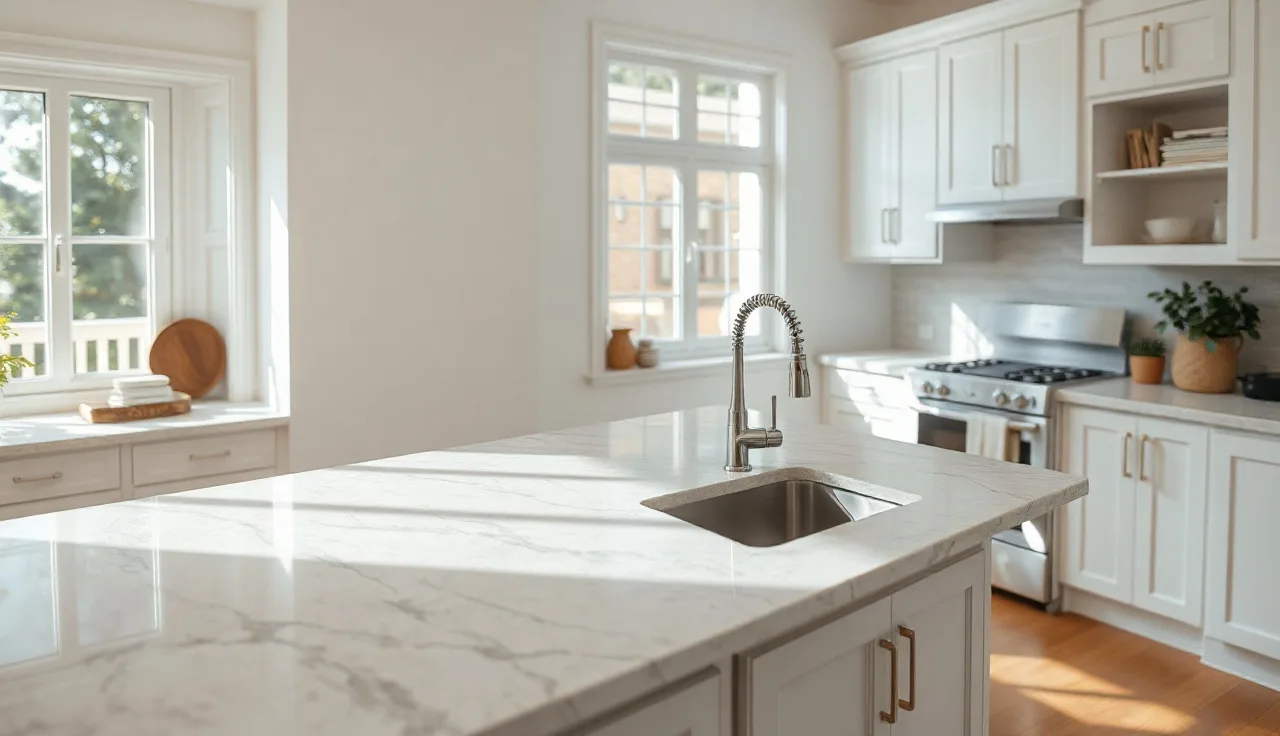
The most popular quartz colors for kitchens, by a wide margin, are white and light gray with soft veining. Calacatta-style quartz (white background, bold gray or gold veins imitating Italian marble) became the dominant look in U.S. kitchen remodels starting around 2015 and hasn't let go. Calacatta Nuvo from MSI, Brittanicca from Cambria, and Calacatta Gold from Caesarstone all compete in this space.
Beyond white, charcoal and graphite quartz works well in modern kitchens with flat-front cabinetry and matte hardware. Soft beige and warm cream tones pair with shaker cabinets and wood accents. True black quartz creates strong contrast in light-colored kitchens, though fingerprints show on polished finishes, which is worth knowing before you commit.
Most manufacturers offer three finishes. Polished is high gloss and very common. Honed is matte, softer, and shows fewer watermarks. Leathered or suede textures are slightly rough and read more casual. Polished quartz is the default and the easiest to wipe clean. Honed looks elegant but needs more attention to prevent smudging from oils.
Photos of quartz kitchen countertops online show the most dramatic version of each color, staged with perfect lighting. The real thing, under your kitchen's actual light, looks different. Take a full-size sample home and live with it for a day before ordering. A 12-inch sample tile from a showroom tells you almost nothing. A 6-by-12 inch section tells you a lot more.
One thing to watch in quartz photos specifically: seams. In a staged photo, seams are hidden or the slab runs continuous. In your actual kitchen, seams are visible, especially on dark quartz where color matching is harder. Ask your fabricator where seams will fall before the template is finalized.
How durable is quartz in a real kitchen environment?
Quartz scores well on nearly every practical durability test. The Knoop hardness of crystalline quartz is around 820 to 1000, which puts it harder than most natural stones used for countertops [6]. Day-to-day cutting, dragging pans, ceramic dishes, and general impact won't scratch it under normal use.
The weak point is heat, not abrasion. The polymer resin used in manufacturing starts to soften around 300°F. A cast iron skillet pulled from a 450°F oven and set directly on quartz can leave a scorch mark or crack. This isn't hypothetical. Fabricators see thermal shock damage regularly. Use a trivet. That one habit removes the risk completely.
Chipping is possible at edges, particularly on sharp 90-degree profiles like eased or square edges. If a heavy pot hits a corner at the right angle, you can chip it. An ogee or bullnose edge resists chipping better because the rounded profile has no thin, exposed point. For a busy kitchen with kids, that's a real design decision.
Cracks from normal use are rare. Quartz is dense and consistent, with no natural fissures or cleavage planes like granite. Cracks that do happen usually trace back to installation error (inadequate cabinet support, improper shimming) or thermal shock, not the material itself.
Long-term color stability is good. Quartz resists UV fading better than some solid surfaces, though prolonged direct sunlight can eventually affect the pigment in certain colors. Most manufacturers warrant against color change from normal indoor use.
Does quartz contain harmful substances like radon or silica?
Two separate concerns come up here, and they're worth pulling apart clearly.
Crystalline silica dust during fabrication. This is a genuine and serious occupational health hazard for stone fabricators, not for homeowners. The Occupational Safety and Health Administration lists crystalline silica as a known carcinogen and sets a permissible exposure limit (PEL) of 50 micrograms per cubic meter as an 8-hour time-weighted average for general industry [7]. OSHA issued a final rule on occupational exposure to respirable crystalline silica in 2016 that specifically targets stone fabrication. Fabricators cutting, grinding, or polishing engineered stone (which has higher silica content than natural granite) must use wet cutting methods, local exhaust ventilation, or supplied-air respirators [11]. Your finished, polished countertop doesn't release respirable silica during normal use.
Radon. Granite, not quartz, carries the trace radiation concern, because granite can contain naturally occurring uranium. The EPA has studied this and found that the contribution from granite countertops to indoor radon is generally small compared to radon entering through foundation cracks, though it varies by stone [5]. Engineered quartz, bound in polymer resin, does not release radon at meaningful levels. If you're switching from granite and worried about radon, your foundation matters far more than your countertop material.
The practical takeaway for homeowners: quartz on your kitchen counter poses no known health risk during normal use. The silica hazard belongs to the shop, not your kitchen.
How hard is quartz to maintain and clean day to day?
This is where quartz earns its popularity. The cleaning routine is a damp cloth and mild dish soap. That's it. No specialty stone cleaners, no pH-balanced formulas, no sealing. For dried-on food or grease, a nonabrasive scrub pad and a little dish soap handles almost everything.
What to avoid: bleach-based cleaners at full strength can dull the surface over time. Highly acidic cleaners (vinegar, some citrus-based products) can break down the resin with repeated use. Abrasive powders scratch the finish. None of these cause instant damage, but routine exposure adds up.
For detailed guidance on daily stone care, the how to clean stone countertops guide covers safe cleaners and what to skip. Quartzite (a natural stone often confused with quartz) has different care needs, covered in how to clean quartzite countertops.
One thing fabricators mention often: the area around the sink shows wear first. Standing water, soap residue, and constant wet-dry cycling can eventually dull the polished finish closest to the sink. Wiping that area dry after use extends the life of the finish noticeably.
How is quartz countertop installation different from granite?
The process for quartz follows the same basic steps as granite: template, cut, edge profile, polish, deliver, install. Two differences matter in practice.
First, quartz slabs are heavier per square foot than most granite. A standard 3cm (1.25-inch) quartz slab weighs roughly 19 to 20 pounds per square foot [8]. A 45-square-foot kitchen countertop weighs close to 900 pounds before you add the island. That drives cabinet support, transport, and crew size on installation day. Your cabinets need to be level and structurally sound before the installer arrives. Shimming after the slab is down is far harder.
Second, quartz is easier to fabricate to tight tolerances because it's consistent. Granite has natural fissures, soft spots, and grain direction that experienced fabricators must read before cutting. Quartz runs uniformly on a CNC machine without those surprises. That doesn't make it a commodity job, but fabricator skill variation shows up more on complex granite than on a standard quartz layout.
Seam placement is negotiated before the template, not after. Once the slab is cut and the seam is set, it's done. If you want the seam away from the cooktop or hidden inside a corner, say so during templating. Fabricators have preferences based on material flow and slab yield, but they can usually accommodate reasonable requests.
Installation day typically runs two to four hours for a standard kitchen. The crew sets the slabs, checks level, applies silicone adhesive at seams and along cabinet rails, and reconnects plumbing if that's part of the deal. The silicone needs 24 hours to cure before heavy use.
What warranties do quartz manufacturers actually offer?
Most major quartz brands offer a limited lifetime warranty to the original purchaser, but what that covers varies more than the marketing suggests.
Cambria offers a transferable lifetime warranty covering manufacturing defects, stains, and cracks under normal use [9]. Caesarstone's warranty is also lifetime but covers manufacturing defects; damage from heat, impact, or improper care is explicitly excluded. Silestone (owned by Cosentino) has a 25-year warranty on most products, reduced from lifetime in recent years for some lines.
The key phrase in all of these is "manufacturing defects." A scorch mark from a hot pan is not a manufacturing defect. A chip from impact is not a manufacturing defect. Color variation between slab batches isn't always covered either. Read the exclusions before you pick a product on warranty length alone.
Installation workmanship is usually warranted separately by your fabricator, not the manufacturer. Most reputable fabricators offer one to two years on their work. If a seam opens up in month three because of bad adhesive or poor support, that's on the fabricator. Make sure your installation contract spells out their warranty terms in writing.
How do you compare quartz to other kitchen countertop materials?
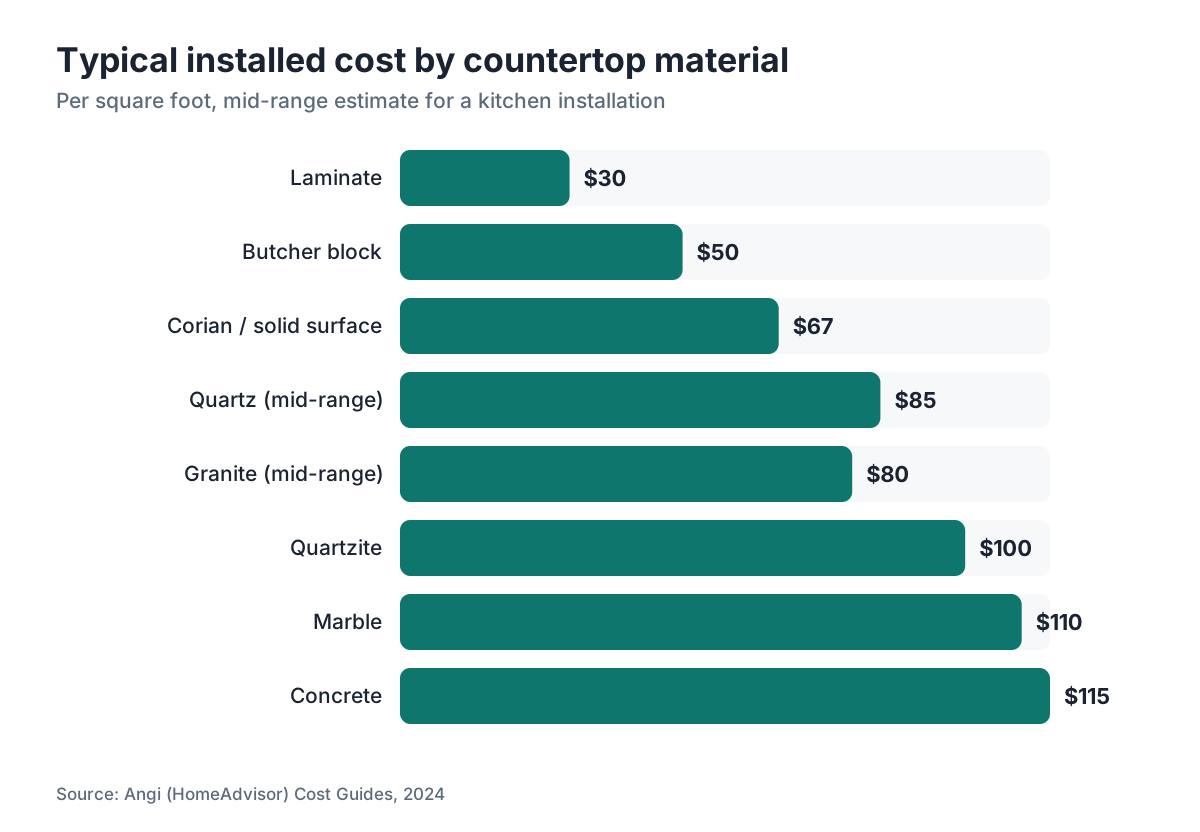
Quartz sits in the upper middle of the kitchen countertop market. It costs more than laminate countertops and Formica countertops, lands roughly even with granite, and comes in under high-end marble in most markets.
Against butcher block countertops: butcher block costs less ($30 to $70 per square foot installed), looks warm and natural, and can be sanded and refinished when it shows wear. It needs oiling and takes water damage at seams. Good choice for prep areas, less practical as a perimeter surface in a wet kitchen.
Against Corian countertops and other solid surfaces: solid surface runs $45 to $90 installed, is fully repairable (scratches sand out), and lets you integrate the sink into the counter with no visible joint. It's softer and more scratch-prone than quartz. Some designers still prefer it for bathrooms and custom shapes.
Against concrete countertops: concrete is unique, custom, and heavy. It needs sealing, can crack, and costs $75 to $150 installed from a skilled fabricator. It has a following among design-forward homeowners who want something nobody else has. Quartz is predictable where concrete is not.
The honest summary: quartz is the default recommendation for most kitchens because it scores well across every practical category without excelling dramatically in any single one. Want the warmth of wood? Get butcher block for the island. Want natural stone character? Granite or quartzite delivers it. Quartz is the reliable middle choice that rarely disappoints.
Shops quoting across multiple materials benefit from software that handles different edge profiles, sink cutouts, and material pricing in one system. SlabWise lets fabricators build quotes for quartz, granite, and every other surface in a single workflow.
What questions should you ask a fabricator before ordering?
The questions that save money and avoid regret aren't about the stone. They're about the process.
Ask where seams will fall, and ask to see it marked on a to-scale layout before you approve the template. Seams in high-visibility spots (center of the island, directly in front of the sink) bother some people a lot. Ask early.
Ask what edge profiles are included in the base price and which cost extra. A standard eased edge is almost always included. An ogee, waterfall, or double-radius edge adds $10 to $25 per linear foot at many shops. On a 30-foot kitchen, that's a $300 to $750 swing.
Ask whether the quoted price includes removal of existing countertops. Most standalone fabricators don't do demo; they quote install only. You may need a separate contractor for removal.
Ask about lot matching. If your kitchen spans multiple slabs, the slabs should come from the same manufacturing batch (lot) to keep color consistent. Ask the fabricator or distributor to confirm lot numbers before the job is locked.
Ask about cabinet level and support requirements before the installation appointment. Most fabricators inspect cabinets during templating and flag issues. Some won't, and then installation day becomes a problem. Confirm this explicitly.
Ask for a written warranty from both the fabricator and the manufacturer, not a verbal assurance. Fabricators who stand behind their work put it in writing without hesitation.
Frequently asked questions
How long do quartz kitchen countertops last?
Quartz countertops are built to last the life of the kitchen under normal use. The polymer resin and quartz aggregate don't degrade with age, and most major manufacturers back that with lifetime warranties against manufacturing defects. The things that shorten a quartz countertop's life are thermal shock from hot pans and physical impact at edges. Avoid both and the material will outlast most kitchen remodels.
Can you put hot pans on quartz countertops?
No, not directly. The polymer resin in quartz starts to soften and discolor around 300°F, and a cast iron skillet from a 450°F oven can leave a permanent scorch mark or crack. This is one of the real trade-offs vs. granite, which handles direct heat without damage. Use a trivet or hot pad every time, and the risk goes to zero.
Does quartz need to be sealed?
No. Quartz is non-porous by design because the resin fills the spaces between the quartz aggregate. There's nothing for sealer to penetrate. This is one of the clearest practical advantages over granite, marble, and quartzite, all of which are porous and need periodic sealing to resist staining. You'll never schedule a sealing appointment for quartz.
How do you get stains out of quartz countertops?
Most stains on quartz lift with warm water and dish soap. For dried-on grease or food, a nonabrasive scrubbing pad works well. For stubborn marks like dried adhesive or ink, a small amount of isopropyl alcohol applied briefly usually does it. Avoid bleach at full strength or highly acidic cleaners like pure vinegar, which can dull the surface resin over repeated use.
Is quartz the same as quartzite?
No, they're completely different materials. Quartz is an engineered product: ground quartz mineral bound with polymer resin, manufactured in a factory. Quartzite is a natural metamorphic rock quarried from the earth, harder than granite, with no polymer content. Quartzite needs sealing, varies per slab, and behaves like a premium natural stone. The names sound similar, which causes real confusion in showrooms and online.
What is the most popular quartz color for kitchens?
White and light gray quartz with soft Calacatta-style veining has dominated U.S. kitchen remodels for most of the last decade. Products like Caesarstone's Calacatta Nuvo, Cambria's Brittanicca, and similar offerings from MSI and Silestone all compete in this space. Soft beige tones and charcoal/graphite are the next most popular, depending on cabinet color. True black quartz creates strong contrast but shows fingerprints on polished finishes.
How thick should quartz countertops be for a kitchen?
Standard kitchen countertops use 3cm (roughly 1.25 inches) thick quartz. This is the default for most fabricators and the thickness most manufacturers' warranties apply to. The older 2cm (about 0.75 inch) thickness is still available and costs a bit less, but it needs a plywood substrate underneath for support and is more vulnerable to cracking. For islands and heavy-use kitchens, 3cm is the right call.
Does quartz add value to a home?
Remodeling Magazine's Cost vs. Value report consistently shows kitchen remodels recoup 60 to 80 percent of their cost at resale, though countertop upgrades alone aren't tracked separately. Real estate agents commonly cite quartz and granite as materials buyers expect in mid-to-upper market homes. Installing quartz over a worn laminate surface improves marketability, but matching the material to your neighborhood's price point matters more than the specific stone choice.
Can quartz countertops be repaired if they chip or crack?
Small chips at edges can be filled with color-matched epoxy kits, and some fabricators offer repair services. Results vary by how visible the location is and how close the color match comes. Cracks are harder to fix invisibly. Most repaired cracks stay slightly visible. Prevention beats repair: use rounded edge profiles to reduce chip risk, and make sure cabinet support is solid to prevent stress cracks.
What's the difference between quartz and granite countertop prices?
Both materials run roughly $50 to $150 per square foot installed, so the price ranges overlap almost completely. Entry-level granite can undercut basic quartz by $10 to $20 per square foot. Premium granite slabs with rare color patterns often exceed premium quartz in price. The bigger cost variable is usually fabrication complexity (seams, cutouts, edge profiles) rather than the material itself at the mid-range.
How do I choose between quartz and marble for a kitchen?
Marble is a luxury natural stone that etches from acids (lemon juice, wine, tomato) and stains without careful sealing. It's genuinely beautiful and ages with character, but it demands more care than most busy kitchens give it. Quartz that mimics Calacatta marble gets you 80 percent of the look with none of the maintenance. For a hard-working primary kitchen, quartz is the practical choice. Marble works best for homeowners who know the trade-offs and accept them.
How long does quartz countertop installation take?
Template to install typically runs five to ten business days for most fabrication shops, though busy shops and custom orders can push to two to three weeks. The installation itself takes two to four hours for a standard kitchen. The silicone adhesive at seams and undermount connections needs 24 hours to cure before normal use. Plan to be without your kitchen sink for that first day.
Does quartz countertop color fade over time?
Indoor quartz resists fading well under normal lighting. Sustained direct UV exposure, like a countertop under a skylight or right beside a large south-facing window, can gradually affect the pigment in some colors over years. Most manufacturers warrant against color change from normal indoor use. If heavy UV exposure is a concern, ask your fabricator or the brand's warranty documentation about UV resistance for the specific color you want.
What edge profiles are available for quartz and which should I pick?
Common edges include eased (slightly softened 90-degree, the standard default), beveled, bullnose (fully rounded), ogee (decorative S-curve), and mitered (sharp 45-degree for a thick waterfall look). Eased and beveled edges are usually included in the base price. Bullnose is a good practical pick for families with kids because it has no thin exposed edge to chip. Ogee and mitered edges cost more and are best saved for islands where they'll get seen.
Sources
- Caesarstone, Product Technical Data Sheet: Engineered quartz is 90 to 95% ground quartz aggregate bound with polymer resin; the resin is vulnerable to heat above roughly 300°F
- HomeAdvisor (Angi), Quartz Countertop Cost Guide: Installed quartz countertops cost $50, $150 per square foot, with most homeowners spending $70, $100
- National Kitchen and Bath Association, NKBA Kitchen and Bath Market Index: Median countertop budget for a major kitchen remodel was approximately $3,500 to $4,500 in recent surveys
- Natural Stone Institute (formerly Marble Institute of America), Care and Maintenance Guide: Granite is porous and requires sealing at installation and re-sealing every one to three years depending on the stone and sealer
- U.S. Environmental Protection Agency, Radiation Protection: EPA has evaluated granite countertops and found their contribution to indoor radon is generally small compared to radon entering through foundation cracks
- U.S. Geological Survey, Mineral Resources Program: Crystalline quartz rates 7 on the Mohs hardness scale, placing it among the hardest minerals commonly used in construction
- U.S. Occupational Safety and Health Administration, Crystalline Silica Rule (29 CFR 1910.1053): OSHA sets a permissible exposure limit of 50 micrograms per cubic meter for respirable crystalline silica and specifically targets stone fabrication operations; final rule issued 2016
- MSI Surfaces, Technical Specifications for Quartz Slabs: A standard 3cm engineered quartz slab weighs approximately 19 to 20 pounds per square foot
- Cambria, Warranty Information: Cambria offers a transferable lifetime warranty covering manufacturing defects, stains, and cracks under normal residential use
- Remodeling Magazine, Cost vs. Value Report 2024: Kitchen remodels recoup 60 to 80 percent of their cost at resale; mid-range and major kitchen remodels are tracked annually
- National Institute for Occupational Safety and Health (NIOSH): NIOSH has identified engineered stone countertop fabrication as producing higher concentrations of respirable crystalline silica than natural stone cutting due to higher quartz content
Last updated 2026-07-09