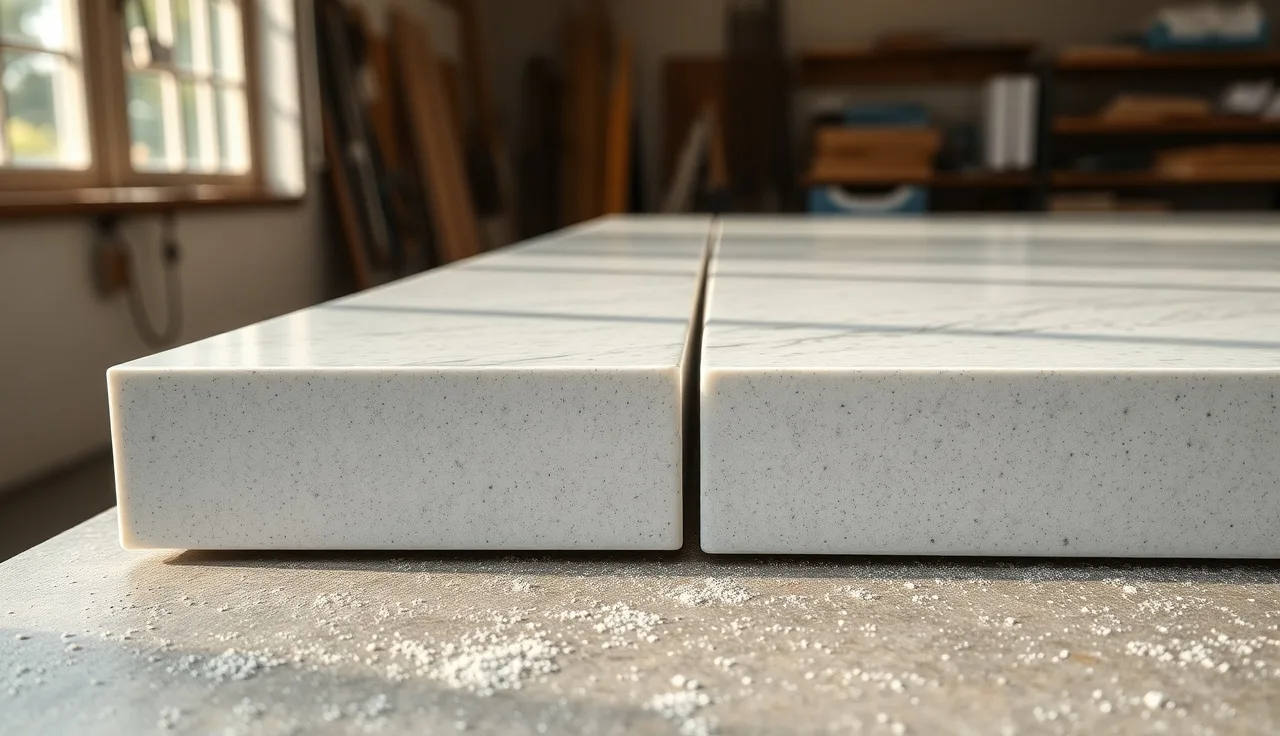
TL;DR
- 3cm (about 1¼ inches) is the best quartz thickness for most kitchen countertops.
- It spans cabinet runs without extra support, shrugs off daily impact, and is what most fabricators stock.
- 2cm works for vertical surfaces and bath vanities but needs a laminated edge or plywood substrate on horizontal runs.
- The price gap is real but smaller than most homeowners expect.
What are the standard quartz thickness options?
Quartz slabs come in two practical thicknesses: 2cm (roughly ¾ inch) and 3cm (roughly 1¼ inches). A few manufacturers also make 1.2cm material for furniture panels and some European cabinetry, but you'll almost never see that spec in a North American kitchen.
The millimeter labeling is the global stone industry standard. Fabricators in the U.S. and Canada mix centimeters and inches freely, so don't get thrown if your quote says "3cm" and the slab warehouse calls it "1.25 inch." Same thing.
Most domestic quartz brands, including Silestone, Cambria, and MSI, produce both thicknesses, though stock varies by region. [1] Some premium lines are 3cm only. Call your local fabricator before you fall for a specific slab color, because special-ordering a 2cm version of a 3cm-only color adds lead time and sometimes a surcharge.
Why do most fabricators recommend 3cm for kitchen countertops?
3cm is the workhorse of the kitchen countertop world, and the reasons are structural. At 1¼ inches, a slab bridges the span between a sink cutout and the nearest cabinet wall without flexing. It also takes the point-load abuse of someone perched on the edge of an island, a dropped cast-iron pan, or a stand mixer shoved against the backsplash.
The Natural Stone Institute's design manual (formerly the Marble Institute of America) recommends a minimum 3cm thickness for unsupported spans over roughly 24 inches in residential work. [2] Quartz makers follow the same span logic because engineered stone has flexural properties close to natural stone.
For fabricators, 3cm also means less labor. You skip the plywood substrate. You skip laminating the front edge to build up thickness. You cut fewer seams to hit a standard profile. That means a cleaner install and fewer callbacks. If you run a shop and price jobs, the labor you save on a 3cm slab often eats up part of the higher material cost over 2cm.
One more thing. 3cm slabs are what most distributors keep in inventory. Need a rush job or a recut? Getting another piece is easy. 2cm in a specific color is often a special order.
When does 2cm quartz make sense?
2cm quartz isn't a budget compromise. In the right spot it's the correct call.
Vertical surfaces are the clearest case. Backsplash panels, furniture panels on the side of an island, and range hood surrounds all want 2cm. 3cm would look oddly heavy hanging on a wall.
Some European-style kitchens use a thin countertop profile on purpose, usually with flush-inset cabinetry. There, 2cm over a full plywood substrate gets the look without the structural risk. The substrate (typically ¾-inch furniture-grade plywood) adds the missing rigidity and raises the finished surface to a comfortable work height.
Bath vanities are another good fit. Spans are shorter, loads are lighter, and the thinner look often suits the room.
The hard no for 2cm without substrate support: spans over 24 to 30 inches, large sink cutouts in unsupported runs, and islands where anyone might sit or lean hard. Every major quartz brand's installation guide says the same thing. [3]
How much does quartz thickness affect the price?
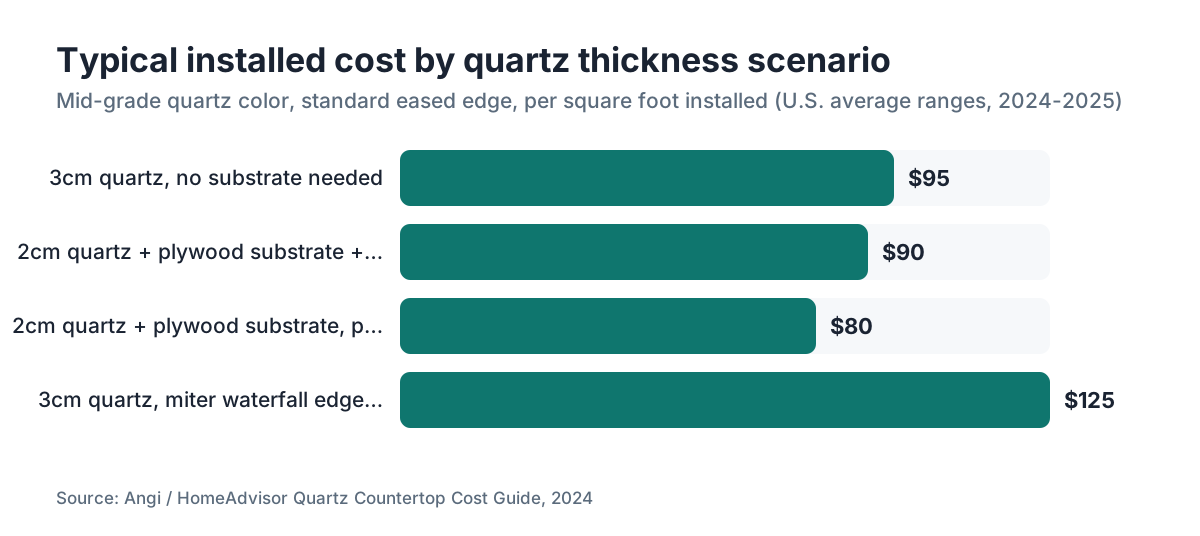
The price gap between 2cm and 3cm quartz is real but not as dramatic as most homeowners assume. Based on wholesale slab pricing and fabricator quotes in the U.S. market through 2024 and 2025, 3cm material usually runs $10 to $20 more per square foot than the same color in 2cm, before fabrication. [4]
That's only part of the math. Spec 2cm for a kitchen countertop and your fabricator will almost certainly add a plywood substrate, which tacks on $5 to $15 per square foot in labor and materials depending on region. So the "cheaper" slab often lands at about the same installed price as 3cm once the substrate is in.
Edge profiles muddy it further. A standard eased or beveled edge on 3cm looks finished as cut. On 2cm, if you want the front to read like a thick slab, the fabricator laminates an extra strip of quartz to build the edge up to a 4cm appearance. That laminated edge adds cost (roughly $15 to $30 per linear foot depending on shop rates) and adds a seam line that's usually invisible but technically there.
The table below sums up the cost factors by thickness for a kitchen countertop install.
| Factor | 2cm quartz | 3cm quartz |
|---|---|---|
| Slab material cost (per sq ft) | Lower by $10-$20 | Baseline |
| Plywood substrate needed? | Usually yes ($5-$15/sq ft) | No |
| Laminated edge for visual thickness | Often yes ($15-$30/lin ft) | No |
| Typical installed price range (mid-grade color) | $65-$110/sq ft installed | $70-$120/sq ft installed |
| Structural support for spans over 24" | Requires substrate | Not required |
These are ranges, not guarantees. Regional labor markets swing hard. A fabricator in a high-cost metro sits at the top of those ranges or above. A rural Midwest shop might come in below. Get at least three quotes. [4]
Does thickness affect how quartz looks on the counter?
Yes, and it's one of the more underrated parts of the decision.
A 3cm countertop has a visible front edge about 1¼ inches tall. That edge carries a mitered waterfall, a full bullnose, an ogee, or any decorative profile that needs material mass to cut. It reads as serious stone, which looks right in most kitchen styles.
A 2cm edge is thinner than a standard sheet of plywood. Left raw, it can look lightweight or even cheap depending on the cabinetry around it. That's why fabricators laminate the front edge. Stacking two strips of 2cm creates a 4cm visible edge, which actually looks heavier than a single 3cm piece. Some designers use this on purpose for drama, especially on islands with a waterfall panel where the slab is already spectacular.
For everyday kitchens, 3cm with a simple eased edge is the right call, both visually and structurally. You're not paying for complexity and the result is clean.
Does quartz thickness affect durability and chip resistance?
Quartz is engineered stone, typically 90 to 93% ground quartz bound with polymer resin and pigments. [5] The resin gives it flex that natural stone lacks, which makes it less prone to cracking under point-load stress than granite or marble at the same thickness.
Still, 3cm is measurably more impact-resistant than 2cm, simply because there's more material between the surface and a failure point. A sharp blow from a dropped cast-iron skillet on an unsupported 2cm section can crack it. The same blow on 3cm over open cabinetry is far less likely to do damage.
Edge chipping is the other risk. Thin edges chip more easily, and a 2cm slab's edge is inherently thinner. Some fabricators argue the laminated edge on 2cm is more vulnerable at the glue seam than a solid 3cm edge, though that depends heavily on installation quality and the adhesive.
The short version: 3cm forgives more in a hard-use kitchen. Cook seriously, have kids, or just want to stop worrying? Go 3cm.
What do quartz manufacturers actually recommend?
The major quartz makers are consistent in their published technical guidelines.
Cambria, one of the largest U.S. quartz producers, specifies that countertop applications need a minimum 3cm slab or a 2cm slab over full plywood support, and that unsupported spans must not exceed 24 inches without extra bracing. [6]
Silestone (by Cosentino) and MSI Quartz publish similar structural requirements in their installation documents. The common thread: 3cm as the default, 2cm only with full substrate support on horizontal runs. [3] [7]
These rules exist partly for structure and partly for warranty. Crack a 2cm countertop on an unsupported span and the claim is unlikely to be covered if the installer skipped the substrate requirement.
Homeowner reading your purchase paperwork? Find the installation spec. If a contractor proposes 2cm on a run with a sink cutout and no plywood, that's a warranty problem waiting to happen.
How does quartz thickness compare to granite and marble?
The same two thicknesses (2cm and 3cm) run through the natural stone world, and the same logic holds. 3cm dominates kitchen countertops in granite and marble for the same structural reasons. [2]
The difference is that natural stone is more brittle than quartz. Granite at 2cm over an unsupported span cracks more readily than quartz at 2cm in the same spot. Cross-shopping materials? Quartz's resin content gives it a small edge in flex resistance.
For homeowners weighing quartz against other materials, the kitchen countertops comparison page is a good starting point. If you're specifically looking at granite, the granite countertops breakdown covers how thickness specs translate for natural stone.
Marble is a different story. At 3cm it's beautiful and structurally sound, but the softness and porosity make maintenance a bigger worry than thickness. The marble countertops guide covers that.
How does thickness affect the countertop installation process?
This is where fabricators and installers have strong opinions, and they've earned them.
3cm slabs are heavy. A single kitchen run in 3cm quartz can weigh 400 to 600 pounds depending on footprint. That needs a two-person (often three-person) crew, real lifting gear, and a truck with the cargo capacity to carry it. Most professional crews are set up for this, but confirm before you book.
2cm slabs over plywood substrate add a step: the plywood goes in first, gets leveled carefully, and gets fastened to the cabinet boxes before the quartz sets. More steps, more chances to get it wrong. A slightly unlevel substrate telegraphs through a thin slab far more than through 3cm.
Seam placement matters for both, but especially for 2cm. On thinner material, a poorly placed or poorly finished seam shows more because the line is narrower and there's less material to sand flush. Good fabricators plan around this, but it's another reason 2cm demands more skilled execution.
The countertop installation guide walks the full process if you want to know what crews are doing on install day.
Shops using quartz-specific quoting software, like SlabWise, track slab dimensions and substrate requirements as separate line items, so quotes reflect the real cost difference between thickness specs from the start.
Is 3cm quartz always worth the extra cost?
For a primary kitchen countertop, yes. The structural reliability, the simpler install, the easier edge profiles, and the warranty compliance all favor 3cm. And the installed price gap is often smaller than the slab sticker suggests, once you fold in the substrate and edge laminate costs on 2cm.
For a small peninsula, a laundry room counter, or a prep surface in a second kitchen, 2cm over plywood is a legit way to stretch a budget without cutting structural corners.
For decorative vertical work, baking station backsplashes, or furniture-scale panels, 2cm wins because it's lighter and often the only option in the color you want.
The honest answer: for most people doing a primary kitchen renovation, going 3cm is correct and you won't regret it. Going 2cm to save money, without a proper substrate and laminated edge, is one of the most common sources of warranty disputes and installer callbacks in the trade.
If budget is genuinely tight, buy 3cm in a mid-range color over 2cm in a premium color. Thickness matters more to function and longevity than the specific stone pattern does.
What about 4cm and mitered edges: are those a thickness option?
Technically, 4cm isn't a slab thickness you can order. It's a visual trick, made by laminating two pieces of 2cm at the front edge, or by mitering two pieces of 3cm at 45 degrees to build a thick waterfall edge or a bold front profile.
Mitered 3cm edge builds are common on high-end islands where designers want a heavy-looking edge (sometimes called a "4cm miter" or "double-thick edge"). The result is a 2.5-inch-thick edge that reads substantial from any angle. The upcharge varies by region but typically runs $30 to $60 per linear foot in fabrication labor above a standard edge profile.
Some homeowners see this in showrooms and assume they need a special slab. You don't. It's a fabrication technique applied to standard 3cm material.
What should you ask your fabricator before ordering?
A few questions worth asking before you sign a contract.
First, confirm the actual thickness of the slab. Not the color name, not the brand, the thickness. Get it in writing on the quote.
Second, if you're getting 2cm anywhere horizontal, ask exactly how the substrate is handled. What thickness plywood? How is it fastened? Is it in the quote or billed separately?
Third, ask about edge lamination on 2cm. Some quotes include it, some don't, and the omission turns into an ugly surprise at install time.
Fourth, ask how the fabricator handles the warranty relationship with the manufacturer. If the slab cracks from a substrate issue, who's on the hook?
Fabricators who use structured quoting tools (SlabWise is one, built for countertop shops) usually break out substrate and edge-build specs as explicit line items instead of burying them in "installation." That makes these conversations easier for homeowners and shops both.
For how other materials handle thickness and substrate questions, the laminate countertops and Corian countertops pages are worth a look if you're still comparing.
Frequently asked questions
Is 2cm or 3cm quartz better for kitchens?
3cm is better for most kitchen countertops. It doesn't need a plywood substrate, handles unsupported spans over 24 inches, resists impact better, and is what most quartz manufacturers specify as the horizontal standard. 2cm fits vertical surfaces, vanity tops with short spans, and situations where a full plywood substrate will be installed.
What is the standard thickness for quartz countertops?
The North American standard for quartz kitchen countertops is 3cm, roughly 1¼ inches. 2cm (about ¾ inch) is also available for specific applications. A few brands make 1.2cm for panel and furniture uses, but that's not a countertop spec in North American residential kitchens.
How much thicker is 3cm quartz than 2cm?
3cm is 1 centimeter, or roughly ½ inch, thicker than 2cm. Sounds small, but it's about a 50% increase in material cross-section, which meaningfully affects flexural strength, impact resistance, and how the edge looks. The visible edge on 3cm is about twice as tall as on 2cm when both are unlaminated.
Does quartz thickness affect durability?
Yes. 3cm quartz resists cracking from impact and from unsupported spans better than 2cm. Quartz's polymer resin gives it more flex than natural stone, but thinner slabs still fail under point-load stress when unsupported. Edge chipping is also more likely on 2cm because there's less material at the edge.
Can you use 2cm quartz for a kitchen countertop?
Yes, with conditions. 2cm quartz on a kitchen countertop needs a full plywood substrate (typically ¾-inch furniture-grade) to prevent cracking. Major manufacturers, including Cambria and Silestone, spell this out. Without a substrate, spans over 24 inches are a structural risk and a warranty void. Budget for the substrate cost when comparing prices.
Does thicker quartz cost more?
Slab material for 3cm typically costs $10 to $20 more per square foot than the same color in 2cm at wholesale. But 2cm kitchen installs usually need plywood substrate and edge lamination, which can add $20 to $45 combined per square foot and linear foot. The all-in installed difference is often smaller than the raw slab gap suggests.
What thickness quartz do I need for an island overhang?
For overhangs up to 12 inches, 3cm quartz is usually fine without added support. Beyond 12 inches, most fabricators and manufacturer guidelines call for corbels, steel brackets, or a reinforced substrate regardless of slab thickness. Check your specific brand's installation guide, since specs vary. 2cm is not recommended for unsupported island overhangs.
What is a laminated quartz edge and when do you need one?
A laminated edge is when a fabricator glues an extra strip of quartz along the front to increase visual thickness. It's most common on 2cm countertops where the raw edge looks too thin. Two pieces of 2cm laminated together create a visible 4cm edge. It adds $15 to $30 per linear foot in fabrication cost and leaves a subtle glue seam line.
Is 3cm quartz heavy enough to damage my cabinets?
3cm quartz is heavy, typically 18 to 20 pounds per square foot, but standard face-frame and frameless cabinets are built to handle it. Your installer should verify that cabinet boxes are level and secured before setting the countertop. Unusually long unsupported spans or non-standard cabinetry may need extra bracing, which a good fabricator flags during templating.
Does quartz thickness matter for a bathroom vanity?
For bathroom vanities, 2cm quartz is often the right pick because spans are shorter, loads are lighter, and the thinner profile suits the space. Many designers and fabricators use 2cm for bath vanities even while specifying 3cm for the kitchen in the same project. A substrate may or may not be needed depending on the span and sink cutout.
What thickness is Cambria quartz?
Cambria makes quartz in both 2cm and 3cm. Its installation documentation specifies 3cm as the standard for kitchen countertops, or 2cm with full plywood substrate support. Not every color or pattern comes in both thicknesses, so confirm availability with your dealer before committing to a specific design in 2cm.
Can quartz countertops be too thick?
There's no practical upper limit for function, but looks matter. Very heavy profiles (like a double-miter waterfall edge) can feel out of scale in a small kitchen. Standard 3cm is almost never too thick visually. Beyond that, the cost and weight of custom thick profiles just means you're paying for a design choice, not structural necessity.
How do I know what thickness quartz I have?
Measure the visible front edge with a tape measure or calipers. Around 1¼ inches (32mm) is 3cm. Around ¾ inch (20mm) is 2cm. If the edge looks thick but you suspect laminated 2cm, look for a faint horizontal seam line running along the face of the edge, usually visible when light hits at an angle.
Sources
- Cambria, Product Specifications and Technical Data: Cambria produces quartz slabs in 2cm and 3cm thicknesses; availability by color varies
- Natural Stone Institute, Dimensional Stone Design Manual: Minimum 3cm thickness recommended for unsupported residential countertop spans exceeding approximately 24 inches
- Silestone by Cosentino, Installation and Care Guide: Silestone specifies 3cm as standard for horizontal countertop applications; 2cm requires full substrate support
- Angi (formerly HomeAdvisor), Quartz Countertop Cost Guide: Installed quartz countertop pricing ranges roughly $65 to $120+ per square foot depending on thickness, region, and edge profile
- U.S. Geological Survey, National Minerals Information Center: Engineered quartz surfacing is typically 90-93% ground quartz crystal bound with polymer resins and pigments
- Cambria, Fabrication and Installation Guidelines: Cambria installation documentation specifies 3cm slabs or 2cm with full plywood support; unsupported spans must not exceed 24 inches
- MSI Surfaces, Quartz Installation Guide: MSI publishes quartz installation guidelines consistent with 3cm as the horizontal countertop standard and substrate requirements for 2cm
- National Kitchen and Bath Association (NKBA), Kitchen Planning Guidelines: NKBA planning guidelines address countertop structural requirements and minimum support spans in residential kitchen design
- Tile Council of North America, Stone and Tile Installation Standards: Industry installation standards for stone surfacing address substrate requirements and support specifications for different material thicknesses
- Natural Stone Institute, Technical Bulletins on Stone Countertops: Technical bulletins cover flexural strength, span limits, and edge treatments for both 2cm and 3cm stone countertop applications
Last updated 2026-07-09