TL;DR
- Bedrock quartz is an engineered stone brand sold mostly through big-box retailers and regional stone dealers.
- Installed, slabs run $55 to $120 per square foot depending on edge profile and color tier.
- The material is 93 to 95% ground quartz bound with polymer resin, so it resists staining but is not heat-proof.
- It competes directly with Silestone, MSI Q, and lower-tier Cambria lines.
What is Bedrock quartz, exactly?
Bedrock quartz is engineered stone, not natural rock. The process binds ground quartz crystals (typically 93 to 95% by weight) with polyester or epoxy resins and pigments under high pressure and heat. What comes out is a non-porous slab that copies the look of granite or marble without the porosity those natural stones carry.
The brand sits in the middle of the engineered quartz market. You find it through home centers and regional distributors, not the boutique slab yards that carry Cambria or a high-end Silestone line. That distribution channel drives pricing, lead time, and how your fabricator sources the material.
Engineered quartz as a category (broader than Bedrock specifically) accounts for a large share of U.S. kitchen countertop installations. The U.S. Geological Survey tracks quartz surface consumption in its industrial minerals reporting, and the category has grown steadily since the early 2000s as buyers walked away from tile and cheap laminate [1].
Here's the confusion worth clearing up early. People mix up Bedrock quartz with quartzite, a natural metamorphic rock. Different materials entirely. Quartzite comes out of the ground, gets cut into slabs, and is porous enough to need sealing. Engineered quartz like Bedrock is made in a factory and never needs sealing. If a salesperson blurs that line, ask to see the material data sheet.
How much do Bedrock quartz countertops cost?
Installed, Bedrock quartz runs roughly $55 to $120 per square foot, and most kitchens land in the $75 to $95 range. That covers the slab, fabrication (cutting, edging, polishing), and standard installation. It does not cover removal of your old countertops, plumbing disconnects, or backsplash work.
Here's how the cost breaks down by tier:
| Cost component | Low estimate | High estimate |
|---|---|---|
| Slab material only | $18, $30/sq ft | $38, $55/sq ft |
| Fabrication (cut, edge, polish) | $20, $35/sq ft | $40, $55/sq ft |
| Installation (set, seam, secure) | $10, $18/sq ft | $18, $28/sq ft |
| Total installed | $55, $75/sq ft | $95, $120/sq ft |
Color and pattern tier drives slab cost more than anything else. Solid whites and basic beiges sit at the bottom. Veined designs that copy Calacatta marble or exotic granites sit at the top. A bright Calacatta-look with thick veining can cost 25 to 40% more than a plain white or gray, because the manufacturing is more complex and throws off more scrap.
Edge profiles add $5 to $25 per linear foot depending on complexity [10]. An eased edge (a slight softening of the 90-degree corner) is the cheapest. An ogee or dupont profile takes multiple passes and burns more machine time. For a standard 10-foot island with four sides, a premium edge can add $200 to $400 to your total.
Nobody has clean national data on Bedrock specifically. The brand doesn't publish average transaction prices. The ranges here match what fabricators across several states quote publicly and line up with Angi's engineered quartz installed-cost surveys [2].
How does Bedrock quartz compare to granite, Cambria, and other quartz brands?
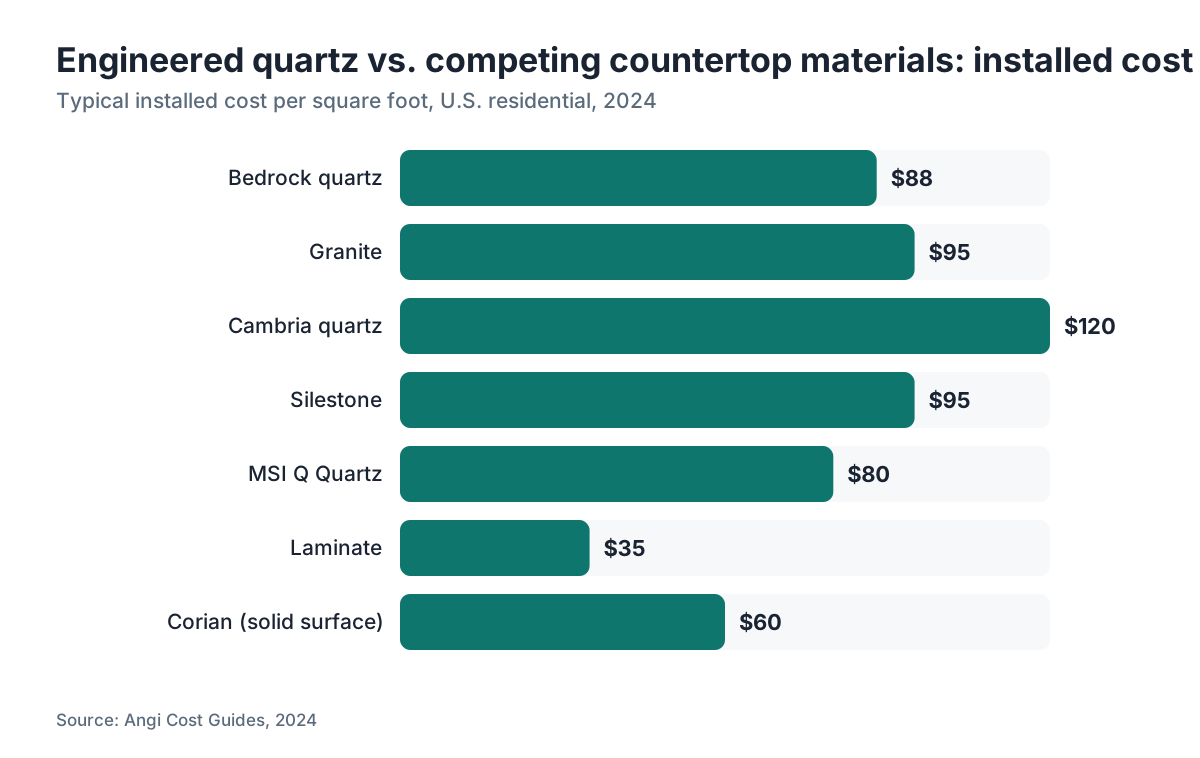
The useful comparison is against the materials homeowners actually pick between: natural granite, Cambria (the premium U.S.-made quartz brand), MSI Q Quartz, and Silestone.
| Material | Installed cost range | Sealing needed | Heat resistance | Scratch resistance |
|---|---|---|---|---|
| Bedrock quartz | $55, $120/sq ft | No | Low (max ~150°F) | High (Mohs ~7) |
| Granite | $50, $140/sq ft | Yes (annually) | High | High (Mohs 6 to 7) |
| Cambria quartz | $80, $160/sq ft | No | Low (same resin limit) | High |
| MSI Q Quartz | $50, $110/sq ft | No | Low | High |
| Silestone | $60, $130/sq ft | No | Low-medium | High |
| Laminate | $20, $50/sq ft | No | Low | Low-medium |
Granite is Bedrock's most direct real-world competition for people who want a natural look at a similar price. Granite countertops beat quartz on heat resistance (you can set a hot pan on granite without fear), but granite needs periodic sealing and can harbor bacteria in the pores once the seal degrades. Bedrock quartz never needs sealing, but it scorches or cracks under direct high heat because the polymer resin in the binder breaks down around 150°F.
Cambria countertops are made entirely in the U.S. and carry longer warranties. Cambria's published limited lifetime warranty covers manufacturing defects [6]. Bedrock's warranty terms vary by retailer but typically run 10 to 15 years on manufacturing defects, with exclusions for heat damage, impact chips, and improper installation. Read the exclusions before you sign.
For fabricators pricing a job, the wholesale material spread between a mid-tier Bedrock slab and a Cambria slab can be $10 to $20 per square foot. That gap often shrinks once you add fabrication and markup, so the installed price difference is narrower than the slab-only numbers suggest.
What colors and patterns does Bedrock quartz come in?
Bedrock's line covers the standard spectrum you'd expect from an engineered quartz brand: solid whites, grays, creams, soft beiges, concrete-look designs, and veined marble-look patterns. The veined patterns keep growing as a share of the catalog because that's what buyers keep choosing.
The most popular Bedrock colors cluster in the same design territory as the best-sellers industry-wide. Bright whites with gray veining (the Calacatta-inspired looks) dominate kitchen sales, while softer beiges and warm creams do well in bathrooms. The dark options (charcoals, blacks, graphite tones) sell for islands and accent pieces, but they show fingerprints and water spots faster than lighter colors. Quartz ranks among the top countertop materials in U.S. kitchen remodels by market share, and the veined-white look leads that demand [9].
One honest note on matching. If you need to match an existing Bedrock installation (say, adding a bathroom vanity to a kitchen done three years ago), colors get discontinued or reformulated with little notice. Engineered quartz brands do this all the time. The resin binder and pigment ratios shift, and a color with the same name can look slightly different between production runs. Order enough material to finish the job the first time, and keep a spare piece or two if you can.
For a broader look at how surface materials fit different design schemes, kitchen countertops covers the full field.
Is Bedrock quartz durable, and what are its real weaknesses?
Durability is one of quartz's real strengths. Engineered quartz rates around 7 on the Mohs scale, so it won't scratch from keys, ceramic dishes, or most everyday kitchen contact. That's on par with granite.
The polymer resin is the weak point. Every quartz brand using standard polyester or epoxy resin shares this limit: heat is the enemy. Set a hot pan straight from the stove, or a casserole fresh from a 400°F oven, on the surface and thermal shock can permanently discolor or crack it. Warranties don't cover this. Use trivets. It isn't a scare tactic. It's a physics fact manufacturers state plainly in their installation guides.
Edge chipping is the other common failure. Unlike a thick granite slab, engineered quartz edges can chip from sharp impacts, especially at corners and around sink cutouts. Thicker slabs (3 cm versus 2 cm) chip less. Most residential installs now run 3 cm as standard.
Stain resistance is where quartz clearly beats natural stone. The surface is non-porous, so wine, coffee, juice, and oil don't soak in. NSF/ANSI 51, the standard covering food equipment materials, is the framework fabricators and manufacturers reference when making food-safety claims about non-porous surfaces [3]. Household cleaners like dish soap and a diluted all-purpose spray handle most messes. Abrasive scrubs and high-pH cleaners (full-strength bleach, oven cleaner) can etch the resin over time, so keep them out of your routine.
UV exposure is a real long-term concern for quartz in sunlit areas. The resins in standard quartz formulations can yellow or discolor under prolonged direct sunlight. This matters most for sunrooms, outdoor kitchens, and counters near large south-facing windows. Some brands have improved UV resistance with modified resins, but confirm Bedrock's UV stability specs with the distributor before you commit to a sunny spot.
How do you clean and maintain Bedrock quartz countertops?
Day-to-day cleaning is genuinely simple. Warm water and mild dish soap with a soft cloth handles almost everything. For dried-on food or grease, lay a damp cloth on the spot for a few minutes to soften it before wiping. A plastic scraper (never metal) takes care of anything hardened on.
Avoid all of these, because they can damage the resin over time: full-strength bleach, oven cleaners, paint removers, drain cleaners, acetone nail polish remover (acetone specifically degrades the resin), and any abrasive scrubbing pad. If you accidentally hit the surface with a harsh chemical, flush it right away with plenty of water.
Sealing is not required. Ever. If someone tells you quartz needs sealing, they're either confused or selling you something you don't need.
For tougher jobs like dried paint or adhesive, isopropyl alcohol on a soft cloth works without harming the resin. Test in a hidden spot first.
For detailed cleaning steps that apply to stone and stone-look surfaces generally, how to clean stone countertops covers the full method.
What does countertop installation with Bedrock quartz actually involve?
The install process for engineered quartz is the same across brands. A fabricator templates your space (usually with a laser measuring tool or a physical template), takes the digital file or paper template back to the shop, cuts the slab to shape, profiles and polishes the edges, then brings the finished pieces to your home for setting.
For most kitchens, templating takes 30 to 60 minutes. Fabrication after templating runs 3 to 7 business days, depending on shop backlog and color availability. Install day for a standard kitchen takes 2 to 4 hours.
Seams are unavoidable in most kitchens because quartz slabs top out at a maximum size (typically 55 to 65 inches wide by 120 to 130 inches long, depending on manufacturer). Your fabricator plans seam placement for low-visibility spots when possible, but L-shaped kitchens and large islands almost always carry at least one seam. Seams get filled with color-matched epoxy. On light-colored veined slabs, seams show more than on solid colors, which is worth knowing before you fall for a dramatic Calacatta white.
For a full walkthrough of the day, countertop installation covers the whole process from template to final placement.
Fabricators who want to tighten quoting and nesting for engineered quartz jobs can look at SlabWise, which handles slab layout and remnant tracking for exactly this kind of material.
Where do you buy Bedrock quartz, and who sells it?
Bedrock quartz sells through big-box home centers, regional stone distributors, and kitchen and bath showrooms. It doesn't carry a flagship retail presence the way Cambria does with dedicated showrooms.
If you're a homeowner, the path usually goes like this. Find a local fabricator who stocks or can source the brand, pick your color from samples, and let the fabricator handle the slab purchase and cutting. Buying a slab yourself from a distributor is possible but uncommon. Most residential customers don't have the equipment or space to store and transport a slab, and most distributors prefer to sell to fabricators anyway.
For comparison shopping, get at least three quotes from local fabricators using the same color and edge profile. Material cost is similar across fabricators since they buy from the same distributors, but fabrication and markup vary a lot. A 20 to 30% price spread between fabricators on the same job is common.
One practical tip: ask to see the actual slab (more than a 4-inch sample) before committing to a veined color. Veining in engineered quartz is printed or pressed into the material and repeats across the slab in a pattern. On large countertops, that repeat becomes visible in a way a small sample never reveals. Some people find the repetition distracting. Others never notice it.
What are the pros and cons of Bedrock quartz versus natural stone?
The comparison against natural stone is where most buying decisions actually get made, so let's be specific.
Strengths of Bedrock quartz over natural stone: no sealing ever, consistent appearance across the slab (no surprise veins or color shifts like natural granite throws), higher stain resistance, and more predictable pricing because the manufacturing is controlled.
Weaknesses versus natural stone: the heat limit (natural granite and quartzite take direct heat without damage), the UV sensitivity in bright rooms, the visible seam pattern on veined designs, and the fact that natural stone gives you a slab no one else has exactly. Some buyers genuinely value that. If you want a one-of-a-kind surface, natural stone delivers it. Engineered quartz is a factory product.
Marble countertops land on a lot of shortlists alongside veined quartz because the look overlaps. Real marble is softer (Mohs 3 to 4), scratches more easily, and etches from acids like lemon juice or vinegar. Quartz wins on maintenance. Marble wins on authenticity and heat resistance.
For lower-cost options, laminate countertops and formica countertops have gotten much better in the past decade and offer the marble and granite look at a fraction of the price, though durability and resale perception differ. And butcher block countertops suit anyone who wants a warm, organic surface over a stone-look aesthetic.
Does Bedrock quartz add value to a home?
Quartz countertops broadly help home appraisal and buyer perception, though the exact number is hard to pin down. Remodeling Magazine's Cost vs. Value Report tracks kitchen remodel returns nationally and has consistently shown that mid-range kitchen remodels (which usually include new countertops) recover 60 to 80% of their cost at resale, though that figure swings by region and market conditions [4].
For Bedrock specifically: it's a respectable mid-tier product that a buyer reads as a real stone-look surface, not laminate. That matters in the $400,000-and-up home market where buyers expect quartz or granite as a baseline. In lower-priced markets, it's likely overkill if you're renovating to flip, and laminate or a basic entry-level quartz might close the gap for less.
What Bedrock quartz probably won't do is command the same premium perception as a Cambria slab with a named color from a brand the buyer recognizes. Buyers don't usually walk into a home and ask what quartz brand is in the kitchen, but when they do, a premium name can support a higher asking price in competitive markets. That's a marginal effect, not a reason to blow your budget.
The more honest answer: install countertops that suit the home's price tier, hold up through the years you'll live there before selling, and don't overspend on a kitchen that won't recover the cost in your specific market.
What should fabricators know about working with Bedrock quartz specifically?
From a fabrication standpoint, Bedrock quartz behaves like any standard engineered quartz slab. The 93 to 95% quartz particle content makes it a bit harder on tooling than granite in some respects, but the resin matrix also makes it more forgiving than natural quartzite, which can fracture without warning.
Blade selection matters. Diamond blades rated for engineered quartz (not the softer blades used for granite) extend tool life and cut edge chipping. The resin generates heat during cutting, so water cooling matters. Dry cutting quartz is a health hazard as well as a quality problem, because the crystalline silica dust from engineered quartz cuts is a serious occupational health concern.
OSHA's permissible exposure limit for respirable crystalline silica is 50 micrograms per cubic meter of air as an 8-hour time-weighted average, set in the 2016 silica rule (29 CFR 1910.1053 for general industry, 29 CFR 1926.1153 for construction) [5]. OSHA states the standard requires employers to "limit worker exposures to respirable crystalline silica." Engineered quartz carries higher free silica content than some natural stones, which makes wet cutting, dust collection, and respirator use non-negotiable. NIOSH's research on engineered stone fabrication documents silicosis cases tied to dry cutting in this exact trade [7].
For shops running multiple quartz jobs a week, slab yield matters. Bedrock slabs (like most brands) come in 55x120-inch or 63x126-inch formats. Nesting pieces to cut waste directly affects job margin. Tools like SlabWise handle this digitally, so fabricators see exactly how pieces fit a slab before the first cut, which heads off costly mistakes on expensive material.
Seam planning on veined Bedrock colors deserves extra attention. The pattern repeat in engineered quartz is fixed at the manufacturing level, so matching veins across a seam takes careful layout. On some colors, a joint that reads as continuous is nearly impossible. On solid colors, seams disappear easily. Set the client's expectations before templating.
Frequently asked questions
Is Bedrock quartz a good brand?
Bedrock quartz is a solid mid-tier product, not a premium brand. It competes on price rather than warranty length or prestige. For most homeowners doing a standard kitchen remodel, it performs well: stain-resistant, durable, low-maintenance. If resale perception or a longer warranty matters to you, Cambria or a Silestone upper tier may be worth the extra $10 to $20 per square foot.
How long does Bedrock quartz last?
Properly installed and maintained, engineered quartz countertops last 20 to 30 years in residential use. The main failure modes are impact chips, heat damage from hot pots, and resin yellowing from UV exposure. None of those are manufacturing defects. They come from use. The polymer resin doesn't degrade under normal kitchen conditions over that timeframe.
Can you put hot pans on Bedrock quartz?
No. The polymer resin in Bedrock (and all standard engineered quartz) starts to break down around 150°F. A pan pulled from a 400°F oven and set directly on the surface can cause permanent thermal discoloration or cracking. That voids the warranty. Use trivets or hot pads every time. This isn't unique to Bedrock. It's a property of the manufacturing process common to all resin-bound quartz brands.
Does Bedrock quartz need to be sealed?
No. Engineered quartz is non-porous by design, so sealers can't penetrate the surface and have no effect. You never need to apply a sealer. This is one of quartz's main advantages over natural granite and marble, which do need periodic sealing to prevent staining. If a contractor recommends sealing your quartz, decline.
How thick is Bedrock quartz?
Bedrock quartz slabs come in 2 cm (about 3/4 inch) and 3 cm (about 1-1/4 inch) thicknesses. Residential kitchen countertops are almost universally installed at 3 cm now, which resists chipping better and has a more substantial look. The 2 cm option shows up occasionally for vertical applications or when weight is a constraint, like a commercial build-out.
What is the difference between Bedrock quartz and quartzite?
Completely different materials. Bedrock quartz is engineered stone made in a factory from ground quartz particles and polymer resin. Quartzite is a natural metamorphic rock quarried from the earth. Quartzite is porous and needs sealing; engineered quartz does not. Quartzite is generally harder and handles heat better. The naming overlap causes a lot of confusion, and some showrooms deliberately blur the line.
Can Bedrock quartz be repaired if it chips?
Small chips at edges or corners can be repaired with color-matched epoxy filler applied by an experienced fabricator. The repair is usually visible on close inspection, especially on veined patterns. Large cracks or fractures generally require replacing the affected piece, which means a new template, new cut, and matching the slab (which may no longer be in stock). Prevention (soft-close cabinet doors, no impact on edges) beats repair.
How does Bedrock quartz compare to Corian?
Corian is a solid-surface acrylic material, not engineered stone. It's softer and scratches more easily, but it's fully repairable by sanding, which quartz is not. Corian costs roughly $40 to $80 per square foot installed, slightly below mid-tier quartz. Quartz wins on scratch and stain resistance; Corian wins on repairability and integrated sink molding. They fit different needs rather than one being strictly better.
Is Bedrock quartz made in the USA?
Most Bedrock quartz slabs are manufactured overseas, primarily in Asia, then imported and distributed in the U.S. This is common across the mid-tier and value quartz segment. Cambria is the most prominent U.S.-manufactured quartz brand. Country of origin affects lead time and occasionally tariff-related pricing, but it doesn't by itself determine quality, since the manufacturing process is standardized across producers.
What edge profiles are available for Bedrock quartz?
Standard options include eased, beveled, bullnose, ogee, dupont, and waterfall (for island sides). Eased and beveled are the cheapest to fabricate and the most popular for contemporary kitchens. Ogee and dupont add cost ($10 to $25 per linear foot extra) and suit traditional or transitional styles. Waterfall edges take extra material and labor and can add $300 to $800 or more depending on panel size.
How do fabricators price a Bedrock quartz job?
Fabricators typically price by the square foot of finished surface, marking up the slab material and adding fabrication labor and installation. Edge profiles, cutouts (sinks, cooktops), and seam count show up as line items. Using remnants for small pieces like sills or small bathrooms can cut material cost. Digital quoting tools help shops calculate exact square footage and nest cuts to minimize slab waste, which directly affects margin.
Can Bedrock quartz be used outdoors?
Not recommended. The polymer resin in standard engineered quartz degrades under prolonged UV exposure, causing yellowing or discoloration. Freeze-thaw cycles can also damage the resin binder. Some manufacturers have developed UV-resistant outdoor quartz formulations, but standard Bedrock lines are meant for interior use only. For outdoor kitchens, granite or porcelain slabs handle the environment much better.
How does Bedrock quartz hold up in bathrooms?
Very well for vanity tops. The non-porous surface resists soap scum, toothpaste, and cosmetics. Moisture is not an issue since the material doesn't absorb water. The heat limit is irrelevant in a bathroom. The main thing to watch is UV exposure if the bathroom has large south-facing windows. Color selection matters too, since light bath spaces favor the bright whites and soft grays that quartz handles consistently well.
Sources
- U.S. Geological Survey, Minerals Information: Industrial Minerals: USGS tracks quartz surface consumption as part of industrial minerals reporting; engineered quartz for countertops has grown steadily as a category since the early 2000s
- Angi (formerly HomeAdvisor), Quartz Countertop Cost Guide: Installed engineered quartz countertop cost surveys indicating typical ranges of $55, $120 per square foot for most residential projects
- NSF International, NSF/ANSI 51 Food Equipment Materials Standard: NSF/ANSI 51 is the standard framework for food-safety claims about non-porous surface materials used in food preparation areas
- Remodeling Magazine, Cost vs. Value Report 2024: Mid-range kitchen remodels nationally recover 60 to 80% of cost in resale value, though results vary by region and market
- U.S. Occupational Safety and Health Administration, Crystalline Silica Standard (29 CFR 1926.1153): OSHA PEL for respirable crystalline silica is 50 micrograms per cubic meter of air as an 8-hour TWA, established in the 2016 silica rule covering general industry and construction; OSHA states the standard requires employers to limit worker exposures to respirable crystalline silica
- Cambria, Product Warranty Information: Cambria offers a limited lifetime warranty covering manufacturing defects in its engineered quartz products
- U.S. Centers for Disease Control and Prevention, NIOSH: Silica, Engineered Stone Fabrication: NIOSH research documents silicosis cases among engineered stone countertop fabrication workers tied to dry cutting and inadequate dust controls
- National Kitchen and Bath Association (NKBA), Design Trends Report 2024: Quartz (engineered stone) has consistently ranked as one of the top countertop materials in U.S. kitchen remodel projects by market share
- Angi, Countertop Installation Cost Guide: Edge profile upgrades for quartz countertops add $5, $25 per linear foot depending on profile complexity
Last updated 2026-07-10