TL;DR
- Quartz countertops cost roughly $50, $150 per square foot installed, resist stains and bacteria without sealing, and come in consistent colors.
- The real drawbacks are heat sensitivity (scorching around 150°F), UV yellowing outdoors, and a manufactured look some people find flat next to natural stone.
- Marble beats quartz on elegance.
- Quartz wins on maintenance, and it isn't close.
What exactly is quartz countertop material?
Quartz countertops are engineered stone, not a quarried slab of natural quartz. A typical quartz slab is about 90 to 94% ground natural quartz crystals bound together with 6 to 10% polymer resins and pigments [1]. Brands like Silestone, Caesarstone, and Cambria make these slabs in controlled factory conditions, which is why every piece in a batch looks nearly identical.
That manufacturing process is the whole ballgame. Because the material is made rather than mined, manufacturers control porosity, hardness, and color with a precision that natural stone can't match. The result is a surface that's non-porous straight out of the factory, with a Mohs hardness around 7. That puts it harder than marble (3 to 4) and roughly even with granite (6 to 7) [2].
People confuse quartz with quartzite constantly. They're not the same thing. Quartzite is a natural metamorphic rock that needs sealing. Engineered quartz does not. If a salesperson uses the two terms interchangeably, that's your cue to slow down and ask questions.
What are the biggest pros of quartz countertops?
Quartz never needs sealing. That's the headline advantage. Natural stone like marble and granite needs a sealer every one to three years to resist staining, and skip it and you'll watch red wine or coffee work into the pores. Quartz has no open pores, so none of that applies.
Stain resistance follows straight from the non-porous surface. NSF/ANSI Standard 51 covers food equipment materials, and quartz clears the bacterial harbor criteria that porous surfaces can fail [3]. That matters most around the sink and prep zones.
Color consistency is another real win. A natural granite or marble slab has veining that shifts across the sheet, so matching two slabs for a big island gets tricky. Quartz is made to a spec, so two slabs from the same production run look essentially the same. For long countertop runs or commercial kitchens, that predictability saves real headaches.
Durability holds up under daily use. Quartz resists chips and scratches better than marble, and better than most people expect. You can cut directly on it without a board, though that will dull your knives rather than the stone. The surface takes normal kitchen abuse for decades with little visible wear.
The color and pattern range is huge. You can get a slab that mimics Carrara marble, a slab that's pure matte white, or something with dramatic dark veining. That variety has grown fast as manufacturers improved their printing and layering.
What are the real cons and downsides of quartz countertops?
Heat is the biggest weakness, full stop. Quartz can discolor or crack above roughly 150°F (65°C) because the polymer resin in the binder softens [4]. A hot pan straight off the stove leaves a permanent mark. This isn't theoretical. Fabricators and installers see it all the time. Use trivets or hot pads every single time.
UV exposure is a problem outdoors or in very sunny kitchens. The resins that bind quartz can yellow over time under direct sunlight. Most manufacturers void the warranty for outdoor installs outright. If your counter catches long stretches of direct sun, you may see gradual discoloration near windows over several years.
The manufactured look bothers some buyers. High-end quartz mimics natural stone well, but a trained eye usually spots the difference. Natural marble and granite have depth, randomness, and variation that even the best engineered quartz doesn't fully replicate. If you want a truly authentic stone aesthetic, quartz comes up a little short.
Repair is harder than it sounds. Small chips on natural granite often fill with matching epoxy and vanish. On quartz, the resin and pigment mix is proprietary, so color-matching a chip is genuinely tough. Most quartz repairs show up close.
Weight runs about 20 to 25 pounds per square foot for a 3 cm slab [5]. Cabinets handle that fine, but for unsupported spans (an island overhang past 12 to 15 inches, say), you need corbels or a thicker substrate. Your fabricator should flag this at templating.
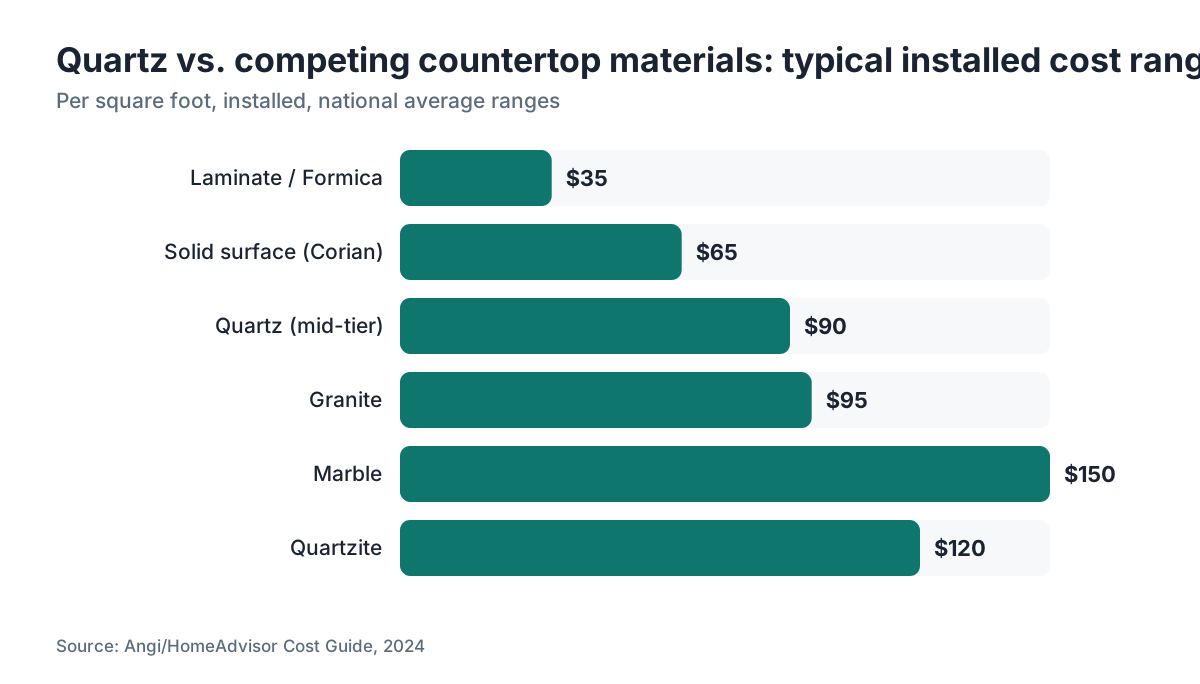
Cost sits above laminate, tile, and most solid surface. The installed range of $50, $150 per square foot puts quartz in the same neighborhood as granite and quartzite, and below the top marbles. This is not the budget pick.
How does quartz compare to marble countertops?
This is the comparison most homeowners actually lose sleep over. Quartz versus marble comes down to maintenance against aesthetics, and that tradeoff is real.
Marble is calcium carbonate, which means acids etch it. Lemon juice, vinegar, tomato sauce, even some sparkling water, dull the finish over time. Etching is different from staining. It's a chemical reaction that changes the surface itself, not a discoloration you wipe away [6]. Quartz, being mostly silica and resin, shrugs off household acids.
Here's the direct comparison:
| Factor | Quartz | Marble |
|---|---|---|
| Sealing required | Never | Every 1 to 3 years |
| Acid/etch resistance | Excellent | Poor |
| Stain resistance | Excellent | Moderate (sealed) |
| Heat resistance | Poor (≥150°F) | Moderate |
| Scratch resistance | Good (Mohs ~7) | Low (Mohs 3 to 4) |
| Repair visibility | High | Moderate |
| UV stability | Poor (outdoor) | Good |
| Typical installed cost | $50, $150/sq ft | $75, $250/sq ft |
| Authenticity/depth | Engineered look | Natural variation |
For a kitchen that sees real cooking, quartz almost always makes more sense than marble. Marble ends up etched and marked over time. Some people love that patina and call it a lived-in look. Others find it depressing.
Bathrooms flip the math. A marble vanity top sees almost no acid, gets cleaned gently, and shows off its natural beauty every day. In that setting, marble's drawbacks nearly disappear.
Want the Carrara look without the upkeep? The best engineered quartz gets close but not all the way. The full marble countertops breakdown covers what living with real marble actually involves.
And for keeping any stone surface clean without wrecking it, the how to clean stone countertops guide is worth reading no matter which material you pick.
How does quartz stack up against granite and other countertop materials?
Granite is quartz's closest natural-stone rival on durability and price. Granite handles heat better (it won't scorch from a hot pan the way quartz does), but it needs periodic sealing and can stain if oil or wine sits long enough. Quartz wins on maintenance. Granite wins on heat. Both land in roughly the same installed price range. The full granite countertops comparison is worth a read if you're torn between them.
Laminate and Formica sit far below, typically $20, $50 installed, and they've gotten a lot better in the last decade. But laminate still can't touch quartz on longevity or resale optics. Laminate countertops and Formica countertops make real sense for rentals or budget remodels, less so for a home you plan to keep ten-plus years.
Corian and solid surface are non-porous like quartz and easier to fix (you can sand out scratches), but they're softer, scratch more visibly under daily use, and carry a matte plastic quality that quartz's stone-look finishes avoid. The Corian countertops guide has the details.
Butcher block is warm, repairable, and much cheaper, but it needs oiling, can harbor bacteria in knife cuts if you neglect it, and warps with moisture. Different use case entirely. Butcher block countertops work great as a dedicated prep zone next to a quartz run.
Short version: quartz is the lowest-maintenance hard surface at this quality tier. If you'd rather never think about your countertops, quartz is the answer.
How much do quartz countertops cost, and what drives the price?
The honest installed range is $50, $150 per square foot, with most residential projects landing between $70 and $110 [7]. That covers material, fabrication, and installation. It does not cover demolition of your old countertops (usually $10, $20 per linear foot extra) or plumbing disconnection around a sink.
What moves the price inside that range:
Slab grade and brand. Entry-level quartz from MSI or IKEA's Kasker line starts around $50, $60 installed. Mid-tier Silestone and Caesarstone runs $75, $100. Premium brands like Cambria, made in the U.S. with a lifetime warranty, land $100, $150 or more.
Edge profiles. A basic eased or beveled edge is usually included. Ogee, waterfall, or mitered edges add $15, $30 per linear foot to fabrication.
Layout complexity. A simple galley kitchen with one sink cutout is cheap to fabricate. An island with a waterfall edge and three appliance cutouts eats far more shop time. Fabricators price by the job once complexity kicks in, not strictly by square footage.
Thickness. Standard is 3 cm (about 1.25 inches). Some projects use 2 cm with a built-up edge to fake the thickness. That's slightly cheaper and not structurally inferior for most residential jobs.
Region. Labor swings hard by metro. The same job costs more in San Francisco than in Memphis.
Shops that use digital templating and CNC cutting price more accurately and waste less slab, which is one reason tools like SlabWise (slabwise.com) keep spreading through professional shops. Tighter nesting means fewer offcuts, which helps keep bids competitive.
For a typical 40-square-foot kitchen replacement, budget $2,800, $4,400 all-in at mid-tier quartz. That's a fair planning number. Getting three quotes from local fabricators is still the right move.
Does quartz add value to a home?
Yes, with nuance. The 2023 Cost vs. Value report from Remodeling Magazine found a minor kitchen remodel (which includes countertop replacement) returns about 85.7% of its cost at resale on a national average [8]. That's one of the higher returns in home improvement, but you still don't recoup every dollar.
The more useful framing: outdated or damaged countertops actively hurt resale and can sink deals. Swapping worn laminate or chipped tile for quartz moves your kitchen from a liability to a neutral-to-positive for buyers. Whether you get $1.00 back for every $1.00 spent depends on your local market and the home's overall condition.
Buyers in most markets recognize quartz on sight and read it as a quality material. That perception carries weight in a competitive listing. Agents generally say stone countertops (granite, quartz, quartzite) photograph better and pull stronger showings than laminate.
The resale case is solid, not infinite. Dropping $15,000 of quartz into a $150,000 house is overkill. Putting $5,000 of quartz into a $500,000 renovation almost always pays off.
How do you maintain and clean quartz countertops?
This is one of quartz's genuine selling points. Daily cleaning is soap and water, or any pH-neutral cleaner. You don't need specialty stone products, though they won't hurt. What to keep away from:
Harsh chemicals. Bleach, oven cleaners, paint strippers, and high-pH cleaners break down the resin binder over time. Need to disinfect? A diluted 70% isopropyl alcohol solution works fine.
Abrasive pads. The polished finish gets applied during manufacturing. Green scrub pads and powdered cleansers scratch it over time. Soft cloths or non-scratch sponges only.
Heat. Covered above, but worth repeating: always use trivets. Always.
Otherwise quartz forgives a lot. Most food stains wipe right off. Dried, stuck-on gunk scrapes away gently with a plastic scraper, then cleans up normally. Wine, oil, and coffee that sit for hours are rarely a problem on a non-porous surface.
No sealing, ever. If a contractor recommends sealing your quartz, they're either confused or selling you something you don't need.
For a wider look at keeping stone and stone-look surfaces clean, the how to clean stone countertops guide covers products and techniques that carry across materials.
Are quartz countertops safe and non-toxic?
Yes, for finished and installed quartz. The surface is inert. It doesn't off-gas, doesn't leach chemicals into food, and doesn't harbor bacteria the way porous surfaces can.
The complicated part lives on the manufacturing and fabrication side. Cutting, grinding, and polishing quartz throws off respirable crystalline silica dust, a serious occupational hazard. OSHA lowered the permissible exposure limit for crystalline silica to 50 micrograms per cubic meter of air as an 8-hour TWA in 2016 [9]. Workers who cut, grind, or drill silica-containing materials risk silicosis, a progressive and potentially fatal lung disease. The National Institute for Occupational Safety and Health (NIOSH) has documented rising silicosis cases among engineered stone fabrication workers specifically [11].
This is a shop safety issue, not a homeowner issue. Fabricators need wet cutting, local exhaust ventilation, and respiratory protection under the OSHA silica standard (29 CFR 1926.1153 for construction). For homeowners, once the slab is fabricated and installed, there's no ongoing exposure from normal use.
OSHA's 2016 silica rule states the standard "requires employers to use engineering and work practice controls to limit worker exposure to the new PEL" [9]. Fabricators should confirm their shops comply.
What should you know before buying quartz countertops?
A few things that show up late in the process and shouldn't:
Lead time varies. Common colors and brands usually sit in stock at a regional distributor and can be fabricated and installed in two to four weeks. Special colors, thick slabs, or imported brands can run six to ten weeks. On a renovation timeline, order early.
Verify the warranty before you commit. Most major brands offer a limited lifetime warranty, but the terms differ a lot. Heat damage and outdoor use are typically excluded. Some warranties require professional installation. Cambria's, for example, is non-prorated and transferable to later homeowners [10]. Read the actual document.
See the slab in person. Quartz reads different in showroom light versus kitchen light. The color can shift. Many fabricators let you bring a door sample or cabinet photo to compare on-site before they cut.
Edge profiles change the whole look. A waterfall edge on an island reshapes the room. A simple eased edge reads clean and modern. Don't lock in an edge from a catalog photo alone.
Let your fabricator template, not you. Measurement errors cost money. Professional templating (often laser-templating now) is worth the fee. The template drives the CNC cut, and a mistake there wastes your whole slab.
Want a rough number before you talk to a shop? The SlabWise instant quote tool at slabwise.com takes your dimensions and gives a ballpark. It's a starting point, not a real quote.
For the full arc from template to seam placement, countertop installation walks through what happens between ordering and install day.
Which quartz brands are worth considering?
The market has consolidated around a handful of big manufacturers and dozens of importers. Here's the honest read on the main players:
Cambria is the only major quartz brand made entirely in the U.S. (Belle Plaine, Minnesota). It carries a genuine lifetime, non-prorated, transferable warranty, and the quality stays consistent. It's also priced at the top. Worth it if you're staying put.
Caesarstone is an Israeli brand with strong U.S. distribution. Reliable quality, solid selection, mid-tier price. It's been around since 1987 and has a track record.
Silestone (from Cosentino in Spain) added a carbon-neutral manufacturing claim and offers one of the widest color ranges. Mid-to-upper pricing. Easy to find through tile and stone distributors.
MSI sources from multiple international manufacturers and prices at the low end of mid-tier. Good value, though batch-to-batch consistency can vary more than with single-factory brands.
IKEA Kasker and similar entry-level lines are genuinely usable quartz at a budget price, but fabrication quality through IKEA's contracted installers is uneven, and edge and cutout options are limited.
The brand matters some. The fabricator matters more. A great fabricator with a mid-tier slab beats a poor fabricator with a premium slab every time. Seams, edge work, and cutout precision are all fabrication quality, not material quality.
Is quartz a good choice for bathrooms, outdoor kitchens, or commercial spaces?
Bathrooms: Yes, strongly. Quartz on a bathroom vanity is close to ideal. No sealing, brushes off soap scum and water, looks good, and the heat limit never comes up because nobody sets a hot pan on a vanity. Want a natural stone look in a bath without the upkeep? Quartz is the answer.
Outdoor kitchens: No. UV sensitivity and temperature-swing sensitivity make quartz a poor outdoor pick. Manufacturers void warranties for outdoor use outright. For outdoor counters, porcelain tile, granite, or concrete beat it.
Commercial kitchens: Quartz passes NSF 51 for food contact surfaces and gets used in commercial settings [3]. Heat is the main concern, and in practice commercial operators set hot pans on prep areas and equipment stands, not on countertops. For a coffee shop bar top or a restaurant host stand, quartz works well. Next to a commercial range, just make sure hot pans never land directly on it.
Wet bars and laundry rooms: Both are great fits. Same logic as bathrooms. Non-porous and low-maintenance is exactly what you want in spaces that see water and detergent all day.
For anyone comparing kitchen countertops across a full renovation, weigh the heat issue against where hot pans actually land in your specific layout.
Frequently asked questions
Does quartz countertop ever need to be sealed?
No. Engineered quartz is non-porous by design because manufacturing binds the quartz crystals in resin, eliminating open pores. There's nothing for a sealer to penetrate or protect. If someone recommends sealing your quartz, they're wrong. Save your money and your afternoon.
Can you put hot pans directly on quartz countertops?
You shouldn't. The resin binder softens and can discolor or crack above roughly 150°F. A pan from the oven or a hot cast iron skillet clears that easily. Use a trivet every time. Most manufacturer warranties exclude heat damage, so if you scorch it, the repair comes out of your pocket.
How long do quartz countertops last?
With normal kitchen use and no serious heat or UV damage, quartz realistically lasts 25 to 30 years or more. The surface doesn't degrade from ordinary wear the way wood or laminate does. The main causes of early failure are heat damage, edge chips from impact, and very rarely, a manufacturing defect in the resin bond.
Is quartz or marble better for a kitchen?
For a working kitchen, quartz is almost always the better practical choice. Marble etches from acids (lemon, vinegar, tomato), scratches easily, and needs regular sealing. Quartz handles all of that with zero maintenance. Marble wins on natural beauty and authenticity, but if your kitchen sees real cooking, marble's upkeep adds up fast.
What's the difference between quartz and quartzite countertops?
Quartz countertops are engineered: ground quartz crystals bound in resin, made in a factory, non-porous. Quartzite is a natural metamorphic rock quarried from the earth, porous, and needs sealing. They look similar but behave very differently. Quartzite handles heat much better than engineered quartz. Confirm which material you're actually buying before you sign anything.
Can quartz countertops be repaired if they chip?
Chips can be filled with epoxy adhesive, but an invisible repair is genuinely hard because the pigment and resin mix is proprietary and tough to match. Small chips in low-visibility spots repair reasonably well. Chips on a front edge or high-traffic area often show after repair. Preventing hard impacts on edges beats repairing them.
Does the color of quartz countertops fade over time?
Indoors, fading is very rare. The bigger indoor risk is yellowing near windows with extended UV exposure, which affects the resin binder. Outdoors, UV degradation and color shift are common enough that manufacturers void warranties for outdoor installs. Keep quartz out of sustained direct sun to avoid gradual yellowing, especially in white or light slabs.
What quartz countertop colors and patterns are most popular?
White and light gray quartz with subtle veining consistently top sales, with names like Calacatta (white with gray veining that mimics Italian marble) and Statuario styles leading. Pure white and concrete-look grays are popular for modern kitchens. Dark colors (charcoal, navy, black) are a minority preference and show fingerprints and water spots more, which is worth knowing.
How much does it cost to replace kitchen countertops with quartz?
For a typical 40-square-foot kitchen, expect $2,800, $4,400 all-in at mid-tier pricing of $70, $110 per square foot installed. Add $10, $20 per linear foot if you need old countertops demolished and hauled away. Edge upgrades, extra cutouts, and complex layouts raise the total. Get at least three quotes from local fabricators for a real number.
Is quartz countertop good for resale value?
Yes, with realistic expectations. A minor kitchen remodel including countertops returns about 85.7% of its cost at resale nationally, per the 2023 Remodeling Magazine Cost vs. Value report. Quartz reads as a quality material to most buyers and photographs well, which helps in competitive markets. The value case is strongest when replacing laminate or tile in a mid-to-high price home.
What cleaning products are safe for quartz countertops?
Dish soap and warm water handle almost everything. pH-neutral stone cleaners work too. For disinfecting, 70% isopropyl alcohol is fine. Avoid bleach (degrades resin over time), high-pH cleaners, abrasive powders, and acetone. Never use oven cleaner or paint stripper. Soft cloths only, no green scrub pads. Dried food scrapes off with a plastic scraper before you wipe clean.
Which is cheaper, quartz or granite countertops?
They overlap a lot. Both typically run $50, $150 per square foot installed. Entry-level granite can come in slightly cheaper because you're buying natural stone without the manufacturing overhead. Premium quartz can top most granite. The better question is total cost of ownership: quartz costs nothing in sealers; granite costs $30, $80 every few years in sealer plus the labor to apply it.
Can quartz countertops be installed over existing countertops?
Technically possible, but fabricators generally advise against it. Installing over existing counters risks an uneven substrate, which can crack the slab. It also raises counter height, which can create clearance problems with appliances and upper cabinets. Most professional fabricators won't guarantee work on an overlay install. Removing the old countertop is the right approach.
Are there any health or safety concerns with quartz countertops in the home?
For homeowners, no meaningful concerns exist with installed quartz. The finished surface is inert, doesn't off-gas, and doesn't harbor bacteria the way porous materials can. The real health risk is crystalline silica dust, and it affects fabricators who cut and grind the material in the shop, not homeowners living with the finished product.
Sources
- Natural Stone Institute (formerly Marble Institute of America), Engineered Stone Overview: Engineered quartz countertops consist of approximately 90 to 94% ground quartz crystals bound with 6 to 10% polymer resins and pigments
- U.S. Geological Survey, National Minerals Information Center: Quartz has a Mohs hardness of approximately 7; marble rates 3 to 4 and granite 6 to 7 on the same scale
- NSF, NSF/ANSI Standard 51: Food Equipment Materials: NSF 51 governs food contact surface materials including stone and engineered stone for bacterial harbor and chemical resistance criteria
- Caesarstone, Care and Maintenance Guide (manufacturer technical documentation): Quartz surfaces can be damaged by temperatures above approximately 150°F (65°C) due to resin binder sensitivity
- Natural Stone Institute, Technical Manual (Weight of Stone Products): A 3 cm quartz slab weighs approximately 20 to 25 pounds per square foot
- Natural Stone Institute, Marble Care and Restoration: Calcium carbonate in marble reacts with acids through a chemical etching process that physically alters the surface, distinct from surface staining
- Angi (HomeAdvisor), Quartz Countertop Cost Guide 2024: Installed quartz countertops cost $50, $150 per square foot nationally, with most residential projects between $70 and $110
- Remodeling Magazine, 2023 Cost vs. Value Report: A minor kitchen remodel returns approximately 85.7% of its cost at resale on a national average basis in 2023
- U.S. Occupational Safety and Health Administration, Crystalline Silica Standard (29 CFR 1926.1153): OSHA set the permissible exposure limit for respirable crystalline silica at 50 micrograms per cubic meter as an 8-hour TWA in 2016; the standard requires employers to use engineering and work practice controls to limit worker exposure to the new PEL
- Cambria, Warranty Information Page: Cambria offers a non-prorated, transferable limited lifetime warranty on its quartz countertop products
- U.S. Centers for Disease Control and Prevention, National Institute for Occupational Safety and Health (NIOSH): NIOSH has documented rising silicosis cases among engineered stone fabrication workers exposed to respirable crystalline silica
Last updated 2026-07-09