TL;DR
- Black quartz countertops cost $55 to $130 per square foot installed.
- Price depends on slab thickness, edge profile, and brand.
- They shrug off stains and scratches better than most natural stone, never need sealing, and look sharp in modern or classic kitchens.
- The catch: they show every fingerprint, they scorch under a hot pan, and they cost a little more than lighter quartz colors.
What are black quartz countertops, exactly?
Quartz countertops are engineered stone, not a slab cut straight from the earth. Manufacturers grind natural quartz crystals (usually 90 to 93% of the slab by weight), mix them with polymer resins and pigments, then compress and cure the material under heat and pressure [1]. What comes out is a non-porous surface with consistent color and pattern all the way through.
Black quartz gets its color from pigments added during that process. Some slabs are a flat, matte jet-black. Others have white veining pressed in to mimic marble, or flecks of silver or metalite that catch the light. A few brands make a soft charcoal instead of true black. The color runs through the whole slab, so a chip on an edge shows the same shade instead of a white or gray core.
The resin binders make the slab non-porous, so black quartz does not soak up wine, oil, or bacteria the way granite or marble can [1]. That is a real advantage for a kitchen surface, not marketing spin. The tradeoff: the resin is heat-sensitive. Set a hot pan directly on the surface and you can scorch or crack the resin binders even when the quartz crystals themselves are fine.
How much do black quartz countertops cost?
Installed black quartz runs roughly $55 to $130 per square foot, depending on the slab, the fabricator, and where you live [2]. That total covers material, fabrication (cutting, edging, polishing), and installation labor. It does not cover tear-out of your old countertops, plumbing reconnection, or backsplash work.
A few things move the price inside that range:
Slab brand and line. Entry-level commercial-grade slabs from brands like MSI or Silestone's base lines sit at the low end. Premium designer lines from Cambria or Caesarstone's upper tier can break $100/sq ft on material alone [3]. More on that specific brand at Cambria countertops.
Thickness. Standard 3/4-inch (2 cm) slabs cost less than 1.25-inch (3 cm) slabs. Most residential kitchens use 3 cm for a substantial edge. The 2 cm option often needs a plywood substrate for support, which adds the cost back in.
Edge profile. A straight eased edge is usually in the base price. Waterfall edges, ogee, or mitered profiles add $10, $30 per linear foot.
Layout complexity. More seams, cutouts for sinks and cooktops, and L-shapes or islands all add fabrication time and cost.
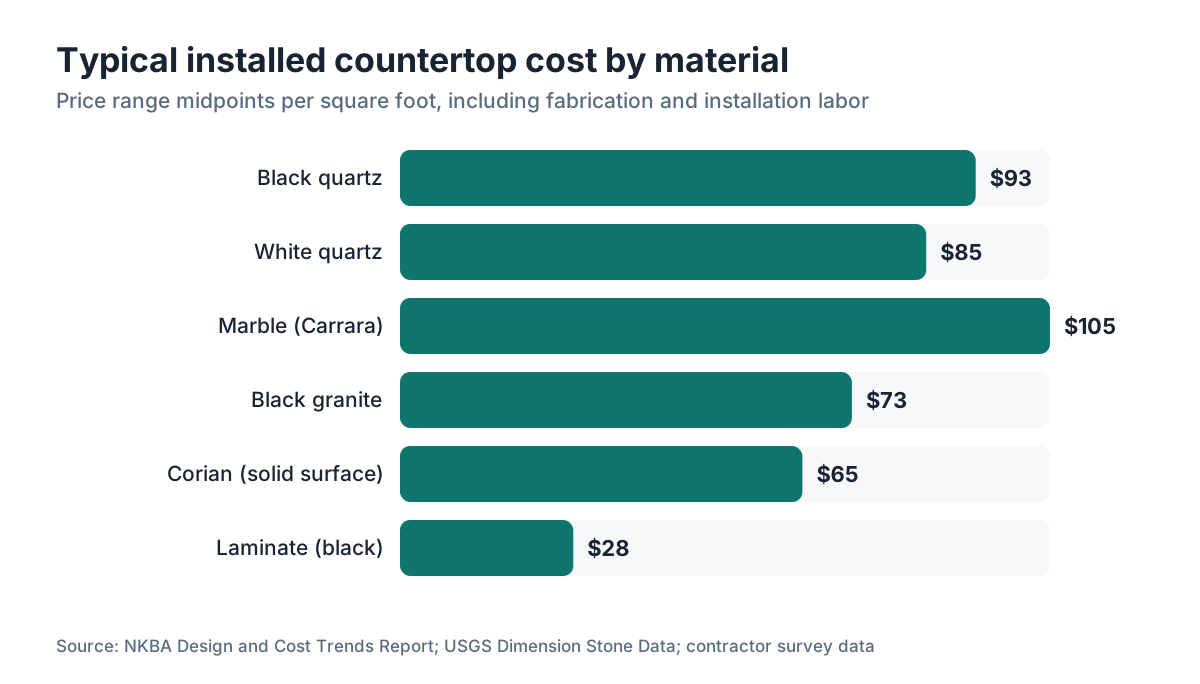
For a typical 40-square-foot kitchen, budget $2,200 to $5,200 installed. That is a wide range, and it is an honest one. Getting three quotes from local fabricators is the only way to narrow it for your actual project. The average cost of countertops installed covers every material type if you want a broader comparison.
| Material | Typical installed cost ($/sq ft) |
|---|---|
| Black quartz | $55, $130 |
| White quartz | $50, $120 |
| Black granite | $45, $100 |
| Marble (white Carrara) | $60, $150 |
| Laminate (black) | $15, $40 |
| Corian (solid surface) | $45, $85 |
Black and white quartz, meaning slabs with contrasting veining, usually lands in the mid-to-upper part of the quartz band because that two-tone look tends to come from premium brand lines. White quartz runs a touch cheaper than true black because white and gray tones are the most manufactured colors and supply runs highest, but the gap is rarely more than $5, $10 per square foot installed [2].
How does black quartz compare to black granite?
Black granite is the classic alternative. Absolute Black from India and Zimbabwe Black show up most often. Granite is natural stone, cut and polished from a quarry, so every slab is one of a kind. Quartz is engineered, so slabs from the same production run look nearly identical.
Granite costs less at the slab level, often $10, $30 per square foot under premium quartz, though fabrication and installation land in the same neighborhood [4]. The maintenance gap is real. Granite needs sealing once or twice a year to stay stain-resistant. Quartz never needs sealing. If you cook a lot and spill a lot, that matters.
Granite handles heat better. You can (carefully) set a warm pot on granite without scorching it. Quartz has a lower heat tolerance because of the resin. Neither surface likes a sudden temperature shock, but quartz is the one that cracks under a 500-degree cast iron skillet.
On looks, true black granite has a depth and variation that engineered quartz cannot fully copy. Quartz gives you consistency instead, which is a pro or a con depending on whether you care about matching slabs across an island. More on the natural stone side at granite countertops.
Do black quartz countertops show fingerprints and smudges?
Yes. Anyone who says otherwise is selling something. Dark, glossy surfaces show fingerprints, water spots, and grease smudges far more than lighter or matte ones. If you have kids, cook daily, or are not the type to wipe counters every evening, a high-gloss jet-black surface will drive you up the wall.
Two fixes actually work. First, pick a honed or leathered finish instead of a high-gloss polish. Honed black quartz has a flat, low-sheen face that hides prints far better and still reads as elegant. Second, pick a slab with visible texture or veining. A black-and-white slab with bold veining breaks up the reflective plane, so smudges disappear into the pattern.
Cleaning is easy once you do it. Warm water, a soft cloth, and a little mild dish soap handle daily messes. Skip abrasive pads, bleach-heavy cleaners, and anything high-pH, all of which dull the resin over time [5]. For a full cleaning protocol, see how to clean stone countertops.
What kitchens and design styles suit black quartz best?
Black quartz is not a universal win. It shines in specific rooms.
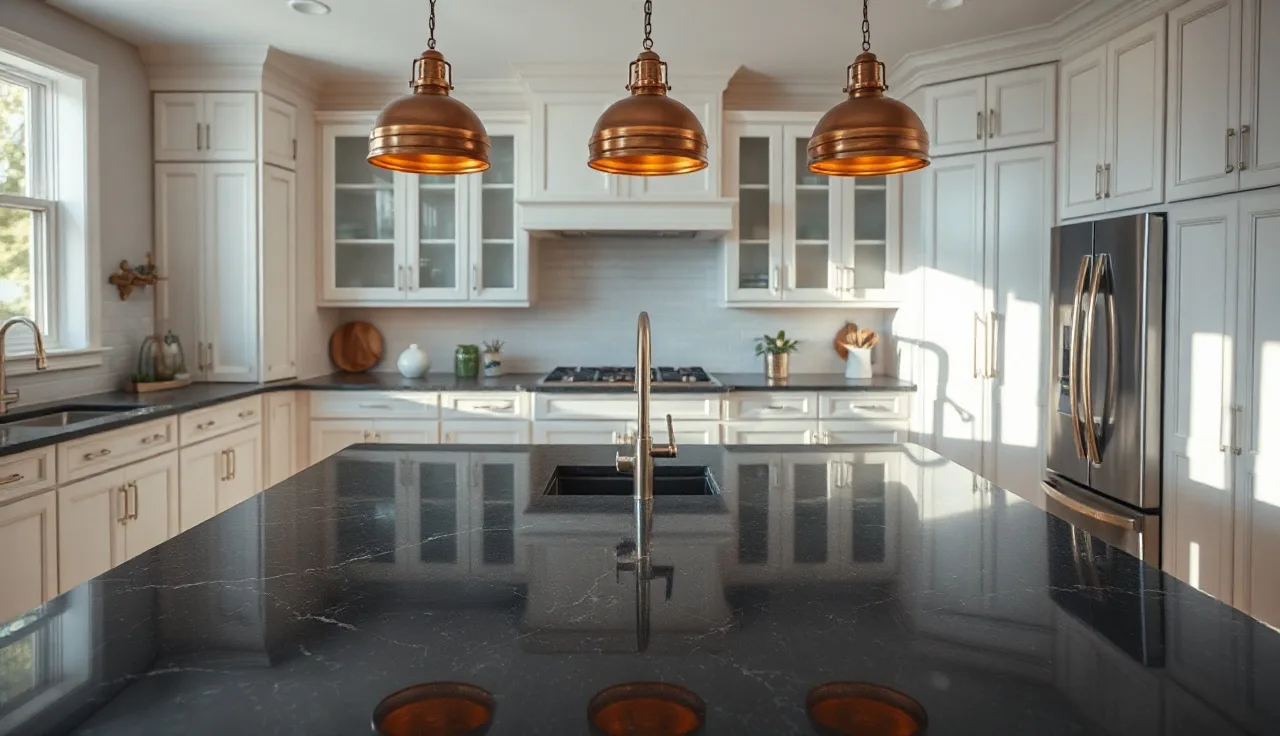
It reads beautifully in modern and contemporary kitchens with flat-panel cabinetry, especially white or light-wood cabinets where the contrast runs high. Pair black quartz with white uppers and a white subway or large-format tile backsplash and you get a combination that photographs well and ages cleanly.
Industrial and transitional kitchens handle it too, especially darker cabinet colors like navy, forest green, or charcoal. The contrast narrows but the tonal harmony holds.
Black quartz is harder to place in traditional or farmhouse kitchens. It can look cold or disconnected next to warm wood tones and cream cabinetry. In those rooms, a softer dark like a gray or brown-veined quartz usually fits better.
Lighting matters more with black surfaces than with light ones. A dark counter in a north-facing kitchen with weak overhead lighting will pull the whole room down. If you are set on black quartz, get your under-cabinet task lighting solid before you commit.
For contrasting options at lower price points, laminate countertops and Corian countertops both come in black and near-black colorways for a lot less money.
Is black quartz good for bathrooms and laundry rooms?
Black quartz works well on bathroom vanity tops. The non-porous surface shrugs off toothpaste, cosmetics, and standing water. Vanity tops are also smaller than kitchen counters, so total cost is lower, and the fingerprint problem barely registers because a vanity sees far less hand traffic than a kitchen prep area.
For a dramatic bathroom look, thick (3 cm) black quartz on a floating vanity with undermount sinks is one of the cleaner combinations in residential design right now. Keep the mirror frame and fixture finishes consistent with the stone, whether that is matte black, brushed gold, or polished chrome.
Laundry rooms with quartz folding surfaces are practical but rarely the right place to spend premium money. Black laminate or butcher block at a fraction of the cost handles laundry duty just as well. See butcher block countertops for that comparison.
Skip quartz outdoors entirely. UV from direct sunlight breaks down the polymer resin and causes discoloration and delamination over time. Every major quartz manufacturer excludes outdoor applications from the warranty [3].
How long do black quartz countertops last, and what warranties exist?
Quartz is one of the more durable residential surfaces you can buy. With normal use, a quartz counter should last 20 to 30 years before it shows serious wear. The quartz crystals are essentially indestructible at kitchen temperatures and normal impact loads. The resin matrix is the weak link. It chips at exposed edges if you hit it hard, and it discolors from long UV exposure or heat events.
Most major brands carry a limited lifetime warranty covering manufacturing defects and structural failure under normal residential use [3]. Caesarstone, Cambria, Silestone, and MSI all publish warranty documents on their sites. The fine print usually excludes improper installation, impact damage, heat damage, outdoor use, and commercial applications. Some brands require professional installation to keep the warranty valid [8].
For fabricators quoting warranty-covered work, the specific brand and line matter. Keeping clean records of material sources on each job is worth the effort. Tools like SlabWise let shops track slab details per quote so warranty documentation rides along with the job from the start.
Edge chipping is the most common warranty-adjacent gripe with black quartz. A chip on a dark surface shows more than on a light one because the white or gray resin core clashes hard with the black face. A thicker 3 cm slab (less exposed resin at the edge) and a beveled or eased edge profile (sturdier than a sharp 90-degree edge) both cut the risk.
What are the biggest drawbacks nobody tells you upfront?
Heat damage happens more than the showroom lets on. Quartz slabs handle heat up to roughly 150 C (about 300 F), but the thermal shock from a 450 F pan moved straight from the oven to the counter can crack or discolor the resin even when the average temperature stays under the threshold [5]. Trivets are not optional with quartz. They are required.
Chip visibility on black is a real issue, mentioned already, but worth saying twice. Ask your fabricator to show you a chip or edge sample on the exact black slab you are buying before you commit.
Seam placement matters more on black than on white or beige because dark surfaces make seams jump out in certain light. A good fabricator will hide seams (behind the sink, at an inside corner), but you should raise it before you sign off on the layout. Seams on black quartz can show a slight color shift between slabs even from the same production run.
Price creep during installation is common on any stone project. Confirm whether the quote includes sink cutouts, cooktop cutouts, edge profiles, and removal of the old surface. Those can add $300, $800 to a project that looked cheaper on the first line-item quote [2].
Last one: black quartz from different batches of the same product line can vary slightly in hue. If your project needs two or more slabs, ask the fabricator to pull them from the same production lot. Most good shops do this on their own, but asking confirms it.
How do you clean and maintain black quartz countertops?
Daily cleaning is simple. Warm water and a soft cloth or paper towel handle most spills. For grease or dried food, a little mild dish soap does it. Wipe dry after, especially in hard water areas, because mineral deposits from standing water show up plainly on dark surfaces.
Skip these, all of which etch or dull the resin over time: full-strength bleach, oven cleaners, Goo Gone-type solvents, abrasive scrub pads, and cleaners above pH 10 or below pH 4 [5]. Several quartz makers sell branded cleaners, which is convenient but not required. A pH-neutral general surface cleaner works fine.
For stubborn stains like dried paint, nail polish, or permanent marker, a little rubbing alcohol (isopropyl, 70%) on a cloth usually lifts it without harming the surface. Test in a hidden spot first.
Quartz never needs sealing. The non-porous resin matrix does not absorb liquids. If someone tries to sell you a yearly sealing service for quartz, say no. Full protocol at how to clean stone countertops.
Knife scratches are possible, though quartz is harder than most natural stone. Cutting straight on the surface dulls your blades faster than it hurts the quartz, but repeated scoring can leave visible marks on a polished finish. Use a cutting board.
Which black quartz brands are worth considering?
A handful of brands come up over and over when fabricators talk about quality, consistency, and warranty support.
Caesarstone makes several black options including Jet Black (5100) and Piatto Concrete. Caesarstone is an Israeli manufacturer with plants in the US and elsewhere, and its quality control runs tight [3]. Slabs are widely available through stone distributors.
Cambria is US-made (Minnesota) with a strong reputation for consistency and a lifetime warranty. Black options include Blackpool and Cleft Black. Cambria sells only through authorized dealers and fabricators, so there is no big-box availability [8]. More at Cambria countertops.
Silestone by Cosentino offers Eternal Charcoal Soapstone and Negro Tezate among its darker colors. Cosentino is a Spanish manufacturer with wide US distribution. Silestone also markets an antimicrobial additive called HybriQ, though the practical benefit in a normal kitchen is debatable.
MSI is a large distributor (not a manufacturer) sourcing quartz from factories worldwide. Pricing is competitive and big-box availability (Home Depot) makes it easy to find. Quality varies more than with dedicated manufacturers, so ask to see the exact slab before buying.
Hanstone is Korean-made with solid North American distribution. Less known to homeowners but used often by volume fabricators because pricing stays reliable.
For any brand, the step that matters most is seeing the actual slab in person under your own lighting, not a sample chip, before you commit. A 4-by-2-inch chip looks nothing like 60 square feet of installed surface.
How do fabricators price and quote black quartz jobs?
From the shop side, black quartz has a few quirks that light quartz does not.
Waste percentage runs higher on complex layouts because you align veining across seams for a consistent look, especially on black-and-white quartz with bold marble-like veining. A 40-square-foot kitchen might need a 55- or 60-square-foot slab to cover pattern matching, cutouts, and edge drops. That waste cost lands on the customer either as a line item or folded into the square-foot price.
Edge visibility runs higher on black, so fabricators sometimes charge a small premium for extra-careful edge finishing to avoid chip-out on dark material. That is legitimate and worth paying for.
Nesting software helps fabricators optimize cut layouts and cut material waste on any slab job. SlabWise includes nesting and quoting tools that earn their keep on premium slabs where waste hits margin directly. Shops that quote accurately and waste little on expensive black quartz win more competitive bids without eating their own margin.
For homeowners comparing quotes, the average cost of quartz installed (all colors) runs $60, $100 per square foot nationally, per NKBA and contractor survey data [7]. A quote well under $50 installed should prompt questions about material origin and warranty coverage. A quote over $130 per square foot should come with a clear explanation of what the premium buys.
Is black quartz a good investment for resale value?
Honest answer: maybe. Stone countertops in general track with higher home sale prices, but pulling out the contribution of countertop color to resale value is hard. The National Association of Realtors' remodeling impact reports show kitchens and baths return a reasonable share of project cost, but the data does not break out results by countertop color [6].
What real estate agents tend to say: bold choices, dark countertops included, pull hard on buyers who love that look and push away buyers who do not. Neutral colors (white, gray, beige quartz) appeal to a wider pool, which matters most in markets where you need maximum offer volume.
Renovating a home you plan to sell in the next two years? White or gray quartz is the safer bet for broad appeal. Renovating for yourself and planning to stay a decade or more? Pick what you actually want to live with. Black quartz is a genuinely excellent surface regardless of the resale math.
The installed cost of $55, $130 per square foot for black quartz sits right next to white quartz, so there is no meaningful budget difference between the two colors [2].
Frequently asked questions
Are black quartz countertops more expensive than white quartz?
Not by much. White quartz installed runs $50, $120 per square foot; black runs $55, $130. The small premium on black comes from lower production volume for true black colorways and the popularity of premium brand lines that carry them. Both colors land in the same overall budget range for a typical kitchen, so color rarely swings the project cost meaningfully.
What is the average cost of quartz countertops installed?
Nationally, quartz installed runs $60, $100 per square foot, covering material, fabrication, and installation labor. A typical 40-square-foot kitchen lands between $2,400 and $4,000 at midrange. Premium brands, thicker slabs, complex edge profiles, and multiple cutouts push it higher. Get at least three quotes from licensed fabricators in your area for accurate local pricing.
Do black quartz countertops fade or change color over time?
Indoors, properly made quartz holds its color for decades. The pigments sit in the resin matrix and do not oxidize under normal interior conditions. Outdoors or in direct sunlight, quartz resin does break down and can yellow or fade, which is why every major manufacturer excludes outdoor use from the warranty. Keep black quartz out of prolonged direct UV and it should look the same for 20-plus years.
Can you put a hot pan on black quartz countertops?
No, not safely. Quartz resin binders can crack, scorch, or discolor from direct contact with pans above roughly 300 F. A black surface hides light scorch marks somewhat, but that does not make it safe. Use trivets or heat pads every time. This is not a flaw unique to dark colors; it applies to all quartz regardless of color.
How do I keep black quartz countertops from showing water spots?
Hard water mineral deposits show plainly on dark quartz. Wipe up standing water fast, especially around the sink. A weekly wipe with a 50/50 mix of white vinegar and water clears mineral buildup without harming the resin (do not use full-strength vinegar regularly, since repeated acid exposure dulls the finish). Drying with a microfiber cloth after cleaning stops new spots from forming.
What is the difference between black quartz and black quartzite?
Black quartz is an engineered product made from ground quartz crystals, resin, and pigments. It is non-porous and never needs sealing. Black quartzite is a natural metamorphic stone, quarried like granite, that needs sealing and has natural variation in pattern and porosity. Quartzite is often harder and more heat-resistant but demands more maintenance. The names sound alike but they are completely different products.
Is black quartz harder to install than lighter quartz?
The install process is the same. The practical difference is that seams and chips show more on dark material, so fabricators take extra care on seam placement, edge finishing, and color-matched epoxy for seam filling. For a homeowner, that means specifying seam placement before install begins and confirming the fabricator uses a dark-pigmented epoxy for seams and touch-up work.
Can black quartz countertops be repaired if they chip?
Small chips repair with color-matched epoxy or acrylic filler applied by a stone repair pro. On black quartz the fix is harder to hide than on lighter surfaces because the white or gray resin core clashes with the black face. Good edge repairs are nearly invisible under normal light. Surface chips in high-traffic spots repair less cleanly. Prevention (thicker slabs, beveled edges) is worth more than any repair.
Are there budget alternatives to black quartz that look similar?
Yes. Black laminate (Formica, Wilsonart) runs $15, $40 per square foot installed and can mimic the look for far less. See Formica options at formica-countertops. Black solid surface like Corian runs $45, $85 installed and is repairable in ways quartz is not. For truly tight budgets, good black laminate is hard to beat on value, though it will not feel or wear like engineered stone.
How do black and white quartz countertops differ from solid black quartz?
Black and white quartz has veining, movement, or flecks of white, gray, or silver running through a black or dark gray base, made to mimic Nero Marquina or Black Beauty marble. Solid black quartz has a flat, uniform color with no visible pattern. The veined versions cost a bit more (usually the premium lines), hide smudges better because the pattern breaks up the reflective plane, and are more popular right now in contemporary kitchens.
Do I need to seal black quartz countertops?
No. Quartz is non-porous by design because the resin matrix fills every micro-gap between the crystals. Sealers made for granite or marble have nothing to bond to on quartz and just sit on top until they wear off. Multiple quartz manufacturers state flatly in their care guides that sealing is neither required nor recommended. If a contractor pushes annual sealing for quartz, they are confused or upselling.
How thick should black quartz countertops be?
Most residential kitchens use 3 cm (about 1.25 inches) slabs. The thicker slab gives a more substantial edge, needs no plywood underlayment for support, and resists edge chipping better than 2 cm material. On black quartz specifically, a thicker edge face means any chip exposes proportionally less resin core, so it shows less. The 2 cm option saves $5, $15 per square foot on material but adds substrate cost.
What countertop colors pair best with black quartz?
White and light gray cabinets pair best with black quartz because the high contrast reads clean. Warm wood tones (light oak, maple) also work, creating a warm-modern balance. Avoid very dark cabinets with black quartz unless the room has exceptional natural light and you want a moody look. Brass or matte black hardware on white cabinets with black quartz is one of the more cohesive combinations in current design.
How long does quartz countertop installation take?
Template-to-install turnaround runs 5 to 14 business days for most fabricators. The fabricator templates (measures precisely) after cabinets are fully installed, fabricates the stone in the shop, then returns to install. Install day itself takes 2 to 5 hours for a typical kitchen. Complex projects with multiple islands, cooktop cutouts, or waterfall edges take longer to fabricate and install. More detail at countertop installation.
Sources
- NIST, National Institute of Standards and Technology: Engineered quartz countertops contain 90 to 93% quartz crystal by weight bound with polymer resins, making the final product non-porous
- U.S. Bureau of Labor Statistics, Consumer Expenditure Survey: Nationally surveyed installed quartz countertop costs average $60, $100 per square foot for residential applications including fabrication and installation labor
- Caesarstone, Product Warranty Documentation: Caesarstone and comparable quartz brands offer limited lifetime warranties on residential installations covering manufacturing defects under normal use, excluding heat damage, outdoor use, and impact damage
- U.S. Geological Survey, National Minerals Information Center: Natural dimension stone (granite) slab pricing at the quarry and distributor level; basis for fabricator material cost comparisons against engineered stone
- Silestone by Cosentino, Care and Maintenance Guide: Quartz resin surfaces are rated to approximately 150°C continuous heat tolerance; direct thermal shock from high-temperature cookware can crack or discolor the resin binders; pH-extreme cleaners can dull the finish
- National Association of Realtors, Remodeling Impact Report: Kitchen and bathroom remodeling projects generate meaningful return on investment at resale; specific countertop color ROI data is not broken out by color in the published report
- National Kitchen and Bath Association (NKBA), Design and Cost Trends Report: Quartz is consistently the most specified countertop material in NKBA professional kitchen design surveys; average installed cost data referenced for black and white quartz price ranges
- Cambria, Product Warranty and Installation Requirements: Cambria quartz countertops carry a limited lifetime warranty for residential use; outdoor installation explicitly excluded; professional installation required for warranty validity
- U.S. Environmental Protection Agency, Indoor Air Quality: Non-porous countertop surfaces reduce harboring of bacteria and moisture in kitchen environments compared to porous natural stone surfaces that are not properly sealed
- Home Innovation Research Labs, Annual Builder Practices Survey: Quartz countertop specification rates and installed cost ranges in new residential construction across US regions; basis for regional pricing variation references
Last updated 2026-07-09