TL;DR
- Butcher block countertops cost roughly $40 to $100 per square foot installed.
- They feel warm to the touch and sand back to new after knife marks and stains.
- The catch: they need oiling every one to three months, and they swell, warp, or crack near sinks if you neglect them.
- Great for islands and prep zones.
- Riskier for the perimeter around a sink.
What are butcher block countertops, exactly?
Butcher block is a thick slab of wood strips glued together under pressure. The strips can run edge-grain (long faces out, the most common), end-grain (the cross-cut faces out, the classic checkerboard look), or face-grain (flat-sawn faces out, cheapest and least durable). Each construction changes how the surface ages and how much it costs.
End-grain is the most forgiving surface to cut on because knife edges slide between the wood fibers instead of across them. It is also the priciest and heaviest, usually 2.5 to 4 inches thick. Edge-grain is what you see in most kitchen showrooms. It looks cleaner, costs less, and still sands out damage reasonably well. Face-grain is essentially furniture-grade lumber glued into a panel. It warps more readily and shows up mostly in low-budget jobs.
Species matters too. Hard maple (Acer saccharum) is the industry standard for cutting boards and countertops because of its tight grain and a Janka hardness rating of about 1,450 lbf [1]. Walnut, cherry, and teak show up as premium options. Teak's natural silica content is hard on cutting tools, so it is more of a showpiece than a workhorse despite the hype.
How much do butcher block countertops cost compared to other materials?
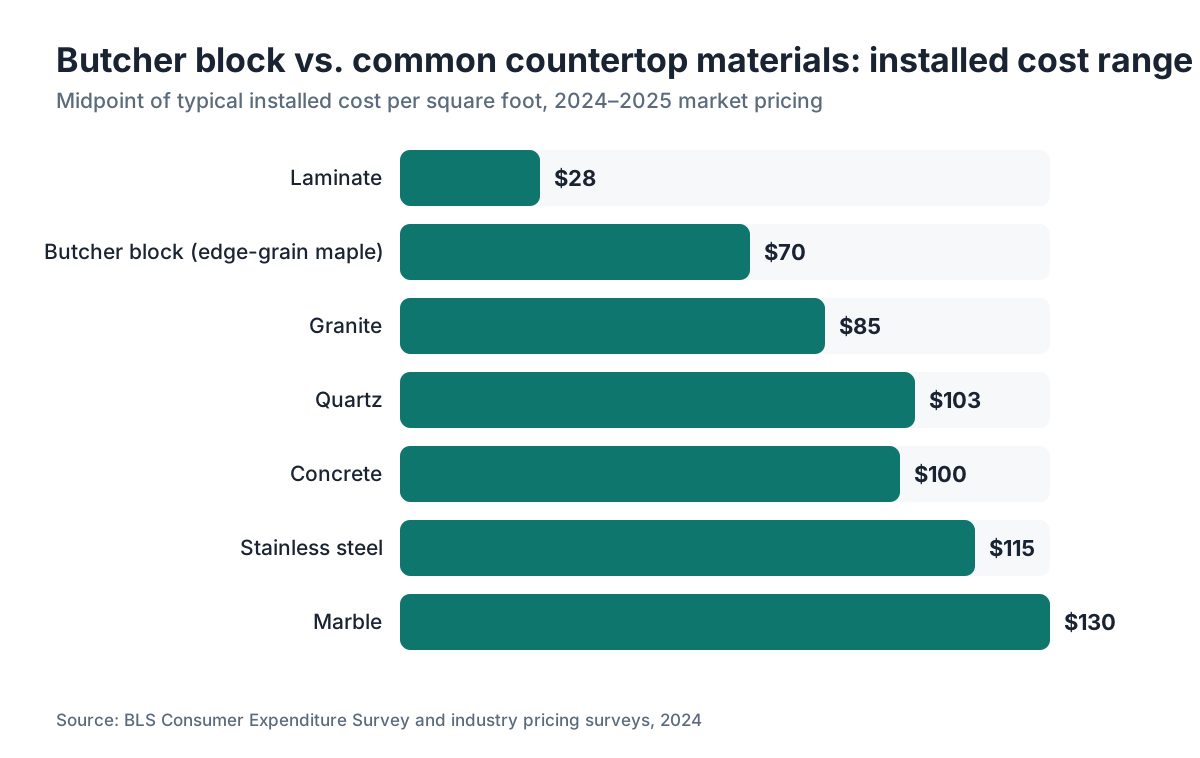
Material and installation together run roughly $40 to $100 per square foot for a typical butcher block job, though pricing swings hard on species, thickness, and region [2]. A basic edge-grain maple slab from a big-box store runs $30 to $50 per linear foot before you touch installation. Premium end-grain walnut from a specialty supplier can hit $150 to $200 per square foot or more.
Here is how it stacks against other common countertop materials on installed cost. These are real market ranges from 2024 to 2025. Your local quotes will vary.
| Material | Installed cost range (per sq ft) |
|---|---|
| Laminate | $15 to $40 |
| Butcher block (edge-grain maple) | $40 to $100 |
| Quartz | $55 to $150 |
| Granite | $45 to $125 |
| Marble | $60 to $200+ |
| Concrete | $65 to $135 |
| Stainless steel | $80 to $150 |
For a typical 30-square-foot kitchen perimeter, butcher block lands in the $1,200 to $3,000 range installed. That makes it genuinely affordable next to quartz or marble while still reading as a real material rather than a laminate print. See how it compares against stone in our guide to kitchen countertops.
Here is the fabricator's headache: wood moves seasonally, so your material cost can jump 10 to 15% between the quote and the install if you are not locking lumber prices fast. Quoting software that lets you put a time-limited expiry on wood jobs saves you from eating that swing.
What are the real pros of butcher block countertops?
The biggest genuine advantage is repairability. A deep gouge in quartz means a professional repair or a new slab. A deep gouge in butcher block means an orbital sander, some elbow grease, and fresh oil. You are not hiding damage. You are removing it. That changes how it feels to own the surface.
Warmth is real, not marketing language. Wood conducts heat far more slowly than stone, so it does not feel cold and does not crack a glass you set down hard the way tile or granite can. If your kids do homework at the island, butcher block is kinder on elbows and dropped mugs.
Installation is easier. You can cut it on site with a circular saw, rout sink cutouts without a bridge saw, and shave the fit without stone tooling. A skilled carpenter can install it. You do not have to hire a stone fabricator. Our guide to countertop installation covers what the process involves either way.
Butcher block is renewable. Wood stores carbon. FSC-certified maple countertops carry a traceable chain of custody back to sustainably managed forests [3]. That argument means nothing to some buyers. For people who care about embodied carbon, wood beats quarried stone or petrochemical quartz binders.
The price-to-looks ratio is hard to beat. A $50-per-linear-foot maple slab from a home improvement store, oiled and set with a decent undermount sink, photographs upscale and looks upscale in person. Laminate cannot do that. Marble costs several times more.
What are the real cons of butcher block countertops?
Water is the enemy, and kitchens are full of it. Standing water near the sink, a slow faucet drip, or a dishwasher venting steam up into the underside of the next counter will eventually cause swelling, warping, and if it drags on, mold. This is the most common failure fabricators and contractors see in butcher block installs that were sealed or maintained poorly.
The maintenance burden is real. A well-cared-for surface needs oil or wax every one to three months, more in dry climates. Mineral oil is the standard for food-contact surfaces because it does not go rancid the way vegetable oils do [4]. Skip the cycles and the wood dries, cracks, and starts holding bacteria in those cracks.
Bacteria is a legitimate concern, and it is more nuanced than the countertop industry usually admits. The USDA Food Safety and Inspection Service recommends non-porous surfaces for food prep because porous materials are hard to disinfect [5]. Wood does have some natural antimicrobial behavior. A 1990s study by Dean Cliver at UC Davis found bacteria drawn into dry wood were not recoverable and eventually died [6]. But that applied to wood that was wetted and then dried, not a moist surface left overnight. The honest answer: a well-oiled, dry butcher block is reasonably sanitary. A damp, cracked one is not.
Butcher block scratches and dents under daily use. That is a feature when you can sand it out, but only if you actually do the sanding. If you want a surface that stays perfect with zero effort, buy quartz.
Heat is the other weakness. A hot pan set straight on oiled wood scorches it. Trivets are non-optional. Stone and quartz buyers rarely think about this. Butcher block buyers have to build the habit.
Is butcher block sanitary enough for food prep?
A dry, well-maintained butcher block is reasonably sanitary for a home kitchen. A damp, cracked one is not. The answer really does depend on how you use and maintain it.
The FDA Food Code, which most state health codes for food service are based on, requires food-contact surfaces in commercial kitchens to be smooth, non-absorbent, and easily cleanable [7]. That language rules out bare wood in licensed commercial kitchens unless it is a hard maple cutting block designated for that use.
Home kitchens are not subject to the Food Code, so the question turns practical instead of regulatory. Dean Cliver's UC Davis research found plastic cutting boards held more recoverable bacteria than wood after knife scarring, because bacteria trapped in plastic grooves survived and multiplied while bacteria pulled into wood's capillaries did not [6]. The researchers put it this way: "we found that new plastic surfaces were easiest of all to clean, but were also cut up more severely than wood by the knife; and that recovery of bacteria from wood was less than the recovery from plastic."
What that means for a countertop: keep the surface dry between uses and oil it so it does not crack, and it works fine for food prep. If you see standing moisture and visible checking, sand and re-oil before you cut raw meat on it. The FDA does not restrict wood countertops in residential kitchens, so the call is yours.
How do you maintain butcher block countertops, and how hard is it really?
The routine is simple but it has to happen. Every one to three months, wipe on a thin coat of food-grade mineral oil, let it soak an hour, wipe the excess, done. A new slab needs more at first: most manufacturers recommend oiling weekly for the first month to saturate the wood. After that you back off to monthly, then quarterly once the wood is fully conditioned.
Mineral oil costs about $5 to $10 for a bottle big enough to last a year of quarterly maintenance. Some people use a beeswax-and-mineral-oil blend (sold as "board cream" or "butcher block conditioner") for extra moisture resistance. That is a good call near the sink.
Skip olive oil, coconut oil, and other food oils that turn rancid inside the wood. Linseed and tung oil do polymerize into the wood, but they are not food-safe until fully cured, which takes days or weeks depending on temperature and ventilation. For a surface where you cut food, plain USP-grade mineral oil is the safe, boring choice.
Got a stain? Salt and lemon juice pull out most food stains without hurting the finish. For deeper marks, 120-grit sandpaper, then 220-grit, then re-oil. Butcher block forgives in a way no other countertop does. But only if you put in the fifteen minutes four times a year.
Can butcher block countertops be used around the sink?
Yes, with caveats. Plenty of designers will tell you to run stone at the sink and butcher block on the island, and that is sensible advice for a low-maintenance house. But full-perimeter butcher block, sink surround included, holds up for decades when installed and maintained right.
The keys: seal the underside and all cut edges with a waterproofing finish before installation, more coats than you use on top. Use a proper undermount or drop-in sink with caulk at every seam. Check that caulk yearly and replace it the moment it pulls away from the wood. Make sure the faucet base does not pool water. Dry the surface after dishes instead of leaving a puddle sitting on the grain.
Some installers set butcher block on a barely perceptible pitch, maybe 1/16 inch over 24 inches, toward the sink so water runs off. Others apply polyurethane or hardwax oil in the sink zone instead of straight mineral oil, trading the natural look for better moisture resistance.
The sink cutout is the riskiest moment in the whole install. Those cut edges are exposed end grain and they drink water. Seal them with multiple coats of finish before the sink goes in. Our guide on countertop installation covers sink cutout best practices across materials.
How does butcher block compare to other popular countertop materials?
Against quartz: quartz wins on durability, stain resistance, and zero-maintenance appeal. Butcher block wins on repairability, warmth, feel, and cost at the low to mid end. Quartz cannot be refinished. Butcher block can. For a house with young kids or heavy cooking, refinishability is a real practical edge.
Against granite: granite countertops are harder, heat-resistant, and basically permanent when sealed. Butcher block is warmer, lighter (easier on cabinets), and installs without stone tooling. Granite chips at the edges. Butcher block dents but does not chip. Granite wins in a wet environment. Butcher block wins on feel and cut-ability.
Against marble: marble countertops etch from acidic foods and scratch easily. Butcher block scratches too, but you fix it yourself. For most kitchens, marble is a bigger maintenance chore than wood despite the upscale image.
Against laminate: laminate countertops are cheaper and waterproof but cannot be refinished. A burn or deep cut in laminate means replacement. The same in butcher block means a Saturday with sandpaper. For long-term value, wood wins.
Against Corian and solid surface: Corian countertops are also repairable (that is the category's whole pitch) and fully non-porous. If sanitation is your top worry and you still want a repairable surface, solid surface beats butcher block. Butcher block wins on looks and the feel of a real material.
Against Cambria countertops and other quartz brands, the math is simple: engineered quartz does not need oiling, does not warp, and stays sanitary more easily, but it costs more and you cannot fix a serious scratch at home.
What finish options do butcher block countertops have, and which is best?
There are four finish categories worth knowing: food-grade oil (mineral oil, beeswax blends), hardwax oil (Rubio Monocoat, Osmo Polyx), polyurethane or water-based poly, and penetrating oil-varnish blends.
Mineral oil and beeswax blends are food-safe immediately, easy to apply, and fully renewable. The downside is they give the least moisture resistance of any option and need the most frequent reapplication. Best for dry climates and islands away from the sink.
Hardwax oils soak into the wood fiber and cure to a flexible film. They are not fully non-porous, but they repel water far better than mineral oil. They are food-safe once cured. Rubio Monocoat, for one, carries food-safe certifications from multiple European regulatory bodies [8]. Recoating beats stripping and refinishing poly. This is what I would put on a full-perimeter install.
Polyurethane builds a plastic film on top of the wood, so you get the best moisture resistance. The tradeoffs: it is no longer a food-contact surface in the traditional sense, it peels and chips over time, and refinishing means stripping the whole thing. Plenty of people love the look. Plenty of wood purists hate it. For a sink area in a low-maintenance house, poly is defensible.
Varnish-oil blends sit between mineral oil and poly. Better moisture resistance than straight oil, easier repair than poly. A solid middle option for a perimeter with moderate sink activity.
How long does butcher block last, and what kills it early?
A well-maintained butcher block countertop lasts 20 to 30 years. Some end-grain maple blocks in commercial kitchens have gone 50 years with regular resurfacing. The wood does not really expire the way other materials do. It just piles up damage until sanding can no longer keep pace.
What actually shortens its life:
Persistent moisture, especially from below. The underside gets neglected. If you never sealed it before installation and there is ambient moisture in the cabinet space, the bottom of the slab swells and the top cups or cracks.
Drying out in low humidity, particularly with forced-air heat in winter. Wood in an unheated shop can sit at 8 to 10% moisture content. In a heated kitchen in a cold climate in January, relative humidity can drop to 20 to 30%, and the wood wants to match it, so it shrinks and can check (develop hairline cracks). A humidifier helps. So does never letting the surface dry out between oilings.
Refinishing too hard. Sanding removes wood. If you are taking 1/16 inch off every couple of years because someone keeps cutting with a cleaver directly on the top, you do have a finite resource. On a 1.5-inch slab that is still many cycles, but it is not infinite.
Insect damage matters if the wood was not properly kiln-dried before fabrication. Reputable suppliers use kiln-dried lumber, which kills insects and their eggs [9]. Bargain countertops from an unknown source with no species or moisture documentation are a gamble.
Who should buy butcher block countertops, and who should skip them?
Buy butcher block if you cook regularly, like the warmth of a natural material, and will spend fifteen minutes with an oiling cloth four times a year. It shines on an island where prep happens and the sink is elsewhere. It is a smart pick for a kitchen that gets hard use and will show wear on any material, because at least with wood you can sand and reset.
It is also a strong budget move on a full renovation. An IKEA edge-grain birch or oak top runs roughly $30 to $60 per linear foot before installation, far cheaper than quartz or stone for a full perimeter. You can upgrade later without feeling like you threw away an expensive slab.
Skip butcher block if your household is genuinely bad at upkeep and nobody will remember to oil it. Skip it if your kitchen has a moisture or ventilation problem you have not fixed. Skip it if someone will set hot pans straight on the surface no matter how many times you ask them not to. Skip it if you want the countertop to look identical in 15 years with zero effort.
Families with very young kids may find wood more forgiving than stone. No chipped edge when a plate falls, warmer if a toddler is parked on the counter. But families with kids who have never met a surface they could not wreck will hit the refinish cycle sooner than they planned.
Fabricators weighing whether to offer butcher block: the skill set overlaps carpentry, not stone work. If your shop is set up for stone, adding wood means new tooling (good router bits, a jointer or access to one for edge work) and a real grasp of moisture management. It is a worthwhile add-on for the right shop, but it is more than swapping wood in for quartz. If you quote in both materials, good quoting software helps you manage the lumber price volatility. SlabWise handles multi-material quoting with expiry dates on time-sensitive materials, which matters more for wood than for stone.
See our overview of kitchen countertops for how butcher block fits a broader material decision.
What do fabricators and installers say about butcher block jobs?
The shop complaint you hear most is moisture content at delivery. Suppliers kiln-dry to roughly 6 to 8% moisture content for interior wood [9], but if the slab sits in a damp shop or a truck for a few days, surface moisture shifts. Installing wood that has not acclimated to the kitchen leads to gaps or buckling once it adjusts to the home's humidity. Standard practice is to let the slab sit in the kitchen with the heat on for 48 to 72 hours before scribing and final cutting.
Sink cutouts separate a clean install from a problem one. The cut edges are exposed end grain and they are thirsty. Three or four coats of finish on those edges, applied before the sink goes in, is not overcautious. Some installers run a bead of clear silicone on the back lip of the cutout as a backup moisture barrier under the sink rim.
Expansion allowance matters. Wood moves with humidity. A top glued or screwed down rigidly in multiple places will crack when it tries to move seasonally. Use wooden clips or figure-eight fasteners that allow slight movement, the same way you would for a hardwood floor or a solid wood tabletop [10].
The last thing experienced installers bring up: get written confirmation of species and construction type (edge, end, or face grain) before the job. A face-grain panel from a discount supplier sold as "edge-grain maple" is a different product with very different durability.
Frequently asked questions
Are butcher block countertops worth it?
For most households that cook regularly and will do quarterly oiling, yes. You get a repairable, warm, natural-looking surface for $40 to $100 per square foot installed, which beats quartz and marble on price. The value shifts if your kitchen has persistent moisture issues or nobody keeps the oiling schedule, because a neglected butcher block deteriorates faster than neglected stone.
How often do butcher block countertops need to be oiled?
Weekly for the first month after installation, then monthly through the rest of year one, then every one to three months depending on climate and use. Dry climates with forced-air heat need it more often. You can tell it is time when water stops beading and soaks in instead. Use food-grade mineral oil on any surface where you cut food directly.
Do butcher block countertops scratch easily?
Yes, they scratch. Hard maple sits at about 1,450 lbf on the Janka scale, reasonably hard for wood but soft next to quartz or granite. Knives, keys, and abrasive pans all leave marks over time. The upside: most scratches sand out with 120-grit paper, then 220-grit, then a re-oil. It is the only common countertop material you can genuinely refinish at home.
Can you cut directly on butcher block countertops?
Technically yes, especially on end-grain, which is built for cutting. In practice it marks the surface and shortens the time between refinishing cycles. Most people keep a cutting board on top for heavy prep to preserve the countertop's look. On a dedicated prep island where function beats appearance, cutting straight on it is fine.
Are butcher block countertops hygienic and safe for food prep?
A dry, well-maintained butcher block is reasonably sanitary. UC Davis research found bacteria drawn into dry wood did not recover and eventually died, while plastic boards held more bacteria after knife scarring [6]. The FDA Food Code restricts wood in licensed commercial kitchens, but residential kitchens are not subject to that rule. Keep the surface dry between uses and oil it so it does not crack, since cracks are where bacteria actually collect.
What is the best finish for butcher block countertops near a sink?
Hardwax oil (Rubio Monocoat, Osmo Polyx) gives the best balance of moisture resistance and repairability near a sink. Polyurethane offers maximum waterproofing but peels over time and is harder to repair. Plain mineral oil is food-safe and easy but gives the least moisture protection, so keep it to islands away from the sink.
How thick should butcher block countertops be?
Most standard butcher block tops are 1.5 inches thick, matching standard lumber dimensions, which is fine for edge-grain and face-grain construction. End-grain blocks usually run 2.5 to 4 inches because that orientation needs more mass to stay stable. Thicker slabs give you more refinishing life and a more substantial look, but they add weight that cheap cabinet boxes may not carry well.
Does butcher block add home value?
No large-scale study isolates butcher block's effect on resale. Remodeling Magazine's Cost vs. Value report covers major kitchen remodels broadly and shows mid-range remodels recouping roughly 49 to 85% of cost depending on region [11], but it does not break out countertop materials. Butcher block reads as premium to buyers when it is in good shape. It reads as a problem when it is neglected and visibly warped or stained.
Can butcher block countertops be repaired after water damage?
Minor water staining and surface swelling often sand out once the wood is fully dry, followed by re-oiling. Severe warping or cupping from long moisture exposure is harder: mild cases sometimes flatten by weighting the slab while it dries slowly, but significant structural warping usually means replacement. Prevention costs far less than repair, which is why sealing the underside and all edges before installation matters.
What wood species is best for butcher block countertops?
Hard maple is the standard: Janka hardness around 1,450 lbf, tight grain that resists bacteria penetration, and wide availability at a reasonable price [1]. Walnut looks great and is premium but softer (about 1,010 lbf). Teak is durable and naturally water-resistant but hard on cutting tools and expensive. Cherry is beautiful but soft. For a working countertop, hard maple is the sensible default.
How do butcher block countertops hold up with kids?
Generally well. Wood is warmer than stone and less likely to crack a dropped dish. Knife marks, crayon, and general abuse usually sand out. The main risk with kids is wet dishes, cups, and spills left sitting, which speeds up moisture damage. With active young children, the quarterly oiling matters more, not less.
How long does butcher block countertop installation take?
A skilled finish carpenter can typically measure, cut, and install a standard butcher block kitchen in one day, sometimes two with complex miters or a full perimeter. Compare that to stone, which usually needs a template, a fabrication lead time of one to three weeks, and a separate install day. Butcher block from a big-box supplier can go from purchase to installed in a weekend.
What are the alternatives to butcher block for a warm, natural look?
For warmth without wood's maintenance, look at soapstone (naturally soft, oiled with mineral oil much like wood, but non-porous) or honed granite or marble. Concrete can feel warm with a matte sealer. None of them refinish at home the way butcher block does, but they handle moisture better. See our guides on granite countertops and marble countertops.
Sources
- The Wood Database, Hard Maple (Acer saccharum) species profile: Hard maple has a Janka hardness rating of approximately 1,450 lbf, making it the standard species for butcher block countertops and cutting boards.
- U.S. Bureau of Labor Statistics, Consumer Expenditure Survey (home improvement cost benchmarks): Countertop material and installation costs cited as reference for the $40 to $100/sq ft installed range for butcher block.
- Forest Stewardship Council, FSC certification standards: FSC-certified wood carries a chain of custody back to sustainably managed forests, applicable to maple butcher block countertops.
- U.S. Food and Drug Administration, Food (guidance and Food Code): Mineral oil is a food-safe substance that does not go rancid, making it appropriate for oiling food-contact wood surfaces.
- USDA Food Safety and Inspection Service, Safe Food Handling fact sheets: USDA FSIS recommends non-porous, easily cleanable surfaces for food preparation because porous materials are hard to disinfect.
- Cliver, D.O. et al., research on plastic and wooden cutting boards contaminated with bacteria, UC Davis Food Safety Laboratory: UC Davis research found bacteria drawn into dry wood were not recoverable and eventually died, while scarred plastic cutting boards harbored more recoverable bacteria than wood.
- U.S. Food and Drug Administration, Food Code (food-contact surface requirements): The FDA Food Code requires food-contact surfaces in commercial kitchens to be smooth, non-absorbent, and easily cleanable, which effectively restricts bare wood except for designated hard maple cutting blocks.
- Rubio Monocoat, product food-safety compliance documentation: Rubio Monocoat hardwax oil is certified food-safe once fully cured by multiple European regulatory bodies, applicable to butcher block countertop finishing.
- USDA Forest Service, Forest Products Laboratory, Wood Handbook (moisture relations and physical properties of wood): Reputable suppliers kiln-dry lumber to roughly 6 to 8% moisture content for interior applications; kiln drying also kills insects and their eggs present in the wood.
- National Wood Flooring Association, installation guidelines (expansion allowance for solid wood): Solid wood must be attached with hardware that allows seasonal movement (figure-eight fasteners or wooden clips) rather than rigid fastening, to prevent cracking.
- Remodeling Magazine, Cost vs. Value Report (kitchen remodel ROI by region): Mid-range kitchen remodels recoup roughly 49 to 85% of costs depending on region, per the annual Cost vs. Value study.
Last updated 2026-07-09