TL;DR
- Quartz is engineered stone bonded with polymer resin, and that resin decides what restoration can and can't do.
- Light scratches and surface haze respond well to polishing compounds or manufacturer kits.
- Deep scratches, chips, and heat damage usually can't be fully reversed.
- Professional repair costs roughly $100 to $300 per incident.
- Full replacement runs $50 to $150 per square foot installed.
What does 'quartz countertop restoration' actually mean?
Restoration covers everything from a five-minute buff with a polishing cloth to an in-home pro job with epoxy fills, color-matching, and diamond-pad finishing. The word gets used loosely. That looseness causes real problems. Homeowners buy polishing kits expecting to erase deep gouges, and fabricators field angry calls when a DIY fix made the surface look worse.
Quartz is not natural stone. It's typically 90 to 94 percent ground quartz aggregate held together with polymer resins and pigments [1]. That resin binder explains every repair limit you'll hit. Granite grinds flat and repolishes over and over because the material is the same all the way through. Quartz slabs have a top layer that's polished or textured at the factory. Sand through that surface and the aggregate and resin underneath read differently under light. You can't fully rebuild the original finish by hand.
So restoration sits on a spectrum. Surface dulling and minor scratches are genuinely fixable with the right products. Chips and deep scratches patch to the point where casual observers won't notice, but they rarely vanish under raking light. Heat damage (white hazing or cracking from a hot pan) is frequently permanent. Knowing where your damage falls on that spectrum saves you time and money before you buy anything.
What are the most common types of damage to quartz countertops?
Six kinds of damage show up over and over on shop repair tickets. Each one behaves differently, and the fix depends entirely on which one you've got.
Surface scratches and swirl marks. Fine scratches from abrasive cleaners, metal cookware dragged across the surface, or rough dish pads. These sit in the top few microns of the polished finish and respond best to restoration.
Deep scratches and gouges. Knife marks, dropped cast iron, a tile edge during a renovation. These cut into the resin matrix itself. You can fill them. You can't make them disappear.
Chips and edge damage. Corners and edges take the most abuse. A hard impact pops off a chunk of material. Epoxy fills are the standard fix.
Heat hazing. Quartz resins begin to degrade around 150 to 160 degrees Celsius (roughly 300 degrees Fahrenheit) [2]. A hot pan left directly on the surface can leave white or yellowish discoloration, sometimes with small surface cracks. This is one of the few damage types where honest fabricators will warn a customer upfront that full restoration is unlikely.
Staining. Quartz is non-porous, so true staining is less common than on granite or marble. But some paint strippers, strong solvents, and permanent markers discolor or etch the resin. Depending on depth, these sometimes respond to targeted chemical cleaners.
Finish mismatch after previous repairs. A poorly done DIY fix can leave a patch that looks worse than the original damage under certain light. That's one of the more common reasons people finally call a pro.
What can you realistically fix yourself at home?
Be honest about what's there before you buy anything. Run a fingernail across the scratch. If it catches, it's deeper than a surface polish will reach.
For surface dulling and micro-scratches, Bar Keepers Friend (oxalic acid based) on a damp cloth with light circular motion clears haze from many quartz surfaces without hurting the resin [3]. Rinse thoroughly after. This is the single most useful step before you even think about polishing.
Manufacturer polishing kits come next. Cambria and Silestone both sell or recommend specific compounds for their products. A kit usually holds a mild abrasive compound, a finishing polish, and sometimes a microfiber applicator. The results are real but modest. They take surface haze down and soften the look of fine scratches. They will not touch anything you can feel with a fingernail.
For chips smaller than a quarter inch, two-part epoxy kits made for quartz repair are sold through stone supply distributors and some big-box stores. The process: clean and dry the chip completely, mix the epoxy per instructions, tint it to match (this is the hard part), fill it slightly overfull, cure fully, then razor-scrape flush and buff. Color matching is genuinely difficult. Even pros sometimes need two passes. White or very light quartz is forgiving. Complex dark patterns are an art.
Here's what to leave alone: grinding and power sanders. An angle grinder or random-orbit sander without proper diamond pads and water cooling builds heat, which makes resin damage worse and leaves an uneven surface that's harder for a pro to fix later. Power-tool work belongs to someone with actual stone-polishing equipment.
How much does professional quartz countertop repair cost?
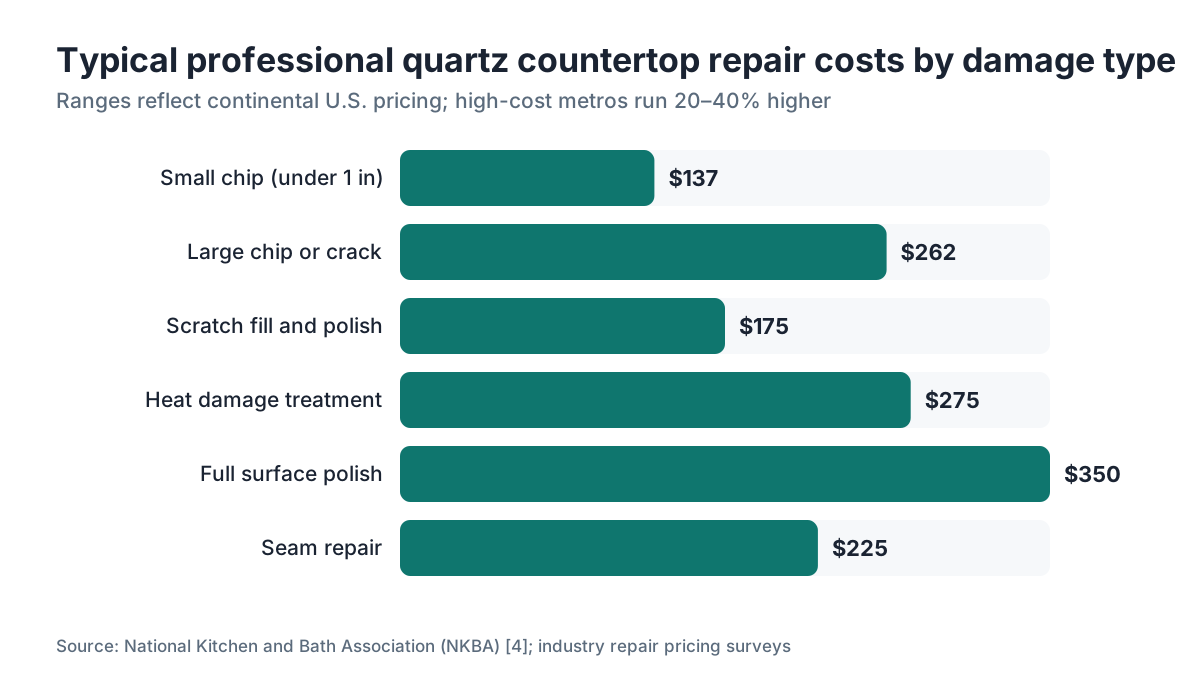
Professional repair runs roughly $100 to $400 for most single incidents, with a $75 to $125 minimum service call fee common on top. Pricing shifts by region, damage type, and how easy the counter is to reach. Based on stone repair contractor rates and fabricator service menus published across the industry, here are realistic ranges:
| Damage Type | Typical Pro Repair Cost |
|---|---|
| Small chip (under 1 in) | $100 to $175 |
| Large chip or crack | $175 to $350 |
| Scratch fill and polish (per area) | $100 to $250 |
| Heat damage (hazing) | $150 to $400 (often partial improvement only) |
| Full surface polish (whole countertop) | $200 to $500+ depending on sq ft |
| Seam repair | $150 to $300 |
Travel minimums are common. Many stone repair specialists charge a $75 to $125 minimum service call fee that applies toward the repair cost. In high cost-of-living metros, every number above climbs 20 to 40 percent.
For comparison: professional quartz replacement runs roughly $50 to $150 per square foot installed, material and labor combined [4]. An average kitchen with 30 square feet of counter runs $1,500 to $4,500. If your damage is one spot and the rest of the counter is fine, repair wins on cost almost every time. If the surface has widespread dulling, several chips, and heat damage across the whole run, replacement starts to make sense.
Can you restore the shine to a dull quartz countertop?
Yes, often. Whether it's worth doing depends on why it went dull in the first place.
The most common cause of dullness is buildup. Hard water deposits, wax-based cleaners, and silicone sprays leave films that scatter light and kill the gloss. The fix is a thorough cleaning with diluted white vinegar or a dedicated countertop degreaser, then rinse and dry. No polishing required. That alone solves the problem in a surprising number of cases.
If cleaning doesn't bring the shine back, you're probably looking at micro-abrasion of the surface finish from repeated scrubbing with pads or gritty cleansers. Here a polish helps. Consumer-grade quartz polishes from Weiman, Therapy Clean, or the manufacturer's own line run $8 to $20 and restore a noticeable degree of sheen. Apply with a soft cloth, work in small sections, buff off.
Professional polishing uses a sequence of diamond pads (typically 400, 800, 1500, and 3000 grit steps) with water cooling on a variable-speed polisher. This is how fabricators hit the factory finish, and it's what a stone restoration specialist brings to a job. The results beat consumer products by a wide margin. But the equipment (a polisher runs $300 to $800, diamond pads $100 to $400 per set) makes it impractical for one-time home use [5].
One honest caveat. If your quartz was a matte or leathered finish to begin with, it won't respond to shine-restoration polishing the way a gloss finish does. Matte surfaces are intentional textures, and polishing them wrecks the look. Know what finish you started with.
Does quartz need sealing as part of restoration?
No. This is one of the most persistent myths in the countertop trade.
Quartz is a non-porous engineered material. Granite has microscopic pores that let liquids soak in, which is why sealing granite makes sense [6]. Quartz doesn't have that structure. A penetrating stone sealer on quartz is pointless at best, and some sealers leave a residue that dulls the surface. Any contractor who tells you to seal your quartz is either confused about the material or selling you something you don't need.
The only surface treatment that makes sense on quartz is a topical polish or coating to restore gloss. Even that is a finishing step after a repair, not a maintenance chore.
Curious how quartz compares to truly porous natural stones that do need sealing and ongoing care? The how to clean stone countertops guide covers that maintenance gap.
When does damage mean you should replace rather than restore?
Replace instead of repair when the damage threatens structure, covers a large area, or has already been patched so many times the counter looks like a map. A few clear signals:
Structural cracks that run through the full thickness of the slab are a safety issue, not a cosmetic one. A cracked slab can fail under load. Repair can stabilize small cracks at seams, but a crack running across a main field usually means replacement.
Heat damage over a large area. If discoloration or hazing spreads more than a few square inches, the repair work (masking, tinting, polishing) rarely lands an invisible result. The cost can approach replacement of that section anyway.
Chip or damage near a sink cutout. Structural integrity around cutouts matters. A fabricator can judge whether the damage compromises the support.
Multiple repaired spots that already look patchy. At some point a kitchen looks better with a fresh slab than with a dozen visible patches.
If the substrate (cabinets, support structure) is also failing, surface restoration makes no sense until the structure is fixed. See countertop installation for what proper support looks like.
A blunt rule of thumb: if repair quotes top 40 to 50 percent of replacement cost for the damaged section, get replacement quotes and compare. A fresh slab gives you a clean start, and a good fabricator's work comes with a warranty.
How do you find a qualified quartz repair specialist?
Start with the original fabricator, then your quartz manufacturer's authorized network, then Natural Stone Institute members. Stone repair is a specialty with no single license or certification body in most U.S. states, so those three filters do most of the quality-screening work. The practical steps:
Ask the original fabricator first. Many offer repair, and they may still have your slab's color and finish code on file, which matters a lot for color-matching a chip.
Check with your quartz manufacturer. Caesarstone, Cambria, and Silestone all keep networks of authorized service contractors. An authorized tech knows the material, and some manufacturers cover repair under warranty for defects (not accidental damage, but worth checking your paperwork).
Look for members of the Natural Stone Institute [7]. It isn't a quartz-specific body, but members have shown stone-work proficiency and tend to carry proper insurance.
Ask for photos of past quartz repairs, specifically color-matched chip fills on similar material. This is the hardest part of the job. A contractor who's done it well will have documentation.
Get at least two quotes. Price variation is real, and a quote that looks suspiciously low usually means a faster, less careful job.
What does the repair process look like when a pro does it?
Knowing the process helps you judge whether a quote makes sense and whether the finished work is any good. A pro chip repair follows a clear sequence, and a full-hardness cure often takes 24 hours even though some fast-cure epoxies set in 30 to 60 minutes.
For a chip repair, a competent technician cleans and degreases the area, dries it completely (moisture under epoxy causes failure), selects and mixes epoxy in the right base color, adds pigment in small increments while test-matching to the slab in natural light, applies the fill slightly proud of the surface, allows full cure, then carefully razors it flat without scratching the surrounding surface, and finally polishes with progressively finer compounds to blend the sheen.
For scratch polishing, a technician runs a slow-speed angle grinder or polisher with diamond-resin pads, starting at a grit matched to the scratch depth and working up through finer grits with water cooling. The goal is a polish level that matches everything around it. On a high-gloss factory finish, that takes patience and several grit steps.
For heat damage, an honest technician tells you upfront the results are unpredictable. Discoloration from thermal resin breakdown sometimes responds partially to polishing and sometimes doesn't budge. Some contractors apply a tinted coating as a last resort. That's not permanent and can look artificial.
A good repair takes two to four hours for a chip and about a half-day for a larger polishing job. Be cautious of anyone promising a 20-minute fix on a serious chip.
How do you prevent quartz from needing restoration in the first place?
Prevention on quartz is simpler than on natural stone and easier to stick to. Heat is the enemy, since it's the damage type most resistant to repair, so the trivet habit matters more than anything else.
Always set a trivet or hot pad under anything that came off a burner or out of an oven. Silicone trivets are cheap. Resin damage is expensive.
Use a cutting board. Quartz is hard but not scratch-proof, and knives mark the surface over time. Cutting directly on the counter dulls your knives faster than it hurts the stone, but it does both.
Clean with pH-neutral dish soap and water day to day. Skip abrasive scrub pads, including the rough side of a standard kitchen sponge. Skip acidic cleaners like undiluted vinegar, bleach, or ammonia-based glass cleaners for routine use. Bar Keepers Friend, used occasionally and rinsed right away, is generally fine but is not a daily cleaner.
Don't stand on the countertop. It sounds obvious, and it's still a common cause of cracking near unsupported spans.
Got quartz in a bathroom? Wipe up nail polish remover (acetone) immediately. Acetone can dissolve the resin binder with extended contact [8].
Comparing materials for durability against daily wear? Kitchen countertops walks through the full comparison. Weighing quartz against natural stone for a wet area? Marble countertops and granite countertops each cover their own maintenance demands.
What about warranty coverage for quartz countertop damage?
Most major quartz brands carry limited lifetime warranties, but the coverage is narrower than the marketing suggests. They protect against defects, not against the everyday accidents most likely to ruin a counter.
Caesarstone offers a limited lifetime warranty to the original purchaser covering defects in materials and workmanship [9]. Cambria's structure is similar [10]. What these warranties almost universally exclude: damage from improper installation, heat, chemical exposure, impact, and normal wear. Which is to say, the exact damage types you're most likely to cause.
What they do cover: manufacturing defects like voids in the slab, delamination, or color inconsistency that shows up in normal use without abuse. If your countertop developed an internal crack with no impact behind it, that's a warranty conversation worth having with the fabricator and manufacturer.
Read the actual warranty document, not the marketing summary. File a claim before you pay for repair if there's any chance the damage looks like a defect. Manufacturers do sometimes make goodwill repairs or replacements outside strict warranty terms, especially on recent installations.
Fabricators running at scale often track warranty claims and repair histories by slab and job. If you're a shop owner managing that documentation, SlabWise keeps job records and material data linked in one place.
Weighing a specific brand's durability and warranty before you buy? Cambria countertops covers that brand's reputation and warranty specifics in detail.
How does quartz restoration compare to other countertop materials?
Quartz sits in the middle on repairability. Better than laminate, not as good as wood or Corian. Some materials come back to life with a sander; quartz doesn't.
Butcher block countertops are the easiest to restore by a wide margin. Sand them down and refinish. A badly beaten wood top can look new for under $50 in materials and a weekend of work.
Laminate countertops and Formica countertops are basically impossible to restore once the surface layer chips or scratches through. You patch or you replace.
Corian countertops are solid-surface acrylic and, like wood, sand and re-polish because the material is uniform throughout. A competent pro removes scratches, burns, and stains from Corian more completely than from quartz.
Granite re-polishes mechanically because the mineral is consistent through the slab, though the work is heavy. Quartzite and marble behave similarly; how to clean quartzite countertops covers the care side of that material.
The high-end quartz look comes with that repair trade-off baked in.
| Material | Scratch Restoration | Chip Repair | Heat Damage Repair |
|---|---|---|---|
| Butcher block | Excellent (sand + oil) | Excellent | Good |
| Corian/solid surface | Excellent (sand + polish) | Very good | Good |
| Granite | Very good (professional repolish) | Good | Good |
| Quartz | Fair (surface only) | Fair (epoxy fill) | Poor |
| Laminate | Poor | Poor | Very poor |
| Marble | Good (professional repolish) | Fair | Fair |
Frequently asked questions
Can deep scratches in quartz countertops be repaired at home?
Deep scratches that catch a fingernail can be partially filled with two-part epoxy kits, but a truly invisible repair is unlikely without professional tools. You can cut the visibility a lot with color-matched epoxy, careful application, and buffing. Expect the repair to show under raking light. For a scratch in a high-visibility spot, a professional repair with proper diamond-pad polishing afterward gives a better result.
Does quartz countertop polish actually work, or is it a gimmick?
Consumer quartz polishes work on surface haze and very fine scratches, and they do restore some gloss on dull surfaces. They don't touch deeper scratches or chips. Weiman Quartz Countertop Polish, Therapy Clean, and manufacturer-specific compounds all produce real but modest results. Clean the surface thoroughly first; a lot of apparent dulling is product buildup that a simple cleaning would have fixed.
How do you fix a chip in a quartz countertop?
Clean the chipped area and let it dry completely. Mix two-part epoxy and add pigment to match the countertop color. Fill slightly overfull, cure for the manufacturer's recommended time, then scrape flush with a razor blade and buff. Color matching is the hardest part. On white or light countertops it's manageable as a DIY project. Complex patterns with veining almost always benefit from a professional doing the color work.
Can heat damage to a quartz countertop be fixed?
Rarely, and not fully. Heat degrades the polymer resin in quartz, usually causing white or yellowish hazing or small surface cracks. Professional polishing can reduce mild heat haze, but significant discoloration or cracking usually can't be made invisible. This is the one damage type where replacing the affected section is often the only satisfying answer. Prevention with trivets is far cheaper than any repair.
Do I need to seal my quartz countertop after restoration?
No. Quartz is non-porous and gets no benefit from sealing. Penetrating stone sealers, meant for granite or marble, do nothing on quartz and can leave a residue that dulls the finish. After a professional polish or chip repair, the only finishing step that makes sense is a topical quartz polish to restore surface sheen. Anyone recommending you seal quartz either misunderstands the material or is upselling.
How long does a professional quartz repair last?
A well-done epoxy chip fill with proper curing and finishing can last the life of the countertop if the area isn't hit repeatedly. Surface polish results last months to a couple of years depending on cleaning habits. Heat damage repairs, where they're possible at all, tend to be less durable. The biggest risk to repair longevity is moisture trapped under an epoxy fill, which is why thorough drying before application matters so much.
Is it worth repairing quartz or just replacing it?
It depends on how much surface is damaged and what kind. A single chip or scratch repair at $100 to $250 almost always beats replacing 30 square feet at $1,500 to $4,500. If you have widespread heat damage, multiple chips, and dulling across the whole kitchen, the math shifts toward replacement. Get repair quotes and replacement quotes and compare; ask fabricators for honest reads on how good a repair will actually look.
How do I remove stains from quartz countertops without damaging them?
For most stains, start with dish soap and warm water. For stubborn ones, a paste of Bar Keepers Friend (oxalic acid) applied briefly with a soft cloth, then rinsed, handles most discoloration. Permanent marker responds to isopropyl rubbing alcohol on a cloth. Avoid full-strength bleach, acetone, and drain cleaners, which can discolor or etch the resin. If a stain won't budge, it may have penetrated the resin and need professional assessment.
Can you use a Mr. Clean Magic Eraser on quartz?
Use it cautiously and not as a routine cleaner. Magic Erasers are micro-abrasive melamine foam, and repeated use can gradually dull a glossy quartz finish. For a stubborn spot where other cleaners failed, a light, brief pass followed by rinsing is unlikely to cause visible damage. But it's not the right daily tool, and it's no substitute for a proper stain-removal approach on quartz.
What products should you never use on quartz countertops?
Avoid acetone and nail polish removers (they dissolve the resin binder), full-strength bleach, drain cleaners and oven cleaners, abrasive scrub pads, paint strippers, and any cleaner with a very high or very low pH used regularly. Caesarstone and Silestone both publish no-use lists in their care documentation. When in doubt, pH-neutral dish soap and water is always safe.
Can a quartz countertop be resurfaced to a different finish?
Technically yes, but in practice it's expensive and rarely done. A fabricator with diamond-pad equipment can take a gloss finish down to matte. Going from matte to gloss is possible too but takes careful work to avoid uneven results. Professional resurfacing of a full kitchen counter runs $400 to $800 or more, close to the low end of replacement pricing. Most people who want a different finish just replace once they're spending that much.
How do fabricators charge for quartz repair jobs?
Most charge a flat rate per repair type (chip, crack, polish area) plus a travel or minimum service call fee. Some bill by the hour at $75 to $150 for stone work. Epoxy and pigment costs are usually built into the flat rate. For large polishing jobs across multiple sections, some fabricators switch to a per-square-foot rate in the $4 to $10 range. Always ask whether the quote includes travel and whether a second visit is covered if the first attempt needs adjustment.
Does quartz crack easily?
Quartz is harder and less brittle than many natural stones, but it can and does crack under enough impact or point load, especially near edges, cutouts, and unsupported spans. Thermal shock (a hot pan on a cold slab) is a cracking risk too, because the resin and quartz aggregate expand at different rates. A properly installed slab with solid cabinet support is far less likely to crack than one with gaps in the substrate or a bad silicone bead at the overhang.
Sources
- USGS Mineral Resources Program, Quartz Industrial Minerals: Engineered quartz slabs are typically 90 to 94 percent ground quartz aggregate bound with polymer resins
- Caesarstone Care and Maintenance Documentation: Quartz polymer resins begin to degrade with direct heat exposure around 150 to 160 degrees Celsius, which is why direct contact with hot cookware is warned against
- Bar Keepers Friend product safety and usage documentation, SerVaas Laboratories: Bar Keepers Friend uses oxalic acid as its active cleaning agent and is approved for use on solid surfaces when rinsed promptly
- National Kitchen and Bath Association (NKBA): Quartz countertop replacement installed typically ranges from $50 to $150 per square foot with material and labor
- Natural Stone Institute, Fabricator Training and Equipment Reference: Professional variable-speed polishers for stone work run $300 to $800; diamond pad sets cost $100 to $400 per set
- Natural Stone Institute, Care and Maintenance Guidelines for Natural Stone: Natural granite and marble are porous and require penetrating sealer applications; engineered quartz is non-porous and does not benefit from sealing
- Natural Stone Institute, Member Directory and Accreditation Programs: The Natural Stone Institute maintains a member directory and accreditation program for stone fabrication and restoration professionals
- Caesarstone Care and Maintenance Documentation: Caesarstone specifically lists acetone-based nail polish removers and paint strippers as substances to avoid on their quartz surfaces due to resin degradation risk
- Caesarstone Limited Warranty, Caesarstone US: Caesarstone offers a limited lifetime warranty to the original purchaser covering manufacturing defects but excluding heat, impact, chemical, and installation-related damage
- Cambria Limited Warranty documentation, Cambria US: Cambria offers a lifetime limited warranty covering manufacturing defects but excludes damage from heat, impact, misuse, and improper care
- Silestone by Cosentino, Care and Maintenance and Warranty Terms: Silestone publishes a list of prohibited cleaning chemicals including bleach at full strength, drain cleaners, and solvents that can damage the polymer resin binder
Last updated 2026-07-09