TL;DR
- Quartz countertops cost $50 to $150 per square foot installed.
- The slab alone runs $25 to $100 per square foot depending on brand and grade.
- A standard 40-square-foot kitchen lands between $2,000 and $6,000 fully installed.
- Cambria and Silestone sit near the top of that range.
- Builder-grade quartz sits near the bottom.
What does quartz countertop cost per sq ft in 2025?
The honest range is $50 to $150 per square foot, all-in. That covers material, fabrication, and installation. It does not cover demolition or plumbing changes.
Material-only pricing (just the slab, before any shop labor) runs $25 to $100 per square foot depending on grade. Entry-level quartz from domestic or less-recognized brands lands around $25 to $40 per square foot for the raw material. Mid-range slabs from brands like MSI, Viatera, or Silestone come in around $40 to $70. Premium and designer slabs, think Cambria, Calacatta-look quartz with thick veining, or large-format book-matched panels, push $70 to $100+ per square foot just for the stone [1].
Fabrication adds roughly $15 to $40 per square foot on top of that, depending on edge profile complexity, cutout count, and regional labor costs. Installation typically adds another $10 to $20 per square foot for a standard drop-in or undermount sink configuration.
So if someone quotes you $60 per square foot installed on a mid-grade quartz, that is a fair price in most U.S. markets. If they quote $120 installed on builder-grade material, ask questions.
How do quartz prices compare to granite countertop cost per sq ft?
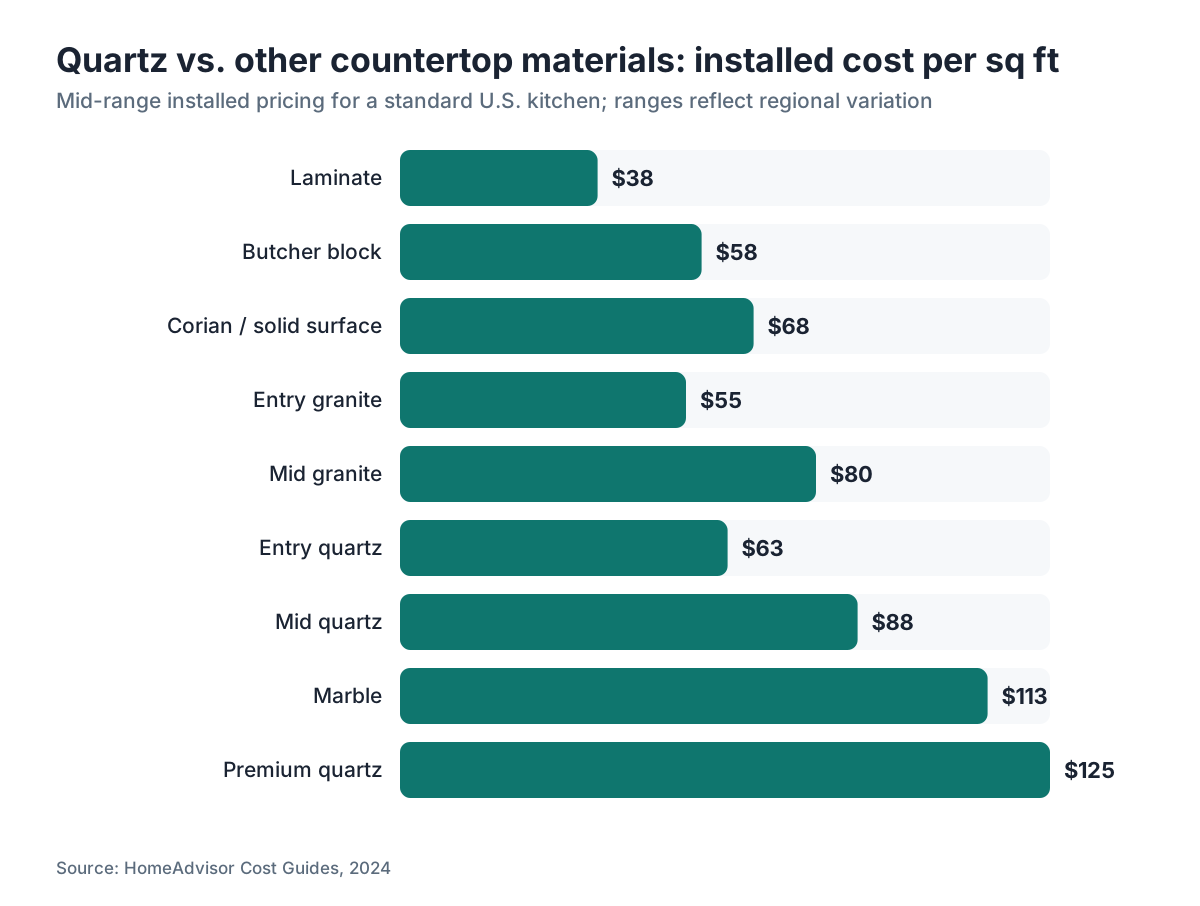
The gap between quartz and granite has narrowed a lot over the past decade. Here is where things stand:
| Material | Material only (per sq ft) | Installed (per sq ft) |
|---|---|---|
| Entry quartz | $25, $40 | $50, $75 |
| Mid quartz | $40, $70 | $65, $110 |
| Premium quartz | $70, $100+ | $100, $150 |
| Entry granite | $20, $35 | $45, $65 |
| Mid granite | $35, $60 | $60, $100 |
| Premium granite | $60, $100 | $90, $140 |
| Marble | $40, $100 | $75, $150 |
| Laminate | $5, $20 | $25, $50 |
| Butcher block | $15, $45 | $35, $80 |
Granite is generally $10 to $20 per square foot cheaper at the entry level because there is far more commodity granite on the market. The cost of granite countertops per sq ft overlaps heavily with quartz once you move into mid-grade territory [2]. The average cost of granite countertops per sq ft installed lands around $55 to $85 for mid-grade slabs in most metro areas.
Here is something fabricators know that homeowners often miss. The granite countertop cost per sq ft shown at stone yards usually does not include fabrication markup. The yard sells the slab. The shop charges separately to cut, polish, and install it. With quartz, many retailers and fabricators quote an all-in installed price, which makes apples-to-apples comparison tricky. Always ask whether a quote includes fabrication labor and installation.
For a deeper look at granite pricing and how slab selection works, see our guide to granite countertops.
What drives the price up or down on a quartz countertop?
Five factors do most of the work.
Slab grade and brand. Quartz is an engineered stone, roughly 90 to 95 percent ground quartz bound with polymer resin [3]. The pigments, resin quality, aggregate pattern, and brand certification all affect price. Cambria, a Minnesota manufacturer, charges more in part because they control their own quarrying and manufacturing and carry a lifetime warranty [4]. Generic offshore quartz can be half the price but may have more color variation batch-to-batch and fewer warranty protections.
Thickness. Most residential countertops come in 3-cm (roughly 1.25-inch) slabs. Some lower-cost options use 2-cm (roughly 0.75-inch) material that requires a laminated edge to look thicker. The 2-cm material costs less per square foot but the laminated edge build-up adds labor. Stick with 3 cm for countertops. Save the 2 cm for vertical applications.
Edge profile. A simple eased or straight edge costs $10 to $20 per linear foot to fabricate. An ogee, waterfall, or dupont profile runs $25 to $50 per linear foot. A full waterfall island where the slab cascades down the sides can add $500 to $1,500 or more to a project because it uses significantly more material and complex mitering.
Cutouts. Every cutout (sink, cooktop, outlet strip) takes time. A standard undermount sink cutout typically adds $75 to $175 to the job. A farmhouse sink cutout requiring a specific reveal and support ledge can run $150 to $300.
Location and shop overhead. Labor costs more in San Francisco than in Tulsa. A fabrication shop with high rent, newer CNC equipment, and certified installers has higher overhead than a two-man shop running older bridge saws. Neither is automatically better, but the price difference reflects real cost differences.
What is the average cost of quartz countertops per sq ft by brand?
Brand matters more with quartz than with natural stone because you are buying an engineered product with proprietary formulas and manufacturing processes. Here is a realistic snapshot of where major brands land, based on fabricator pricing data and published retail ranges [1][5]:
| Brand | Approx. material cost per sq ft | Notes |
|---|---|---|
| Cambria | $70, $110 | Made in USA, lifetime warranty |
| Silestone (Cosentino) | $55, $90 | Spanish-made, antibacterial surface |
| Caesarstone | $55, $85 | Israeli-origin, wide U.S. distribution |
| MSI Q Premium | $40, $65 | Good mid-range value |
| Viatera (LX Hausys) | $40, $65 | Korean-manufactured |
| HanStone | $40, $65 | Canadian, LG affiliate |
| Allen + Roth (Lowe's house) | $30, $55 | Entry-mid, limited fabrication support |
| Generic/off-brand | $25, $45 | Widest quality variance |
These are material-only prices. Add $25 to $50 per square foot for fabrication and installation to arrive at an installed price.
For a dedicated look at Cambria's lineup and pricing structure, the Cambria countertops guide goes deeper.
One honest caveat: nobody publishes real-time wholesale pricing publicly, so these ranges come from fabricator pricing sheets and retail quotes gathered across multiple U.S. markets. Prices shift with resin and silica supply costs, which have been volatile since 2021.
How much does a typical kitchen quartz countertop project cost total?
Most kitchens run 30 to 50 square feet of countertop surface, not counting the backsplash (which is a separate surface and usually priced separately). Here is what real totals look like:
| Kitchen size | Approx sq ft | Budget quartz (installed) | Mid quartz (installed) | Premium quartz (installed) |
|---|---|---|---|---|
| Small (galley, condo) | 25 to 35 sq ft | $1,250, $2,625 | $1,625, $3,850 | $2,500, $5,250 |
| Medium (standard) | 35 to 50 sq ft | $1,750, $3,750 | $2,275, $5,500 | $3,500, $7,500 |
| Large (island included) | 55 to 80 sq ft | $2,750, $6,000 | $3,575, $8,800 | $5,500, $12,000 |
The island is where budgets get hurt. A 4-by-8-foot island is 32 square feet of additional material plus edge profiles on three or four sides plus potentially a waterfall detail. That alone can run $2,000 to $6,000 depending on grade.
Demolition of existing countertops is usually $150 to $400 for a standard kitchen if you hire it out, though many homeowners demo themselves to save money. Plumbing disconnection and reconnection (removing and resetting a sink) typically runs $100 to $250 depending on your plumber's rates [6].
Does quartz cost more or less than other countertop materials?
Quartz sits in the upper-middle tier. It costs more than laminate, Formica, or tile. It costs less than most exotic natural stones and some high-end solid surfaces.
Comparing directly:
Laminate countertops (including Formica countertops) run $25 to $50 installed per square foot. Half the price of entry quartz, and modern laminates look a lot better than they did 20 years ago. For a rental unit or a tight-budget kitchen, laminate is a reasonable answer.
Butcher block countertops run $35 to $80 installed per square foot. Warm, distinctive look, but it requires sealing and is not ideal near a sink if you are not diligent.
Corian countertops (solid surface) run $45 to $90 installed per square foot. The joints disappear, scratches sand out, but the material is softer than quartz.
Marble countertops run $75 to $150 installed per square foot. Beautiful, but it etches with acids and needs more maintenance than quartz.
Quartz wins on the combination of durability, stain resistance, and low upkeep. It will not etch with lemon juice the way marble does, does not need sealing the way granite does, and resists scratches better than solid surface. If you want the stone look without the stone maintenance, quartz is the rational choice for most kitchens.
What do fabricators actually pay per sq ft, and how does markup work?
This is where the cost guide gets interesting for shop owners and for homeowners who want to understand why quotes vary.
A fabrication shop typically buys quartz slabs at wholesale, which might be 40 to 60 percent of the retail slab price depending on their volume and distributor agreements. A slab that a homeowner sees priced at $70 per square foot at a stone yard might cost the shop $35 to $45 per square foot. The shop then charges for:
- Slab cost (passed through at some markup)
- Fabrication labor (saw time, CNC time, polishing)
- Edge finishing
- Cutouts
- Template (either physical or digital)
- Installation labor and travel
- Overhead and profit
A well-run shop targets 40 to 55 percent gross margin on fabricated countertop jobs, though actual numbers vary widely and there is no good public dataset on shop margins specifically. The National Kitchen and Bath Association and the Marble Institute of America both publish industry data but do not break out per-square-foot margin figures in publicly available reports.
For shops managing multiple jobs and trying to keep material waste low, nesting software matters. Tools like SlabWise let fabricators lay out cuts across slabs digitally before any stone is touched, which cuts scrap and tightens the relationship between quoted material cost and actual cost. That gap between what you quoted and what you spent on stone is often where profitability lives or dies.
For homeowners, the takeaway is simple. Get three quotes, ask what is and is not included in each, and compare line by line rather than just the bottom number.
Are there hidden costs in a quartz countertop project?
Yes, and they add up fast if you are not watching.
Backsplash. Many quotes cover only the horizontal countertop surface. If you want a quartz backsplash (4-inch standard or full height to the uppers), that is typically priced separately at the same per-square-foot rate or slightly lower because the pieces are smaller and easier to handle.
Seams. On any run longer than about 10 feet, you will likely have a seam. Fabricators try to hide seams in corners or under appliances, but on a long island, a seam is visible. Some shops charge a seam fee ($50 to $150 per seam) on top of the base price.
Overhang. Standard countertop overhang is about 1.5 inches over base cabinets and 10 to 12 inches on a seating overhang. Anything beyond 12 inches typically requires corbel or hidden bracket support, adding material and labor cost.
Templating fee. Some shops charge $75 to $200 for a digital template visit separately from the quote. Others roll it into the job. Ask upfront.
Permit. Countertop replacement almost never requires a permit in most U.S. jurisdictions because it is a like-for-like finish replacement, not a structural change [7]. But if you are doing a full kitchen remodel that changes the footprint, your general contractor's permit may or may not cover the countertop trade. Confirm this with your local building department.
Sink resetting. If an existing undermount sink needs to go back in, it needs to be re-clipped and re-caulked. Many shops include this. Some charge $75 to $150 extra.
How do you get an accurate quote for quartz countertops?
Accurate quotes require accurate measurements. Most fabricators will not give a firm price off a rough sketch, because even a 2-square-foot error on a premium slab is a $140 to $200 mistake in material cost alone.
Here is how to get a quote that will actually match the final invoice:
- Measure your countertop footprint carefully (length times depth for each section, add them together). Include the island separately.
- Note the number of sinks, cooktops, and any pop-up outlet cutouts.
- Decide on edge profile before you quote shop, because the profile changes the price.
- Specify thickness (almost certainly 3 cm for most residential work).
- Pick two or three slab grades or brands you are considering so the shop can quote real materials, not a generic range.
For homeowners who want a ballpark before calling any shop, the SlabWise instant quote tool walks through these inputs and returns a realistic range based on current regional pricing. That gives you a defensible number before you sit down with a fabricator.
Get at least three quotes. The range between the lowest and highest legitimate bid on the same scope is often 20 to 35 percent. That spread reflects real differences in overhead, slab sourcing, and what each shop considers standard versus extra.
Does quartz hold its value in a home?
Real estate data on specific countertop materials is thin. The most-cited figure comes from Remodeling magazine's Cost vs. Value Report, which surveys realtors and contractors annually on remodel ROI. A major kitchen remodel (which includes countertops among many other items) returns roughly 30 to 45 percent of cost at resale on average, depending on the year and market [8]. There is no clean number for countertops alone.
Here is what realtors generally say. Quartz and granite countertops are table stakes in most mid-to-upper-price home markets. Buyers expect them. They are not a differentiator so much as an absence of a negative (the presence of laminate in a $600,000 home is a negotiating point against the seller).
For homes priced below the median in a given market, installing premium quartz is probably not a smart financial decision because you will not recover the cost. For homes above median, the absence of stone countertops is more likely to cost you at sale than the presence of quartz is to gain you.
If you are doing a kitchen remodel specifically for resale, mid-range quartz or granite in a neutral color is the move. Do not spend $120 per square foot on a designer quartz in a home you are selling in two years.
How does quartz countertop installation actually work?
Understanding the process helps you know what you are paying for.
After you select your slab, a fabricator's templater visits the kitchen and measures the exact countertop footprint. This is done either with a physical template (thin strips of cardboard or luan taped together to match the countertop outline) or a digital laser tool. The template captures every wall angle, because almost no wall is perfectly square.
Back at the shop, the template drives the cut layout. The fabricator (or their CNC machine) cuts the slab to shape, then runs the edges through polishing wheels to achieve the specified profile. Cutouts for sinks and cooktops are made at this stage. The whole fabricated piece is then loaded, driven to the site, and set on the cabinets with adhesive and/or mechanical clips.
Installation day for a standard kitchen is typically a half-day to full day for two installers. The countertop is set, seams are filled with color-matched epoxy and clamped, and the sink is re-secured. Caulking along the wall and any appliance gaps is the last step.
For more on what to expect during and after installation, the countertop installation guide covers the full process. For care after install, how to clean stone countertops covers quartz and natural stone together, since the basics overlap.
One thing the process reveals: quartz is heavier than it looks. A 3-cm slab runs about 20 pounds per square foot [3]. A 30-square-foot countertop weighs around 600 pounds. Make sure your cabinets are in good shape before installation day.
What should you watch out for with cheap quartz countertops?
Bargain quartz exists, and some of it is fine. Some of it is not.
The main risks with very low-cost quartz:
Inconsistent color lots. Engineered stone is manufactured in batches. Budget brands sometimes have more batch-to-batch variation, which matters if you need a second slab for a repair or an addition later.
Warping. Low resin-to-quartz ratios or substandard curing can cause slight bowing in large slabs. This usually shows up at seams or on long spans.
Silica content and safety during fabrication. This is the most serious point. Dry-cutting quartz generates respirable crystalline silica dust, which is classified as a known human carcinogen by OSHA and linked to silicosis, an irreversible lung disease [9]. OSHA's permissible exposure limit of 50 micrograms per cubic meter of air (as an 8-hour TWA) applies to all quartz fabrication regardless of brand [10]. The hazard is in the fabrication process, not in living with a finished countertop. When buying, this is a reason to use shops that follow proper wet-cut and ventilation procedures, not a reason to avoid quartz in your kitchen.
No warranty. Most reputable quartz brands offer 10-year to lifetime warranties on the material [4][5]. Generic brands may offer nothing or a short window. Read the warranty before buying, not after.
If a quote is dramatically below every other quote you received for the same scope, ask specifically what brand and grade of slab they are using. Then look that brand up.
Frequently asked questions
What is the average cost of quartz countertops per sq ft installed?
The average cost of quartz countertops per sq ft installed is roughly $75 to $100 for mid-range material in most U.S. markets. Entry-level quartz installs for $50 to $75 per square foot. Premium brands and designer patterns push $100 to $150. These figures include material, fabrication labor, and installation but not demo or plumbing work.
Is quartz more expensive than granite per square foot?
At the entry level, granite is usually $5 to $15 per square foot cheaper installed. In the mid-range, quartz and granite overlap significantly, both running roughly $60 to $110 installed. At the top end, exotic granite and premium quartz cost about the same. The average cost of granite countertops per sq ft installed is around $55 to $85 for mid-grade material, which is close to quartz in that tier.
How much does a 30-square-foot quartz countertop cost?
At mid-range pricing ($75 to $100 per square foot installed), a 30-square-foot countertop runs $2,250 to $3,000. Budget quartz at $50 to $65 per square foot installed brings that to $1,500 to $1,950. Premium quartz at $120 per square foot would be $3,600. These are installed totals including fabrication.
Does the edge profile really affect the price that much?
Yes, meaningfully. A basic eased edge adds $10 to $20 per linear foot in fabrication cost. An ogee or dupont profile adds $25 to $50 per linear foot. On a kitchen with 25 linear feet of exposed edge, switching from eased to ogee could add $375 to $750 to your total. The waterfall island edge, cascading down the side panels, can add $500 to $1,500 by itself.
Do I need to seal quartz countertops?
No. Quartz is non-porous by design because the resin binders fill the gaps between quartz particles. It does not absorb liquids the way granite does and does not need sealing. This is one of the main practical advantages over natural stone. Clean it with mild soap and water or a pH-neutral cleaner. Avoid harsh chemicals and prolonged heat exposure.
What thickness of quartz should I choose?
For countertops, 3 cm (roughly 1.25 inches) is the standard and the right choice for most kitchens. It is stiff enough to span cabinet runs without support blocks in most situations and looks proportional. Some budget-oriented jobs use 2-cm material with a built-up laminated edge to simulate thickness, which saves on stone cost but adds fabrication labor. The cost difference is modest and usually not worth the compromise.
Can I install quartz countertops myself to save money?
Technically possible, but genuinely difficult. The slabs are extremely heavy (around 20 pounds per square foot for 3-cm material), require precise cuts that need specialized saw equipment, and any chip or crack during handling is irreversible. Most manufacturers also void their warranty on self-installed stone. The labor portion of an installed price is usually $25 to $40 per square foot. Saving that on a 40-square-foot kitchen is $1,000 to $1,600, but the risk of damaging a $1,500 slab is real.
How does quartz countertop cost compare to Corian or solid surface?
Corian and solid surface generally run $45 to $90 per square foot installed, which puts them slightly below mid-range quartz. Solid surface has the advantage of being repairable (scratches sand out) and joins with no visible seam. Quartz is harder and more heat-resistant. If budget is tight and a joint-free look matters, solid surface is worth considering. For durability and stone aesthetics, quartz wins.
Is there a cost difference between quartz colors or patterns?
Yes. Solid whites and basic salt-and-pepper patterns are the cheapest to manufacture and source. Realistic marble-look quartz with hand-applied veining or large continuous patterns costs more because the manufacturing is more complex and the patterns require careful slab matching at seams. A Calacatta-look quartz can cost 20 to 40 percent more per square foot than a solid white from the same brand.
What is the cost per sq ft for granite countertops compared to quartz?
The cost per sq ft for granite countertops installed runs roughly $45 to $140, nearly identical to quartz. Entry granite is a bit cheaper. The granite countertop cost per sq ft for mid-grade material is around $60 to $100 installed in most markets. The practical cost difference between quartz and granite for a typical kitchen is often $200 to $600 total, not a dramatic gap.
Do fabricators charge more for unusual countertop shapes?
Yes. L-shapes and U-shapes are standard and do not typically add a surcharge. Curved countertops, angled cuts not at 90 degrees, custom radius corners, and any shape that wastes more slab material all cost more. Complex shapes also require more CNC programming time. If your design has unusual geometry, expect to pay 10 to 25 percent more than a simple rectangular layout of the same square footage.
How long does quartz countertop installation take from order to completion?
A typical timeline is 2 to 4 weeks from signed contract to installed countertop. The slab needs to be sourced or pulled from inventory, the template visit scheduled, the fabrication completed, and the install day booked. During busy seasons (spring and fall kitchen remodel peaks), shops may be 4 to 6 weeks out. Some shops offer 1-week fast-track at a premium.
Are there health concerns with quartz countertops in the home?
For homeowners living with a finished quartz countertop, there are no established health concerns from normal use. The serious health risk is during fabrication, specifically dry-cutting silica-rich quartz, which generates hazardous airborne dust. OSHA regulates this as an occupational hazard for fabrication workers, not for kitchen users. A finished, polished quartz countertop does not release silica dust in normal household use.
What questions should I ask a quartz fabricator before signing a contract?
Ask: Is this an all-in price including fabrication and installation? What brand and grade of slab are you quoting? What does the edge profile include and what costs extra? How do you handle seams and where will they fall? What is your lead time? What does the warranty cover and for how long? Is demo and sink reset included? Getting these answered in writing prevents most budget surprises.
Sources
- HomeAdvisor, Quartz Countertops Cost Guide: Quartz countertop installed cost range of $50 to $150 per square foot and brand-tier material pricing
- HomeAdvisor, Granite Countertops Cost Guide: Average cost of granite countertops per sq ft installed in mid-grade range of $55 to $85
- Marble Institute of America, Quartz Surface Products Reference: Quartz engineered stone is approximately 90 to 95 percent ground quartz bound with polymer resin; 3-cm slab weight approximately 20 pounds per square foot
- Cambria, Lifetime Warranty Terms: Cambria offers a lifetime warranty on its quartz surfaces; made in USA
- Silestone by Cosentino, Product and Warranty Information: Silestone quartz material pricing and warranty coverage terms
- Angi (formerly Angie's List), Plumber Cost Guide: Plumbing disconnection and reconnection for sink during countertop replacement typically costs $100 to $250
- U.S. Department of Housing and Urban Development, Residential Improvement Permit Guidance: Like-for-like countertop replacement generally does not require a building permit in most U.S. jurisdictions
- Remodeling Magazine, Cost vs. Value Report 2024: Major kitchen remodel returns roughly 30 to 45 percent of cost at resale on national average
- OSHA, Occupational Exposure to Respirable Crystalline Silica (29 CFR 1910.1053): Respirable crystalline silica is classified as a known human carcinogen and linked to silicosis; dry-cutting engineered stone generates hazardous silica dust
- OSHA, Permissible Exposure Limits for Respirable Crystalline Silica: OSHA PEL for respirable crystalline silica is 50 micrograms per cubic meter of air as an 8-hour TWA for general industry (29 CFR 1910.1053)
- National Kitchen and Bath Association, Industry Research: Kitchen remodel cost benchmarks and countertop material preferences in U.S. residential construction
Last updated 2026-07-09