TL;DR
- Professional stone fabrication is the process of cutting, shaping, edging, and finishing raw stone slabs into countertops, vanities, and other surfaces.
- A full job runs from slab selection through templating, CNC or hand cutting, edge profiling, and installation.
- Total cost ranges from $40 to $200 per square foot installed, depending on stone type, edge complexity, and your market.
What does professional stone fabrication actually involve?
Stone fabrication is more than cutting a slab. It's a multi-step manufacturing process that starts with a raw 4-to-6-cm-thick slab, often weighing 600 to 1,200 pounds, and ends with a piece that fits your exact kitchen within about 1/16 of an inch. Every step matters, and a mistake at any one of them shows up in your finished countertop forever.
The core steps are: slab selection, digital or physical templating, layout and nesting on the slab, waterjet or bridge-saw cutting, edge profiling, surface finishing, cutouts for sinks and cooktops, quality inspection, delivery, and installation. Some shops do every one of these in-house. Others outsource cutting or waterjet work to a trade shop and handle only templating and install. Both models can produce excellent results. The real question is who's accountable when something goes wrong.
The word "fabrication" covers natural stone (granite, marble, quartzite, soapstone, limestone), engineered stone (quartz composites like Cambria or Silestone), and ultra-compact surfaces (porcelain slabs, sintered stone). Each material behaves differently under tooling. Porcelain is brittle and unforgiving at inside corners. Marble is soft and scratches during transport. Granite varies in hardness by origin, which changes blade wear and cut speed. A shop that's great with granite may not own the right diamond tooling for sintered stone. Ask specifically about the material you're buying.
For homeowners reading this: fabrication is the labor-and-equipment cost on top of your slab price. For fabricators: this article walks the full process, the common failure points, and what customers misunderstand most.
What are the steps in stone fabrication from slab to installation?
Here is the sequence most professional shops follow, with the realistic time each step takes.
Slab selection and purchase. You or your designer picks a slab at a stone yard or distributor. Residential slabs typically run 55 to 65 square feet for a standard 3cm slab. The slab gets tagged with your name and held. Time: same day.
Templating. A technician visits your home and captures exact measurements of your cabinets. Most professional shops now use digital templating systems (LT-55, Prodim Proliner, or similar laser tools) that generate a digital file directly. Traditional cardboard template strips still work fine for simple layouts. Digital templating kills transcription errors and feeds straight into CNC machines. Time: 30 to 90 minutes on-site, then file processing back at the shop.
Layout and nesting. The fabricator maps your template pieces onto the slab digitally, deciding which features of the stone (veining, color pockets, bookmatching opportunities) land where on your counter. This is where skill genuinely shows. A good layout minimizes waste and hides the seam where you'll notice it least. Time: 15 minutes to several hours, depending on complexity and how much the customer cares about matching.
Cutting. Bridge saws cut straight lines. CNC routers handle curves, cutouts, and complex shapes. Waterjet cutters (using a 60,000 PSI water-abrasive stream) are best for tight curves, fragile stones, and mitered edges. Many shops combine all three [1]. Time: 1 to 4 hours of machine time per typical kitchen.
Edge profiling. The exposed edges get shaped: eased, beveled, bullnose, ogee, waterfall, or any of a dozen other profiles. CNC edge machines are now common, but hand-profiling on an angle grinder is still used for custom shapes and repairs. Edge work is slow. A full perimeter of an L-shaped kitchen can take 2 to 3 hours on a CNC edge machine.
Surface finishing and polishing. Fabricators sand through progressively finer diamond grits (typically 50, 100, 200, 400, 800, 1500, 3000) to reach the final finish level. A high polish on granite or marble takes the surface to 3000 grit or beyond. Honed finishes stop earlier, around 400 to 800 grit. Leathered or brushed finishes use a different tooling pass entirely.
Cutouts. Sink, cooktop, and faucet holes are cut with either a CNC router or a manually guided router jig. An undermount sink cutout is one of the highest-risk moments in fabrication. The web of stone between the cut and the edge can crack if the support and sequence are wrong.
Quality check, sealing, and delivery. Finished pieces are inspected for chips, cracks, and finish consistency. Most shops apply a penetrating sealer before delivery on porous stones. Delivery uses specialized trucks with A-frame racks. Slabs always travel on edge, never flat.
Installation. Installers set the stone on cabinets, level it, cut any field adjustments with a grinder, join seams with color-matched epoxy, and silicone the perimeter. A typical kitchen install takes 2 to 4 hours with a two-person crew [2].
How much does professional stone fabrication cost?
Cost has two parts: the slab itself, and the fabrication plus installation labor. Most quotes bundle them together, but you should understand what you're actually paying for.
Slab prices vary enormously. Commodity granite (think consistent gray or black) can run as cheap as $5 to $15 per square foot at the yard. Exotic marble with dramatic veining runs $50 to $200 per square foot at the yard or more. Engineered quartz slabs generally land between $25 and $70 per square foot depending on brand.
Fabrication and installation labor, separate from slab cost, typically runs $35 to $100 per square foot for standard work [3]. Complex jobs with mitered waterfall edges, multiple seams, or difficult site access push higher.
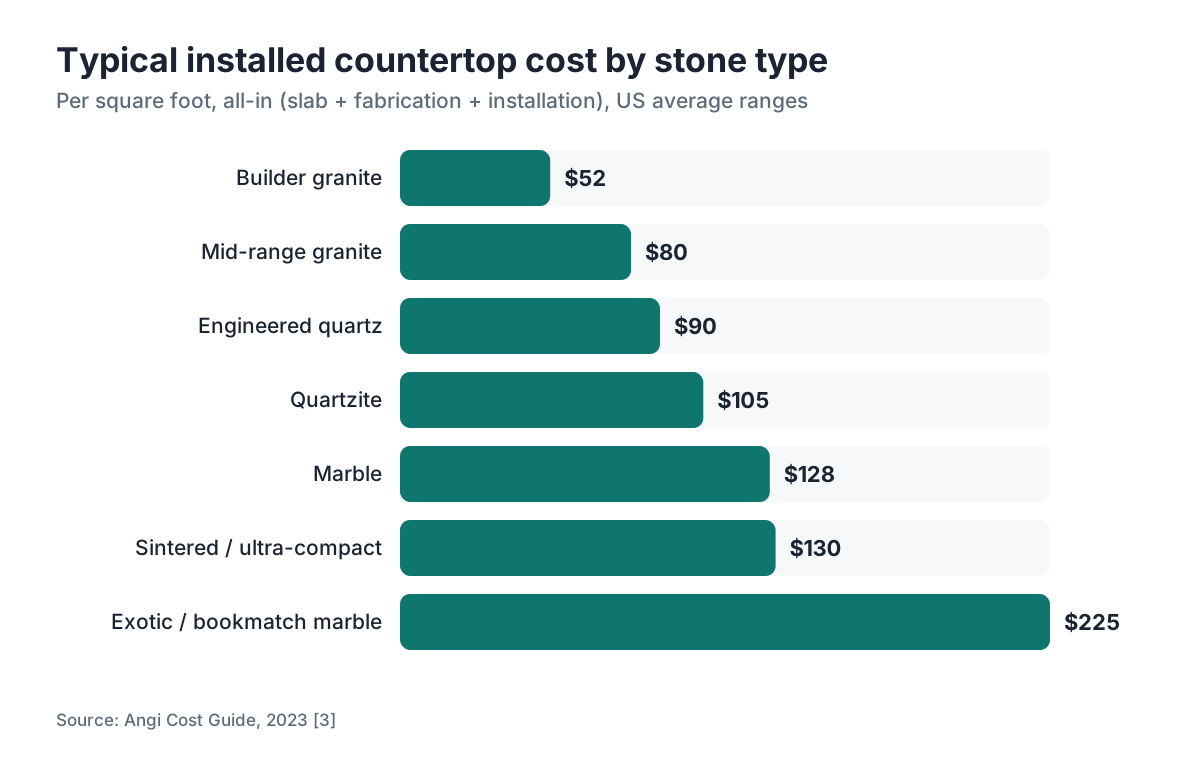
When you buy an "installed countertop," the all-in price (slab plus fab plus install) usually breaks down like this:
| Stone type | Typical installed price range (per sq ft) |
|---|---|
| Builder-grade granite | $40, $65 |
| Mid-range granite | $60, $100 |
| Quartzite | $70, $140 |
| Engineered quartz | $60, $120 |
| Marble | $75, $180 |
| Exotic / bookmatch marble | $150, $300+ |
| Sintered / ultra-compact | $80, $180 |
These ranges come from regional contractor and distributor pricing data and swing hard by city [3][4]. A kitchen in rural Kansas and one in San Francisco can see 40% cost differences for the same stone and the same work.
The things that actually inflate your quote beyond these ranges: waterfall edges (mitering thick slab edges adds 4 to 8 hours of labor), radius cutouts on non-standard sinks, monument-quality matching on slabs with heavy movement, and any demo of old countertops the fabricator has to do before setting stone.
For kitchen countertops specifically, the average homeowner uses 45 to 65 square feet of countertop surface. At mid-range granite pricing, a typical kitchen runs $3,000 to $5,500 installed.
What equipment does a professional stone fabrication shop use?
The equipment in a shop tells you what they can and can't do. A basic shop might have one bridge saw and a hand polisher. A full-service facility runs multiple machines that cover every part of the process.
A bridge saw is the workhorse: a large, water-cooled diamond blade that rides on a gantry over the slab. It cuts straight lines fast and precisely. Most bridge saws today are CNC-controlled, meaning they follow a digital file rather than a manual fence. Manual bridge saws need a skilled operator to hold a consistent cut. CNC saws lower that skill requirement but demand good software and accurate templates.
A CNC router (also called a CNC machining center) handles cutouts, curves, profiled edges, and drilling. It's the machine that makes a perfect sink cutout repeatable. Good CNC routers run $80,000 to $250,000 and up [5].
Waterjet cutters use a high-pressure stream of water mixed with garnet abrasive to cut stone without heat or blade pressure. They're essential for fragile stones (thin marble, porcelain) and for cutting shapes that would chip under a blade. They're slower than saws but far more precise on complex geometry.
Edge polishing machines (also called edge profilers) grind and polish exposed edges through a sequence of diamond wheels. CNC edge machines run a profile automatically. Older shops do this on an angle grinder with hand-held diamond pads.
Digital templating tools like the Prodim Proliner or the LT-55 capture field measurements as a digital point cloud or vector file. These feed straight into CNC machines, cutting out the human error of hand-measuring and drawing. Shops using digital templating see far fewer remakes caused by measurement error.
A shop without waterjet capability will tell you they don't need it, and for 80% of residential work they're right. But if you're doing a complex mitered edge or working with brittle porcelain slabs, a shop with waterjet access (even if they outsource those cuts) is the safer bet.
How do you choose a stone fabrication shop?
The fabrication shop matters more than most homeowners realize. A mediocre shop with good stone will produce a mediocre countertop. A skilled shop with mid-tier stone can make something beautiful.
First, look at their physical shop. Any shop should let you visit. If they won't, walk away. You want to see three things: how clean the place is (stone dust is everywhere, but it should be managed), the equipment they actually own versus rent or outsource, and pieces currently in production. Finished edges on pieces sitting in the shop tell you more than any photo in a portfolio.
Ask specifically: Do they do their own CNC work, or do they outsource cutting? Who does their installs, employees or subcontractors? What's their process if a piece breaks during install? What's their turnaround on a job like yours right now, not in ideal conditions?
Check their licensing. Most states don't have a specific stone fabricator license, but contractors who install countertops (and perform any incidental plumbing disconnect or reconnect) may need a general contractor or specialty contractor license depending on the state. Check your state contractor licensing board. In California, for example, work over $500 requires a licensed contractor [6].
Reviews on Google and Houzz are useful, but filter for the ones that describe a specific problem and how the shop handled it. A company with 200 reviews and two unresolved nightmare complaints is more informative than one with 50 perfect reviews.
For countertop installation specifically, ask how they handle seams. Every shop will claim their seams are invisible. Look at photos of seams in completed jobs, in good light. A seam in granite can be nearly invisible. A seam in marble with heavy veining will always show. That's physics, not bad workmanship.
Get three quotes. Quotes that come in wildly low almost always mean something: a lower-quality slab, fewer edge feet included, or subcontracted install crews who aren't accountable to the shop.
What is the typical turnaround time for stone fabrication?
Plan for two to three weeks from the day you finalize your slab selection to the day the countertop is installed. That's the realistic average for a residential kitchen job at a shop that isn't overloaded [2].
The breakdown is roughly: slab procurement and holding (same day to 3 days), scheduling and templating (3 to 7 days out depending on the shop's backlog), fabrication once the template is done (3 to 5 business days for most residential jobs), and installation scheduling (2 to 5 more days).
Shops get backed up. During remodel season (spring through early fall), a good shop can be 4 to 6 weeks out. If a contractor tells you your countertops will be done in 5 days, either they have no work or they're cutting corners on the schedule.
Rushes are possible, but they cost money. Most shops charge a rush fee of 10 to 20% to jump the queue. Whether it's worth it depends on your situation. If your kitchen is completely torn up and you can't cook, maybe. If you're just impatient, probably not.
Material availability is the wild card. A specific exotic slab you fall in love with at the yard might be the only one in the state. Once it's gone, it's gone. Pick a backup before you commit.
What stone materials can fabricators work with?
Professional fabricators can work with almost any stone or stone-like material, but their equipment, tooling, and skill set have to match the material. Not all shops handle all materials equally well.
Granite is the most common material fabricated in the US. It's hard, relatively forgiving during cutting, and takes a high polish well. Most shops are very comfortable with granite. See our granite countertops guide for material details.
Marble is softer and more variable. It scratches and etches during fabrication if the shop isn't careful. Marble also breaks more easily during transport and installation. High-vein marble with heavy movement demands careful slab layout to minimize seam visibility. Our marble countertops guide covers what to expect from the material long-term.
Quartzite gets confused with quartz constantly (they're completely different). Quartzite is a natural metamorphic stone, harder than granite in many cases, and it needs aggressive diamond tooling. Some quartzite is so hard it eats blades. Ask a shop directly how much quartzite they fabricate a year before trusting them with it.
Engineered quartz (brands like Cambria, Silestone, Caesarstone) is consistent and predictable to cut but heavy, and it can delaminate at seams if epoxy and pressure aren't managed correctly during install.
Soapstone is soft and easy to cut but has to be handled carefully to avoid scratching the finish. See our how to clean soapstone countertops guide for material characteristics that affect fabrication decisions.
Porcelain and sintered stone (Neolith, Dekton) need waterjet cutting or extremely sharp, slow diamond blades. Inside corners chip easily. These materials have grown popular, but many shops still lack the tooling confidence to handle them. If your shop hasn't fabricated at least 20 porcelain or sintered jobs, find one that has.
Non-stone alternatives like butcher block, laminate, Formica, and Corian go to different fabricators entirely: woodworkers and plastic fabricators, not stone shops. If your project mixes materials (stone island, wood perimeter), you may need two separate fabrication trades.
What questions should homeowners ask a fabricator before signing a contract?
Here are the questions that actually reveal whether a shop is any good, versus the ones every shop has a polished answer for.
Who does your installation, and are they your employees? Shops that use subcontracted install crews often have a gap in accountability. If the sub damages a cabinet, who pays?
Can I see the slab I'm getting before fabrication starts? Non-negotiable on any natural stone. Slabs are not identical. The sample at the showroom is not your slab. Visit the yard, mark the slab, and confirm it hasn't been swapped.
Where will the seams be, and can I approve seam placement before cutting? A good shop will show you the digital layout before any cut happens. Seam placement can often be nudged. Once the saw runs, it can't.
What does your warranty cover, and for how long? Industry-standard warranties cover workmanship defects for 1 year. Cracks from normal use and natural stone color variation are almost never covered. Get this in writing.
What is your turnaround commitment, and what happens if you miss it? Some shops will put milestone dates in the contract. Most won't. If your GC has a hard completion date, say so upfront and get a written acknowledgment.
Do you use digital templating? Not mandatory, but it cuts error significantly on complex layouts.
What's your process when a piece breaks? It happens. A shop that has a clear, practiced answer (they keep extra slab material, they have a defined remake timeline) is more trustworthy than one that hedges.
How do fabricators price a job, and what's in a quote?
Most fabrication quotes are priced per square foot of finished stone, with line-item add-ons for extras. Understanding the math protects you from sticker shock and lets you compare quotes accurately.
The base square footage in your quote is usually calculated from the outside dimensions of each piece (length times width), not the net area after cutouts. An undermount sink cutout is a hole in the stone, but you've paid for the material that got cut away. That's standard practice and fair: the shop still bought that slab area and spent time cutting it.
Line items that add to a base quote:
- Each linear foot of edge profiling (for exposed edges only; edges against walls don't count)
- Sink cutouts: typically $75 to $200 each depending on complexity
- Cooktop cutouts: $100 to $250 each
- Faucet holes: $30 to $75 each
- Seams: sometimes priced per seam at $50 to $150, sometimes included
- Removal of existing countertops: $150 to $400 depending on material and size
- Delivery and install: sometimes separate, sometimes bundled
Shops that use software like SlabWise can generate itemized quotes in minutes directly from a digital template, which makes the pricing transparent and easy to audit as a customer. Asking a shop for an itemized quote (more than a total) is always reasonable, and any shop that refuses is a red flag.
Comparing quotes: make sure you're comparing the same scope. Quote A that includes a sink cutout, removal of old counters, and a full edge profile may look pricier than Quote B that tacks each item on separately. Build a line-by-line comparison before you decide.
For how to clean stone countertops after installation, note that some sealers applied during fabrication last 1 to 5 years and some last 10 to 15 years. Worth asking about at quote time.
What can go wrong in stone fabrication, and how do good shops handle it?
Fabrication has real failure modes. Most are recoverable. Some are not.
Measurement error is the most common problem. A piece comes back 1/4 inch too short on one side, or the sink cutout lands 1/2 inch off center. Digital templating has cut this failure mode dramatically, but it still happens, especially when template files get transferred between systems incorrectly. Fix: re-fabricate the piece. Good shops absorb this cost. Bad shops argue with you.
Chipping during cutting or transport. Granite chips at corners and sink edges. Marble chips everywhere. A skilled installer can fill small chips with color-matched epoxy and make them nearly invisible. Larger chips mean a replacement piece.
Cracking during installation. The most stressful failure mode. Cracks happen when cabinets aren't level (point loads), when the stone is over-leveraged during placement, or when there's a structural defect in the slab. Natural stone has fissures, and some slabs carry hidden weaknesses that only show up under installation stress. A crack during install is a partial or full remake. Who pays depends on the cause: workmanship (shop pays), site condition (usually shared), or natural slab defect (sometimes covered by the slab supplier).
Seam quality. A poorly filled or poorly aligned seam is one of the most common complaints in online reviews of fabricators. Stone seams are filled with two-part epoxy mixed to match the stone color. Mismatched color, proud fill (epoxy sitting above the stone surface), or a visible height offset between pieces are all workmanship issues the shop should fix.
Incorrect finish. Honed when you wanted polished, or the reverse. Fixable, but expensive: re-polishing or honing an installed countertop is much harder than doing it on a flat factory surface. Confirm the finish in writing before fabrication starts.
The shops that handle failures well are the ones worth using. Ask for references specifically from customers who had a problem that required a redo.
How is stone fabrication for commercial projects different from residential work?
Commercial stone fabrication uses the same materials and equipment but operates under different constraints. Volume, timeline pressure, and documentation requirements all ratchet up.
Commercial jobs often involve 10 to 100 times the square footage of a residential kitchen. That means coordinating multiple slabs from the same dye lot (batch) to hold color consistency across a hotel lobby or restaurant, which takes serious planning at the slab-procurement stage. Get it wrong and you see visible color variation across a floor of matching vanities or a long reception counter, with no fix short of replacement.
Building codes and ADA compliance come into play on commercial work. Countertop heights, edge clearances, and overhang dimensions can be governed by state building codes or ADA Standards for Accessible Design [7]. The ADA requires a 27-inch clear knee space under accessible work surfaces, which shapes countertop support design.
Schedule coordination with a GC is tighter. A residential fabricator can absorb a one-day delay without much pain. On a hotel renovation where trades are sequenced by floor, a late countertop delivery can cost a GC thousands of dollars a day in carrying costs.
Insurance and bonding requirements are higher. Most commercial GCs require subcontractors to carry $1 million to $2 million in general liability coverage. Fabricators moving into commercial work without that coverage will lose bids.
Bidding commercial work also runs on formal take-offs from architectural drawings, not a field template. Getting it right takes someone on staff who can read CAD drawings and translate them accurately into shop tickets. Plenty of small residential shops are technically capable of commercial-quality fabrication but aren't set up for the administrative side.
Is stone fabrication a good career or business to get into?
This is a real question people search, especially people who've worked in construction and want to own a shop. The honest answer: yes, with significant caveats.
The US kitchen and bath remodeling market was valued at roughly $161 billion in 2022 [8]. Stone fabrication captures a slice of that, and demand for natural and engineered stone countertops has grown steadily over the past decade as stone has replaced laminate in new construction and remodeling.
Starting a fabrication shop takes serious capital. A basic shop (bridge saw, basic edge polisher, templating tools, a truck with A-frame racks) can be put together for $100,000 to $200,000 in equipment. A full CNC shop is $500,000 to $1 million or more [5]. New fabricators sometimes start as installers only, outsourcing all cutting to a trade shop, and build volume before buying machines.
The labor pool is a real challenge. Skilled stone fabricators and CNC operators are hard to hire. Community college programs in some states offer relevant coursework (CAD, CNC operation, construction trades), but there's no national certification or apprenticeship pipeline for stone fabrication specifically. Most shops train in-house.
Worker safety is a serious consideration. Silica dust from cutting and grinding stone is a major occupational hazard. OSHA's silica standard (29 CFR 1926.1153) sets a permissible exposure limit (PEL) of 50 micrograms per cubic meter of air as an 8-hour time-weighted average for construction, and requires engineering controls (wet cutting, local exhaust ventilation), exposure monitoring, and medical surveillance for workers above the action level [9]. IARC classifies inhaled crystalline silica from occupational sources as a Group 1 carcinogen [10]. A shop that cuts dry, without water or vacuum, is both a health risk and an OSHA liability.
The business model rewards efficiency. Material waste (drops and offcuts) erodes margin directly. Shops that invest in nesting software to optimize slab layout cut waste by 10 to 20% on complex jobs, which at current slab prices can mean hundreds of dollars per job. For fabricators curious about that side of the business, a free demo of SlabWise shows exactly how digital quoting and nesting affects shop economics.
Frequently asked questions
How long does stone countertop fabrication take from start to finish?
For a typical residential kitchen, plan on 2 to 3 weeks from the day you finalize your slab selection to installation day. That covers slab procurement, scheduling a template appointment (usually 3 to 7 days out), 3 to 5 days of actual fabrication, and install scheduling. During busy spring and fall remodel seasons, well-regarded shops can be 4 to 6 weeks out.
What is the difference between stone fabrication and stone installation?
Fabrication is the manufacturing process: cutting, edging, polishing, and making cutouts. Installation is setting the finished pieces on your cabinets, joining seams, and siliconing the perimeter. Some shops do both with their own crews. Others fabricate and subcontract installation. If there's a problem, a single-source shop is easier to hold accountable.
Do I need to visit the slab yard, or can I just pick from photos?
Visit the yard. Photos help narrow your choice, but stone varies within a single slab and dramatically between slabs in the same batch. The veining, color tone, and surface character you see on screen can differ a lot from the actual piece. You're spending real money on a permanent surface, so see it in person before it's cut.
What edge profiles are available and does the edge affect the price?
Common edges include eased, beveled, bullnose, ogee, dupont, and waterfall (mitered). Simpler profiles like eased or beveled are usually included in base pricing. Complex profiles like ogee or full waterfall miters add labor, often $15 to $30 per linear foot on top of standard edge pricing. Waterfall edges on a full island can add $800 to $2,000 to a job.
How are seams placed in stone countertops, and can I choose where they go?
Seams are necessary whenever a countertop run is longer than a single slab can cover (typically over 100 inches) or around corners. The fabricator should show you the planned seam locations in a layout review before cutting. You can often influence placement within limits. Seams are best placed away from sink cutouts and high-traffic visual areas. Natural stone seams are filled with color-matched two-part epoxy.
Is engineered quartz fabricated differently from natural stone?
The cutting and edging process is similar, but engineered quartz is denser and heavier than most natural stone. Seam technique differs slightly: quartz seams need careful epoxy color matching to the manufacturer's specific tone. Quartz also can't be repaired by a stone restorer the way natural stone can. Deep damage in engineered quartz usually means a section replacement.
What is silica dust and why does it matter for stone fabrication?
Cutting and grinding stone releases crystalline silica dust, which causes silicosis (irreversible lung scarring) and is classified as a known human carcinogen by IARC. OSHA's silica standard (29 CFR 1926.1153) requires shops to keep worker exposure below 50 micrograms per cubic meter (8-hour average) using wet cutting, local exhaust, or both. A shop that cuts dry without water suppression is a legal and health risk.
What should a stone fabrication contract include?
A solid contract should specify: the exact slab (tag number if possible), square footage and edge linear feet being fabricated, all cutout locations and sizes, the edge profile, finish type, seam locations, installation date commitment, payment schedule, warranty terms, and what happens if a piece breaks. Vague contracts almost always favor the shop when disputes arise.
Can existing stone countertops be repaired rather than replaced?
Many issues can be repaired. Chips and cracks in natural stone can be filled with color-matched epoxy and polished flat. Scratches in granite or quartzite can be ground out and re-polished by a stone restoration specialist. Etching on marble (acid damage from lemon juice or wine) can be honed out and re-polished. Full replacement is usually only necessary when structural cracks run the full depth or across seams.
What is digital templating and is it better than traditional cardboard templates?
Digital templating uses laser or photogrammetry tools to capture precise field measurements as a digital vector file. That file feeds straight into CNC machines, eliminating transcription errors. Traditional cardboard templates work fine for simple layouts but rely on the operator's accuracy at every transfer step. For complex kitchens with multiple pieces or unusual geometry, digital templating noticeably reduces remake rates.
Do fabricators seal stone before installation?
Most professional shops apply a penetrating sealer to porous natural stones (granite, marble, quartzite) before delivery. Engineered quartz doesn't need sealing; it's non-porous. Soapstone is typically treated with mineral oil rather than a sealer. Ask your shop what sealer they use and how long it's rated to last, since resealing schedules run from 1 to 15 years depending on the product.
How much does stone fabrication cost for a bathroom vanity versus a kitchen?
Bathroom vanity tops are smaller (typically 15 to 30 square feet) but have a high cutout-to-area ratio and often include integrated or undermount sinks. Expect $400 to $1,200 for a basic single-sink vanity top installed. Per-square-foot cost is often higher than kitchens because small jobs don't benefit from the same efficiency, and the cutout represents a larger portion of the work.
What causes stone countertops to crack after installation?
The most common causes are unlevel cabinets creating point loads on the stone, overhangs without adequate support (unsupported overhangs over 12 inches should have corbels or brackets), thermal shock near cooktops, and hidden fissures in the natural slab. Thin stones like marble and quartzite crack more readily than thick granite. A fabricator should check cabinet levelness before setting stone.
Sources
- OSHA, Countertop Fabrication: Controlling Silica Exposure: Stone fabrication shops use bridge saws, CNC routers, and waterjet cutters; cutting generates silica dust requiring engineering controls.
- National Kitchen and Bath Association (NKBA), Kitchen and Bath Market Index: Typical residential countertop installation takes 2 to 4 hours for a two-person crew; overall project timelines of 2 to 3 weeks are standard.
- HomeAdvisor / Angi, Countertop Installation Cost Guide: Fabrication and installation labor ranges $35 to $100 per square foot; installed stone countertop totals range from $40 to $200+ per square foot depending on material.
- RSMeans Building Construction Cost Data, 2023 Edition: Regional labor rate differences of 30 to 40% exist between low-cost and high-cost US markets for stone installation trades.
- Stone World Magazine, Annual Fabricator Survey: CNC machining centers for stone fabrication cost $80,000 to $250,000 and up; full CNC shop buildouts reach $500,000 to $1 million.
- California Contractors State License Board (CSLB): In California, any construction work valued over $500 in labor and materials requires a state contractor's license under California Business and Professions Code Section 7028.
- ADA.gov, ADA Standards for Accessible Design: ADA Standards require a 27-inch minimum clear knee space under accessible work surfaces in commercial applications.
- Grand View Research, Kitchen and Bath Remodeling Market Report 2023: The US kitchen and bath remodeling market was valued at approximately $161 billion in 2022.
- OSHA, 29 CFR 1926.1153 Respirable Crystalline Silica in Construction: OSHA's silica standard sets a permissible exposure limit of 50 micrograms per cubic meter (8-hour TWA) for construction workers and requires wet cutting, local exhaust, or equivalent controls.
- IARC Monographs Volume 100C, Silica Dust, Crystalline: IARC classifies crystalline silica inhaled from occupational sources as a Group 1 carcinogen (known human carcinogen).
- U.S. Bureau of Labor Statistics, Occupational Employment Statistics: Grinding and Polishing Workers: Stone grinding and polishing occupations exist as a tracked category in BLS OES data, reflecting a defined skilled trade market in the US.
Last updated 2026-07-10