TL;DR
- Stone fabrication services take a raw slab of granite, marble, quartzite, or quartz and turn it into a finished, installed countertop.
- The work includes templating, CNC or saw cutting, edge profiling, sink cutouts, and installation.
- Total project costs typically run $40 to $200 per square foot installed, depending on material, edge detail, and shop overhead.
What do stone fabrication services actually include?
Stone fabrication is the full sequence of work that turns a rough slab into a countertop sitting in your kitchen. Most shops bundle at least five distinct steps into what they call a fabrication quote, and it pays to know what each one involves so you don't get surprised by add-on line items.
First is templating. A technician comes to your home or job site and measures every run of countertop, cabinet, and appliance opening. Traditional shops still use thin strips of luan wood taped together on-site; higher-volume shops use a laser templater (brands like Proliner or Leica are common) that captures a digital point cloud of the space in 20 to 40 minutes. That digital template feeds directly into CNC software, which cuts down on human transcription errors.
Second is cutting. The slab gets cut to rough shape with a bridge saw, a water-cooled circular saw that runs on a gantry over the stone. Shops with CNC waterjet or CNC router tables can do complex curves and cutouts in the same pass. Manual shops rough-cut with the bridge saw and then hand-grind edges and cutouts.
Third is edge profiling. The exposed edge of a countertop is run through an edge polisher, which uses a series of diamond wheels at progressively finer grits to shape and polish the profile you ordered. Simple eased or beveled edges take one pass. Ogee, dupont, and waterfall profiles take longer and cost more.
Fourth is the sink cutout and any penetrations for faucets, cooktops, or outlets. This step matters more than most homeowners realize; a sloppy cutout creates stress points that can crack the stone six months later.
Fifth is installation. The finished pieces get delivered to the site, set on the cabinets with silicone adhesive (and mechanical clips on overhanging sections), seams are joined and color-matched with epoxy, and the top gets a final polish pass. Most shops include one standard seam in the base price and charge extra for each additional seam or for field-polishing a damaged edge.
Some shops also offer sealing as part of installation. Some charge separately. Always ask.
What materials can stone fabricators work with?
The word "stone" in stone fabrication covers both natural and engineered materials, and a full-service shop handles most of them.
Natural stones are granite, marble, quartzite, soapstone, slate, travertine, and limestone. Granite countertops are the volume workhorse of most fabrication shops because granite is hard, relatively forgiving to cut, and available in hundreds of colors across every price tier. Marble countertops are more demanding: the material is softer, prone to etching from acids, and the veining means layout decisions matter a lot at the slab yard. Quartzite sits between the two in hardness and requires different diamond tooling than granite.
Engineered stone (sometimes called quartz or engineered quartz) is the other major category. Brands like Cambria, Silestone, Caesarstone, and MSI Q Premium are made from roughly 90 to 94 percent crushed quartz bound with polymer resin [1]. Cambria countertops and similar products machine cleanly and don't require sealing, but they're heat-sensitive (the resin can discolor above about 300°F) and they can't be used outdoors because UV degrades the resin binder.
Some fabricators also work with porcelain slabs, ultra-compact surfaces like Dekton and Neolith, and occasionally solid surface materials like Corian countertops. Each material has different blade and wheel requirements, so ask a shop upfront whether they have experience with your specific material before committing.
What a shop won't typically do is laminate countertops or butcher block countertops. Those are usually handled by woodworkers or kitchen dealers, not stone shops.
| Material | Typical hardness (Mohs) | Needs sealing? | Heat resistant? |
|---|---|---|---|
| Granite | 6 to 7 | Yes (periodic) | Yes |
| Marble | 3 to 4 | Yes (frequent) | Yes |
| Quartzite | 7 to 8 | Yes (periodic) | Yes |
| Engineered quartz | 7 (composite) | No | Limited (resin) |
| Soapstone | 1 to 2 | No (oil instead) | Yes |
| Porcelain slab | 7 to 8 | No | Yes |
How much do stone fabrication services cost?
Cost is the question everyone asks first, and the honest answer is that it varies enough to make a single number nearly useless without more context. Real ranges do exist, though.
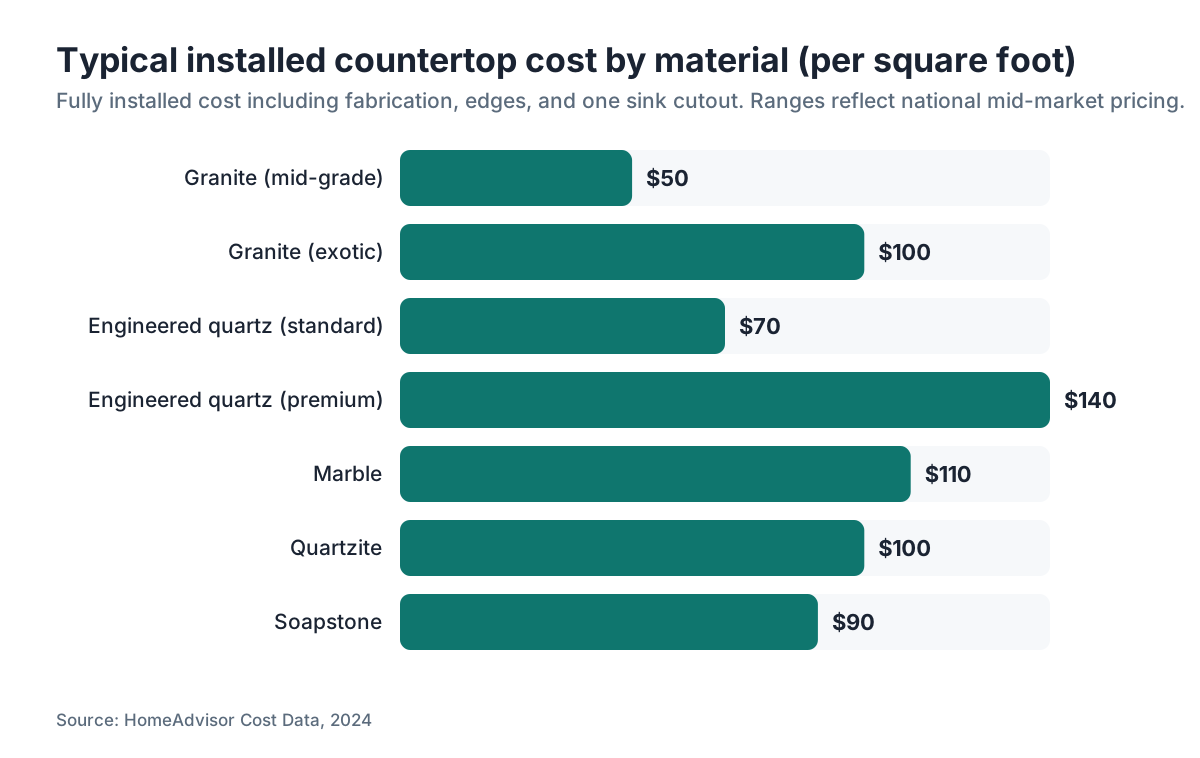
For a fully installed granite countertop, the national cost range reported by HomeAdvisor's cost data (based on project submissions from homeowners) runs roughly $40 to $60 per square foot for mid-grade granite with a standard edge, up to $100 or more for exotic slabs or complex layouts [2]. Marble typically runs $75 to $150 per square foot installed. Engineered quartz falls between $55 and $150 per square foot depending on brand and collection tier.
A typical kitchen with 45 to 55 square feet of countertop surface (a rough average for a U-shaped or L-shaped kitchen) will therefore run somewhere between $1,800 and $8,000 for material and fabrication combined, before any demo or plumbing disconnect costs. Those bookend numbers assume a relatively simple layout with one or two seams.
What drives cost up?
- Exotic or book-matched slabs: Premium quartzite and rare marble varieties carry higher slab costs and more labor because the fabricator has to lay out pieces carefully to match veins across seams.
- Complex edge profiles: An ogee or dupont edge can add $15 to $30 per linear foot over a simple eased edge.
- Additional seams: Each seam requires matching, filling, and polishing. Expect $150 to $400 per seam depending on shop.
- Undermount sink cutouts: Usually $100 to $250 per sink, sometimes included in base price.
- Radius or curved sections: Anything that requires hand-grinding or a CNC waterjet path beyond a straight cut adds time.
- Backsplash fabrication: Shops that cut 4-inch or full-height backsplash pieces from the same slab charge for that material and labor separately.
What drives cost down? Choosing a shop with efficient CNC equipment (less labor per square foot), buying a remnant slab for a small project like a bathroom vanity, or timing your project during slower winter months when some shops discount to fill capacity.
What is the stone fabrication process from start to finish?
Here is the sequence as it actually runs in a production shop, not the idealized version.
Step 1: Slab selection. You visit a stone yard or a distributor (sometimes your fabricator has an on-site yard) and pick your slab. If you're doing granite or marble, mark the slab with your name or a tag immediately. Slabs sell to whoever pays first, and good ones move fast.
Step 2: Quote and deposit. The fabricator measures your layout, counts the edges and cutouts, and gives you a written quote. Most shops require a 50 percent deposit to hold your slab and schedule date.
Step 3: Template. Usually scheduled 2 to 5 business days before your installation date. The templating crew visits the job site. Cabinets must be fully installed and level before this visit; if they're not, the template will be wrong. This is the step inexperienced GCs skip most often, and it causes more callbacks than almost anything else.
Step 4: Digital file prep and nesting. The template data gets imported into fabrication software (shops use products like Slabsmith, Moraware, or others in this space) to nest the pieces efficiently on the slab and minimize waste. Good nesting can save a quarter slab on a typical kitchen, which is real money when you're paying $500 to $1,500 for a premium slab.
Step 5: Cutting and profiling. The shop cuts pieces on a bridge saw, runs edges through the profile machine, cuts sink openings, and does any mitering for waterfall islands. Turnaround in most shops is 3 to 7 business days after template.
Step 6: Quality check. Better shops do a dry fit on a flat table before delivery. Pieces are labeled, padded, and loaded on an A-frame truck or van.
Step 7: Installation. The install crew typically arrives in the morning, sets pieces with silicone and support brackets where needed, epoxies and clamps seams, and does final polish. A standard kitchen takes 2 to 4 hours. They'll ask you to stay off the counters for a day while the silicone cures.
Step 8: Sealing. Some shops seal on-site after install. Others leave sealant with you. On granite and marble, the first seal should go on within a few days of install; the stone is exposed until then. You can read more about caring for your new surface at how to clean stone countertops.
How do you choose a stone fabrication shop?
Choosing a shop is about more than the lowest price. The material cost is fixed by the slab market. What varies is the fabricator's precision, reliability, and what happens when something goes wrong.
Look for shops that own CNC equipment. A shop running a CNC bridge saw and CNC router produces more consistent cutouts and tighter seams than one relying entirely on hand work. That's not a knock on craftspeople; it's a throughput and tolerance reality. Ask directly: "Do you have CNC equipment on-site?"
Check warranty terms. A reputable shop warrants their fabrication work (not the material itself) against defects in cutting, finishing, or installation for at least one year. Get that in writing. Some shops offer lifetime installation warranties on seams.
Ask about their templating method. Digital laser templating is more accurate than manual wood templates, particularly on walls that are out of square (which is almost every wall in an older home). A 3 to 4 mm error in a manual template becomes a visible gap at the wall.
Verify they pull permits if required. Countertop installation doesn't typically require a permit in most jurisdictions, but if the project involves plumbing modifications or structural support changes, those pieces may. Your GC or kitchen designer should clarify this.
Read actual reviews with skepticism. Five-star reviews are easy to game. Look for reviews that describe a specific problem and how the shop resolved it. A shop that fixes mistakes quickly is often better than one that never seems to have them (which usually just means no one writes about them).
Get at least three quotes. Not because the cheapest is best, but because you'll learn what's included in each. One shop's base price may include templating and one seam; another may itemize everything separately. You need to compare apples to apples.
For fabricators running their own shops: software that handles quoting, job costing, and nesting in one workflow makes a real difference in how fast you can turn around accurate bids. SlabWise was built specifically for this, and a demo takes about 20 minutes.
What questions should you ask a fabricator before signing a contract?
Most homeowners walk into a fabrication shop without a prepared list and end up agreeing to terms they don't fully understand. Here are the specific questions worth asking.
"Is the template included in your quote?" Some shops charge $100 to $200 for templating as a separate line item, credited back if you proceed. Others include it. Know before you schedule.
"How many seams will my project require, and where will they be?" The fabricator should show you a layout drawing. Seams should avoid high-stress areas (near sink corners) and, where possible, land under upper cabinets rather than in open runs where they're visible.
"What edge profile is included, and what does an upgrade cost?" Every shop has a base edge (usually eased or slightly beveled) included in their standard price. Anything more complex costs more.
"What happens if the slab cracks during fabrication?" This does happen, especially in large sink cutouts on thin slabs. A reputable shop eats that cost and sources a matching slab or replacement. Get their policy in writing.
"Who will be doing the installation?" Some shops sub out installation. That's not automatically bad, but you want to know who's coming to your house and whether they're covered by the shop's warranty.
"What care does this material need after install?" A shop that can't answer this question about the specific stone you've chosen hasn't done that material often enough. For quartzite care specifics, see how to clean quartzite countertops.
"What is your lead time right now?" Lead times fluctuate. Summer kitchen remodel season (May through August) can stretch fabrication queues to 3 to 4 weeks in busy markets. January through March is typically faster.
How does stone fabrication work for countertop installations specifically?
Countertops are far and away the biggest single category of work for most stone fabrication shops. The Marble Institute of America (now part of the Natural Stone Institute) has tracked the industry for decades, and residential countertops consistently represent the majority of shop revenue [3].
The countertop installation process has a few specifics that differ from, say, flooring or cladding fabrication.
Thickness matters a lot. Residential countertops are almost universally 3/4 inch (2 cm) or 1.25 inch (3 cm) thick. Three-centimeter slabs are heavier and structurally self-supporting over spans up to about 24 inches without substrate. Two-centimeter slabs are lighter (useful in some bathroom applications) but require a plywood underlayment for spans over 18 inches, and that adds to the project cost.
Overhangs have limits. A standard granite or quartz overhang for seating can run 10 to 12 inches without additional support. Beyond 12 inches, most fabricators require corbels or metal brackets underneath, and at 16 to 18 inches (a standard bar-height knee wall), steel support plates are standard. Building codes vary by jurisdiction; the International Residential Code doesn't specifically regulate countertop overhangs, but local amendments sometimes do [4].
Seams are an art and a science. The epoxy color has to be matched to the stone under different lighting conditions. A seam visible from 2 feet in direct sunlight is a quality failure; a seam visible only when you're looking for it is normal. Fabricators use UV-cured and two-part epoxies; the specific product matters less than the color match and the shop's experience doing it.
For homeowners comparing all types of countertop options, the broader guide to kitchen countertops covers material tradeoffs beyond stone.
What are stone fabrication services like in the San Jose and Bay Area market?
The San Jose and broader Bay Area market is one of the most competitive stone fabrication markets in the United States. High housing costs translate into high renovation budgets, which supports premium slab pricing but also supports a dense concentration of shops competing on price and service.
Stone fabrication services in San Jose and the South Bay generally fall into three tiers. Large production shops serve the developer and production-builder market, quoting high volume at tight margins. Mid-size shops target the remodel market, offering more selection and customer service at moderate prices. Boutique fabricators specialize in ultra-premium stones and custom work for high-end kitchens.
For a typical kitchen remodel in San Jose, the material and fabrication cost for granite countertops runs roughly 10 to 20 percent higher than the national average, reflecting higher shop labor costs in the Bay Area market [2]. That's not a firm number; it's an approximation based on regional cost-of-living data, and prices shift with the market.
California OSHA regulations apply to stone shops, including rules on silica dust exposure that got significantly stricter in recent years. California's Division of Occupational Safety and Health (Cal/OSHA) adopted a permissible exposure limit (PEL) for respirable crystalline silica of 50 micrograms per cubic meter of air as an 8-hour TWA, matching the federal OSHA standard [5]. Engineered quartz, which is 90 to 94 percent silica by weight, generates high-silica dust when cut dry. Reputable Bay Area shops use wet cutting, local exhaust ventilation, and respiratory protection to meet this standard. If you tour a shop and see workers cutting stone dry without respiratory protection, that's a flag for both safety and regulatory compliance.
California also has specific VOC regulations that affect the adhesives and sealers stone shops use, administered by the California Air Resources Board [6]. Shops in compliance use low-VOC epoxies and sealers, which matters if you're sensitive to chemical odors during installation.
What are the silica dust and safety rules that stone fabricators must follow?
This section matters both for homeowners touring shops and for fabricators running them.
Respirable crystalline silica is classified as a human carcinogen (Group 1) by the International Agency for Research on Cancer [7]. Prolonged exposure causes silicosis, an irreversible lung disease, and has been linked to lung cancer and kidney disease. Engineered quartz countertops, because of their very high silica content, have become a particular focus of occupational health research. A 2019 study in the journal Occupational and Environmental Medicine found accelerated silicosis cases among engineered stone countertop workers in Israel, Spain, and the United States, with some cases appearing after as little as 3 years of exposure [8].
Federal OSHA's silica standard for construction (29 CFR 1926.1153) requires employers to limit worker exposure to 50 micrograms per cubic meter as an 8-hour TWA, down from the previous PEL of 250 micrograms [9]. Table 1 of that standard lists wet methods and engineering controls as the primary compliance mechanism for most stone cutting tasks.
For homeowners, the practical implication is that you want your fabrication work done in a shop (not dry-cut in your home) and that any on-site cutting during installation should use wet methods. Field cuts at installation are sometimes unavoidable; a responsible installer wets the blade and sets up local ventilation or does the cut outside your home.
For fabricators, the OSHA silica standard also requires a written exposure control plan, medical surveillance for exposed workers, and recordkeeping. The OSHA small entity compliance guide for the silica standard is free and available on OSHA's website [9].
How long does stone fabrication take from template to installation?
The short answer: plan on 5 to 14 business days between template and installation in normal market conditions.
Here's where that time goes. Templating itself takes 30 to 90 minutes on-site depending on kitchen size and complexity. Digital file prep and nesting can happen the same day. Most shops batch their CNC cutting runs and run bridge saws 8 to 10 hours a day, so your pieces get queued behind whatever is already scheduled. Edge profiling and sink cutouts typically happen the day after cutting. Quality check and crating take a few hours. Delivery and installation scheduling depends on your geographic slot.
What pushes turnaround past 14 days? A few things. If your slab has to be transferred from a distributor warehouse to the shop (common for exotic or special-order material), add 2 to 5 days. If your cabinets aren't ready at the time of template, the shop can't proceed and you lose your queue position. High season backlogs (particularly June, July, and August) can stretch lead times to 3 to 4 weeks at busy shops. Custom or book-matched layouts that require extensive digital layout review take longer.
Rush fees exist. Some shops can accelerate to 3 to 5 business days for an added cost of $200 to $500, depending on how much they have to rearrange their queue. If your project has a hard deadline (a contractor's punch-out date, a rental turnover), discuss rush options upfront, not after you've signed.
One thing that doesn't speed things up: pressuring the shop during fabrication. Cutting errors happen when crews rush. A shop that takes 10 days and gets it right is better than one that takes 5 days and sends a cracked piece.
How is stone fabrication priced and quoted?
Understanding how quotes are built helps you compare them accurately and catch hidden costs.
Most shops price countertops by the square foot of finished stone. That square footage is calculated from the bounding box of each piece (the overall rectangle that contains the shape), not the net area after cutouts. This matters for L-shaped pieces and pieces with sink openings: you pay for the rectangle, more than the stone that's left after the hole is cut out. Industry practice is to charge full price for sink cutout areas because that material was still cut, handled, and wasted.
Edge profiling is usually priced by the linear foot of exposed edge. A standard kitchen might have 18 to 25 linear feet of exposed edge. Edge upcharges of $10 to $30 per linear foot are common for complex profiles.
Sink cutouts run $100 to $250 each for undermount sinks. Cooktop cutouts are similar. Faucet holes are often included or charged at $20 to $40 each.
Material cost is usually quoted separately from fabrication labor, or bundled. When a shop quotes you a per-square-foot installed price, that number should include: slab material, all fabrication labor, delivery, and installation. Ask specifically what's in the number.
For fabricators building faster, more accurate quotes, software that combines slab inventory, edge pricing tables, cutout line items, and waste calculation in one place eliminates the manual spreadsheet errors that eat into margin. Tools like SlabWise are built specifically for that workflow, and they're worth looking at if you're running more than 15 to 20 projects a month.
Tax treatment of fabrication services varies by state. In California, for example, stone countertop fabrication and installation is treated as a mixed supply of goods and services; the California Department of Tax and Fee Administration (CDTFA) applies sales tax to the material component of the transaction [10]. In some states, the full installed price is taxable. Fabricators should verify with their state tax authority or a CPA.
Frequently asked questions
What is the difference between a stone fabricator and a stone installer?
A fabricator cuts and finishes the stone; an installer sets it in place. Many shops do both. Some fabricators sub out installation to a separate crew. When you get a quote, ask whether the same company handles both steps, because if there's a gap issue at the wall or a seam problem, you want one party responsible, not two pointing at each other.
Can a stone fabricator work from a slab I already own?
Yes, most shops will fabricate from customer-supplied material. You may pay a slightly higher labor rate because they have no slab margin to buffer against. Make sure the slab is already at the shop (or factor in delivery) and confirm the shop has handled that specific material before. Unusual stones like ultra-thin porcelain or rare quartzite require specific blade types and tooling.
What is a remnant slab and is it worth buying one?
A remnant is a piece of stone left over from a previous project, stored in the shop's yard and sold at a discount. Remnants work well for small projects: bathroom vanities, laundry room tops, bar sections. For a full kitchen, most remnants are too small. Prices vary widely; a remnant that's perfect for your project can save 30 to 50 percent on material cost.
How thick should kitchen countertops be?
The two standard thicknesses are 2 cm (about 3/4 inch) and 3 cm (about 1.25 inches). Three centimeter is now the residential standard for kitchens because it's self-supporting and requires no plywood underlayment. Two centimeter is lighter and sometimes used for wall cladding or bathroom vanities with a buildup edge to simulate 3 cm thickness.
Does stone fabrication include sealing the countertop?
Sometimes. Ask before you assume. Some shops seal as part of installation; others hand you a bottle of sealer and instructions. For granite and marble, the first seal should happen within a few days of install. Engineered quartz doesn't need sealing at all. Soapstone is treated with mineral oil rather than penetrating sealer. See how to clean soapstone countertops for care specifics.
What is book-matching and how much does it cost?
Book-matching means mirroring two slabs cut from the same block so the veining creates a symmetrical pattern across an island or large surface. It requires buying two sequential slabs and careful digital layout to align the veins. It adds roughly 20 to 40 percent to material cost and significant layout labor. The result can be striking on dramatic marble or quartzite, but it's overkill for uniform stones like most engineered quartz.
Is engineered quartz or natural stone better for kitchen countertops?
Neither is universally better; they perform differently. Engineered quartz is harder to stain, doesn't need periodic sealing, and has consistent color throughout the slab. Natural stone has more variation and character, is heat-resistant, and can be refinished if damaged. For a household with kids and heavy daily use, quartz is often the lower-maintenance choice. For a cook who sets hot pans directly on the surface, granite or quartzite is safer.
Can a cracked stone countertop be repaired?
Hairline cracks and chips can be filled with color-matched epoxy and are often nearly invisible after a skilled repair. Full fractures through the thickness of the stone are harder to fix well. A repaired full crack may hold structurally but will usually be visible under raking light. Prevention is better: avoid thermal shock (hot pans on cold stone), don't lean on unsupported overhangs, and support large slabs properly during installation.
What should I do if my countertop has a bad seam after installation?
Document it with photos immediately and notify the fabricator in writing (email creates a date-stamped record). Most reputable shops will revisit and regrind and re-epoxy a seam that's visibly uneven or has a color mismatch. If the shop is unresponsive, your next options are a demand letter citing the written warranty, a complaint to your state contractor licensing board, or small claims court for amounts under your state's limit.
How many square feet of countertop does a typical kitchen have?
A small galley kitchen might have 25 to 35 square feet. A standard L-shaped or U-shaped kitchen runs 45 to 55 square feet. A large kitchen with a big island can easily reach 70 to 90 square feet. Fabricators calculate bounding-box square footage, which is slightly higher than net area after sink and cooktop cutouts, so budget estimates should use the higher number.
Do stone fabricators do outdoor countertops?
Yes, but not all materials work outdoors. Natural stones (granite, quartzite, soapstone, slate) handle outdoor conditions well. Engineered quartz should not go outdoors because UV light degrades the polymer resin binder over time, causing discoloration and surface breakdown. Porcelain slabs and Dekton are two alternatives specifically rated for exterior use. Tell your fabricator upfront that the application is outdoor.
What are the silica dust risks I should know about as a homeowner during installation?
If field cuts happen inside your home during installation (sometimes necessary to fit a wall that was measured wrong), silica-containing dust is generated. Ask the installers to wet-cut and to set up ventilation or do the cut outside. The OSHA permissible exposure limit for respirable crystalline silica is 50 micrograms per cubic meter, and even brief high-concentration exposure from a dry cut in an enclosed kitchen is worth avoiding.
How do I know if a stone fabricator is licensed and insured?
Requirements vary by state. In California, countertop fabrication and installation that exceeds $500 in combined labor and materials requires a contractor's license from the Contractors State License Board (CSLB). Verify license status directly at the CSLB website using the contractor's license number. Ask for proof of general liability insurance and workers' compensation before any work begins on your property.
Sources
- Natural Stone Institute, Quartz Surface Products guidance: Engineered quartz countertops are composed of roughly 90 to 94 percent crushed quartz bound with polymer resin
- HomeAdvisor, Countertop Installation Cost Guide: Granite countertop installation costs range roughly $40 to $60 per square foot for mid-grade material and up to $100+ for exotic slabs
- Natural Stone Institute (formerly Marble Institute of America), Industry Data: Residential countertops represent the majority of revenue for most stone fabrication shops
- International Code Council, International Residential Code (IRC): The International Residential Code does not specifically regulate countertop overhangs; local amendments may apply
- California Department of Industrial Relations, Cal/OSHA Silica Standard: Cal/OSHA adopted a permissible exposure limit for respirable crystalline silica of 50 micrograms per cubic meter as an 8-hour TWA
- California Air Resources Board, Consumer Products Regulations: California Air Resources Board regulates VOC content in adhesives and sealers used in stone fabrication shops
- International Agency for Research on Cancer, IARC Monographs Vol. 100C: Respirable crystalline silica is classified as a Group 1 human carcinogen by the International Agency for Research on Cancer
- Occupational and Environmental Medicine, 2019 study on accelerated silicosis in engineered stone workers: A 2019 study found accelerated silicosis cases among engineered stone countertop workers in Israel, Spain, and the United States, with some cases appearing after as little as 3 years of exposure
- U.S. Occupational Safety and Health Administration, 29 CFR 1926.1153 Respirable Crystalline Silica Standard for Construction: Federal OSHA requires employers to limit worker exposure to respirable crystalline silica to 50 micrograms per cubic meter as an 8-hour TWA
- California Contractors State License Board, License Requirements: In California, countertop fabrication and installation exceeding $500 in combined labor and materials requires a contractor's license from the CSLB
Last updated 2026-07-09