TL;DR
- Stone fabrication turns a raw slab into a finished, installed surface: countertop, vanity, fireplace, shower.
- It runs from templating through cutting, edge work, and setting the last piece.
- Installed cost is $40 to $200+ per square foot depending on stone type and edge complexity.
- The fabricator you pick matters more than the slab you pick.
What is stone fabrication, exactly?
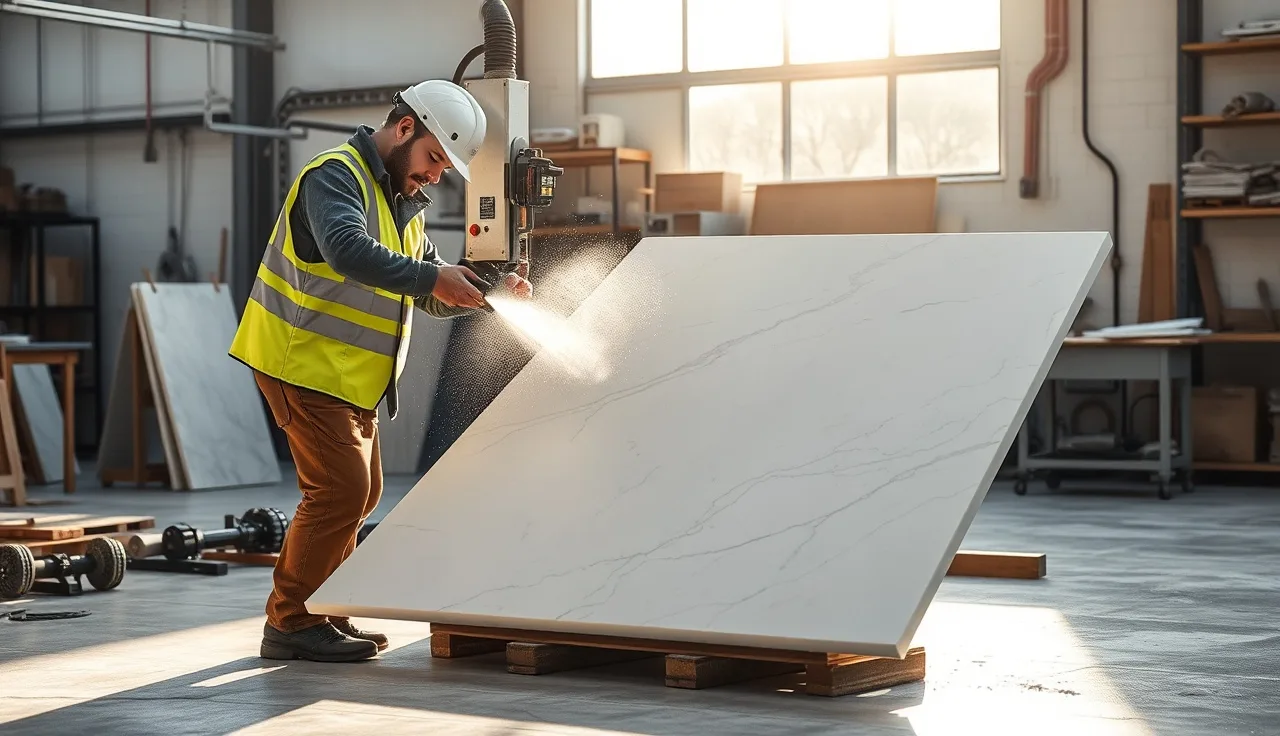
Stone fabrication is the process of turning a raw slab into a finished, installed surface: a countertop, vanity top, fireplace surround, shower pan, or outdoor kitchen. It starts the moment someone measures your space. It ends when the installer sets the last piece and caulks the seams.
The steps run in order: templating, layout on the slab, cutting, edge profiling, cutouts for sinks and cooktops, seaming (if needed), grinding and polishing, then installation. Skip or rush any one of them and you get gaps, chips, or seams that jump out at you across the room.
"Premier" gets stapled onto shops that buy the right equipment, hold tight tolerances, and hire people who've done the work for years. It's not a certification. It's not a trade group title. Any shop can print the word on a brochure. What actually separates them is measurable: seam width, edge consistency, cutout radius accuracy, and whether the template matches what the installer ends up setting.
This is a manufacturing process, not a retail one. The slab you fall in love with at the warehouse is maybe 30 percent of the result. The other 70 percent is what the shop does with it.
What materials do stone fabricators work with?
The core materials are granite, marble, quartzite, soapstone, engineered quartz, and porcelain slabs. Each one behaves differently on the saw and at the polishing wheel. That's exactly why no shop is equally good at all of them.
Granite countertops have paid the industry's bills for 30 years. Granite is forgiving. It's hard, it cuts clean, it polishes fast. Almost any competent shop can turn out a solid granite job.
Marble countertops are where the skill gaps start to show. Marble is soft (Mohs 3 to 4 against granite's 6 to 7), so blade speed and water flow have to be dialed in or the stone chips at sink cutouts and miter edges. Good shops run test cuts on every new marble lot before they touch the customer's slab.
Quartzite is the hard exam. The name confuses homeowners and plenty of showroom salespeople, but true quartzite is a metamorphic rock, often harder than granite and brutally abrasive on blades. A shop that can't tell real quartzite from a "soft quartzite" that's actually marble will wreck a $2,000 slab in one bad pass. If you're buying quartzite and want to know how to care for it afterward, you also need a fabricator who finished the surface right in the first place.
Engineered quartz (Silestone, Caesarstone, Cambria countertops, and others) is a polymer-bonded stone composite. It's dimensionally consistent, which helps layout, but the resin can gum up a blade. The major quartz brands run certified fabricator programs, and buying brand-warranted quartz from an uncertified shop can void your product warranty.
Porcelain slabs (6mm to 12mm thick, often 126" x 63") are the newest mainstream material. They need diamond tooling built for porcelain, different blade angles, and an operator who respects that the material has almost no flex tolerance. Most older shops are still learning it.
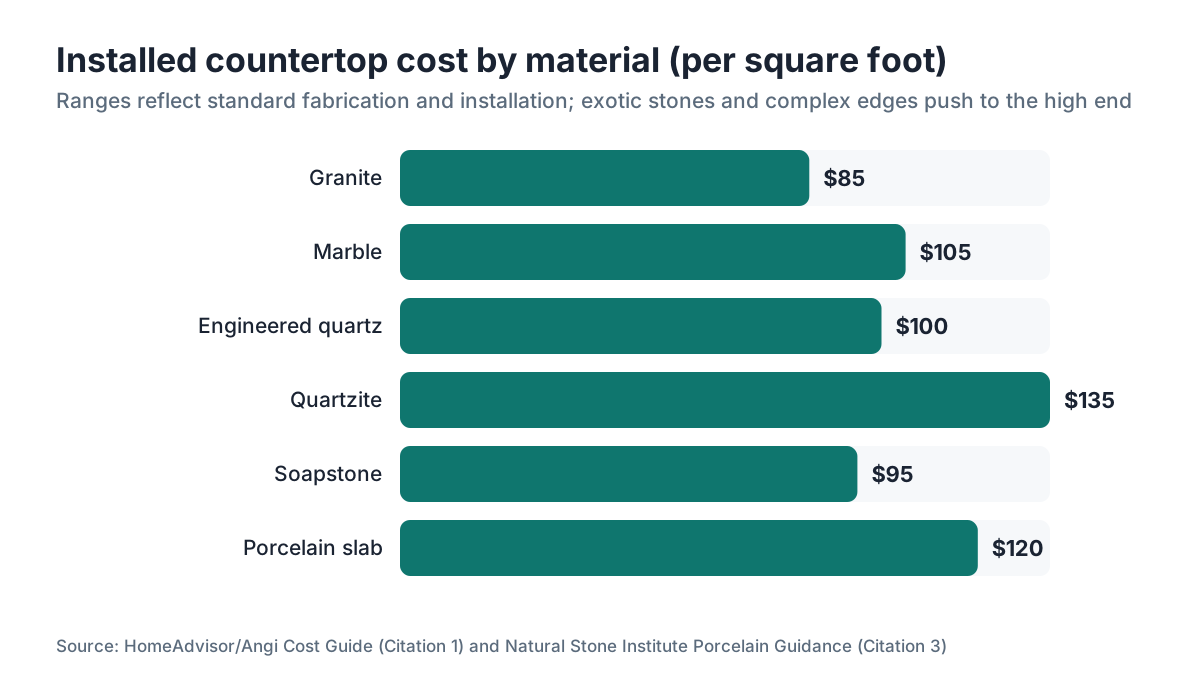
| Material | Mohs hardness | Relative fabrication difficulty | Typical installed cost range |
|---|---|---|---|
| Granite | 6 to 7 | Low | $50, $120/sq ft [1] |
| Marble | 3 to 4 | Medium | $60, $150/sq ft [1] |
| Quartzite | 7 to 8 | High | $70, $200+/sq ft [1] |
| Engineered quartz | 7 (approx) | Medium | $55, $150/sq ft [2] |
| Soapstone | 1 to 2 | Low-medium | $70, $120/sq ft [1] |
| Porcelain slab | 7 to 9 | High | $65, $180/sq ft [3] |
How much does professional stone fabrication cost?
The honest number is $40 to $200+ per square foot installed. That range is huge because it covers everything from a basic granite remnant to a 12-foot waterfall island in Calacatta Gold with hand-mitered edges.
Here's how the number builds.
The slab itself runs $5 to $100+ per square foot wholesale, depending on origin, rarity, and size. Exotics like Patagonia granite or Van Gogh quartzite push past $100 per square foot for the raw stone alone [1].
Fabrication labor adds $30 to $60 per square foot for standard work. That's cutting, a standard edge, one or two sink cutouts, and polishing. Each extra cutout (cooktop, prep sink, soap dispenser) adds $50 to $150 depending on shape [4].
Edge profiles move the price hard. An eased edge is cheap, often free. A full bullnose adds $15 to $25 per linear foot. A hand-mitered waterfall edge on an island adds $500 to $2,500 depending on corner count and top thickness [4].
Installation runs $200 to $600 for most residential kitchens, billed flat or folded into the per-square-foot rate. Tearing out the old countertops adds $150 to $400 depending on volume and material.
The most common homeowner mistake is comparing two quotes that don't cover the same things. One shop's $65 per square foot includes slab, edge, sink cutout, and install. Another shop's $45 is fabrication only, no material, no install. Make every shop quote the same scope in writing.
What equipment separates a premier shop from an average one?
Here's where fabricators and homeowners see different things. Homeowners look at the finished surface. Fabricators know the finished surface is a direct output of the machine that made it.
A CNC bridge saw is the standard for precision cutting. Older shops run manual bridge saws, which can do good work in skilled hands but add operator-to-operator variation. CNC saws hold tolerances under 1mm on cut length, which is what keeps seams and miters tight [5].
A CNC router or multi-axis machining center handles edge profiles, sink cutouts, and radius work. The difference between a hand-profiled edge and a CNC-profiled one shows up on any edge longer than 36 inches. The CNC version stays consistent end to end. The hand version often tapers slightly or wobbles in radius, and it catches the light.
Water jet cutting makes shapes a saw can't: curved countertops, medallion inlays, corbels. Not every shop has one. Not every job needs one. But a shop that owns a water jet and knows how to run it is playing a different game.
Digital templating gear (Proliner, LT-2D3D, or similar) trades paper template strips for a laser device that feeds straight into the CNC software. Digital templates carry errors of 0.5mm to 1mm. Paper templates run 3 to 5mm, which is enough to gap a seam or send a top back for a recut [6].
Shop ventilation and water management matter more than most homeowners know. OSHA's 2016 silica rule (29 CFR 1926.1153) requires engineering controls like wet cutting and local exhaust ventilation to keep airborne respirable crystalline silica below 50 micrograms per cubic meter as an 8-hour TWA [7]. A compliant shop is one where the crew isn't wrecking their lungs, and that discipline tends to travel with quality across the whole operation.
What does the templating process involve and why does it matter so much?
Templating is the measurement step. The fabricator (or a tech) comes to your space, measures every wall, records every out-of-square corner, marks outlets, scribes, and obstructions, and documents the exact footprint that gets cut from the slab.
A bad template gives you a countertop that gaps at the wall (a measurement came up short) or won't sit flat (a corner got recorded as 90 degrees when it's really 91.5). Neither is cheap to fix.
Digital systems kill most of the human error. A Proliner uses a laser arm to capture wall points to within 0.5mm and exports a DXF file that drops straight into the CNC software. Nobody reads a paper template and types numbers by hand, so nobody fat-fingers a dimension [6].
For homeowners: the visit should take 30 to 90 minutes for a typical kitchen. The tech should ask about overhang preference, confirm the exact sink model (the cutout gets driven off the template file, not sized later in the shop), and note anywhere the wall or cabinet isn't plumb. If they're in and out in 10 minutes with a paper strip, start asking questions.
For fabricators: this is where profit gets protected or torched. A template error that forces a recut on a $1,200 slab is a $1,200 loss plus labor. Digital templating equipment costs $15,000 to $60,000 and pays back in rework savings inside the first year at most mid-sized shops [6].
How do fabricators lay out slabs to minimize waste?
Slab layout is part art, part arithmetic. The fabricator has to fit the countertop pieces onto the slab (or slabs) in a way that trims waste, keeps grain and veining consistent where pieces will seam, and steers natural voids and fissures away from high-stress zones like sink corners.
On a heavily veined marble or quartzite, layout is a real skill. The customer often expects (and pays for) book-matched veining at a seam, where two pieces mirror each other like open pages of a book. That means flipping one piece and cutting both from adjacent sections of the slab. Doing it on paper invites mistakes. Doing it in slab layout software is reliable and repeatable.
Nesting software calculates how to fit every piece onto the available stone to squeeze out the most yield. A well-nested job on a standard 9-foot by 5-foot slab loses 15 to 20 percent to kerf, cutouts, and edge allowance. A poorly nested job loses 30 to 40 percent, which either forces an extra slab purchase or leaves the client with useless scraps [8].
For shops running several jobs a day, software that handles quoting and nesting in one place cuts the gap between a signed contract and saw time. Tools like SlabWise are built for exactly this, connecting the quote to the shop floor with no manual re-entry step.
Remnant management is where good layout compounds. A shop that nests well throws off consistent remnant sizes it can sell or reuse on small jobs. A shop that nests badly throws off odd fragments that go straight to the dumpster.
What edge profiles are available and how do they affect price?
The edge profile is the shaped surface along the front of the countertop. It's one of the most visible design calls in a kitchen. It's also one of the most variable line items in a quote.
Standard profiles most shops offer:
Eased edge: a simple 1/8-inch top chamfer with a flat face. Fast, clean, modern. Usually baked into the base fabrication price.
Bevel edge: the top corner cut at 45 degrees, typically 1/4 to 1/2 inch. A bit more material removal than eased, still quick on a CNC.
Bullnose: fully rounded top and bottom into a half-circle profile. A classic for traditional kitchens. Adds $15 to $25 per linear foot over eased [4].
Ogee: an S-curve, concave below and convex above. Common in formal kitchens. Tricky to run on older gear. Adds $25 to $40 per linear foot [4].
Waterfall edge (mitered): the countertop surface turns and runs vertically down the side of an island, meeting a vertical slab piece at a 45-degree miter. This is demanding. The miter has to be perfect or the seam telegraphs. Waste runs high because you need enough slab to cut both horizontal and vertical pieces while holding grain continuity. Budget $800 to $3,000 extra for a full waterfall island depending on slab cost and complexity [4].
Laminated edge: two layers of stone bonded to fake a thicker edge (commonly a 3/4-inch slab built up to look like 1.5 inches). Cheaper than true 3cm stone, but it adds labor.
Hand-worked and leathered edges come from high-end shops for specific stones. Soapstone takes a hand-rubbed chamfer beautifully. If you're working with soapstone countertops, the edge finish changes how the surface weathers over the years.
How long does stone fabrication and installation take?
From signed contract to installed countertops, most residential jobs take 1 to 3 weeks. Here's where the time actually goes.
Slab procurement: if your stone is in stock at the local distributor, 0 to 3 days. If it's a special order or you're chasing a specific lot, 2 to 6 weeks.
Job scheduling: most active shops run a 1 to 2-week queue between template and install. Busy season (spring and fall renovation peaks) can push that to 3 to 4 weeks [9].
Fabrication: once a slab hits the floor, a standard kitchen set takes 4 to 8 shop hours for a skilled crew. Complex jobs with waterfall edges, multiple cutouts, or difficult stone can run 12 to 20 hours.
Installation: plan for 2 to 4 hours on a typical kitchen. Add 1 to 2 hours per bathroom vanity. The plumber has to come back after install to reconnect the sink, and that adds a scheduling knot.
The timeline blows out when the template turns up a problem: cabinets that aren't level, a wall out of square by more than 1/2 inch, an appliance that doesn't match the specified model. Any of those needs a site fix before stone goes in. The fabricator can't fix your cabinets, so leave room for that handoff.
How do you find and evaluate a premier stone fabricator?
Start with the Natural Stone Institute member directory [10]. Member shops have agreed to industry standards for fabrication and installation. Membership doesn't guarantee quality, but it does guarantee somebody at that shop has read the standards.
Ask for a shop tour before you sign anything. A shop with clean, calibrated CNC equipment, organized slab storage, and a real quality check before pieces leave the floor is a different animal than a shop where slabs lean on the ground and the saw is buried in dust.
Ask direct questions. Do you use digital templating? What CNC equipment are you running? How do you handle a recut when the template is wrong? What's your OSHA silica compliance program? A good fabricator answers all four without flinching. Dodging the OSHA question is a red flag for a shop cutting corners on worker safety, and those shops usually cut corners elsewhere too [7].
Read reviews with a cold eye. Five-star reviews come easy from happy customers who don't know what they don't know. One-star reviews about seam quality, delivery times, or install damage are the ones worth reading twice. How the shop responds to a bad review tells you nearly as much as the review.
Get three quotes on identical scope. When they come back, ask the low bidder exactly what they left out. Sometimes the number is low because the shop is fast and efficient. More often it's low because the slab cost, the edge upgrade, or the install fee gets added later.
What are the silica and health regulations stone fabricators must follow?
This is not a regulatory footnote. Silicosis from stone dust is a serious, irreversible occupational disease, and the fabrication industry has a documented cluster of cases, including young workers cutting engineered quartz [11].
OSHA's respirable crystalline silica standard for construction (29 CFR 1926.1153) and the general industry standard (29 CFR 1910.1053) both set a permissible exposure limit of 50 micrograms per cubic meter as an 8-hour time-weighted average. OSHA flags engineered stone countertop fabrication as a high-priority operation because engineered quartz can run over 90 percent silica by weight [7].
Engineered stone carries a higher silica risk per cut than most natural stone. A 2023 study in JAMA Internal Medicine tied accelerated silicosis to engineered stone countertop workers, with a median age at diagnosis under 45. The authors wrote that the cases represent "a resurgence of an occupational disease that was thought to be well controlled" [11]. California's Cal/OSHA has taken enforcement action against fabrication shops for silica overexposure, and several states have moved on restrictions beyond the federal floor [12].
For homeowners, this is mostly background. For fabricators, the requirements are concrete: engineering controls (wet cutting, integrated water suppression, local exhaust ventilation), a respiratory protection program, medical surveillance for exposed workers, and a written exposure control plan [7]. A shop that can hand you its silica program binder is a shop paying attention to process everywhere else.
How does stone fabrication compare to other countertop options?
Not everyone needs stone fabrication. The choice is real and so is the price gap.
Laminate countertops and Formica countertops run $20 to $50 per square foot installed, labor included. Corian countertops and other solid surface run $45 to $100. Butcher block countertops run $40 to $100 installed depending on wood species and thickness.
Stone, natural or engineered, starts at $50 and climbs past $250. The fabrication labor alone can top the entire installed cost of some of those alternatives. That's a fair trade only if you want what stone gives you: hardness, heat resistance, a look no laminate print can fake, and resale value that shows up in an appraisal.
For the whole kitchen decision, the full material comparison is in our kitchen countertops guide.
Comparing stone to stone for a specific room, the installation shares common steps across materials, but the stone-specific parts (templating tolerances, seam location, edge tooling) are where the fabricator's skill shows. More on what that looks like on-site is in our countertop installation guide.
For most mid-range remodels, the right answer is engineered quartz or granite from a competent shop at $70 to $120 per square foot installed. That's the zone where you get durability, good looks, low maintenance, and a shop doing enough volume to have the process dialed in. The high end (rare natural stone, complex waterfall edges, large-format porcelain) earns its premium only when the design actually calls for it.
What should a homeowner ask before signing a fabrication contract?
The contract should answer all of these. If it doesn't, ask before you sign.
What slab am I actually buying? Get the slab number, bundle number, and where it's stored. You should be able to go verify it yourself.
What edge profile is included in this price, and what's the upgrade cost?
How many cutouts are included, and what's the charge per extra cutout?
Who does the installation, and is that labor in this quote?
What's your recut and remediation policy if there's a fabrication error?
Does the work come with a warranty? Industry standard for workmanship is 1 year; material warranties flow from the stone manufacturer.
For engineered quartz: are you a certified installer for this brand? It matters for the warranty.
What happens if the slab breaks during fabrication? Better shops eat it; some charge you for a replacement on certain materials. Know this going in.
None of these are hostile questions. A fabricator who runs a tight shop answers all of them in under five minutes. One who gets cagey or annoyed just told you how they'll handle a problem when one shows up.
If you're quoting digitally, the SlabWise instant quote tool splits material, fabrication, and install into separate line items so you can compare apples to apples before you ever call a shop.
Frequently asked questions
How long does stone countertop fabrication take from template to install?
Most residential jobs run 1 to 3 weeks from the template appointment to installation day. Fabrication of the actual pieces takes 4 to 8 shop hours once the slab hits the floor. The rest is scheduling queue, which runs 1 to 2 weeks at most active shops and stretches to 3 to 4 weeks during spring and fall renovation peaks.
What is the difference between a stone fabricator and a stone installer?
A fabricator cuts, profiles, and polishes stone into finished countertop pieces. An installer sets those pieces on the cabinets, adheres them, and caulks the seams and backsplash. Many shops do both under one roof; some outsource install to subcontractors. If those are two different crews, ask specifically who's accountable when a seam or cutout doesn't sit right after install.
What is the average cost per square foot for stone countertop fabrication?
Fabrication labor alone runs $30 to $60 per square foot for standard work. Installed cost including material ranges from $50 for basic granite to $200+ for exotic quartzite or complex waterfall edges. The spread comes from material cost, edge complexity, and regional labor rates. Always ask whether a quote includes slab, edge, cutouts, and installation.
Do I need to be home for the stone templating appointment?
Yes. Someone who knows the layout decisions needs to be there. The technician asks about sink model, overhang depth, seam placement, and whether any appliances are getting swapped. Decisions made wrong at the template step are expensive to fix once the stone is cut. This is not an appointment to hand off to a neighbor.
What is digital templating and is it worth paying more for?
Digital templating uses a laser measurement arm (like a Proliner) to capture wall points to within about 0.5mm and export a DXF file straight to CNC software. Paper templates carry 3 to 5mm error risk, enough to gap a seam or force a recut. You usually aren't charged extra for it; it's built into the shop's process. If a shop still runs paper templates, factor that risk into your call.
What is a waterfall edge on a countertop and how much does it cost?
A waterfall edge runs the countertop material vertically down the side of an island or cabinet, meeting a vertical slab piece at a 45-degree miter joint. It's a high-design look common in contemporary kitchens. Expect to add $800 to $3,000 over a standard edge, depending on slab cost, grain-matching, and how many corners are involved.
Are stone fabricators required to follow OSHA silica rules?
Yes. OSHA's 29 CFR 1926.1153 and 1910.1053 set a permissible exposure limit of 50 micrograms per cubic meter of respirable crystalline silica as an 8-hour TWA. Stone fabrication, especially engineered quartz cutting, is called out as a high-priority exposure operation. Compliant shops run wet cutting, local exhaust ventilation, and medical surveillance programs for exposed workers.
What stone materials are hardest to fabricate correctly?
True quartzite (Mohs 7 to 8) and large-format porcelain are the most demanding. Quartzite eats blades and needs precise feed rates. Porcelain has near-zero flex tolerance and chips at edges if the tooling isn't built for ceramics. Marble cuts easily but is soft enough to chip at sink cutouts when blade speed is wrong. Ask a prospective shop what share of their volume is each material.
Does my stone countertop warranty cover fabrication defects?
Material warranties from slab manufacturers typically cover defects in the stone itself, not workmanship. Fabrication workmanship (seam quality, edge consistency, cutout finish) should be covered by the fabricator's own warranty, usually 1 year for residential work. For branded engineered quartz, using a non-certified installer can void the product warranty entirely, so verify certification before you sign.
What is book-matching in stone fabrication?
Book-matching means cutting two adjacent slabs (or two pieces from one slab) and flipping one so the veining mirrors the other, like pages of an open book. It's common on islands and feature walls where a seam would otherwise look random. It takes careful layout planning, increases material waste, and is priced into jobs where the customer requests it. Confirm it's in writing.
Can a stone fabricator work with remnants to save money?
Yes, and for smaller surfaces it cuts cost significantly. Remnants are leftover pieces from earlier jobs; a 24-by-48-inch remnant might run $100 to $300 versus $400 to $800 for the same area cut from a new slab. The trade-off is limited selection, no grain continuity with other pieces, and spotty availability. Good shops keep a documented remnant inventory. Worth asking about for bathrooms, laundry rooms, or small bar tops.
How do I clean and maintain stone countertops after fabrication?
Most natural stone needs a penetrating sealer applied at install and refreshed every 1 to 5 years depending on use and porosity. Daily cleaning is warm water and dish soap; skip acidic cleaners like vinegar and lemon juice on marble and limestone. Our guide on how to clean stone countertops covers the details by material. Engineered quartz needs no sealing but takes heat worse than natural stone.
Sources
- HomeAdvisor / Angi, Countertop Installation Cost Guide: Installed stone countertop costs range from $50 to $200+ per sq ft depending on material; granite $50-$120, marble $60-$150, quartzite $70-$200+, soapstone $70-$120
- Countertop Specialty, Quartz vs Granite Cost: Engineered quartz installed cost ranges from $55 to $150 per square foot
- Natural Stone Institute, Porcelain Slabs Technical Guidance: Large-format porcelain slabs installed run $65 to $180 per square foot; require specialized diamond tooling
- National Kitchen and Bath Association (NKBA), Cost vs. Value Research: Edge profile upgrades add $15-$25/lf for bullnose, $25-$40/lf for ogee; waterfall edge adds $800-$3,000 per island
- Natural Stone Institute, Dimension Stone Design Manual: CNC bridge saws hold cutting tolerances under 1mm, improving seam and miter consistency compared to manual saws
- SlabWise editorial estimate based on published Proliner and LT-2D3D digital templating specifications: Digital templating captures wall points to within about 0.5mm and exports DXF to CNC; paper templates carry 3-5mm error risk; equipment runs $15,000-$60,000
- U.S. Occupational Safety and Health Administration (OSHA), Respirable Crystalline Silica Standard for Construction, 29 CFR 1926.1153: OSHA PEL for respirable crystalline silica is 50 micrograms per cubic meter as an 8-hour TWA; stone fabrication identified as high-priority exposure operation
- SlabWise editorial estimate based on standard slab yield practice: Well-nested jobs on a 9x5-foot slab lose 15-20 percent to kerf and edge allowance; poorly nested jobs lose 30-40 percent
- National Association of the Remodeling Industry (NARI): Stone fabrication shop queues run 1-2 weeks standard, extending to 3-4 weeks during spring and fall renovation peaks
- Natural Stone Institute, Member Fabricator Directory: Member fabricators have agreed to industry standards for fabrication and installation; NSI operates a member directory for consumer lookup
- JAMA Internal Medicine, Silicosis Among Engineered Stone Countertop Workers in California, 2023: 2023 JAMA Internal Medicine study linked accelerated silicosis to engineered stone countertop fabrication workers, with median age at diagnosis under 45
Last updated 2026-07-10