TL;DR
- Precut (prefabricated) granite countertops are factory-cut slabs sold in standard sizes, usually 25.5" or 26" deep, at $40 to $100 per square foot installed.
- That runs 30 to 50% below custom fabrication, but you're locked into stock edge profiles, stock colors, and stock sizes.
- Prefab wins in a plain rectangular kitchen.
- It fights you in L-shapes, curved edges, and undermount sink cutouts.
What are precut granite countertops, exactly?
Precut granite countertops, also called prefabricated granite or prefab granite, are slabs a factory already cut to common countertop widths, polished on one or more edges, and shipped to home improvement stores and countertop dealers in stock lengths. You buy them, trim them on-site if you have to, and install them. Nobody comes out to measure your kitchen, cut a custom slab, and finish it to your exact numbers.
Standard depth is 25.5 inches or 26 inches, which matches most base cabinets plus a small overhang. Lengths usually come in 4-foot, 8-foot, and 10-foot pieces, and some suppliers stock sections up to 12 feet. The front edge arrives finished, most often with a simple eased or beveled profile. The back edge is raw because it hides against the wall.
The stone is real granite. Same hardness (6 to 7 on the Mohs scale), same heat resistance, same sealing needs as a custom slab [1]. What you give up is sizing, edge choice, and color range, not material quality. Prefab granite comes in a short list of the most popular patterns. Think Santa Cecilia, Uba Tuba, and Venetian Gold, not the hundreds of options waiting at a slab yard.
Home Depot, Lowe's, Ikea, and dedicated countertop wholesalers all sell prefab granite sections. Some fabricators carry prefab too, as a lower-cost line next to their custom work.
How much do precut granite countertops cost?
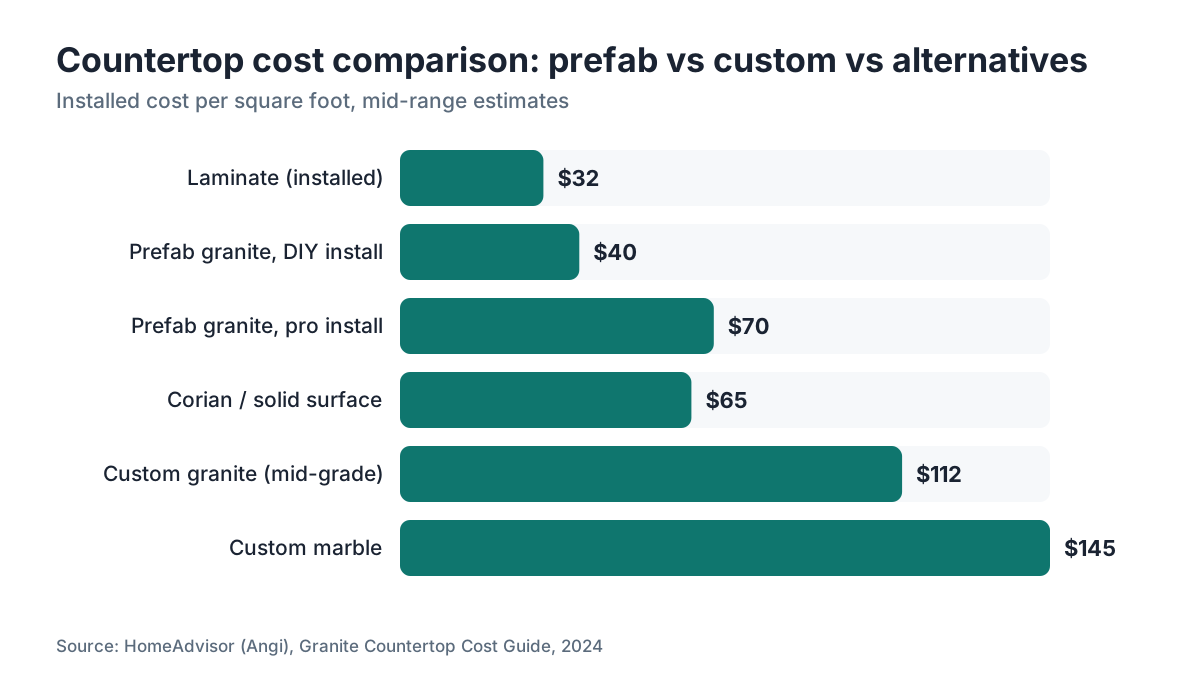
Prefab granite runs about $40 to $100 per square foot installed, and where you land inside that range depends on your region, the dealer, and whether you hire the install or do it yourself [2]. Material alone, no install, runs roughly $20 to $60 per square foot at retail.
Custom granite fabrication and installation lands between $75 and $175 per square foot installed, with a national average near $100 to $125 for a mid-grade slab [2]. That gap is real money. On a 40-square-foot kitchen, prefab might cost $1,600 to $4,000 installed while custom runs $3,000 to $7,000 or more.
Here's where the savings come from. The factory makes the big cuts on expensive CNC equipment at volume, which strips out the most labor-heavy part of fabrication. You skip the templating visit, usually $50 to $150 on its own. And because the pieces are standardized, almost no slab waste gets charged back to you.
Here's what eats the savings. If your kitchen needs more than light trimming, you're renting a wet saw with a diamond blade at $60 to $120 a day [3]. Cut mistakes hurt, because granite doesn't forgive. And if you hire a contractor for the trimming and install, labor usually runs $200 to $400 for a basic kitchen, which pushes a small job right back into the low end of custom territory.
| Option | Material cost (per sq ft) | Installed cost (per sq ft) | Lead time |
|---|---|---|---|
| Prefab granite (DIY install) | $20, $60 | $20, $60 | Same day to 1 week |
| Prefab granite (pro install) | $20, $60 | $40, $100 | 3 to 7 days |
| Custom granite fabrication | $40, $90 | $75, $175 | 2 to 6 weeks |
| Laminate (for reference) | $8, $20 | $20, $45 | 1 to 2 weeks |
Source: HomeAdvisor (Angi) cost data, 2024 [2].
What sizes do prefab granite countertops come in?
Standard prefab granite depths are 25.5 inches and 26 inches. A few specialty suppliers make 24-inch and 30-inch versions, but those are exceptions you'll have to hunt for.
Lengths at most home improvement stores run 4 feet, 6 feet, 8 feet, and 10 feet. Some wholesale dealers carry 12-foot sections. Say your run is 11 feet. You've got two moves: find a 12-foot piece, or buy an 8-foot and a 4-foot and join them. Prefab seams show more than custom seams do, because the factory polish on two different pieces won't always match, and the joint is harder to pull tight without pro clamps.
The fixed depth is the bigger constraint for most kitchens. Standard U.S. base cabinets are 24 inches deep, and countertops overhang the cabinet face by 1 to 1.5 inches, which lands you right around 25 to 25.5 inches. If your cabinets aren't standard (older homes sometimes have 22-inch base cabinets, or you've got a peninsula that needs finished stone on two sides), prefab sizing turns into a problem fast.
Islands are the worst case. Most prefab sections are too narrow for a typical island, which often wants 36 to 42 inches of depth. You can sometimes join two prefab pieces, but a seam running down the middle of your island is a hard thing to sell your eyes on.
Can you cut precut granite to fit your kitchen?
Yes, but it takes the right tools and a steady hand. Granite needs a wet saw with a diamond blade, or an angle grinder with a diamond cutting disc for straight cuts [3]. A regular circular saw will kill the blade and maybe the granite. You also need continuous water flow to cool the blade and knock down silica dust, which is a serious respiratory hazard (more on that below).
Straight cuts, like trimming 2 inches off the length to meet a wall, are doable for a careful DIYer with a rented wet saw. Curved cuts for an undermount sink are a different animal. Most prefab pieces ship with a pre-scored sink knockout or no cutout at all, so an undermount means cutting that opening yourself, precisely. A bad sink cutout can crack the slab or leave gaps that trap water and grow mold.
The safest way to trim: measure twice, cut once, and make the cut on the underside of the slab to keep chipping off the visible face. Run blue painter's tape along the cut line to reduce surface splintering. Practice your whole setup on scrap stone or tile before you touch the real piece.
If power tools and 400-pound stone aren't your comfort zone, pay a pro. One mistake wrecks a $200 to $400 piece of material.
What are the real downsides of prefab granite?
Limited color and pattern is the complaint you hear most. You're picking from maybe 10 to 20 patterns at a big-box store versus hundreds at a slab yard. Fall in love with a specific exotic granite and prefab simply won't have it.
Edge options barely exist. Most prefab granite ships with an eased edge (a barely softened 90-degree corner) or a simple bevel. Ogee, bullnose, dupont, waterfall: all of those need a fabricator's edge-profiling machine, and none of them come on prefab pieces.
Seams are harder to hide. Custom fabricators plan seam placement for the least visible spots and use color-matched epoxy to make joints nearly disappear. With prefab, you're often joining pieces from different factory batches, so slight color shifts are common and the seam reads more obvious.
L-shaped and U-shaped kitchens need inside corner cuts, which means a mitered corner joint. Getting that right with prefab pieces takes real skill. A bad miter leaves a gap or a raised lip that's ugly and a place for crumbs and bacteria to collect.
Then there's the physical problem. A 10-foot prefab section weighs 400 to 500 pounds [4]. Moving it without cracking it takes at least two people who know how to carry stone (always vertical, never flat). Drop it on a corner and it will almost certainly crack or shatter.
Is prefab granite a good DIY project?
For a simple, straight galley kitchen with a drop-in sink, prefab granite is about the most doable stone countertop project a homeowner can take on. The slab arrives finished. You might need one straight trim cut. The install is basically this: level the cabinets, dry-fit the pieces, run silicone adhesive on the cabinet tops, set the granite, shim as needed, caulk the backsplash joint.
What makes it hard: weight, silica dust during cuts, and the fact that stone punishes a wrong measurement. OSHA's permissible exposure limit for respirable crystalline silica is 50 micrograms per cubic meter of air as an 8-hour time-weighted average, and dry-cutting granite blows past that in a hurry [5]. This isn't a scare tactic. It's the reason wet cutting and an N95 respirator (better, a P100 half-face respirator) are non-negotiable any time you cut granite [9].
If your kitchen has any of these, stop and seriously weigh custom or pro install: angles that aren't 90 degrees, a farmhouse (apron) sink, a cooktop cutout, a peninsula with a finished edge on both sides, or cabinets more than 1/4 inch out of level. Each one adds complexity that prefab handles badly.
Fabricators, read this part. Prefab granite is often a customer's first stone experience. When they come to you after a prefab install that went sideways, or because their kitchen can't fit what prefab offers, that's a warm lead sitting in your inbox. Tools like SlabWise let you quote those custom jobs fast enough to hand over a number on the spot.
How does prefab granite compare to other budget countertop options?
The main rivals at a similar price are laminate countertops, Formica countertops, and Corian countertops.
Laminate is cheaper (installed cost $20 to $45 per square foot), much lighter, and far easier to cut and install. It isn't heat-resistant and it can swell if water sneaks under the seams, but modern laminate looks dramatically better than the stuff from 20 years ago. For a rental or a hard-used utility kitchen, laminate is a defensible pick.
Corian and other solid-surface materials run $45 to $85 per square foot installed. Joints can be made nearly invisible, the surface is repairable, and it's non-porous. It scratches easier than granite and can't take a hot pan set straight on it.
Prefab granite beats both on heat resistance and on the feel of real stone under your hand. It beats custom granite on cost and speed. It loses to all of them on flexibility.
Want a straight stone-to-stone comparison? Marble countertops come in prefab form too, but marble is much softer (Mohs 3 to 4 against granite's 6 to 7) and etches from acids like lemon juice and vinegar [6]. Prefab marble is even less forgiving than prefab granite for a DIY install, because of how easily it chips during cutting.
What edge profiles are available on prefab granite?
Short answer: very few. Most prefab granite ships with one of two edge treatments. An eased edge is a 90-degree corner with a light sand-smoothing so it won't cut you. A beveled edge is a 45-degree chamfer along the top front corner. A small number of suppliers offer a basic bullnose, a fully rounded top edge.
Want an ogee, a dupont, a mitered waterfall, a chiseled edge, or an arris profile? That's custom fabrication. Those profiles need a CNC router or an edge polisher that no homeowner owns and that nobody runs on prefab production pieces.
This matters if you're remodeling toward a specific look. An eased edge looks fine in a casual or transitional kitchen. It looks out of place in a high-end traditional kitchen where the cabinetry carries decorative profiles and molding. Know exactly what edge you're buying before you buy.
How do you install precut granite countertops?
Here's the install sequence for prefab granite, assuming level cabinets and a simple rectangular kitchen:
- Measure the run and pick your prefab pieces. Always add 1 to 2 inches to scribe to the wall.
- Dry-fit everything before any adhesive touches anything. Lay the pieces in place. Check that they sit flat, the overhang is consistent, and the seams (if any) land where you want them.
- If you need to trim, mark the cut line with pencil and painter's tape, set up the wet saw with a diamond blade, and cut on the underside of the slab where you can [3].
- Cut the sink opening if it isn't pre-scored. This is the hardest step. Slow down.
- Run a bead of 100% silicone adhesive on the top edges of the cabinet boxes, not the face frame. Use 3/8-inch beads about 12 inches apart.
- Set the granite with help. Two people minimum, three for pieces over 8 feet.
- Press the slab down, check the overhang, and tap into final position with a rubber mallet.
- For seams, apply color-matched epoxy seam adhesive (most prefab dealers sell it), pull the seam tight with seam clamps, cure 30 to 45 minutes, then scrape flush with a single-edge razor.
- Caulk the backsplash joint with color-matched silicone. Skip grout; it cracks.
- Seal the granite. Most prefab pieces arrive pre-sealed, but a fresh coat of penetrating sealer after install adds protection. The Natural Stone Institute recommends a water-based penetrating sealer and re-sealing every 1 to 3 years depending on use [7].
For the broader process, see our countertop installation guide.
Does prefab granite need to be sealed?
Yes, though the timing depends on what the factory already did. Most prefab granite sections leave the factory with a sealer applied. That coat protects the stone through shipping and retail display, but it isn't necessarily the long-term sealer you want under daily kitchen use.
Run the field test. Put a few drops of water on the granite and watch for 15 to 30 minutes. If the water beads and leaves no dark spot when you wipe it away, the existing sealer is fine. If the water soaks in and darkens the stone, seal before you use the surface [7].
A penetrating (impregnating) sealer takes about 30 minutes to apply, plus cure time. Products like Tenax Proseal and Aqua Mix Sealer's Choice Gold are common in the trade. Apply, let it penetrate 5 to 10 minutes, wipe off the excess, then give it a full 24-hour cure before wet use.
Ongoing care is the same for prefab as for custom: no harsh acids, no abrasive scrubbers, reseal every 1 to 3 years. Our guide to cleaning stone countertops covers daily maintenance in detail.
Where do you buy precut granite countertops?
The easiest source is the big-box retailers. Home Depot and Lowe's both stock prefab granite sections in-store in limited colors, with wider selections through online ordering and in-store pickup. Ikea sells a granite countertop option too, though its sizing is built around its own cabinet system.
Dedicated countertop wholesalers usually have better selection and sometimes better pricing than big-box stores, and they're more likely to carry longer sections. Search "granite countertop wholesaler" or "prefab granite countertops" plus your city. Most metro areas have at least two or three.
Some local fabricators carry prefab as a product line alongside their custom work. Buying from a fabricator has one real advantage: they can cut and install the prefab professionally, which gets you the cost savings of prefab material with a cleaner result than a DIY install.
Online retailers like BuildDirect ship granite sections freight. The economics work if local options are thin, but read the return policy first. Shipping a cracked or wrong-color piece back is a headache you don't want.
For the full picture, including custom slabs, see our granite countertops guide, or browse the broader kitchen countertops overview if you're still choosing a material.
What should fabricators know about competing with precut granite?
The homeowner who calls after pricing prefab granite at Home Depot is an opportunity, not a lost cause. They've told you something by calling: they actually want granite. They're just doing the math.
The honest pitch isn't "prefab is junk." The material is real granite. The honest pitch is scope. Prefab works well for maybe 20% of kitchens and looks obviously prefab in the other 80%. If their kitchen has angles, odd dimensions, a big island, a farmhouse sink, or any wish for a specific color, prefab won't get them there.
Speed is the other honest argument. Prefab is fast because it's already cut. Custom fabrication averages 2 to 4 weeks from template to install at most shops [8]. If you turn jobs in 10 to 14 days, say so plainly. Plenty of homeowners have no idea a well-run shop moves that fast.
Quoting speed swings this comparison hard. A homeowner who gets a custom quote in 48 hours is far more likely to weigh it seriously against the prefab price than one who waits a week. Shops running estimating software like SlabWise can send quotes the same day, which changes the whole dynamic.
On material cost and waste: prefab competes partly because it kills remnant waste. Cut a 40-square-foot kitchen from a custom slab and you might throw away 20 to 30% of it. Tight nesting on your orders closes a lot of that gap.
Frequently asked questions
Are precut granite countertops real granite?
Yes. Prefab granite is quarried and processed from real granite. The only difference is that a factory cuts and polishes it to standard dimensions before it reaches you, instead of a local fabricator cutting it to your exact measurements. Hardness, heat resistance, and porosity are identical to custom granite from the same stone type.
How long do precut granite countertops last?
Sealed and maintained, prefab granite lasts as long as custom granite, which is effectively forever for the stone itself. Granite rates 6 to 7 on the Mohs scale and doesn't degrade structurally. Seams, caulk joints, and adhesive may need attention every 10 to 20 years, but the stone surface doesn't wear out under normal kitchen use.
Can I install precut granite countertops myself?
Yes, for a simple straight kitchen with standard dimensions. You need at least two people for the lifting (a 10-foot section weighs 400 to 500 pounds), a wet saw with a diamond blade if any trimming is needed, silica dust protection during cuts, and silicone adhesive for the set. L-shapes, curved edges, undermount sink cutouts, and out-of-level cabinets all push you toward hiring a pro.
What is the standard thickness for prefab granite?
Most prefab granite sold in the U.S. is 3/4 inch (18mm or 20mm nominal). Custom granite is typically 3/4 inch or 1.25 inches (30mm or 3 cm). Because prefab is thinner, it often includes a laminated edge build-up strip on the front to fake the look of a thicker slab, especially on bullnose or beveled edges.
Do precut granite countertops come with sink cutouts?
It varies by retailer. Some prefab pieces come with a pre-scored or pre-cut drop-in sink knockout sized for a standard 33-inch single-bowl sink. Others ship with no cutout at all. Confirm what you're getting before purchase. If you need an undermount cutout, you'll almost certainly cut it yourself or hire it out, since prefab pieces are rarely factory-cut for undermount sinks.
How do you cut precut granite to fit?
Use a wet saw with a continuous-rim diamond blade, or a 4.5-inch angle grinder with a turbo-rim diamond disc for short cuts. Always wet-cut to protect the blade and suppress silica dust. Wear a P100 or N95 respirator, eye protection, and hearing protection. Score the cut line on the underside where you can to limit surface chipping. Never dry-cut granite; it throws dangerous respirable silica dust.
What colors are available in prefab granite?
Selection is limited next to a slab yard. Typical prefab colors include Santa Cecilia (gold and cream), Uba Tuba (dark green-black), Venetian Gold, Black Galaxy, Giallo Ornamental, and a few whites and grays. Most stores carry 8 to 20 patterns. Slab yards typically stock 100 to 300 or more granite varieties, including exotic patterns you won't find in prefab.
Is prefab granite good for bathroom vanities?
Prefab granite is a strong fit for bathroom vanities. Vanity tops are simpler in shape than kitchen counters, the loads are lighter, and the standard 22-inch vanity depth is close enough to the 25.5-inch prefab standard that trimming is manageable. Plenty of homeowners rip prefab down to vanity depth with a wet saw. Some suppliers also sell prefab pieces sized specifically for 22-inch vanities.
Can prefab granite be used for kitchen islands?
Only with limits. Standard prefab granite is 25.5 to 26 inches deep, and most islands need 36 to 42 inches for seating or prep. You can join two prefab pieces to hit the wider dimension, but the center seam is hard to hide and leans on the cabinet support below. For islands, most designers and fabricators steer you to custom slab work.
Does Home Depot or Lowe's cut prefab granite to size?
Neither Home Depot nor Lowe's cut granite in-store as a standard service. Some locations partner with local fabricators who cut pieces sold through the store, but that varies a lot by location. If you need more than minor trimming, plan to rent a wet saw, hire a local stone fabricator, or find a countertop dealer that sells prefab material and offers cutting.
How much does it cost to have precut granite installed professionally?
Professional install of prefab granite typically costs $200 to $400 for a basic kitchen, on top of material. Some contractors charge by the linear foot ($25 to $50 per linear foot is common) instead of a flat rate. Complex installs with seams, sink cutouts, or tough angles run higher. Total installed cost including material lands between $40 and $100 per square foot from most sources.
How does prefab granite compare to butcher block?
Prefab granite is harder, more heat-resistant, and lower maintenance than butcher block. Butcher block costs $40 to $100 per square foot installed but needs oiling every few months and takes water damage and knife marks. Granite skips the oiling and handles hot pots directly. Butcher block is easier to DIY and can be sanded to repair damage; granite can't be refinished once installed. See our butcher block countertops guide for more.
What is the difference between prefab granite and modular granite?
The terms get used interchangeably, but modular granite sometimes means smaller tile-format pieces (typically 12x12 or 18x18 inches) set like tile on a substrate, while prefab granite usually means full countertop-depth sections 8 to 10 feet long. Modular tiles cost less but add far more grout lines, which need maintenance. Full prefab sections look more like a slab and carry fewer seams.
Sources
- USGS National Minerals Information Center: Dimension Stone: Granite is rated 6 to 7 on the Mohs hardness scale; physical properties are consistent across quarried and factory-processed granite.
- HomeAdvisor (Angi), Granite Countertop Cost Guide, 2024: Prefab granite runs $40, $100/sq ft installed; custom granite runs $75, $175/sq ft installed; national average ~$100, $125/sq ft.
- Natural Stone Institute, Handling and Safety Guidelines: A 10-foot granite countertop section weighs approximately 400 to 500 pounds depending on thickness; stone must be carried vertically to prevent cracking.
- OSHA, Respirable Crystalline Silica Standard for Construction (29 CFR 1926.1153): OSHA's permissible exposure limit for respirable crystalline silica is 50 micrograms per cubic meter of air as an 8-hour time-weighted average.
- Natural Stone Institute (formerly Marble Institute of America), Care and Maintenance of Natural Stone: Marble is rated Mohs 3 to 4 and etches from acidic substances; granite is rated Mohs 6 to 7 and is acid-resistant.
- Natural Stone Institute, Sealing and Maintenance Recommendations: Granite should be sealed with a water-based penetrating sealer and re-sealed every 1 to 3 years depending on use; water absorption test recommended to determine sealing need.
- National Kitchen and Bath Association (NKBA), Kitchen and Bath Market Index: Average lead time from template to installation for custom stone countertops at fabrication shops is 2 to 4 weeks.
- CDC/NIOSH, Silica Dust and Stone Fabrication Health Hazards: Cutting stone without water suppression and respiratory protection creates respirable crystalline silica dust at levels exceeding safe exposure thresholds; P100 respirator recommended.
- U.S. Census Bureau, American Housing Survey: Stone (granite, marble, quartz) is among the most common countertop materials in owner-occupied U.S. homes; adoption has grown substantially since 2005.
Last updated 2026-07-09