TL;DR
- Precision stone fabricators measure, cut, edge, and install natural and engineered stone countertops using CNC machines and digital templating.
- The best shops hold seam gaps under 1/16 inch, carry current licensing and insurance, and back their work with a written warranty.
- Plan on $40 to $100 per square foot installed for granite, more for exotic stone, far less for laminate.
What does a precision stone fabricator actually do?
A stone fabricator takes a raw slab and turns it into a countertop that fits your kitchen exactly. That slab might be quarried granite, engineered quartz, marble, or quartzite. The job sounds simple. It is not.
It starts with a template. A good shop sends a technician to your home after the cabinets are set, and captures every wall angle, sink cutout, and corner radius. That happens with physical strips of luan plywood or cardboard, or with a laser device like a Proliner or LT-55. That data drives everything downstream. A bad template is the single most common reason a countertop shows up and does not fit.
From the template, the shop builds a cutting file and loads it into a CNC (computer numerical control) bridge saw or waterjet cutter. Maintained correctly, these machines cut slab sections to within fractions of a millimeter. An edge profile gets routed next on a CNC shaper, whether that is a simple eased edge, a full bullnose, or an ogee. Polishing runs in stages, usually up through 3,000-grit diamond pads, sometimes higher on a mirror-finish marble.
Then the crew moves. Installers transport the finished pieces, set them on the cabinets, cut any final adjustments on site with a wet angle grinder, glue and clamp the seams, and anchor the tops with silicone or construction adhesive. The whole chain from template to installation usually runs five to ten business days for in-stock slabs. Busy shops in hot markets can run three to four weeks [1].
How is precision fabrication different from standard stone cutting?
The word "precision" earns its keep here. Traditional stone cutting, the norm before the early 2000s, leaned on hand measurements, hand-held saws, and experienced eyes. Skilled people did beautiful work. But seams varied, angles drifted, and callbacks for tops that did not fit were common.
Modern precision fabrication uses digital templating, CNC machinery, and software-driven nesting to strip out most of that variability. The Marble Institute of America (now part of the Natural Stone Institute) long cited an industry standard for seam gaps of no more than 1/16 inch, about 1.6 mm [2]. A precision shop holds that or tighter. CNC lines from Park Industries or Breton advertise positioning repeatability of plus or minus 0.1 mm on dry cuts [10].
Precision also means better material use. A software-driven nesting layout places cut pieces across the slab to cut waste, which matters because slabs are priced by the square foot and waste costs real money. Shops running optimization software routinely trim remnant waste by 10 to 20 percent against manual layout, which is one reason fabrication software like SlabWise exists.
For homeowners, the difference shows up in three places. Seams that are nearly invisible. Edges that match from one side of the kitchen to the other. Cutouts for sinks and cooktops that drop in clean.
For fabricators, it shows up as fewer site callbacks, lower labor cost per job, and more square footage per day out of the same shop floor.
What materials can a precision stone fabricator work with?
Most shops work across a broad set of stone and stone-look materials. Not every shop is equally good with every one.
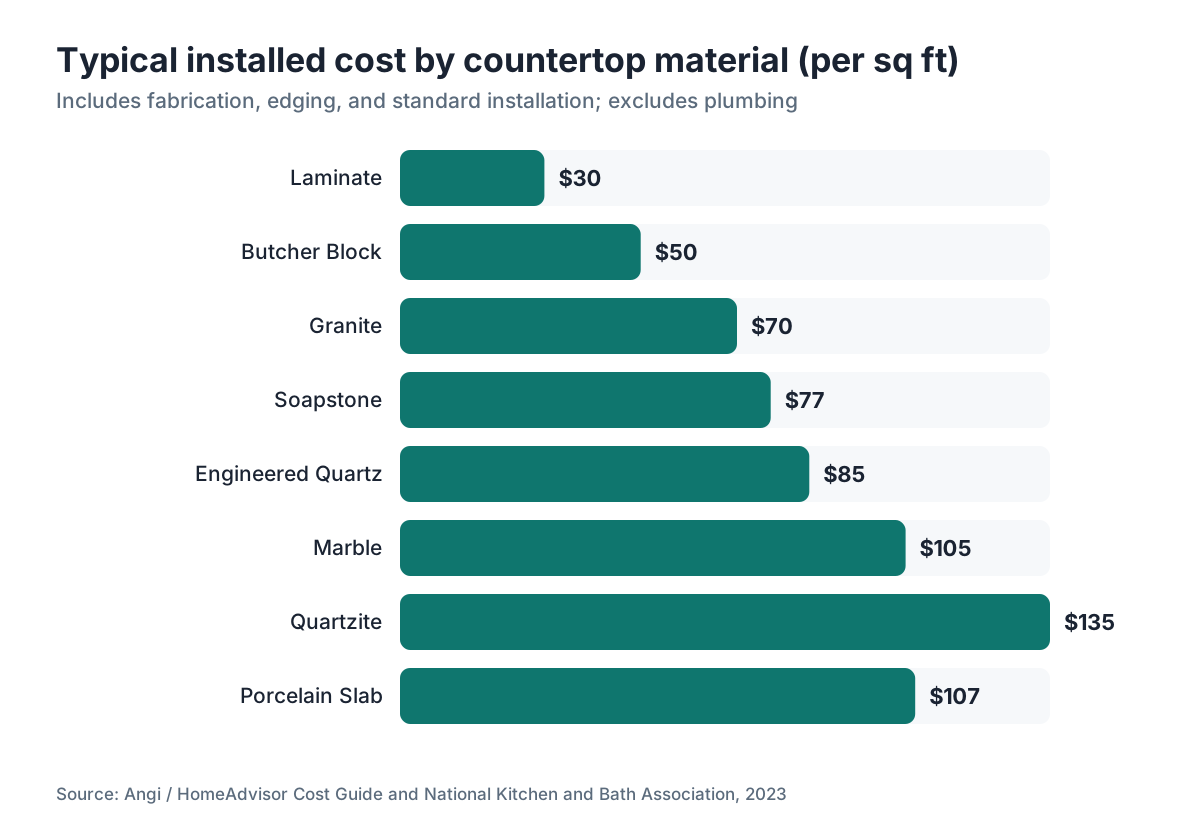
Kitchen countertops break down roughly like this across material types:
| Material | Mohs Hardness | Fabrication Difficulty | Typical Installed Cost ($/sq ft) |
|---|---|---|---|
| Granite | 6-7 | Moderate | $40-$100 |
| Quartz (engineered) | 7 | Low-Moderate | $50-$120 |
| Marble | 3-4 | Moderate-High | $60-$150 |
| Quartzite | 7+ | High | $70-$200 |
| Soapstone | 1-2 | Low | $55-$100 |
| Porcelain slab | 7-8 | Very High | $65-$150 |
Granite is the workhorse. Hard enough to take a good polish, forgiving enough to cut clean, and widely available. Granite countertops make up the bulk of most fabricators' revenue. Marble countertops are softer and prone to acid etching, which makes a mis-cut more expensive to fix. Quartzite gets confused with marble at the slab yard constantly, but it is dramatically harder, so it chews through blades and tooling faster.
Engineered quartz from brands like Cambria is consistent in thickness and color, which makes layout easier. But many products come as 1.2 cm or 2 cm slabs that need backing or edge lamination for a thicker look. Cambria countertops are a good example of a product that reads like stone but gets fabricated a little differently from natural stone.
Porcelain and sintered stone panels like Dekton or Neolith are the hardest thing a fabricator sees regularly, sometimes past 8 on the Mohs scale. They need diamond blades built for the material, slower feed rates, and careful handling so thin edges do not chip. Not every shop has the gear or the reps to do this well.
A fabricator's equipment list tells you a lot. A shop with a hand-held angle grinder and a basic bridge saw is not the same animal as one running a five-axis CNC work center.
What equipment does a precision stone fabrication shop need?
Equipment is what separates shops that call themselves precision fabricators from the ones that are. Here is what a well-equipped shop runs.
A CNC bridge saw is the backbone. Machines from Park Industries, Intermac, or Breton make straight cuts and miter cuts under computer-controlled positioning. Feed rates, blade depth, and angles are all programmable. A waterjet cutter adds tight curves, inlays, and complex sink cutouts without the thermal stress a dry blade creates near edges.
A CNC router or edge profiler shapes the edge detail. Some shops use a dedicated edge polisher that runs the piece through a series of diamond abrasive heads and produces a consistent polished edge automatically. Manual edge work is slower and less consistent, though custom profiles still call for some hand finishing.
Digital templating systems are close to standard now. Devices like the Prodim Proliner or the LT-55 use laser or wheel measurement to capture a space digitally and output a DXF file that feeds the CNC directly. That kills measurement transcription errors and moves the shop floor faster.
Lifting and handling gear matters more than most homeowners realize. Full slabs run 700 to 1,200 pounds each. Vacuum lifters, A-frames, and slab carts are safety and quality tools, not luxuries. A shop that drags slabs across a bare concrete floor will scratch polish and crack thin edges.
Water recirculation and filtration are required in most states under slurry discharge rules, enforced through the Clean Water Act's NPDES permit program [3]. Shops without proper water handling are cutting corners on compliance. Worth knowing if you care about hiring a legitimate business.
How do you evaluate a stone fabricator before hiring one?
Start with licensing and insurance. Requirements vary by state, but most states require a contractor's license for installation work involving trade labor above a threshold. California requires contractor licensing, with applicable classifications including C-29 Masonry and C-54 Ceramic and Mosaic Tile depending on scope [4]. Ask to see the current license certificate and verify it against the state board's public lookup tool.
General liability insurance of at least $1 million per occurrence is the baseline for any fabricator doing residential work. Workers' compensation coverage is required for employers in every U.S. state except Texas, which makes it elective for private employers [5]. Get a certificate of insurance with your name listed as an additional insured before work begins.
Now look at the work. Ask for three or four recent job addresses where you can see their seams in person, or at least a portfolio of closeup seam photos. A seam wider than 1/16 inch, a visible color mismatch across a joint, or chipped edges near cutouts are all red flags. Ask what digital templating system they use. A vague or defensive answer usually means hand measuring.
Ask about the warranty. A reputable fabricator backs installation defects for at least a year: poor seams, cracked tops from bad support, edge chips from their own handling. Stone itself carries no fabricator warranty against natural characteristics like fissures, pitting, or color variation, because those come with the material.
Turnaround time is a fair signal of capacity. Five to ten business days from template to install is normal. Under three days suggests they are skipping template verification. Over four weeks on standard material suggests they are overbooked or disorganized. Neither helps your project.
Get at least three bids. A 20 to 30 percent spread between bids on the same material is common and normal. A bid 40 percent under the next lowest quote deserves hard scrutiny. Slab cost, machine time, and skilled labor are real costs. A fabricator who bids far below market is cutting something, and you usually learn what after installation.
What does precision stone fabrication cost, and what drives the price?
Pricing has several parts, and quotes bundle them differently, which makes comparison tricky. Break it apart before you compare.
Material (the slab) is usually the largest single line item. Entry-level granite or standard engineered quartz runs $5 to $15 per square foot at the slab yard. Premium imported marble or rare quartzite can run $50 to $200 per square foot before any fabrication [6]. Some fabricators charge material at cost-plus a markup (typically 20 to 40 percent), others buy wholesale and sell at retail. Either model is fine. What matters is whether the quote includes material at all.
Fabrication charges, meaning cutting, edging, and finishing labor, typically run $10 to $25 per square foot on top of material for standard work. Multiple cutouts, detailed edge profiles, mitered waterfalls, or very hard materials like porcelain and quartzite cost more.
Installation, meaning delivery and setting, commonly runs $200 to $500 for a standard kitchen. Large or multi-level homes with tight access push that higher.
Watch for these extra line items: sink cutout fees ($75 to $150 each), cooktop cutout fees ($50 to $125), edge upgrades past a standard eased or bevel edge ($5 to $15 per linear foot for an ogee or waterfall), and seam placement fees if you want a say in where seams land.
Here is the honest total for a typical 40 to 60 square foot kitchen. Granite or standard quartz: $2,400 to $6,000. Marble or premium quartz: $3,500 to $10,000 and up. Exotic quartzite or porcelain: $4,000 to $14,000 and up. These ranges draw from published installer surveys and regional pricing guides, not a single authority, because the stone trade has no centralized wage or price reporting the way some industries do [7].
If budget is a hard constraint, laminate countertops and Formica countertops stay the cheapest option at $20 to $40 installed per square foot, and a different trade fabricates them. Butcher block countertops land in the $35 to $65 range, worth knowing about for a run of cabinetry where warmth and repairability beat hardness.
How does digital templating actually work, and why does it matter?
Digital templating replaced physical luan templates in progressive shops across roughly 2010 to 2020 as the devices got affordable. The idea is simple. Instead of tracing your walls with a strip of wood and copying numbers by hand, a technician uses a laser or mechanical digitizer to capture every point in the space as a coordinate.
The Prodim Proliner is the most widely used device in North American shops. The technician plants it in the room, then rolls a wheel arm along the wall, around sink openings, and across any feature that needs to land in the cut file. The device logs X-Y coordinates for each point. The resulting DXF file goes straight to the shop floor software, which nests the pieces on a virtual slab and exports the cutting program for the CNC.
The error reduction is real. Hand measurement stacks error. A kitchen with eight wall segments, a farmhouse sink, a cooktop, and two inside corners can pile up an eighth of an inch or more across all those transfers. A digital template captures the actual geometry. Walls that are not square show up as they truly are, so a countertop does not arrive with a 90-degree corner being forced against a wall running at 89.3 degrees.
For homeowners, the clearest sign a shop uses digital templating is that they show you a rendered drawing of your countertop before cutting anything. You get to see where seams land, confirm the drainboard direction on the sink cutout, and catch errors while stone is still uncut. This is table stakes for any shop doing premium work.
For fabricators, digital templating cuts labor time on the floor and kills the single biggest source of costly remakes: parts that just do not fit.
What certifications and training standards exist for stone fabricators?
The trade has a real credentialing body. The Natural Stone Institute (NSI), formed by the 2015 merger of the Marble Institute of America and the Building Stone Institute, runs the Accredited Natural Stone Fabricator (ANSF) program [2]. A shop earns ANSF accreditation through a third-party audit of its facilities, equipment, safety practices, and quality control.
As of 2024, fewer than 200 fabrication shops in the United States hold ANSF accreditation out of an estimated 6,000 to 8,000 shops nationwide [12]. That is a small slice. So most good shops are not accredited, and the badge alone does not promise great work. But it is a useful filter when you have nothing else to go on.
For workers, NSI offers individual credentials like the Certified Stone Technician (CST), covering fabrication technique, material knowledge, and installation. Workers can also pursue OSHA 10 or OSHA 30 general industry safety training, which is relevant because stone shops carry real hazards: silica dust from dry cutting, overhead lifting, wet-floor slips.
Silica dust deserves a specific mention. Cutting engineered quartz and some natural stones produces respirable crystalline silica, which causes silicosis, a serious and irreversible lung disease. OSHA's Respirable Crystalline Silica Standard (29 CFR 1926.1153 for construction and 29 CFR 1910.1053 for general industry) requires engineering controls including wet cutting, local exhaust ventilation, and respiratory protection above the permissible exposure limit of 50 micrograms per cubic meter as an eight-hour time-weighted average [8]. A shop that dry-cuts engineered quartz without respiratory controls is breaking federal OSHA rules and is dangerous to work in. This has been a heavy enforcement and litigation area since OSHA's June 2018 enforcement date [11].
Fabrication software helps here indirectly. Shops running CNC equipment with integrated water systems handle most cuts wet and enclosed, which drops airborne silica sharply compared to handheld cutting.
How do stone fabricators handle seams, and can you hide them?
Seams are unavoidable whenever a countertop run beats the slab size, which is typically 55 to 65 inches wide by 100 to 120 inches long for most commercial slabs. An L-shaped kitchen almost always has at least one. A straight galley kitchen with a run over 10 feet needs one too.
Seam placement is part craft, part negotiation. The fabricator's first goal is structural: seams should land away from the front edge where possible, and never over a cabinet opening or across an unsupported gap. Past that, placement is an aesthetic call. Across a seam you will see a line, and depending on the stone's movement, maybe a color shift if the two pieces came from different parts of the slab.
The way to hide a seam is to cut both edges from the same slab, keep them in sequence, and align the pattern at the joint before cutting. Some fabricators charge extra for intentional pattern matching. On busy, veined stone like Calacatta marble, a good match across a seam is nearly invisible at normal viewing distance. On a uniform material like Absolute Black granite, a seam almost never shows because there is no pattern to misalign.
Seam glue matters too. Most shops use color-matched epoxy or polyester adhesive, mixed with pigment in-shop to match the stone's background tone. A well-colored seam on a mid-gray granite disappears from three feet away.
The Natural Stone Institute's guidelines say finished seams on polished stone should be filled flush, free of gaps wider than 1/16 inch, and free of adhesive buildup above the surface plane [2]. Any seam you can catch with a fingernail is a defect under those standards.
What should you do after installation to protect precision-cut stone?
Great fabrication does not save you if aftercare is wrong. Care depends heavily on the material.
For most natural stone, sealing comes first. Granite that is properly sealed shrugs off oil and liquid. Most fabricators apply a penetrating impregnating sealer before delivery. Ask whether yours does. If not, a product like StoneTech BulletProof or Miracle Sealants 511 Impregnator goes on easily and protects for a year to several years depending on use [9]. Marble and limestone need re-sealing more often than granite because they are more porous.
Quartzite care and marble care overlap enough to read from the same basic guide. See how to clean quartzite countertops and how to clean stone countertops for the full walkthrough on daily cleaning and stain removal. The short version: pH-neutral soap or a dedicated stone cleaner, no vinegar or citrus, and dry standing water fast.
Soapstone breaks the pattern. It needs no sealing but likes periodic oiling with mineral oil to keep an even patina. See how to clean soapstone countertops for the specifics.
Engineered quartz from brands like Cambria needs no sealing at all, which is a genuine practical edge for the material.
For countertop installation logistics, the most common post-install issue is the silicone bead along the backsplash and sink. That bead is the only waterproofing between your countertop and the cabinet below. It fails over time through movement and mold. Replacing it is a DIY job with a utility knife, painter's tape, and a tube of 100% silicone. Redo it every five to seven years no matter how good the original fabrication was.
How do fabricators use software to price and run jobs more efficiently?
Stone fabrication ran for decades on paper estimates, handwritten shop tickets, and verbal seam placement calls. That worked at 10 to 15 jobs a month. It gets ugly fast at 30 to 50.
Modern fabrication software connects the quote, the template, the slab inventory, and the shop floor into one workflow. A customer asks for a price on 50 square feet of granite with a farmhouse sink cutout, an undermount prep, and an ogee edge. A system that already knows current slab cost, machine time per linear foot of edge, and labor rates spits out a margin-correct quote in minutes. The manual sheet takes 30 to 45.
Nesting is where the software pays for itself most visibly. Placing cut pieces on a virtual slab to maximize yield is a constraint-optimization problem. A human does it by eye. An algorithm tests thousands of placements in seconds. On a job with several odd-shaped pieces and a veined slab where you want pattern continuity, the yield difference can be five to ten square feet of saved material on one kitchen.
Shops using quoting and nesting software like SlabWise report faster quote turnaround, fewer material overruns, and clearer margin per job. If you are a fabricator still quoting on spreadsheets, the ROI math on software usually turns positive within a few months at any shop running more than 15 jobs a month.
For homeowners, a software-equipped fabricator can show you a rendered cutting diagram during the design consultation, so you approve seam placement before any stone gets touched. Ask for it.
What are the most common problems with stone fabrication jobs, and how do you avoid them?
Callbacks and disputes cluster around a short list.
Seams that are too wide or badly colored are the most common complaint. Prevention: ask to see seam samples before installation and agree on epoxy color in writing. If the fabricator will not commit to a color match, that tells you something.
Cracks near sink or cooktop cutouts happen when the stone bridge (the material left between the cutout and the front edge) is too thin, or when a natural fissure runs through the cut area. A good fabricator inspects the slab for fissures before cutting and orients cutouts to dodge them. Ask directly: did you check this slab for fissures before placing my cutout?
Uneven overhangs, where one side of the island runs a quarter-inch longer than the other, come from stacked measurement error. Digital templating kills most of this, but out-of-level cabinets or twisted walls can still cause it. The installer adjusts on site, which means they need time and the right tools. Rushed installs skip that step.
Chipped edges at the front corners happen during transport or installation. A piece that chips during your fabricator's handling is their problem. A chip after installation is yours. Document the condition of every piece at delivery with photos before the crew leaves.
Last, the countertop that rocks on a high cabinet corner or gaps in the middle is a cabinet problem more often than a stone problem. Cabinets need to be level and coplanar before stone goes on. If they are not, your fabricator should tell you, not shim the stone and vanish. Ask before templating: do you check cabinet level, and what is your policy if they are out?
Most of these problems die in a conversation before the job starts. A fabricator who finds these questions annoying is telling you how they handle problems after installation.
Frequently asked questions
How long does stone fabrication and installation take from start to finish?
For in-stock slabs, the typical timeline runs five to ten business days from templating to installation. The template appointment happens after cabinets are fully installed. Shops add time for custom orders, rare materials, or backordered slabs. Some busy markets run three to four weeks during peak season. Ask for a written schedule before you commit, and confirm whether your material is in stock.
What is the difference between a stone fabricator and a stone installer?
A fabricator cuts and finishes the countertop in a shop. An installer sets it in the home. Many companies do both, but some fabricators wholesale finished pieces to separate installation crews. When comparing quotes, confirm whether labor to set and secure the tops, caulk the backsplash, and install the undermount sink clips is included. If it is not, add $200 to $500 for a typical kitchen.
Can a precision stone fabricator cut custom shapes like curved islands or radius corners?
Yes. CNC bridge saws handle straight cuts, and five-axis CNC work centers or waterjet cutters handle curves, radii, and complex shapes. Custom shapes cost more than straight cuts, both in machine time and in material waste. A full bullnose radius on an island corner, for example, might add $75 to $150 per corner. Get the custom work itemized in your quote so you know what each feature actually costs.
Does precision stone fabrication require a permit?
Stone countertop replacement typically does not require a building permit in most jurisdictions because it counts as finish work rather than structural or mechanical alteration. But if the project involves moving or adding a sink (plumbing permit) or a gas cooktop (gas permit), those separate trades need permits. Check with your local building department. The fabricator's license covers their work, but permits are the homeowner's responsibility unless otherwise agreed.
What is the ANSF accreditation for stone fabricators?
ANSF stands for Accredited Natural Stone Fabricator, a program run by the Natural Stone Institute. Shops earn it through a third-party facility audit covering equipment, quality control, and safety. Fewer than 200 U.S. shops hold it as of 2024. Accreditation is a useful signal but not a guarantee of quality, and many excellent shops have not pursued the audit. Use it as one factor, not the only one.
How do I know if a stone fabricator is using real CNC machinery versus manual cutting?
Ask directly what machines they run and for the manufacturer name and model. A real CNC bridge saw will be from a recognizable manufacturer like Park Industries, Intermac, or Breton. Ask whether they use digital templating and what device. Ask whether they can provide a rendered cutting diagram before fabrication starts. Shops doing manual work may give vague or deflecting answers to these questions, which is itself informative.
Can a stone fabricator repair a chip or crack in an existing countertop?
Small chips at edges or corners can often be repaired with color-matched epoxy by an experienced technician. The repair is usually invisible at normal viewing distance on textured or patterned stone, more visible on highly polished uniform material. Cracks that run through the full thickness of the slab are harder to repair invisibly and may indicate structural failure. A fabricator can assess in person, but full crack repairs rarely look perfect long-term.
What silica dust rules apply to stone fabrication shops?
OSHA's Respirable Crystalline Silica Standard (29 CFR 1910.1053 for general industry) applies to stone fabrication. The permissible exposure limit is 50 micrograms per cubic meter as an eight-hour time-weighted average. Shops must use wet cutting, local exhaust ventilation, or respiratory protection to stay under the limit. Engineered quartz is particularly high-risk because of its high silica content. OSHA began enforcing the standard in June 2018.
Is precision stone fabrication available in rural areas, or is it mainly in cities?
Precision CNC fabrication shops concentrate in metro areas and near large slab distributors. In rural areas, you may find smaller local shops that hand-cut and hand-finish, or you may need a regional shop that serves a multi-county area. Travel distance affects template and installation scheduling more than cost in most cases. Some shops charge a travel fee beyond a set radius, typically $0.75 to $1.50 per mile.
What warranty should I expect from a precision stone fabricator?
A standard industry practice is a one-year warranty on workmanship: seams, edge finish, and installation quality. Material defects are often excluded because natural variation in stone is not a fabrication error. Get the warranty scope in writing before signing. A fabricator who cannot or will not provide a written warranty document is a shop to avoid, regardless of price.
How do I compare quotes from different stone fabricators when they bundle items differently?
Ask every fabricator to break out: material cost per square foot, fabrication labor per square foot, edge profile cost per linear foot, cutout fees per opening, and installation. Then rebuild the quotes on a common structure. The most common source of apparent price differences is that one shop includes material in the quote and another does not. Standardizing the line items usually reveals much smaller real differences in labor and margin.
What is book-matched stone and do all fabricators offer it?
Book-matching means cutting two sequential slabs from the same block and opening them like a book so the veining mirrors across a seam or across adjacent surfaces. It is most common on feature walls, fireplace surrounds, and dramatic kitchen islands. Not all fabricators have the equipment or experience to execute it well, and it requires buying two slabs for what might otherwise need one. Ask to see portfolio examples before committing to this approach.
How do water discharge rules affect stone fabricators, and should I care as a homeowner?
Wet cutting produces slurry, a mix of stone particles and water, that cannot go untreated into storm drains under the EPA's Clean Water Act NPDES permit rules. Compliant shops run recirculating water systems with settling tanks. As a homeowner this matters indirectly: a shop ignoring environmental compliance is also likely ignoring OSHA and licensing requirements. Compliance signals a shop that takes its legal obligations seriously across the board.
Sources
- Natural Stone Institute, Fabrication & Installation Guidelines: Typical timeline from template to installation is five to ten business days for in-stock slabs at most fabrication shops.
- Natural Stone Institute, ANSF Accreditation Program and Technical Standards: Industry standard for finished seam gaps on polished stone is no more than 1/16 inch; seams should be filled flush and free of adhesive buildup above the surface plane.
- U.S. EPA, NPDES Permit Program Basics: Stone fabrication shops must manage and treat slurry discharge under the Clean Water Act NPDES permit program before releasing water to storm or sanitary systems.
- California Contractors State License Board, License Classifications: California requires contractor licensing for stone installation work; applicable classifications include C-29 Masonry and C-54 Ceramic and Mosaic Tile depending on scope.
- U.S. Department of Labor, State Workers' Compensation Laws: Workers' compensation coverage is required for employers in every U.S. state except Texas, which makes coverage elective for private employers.
- National Kitchen and Bath Association, 2023 Design Industry Survey: Material costs for natural stone slabs range from approximately $5 per square foot for entry-level granite to over $200 per square foot for rare quartzite and premium marble.
- Angi, Countertop Installation Cost Guide: Total installed cost for granite countertops in a typical kitchen runs $2,400 to $6,000; marble and premium quartz run $3,500 to $10,000 or more.
- OSHA, Respirable Crystalline Silica Standard for General Industry, 29 CFR 1910.1053: OSHA's permissible exposure limit for respirable crystalline silica is 50 micrograms per cubic meter as an eight-hour time-weighted average; stone fabrication shops must use wet cutting, LEV, or respiratory protection to comply.
- Marble Institute of America (Natural Stone Institute), Stone Maintenance and Care Guide: Penetrating impregnating sealers protect natural stone from oil and liquid penetration; reapplication frequency depends on stone porosity and ranges from one to several years.
- Park Industries, CNC Stone Fabrication Equipment Specifications: CNC bridge saws and routers from major manufacturers advertise positioning repeatability of plus or minus 0.1 mm on dry cuts under calibrated conditions.
- OSHA, Silica Crystalline: Construction Standard, 29 CFR 1926.1153: OSHA began enforcing the Respirable Crystalline Silica Standard for construction and general industry in June 2018, with specific table controls for tasks including cutting stone with power saws.
- Natural Stone Institute, ANSF Accredited Fabricator Directory: Fewer than 200 stone fabrication shops in the United States hold ANSF accreditation as of 2024, out of an estimated 6,000 to 8,000 shops nationwide.
Last updated 2026-07-09